Specs are compiled from manufacturer listings and verified buyer reviews and can change over time — please confirm the key details on the product page before buying.
You want your mic untethered without losing the clean, quiet signal an XLR cable gives you. That is the whole job of a wireless XLR transmitter and receiver: it plugs onto the bottom of your dynamic mic, the receiver plugs into your mixer or PA, and the cable disappears while your voice stays clean. The pick that does it most convincingly is the Xvive U35, a 5.8GHz system whose Channel Scan locks a clean frequency in about three seconds and whose 110 dB dynamic range keeps loud passages from clipping.
This guide is built by comparing the manufacturers’ published specifications and the patterns across verified customer reviews, so you get each pick’s real strengths and trade-offs instead of marketing spin.
Below you get nine real options sorted by what they actually solve — stage use, moving between mixer and speakers, phantom power for condensers — and every spec comes with what it means in plain terms. If you just want the short version, the best XLR Wireless Transmitter and Receiver here is the Xvive U35, which scans for a clean channel and keeps your tone intact.
Top Picks


How To Choose The Best XLR Wireless Transmitter and Receiver
Most buyers get this wrong: they chase the longest range claim and end up with hiss in a crowded room. Range in open air is not the same as a clean signal at a busy wedding or church service. Start with the band and the audio specs, then match the extras to how you actually perform.
The frequency band is your first filter
A UHF system (ultra-high frequency, a TV-band style radio signal) is tuned to dodge the Wi-Fi and Bluetooth traffic that floods a room. A 2.4GHz or 5.8GHz system shares the same airspace as every phone and router nearby. Both can work fine; just know that UHF tends to feel steadier in a packed venue.
Dynamic range and SNR explained simply
Dynamic range (how wide a swing between whisper and shout the system can carry) tells you whether loud singing stays clean. SNR (signal-to-noise ratio) tells you how much background hiss rides under your voice — a higher number means less hiss. Look for both numbers spelled out on the listing, because a vague “crisp” claim tells you nothing.
Phantom power: do you need it?
A dynamic mic (the tough stage mic that needs no power) plugs straight in. A condenser mic needs phantom power — usually 48V — which some transmitters supply and some do not. If you use a condenser, phantom power support decides whether the system works for you at all. Check the voltage range before you buy.
Side-by-Side Comparison
| Model | Best For | Band | Battery | Channels | Amazon |
|---|---|---|---|---|---|
| Xvive U35★ Best Overall | Cleanest all-round stage pick | 5.8GHz | — | Channel scan | Amazon |
| Donner CV-2Top Performer | High-resolution vocals on a budget-plus | 2.4GHz | 8 hours | 6 | Amazon |
| Phenyx Pro PTU-XAuto-Scan Pick | Auto-scan reliability with phantom power | UHF 500MHz | 7 hours | 16 | Amazon |
| AirSync | Long-range and speaker hopping | UHF | 8 hours | 16 | Amazon |
| YXG M-ONE | Long battery with phantom power | UHF | 9 hours | 10 sets | Amazon |
| AROMA ARC2 | Simple UHF on a light budget | UHF | — | 7 | Amazon |
| JOYO MW-2 | Easy pairing for speeches and church | 2.4GHz | 6-8 hours | 4 sets | Amazon |
| M2 (STRICH) | 16 channels for crowded venues | UHF | 6-8 hours | 16 | Amazon |
| Pyle PDWMU90 | One mic to many receivers | UHF | 5 hours | 1-to-10 | Amazon |
Detailed Reviews
1. Xvive U35 Wireless Microphone System 5.8GHz
Our pick — 4.0+★ from 100+ verified ratings; the strongest balance of quality and price.
The scan-and-lock system that finds a clean channel before you step onstage.
What sells the U35 is the Channel Scan mode — you hold the receiver button for three seconds and it hunts for the cleanest channel, then holds steady. On a stage with lights, phones, and other wireless gear all firing, that one feature saves you the most common live-audio headache: a channel that was clear at soundcheck and noisy by showtime. It runs on 5.8GHz true diversity, which means two antennas working together to keep the signal solid over a 100 ft / 30.5 m range.
The audio chain is where it earns its place near the top. A 20Hz to 20kHz frequency response covers everything your voice and mic can produce, and 110 dB dynamic range with 110 dB SNR keeps loud passages clean and quiet passages free of hiss. It records at 24-bit/48kHz, so detail survives the wireless hop. There are also two modes: Mic mode for regular aux signals from a computer or MP3 player, and Line mode for bigger outputs like a mixer main out, which avoids the popping you get when a loud source hits a mic-level input. In a head-to-head on noise floor, the Xvive’s 110 dB SNR leads the JOYO MW-2 at 105dB — a real edge when you push volume.
The one thing to plan around: it needs a recharge, and it ships with a USB-C cable and a carry bag but no stated hour figure on the listing — buyers commonly report getting at least four hours from a charge, so a long double-set day means topping it up at the break. Weight is 8 ounces and the housing is metal, which feels planted on the mic without dragging the stand. The crowd favorite here sits at 4.0+ stars across 100+ owners, and the recurring praise is how well it holds up in crowded rooms with multiple wireless signals around.
What wins performers over
- Channel Scan locks a clean frequency in about three seconds
- 110 dB dynamic range and 110 dB SNR keep loud and soft passages clean
- 24-bit/48kHz audio and 20Hz-20kHz response preserve vocal detail
- Mic and Line modes handle everything from a phone to a mixer main out
Where it asks a little of you
- No stated battery hours on the spec sheet — plan a mid-day recharge
- 5.8GHz shares airspace with busy Wi-Fi, so the scan matters
Made for: the performer or presenter who wants the system to sort out its own frequency and keep the tone honest.
Think again if: you need a published all-day battery number before you commit.
2. Donner CV-2 Wireless XLR Microphone Transmitter Receiver
Studio-grade sampling in a black metal body that matches a pro mic.
For vocal work where you want the wireless link to disappear, the CV-2 leans on resolution. It samples at 24-bit/192kHz — a very high rate that keeps fine detail intact — with a 20-20KHz response and 110dB SNR, so a clean voice stays clean through the air. Latency of less than 5ms means you do not hear a delay between your mouth and the speaker, which matters for anyone singing or speaking live. Its 2.4GHz band gives a 100-foot working range.
Battery is a straight win: built-in rechargeables run up to 8 hours, enough for a full event without hunting for an outlet. Up to 6 simultaneous channels let a small panel or multi-mic setup share a room. It is automatic once powered on — no menu diving, just switch both ends on and they connect. Do check your mic type first, because the CV-2 is built for dynamic mics and is explicitly not suitable for condenser microphones, so a phantom-hungry condenser will not work here.
What owners come back to most is raw performance, followed closely by sound quality, and the black metal housing reads as durable rather than toy-grade. Among the few gripes, connectivity and battery life draw mixed notes, so if you are in a heavily crowded 2.4GHz environment the UHF picks further down may feel steadier. The metal look ties neatly to a pro dynamic mic, which is the small detail buyers notice onstage.
Sound-first pick: 24-bit/192kHz sampling and 110dB SNR make this the vocalist’s choice when tone is the priority, and 8 hours covers a full set day.
Mic-type caution: it stays a dynamic-mic tool — plan on a different system if you perform with a condenser.
Reach for this if: you sing or speak through a dynamic mic and want high-resolution audio with almost no perceptible delay.
Look elsewhere if: your mic is a condenser that needs phantom power.
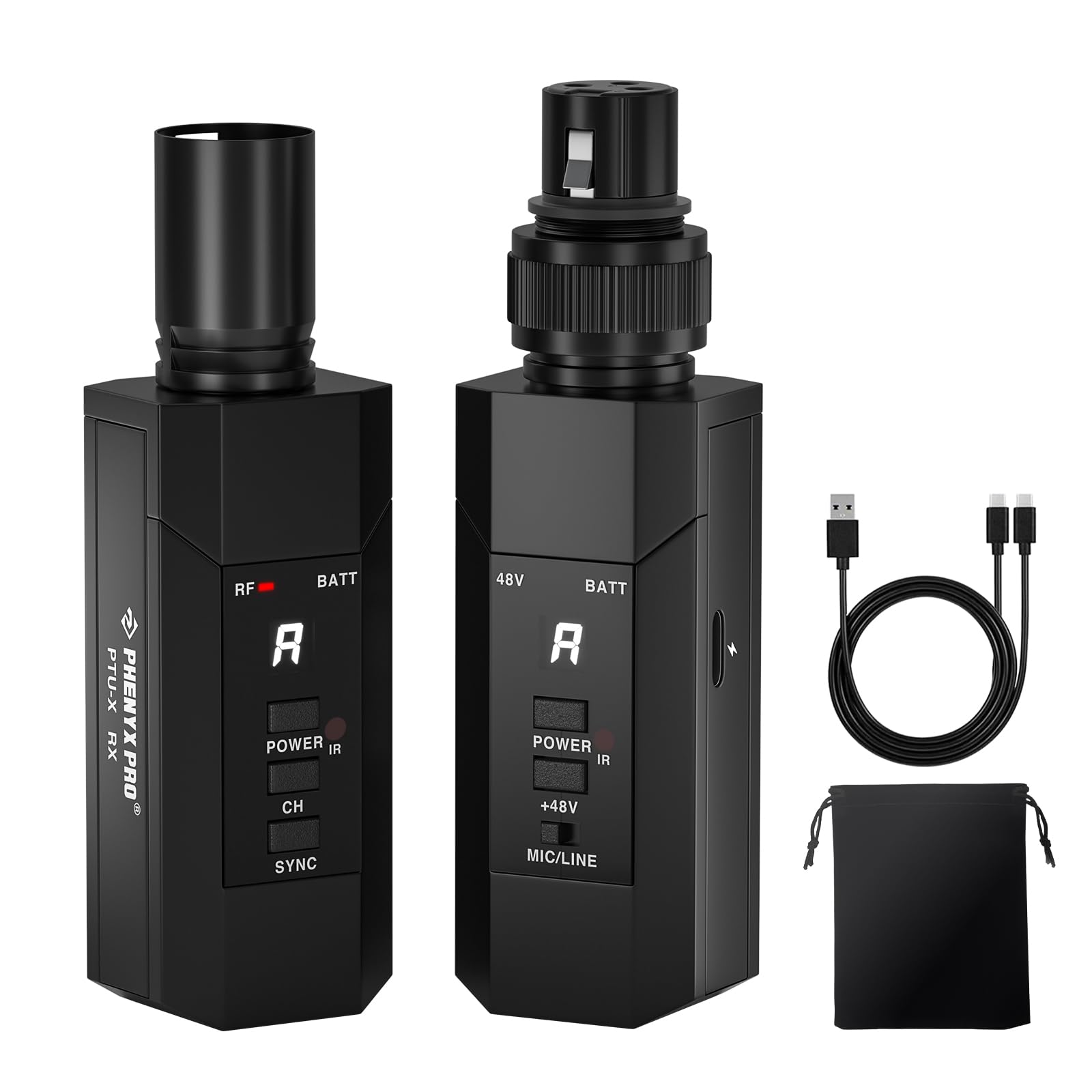
3. Phenyx Pro UHF Auto Scan XLR Wireless System PTU-X
Auto-scan on the 500MHz band, with phantom power for your condenser.
Here is your pick if you want the system to find a clean frequency and also power a condenser microphone. The PTU-X runs on a 500MHz UHF band, which keeps it clear of the Wi-Fi and Bluetooth clutter that 2.4GHz gear fights, and its auto-scan hunts down a clean frequency across 16 selectable options. Range is up to 100ft in open line of sight, and the +48V phantom power opens the door to compatible condenser mics. A flexible MIC/LINE gain control lets you switch between mic-level and larger mixer or keyboard outputs.
On audio, over 100dB dynamic range and a 98dB signal-to-noise ratio preserve vocal detail and keep the sound natural. The 1000mAh battery runs up to 7 hours, or approximately 4.5 hours once you switch phantom power on — so if you lean on a condenser, budget the shorter figure for a full day. What owners talk about most is build and sound quality, backed by steady wireless connectivity and a strong signal that holds well inside a room. The all-metal-and-plastic housing feels solid in the hand.
The trade-off is the phantom-power battery hit: those 4.5 hours are the realistic ceiling when you are feeding a condenser. For a plain dynamic mic, you get the full 7. One small point in its favor for anyone moving between setups — the MIC/LINE switch saves you a re-patch when you change sources.
Reasons it earns its spot
- Auto-scan finds a clean frequency across 16 options on the 500MHz band
- +48V phantom power supports compatible condenser mics
- 1000mAh battery gives up to 7 hours, or about 4.5 with phantom on
- MIC/LINE gain switch handles mics, mixers, and keyboards
Keep in mind
- Phantom power drops the rated runtime from up to 7 hours to about 4.5 hours
- 100ft range is specified for open line of sight
Best match for: a presenter or musician who wants auto-frequency hunting and phantom power in one plug-on system.
Weigh this: if you run a condenser all day, plan on getting nearer the 4.5-hour figure.
4. AirSync Wireless XLR Transmitter and Receiver
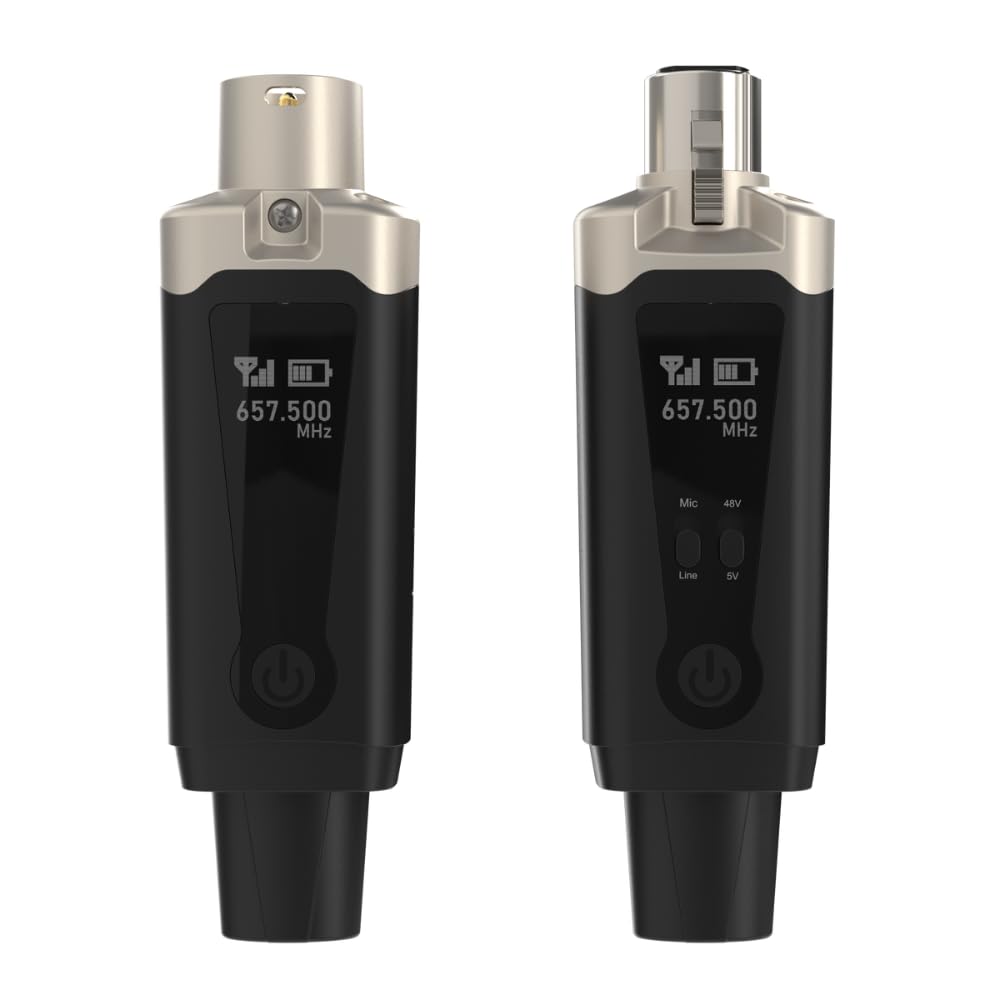
The room-crosser that turns a soundboard into a wireless feed for powered speakers.
If your job is moving audio across a big space rather than just getting the mic free, the AirSync is the one to look at. Its 150-foot range and UHF band suit large venues and outdoor stages, and under 3ms latency keeps audio in real time for live events. It handles both dynamic (5v) and condenser (48v) mics, so the same unit covers your whole mic locker, and it supports up to 16 units simultaneously for bigger productions.
Battery is built in and rechargeable with quick USB-C charging, rated up to 8 hours. One standout use: it can wirelessly feed a powered speaker system from your soundboard, so you can set up weddings, auctions, and outdoor events without a snake of cables running across the floor. Setup is a single click — no pairing menus or programming — which keeps a fast load-in fast. Owners describe the audio as sounding like a physical cable, which is the highest compliment a wireless link can get, and quality and sound quality draw the strongest praise.
The honest catch is battery life: it is rated at up to 8 hours, but the real-world reports are split — some run a full 6-8 hours, others find it does not reach the advertised figure. On a long day, carry the charger. Noise level and wireless connectivity also come up with mixed notes, so test placement in a tricky room before the doors open.
The standout: 150-foot range and 16 simultaneous units make this the pick for sprawling venues where one mic just needs to reach the back row.
The honest caveat: treat 8 hours as a best case and keep the USB-C cable handy for longer events.
Ideal for: event crews sending audio from a soundboard to powered speakers across a large room.
skip it if: you need guaranteed all-day runtime and never want to think about charging.
5. YXG UHF Wireless XLR Transmitter and Receiver

A 9-hour built-in battery for the presenter who never wants to stop and charge.
Runtime is the headline here: a built-in lithium battery rated for 9 hours across transmitters and receivers. For a worship service that runs long or a mobile DJ night that does not quit early, that is the number that keeps you from swapping batteries mid-set. The UHF band holds a stable RF connection within 160 feet, and it transmits uncompressed with a signal-to-noise ratio up to 107 dB and 107 dB dynamic range, so quiet detail and loud peaks both survive. Audio is 24-bit/48kbps across a 20Hz-20KHz response.
It is a phantom-power model with a 48V setting, so condenser mics are in play alongside dynamics. Up to 10 sets can run in the same location, and it broadcasts on 20 channels with delay under 0.25 milliseconds, which effectively means no perceptible lag. The kit is a one-drag-two set with two conversion plugs and two charging cables included, so a second mic does not need a second purchase. What buyers lean into is that it just works, paired with solid sound quality and good value.
The flip side of that big battery is weight and bulk to carry, and the housing is plastic rather than metal. Battery life, noise, and overall quality all pull mixed notes, so if you are in an ultra-quiet studio the noise floor deserves a listen before a serious recording. For live speaking and performance, though, the 9-hour battery is the reason this pick exists.
Built for: all-day presenters and worship leaders who value uptime over everything else.
Consider your room: in a hushed studio, check the noise floor before trusting it for critical recording.
6. AROMA ARC2 Wireless XLR Transmitter and Receiver

The light UHF starter that saves power when you forget to switch it off.
For a first wireless setup or a quick speech gig, the ARC2 keeps it simple. It runs UHF transmission, which the maker says holds up in crowded environments like a mall or a trade floor, and it offers 7 clean channels you can switch between for multi-device pairing. It supports lossless 20Hz to 20kHz transmission with a 106dB dynamic range, and the lightweight plastic body fits easily in your hand or a gear bag.
A smart touch is the auto power-off after 30 minutes of inactivity, which quietly saves the battery when a forgetful performer walks away. That is a genuinely useful detail for anyone who has ever found a dead transmitter right before a talk. Pair it with a dynamic mic and you are running in seconds.
Be realistic about what a budget UHF unit gives you: the honest knock is the sound, since it works with a “lossless” claim on paper but some users find too much hiss at higher volumes. It is a great value for the basics — the lightweight build and 7 channels are what you get for a friendly outlay — but not the system for a critical studio vocal. One charging quirk: it needs a USB-A to USB-C cable as supplied and will not take a USB-C to USB-C cable.
Good value, honest limits: a light UHF system with 7 channels and a power-saving auto-off, priced to get you wireless without overthinking it.
Where it shows its budget: the noise floor is the weak point, so keep it for casual speaking rather than critical vocals.
Right size for: an entry-level or occasional user who wants UHF wireless without spending much.
Look up the range if: a clean, quiet signal under heavy volume is non-negotiable.
7. JOYO MW-2 2.4GHz Wireless XLR Microphone System
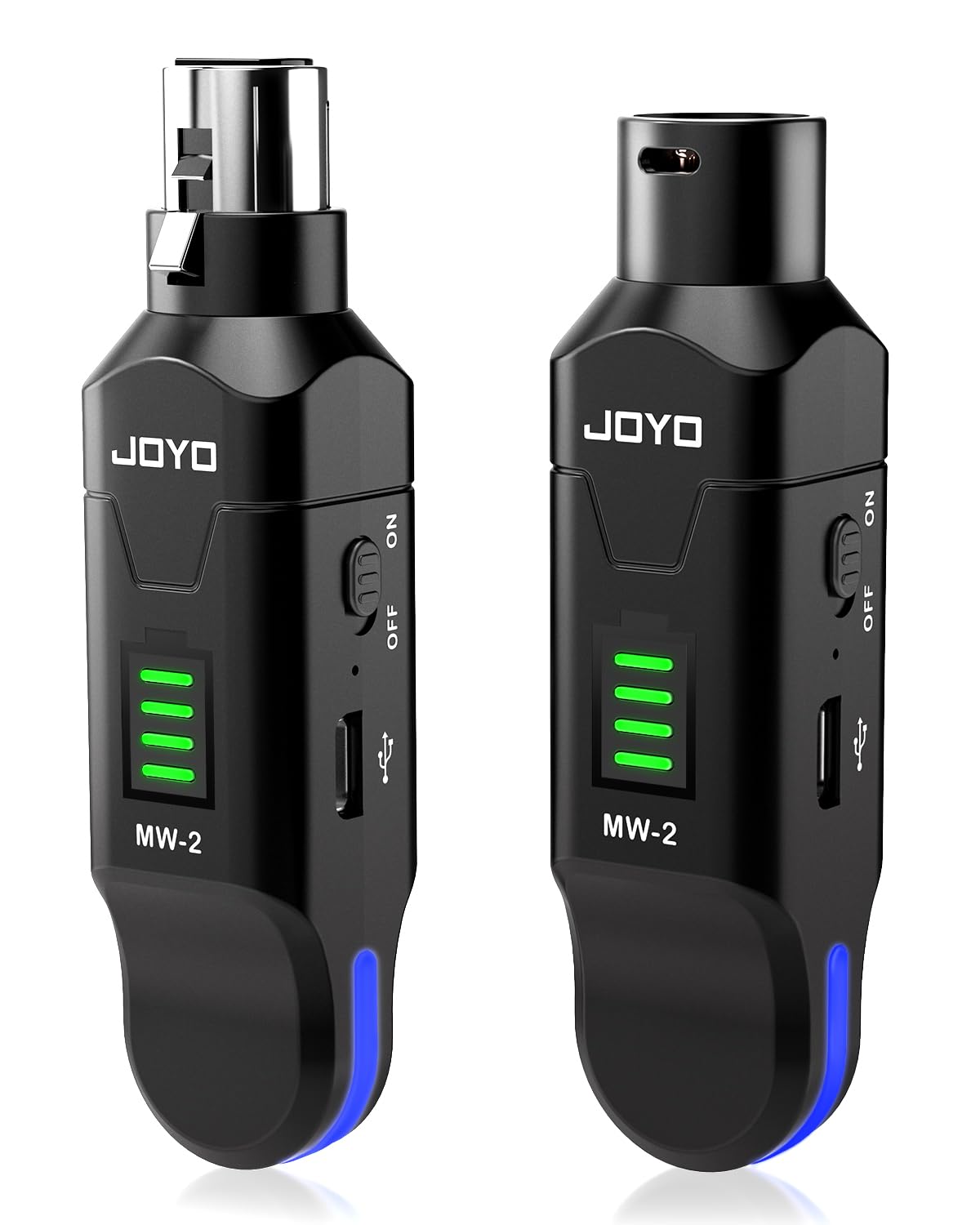
Set-and-sing 2.4GHz freedom for church, weddings, and live speeches.
For anyone who wants the cable gone with the least fuss, the MW-2 is a friendly starting point. It transmits on 2.4GHz with automatic frequency hopping — the system jumps between frequencies to dodge interference — over a rated range of over 100ft (30m) in open areas, with up to 4 sets usable in one venue. Audio runs 24-bit/48kHz digital with a rated 105dB SNR and 20Hz-20kHz response, and wireless latency is specified at 16ms. It works with dynamic mics, and select condenser mics designed for 24V or lower phantom power can also be used.
Power is about 6-8 hours with LED battery indicators on both transmitter and receiver, and both recharge in around 2 hours with the included dual USB-C cable — though they cannot be used while charging, so a full day means planning the recharge. Pairing is one-by-one: power on each transmitter first, then its receiver, and keep 48V phantom power off on the mixer channel feeding the receiver. Muting the channel before switching on or off avoids loud pops. In a crowd, buyers report reaching 40 feet between transmitter and receiver with no trouble.
The honest tension here is sound quality — some find it clear, others describe it as noisy — and durability also splits. On the plus side, the moment it works the way the venue needs, it just keeps working; the recurring theme from owners is simply that they would recommend it. For a church or wedding speaker who values repeatable setup over studio silence, that reliability is the trait that matters.
What keeps it in rotation
- Auto frequency hopping on 2.4GHz with over 100ft open-area range
- About 6-8 hours with LED indicators on both ends
- Dual USB-C cable included and both ends recharge in around 2 hours
- Pairing is simple and repeatable once you know the order
The fair trade-offs
- Cannot be used while charging, so plan a mid-day top-up
- Sound quality and durability split opinion; some report hiss
Best for: church and wedding presenters who want an easy, repeatable wireless mic setup.
Think twice if: you expect studio-silent audio or need to play and charge at once.
8. M2 UHF Wireless XLR Mic Transmitter & Receiver

Sixteen channels for the crowded stage where everyone has a mic.
When a venue is packed with wireless gear and you need your own lane, the M2 gives you room. It supports 16 frequency points and lets 16 sets run in the same place at once, which is what you want at a busy wedding or a multi-band bill. It runs on UHF with less than 6ms latency, so timing stays tight, and the metal XLR interface locks onto mics, speakers, mixers, and PA systems firmly.
Phantom power is switchable across a 9-24V range, which means it can drive a condenser with the switch on, or a dynamic with it off — just note that high-capacitance mics are out of scope. An included XLR to 1/4 adapter widens the places you can plug in. Normal working hours run 6-8 hours on a charge. Two small notes worth setting expectations: the housing is metal for solid handling, and the unit itself is a compact rose gold, which stands out on a dark stage.
Also worth knowing before you buy — the data on this one is thinner, so base your decision on the 16-channel flexibility and metal connectors rather than on owner feedback.
What you are buying: 16 simultaneous channels, under 6ms latency, and a firm metal XLR connection — the tool for a stage that is already crowded with wireless.
The planning point: phantom power handles 9-24V, but high-capacitance mics are not supported.
Fits best: a busy multi-mic event that needs many channels and sturdy metal connectors.
Look up specs if: you need a published noise or SNR figure to compare against rivals.
9. Pyle UHF Wireless XLR Adapter System (PDWMU90)

Send one mic to ten different devices without a cable in sight.
The Pyle’s trick is fan-out: pair one transmitter with up to 10 receivers and send the same audio to multiple devices at once. That fan-out is exactly what a recording room, a multi-feed live interview, or a gig needing one vocal in several places calls for. It works with any dynamic mic and ships with a 6.35mm adapter for other sources, so it can feed an active PA, monitor, DJ mixer, or pedal board.
UHF transmission and onboard DSP keep the signal stable, and the stated operation range is up to 90 feet — though the listing is upfront that RF absorption, reflection, and interference between transmitter and receiver all trim that figure in a real room. It runs up to 5 hours of continuous use on a USB-rechargeable battery with 2-3 hours charging time. In a straight comparison, that 5-hour rating trails the M2’s 6-8 hours, and at 12.6 ounces the Pyle is the heavier unit to hang on a mic stand.
Setup is the part buyers genuinely like here — it is described as easy, with clear audio and good connectivity. The honest catch is battery: 5 hours is the shortest window in this group, so a long day means a charge break. For a stationary studio or a rack of receivers, though, that limitation barely bites, and the 1-to-10 pairing is the reason this pick earns its place.
Where it shines
- One transmitter pairs to up to 10 receivers for multi-device fan-out
- Works with any dynamic mic and includes a 6.35mm adapter
- USB-rechargeable battery with up to 5 hours of continuous use
- Onboard DSP and solid XLR connections
Set expectations
- 5-hour battery is the shortest in this group
- At 12.6 ounces it is the heaviest to hang on a boom
Pick this one if: you need the same mic feeding several devices across a studio or interview setup.
Look up the battery if: you perform long sets and cannot stop to charge.
Know the Specs
Every number on these listings maps to something you will feel onstage. Here is the plain version.
Frequency Band (UHF vs 2.4GHz vs 5.8GHz)
UHF means the system rides a TV-band-style radio signal, which tends to avoid the Wi-Fi and Bluetooth traffic that fills a room. 2.4GHz and 5.8GHz share the same crowded airspace as phones and routers but can be perfectly usable when they auto-hop or scan for a clean channel. In a packed venue, a scanning or auto-scan system is your best guard against mid-show noise.
Latency (in Milliseconds)
Latency is the tiny delay between your mouth moving and the sound leaving the speaker. Under 5ms is essentially imperceptible to a performer; lower numbers like the M2’s less than 6ms or the YXG’s under 0.25 milliseconds keep you locked to the beat. If you monitor through a mix, low latency keeps your timing honest.
Dynamic Range & SNR
Dynamic range is the spread from your quietest word to your loudest shout that the system can carry without breaking up. SNR (signal-to-noise ratio) is how much hiss rides underneath your voice — higher means quieter. A 110 dB SNR like the Xvive’s keeps a soft passage clean at high gain, which is why it holds up in a busy room.
Battery Hours & Phantom Drain
Battery hours tell you how long the transmitter and receiver run before a recharge. Phantom power, which feeds condenser mics, draws extra current — the Phenyx Pro, for example, drops from up to 7 hours to about 4.5 with 48V on. If you use a condenser all day, plan around the shorter figure.
Common Questions
Will a wireless XLR transmitter work with my condenser microphone?
Can I use several of these systems in the same room?
Is UHF better than 2.4GHz or 5.8GHz for a crowded venue?
How much latency is noticeable on a wireless XLR system?
Can the transmitter and receiver charge while in use?
What range can I realistically expect from one of these?
Will it add hiss to my vocal?
Can I send one mic to multiple speakers or devices?
Do I need a special cable to charge these adapters?
Which system suits a dynamic mic versus a condenser?
The Bottom Line
For most performers, the xlr wireless transmitter and receiver to beat is the Xvive U35, because its Channel Scan finds a clean frequency in about three seconds and its 110 dB dynamic range keeps your tone intact when you push volume. If your priority is high-resolution vocals with almost no delay, the Donner CV-2 brings 24-bit/192kHz sampling and 8 hours of runtime. And if you need phantom power plus auto-scan for a condenser, reach for the Phenyx Pro PTU-X. One nudge: with the Xvive rated at 4.0+ stars across 100+ owners and the Donner at 4.0+ stars across a larger field of 200+ ratings, either is a safe place to start if you would rather buy once and rehearse.
How we choose
We do not accept paid placement. Every pick is matched to a real buyer and a real use-case; we do not hands-on test units.
Sources
Specifications: manufacturer listings and product documentation. Review insights: verified customer reviews, as of July 2026. Pricing: not shown on this page (it changes often); check the current price via the retailer link.
As an Amazon Associate, Tactical Gear Guy earns from qualifying purchases. This does not affect which products we feature.