Specs are compiled from manufacturer listings and verified buyer reviews and can change over time — please confirm the key details on the product page before buying.
If your powered speaker is humming, buzzing, or dropping signal, the cable between your mixer and that speaker is usually the cheapest part of the chain — and the first place to look. This guide sorts out which balanced XLR-to-speaker cable actually earns its place in your rack, based on what each one is built from and what buyers report after living with it.
This guide is built by comparing the manufacturers’ published specifications and the patterns across verified customer reviews, so you get each pick’s real strengths and trade-offs instead of marketing spin.
The picks below split into two jobs — line-level patch runs from an interface to a powered monitor, and heavier speaker-level runs to a passive cabinet — and a few cover both ends of that list. Here is the honest, spec-by-spec read on every xlr to speaker cable worth your rack space right now.
Top Picks


How To Choose The Best XLR to Speaker Cable
Two cables get called an “XLR to speaker” cable, and mixing them up is the most common mistake in this category. One is a balanced line-level interconnect that runs from a mixer or audio interface into a powered speaker. The other is a heavier speaker-level run that feeds a passive cabinet from a power amp. They look similar at a glance and behave nothing alike.
Line-level versus speaker-level: know which one you need
A powered speaker has its own amplifier built in, so you feed it a low-level line signal — a 1/4-inch TRS to XLR male cable does exactly this job. A passive speaker has no amp of its own, so it needs a speaker-level cable and will not work properly off a line-level interconnect. If you are running from a small mixer to self-powered monitors, you want the balanced patch cable style.
Connector gender is the specification that bites
An XLR male plug has pins inside a barrel; an XLR female socket has holes. A TRS-to-XLR male cable cannot plug into a microphone, because mics output through a male XLR. Buy the wrong gender and you will be sending it straight back — check both ends of your devices before you order.
Read the conductor gauge before anything else
Thicker copper means less signal loss over a long run, and gauge in AWG (American Wire Gauge, a wire-thickness scale) tells you how thick the copper is: a lower number means thicker wire. One pick here uses 22 AWG and the others use 24 AWG, and the maker of the 22 AWG cable claims it is 25% thicker than standard 24 AWG cable — a direct comparison worth knowing.
Shielding decides how quiet your studio runs
Shielding is the foil or braided layer wrapped around the conductors to block interference from routers, phone signals, and power cords. Double-shielded and star-quad designs push that further. If your desk has a WiFi router on it, that shielding layer matters more than any other spec on the listing.
Side-by-Side Comparison
| Model | Best For | Connector Pair | Length | Shielding | Amazon |
|---|---|---|---|---|---|
| Hosa HSX-010★ Best Overall | All-purpose studio and stage interconnect | 1/4-inch TRS male to XLR3 male | 10 feet | Balanced interconnect | Amazon |
| Seefeful 2-PackBudget Pair | Two-channel hookup on a tight budget | XLR female to 1/4-inch TRS | 6.6 feet | Copper braid with cotton yarn wrap | Amazon |
| Smithok 2-PackRoad-Ready Pick | Braided cable for regular stage work | 1/4-inch TRS to XLR male | 6.6 feet | Shielded OFC | Amazon |
| Ihurllu 2-Pack | Short, tidy desktop monitor runs | 1/4-inch TRS to XLR male | 3.3 feet | Aluminum foil plus spiral OFC | Amazon |
| HUALEU 2-Pack | Longer runs from a compact mixer | 1/4-inch TRS to XLR female | 10 feet | Double aluminum and copper | Amazon |
| SNANSHI 2-Pack | Clean stereo monitoring in one buy | 1/4-inch TRS to XLR male | 6.6 feet | Aluminum foil plus OFC shield | Amazon |
| HBU Speakon to XLR | PA rigs with a twist-lock cabinet | Speakon male to 3-pole XLR female | 10 feet | Not specified | Amazon |
| BEZOKABEL | Daily hookups that get plugged and unplugged | XLR female to 1/4-inch TRS | 6 feet | Double shielding with magnetic ring | Amazon |
| Mogami Gold | Silence at full volume in a pro room | 1/4-inch TRS to XLR male | 6 feet | Star-quad with 100 percent coverage spiral | Amazon |
Detailed Reviews
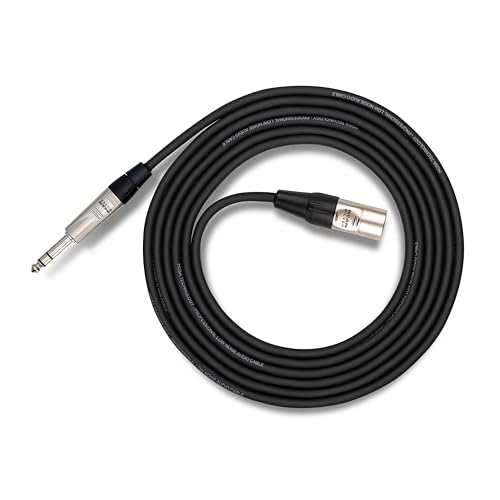
1. Hosa HSX-010 Pro Balanced Interconnect
Our pick — 4.5+★ from 850+ verified ratings; the strongest balance of quality and price.
The Hosa that swallows ten feet of stage floor without a pickup in its voice.
Ten feet is the number that decides this one: enough to run from a small mixer on a shelf down to a powered speaker across a stage, with slack to route the cable away from power lines instead of dragging it straight through them. The REAN ends (the brand of connector Hosa fits at the plug) are the other half of the pitch, because the plug is where most cheap cables eventually fail.
This is a balanced interconnect (a cable that cancels noise by carrying the signal on two wires plus a ground) using 24 gauge wire, so the copper is on the thinner side. That makes it right for line-level work between a mixer, audio interface, or monitor — not for driving a passive cabinet. Owners consistently report a quiet line with no hum or buzz in the room.
What wins people over is the flexible jacket, which coils back flat without kinking after a couple of gigs. The catch is honest and it is not a defect — a 10-foot length is more cable than a desktop setup needs, and shorter runs behind a desk are better served by the Ihurllu pair below.
Why It Stays In The Rack
- Ten feet of reach lets you route around power cords instead of beside them
- REAN 1/4-inch TRS to XLR3 male covers the common mixer-to-powered-speaker hookup
- Flexible jacket coils down flat — no permanent kinks after repeated packing
- 24 gauge balanced interconnect built for line-level signal, not amp output
The Honest Limits
- Too long for a desktop monitor run where three feet would do
- Both ends male, so it will not plug into a microphone directly
- A single cable, so a stereo pair means ordering twice
Reach for this if: you need one reliable, quiet line between a small mixer and a powered speaker, and you want the extra length to make that routing tidy — the crowd favorite here at 4.5+ stars across 800+ ratings.
Look elsewhere if: your whole rig sits on one desk and you would rather have two shorter cables for the same outlay.
2. XLR to 1/4 TRS Balanced Adapter Cable 2 Pack
Two cables, gold-plated ends, and a copper braid that keeps the noise down.
The gender here is the detail that matters: XLR female on one end, 1/4-inch TRS on the other. That means it plugs into gear with a male XLR output and a 6.35mm socket, which covers a lot of small mixers, power amplifiers, and soundbox hookups. You get two of them in the pack, so a stereo pair is one purchase.
The jacket is flexible PVC at 6.0mm outer diameter, with a thick copper braid inside and a cotton yarn wrap that the maker says reduces noise. Polyethylene insulation is used to help high-frequency response. At 0.29kg the pair carries a little weight, which reads as solid rather than flimsy in the hand — noticeably more cable mass than the Ihurllu pair at 0.2kg.
The 6.6-foot length sits in the useful middle ground between a desk run and a small stage run. This is not the pick for a passive cabinet, though — it is a line-level adapter cable, and the plugs are what they are.
Where it earns its keep: stereo hookups on a shoestring, with two gold-plated cables in the box and a braided copper core that pushes back on hum.
Know before you order: the female XLR end will not mate with a device that also has a female XLR socket — check the port, not the product photo.
Best fit: anyone building a two-channel run from a mixer or amp and wanting both cables in one go.
Wrong tool for: driving a passive speaker from a power amp, which needs a genuine speaker cable.
3. Smithok 2Pack 1/4″ to XLR Cable
A nylon-braided pair built for the cable that gets stepped on every week.
Braided jackets exist for one reason: the cable that gets coiled, thrown in a bag, and dragged across a stage floor needs something tougher than soft rubber over it. This pair wraps 24 AWG 4N oxygen-free copper in that braid, with an outer diameter of 6.3mm and molded strain relief at the plug to carry the weight of a hanging device. The drag-proof design at the TRS plug tail is meant to stop the wire pulling out of the connector over time.
It is a balanced 1/4-inch TRS to XLR male cable, so the signal flows from a balanced TRS output into a balanced XLR input — the standard mixer-to-active-speaker run. Gold plating on both plugs keeps corrosion off the contacts.
What buyers talk about most is the construction quality, and the maker backs it with a two-year warranty and a promise to test each cable before packing. If you are wiring a small live rig and want cables that survive the trip home, this is the pair to look at. The 6.6-foot length keeps it honest for stage work but short for a long throw.
The braid is the whole argument: a nylon jacket and strain relief designed around cables that travel, plus a two-year warranty behind each one.
Fair warning: the plug is a 1/4-inch TRS on one end only — do not order this hoping to patch two XLR devices together.
Made for: gigging players and small PA operators who want two braided cables that take abuse without a fuss.
Not the answer for: a permanent desktop install, where the heavier jacket is more than the job requires.
4. Ihurllu Balanced 1/4-Inch TRS to XLR Male Patch Cable 2-Pack
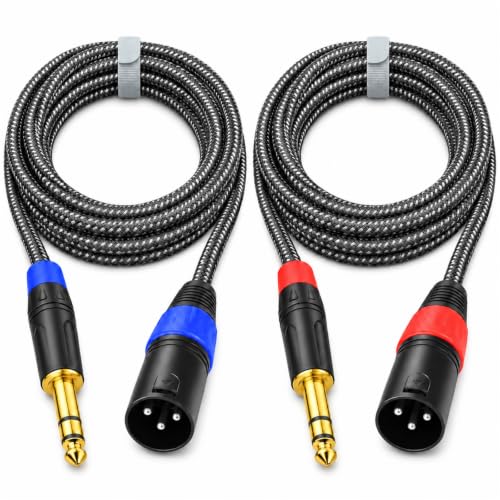
Short runs, red and blue rings, and a clamp that saves the solder joints.
Three feet three inches is not a compromise here — it is the point. On a desk where an audio interface feeds a pair of powered monitors sitting right beside it, a short cable keeps the run tidy instead of looping slack behind the rack. This pair is sized exactly for that nearfield layout, and the 4N oxygen-free copper conductors carry a balanced mono line down each cable.
The red and blue rings are the quiet feature that earns its place. One cable has red rings at both ends, the other blue, so you can trace left and right from interface to monitor without crawling behind the desk. Each cable also ships with its own reusable strap, and the TRS plug has an internal clamp that grips the jacket so everyday pulls do not reach the solder joints.
Two layers of shielding — aluminum foil beneath a spiral oxygen-free copper shield — fend off interference from nearby power cords. Owners describe the cable as well-made and sturdy, but the recurring honest note is noise: silent in most setups, with static reported in a few rigs, so test yours on first install.
Two years of product support backs the pair. Weighing 0.2kg, it is the lighter of the two multi-packs discussed here — the Seefeful pair comes in at 0.29kg.
Why desk setups like it: 3.3-foot runs, red-and-blue channel tracing, and a clamp at the plug where cables usually fail first.
The recurring gripe: noise performance is the mixed spot — silent in most rooms, but a few rigs picked up static, so test yours early.
Suits you if: your interface and monitors share one desk and you want the run to disappear behind them.
Skip on this one if: you are wiring across a stage — 3.3 feet will not bridge the gap.
5. HUALEU 2 Pack 1/4 TRS Male to 3Pin XLR Female Microphone Cable
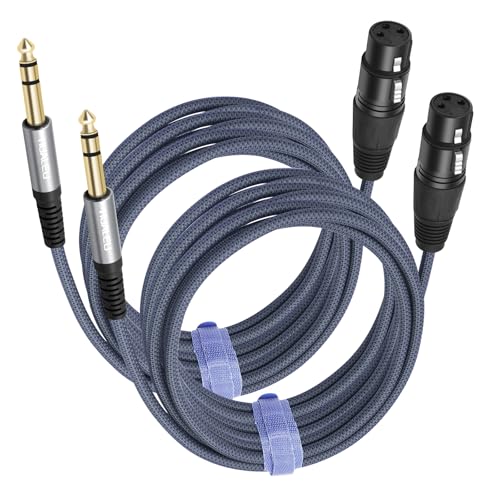
Ten feet of braided reach, and the XLR end is female — check that first.
Here is the specification to read twice: the XLR connector on this cable is female, and the 1/4-inch end is TRS male. That combination suits gear with a male XLR output feeding a 6.35mm jack input, and it is a different pairing from the male-XLR cables higher up this list. If your device has a male XLR socket, this is the one that mates with it.
Two 10-foot cables in the pack covers a wide stereo spread or a longer throw from a compact mixer to speakers set apart on stands. Inside is 4N oxygen-free copper with double aluminum and copper shielding, aimed at knocking down hum and interference over that distance. The maker lists a 10,000+ flex lifespan for the braided jacket, and the PVC outer layer is designed to resist tangling.
In daily use on monitor outputs from compact mixers, the sound comes across clean. Connectors are nickel-plated on the XLR end and gold-plated on the 1/4-inch jacks, sized for a snug fit rather than a loose wobble.
What it solves: a long, two-channel run where the source has a male XLR out and the destination takes a 1/4-inch plug.
The compatibility trap: order this for a mic or a female-XLR input and it will not connect — the gender is fixed.
Right for: anyone stretching a stereo pair across a stage or a wide desk from a compact mixer.
Think twice if: you need a cable that terminates in a male XLR — that is a different product entirely.
6. SNANSHI 1/4 TRS to XLR Male Cable 2-Pack
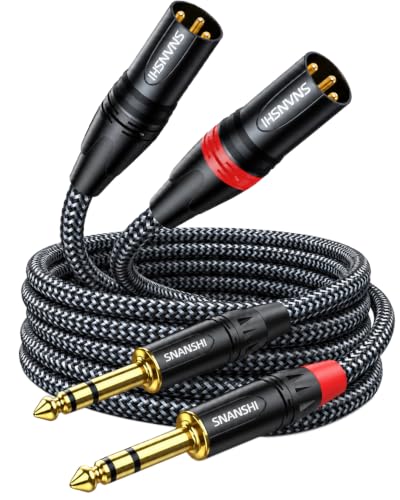
Thicker 22 AWG copper, and a warning label that saves you a return.
The conductor is where this one separates itself: 22 AWG oxygen-free copper, which the maker states is 25% thicker than standard 24 AWG cable. Thicker copper means lower resistance and less signal loss down the run, and for a studio monitor feed that translates to a cleaner balanced signal from interface to speaker. It is the gauge to look for if you have been buying the cheapest 24 AWG patch cables and hearing them.
Both ends are male — 1/4-inch TRS male and XLR male — which is why the listing opens with a warning that this is not for microphones. It is built for line-level routing only: audio interface or mixer output into a powered studio monitor or PA speaker XLR input. The two-pack covers left and right with a black ring on one cable and a red ring on the other, so you can identify channels behind a rack without tracing.
Shielding is aluminum foil plus OFC copper, aimed at the WiFi and stage-lighting interference that creeps into home studios. The braided nylon jacket is rated by the maker for 15,000+ bends and carries a 3-year warranty. In the 277.8g range for the pair, it feels like a serious cable in hand. The one honest gap: no 10-foot option in this exact listing — you would step up to the HUALEU pair for that reach.
The spec that sells it: 22 AWG OFC conductors the maker calls 25% thicker than 24 AWG, with a 3-year warranty and a 15,000+ bend rating behind the braid.
The gotcha spelled out: two male connectors means it cannot touch a microphone — this is a line-level cable only.
Built for: home studio producers wiring a Focusrite-style interface into powered monitors who want the thicker gauge.
Look past it if: your run is longer than 6.6 feet or you need an XLR female end.
7. HBU Pack of 1 Speakon to XLR Female Cable – 10Ft, Twist Lock

The odd one out here — a Speakon lock on one end, XLR female on the other.
Most cables on this list end in a 1/4-inch plug; this one ends in a Speakon male connector on one side and a 3-pole XLR female on the other, wired 2-core for speaker and microphone connections. On a PA rig where the cabinet takes a twist-lock Speakon, that is the termination you actually want — the lock clicks in and stays there rather than slipping out mid-set. At 16 gauge it is the heaviest wire on this list, built for speaker-level duty.
The rubber jacket is meant for harsh handling — tugged, stepped on, twisted, pulled, and dragged are the words the maker uses — and the connector is rated to a temperature tolerance of -30 °C to +80 °C. Ten feet of length gives you room to place the cabinet away from the amp. Being a sealed locking connector, it also stays put under vibration better than a bare plug.
Owners mention the Speakon lock clicking in and holding through a full set, with little else to say in the reviews. If your rig is standard 1/4-inch throughout, this is not your cable; if your cabinets are Speakon, it is the one to reach for.
Its job in one line: Speakon male to 3-pole XLR female, 16 gauge, with a twist lock that does not let go mid-set.
Check before buying: the Speakon end only helps if your cabinet or amp actually has a Speakon socket.
Pick it up when: your PA gear speaks Speakon and you need a solid, locking ten-foot run.
Leave it alone if: everything you own terminates in a 1/4-inch jack.
8. BEZOKABEL XLR to 1/4 Inch TRS Cable
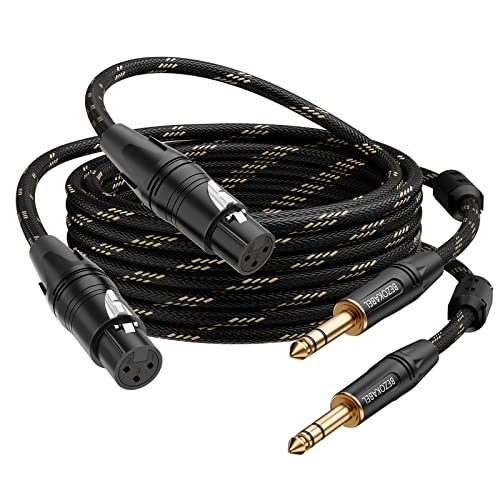
The connector that clicks shut — and an anti-jamming ring most cables skip.
The XLR end on this cable is self-locking, which means it clicks into place and stays put while you move around a desk or a small stage. Fewer cables in this category offer that positive lock at the plug, and it is the feature you notice the first time you pull a cable and it does not come loose.
Inside is 24 AWG oxygen-free copper with double shielding, and the plugs are housed in aluminum alloy with gold-plated 6.35mm adapters. There is also an anti-jamming magnetic ring on the cable that handles interference and filtering, which the maker says helps keep signal transmission stable. In the 0.32kg range, this one carries more heft than shorter cables here — it is six feet of solid cable, not a flimsy patch lead.
Owners point to the aluminum-alloy plugs and self-locking XLR first, then the value, and describe the sound as free of humming and hissing. The catch is that the cable is six feet, so it is a desk or short-stage run, not a long throw.
what separates it: a self-locking XLR end and an anti-jamming magnetic ring, on a 24 AWG double-shielded cable.
The compromise: six feet of length will not cover a wide stage — this is a desk-length cable.
Go with this if: you want a locking XLR connection and solid shielding on a cable that stays plugged in.
Hold off if: your gear has an XLR male socket — this cable needs an XLR female socket.
9. Mogami Gold 1/4 TRS to XLR Male Cable

Four conductors instead of two — the cable that goes silent at full volume.
The Neglex star-quad design is the whole reason this cable exists: it runs four conductors instead of the usual two to cancel the noise cheaper cables let through. Add a 100 percent coverage spiral pure-copper shield running the full length, and the line from your interface to your powered monitors stays quiet even with a phone on the desk and a router nearby. Owners describe it as silent at full monitor volume, with no hum, buzz, or hiss.
The job it is built for is a balanced line connection — 1/4-inch TRS output into an XLR male input on studio monitors, mixers, audio interfaces, or powered speakers. Gold-contact connectors lock in a tight fit and resist corrosion. At six feet it is a desk-length cable, weighing 6.4 ounces, and it is the most substantial single cable here.
The honest split is the price tier. But it carries a lifetime warranty, and if something breaks Mogami replaces it free for life. If you have chased a hum you could not find, the star-quad build is what the premium buys.
Why it earns the premium tier: a star-quad four-conductor build with a 100 percent coverage spiral copper shield and a lifetime warranty.
The fair trade-off: value is the mixed note — you are paying for silence at this tier, not for a longer cable.
It is for you if: a hum you cannot track down has already cost you more than the cable would.
Move on if: your setup is a casual desk run where a factory-length six-foot cable and a standard shield will do.
Know the Specs
Balanced versus Unbalanced
A balanced cable carries three conductors — two signal lines and a ground — and uses the difference between the two signal lines to cancel noise picked up along the run. That is why a balanced 1/4-inch TRS to XLR cable stays quiet even in a room full of power cords. An unbalanced cable has only two conductors and no such noise rejection, which is why hum creeps in over longer runs. For a line-level feed from a mixer to a powered monitor, balanced is the standard.
Gauge (AWG) and Conductor Material
AWG measures wire thickness, and a lower number means thicker copper. A 22 AWG cable has less resistance than a 24 AWG one, so it loses less signal over the same distance. Oxygen-free copper (OFC) is copper refined to remove oxygen, which slows oxidation at the conductor. On listings, both of these numbers affect how the cable behaves over a long run — and thicker gauge with OFC copper is generally worth the step up on a longer feed.
Shielding Types
A foil shield is a thin metallic layer wrapped around the conductors; a braided shield is woven copper that flexes without breaking as easily. Many cables here combine both — an aluminum foil layer with a copper spiral or braid over it. The design of the shield determines what kind of interference the cable rejects: WiFi, phone signals, stage lighting, or the electrical hum from nearby power cords. On a noisy desk, the shield is often the part that decides the result.
Connector Gender and Type
XLR connectors come in male (pins inside a barrel) and female (holes in a socket). A TRS plug has three sections on the shaft — tip, ring, sleeve — and carries a balanced mono signal in this context, despite the socket looking like a stereo headphone jack. A Speakon connector is a twist-lock speaker termination that clicks into place, unlike a plain 1/4-inch jack. The gender and the type at each end is the single biggest compatibility question in this category.
Common Questions
Will an XLR female to 1/4-inch TRS cable work for connecting a mixer to a powered speaker?
Can I use an XLR to 1/4-inch cable as a speaker cable for a passive cabinet?
Why does my XLR to 1/4 cable hum or buzz?
What is the difference between 22 AWG and 24 AWG cable?
Can a TRS to XLR male cable plug into a microphone?
Is a Speakon to XLR cable different from a 1/4-inch TRS cable?
How long a run can I make with a 6-foot XLR to 1/4 cable?
Do gold-plated connectors actually help on an audio cable?
Can I use these cables to connect my audio interface to a pair of powered monitors?
Does cable length affect sound quality on a line-level balanced run?
The Bottom Line
For most rigs, the xlr to speaker winner is the Hosa HSX-010, because a ten-foot run with REAN ends covers the mixer-to-powered-speaker job without fuss, and the flexible jacket survives repeated coiling. If you want thicker copper and a longer warranty on your studio feed, the SNANSHI pair is the one to grab — its 22 AWG OFC build is the gauge-savvy pick here. And for the rig that will not stop humming, the Mogami Gold is the cable to reach for, with the star-quad design and the lifetime warranty behind it.
How we choose
We do not accept paid placement. Every pick is matched to a real buyer and a real use-case; we do not hands-on test units.
Sources
Specifications: manufacturer listings and product documentation. Review insights: verified customer reviews, as of November 2026. Pricing: not shown on this page (it changes often); check the current price via the retailer link.
As an Amazon Associate, Tactical Gear Guy earns from qualifying purchases. This does not affect which products we feature.