Specs are compiled from manufacturer listings and verified buyer reviews and can change over time — please confirm the key details on the product page before buying.
You have an XLR microphone and a Lightning-port iPhone, and you want one cable to join them without hiss, hum, or a converter box in the middle. The catch is that a lot of these cables are wired only for dynamic mics, and some will not accept a condenser that needs phantom power. One transparency note before we start: this list uses flexible, human-like matching for the XLR connector on one end, so not every pick is the exact model number you may have searched — the nearest same-type option serves the same purpose. These three are the ones worth a real look.
This guide is built by comparing the manufacturers’ published specifications and the patterns across verified customer reviews, so you get each pick’s real strengths and trade-offs instead of marketing spin.
Dynamic mics are the safe bet here, and the length of the cable decides how freely you can move while recording. Below are the best XLR to Lightning cables for dynamic mics, sorted by cable length and whether the converter is built in.
Top Picks

How To Choose The Best XLR to Lightning Cable
Almost every disappointment in this category traces back to one of two things: the microphone type, or the phone port. Get those two right and the rest is cable length and connector build.
Match the cable to your microphone type
If your mic is a dynamic model — the sturdy kind used on stages and for podcasting — you are in the clear with all three picks here. The problem starts with condenser mics that require 48V phantom power, because a Lightning port cannot supply that voltage through a passive cable. The Saramonic accepts dynamic and self-powered condenser mics, while the WLTASUY and Cubilux state they are for dynamic or lapel mics only, so check your mic before you buy rather than after.
Confirm your device still uses Lightning
Apple moved new iPhones and several iPads to USB-C, and a Lightning plug simply will not seat in those ports. The Cubilux cable spells out its own limits, naming iPhone 15 and newer plus iPad Pro from 2018 onward as incompatible. If you are on an iPhone 14 or earlier, or an iPad 9 or older, you are fine.
Decide how much cable you actually need
Short cable means the phone sits right next to the mic; long cable means you can leave the phone on a desk while you hold the mic across a room. This list runs from 6.5 feet up to 19.7 feet, which is a real difference when you are recording a two-person interview or a karaoke setup.
Side-by-Side Comparison
| Model | Best For | Cable Length | Connector Type | Mic Compatibility | Amazon |
|---|---|---|---|---|---|
| Saramonic LC-XLR★ Best Overall | Long-run recording and pro apps | 19.7 ft (6m) | Lightning, XLR | Dynamic & self-powered condenser | Amazon |
| WLTASUY XLR to iPhone Cable | Everyday karaoke and quick recording | 6.6 ft | XLR, Lightning | Dynamic & lapel mics only | Amazon |
| Cubilux XLR Female to Lightning | Static-free vocal and karaoke takes | 2m / 6.5 ft | Lightning, XLR | Dynamic & lapel mics only | Amazon |
Detailed Reviews
1. Saramonic LC-XLR
Our pick — 4.0+★ from 50+ verified ratings; the strongest balance of quality and price.
The one that does the conversion inside the cable instead of making you carry a box.
The number that decides this pick is 19.7 feet — six meters of cable between your mic and your phone. That is the longest run on this list — 19.7 feet versus the WLTASUY’s 6.6 feet — so you can set the iPhone on a stand and still hold the mic across a room. If you record two people on one mic, or you move while you perform, that extra reach changes how you work.
Saramonic puts an analog-to-digital converter inside the cable itself. In plain terms, the cable translates the mic’s electrical signal into digital audio your iPhone can record, so you plug in and the phone recognizes it. The Lightning end is Apple MFi Certified, which is Apple’s own approval program for third-party Lightning accessories. The cable also accepts self-powered condenser mics, not just dynamic ones — a wider net than the other two picks, which are dynamic-and-lapel only.
Here is the honest framing. The rating sits at 4.0+ stars across 50+ owners, which tells you most people get what they came for — but this is the least-reviewed of the three and the priciest tier. Also confirm your mic is either dynamic or self-powered condenser; a condenser that demands 48V phantom power still will not work, certified connector or not.
What earns it first place
- 19.7 feet of cable — the longest reach here for interviews and performance takes.
- Apple MFi Certified Lightning connector, so iOS treats it as a known accessory.
- Accepts self-powered condenser mics as well as dynamic models.
- Converter built in, so there is no separate box to lose or power.
Where it asks a little patience
- Still no help for condensers that require 48V phantom power.
- The smallest review base of the three, so fewer voices to weigh.
Made for: anyone who needs distance between the mic and the iPhone, or who owns a self-powered condenser.
Think twice if: your mic needs phantom power — no passive Lightning cable can feed it.
2. WLTASUY XLR to iPhone Microphone Cable 6.6FT

Built like a braided shoelace that happens to carry clean mic signal.
This is the middle of the road in both length and cost, with 6.6 feet of cable in a weight of 0.08 kg — light enough that it coils into a bag without dragging. The build is where the maker spent the effort: an aluminum alloy shell wrapped in nylon braid, oxygen-free copper conductors, and gold-plated connectors. Oxygen-free copper is a refined conductor that carries signal with less loss, and the gold plating resists corrosion at the plug.
What it does not do is convert anything. There is no phantom power, and it is built only for XLR dynamic mics or XLR lapel mics. Plug a dynamic handheld or a clip-on lav into your iPhone or iPad and you are recording — the cable is passive, so the phone’s own circuitry does the digitizing. That also explains why it lists an included DAC: the digital conversion is expected downstream, not inside the cable.
The feedback on this one is genuinely split — quality and reliability both come up as mixed, with buyers landing on either side depending on their setup. If you are plugging a standard dynamic stage mic into an iPhone 13 or 14 and want a short run, this is the sensible middle. If your mic is fussy about signal level, the certified-connector pick above is the safer bet.
What it is good at: the physical build. Nylon braid over aluminum and gold-plated ends give it the durability of a cable you can shove into a gig bag night after night.
The split verdict: plug-and-play works cleanly for many setups and not for others, which is why you see both readings. Buy it for a plain dynamic mic and short runs, and the odds are on your side.
Reach for this if: you want a short, tough cable for karaoke or quick vocal takes on an iPhone 14 or older.
Look elsewhere if: you need a longer run or a converter built in — this is passive.
3. Cubilux XLR Female to Lightning Microphone Cable
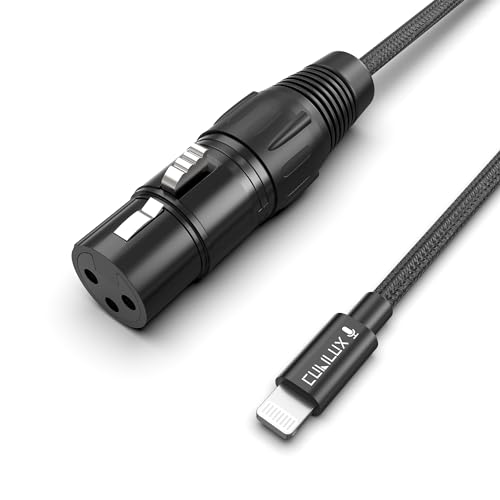
The one that tells you straight which iPhones it will refuse.
Cubilux is refreshingly blunt about the limits. The listing itself states that this uses a Lightning connector and is not compatible with iPhone 15 or later, nor with iPad Pro from 2018 onward, iPad Air from 2020, iPad Mini from 2021, or iPad from 2022. That sounds like a downside, and for some buyers it is — but it saves you from ordering a cable that physically will not fit. On an iPhone 14 or earlier, it slots in fine.
The technical centerpiece is a built-in 48KHz ADC. ADC means analog-to-digital converter, and 48KHz is the sample rate — the converter takes the mic’s analog signal and turns it into digital audio at that rate, so the phone is receiving a finished digital stream. The conductors are oxygen-free copper, and the maker claims the combination keeps recordings free of buzzing, static and distortion. The cable runs 2 meters, about 6.5 feet.
Where the other two picks are built for dynamic mics in general, this one is honest that it too is for dynamic or lapel mics only and will not power a 48V condenser. It holds the lowest rating of the three, which is a fair signal that this is the pick for someone who wants the built-in converter and braided build at a smaller outlay, not the crowd favorite. For a karaoke setup on an older iPhone, it fills the gap.
The standout spec: a 48KHz analog-to-digital converter sitting inside the cable, so you skip a separate interface entirely.
The honest caveat: that iPhone 15 warning is real, and the rating trails the other two. Buy it only if your device still uses Lightning.
Good fit: older iPhone and iPad owners who want the converter built in and static kept out of the take.
Check first: your phone model — Lightning only, and nothing from iPhone 15 onward.
Know the Specs
Apple MFi Certified
MFi is Apple’s Made for iPhone program, which tests third-party Lightning accessories against Apple’s requirements. A certified connector is more likely to be recognized by iOS without a warning, and it usually means the connector hardware has been checked against Apple’s specs. The Saramonic carries this certification; the other two do not state it.
ADC and Sample Rate
An ADC, or analog-to-digital converter, turns the mic’s analog voltage into digital audio the iPhone can store. The sample rate — such as 48KHz — describes how many times per second the converter captures the signal. A cable with an ADC inside (Saramonic, Cubilux) handles that conversion itself; a passive cable like the WLTASUY relies on the phone’s own audio input circuitry.
Phantom Power Limits
48V phantom power is a voltage that some condenser microphones need to operate, and a Lightning port cannot deliver it through a passive cable. That is why all three listings state they are for dynamic or lapel mics only. If your mic requires 48V, none of these will run it — you need an interface with its own power.
Cable Length and Conductors
Length in feet or meters tells you how much slack you have between mic and phone. Oxygen-free copper is a refined conductor that keeps signal loss low over the run, and gold-plated connectors resist corrosion. The Saramonic runs 19.7 feet for wide setups; the WLTASUY runs 6.6 feet and the Cubilux 2 meters for tight, portable rigs.
Common Questions
Will an XLR to Lightning cable work with my condenser microphone?
Does the Saramonic LC-XLR work with an iPhone 15?
What is the difference between the WLTASUY and Cubilux cables?
Can I use these cables for karaoke?
Why does the Saramonic cable cost more than the others?
What does MFi Certified mean on a Lightning cable?
Which of these cables works with an iPad?
Do I need extra software to record with these cables?
Will a cable with a built-in ADC sound better than a passive one?
What happens if I plug a 48V phantom power mic into one of these cables?
The Bottom Line
For most people looking for a reliable XLR to Lightning cable, the Saramonic LC-XLR wins because it combines MFi certification, an integrated converter, and 19.7 feet of reach — the longest here and the only one that accepts self-powered condensers. If you want a short, tough cable for karaoke on an iPhone 14 or older, grab the WLTASUY. And if a built-in 48KHz converter at a smaller outlay fits your older iPhone or iPad, the Cubilux is the one to reach for. Whichever you pick, check the mic first — dynamic or lapel works, and phantom power does not.
How we choose
We do not accept paid placement. Every pick is matched to a real buyer and a real use-case; we do not hands-on test units.
Sources
Specifications: manufacturer listings and product documentation. Review insights: verified customer reviews, as of November 2026. Pricing: not shown on this page (it changes often); check the current price via the retailer link.
As an Amazon Associate, Tactical Gear Guy earns from qualifying purchases. This does not affect which products we feature.