Specs are compiled from manufacturer listings and verified buyer reviews and can change over time — please confirm the key details on the product page before buying.
If you are tired of taping down four separate mic cables from the stage to the desk, the fix is a breakout box that turns one network cable into four XLR channels. This guide covers the adapters that actually hold a signal, which ones pass 48V phantom power to your condenser mics, and which ones quietly do not.
This guide is built by comparing the manufacturers’ published specifications and the patterns across verified customer reviews, so you get each pick’s real strengths and trade-offs instead of marketing spin.
You will see where each box lands on channel count, phantom power, and build, so you can buy once. This breakdown of xlr to ethernet adapters covers the honest trade-offs before you order.
Top Picks


How To Choose The Best XLR to Ethernet Adapter
You can replace four long XLR runs with one network cable. A box at each end splits that single cable back into four 3-pin channels. Your buying decision depends on four things: how many channels you need, whether your mics need phantom power (the power that condenser mics require), whether you are moving audio or lighting (or both), and how rough your venue gets.
Channel count and connector gender
Most of these breakers give you four channels per box. What you must check is the gender at each end. A pair with one male box and one female box lets you plug mics straight in at one end and go into a console at the other. Match the gender to the jacks you already own before you buy.
Phantom power for condenser mics
A condenser mic or an active DI box needs 48V phantom power running down the line. Not every adapter passes it. If your kit includes condensers, look for a model that explicitly states phantom power support. Otherwise you will be troubleshooting a dead-sounding vocal channel on show day.
Audio, DMX, or both
Some buyers need this cable path for stage lighting, not microphones. DMX is a lighting control signal that rides the same 3-pin connection. Most four-channel boxes handle analog audio, AES digital audio, and DMX together. Confirm the protocol support in the listing so you are not surprised mid-set.
Side-by-Side Comparison
| Model | Best For | Channels | Cable Category | Phantom Power | Amazon |
|---|---|---|---|---|---|
| LyxPro 4-Channel XLR to Cat6 Ethercon Breakout Box Pair★ Best Overall | Stage-to-desk runs | 4 channels per box | Cat 6 | Not stated | Amazon |
| GEARit XLR Over Ethernet 4 Channel SnakePhantom-Capable Pick | Phantom-powered mics | 4 channels per box | Cat 5/Cat 6 | 48V supported | Amazon |
| Y.D.F 4 Channel 3-Pin XLR Over EtherconHighest Rated | Full-passive pro rigs | 4 channels per box | Cat 5e/Cat 6/Cat 7/Cat 8 | 48V up to 850 ft | Amazon |
| Toronce DMX to RJ45 Adapter Set | Quick DMX cable build | Single channel | Cat 5 | Not stated | Amazon |
| Copkim 2 Pack 4 Channel XLR Over RJ45 | Budget two-box kit | 4 channels per box | Cat 5 | Not stated | Amazon |
| VANDESAIL 4 Channel 3-Pin XLR Over Ethernet | Long venue runs | 4 channels per box | Cat 5 | Not supported | Amazon |
| Cable Matters 2-Piece 4-Channel Breakout Box Kit | Tidy rack installs | 4 channels per box | Cat 5e | Not stated | Amazon |
| Cable Matters XLR Audio Over Ethernet Snake Pigtail Kit | Flexible pigtail routing | 4 channels per box | Cat 6 | Not stated | Amazon |
| GEARit XLR Over Ethernet 4 Channel Snake 2ft Breakout | Console-side breakout | 4 channels per box | Cat 5/Cat 6 | 48V supported | Amazon |
Detailed Reviews
1. LyxPro 4-Channel XLR to Cat6 Ethercon Breakout Box Pair
Our pick — 4.5+★ from 650+ verified ratings; the strongest balance of quality and price.
Four mic channels down one Cat6 run, with a male box and a female box in the case.
It is the most-reviewed box pair in this guide, with a longer track record than the rest. Each box is about 5.6 inches long and weighs roughly 1.1 pounds, so it sits stable on a stage floor instead of skating around when a cable is yanked. You get a male 3-pin box for the mic end and a female 3-pin box for the desk end, which means no gender adapters to hunt for.
You can place the console at front-of-house and the mics at the back of the room without running four long XLR lines, because the run stretches up to 330 feet over a compatible Cat6 cable (a common network cable). Balanced analog audio, AES digital audio (a standard for sending digital audio over cables), and DMX lighting (a standard for controlling stage lights) all travel down that same cable, so one system covers audio and lights. The LyxPro measures 5.6 by 1.6 inches, slightly larger than the Copkim pair at 5.5 inches long and 1.57 wide — a minor difference, but the LyxPro has the longer standing reputation in studios.
Buyers consistently praise the clean signal. Pro-studio users describe clear sound with no noticeable noise, and one recurring theme is how much easier this is than dragging a traditional snake. The network connection is the one thing to keep an eye on — most buyers are fine, but a few find the Ethercon-style joint needs a firm seat before it locks. It holds 4.5+ stars across 600+ owner reviews.
Where it shines
- Four separate 3-pin XLR channels through a single Cat6 cable
- Extends up to 330 feet, so front-of-house can sit far from the stage
- Passes balanced analog audio, AES digital audio, and DMX lighting
- Comes as a matched male and female pair, so both ends are covered
Worth knowing first
- The Ethercon-style joint needs a solid push to seat and lock properly
- Phantom power support is not stated, so check your mic type before buying
Reach for this if: you are wiring a stage, church, or studio and want one proven box pair that carries audio and DMX together.
Look elsewhere if: your rig runs condenser mics that need 48V down the line — you want an explicitly phantom-capable box instead.
2. GEARit XLR Over Ethernet 4 Channel Snake Ethercon Cat6 DMX RJ45
The box that feeds your condenser mics while keeping noise off the line.
Phantom power is the headline here. This pair is built to pass 48V through a compatible shielded RJ45 cable, which means a phantom-powered mixer can feed supported condenser mics or active DI boxes across the run. Four independent channels of analog XLR audio or 3-pin DMX travel up to 300 feet over one shielded Cat5 or Cat6 cable, sold separately. Each box uses an aluminum housing with EMI/RFI shielding — metal shielding that cuts hum and interference from nearby lighting rigs — so balanced audio and DMX stay cleaner.
Functionality is what people lean on first. The adapter works as promised, including over long distances up to 300 feet, and the build quality holds up to live use. Set-up is quick and simple thanks to the locking EtherCON-compatible RJ45 connectors, which keep the network cable firmly seated when a DJ bumps the table mid-set. At its price it undercuts the premium picks below while still passing 48V.
The catch is a real one: sound quality splits buyers. Some report clear audio, while others hear hum in their speakers. That hum is usually the cable, not the box — the shielding only does its job with a properly shielded Cat5 or Cat6 run, so budget for good cable. If you are chasing phantom-powered mics on a budget, this is the sensible stop.
What earns the spot
- Passes 48V phantom power over compatible shielded RJ45 cable
- Carries four analog XLR channels or 3-pin DMX up to 300 feet
- Aluminum housing with EMI/RFI shielding to cut hum and noise
- Locking EtherCON-compatible RJ45 keeps the cable seated
Before you commit
- Some users hear hum unless the Ethernet cable is properly shielded
- Shielded Cat5 or Cat6 cable is sold separately
Built for: anyone running condenser mics or DI boxes who needs phantom power down a single cable and wants locking network joints.
Skip the upgrade if: you already own unshielded network cable — the noise risk is real, and this box rewards proper cable.
3. Y.D.F 4 Channel 3-Pin XLR Over Ethercon Cable Multi Extender
A fully passive snake that stretches 48V phantom power up to 850 feet.
The 850-foot phantom power reach is what separates this box from the rest: over double-shielded Cat 5E, Cat6, Cat7, or Cat8 cable it carries 48V far beyond most stage runs. It is a fully passive box, meaning no power supply to plug in and nothing to fail on show day. Four channels of balanced digital or analog audio move over one Ethercon RJ45 network cable, and the same box handles DMX, AES, and other 3-pin XLR control systems.
It suits stadium-scale stages and churches whose console sits across a parking lot from the mics. The pairing is a male box and a female box, so both ends match your jacks. Build is rust-resistant and rugged enough for life on stage, and it plugs in with no additional power needed.
Where it earns trust: the fully passive design means fewer points of failure, and its 850-foot phantom-power rating outruns every other box here on shielded cable.
The honest caveat: with this few sales it is a young product, so you are trusting the spec sheet more than a deep track record.
Best for: big venues that need phantom power across hundreds of feet with a passive box that needs no power.
Think twice if: you need a long track record of buyers before you buy — this one has less history than the more-reviewed picks.
4. GEARit XLR Over Ethernet 4 Channel Snake Ethercon Cat6 DMX 2ft

The version with 2-foot cables built in, so the boxes sit right at your console.
Where the earlier GEARit box expects you to plug straight into its panel jacks, this one ships with 2-foot XLR breakout cables in the box — a male set and a female set. That 24-inch lead gives you slack to reach the jacks on a rack console without a strain, and it keeps the RJ45 joint clear of your mixer inputs. You still get the same up-to-300-foot single-cable run across stages, studios, and DJ venues, carrying four XLR audio channels or 3-pin DMX.
The EtherCON-compatible RJ45 connectors lock in place during live shows, so the network cable will not detach when the floor gets busy. It passes 48V phantom power over compatible RJ45, letting you feed stereo DI boxes or groups of condenser mics to your preamps. Reviewers repeatedly praise the build — the aluminum boxes survive knocks and repeated teardown.
The honest part: reliability draws mixed reports. It works well for most setups, but some buyers find it will not pass phantom power in their configuration, and a few report sound issues. If you want a box with tails that drops right onto a console rack, this earns a hard look.
The 2-foot advantage: built-in breakout cables in both male and female form let this box reach console jacks cleanly, while the 300-foot single-cable run keeps the stage tidy.
Read this before ordering: phantom power success depends on a shielded compatible RJ45 run, and without that some setups come up short.
Pick this when: you want breakout tails already attached and a locking network joint for live events.
Only if the tails matter: if a plain panel-jack box suits you, the value is not here — the extra leads are the whole reason to choose it.
5. Cable Matters XLR Audio over Ethernet Snake 4-Channel Pigtail Kit
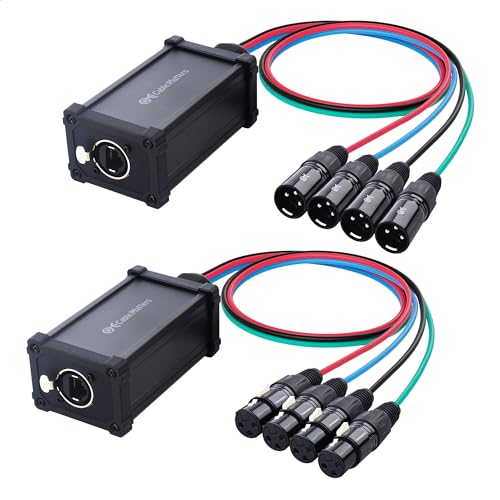
Pigtail leads on both boxes, so every XLR jack has its own flying cable.
This is the Cable Matters kit for people who want the XLR connectors on flexible leads rather than fixed to the box face. Each box gives you 4 XLR pigtails — one box with male tails and one with female tails — and converts an Ethernet connection into those four channels. The RJ45 port is EtherCON-compatible, which gives you a lockable, secure joint so the network cable stays put. Analog, digital, and audio signals ride that single cable, and the boxes support AES/EBU and DMX for lighting.
Performance is what buyers come back to — it works effectively, including for dynamic mics, and the solid build makes setups simpler. The pigtail format helps most when your gear has jacks in awkward spots and a fixed box face cannot reach. It weighs 0.7 kg as a kit, so it packs flat into a case.
The caveat is the split on sound. Some hear fine audio, others report noisy channels or signal-transmission hiccups. With pigtails, a loose or poorly shielded lead at the jack is the usual suspect — tidy wiring and good Cat6 cable head off most of it. If a flexible snake suits your rack better than a rigid box, this is the Cable Matters answer.
Why it earns a place
- 4 XLR pigtail leads per box, male on one and female on the other
- EtherCON-compatible RJ45 for a lockable, secure network joint
- Supports analog audio, digital audio, AES/EBU, and DMX
- Flexible leads reach awkward jacks a fixed panel box cannot
What to watch
- Some users report noisy channels or signal drops — check your cable and lead seating
- Pigtail leads need tidy routing to avoid strain at the jack
Made for: racks where fixed panel jacks cannot reach, and you want fly leads on both ends.
Only pick it if: that flexibility matters — a panel box is tidier if your jacks are already accessible.
6. Cable Matters 2-Piece XLR over Cat5/Cat6 Breakout Box Kit
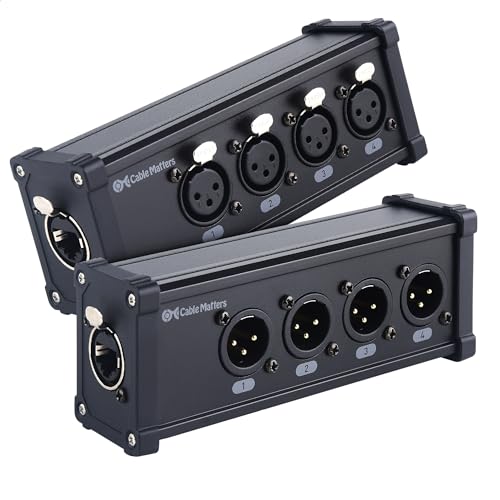
Two compact boxes, panel jacks, and a lockable EtherCON joint for permanent installs.
This kit is the fixed-jack cousin of the pigtail version above. Each box converts one Ethernet connection into 4 XLR connectors — one box with 4 male XLR and one with 4 female XLR. The RJ45 port is EtherCON-compatible for a durable, lockable connection, and the boxes carry analog, digital, or audio signals over the network cable. AES/EBU and DMX are both supported, so the same pair can move your audio and your lights.
It ships in a rigid box and weighs 0.42 kg as a kit, making it easy to mount or store. Pro support is broad, which is why it suits a permanent install in a church, theater, or fixed studio rack — you set it once and leave it. The 2-piece kit gives every configuration a male-to-female answer, so you are not hunting for gender adapters.
The install case: panel jacks and a lockable network joint mean fewer loose parts and a cleaner rack face than pigtails, and the 4-male plus 4-female boxes cover both ends of your run.
One detail to know: it is rated for indoor use, so keep it out of weather if your stage is outdoors.
Choose this for: fixed installs and clean rack faces where you want panel jacks and a lockable network connection.
Not for: outdoor stages — the indoor-only rating is the limitation here.
7. VANDESAIL 4 Channel 3-Pin XLR Over Ethernet Ethercon Cat6
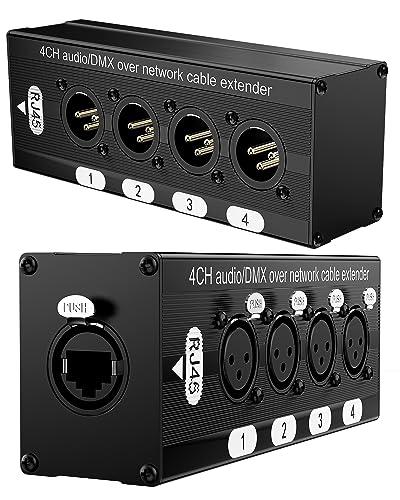
Color-coded inputs that let you match a channel at a glance on a dark stage.
The little detail that saves real time here is the color coding. Each of the four 3-pin inputs is marked so you can hold track of which channel handles XLR audio, AES-EBU, or DMX without reading a label by flashlight. The setup is a 4-channel XLR snake — male and female — that connects to a single Ethercon Cat6 network cable, and the reach runs up to 330 feet. That is long enough to move audio and lighting from the stage to a distant mixer or lighting console.
The point of this box is getting signals to a faraway console at lower cost than long individual XLR runs. It is light and road-ready, which makes it easy to pack and set up in hotels, churches, and cruise ships. Reliability is the aspect buyers lean on, and the build quality holds up to repeated setup and teardown.
One hard limit to know up front: this device does not support 48V phantom power, even with shielded Cat 5 or Cat 6 cable. If you are running dynamic mics, that is a non-issue. If you need to feed condensers, look at a phantom-capable box instead. For dynamic-mic and lighting work, it stands on its own.
What it gets right: color-coded 3-pin inputs and a 330-foot single-cable run make this a fast, tidy option for audio and DMX to a far console.
The deal detail: 48V phantom power is not supported, so it is strictly for dynamic mics and lit equipment.
Suits you if: you run dynamic mics plus DMX lighting and want a color-coded box that reaches a distant console.
Root for another pick if: condenser mics are in your kit — no phantom power means they will not work here.
8. Copkim 2 Pack 4 Channel 3 Pin Multi Network XLR Cable
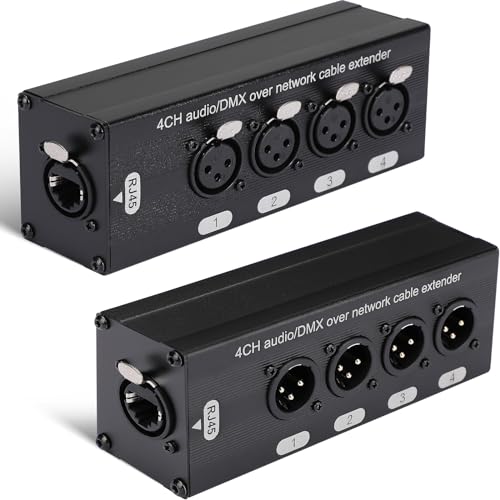
A matched male-and-female box pair for the buyer who wants the job done simply.
Two boxes, one male and one female, packed together for a four-channel run. Each is 5.5 inches long by 1.57 inches wide and weighs 0.2 kg, small enough to sling in a gig bag. The shell is an integrated aluminum alloy body built to give reliable, stable signal transmission and cut noise. The full-metal housing is sturdy enough to survive transport and repeated stage wiring.
Part of the appeal is the cable compatibility — it accepts Cat5, Cat5e, Cat6, Cat6a, Cat7, and other general network cable, so you are not boxed into one cable class. That flexibility is why buyers reach for it. Quality is the thing they pick it for, and the convenience of a matched pair keeps setup quick in live sound, lighting, and studio use.
Where it is honest: this is a no-frills box, so it does not spell out 48V phantom power support the way the phantom-capable picks do. Treat it as a straightforward audio-and-lighting router rather than a condenser-mic solution. For a tidy, compact pair, it pulls its weight.
What it brings
- Matched male and female boxes in one pack
- Aluminum alloy body for stable signal and cut noise
- Accepts Cat5, Cat5e, Cat6, Cat6a, Cat7, and other network cable
- Compact 5.5 x 1.57 inch bodies with a 0.2 kg per-box weight
Loose ends to check
- Phantom power support is not stated — confirm before buying for condensers
- Simple build and fewer reviews than the top picks
Good fit for: buyers who want a matched male-and-female pair and wide cable compatibility without fuss.
Not the one for: phantom-powered condenser mics, since that support is not documented here.
9. Toronce DMX to RJ45 Connector 3 Pin XLR Adapter Set

A single-channel adapter that turns any Cat 5 cable into a DMX line.
This is the small piece of the puzzle, not the full box. It is a 3-pin XLR to RJ45 adapter that lets you use any Cat 5 Ethernet cable as a DMX512 cable — that is the control signal your stage lights use. It comes as a pair (one male, one female), and the different adapters can be mixed, for example to go from a 5-pin to a 3-pin setup. At 3.98 inches long, it slips into a tool bag and solves a mismatch on the spot.
Reach for this when you need a DMX cable quickly and have a Cat 5 run handy, not when you need four channels of audio. It is a complement to the four-channel boxes above rather than a replacement. The build is straightforward, and the whole point is speed — you get a usable DMX link without soldering anything.
The use case: a fast fix for stage lighting, turning a spare Cat 5 cable into a working DMX512 link with a 3-pin XLR adapter pair.
Mind the scope: it handles one channel, so it is not your four-mic snake — it is the accessory you keep for quick DMX repairs.
Get this if: you need a quick DMX-to-Cat 5 adapter and have the four-channel snake handled elsewhere.
Look past it if: you need multi-channel audio over one cable — this is a single-channel lighting adapter.
Know the Specs
48V Phantom Power
Phantom power is the 48-volt charge a mixer sends up the XLR line to power a condenser mic or an active DI box. A passive breakout box can only pass that charge if its wiring and the network cable are up to it. If you see phantom power stated, that box is built to carry it over a compatible shielded RJ45 cable — check that spec first if condensers are in your kit, or you will be left with dead-sounding channels.
Shielded Cat5/Cat6 Cable
A network cable is not automatically quiet. Shielded cable adds a metal wrap that blocks hum and radio interference from nearby lights and power lines. Boxes with EMI/RFI shielding in their aluminum housing help reject that noise, but only the cable carries the signal cleanly. When buyers report hum through these adapters, the cable and its shield are the first thing to look at — not the box alone.
Channel Count
A four-channel box lets you move four separate 3-pin signals down one cable at the same time. That is what replaces four long XLR runs. For a full live band you will want four; for a quick lighting fix, a single-channel adapter like the Toronce is enough. Match the channel count to how many mics or DMX universes you actually run.
Distance Rating
These boxes carry the signal a set distance over the network cable: the LyxPro and VANDESAIL reach up to 330 feet, the GEARit pair handles up to 300 feet, and the Y.D.F boxed model lists phantom power support up to 850 feet. The farther you go, the more important a properly shielded cable becomes (shielding blocks electrical interference). Measure your stage-to-console run before you buy.
Common Questions
Will these XLR to Ethernet boxes work with my existing microphone cables?
Do these adapters pass 48V phantom power for condenser mics?
Can I use one of these to replace a long four-channel XLR snake?
What is the difference between a breakout box and a pigtail kit?
Will these adapters carry DMX for my stage lighting?
Why am I getting hum or noise through the adapter?
How long a network cable can I use with these boxes?
Do I need power at either end for a passive breakout box?
Is the Cable Matters pigtail kit the same as the Cable Matters box kit?
Can I mix a 3-pin and 5-pin XLR system with these adapters?
The Bottom Line
The best xlr to ethernet pick for most buyers is the LyxPro 4-Channel Ethercon Box Pair — a male and female box, four channels per cable, and a 330-foot reach that covers stage-to-front-of-house runs. If your kit includes condenser mics, grab the GEARit XLR Over Ethernet Snake for its stated 48V phantom power support, and for the longest run the Y.D.F Passive Snake stretches phantom power up to 850 feet. Buy the one that matches the mics you actually run, and the cabling question takes care of itself.
How we choose
We do not accept paid placement. Every pick is matched to a real buyer and a real use-case; we do not hands-on test units.
Sources
Specifications: manufacturer listings and product documentation. Review insights: verified customer reviews, as of November 2026. Pricing: not shown on this page (it changes often); check the current price via the retailer link.
As an Amazon Associate, Tactical Gear Guy earns from qualifying purchases. This does not affect which products we feature.