Specs are compiled from manufacturer listings and verified buyer reviews and can change over time — please confirm the key details on the product page before buying.
If your recordings sound thin, hissy, or oddly distant, the microphone’s self-noise and capsule are usually the reason — not your voice. This guide covers the XLR condenser microphones worth plugging into your interface, sorted by what each one actually does well, so you can pick the right capsule for your room and your budget without guessing. You will learn which specs decide whether a mic flatters a voice or fights it: capsule size, self-noise in decibels, polar pattern, and the switches that tame a loud source.
This guide is built by comparing the manufacturers’ published specifications and the patterns across verified customer reviews, so you get each pick’s real strengths and trade-offs instead of marketing spin.
Every pick here uses a true XLR output, so it needs an audio interface or mixer rather than a straight USB port. Below you will find what each capsule sounds like in a home room, which ones stay quiet when you push the gain, and where the honest limits sit. The right xlr condenser microphone turns a noisy spare bedroom into a room you can actually record in.
Top Picks


How To Choose The Best XLR Condenser Microphone
Buying a condenser mic for a home setup is mostly about matching the capsule to the voice and the room you actually have. A large-diaphragm condenser that sounds glorious in a treated studio can sound muddy in a bedroom with hard walls, because it picks up the reflections. Start with your voice and room, then work backwards through self-noise, sensitivity and polar pattern.
Capsule size and what it does to your voice
A large diaphragm capsule captures more low-end weight and detail up close, which is why it flatters most singers and voice-over work. A smaller, instrument-focused capsule stays tighter and rejects more of the room. If your space is untreated, a cardioid mic with strong rear rejection and a low-cut filter protects you more than raw capsule size does.
Self-noise, sensitivity, and gain
Self-noise is the microphone’s own electrical hiss, measured in decibels. A lower number means you can push the gain without hearing the mic behind your voice — the LEWITT LCT440PURE lists 7 dB of audible noise, while the Audio-Technica AT2020 lists 20 dB. Sensitivity, also in decibels, tells you how much output the mic sends to your interface, so a quieter interface can still reach healthy levels with a hotter mic.
Patterns, pads and filters
Cardioid is the standard pattern for solo voice and most instruments because it picks up the front and rejects the rear. A pad switch drops the signal before it hits the circuitry, which keeps loud drums and amps from distorting. A low-cut filter rolls off rumble from traffic, footfall, and desk knocks before it reaches your recording.
Side-by-Side Comparison
| Model | Best For | Audible Noise | Sensitivity | Capsule / Pattern | Amazon |
|---|---|---|---|---|---|
| LEWITT LCT440PURE★ Best Overall | Low-noise studio all-rounder | 7 dB | 44 dB | 1″ condenser / Cardioid | Amazon |
| sE Electronics X1 ABest Value | Loud sources on a budget | 20 dB | 34 dB | Condenser / Cardioid | Amazon |
| MXL 770 Vintage WhiteStandout Style | Podcasters who want a look | — | — | Large diaphragm / Cardioid | Amazon |
| Audio-Technica AT2020 | First home studio mic | 20 dB | 37 dB | Low-mass diaphragm / Cardioid | Amazon |
| AKG P220 Perception | Rugged all-round recording | — | — | Condenser / Cardioid | Amazon |
| Blue Bluebird SL | Streaming and vocals | 20 dB | 20 dB | Large diaphragm / Cardioid | Amazon |
| Audio-Technica AT4040 | Clean vocal detail | — | — | True condenser / Cardioid | Amazon |
| Shure SM81-LC | Acoustic instruments live | — | — | Condenser / Cardioid | Amazon |
| AKG C214 | Close-miking loud sources | — | — | Large single capsule / Cardioid | Amazon |
Detailed Reviews
1. LEWITT LCT440PURE Large Diaphragm Condenser Mic
Our pick — 4.5+★ from 750+ verified ratings; the strongest balance of quality and price.
The quietest capsule on this list, and the one that flatters a plain untreated room.
The number that decides this pick is 7 dB of audible noise — the microphone’s own electrical hiss, which sits so far below your voice that you stop thinking about gain. Compare that with the 20 dB the Audio-Technica AT2020 lists and the gap is the difference between a silent background and one you have to gate out in editing. The 1″ true condenser capsule is the reason: a larger capture surface that gathers depth and detail up close, so a plain vocal take sounds finished rather than raw.
A metal body that one buyer compared to a Sherman tank keeps it honest on the road, and the cardioid pattern (which rejects sound arriving at the back of the mic) keeps a noisy room out of the take. The 44 dB of sensitivity means it pushes a healthy level into your interface without cranking the gain, which is why it pairs cleanly with a Scarlet Solo 3rd Generation.
The bundle matters more than usual here: a shock mount and a magnetic pop filter arrive in the box, so you are not buying accessories before your first session. The honest catch is sensitivity itself — at 44 dB this mic picks up everything, including a fridge hum or a laptop fan you had stopped noticing. If your room is genuinely loud, budget for treatment or a dynamic mic instead. For everyone recording voice, acoustic guitar, drums or amps in a reasonably quiet space, it is the strongest all-rounder in this group.
Where the LCT440PURE Pulls Ahead
- 7 dB self-noise keeps hiss out of quiet passages and quiet interfaces
- 1″ true condenser capsule with real low-end depth for vocals and instruments
- Shock mount and magnetic pop filter included in the box
- Cardioid pattern with effective rear rejection for a home room
What To Weigh First
- High sensitivity means it hears your room, your fan, and your desk
- Needs an XLR interface with phantom power — no USB option
Worth it for: anyone who records voice or acoustic instruments in a room that is quiet but not treated — the 7 dB noise floor does the heavy lifting.
Reconsider if: your space has steady background noise you cannot remove, because 44 dB of sensitivity will find it.
2. SE ELECTRONICS X1 A Large Diaphragm Condenser Microphone
Designed to survive a drummer — 150 dB of headroom before it distorts.
Most budget condensers flinch when you point them at a snare. This one lists a maximum SPL (sound pressure level — how loud a source it can take before distorting) of 150 dB, so drums, amps and belted vocals arrive clean. The -20 dB pad drops the signal before the circuitry, and the 100 Hz low-cut filter trims rumble and desk thump at the source. Those two switches are the reason this mic stretches across guitar cabs, kick drums and spoken word without sounding like it is straining.
Where it sits against the LEWITT above is the honest trade: 34 dB of sensitivity and 20 dB of audible noise versus the LEWITT’s 44 dB and 7 dB. That means the LEWITT is the quieter, hotter mic for a soft voice in a quiet room, while the sE is the one you reach for when the source is loud and you need it not to distort. The built-in internal windscreen tames plosives without an external pop filter, which saves you a purchase and a positioning headache.
Sound quality is the split here, and it is genuinely mixed — some recordings come out with the “amazing” clarity the brand promises, others land closer to average depending on the voice. The all-metal chassis with a gold-plated XLR connector keeps interference out of the signal chain. Go in expecting a capable workhorse for loud sources rather than a vocal-showcase mic, and this is a fair entry point into a real XLR setup.
The honest split: treat this as your loud-source mic — 150 dB SPL handling and an internal windscreen make drum and amp work easy, and the pad and filter cover the rest.
Fit check: if your main job is a quiet spoken voice at low gain, the higher noise figure and lower sensitivity mean the LEWITT suits you better.
Reach for this: when your source is loud and your budget is tight — drums, cabs and pushy vocals all stay clean.
Look elsewhere: if you record breathy, quiet voice-over, where the noise floor matters more than SPL.
3. MXL 770 Condenser Microphone, Cardiod – Vintage White
A large-diaphragm podcasting mic that looks as deliberate as your desk setup.
The first thing you notice is the Limited Edition Vintage White finish, and that is not a throwaway detail for a streaming or podcast desk where the mic sits in frame. Behind it sits a large diaphragm cardioid capsule tuned for a balanced bass response and high-end clarity — the combination that keeps a spoken voice warm without turning muddy. The low-noise FET preamp (a small amplifier stage inside the mic that adds gain without adding much hiss) does the quiet lifting before the signal reaches your interface.
Three controls give you real flexibility: a low-frequency roll-off to cut room rumble, a -10 dB pad for loud sources, and the cardioid pattern to reject sound from the sides and rear. A shock mount and a carrying case come in the box, which is more than several mics at this tier include. For gaming, streaming and singing, the capsule does what the spec sheet says — focused pickup, less background.
Where this one differs from the audio-first picks here is headroom. A -10 dB pad is a shallower cut than the -20 dB pad on the sE X1 A, so a genuinely violent source has less room to move. Treat the MXL as a voice and acoustic mic that looks the part on camera, and it earns its place on the desk.
Desk appeal plus a real capsule: a large diaphragm with balanced bass and high-end clarity, a low-noise FET preamp, and a shock mount and case included — this is a setup mic, not just a look.
Do this instead: if you are recording a cranked amp or a close-miked drum, the sE’s deeper -20 dB pad gives you more safety margin.
Made for: streamers, podcasters and singers who want a camera-ready mic with genuine controls and the accessories already in the box.
Not the pick for: extreme-volume sources that need a deeper pad than -10 dB.
4. Audio-Technica AT2020 Microphone

The mic most home studios end up owning first, and for a straightforward reason.
Its custom low-mass diaphragm is engineered to move fast, which extends the frequency response and gives transients — the sharp front edge of a consonant or a plucked string — a snappy, accurate shape. At 37 dB of sensitivity and 20 dB of audible noise, it sits between the quieter LEWITT and the louder-capable sE. The cardioid pattern reduces pickup from the sides and rear, so a home room bleeds in less than you would expect.
What makes this the crowd favorite rather than a spec winner is consistency: several thousand buyers land on the same conclusion, that it sounds like a more expensive model and suits home studios and podcasting. The included stand mount, threaded adapter and soft pouch mean it is usable the day it arrives. A buyer did note the build quality feels mixed, with a report of one unit failing after 8 days — treat that as an occasional unit rather than a pattern, and it stays the safest first buy in this category.
The limit worth knowing up front: there is no pad and no low-cut filter on this model, so you handle loud sources and rumble in your interface rather than at the mic. The AT4040 below is the direct upgrade if those switches matter to you.
Why It Sells So Consistently
- Low-mass diaphragm delivers extended response and quick transients
- 37 dB sensitivity suits most home interfaces without gain stacking
- Cardioid pattern keeps side and rear pickup down in an untreated room
- Stand mount, threaded adapter and pouch included
Limits To Know
- No pad and no low-cut filter — you solve loud sources at the interface
- An occasional unit arrives faulty; worth a quick test on day one
Start here if: this is your first XLR condenser and you want a known-good voice and instrument mic without a learning curve.
Step up if: you need on-mic pad and filter switches for loud sources — that is the AT4040’s job below.
5. AKG P220 Perception 220 Professional Studio Microphone
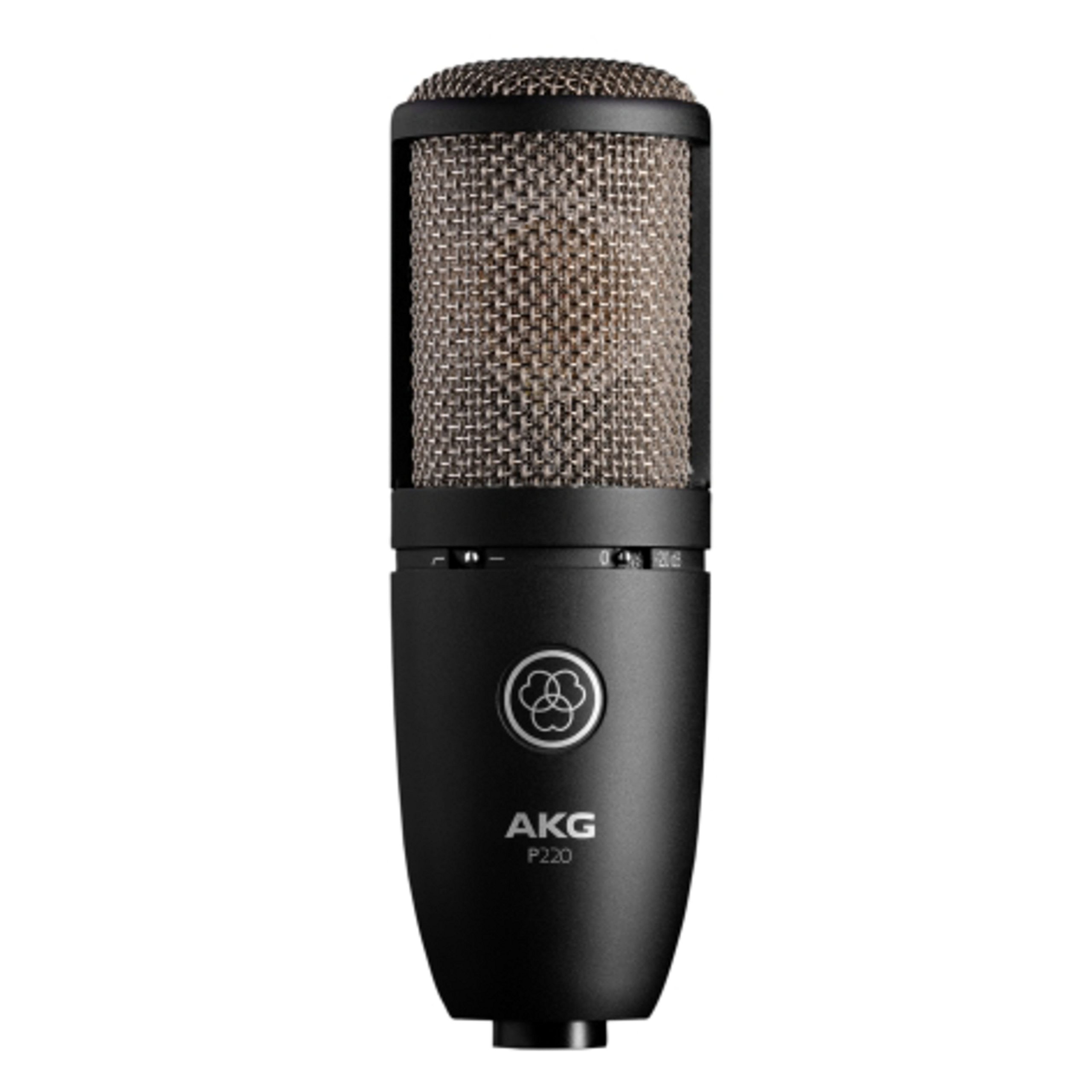
A road-ready metal body with a bass-cut switch that saves you from footfall noise.
Engineered in Vienna and wrapped in an all-metal chassis, the P220 is the pick for anyone who moves their mic between rooms, stages, or a bag. The switchable bass-cut filter (a low-frequency roll-off) kills rumble and footfall before it reaches your take — a real advantage if you record while someone walks around upstairs. The cardioid pattern and 200 ohm impedance keep it predictable across interfaces.
The case for it is value. Owners consistently frame this as an excellent alternative to far more expensive large-diaphragm condensers, and the clarity and tonal balance hold up on acoustic guitar and vocals alike. Nothing here feels fragile, which is more than can be said for mics that live in a case and travel.
The trade-off is that this mic is not chasing extreme detail or the lowest self-noise in the group — it is chasing durability and a usable voice sound. If your room is reasonably quiet and your priority is an all-metal mic that survives being packed up twice a week, the P220 is the sensible pick. If you record in a fixed, quiet studio and want the lowest self-noise here, the LEWITT’s 7 dB beats the P220.
What you get: an all-metal body, a switchable bass-cut filter, and Vienna-engineered tonal balance that suits acoustic guitar and vocals — with a value story that is hard to argue with.
What you give up: it is not the lowest-noise or most detailed mic here; it is the one most likely to survive the trip.
Choose it for: mobile recording and shared spaces, where the metal body and bass-cut filter earn their keep.
Pass if: your whole world is a quiet fixed studio and you only want the lowest noise floor.
6. Blue Bluebird SL XLR Cardioid Condenser Microphone

Custom capsule tuned to push vocals forward — a streaming mic that makes a voice cut.
The gold-sputtered Mylar diaphragm (a thin metal-coated film inside the capsule) is tuned for superior resonance at higher frequencies, and that is the whole point of this mic: it helps a voice cut through a mix without EQ. The custom Blue condenser capsule carries the brand’s broadcast sound, and the precise cardioid pattern keeps pickup focused on the face in front of it — useful for gaming and streaming where you cannot control the room.
Two switches do the practical work: a high-pass filter reduces rumble from the room or your desk, and a -20 dB pad keeps a loud source from distorting. If you record a range of voices, the capsule handles the whole vocal range without collapsing. The wooden storage box and custom shock mount come in the box, so it is a complete kit rather than a bare mic.
The honest caveat, and it is real: fragility comes up, and a few owners describe rattling. Handle it like studio gear rather than a stage mic, and keep it in the included wooden box between sessions. At 20 dB of sensitivity it wants a decent interface with clean gain, which most creators already own.
The draw: a custom capsule with a gold-sputtered Mylar diaphragm that lifts the presence and brilliance of a vocal, plus a high-pass filter and -20 dB pad for control.
Treat it gently: this is a desk-and-booth mic, not a road mic — the fragility talk is your cue to keep it in its case.
For you if: you stream, game, or record vocals and want a voice that sits forward in the mix without extra processing.
Skip if: your mic regularly travels in a gig bag — the P220 takes that life better.
7. Audio-Technica AT4040 Cardioid Condenser Microphone

Transformerless circuitry that keeps fast transients intact and low end clean.
This is an externally polarized true condenser design with transformerless circuitry, which in plain terms means the signal path is shorter and low-frequency distortion is largely removed. The result is a mic that reproduces transients — the attack of a plucked string or a hard consonant — with a precision the AT2020 cannot match. A nickel-plated brass acoustic baffle holds the capsule stable, so sensitivity does not drift with temperature.
Compared with the AT2020 above, this is a genuine step up in noise performance and detail rather than a sideways move. Vocals sit forward and clear, and it holds its own across YouTube, vlogging and podcasting work. Value is the thing people land on most, and the framing is consistent: it matches the performance of more expensive models.
What it does not have is a pad or a low-cut filter on the body — the function set is focused on the capsule and circuitry. If you need to tame a loud amp at the mic, the sE X1 A or the AKG C214 gives you those switches. For a clean vocal and acoustic capture in a controlled room, this is the more refined instrument.
Where it shines: a true condenser with transformerless circuitry and a stable brass baffle — detail and transient response that the AT2020 above it simply cannot reach.
The gap to fill: no on-body pad or filter, so loud-source control lives at your interface or preamp.
Pick this when: vocal clarity and transient accuracy matter more than switches, and your room can give the capsule a clean signal.
Think again if: you routinely close-mic loud amps and want the pad on the microphone itself.
8. Shure SM81-LC Cardioid Condenser Instrument Microphone

The acoustic guitar mic that live engineers reach for without thinking twice.
Build first: a steel body that operates across a wide range of temperatures and humidity, furnished with a swivel adapter, a lockable attenuator switch, a foam windscreen and a hard case. That is a mic designed to be clamped to a stand at an outdoor festival and still work when the dew settles. A 20 Hz to 20 kHz frequency response with a flat curve means it reproduces the source rather than coloring it.
Phantom power is the practical note. This mic needs it and performs best at 48 Vdc; it will still operate with slightly decreased headroom and sensitivity as low as 11 Vdc, so check what your preamp supplies. A selectable low-frequency response with flat, 6 or 18 dB/octave rolloff gives you real control over rumble and body. A 0 dB/10 dB lockable attenuator keeps a hot source from overloading the circuitry.
The reputation here is specific and well-earned: it is held up as a standard for high-quality live instrument sound, and it is a go-to on acoustic guitar. Cardioid with symmetric off-axis rejection means a crowded stage bleeds in less. If you are a vocalist first and an instrumentalist second, look at the AT4040 instead — this mic is built for sources, not for flattering a voice.
The Case For The SM81-LC
- Flat 20 Hz to 20 kHz response that reproduces rather than colors
- Steel body usable across wide temperature and humidity swings
- Selectable flat, 6 or 18 dB/octave low-frequency rolloff
- Swivel adapter, attenuator lock, windscreen and case included
What It Asks Of You
- Requires phantom power; best at 48 Vdc and only degraded below that
- Tuned for instruments, so a solo voice may want a different capsule
This is your mic if: acoustic guitar, strings and live instrument capture are the job, and the gear has to survive outdoor conditions.
Not your mic if: you mainly record spoken voice — the AT4040 flatters a voice in a way this one does not try to.
9. AKG Pro Audio C214 Microphone

156 dB of headroom means you can put this in front of a kick drum and walk away.
A single large diaphragm capsule with ultralow noise and outstanding dynamic range, rated at up to 156 dB SPL for close-up recording of high-output sources. That is the headline: it takes a loud source right against the grille without flinching, which is why it is equally at home on a drum, a guitar cab, or a belted vocal. The switchable 20 dB attenuator and bass-cut filter handle proximity effect — the bass buildup you get when a source is very close to the capsule.
An integrated suspension (a built-in shock mount) reduces mechanical noise and vibration from the stage, so a foot-tap or a stand knock does not travel into the recording. The aluminum body and included rugged carrying case make it a mic you can transport without ceremony. Note the weight: this is a substantial microphone, so use a stand that can hold it.
Vocals here are crisp and clear, with one consistent observation that it handles lows and mids better than high pitches — useful if you record baritone or warm instruments, less so if you want airy top end. For acoustic guitar and vocals it is a strong performer, and owners describe a mic that should last for years. At this level, it is the pick for loud sources and close miking rather than an all-purpose first mic.
The reason it earns its place: 156 dB SPL handling, ultralow noise, and an integrated suspension — a close-miking tool for drums, cabs, and strong voices.
Worth noting: it favors lows and mids over high pitches, so a bright, airy vocal wants a different capsule.
Match made for: close-miking loud sources — kick drums, cabs, and powerful vocals that want body rather than air.
Wrong tool for: breathy, high-pitched vocals that need lift in the top end.
Know the Specs
Self-Noise And Sensitivity
Self-noise is the microphone’s own electrical hiss, expressed in decibels — the lower the figure, the less the mic adds to a quiet recording. The LEWITT’s 7 dB is a very low number; the AT2020’s 20 dB and the sE X1 A’s 20 dB are typical for their tier. Sensitivity is a separate number that tells you how much signal the mic sends out; 44 dB on the LEWITT pushes a strong level into your interface, while 20 dB on the Bluebird SL asks more of your gain. Match a high-sensitivity mic to a quiet room, and a lower-sensitivity mic to a loud source.
Pads, Filters And Phantom Power
A pad is a switch that lowers the signal before it hits the microphone’s circuitry, so a loud source does not distort — the sE X1 A drops it by 20 dB and the MXL 770 by 10 dB. A low-cut or bass-cut filter rolls off low rumble before you record, useful for footfall and traffic. Every mic on this list uses an XLR connection and needs phantom power from your interface or mixer to run; the Shure SM81-LC performs best with a 48 Vdc supply and will operate with slightly reduced headroom as low as 11 Vdc.
Common Questions
Do I need an audio interface to use an XLR condenser microphone?
What is phantom power and which mics here need it?
Is a lower self-noise number always better for recording vocals?
What does the cardioid pattern actually reject?
Should I use a pad switch for singing?
Can a condenser mic record a loud guitar amp or drum?
Do I need a shock mount and pop filter with these mics?
Is a large diaphragm condenser better than a small one for voice?
Will the AT2020 work with my Scarlett interface?
Can I use these microphones for podcasting as well as music?
The Bottom Line
For most people, the xlr condenser microphone to buy is the LEWITT LCT440PURE, because 7 dB of self-noise and a 1″ true condenser capsule give you a studio-quiet recording without a studio — and it arrives with the shock mount and pop filter already in the box. If you record loud sources and want pad and filter switches at the capsule, grab the sE Electronics X1 A with its 150 dB SPL handling. And for acoustic instruments on a live stage, the Shure SM81-LC is the one that has earned its reputation. Match the capsule to your room first, then choose the pad, filter and sensitivity to suit it.
How we choose
We do not accept paid placement. Every pick is matched to a real buyer and a real use-case; we do not hands-on test units.
Sources
Specifications: manufacturer listings and product documentation. Review insights: verified customer reviews, as of November 2026. Pricing: not shown on this page (it changes often); check the current price via the retailer link.
As an Amazon Associate, Tactical Gear Guy earns from qualifying purchases. This does not affect which products we feature.