Specs are compiled from manufacturer listings and verified buyer reviews and can change over time — please confirm the key details on the product page before buying.
You want to send music from your phone or laptop into a mixer, PA speaker, or DJ rig without running a cable across the floor. An XLR Bluetooth receiver plugs into that XLR input and turns it into a wireless target for your phone. The catch most buyers hit is simple: these boxes receive Bluetooth only — they do not transmit, they do not amplify, and they cannot drive a passive speaker on their own. Get that straight and the choice becomes easy. The blafili B3 is the one to beat, thanks to its ESS ES9018K2M DAC and four simultaneous outputs, and it holds a 4.5+ star score from 300+ buyers.
This guide is built by comparing the manufacturers’ published specifications and the patterns across verified customer reviews, so you get each pick’s real strengths and trade-offs instead of marketing spin.
Below you will find the codec support, battery hours, and connection range that actually separate these units, so you can match one to your mixer, powered speaker, or DJ controller with confidence. This breakdown of the xlr bluetooth receiver market focuses on what each box does when the music starts and the room fills up.
Top Picks

How To Choose The Best XLR Bluetooth Receiver
Start with the direction of the signal, because that single detail decides whether a box is useful to you at all. These receivers take Bluetooth audio in from a phone, tablet, or laptop and push it out through an XLR plug into a mixer, powered speaker, or PA system. They will not send audio the other way to headphones, and they will not power a passive speaker by themselves.
Match the codec to the source you actually play from
Bluetooth codecs are the compression formats used to squeeze audio through the wireless link. LDAC and aptX HD carry more detail than plain SBC, so a box that supports them gives your mixer more to work with. If you only ever stream from an iPhone, AAC support is the one that matters most.
Decide if you need one box or two
A single receiver feeds one XLR input, which gives you mono playback. Pair two units together — often called TWS or stereo linking — and you get separate left and right channels for two powered speakers. If you run a stereo PA, plan for two boxes or buy a set that ships as a pair.
Weigh battery hours against your event length
A wedding, a church service, and a DJ set all run longer than a quick soundcheck. Built-in rechargeable batteries on these units range widely, and a USB-C port means you can top up from any 5V source between sets. Check the listed operating hours against your longest slot before you commit.
Check the range and the connector type
Range figures assume a clear line of sight without obstacles, so walls and bodies in the room cut them down. A removable antenna lets you upgrade the reach on some models, but the manufacturer warns that range drops sharply if that antenna is not installed. Also confirm the plug is a standard 3-pin XLR male that fits your mixer input.
Side-by-Side Comparison
| Model | Best For | Codec Support | Battery | Wireless Range | Amazon |
|---|---|---|---|---|---|
| B3 Professional XLR Bluetooth 5.1★ Best Overall | Home stereo and multi-output installs | LDAC, aptX HD, aptX LL, aptX, SBC, AAC | USB-C powered | Up to 100 ft | Amazon |
| AK-M1 XLR Bluetooth ReceiverBest Value | Live sound on a budget | Not stated | Up to 8 hours | 100 ft | Amazon |
| Donner CV-1 XLR Bluetooth ReceiverLongest Runtime | Long battery life on stage | SBC, AAC, APTX, APTX HD | Up to 20 hours | 130 ft | Amazon |
| blafili XLR Bluetooth Audio Receiver | Quiet rooms and custom naming | aptX HD, aptX LL, aptX, AAC, SBC | 10+ hours | Not stated | Amazon |
| Xvive P3 Wireless XLR | Plug-and-play simplicity | A2DP / AVRCP over BT 5.1 | Up to 8 hours | Up to 100 ft | Amazon |
| MELONARE MB-1 XLR Receiver | Long range and long runtime | MP3, FLAC, AAC, SBC | Up to 15 hours | Up to 150 ft | Amazon |
| Xvive P3D Stereo Set | True stereo PA setups | A2DP / AVRCP over BT 5.1 | Up to 8 hours | 100 ft | Amazon |
| Denon Professional DN-200BR | Permanent installed systems | Mainstream Bluetooth profiles | AC powered | Up to 33m | Amazon |
Detailed Reviews
1. B3 Professional XLR Bluetooth 5.1 Audio Receiver
Our pick — 4.5+★ from 350+ verified ratings; the strongest balance of quality and price.
The box that feeds four outputs at once and stays silent while it does it.
If your rack already holds a mixer, a powered speaker, and an amplifier, the B3 lets you send the same Bluetooth stream to all of them at once. It ships with dual balanced XLR left and right, RCA left and right, optical, and coaxial outputs, and every one of those can run at the same time. That is a genuinely rare thing in this category.
The audio engine is the reason it sits at the top. A Qualcomm QCC5125 Bluetooth chipset pairs with an ESS ES9018K2M DAC — a digital-to-analog converter, the part that turns the wireless stream back into a clean analog signal. The maker rates that converter for low noise, low distortion, and wide dynamic range. Codec support covers LDAC, aptX HD, aptX Low Latency, aptX, SBC, and AAC, so a high-resolution phone source has room to breathe.
What wins people over is the silence. The B3 plays no pairing, connection, or disconnect tones, which matters when the box feeds a church PA or a classroom during a quiet moment. Range reaches up to 33m (100 ft), and the antenna is removable via an RP-SMA connector if you want to push further. It also doubles as a plug-and-play USB DAC for a laptop or PC at up to 16bit 48kHz audio resolution, though Bluetooth input takes precedence over USB whenever both are live.
Where It Pulls Ahead
- Four outputs — dual XLR, RCA, optical, coaxial — all usable at the same time
- LDAC and aptX HD support for higher-detail wireless audio
- No pairing beeps or voice prompts to bleed through your PA
- Custom Bluetooth name up to 12 letters or numbers, plus an optional 4-digit passcode
What To Plan Around
- No power adapter in the box — you supply the 5V USB source
- RCA, XLR, and coaxial cables are not included
- Receives only; it will not send audio to headphones or drive passive speakers
Built for the rack: a home stereo or venue install with several amp and mixer inputs to feed at once.
Budget the adapter: the USB power supply and most of the cables are on you, so gather them before the box arrives.
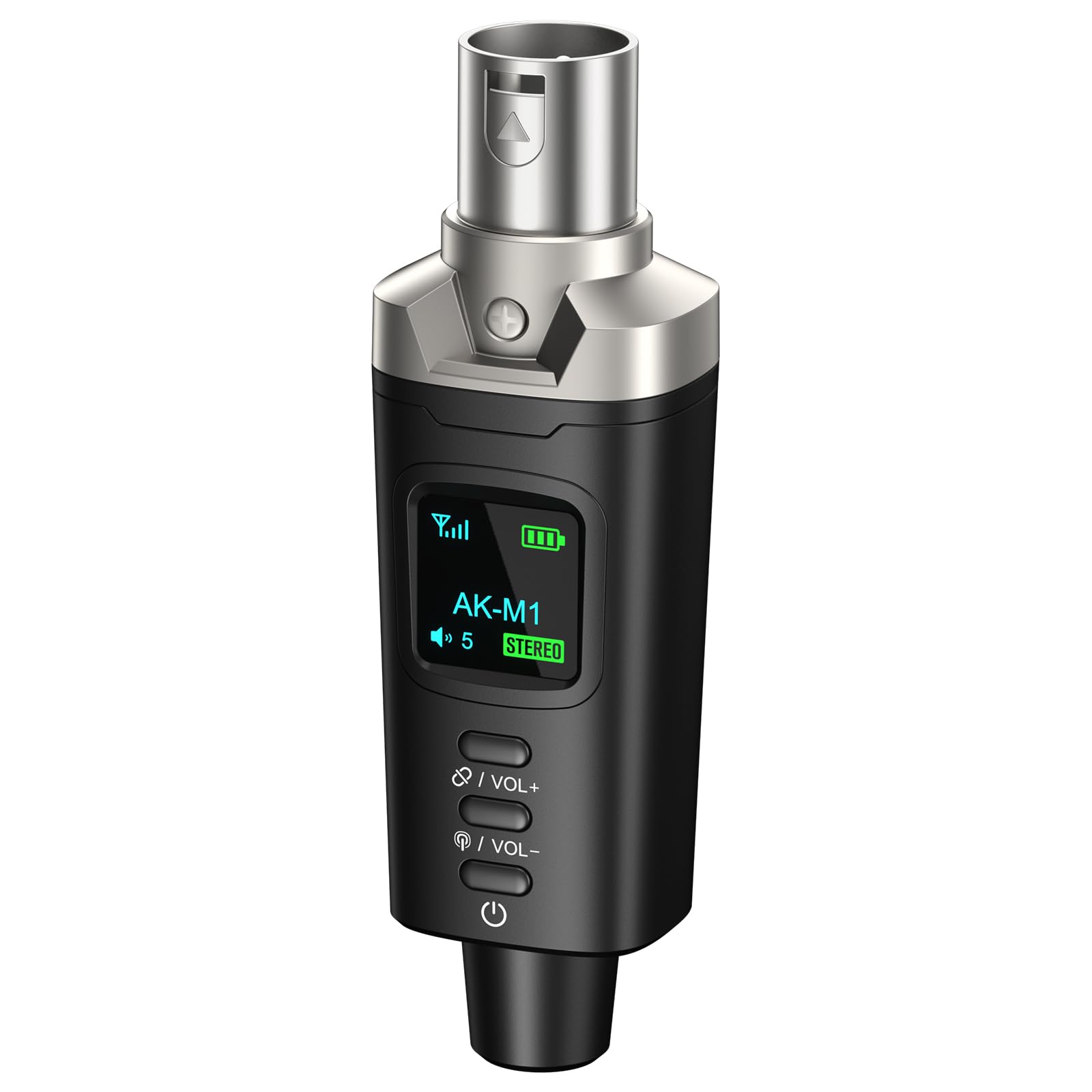
2. AK-M1 XLR Bluetooth Receiver
A plug-in receiver that opens up a cable-free live set without asking much of your wallet.
This is the pick for the solo performer who wants to drop a backing track onto an active PA speaker and stop tripping over a cable. It takes Bluetooth from an iPhone, iPad, or laptop and pushes it out through the XLR plug into an active speaker or a music mixer. The pairing process is quick and the setup is plain — plug it in, pair, play.
The old weak spot in budget Bluetooth boxes is the converter, and the AK-M1 addresses that directly. Its DAC runs at 16-bit/48kHz, which the maker claims matches a wired cable for distortion and loss. Connectivity relies on Bluetooth 5.1 with A2DP and AVRCP, and the listed stable range is 100 feet. That is 30 feet shy of the Donner CV-1’s 130 feet, so a large outdoor stage is where it starts to feel the gap.
Runtime lands at up to 8 hours from the built-in rechargeable battery, with a full charge in about 2 hours through the USB Type-C port. Buyers rate its overall build and feel above any single feature. Worth knowing: the base unit is a single receiver for mono playback — if you want two-channel output you need the P3D version, and its 8 hours falls well short of the Donner CV-1’s 20.
Grab one for a first wireless rig: solo gigs, a small church setup, or a single powered speaker on a stand.
Add a second box for stereo: one unit gives you mono, so a true left-and-right PA needs the dual version.
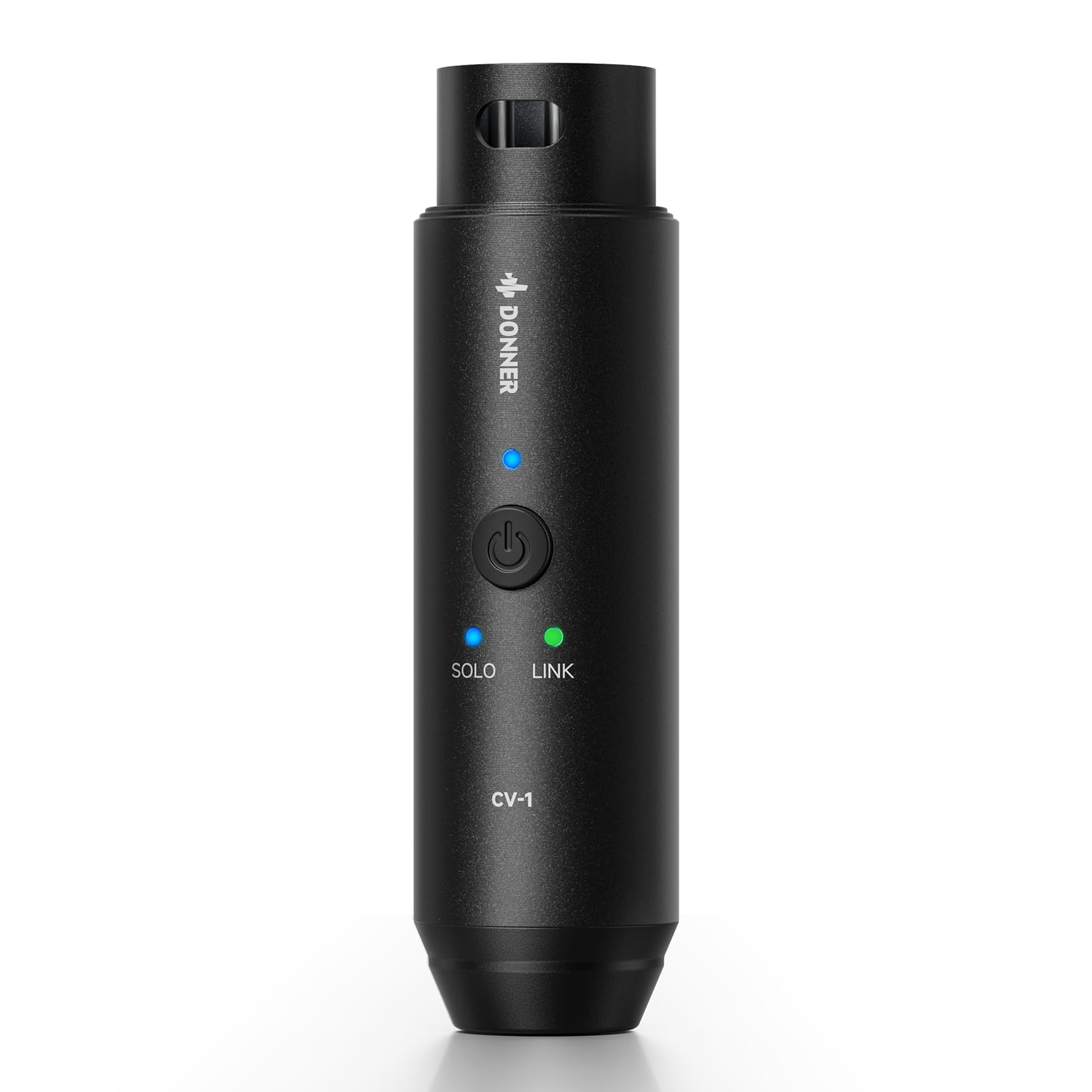
3. Donner XLR Bluetooth Receiver CV-1
Twenty hours on a charge and 130 feet of reach, from a metal body that fits in a mic pouch.
The headline here is endurance. A built-in rechargeable battery carries the CV-1 for up to 20 hours of working time, which is far beyond the AK-M1’s 8 hours and the Xvive P3’s 8. Alongside that, Bluetooth 5.3 covers a wireless range of 130 feet for live performance, DJ sets, parties, and church events. Those are the two numbers that make this one stand out in the group.
Audio specs run a 48KHz sampling rate, a 20-20KHz frequency range, a 75 dB signal-to-noise ratio (the gap between the audio you want and the background hiss), and 24-bit sampling depth. Total harmonic distortion sits at ≤0.08, a measure of how little the box muddies the signal. Codec support covers SBC, AAC, APTX, and APTX HD. A twin-receiver stereo pairing mode is built in, activated by five clicks on both power buttons.
The honest trade-off is that this is the shakiest of the front-runners on consistency. Buyers report a real split — some find it works great with good sound, while others describe quiet output even at full volume and connections that drop or will not latch onto a second device. Long-pressing the power button for 5 seconds while off clears the previous pairing and is the fix to try first. Buy it for the battery and range; be ready to do a full soundcheck before you rely on it in front of a room.
What earns it a place: 20 hours of runtime, 130 feet of Bluetooth 5.3 range, and a 6.3 oz metal body that slips into a gig bag.
Right for long days off the mains: all-day outdoor events and back-to-back sets where a charging cable is out of reach.
Soundcheck first: pairing quirks show up often enough that a dry run before the doors open is worth the ten minutes.
4. blafili XLR Bluetooth Audio Receiver
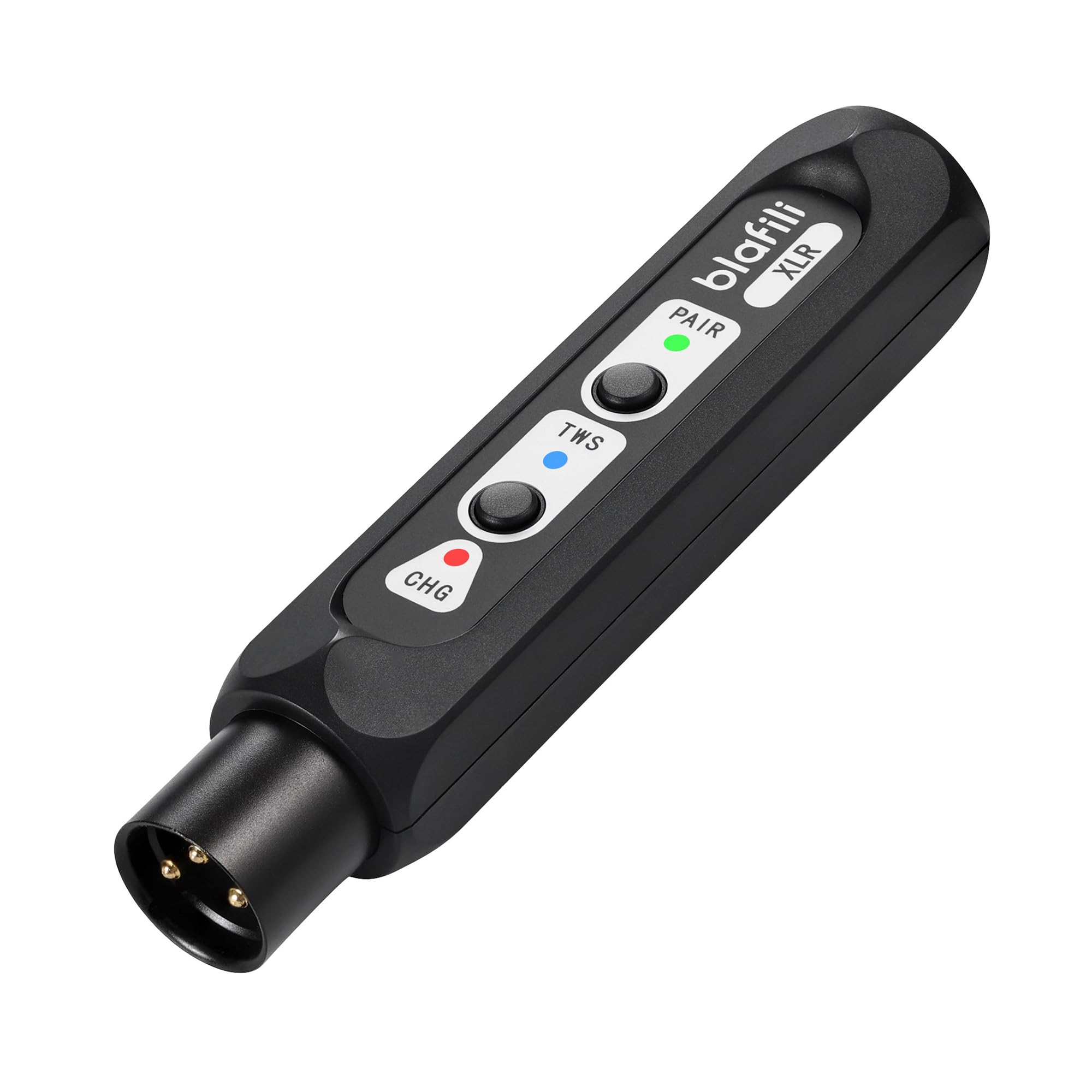
The receiver that keeps its mouth shut through every connect and disconnect.
Picture a wedding ceremony, a quiet church, or a lecture hall where you need one more music feed. Any loud beep from a pairing event goes straight through the PA and into the room. This blafili is designed to stay silent during connection changes, which is exactly the trait that makes it useful in those settings.
Sound runs on a Qualcomm Bluetooth chip with support for aptX HD, aptX Low Latency, aptX, AAC, and SBC. Runtime is up to 10+ hours with USB-C charging, and the ABS and aluminum enclosure takes daily handling. Set up is driver-free and app-free: plug into an XLR input, pair your phone or laptop, and stream. Keep phantom power switched off on the connected mixer input, since this box does not need it.
Where it goes beyond the AK-M1 is in multi-venue management. You can rename the Bluetooth broadcast so each unit carries a room, stage, or zone label — useful across churches, schools, studios, and multi-room installs. One thing that is not supported: pairing passcodes, so this is name customization only. Owners praise the build first, with easy setup and instant connection close behind.
Built for rooms that need silence: weddings, worship services, classrooms, and any venue where a beep is a problem.
Two units for real stereo: a single box is mono, so pair a second via TWS for left and right channels.
5. Xvive P3 Wireless XLR Bluetooth Receiver

The one that just works, over and over, across the most different rigs.
Reliability is the whole pitch with the P3. Owners treat it as a working tool rather than a gadget, and the scenarios it handles range wide — one setup runs two transmitters and four receivers without a stumble. Plug it into an XLR input on a mixer or powered speaker, pair your phone or tablet, and music starts. No app, no menu, no fuss.
Bluetooth 5.1 with A2DP and AVRCP keeps the link steady up to 100 feet, which covers weddings, dance parties, and event floors with room to spare. The DAC resolution is 16-bit/48kHz, so the stream arrives with detail intact. A built-in rechargeable battery gives up to 8 hours, topped up through USB Type-C from any 5V source in about 2 hours — the same 8-hour figure the AK-M1 and P3D carry, well under the Donner CV-1’s 20.
Two P3 units can be linked for cable-free stereo playback, which makes it easy to grow into a two-speaker setup later. What earns it its following is plain functionality — it does the basic job consistently and the connection holds. The runtime is the item to watch: a full-day event will outlast one charge, so keep a USB battery pack in the case.
The consensus read: this is the unit people reach for when they want a receiver that behaves the same way every time they power it on.
For the working DJ or event host: a dependable single-input solution that pairs in seconds and stays paired.
Pack a battery: 8 hours covers a set or a service, not an entire day of programming.
6. MELONARE XLR Bluetooth Receiver BT 5.3 Mono/Stereo 15H MB-1
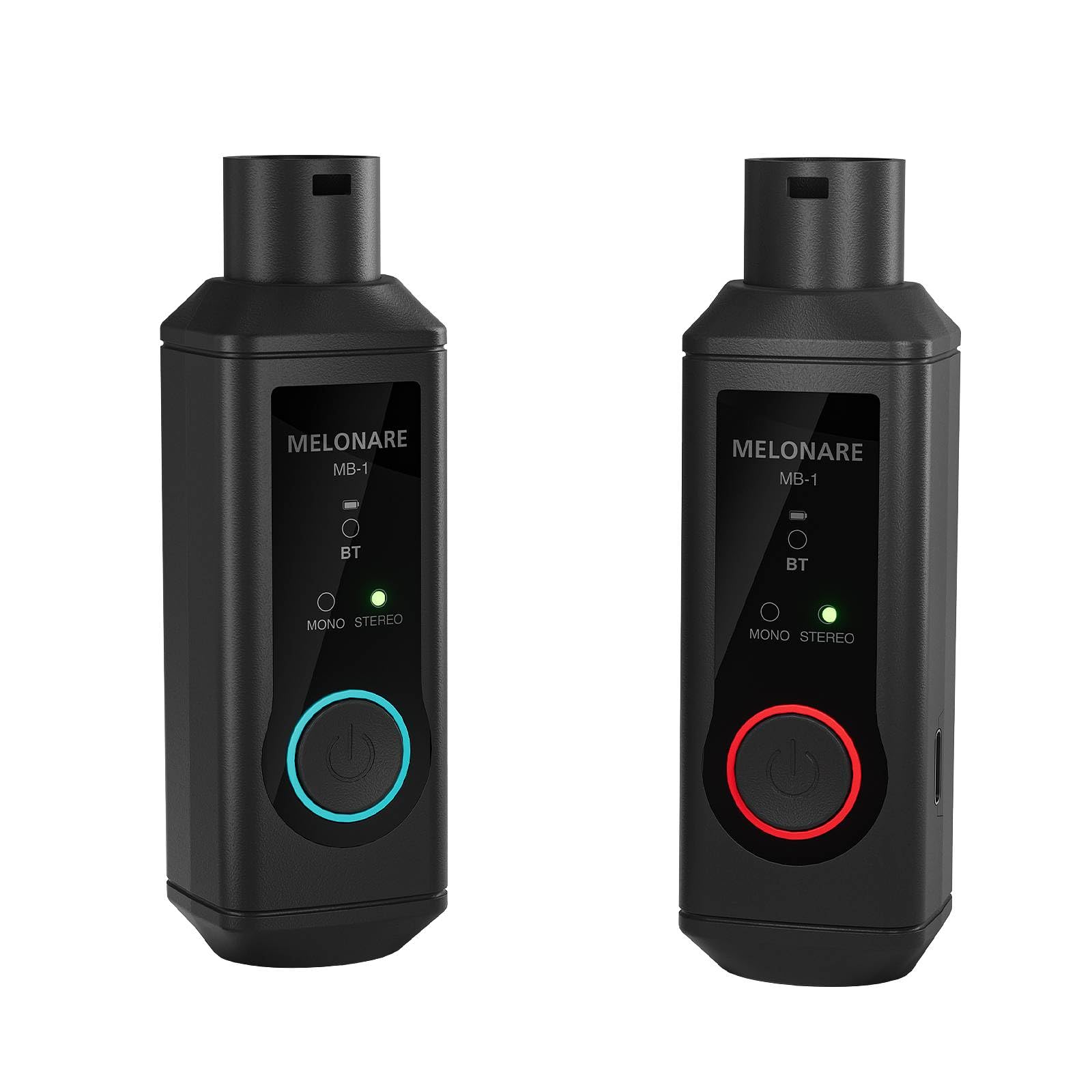
One hundred fifty feet of reach from a receiver small enough to live in a cable pouch.
When the mixer sits at the back of a hall and you are walking the room with a phone, range becomes the deciding spec. The MB-1 lists a transmission range of up to 150ft on Bluetooth 5.3, which is the longest figure in this group — 20 feet beyond the Donner CV-1’s 130 and 50 beyond the Xvive P3’s 100. For a conference hall or an outdoor event space, that margin is the difference between a clean stream and a stutter.
Runtime comes from a built-in 500mAh battery, rated for up to 15 hours of continuous use. That sits between the Donner CV-1’s 20 hours and the 10+ hours of the blafili XLR. The audio path uses a 16-bit/48kHz DAC and handles MP3, FLAC, AAC, and SBC formats. The connector is a standard gold-plated XLR male with balanced output, which the maker says rejects hum and pops.
Mono and stereo modes are both supported — one unit for focused mono, two units paired for synchronized left and right. Owners rate the sound and the battery highest, and the range gets consistent praise. The honest snag is pairing in stereo mode, which some find fiddly. Expect to spend a moment getting two units to link rather than expecting it to happen on the first press.
Why It Stands Out
- Up to 150ft range on Bluetooth 5.3 — the farthest in this lineup
- 500mAh battery rated for up to 15 hours
- Gold-plated XLR male with balanced output
What To Expect
- Stereo mode pairing takes patience on the first attempt
- Two units are needed for true stereo output
Made for the big room: conference halls, outdoor stages, and any setup where the phone roams far from the mixer.
Set the stereo link at home: get the two-unit pairing sorted before you are standing in front of an audience.
7. Xvive P3D Stereo Wireless XLR Bluetooth Receiver

Two receivers in the box, so your stereo PA goes wireless on day one.
Buying two single receivers is the usual path to a stereo setup, and it leaves you sorting the pairing yourself. The P3D skips that step — the set ships with two P3 Bluetooth audio receivers that link to receive a stereo signal, or run as dual mono if that is what your rig wants. If your PA has left and right powered speakers, this is the box that fills both.
Coverage runs a stable 100 ft line-of-sight without obstacles, which handles parties, events, and weddings. Each unit carries an internal rechargeable battery rated for 6 hours of operation, charged through USB Type-C from any 5V USB power source. Compare that 6-hour figure with the Donner CV-1’s 20 hours and the runtime difference is the main thing you are trading away for the stereo convenience.
The pairing is plain: it connects smartphones and laptops to audio broadcast systems over Bluetooth so you can amplify music or other audio. Owners highlight the sound and the plug-and-play nature of the set, and the value of getting two matched units together reads clearly. At 50 g per unit, the pair adds barely any weight to a gear bag.
Where it fits: anyone running two powered speakers who would rather not buy, pair, and label two separate boxes.
Best for the two-speaker rig: a DJ or venue setup with a left and right cabinet that both need a feed.
Plan for shorter sets: 6 hours per unit means a charger or a spare set belongs in your case for long days.
8. Denon Professional DN-200BR Bluetooth Audio Receiver
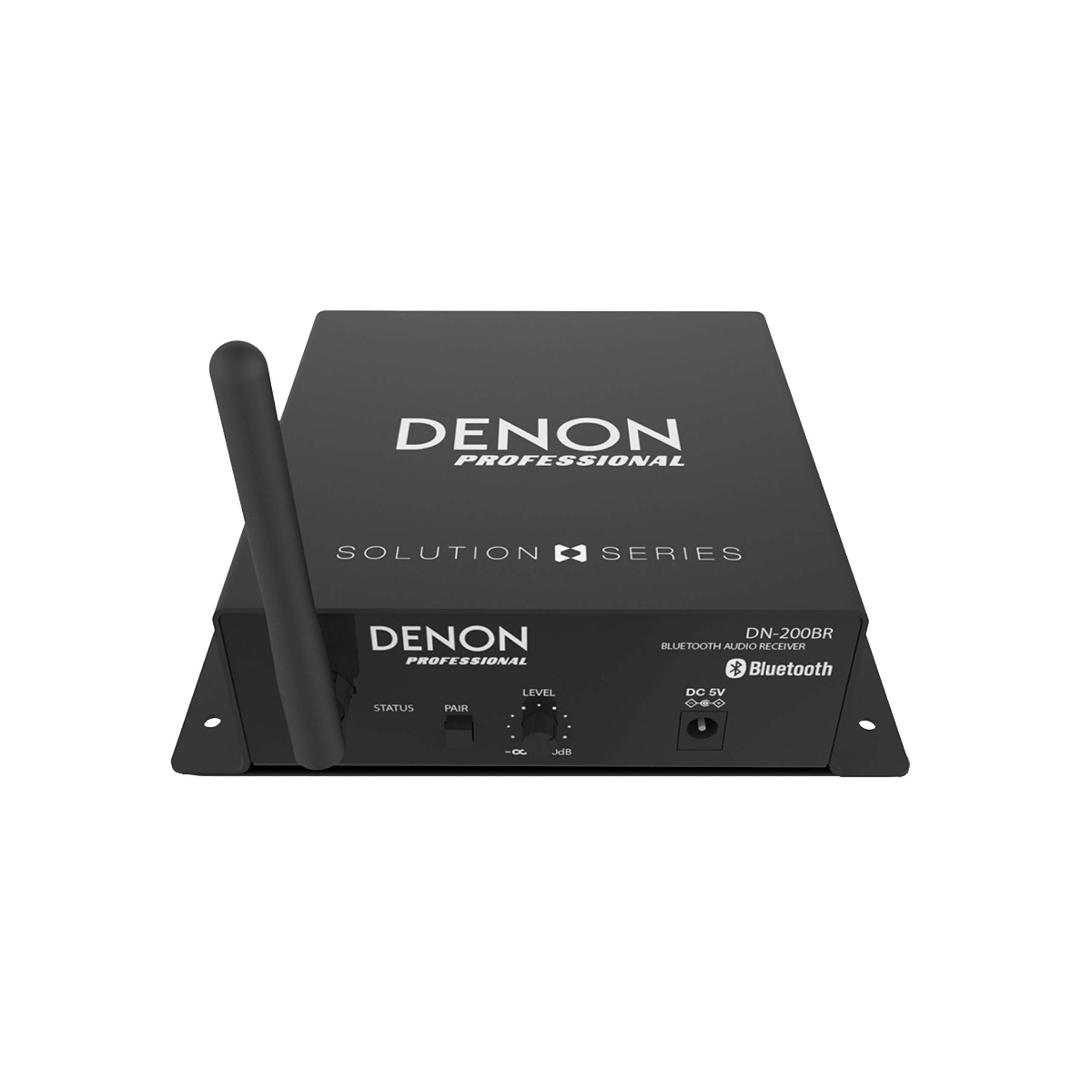
A mains-powered box built to be screwed into a shelf and forgotten about.
Most receivers here run on a battery and move from gig to gig. The DN-200BR takes the opposite approach — a rugged metal enclosure with built-in eyelets for mounting screws, wired to a power adapter and left in place. In a permanent install, that is the trait you want. Nothing to recharge, nothing to lose, nothing that walks off.
The connectivity is aimed squarely at pro gear. Balanced XLR and ¼-inch audio outputs both come standard, so it drops into a mixer or an amplification system without an adapter. Range reaches up to 33m, and a 6-foot magnetic antenna is included to help hold the signal. The maker lists a full-range frequency response and a signal-to-noise ratio above 75 dB.
Profile support is broad — AVCTP 1.0, AVRCP 1.0, GAVDP 1.2, AVDTP 1.0, A2DP 1.2, Hands-Free Profile 1.5, and Headset Profile 1.1 all appear on the spec sheet. Owners most often praise the sound and the straightforward setup. Bluetooth performance is the split note: connection quality and range draw mixed views, with some finding it solid and others hitting drops. That makes it a fit for a fixed room where you can reposition the antenna, not a touring act.
Suits installed systems: a bar, studio, or venue shelf where the receiver lives permanently and runs on mains.
Not for the road: the powered design and mixed Bluetooth reports mean a battery-powered unit serves gigging players better.
Know the Specs
Bluetooth Codecs: LDAC, aptX HD, AAC, and SBC
A codec is the compression format used to send audio over the wireless link. SBC is the basic one every device supports. AAC is what Apple devices favor. aptX HD and LDAC carry more detail, so a receiver that supports them gives a high-resolution source more room to work. If you stream from a plain phone, AAC and SBC are the ones you will use in practice.
DAC Resolution: 16-bit / 48kHz
The DAC — digital-to-analog converter — turns the wireless stream back into an analog signal your mixer can use. A 16-bit/48kHz resolution is a common figure across these units, and the number describes how much detail the converter can resolve. Several boxes here list that exact spec, so it is not a strong differentiator on its own. Look at the chipset and codec list alongside it.
Battery Hours and USB-C Charging
These receivers carry rechargeable batteries rated in operating hours. Published figures in this group run from 6 hours up to 20 hours. USB Type-C charging from any 5V source lets you top up between sets. Match the hours against your longest event slot, and remember that a mains-powered unit like the DN-200BR has no runtime to worry about at all.
Wireless Range and Antenna Options
Range figures assume line of sight without obstacles. Walls, bodies, and gear all cut them down. A removable antenna, like the RP-SMA connector on the blafili B3, lets you upgrade the reach, but the maker warns that range drops sharply if the antenna is not installed. Treat the published number as a best case in an open room.
Common Questions
Will this XLR Bluetooth receiver send audio from my TV to wireless headphones?
Can one receiver feed two powered speakers in stereo?
Do I need phantom power for one of these boxes?
Why does my receiver keep connecting to the last device instead of my new phone?
Is a 100 ft range enough for a large hall?
What is the difference between mono and stereo on these receivers?
Can I use one of these as a USB audio interface for my laptop?
How long does the battery last during a full event?
Why do some of these receivers beep when they pair?
Can I rename the Bluetooth device so I can tell units apart in a venue?
The Bottom Line
For most setups, the xlr bluetooth receiver winner is the blafili B3 because its ESS ES9018K2M DAC and four simultaneous outputs cover a rack full of gear, and it stays silent through every pairing change. If battery hours are what you are chasing, grab the Donner CV-1 and its 20-hour rating. And for a stereo PA that needs two receivers from the start, the Xvive P3D set is the one to reach for.
Here is the one call worth making: the blafili B3 holds the top score in this group, and the blafili XLR runs it close. If your budget leans tighter, the blafili XLR pairs silently and covers the same quiet-room problem for less.
How we choose
We do not accept paid placement. Every pick is matched to a real buyer and a real use-case; we do not hands-on test units.
Sources
Specifications: manufacturer listings and product documentation. Review insights: verified customer reviews, as of November 2026. Pricing: not shown on this page (it changes often); check the current price via the retailer link.
As an Amazon Associate, Tactical Gear Guy earns from qualifying purchases. This does not affect which products we feature.