Specs are compiled from manufacturer listings and verified buyer reviews and can change over time — please confirm the key details on the product page before buying.
An XL electric bike succeeds or fails on two numbers: whether the frame actually fits your body, and whether the motor can drag that heavier bike up the hill on your commute. Get either wrong and you have bought a heavy machine you resent. Get both right and a fat-tire XL e-bike can stand in for the car on short trips. Below are five picks that hold up, from a step-through that carries up to 500 lb to a dual-motor rig with 210 Nm of torque.
This guide is built by comparing the manufacturers’ published specifications and the patterns across verified customer reviews, so you get each pick’s real strengths and trade-offs instead of marketing spin.
Big riders get ignored by most e-bike listings, so fit comes before wattage here. Every pick below states its real rider height window and payload, and this guide to the xl electric bike keeps those numbers front and center.
Top Picks
How To Choose The Best XL Electric Bike
The biggest mistake tall and heavy riders make is shopping wattage first. Fit and payload decide whether you can ride the thing comfortably at all. Power only decides how fast you get there.
Start with the rider height window, not the frame sticker
An “XL” badge means nothing on its own. What you want is the manufacturer’s stated rider range. One pick here is recommended for riders 5’5″ to 7’2″. Another fits roughly 5’6″ to 6’9″. Match your own height to that window before you look at anything else, because a frame that is too short puts your knees in the wrong place on every pedal stroke.
Check the payload against your body weight plus cargo
Payload is the total the frame and wheels are rated to carry. A 500 lb rating leaves real headroom for a heavy rider plus a backpack or a rear rack bag. A 400 lb rating is still generous, but do the math on your own weight plus whatever you plan to haul. Never assume an XL bike automatically carries more.
Understand rated power versus peak power
Rated power is the continuous figure a motor can hold. Peak power is the short burst it can deliver on a climb or a hard start. A bike advertised at 6000W peak is not pulling 6000W the whole ride. Peak is the number that predicts whether the bike surges up a steep grade, so compare peak to peak and rated to rated.
Weigh torque and climb angle together
Torque in Nm measures twisting force at the motor, and it is what actually pushes a heavy bike uphill. Climb angle in degrees is the practical result. A dual-motor bike rated for 40° slopes with 210 Nm combined torque will handle terrain that a single-motor bike rated for 23° simply will not. If your route has real hills, these two figures matter more than top speed.
Side-by-Side Comparison
| Model | Best For | Peak Power | Battery | Stated Range | Amazon |
|---|---|---|---|---|---|
| Aipas M1 Pro★ Best Overall | Tall riders who want an easy step-through | 1800 W | 48V 17.5Ah | Up to 85 miles | Amazon |
| FREESKY Warrior UltraOff-Road Powerhouse | Off-road climbing and long range | 6000 W | 60V 30Ah LG cells | Up to 60–120 miles | Amazon |
| BIGNIU BG-X PRO | Style-first urban commuting | 1500 W motor | 52V 29.4Ah | Up to 38 miles | Amazon |
| BIGUODIR Dual Motor AWD | All-wheel-drive traction and heavy loads | 5000 W combined | 52V 35Ah | Up to 100 miles (PAS) | Amazon |
| FREESKY Swift Horse Ultra | Long-distance touring and cargo | 4000 W BAFANG | 48V 35Ah LG cells | Up to 140 miles | Amazon |
Detailed Reviews
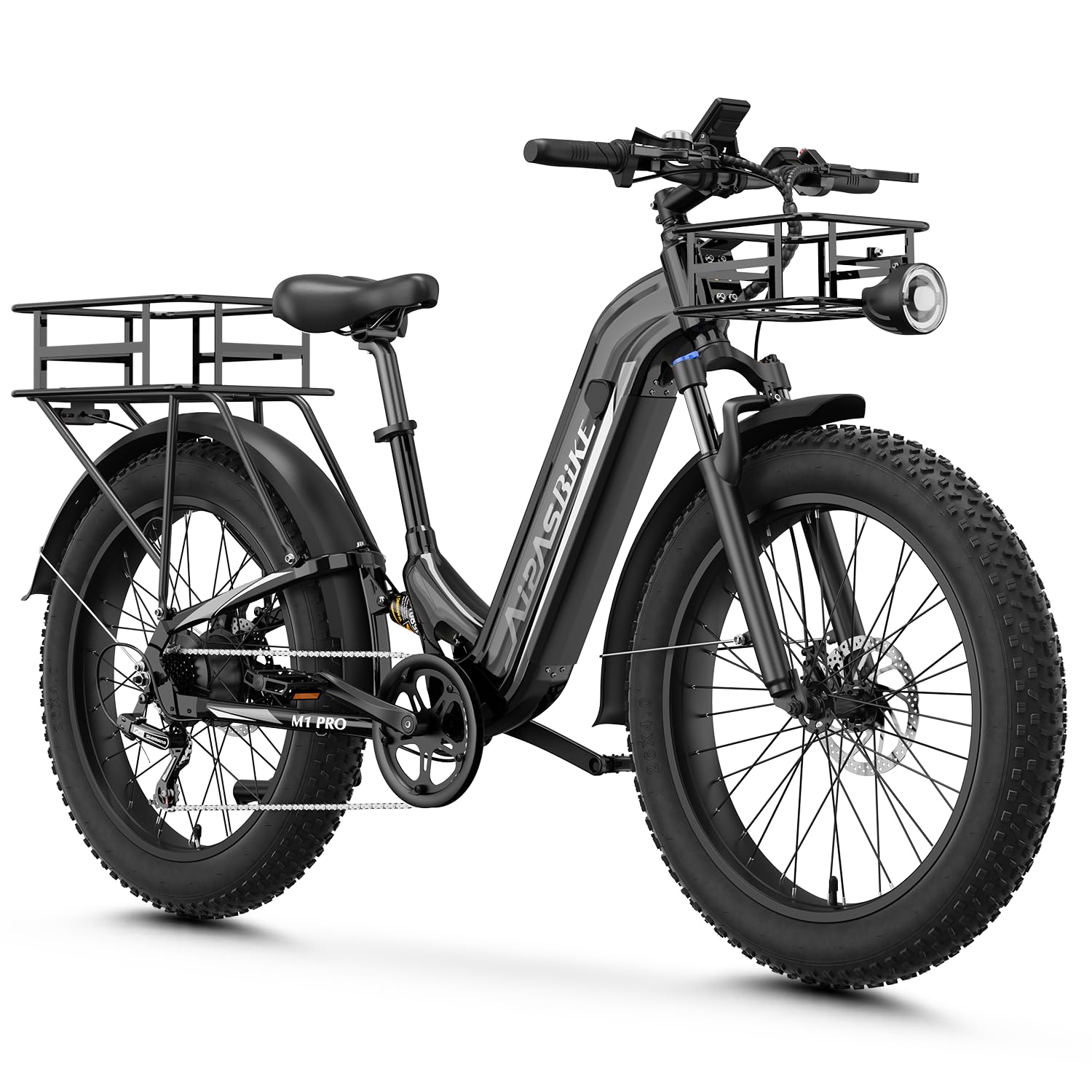
1. Aipas M1 Pro Electric Bike
Our pick — 4.5+★ from 300+ verified ratings; the strongest balance of quality and price.
The step-through XL that swallows a 500 lb load and still fits riders up to 7’2″.
The Aipas M1 Pro earns the top spot for one unglamorous reason: it is the easiest XL bike here to actually get on and off. The step-through frame and height-adjustable seat are recommended for riders 5’5″ to 7’2″, which is the widest stated window in this group. If you are a tall rider who has been squeezing onto standard frames, that range is the whole point. It also carries a 500 lb max load, the highest payload rating on this list.
A 1800W peak rear-hub motor with 110Nm of torque pushes it up climbs rated to 23°. That is not dual-motor territory, and it should not be. The 26 x 4-inch fat tires (wide, balloon-style tires that spread your weight) give you traction on gravel and uneven pavement rather than deep sand. Dual 180mm mechanical disc brakes haul the 88 lb bike down with metal pads that hold up to heat better than resin. Comparing the two FREESKY bikes, the Warrior Ultra climbs 40° against this bike’s 23° — but the Aipas gets you there on a much simpler single-motor drivetrain.
Buyers consistently describe the frame and hardware as solid, not toy-grade. Build quality is the thing buyers talk about more than anything, followed by how straightforward the assembly is — it arrives 90% pre-assembled with a toolkit and manual. Battery range is listed at up to 85 miles in pedal assist, and the removable 48V 17.5Ah pack charges on or off the bike in about 4-6 hours. Charge time is where it beats the bigger FREESKY handily: 4-6 hours versus 8-10 hours on that dual-motor bike.
The honest catch is weight. At 88 lb it is not a bike you carry up stairs or lift onto a bus rack casually. That is the trade-off for the steel frame and the 500 lb rating. Riders who need to lug the bike around rather than ride it will feel every pound.
What earns it the crown
- Fits riders 5’5″ to 7’2″ — the widest stated fit window of the five
- 500 lb max load handles a heavy rider plus cargo
- Step-through frame and adjustable seat make mounting easy
- Charges on or off the bike in about 4-6 hours
- USB port under the handlebar controller charges your phone mid-ride
Where it gives ground
- 88 lb is a lot of bike to lift or store
- 23° climb rating trails the dual-motor picks
- Mechanical disc brakes, not hydraulic
Settle on this one if: you are a taller rider who wants easy mounting, a big payload, and a single motor that just works.
Keep shopping if: your daily route includes grades steeper than 23° or you need to carry the bike up steps.
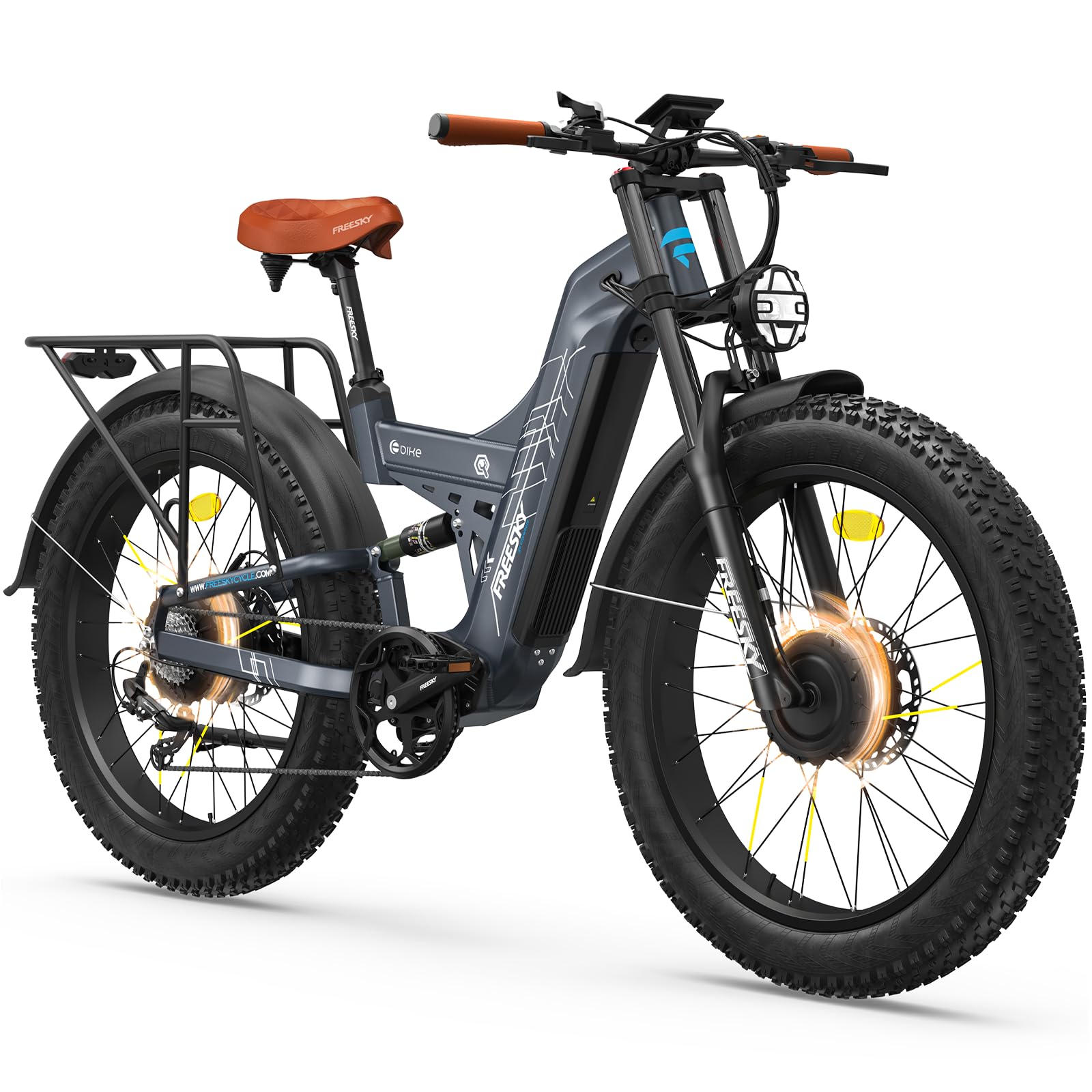
2. FREESKY 6000W Electric Bike
Two 130Nm hub motors and a 40° climb rating make this the hill-conqueror of the group.
The Warrior Ultra is the pick for anyone whose ride includes a grade that stops other bikes. Two hub motors at 130Nm each produce 6000W of peak output and a 40° slope rating. Against the Aipas M1 Pro’s 1800W peak and 23° climb rating, that is a different class of machine entirely — for sand, steep mountain trail, or a muddy backcountry path. A short press of the “O” button toggles between rear-only and dual-motor drive.
There is a smart two-mode setup for legal use. Factory default is Class 2: 750W rated power, 20MPH max assist speed on throttle and pedal assist, which meets US public road standards. Manual off-road mode open up the extra power for private closed courses only. In practice that means one bike handles your commute and your weekend trail day without a second purchase. The whole system is UL2849 certified by TÜV SÜD and the LG-cell battery pack is UL 2271 certified with a BMS (battery management system) guarding against over-charge, over-discharge, and short-circuit.
Range lands between 60 and 120 miles depending on mode, terrain, speed, and rider weight, from a 60V 30Ah removable battery. The dual suspension uses an adjustable hydraulic downhill front fork and rear shock absorbers, paired with 26″ x 4.0″ anti-slip fat tires. An 800-lumen headlight, turn signals, brake lights, and swipe-to-lock NFC (near-field communication, a tap-to-open up card system) round out the daily kit. Owner reviews repeatedly cite build quality and stability at speed, backed by a double-triangle aluminum frame.
The catch: 8-10 hours to recharge with the 3A charger roughly doubles the Aipas M1 Pro’s 4-6 hours. Plan charging around an overnight stop, not a lunch break.
Recharge reality: The 8-10 hour charge window is the price of the 60V 30Ah pack. For a commuter who plugs in overnight that is invisible. For a rider who wants two sessions in one day, it is a scheduling problem.
Value read: Factory-standard Class 2 legal mode plus off-road open up means you are not choosing between road-legal and trail-worthy — you get both in one frame.
Built for: the rider with real elevation and loose terrain on the route, who wants legal road manners by default and dual-motor muscle on demand.
Think twice if: you need fast turnaround charging between rides.
3. BIGNIU BG-X PRO Electric Bike

Ape Hangers bars and turn signals — the XL commuter that turns heads on the way to work.
This is the pick for the rider who wants ape-hanger bars and a head-turning silhouette. The Ape Hangers handlebar design gives you a natural arm-extension posture and a silhouette you will not mistake for anything else on the street. Underneath, a 52V 29.4Ah high-voltage battery feeds a 1500W motor for quick acceleration and hill climbing. The frame is rated “Larger” in size and built from alloy steel.
The safety kit is unusually complete for this tier. Front and rear turn signals, dual hydraulic disc brakes with large discs, a horn, and an LCD screen showing speed, speedometer, odometer, and trip odometer all come standard. A front inverted fork plus a rear dual suspension system soaks up road bumps. It is UL and GCC certified. Commute reach tops out at up to 38 miles on a charge — that is the shortest stated range of the five, and the trade-off for the smaller pack versus the 140-mile FREESKY Swift Horse.
Your gearing is a 3-speed setup. Compare that with the 7-speed Aipas M1 Pro and the 7-speed gearbox on the BIGUODIR AWD bike — a 3-speed means less control across a hilly route, though on flat urban pavement it will not hold you back. The drivetrain is intended for paved roads and urban terrain specifically, which tells you where this bike wants to live.
The catch: it has the thinnest owner-review base in this group, so long-term durability is unproven. The 12-month parts warranty is there, and the maker asks you keep the original box for 30 days. Treat it as a style-led commuter that needs a careful first season rather than a battle-scarred trail rig.
Go for it if: you commute on paved streets and want a bike that reads aggressive and individual, with turn signals most competitors skip.
Bear in mind: the 3-speed gearing and 38-mile range limit it to urban and short-trip duty.
4. BIGUODIR Dual Motor Electric Bike
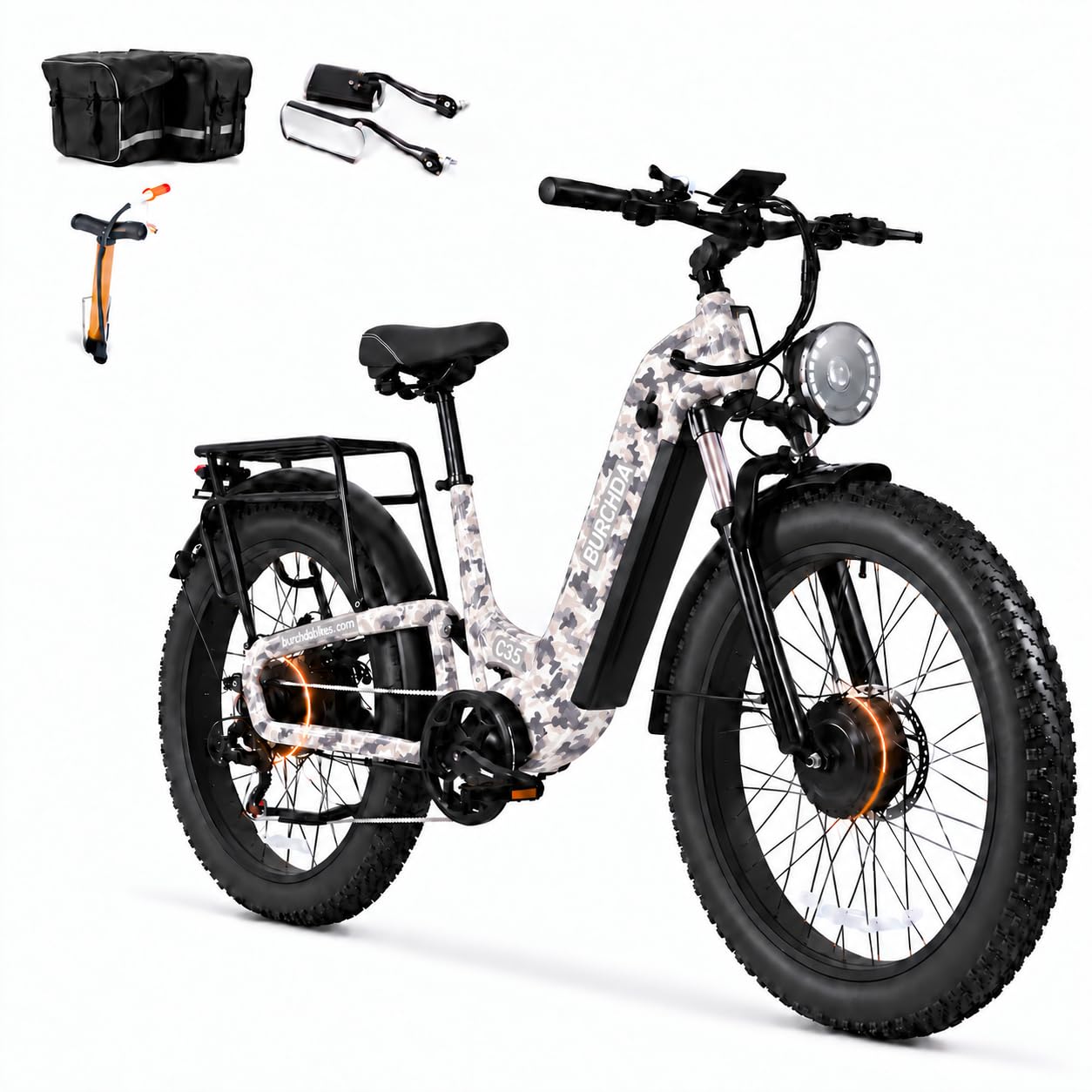
Front and rear hub motors with 210Nm combined torque and true on-demand all-wheel drive.
The BIGUODIR AWD is the most technically ambitious bike here and earns the highest owner score of the group. Its two hub motors — front and rear — combine for 5000W peak output and 210Nm of combined torque, with a 45° climbing capability. Speeds run up to 40 MPH under test conditions. The clever part is the switchable drive: single motor for cruising, dual motor for hills and loose surfaces, which means you choose traction on demand rather than living with it.
Battery is a 52V 35Ah removable pack with 1,820 Wh of capacity and BMS protection. Range runs up to 100 miles in PAS (pedal-assist) mode, up to 75 in single-motor mode, or up to 45 in dual-motor mode. The 52V 3A charger fills it in about 9 to 10 hours, on or off the bike. Compare that to the FREESKY Warrior Ultra’s 8-10 hour window — near enough to be a tie for overnight charging either way.
Comfort spec is three-point suspension: front fork, rear coil shock, and a shock-absorbing saddle working with 26 x 4.0 fat tires. Braking is dual 180mm hydraulic discs, and the package includes a center color LCD, an 800-lumen headlight, six riding modes, cruise control, and an SHM 7-speed drivetrain. The low-step frame is sized for riders about 5’6″ to 6’9″, with a 34 to 41 inch saddle height and a 500 lb maximum payload. It ships 95% pre-assembled with a free rear rack, mirrors, fenders, and a pump with rack bag.
Owners repeatedly praise the sturdy, wobble-free build and stable ride at speed, with one reporting 30 mph uphill without pedaling. The one honest note: the frame is carbon steel, so it is not the lightest option for a rider who plans to load the bike on a rack regularly.
The case for AWD
- Switchable single or dual motor for traction on demand
- 5000W peak and 210Nm combined torque
- 45° climbing capability — the steepest rating in this group
- Fits riders 5’6″ to 6’9″ with a 500 lb payload
- Ships 95% assembled with rack, mirrors, fenders, and pump included
Where it asks for patience
- 9-10 hour charge time limits back-to-back rides
- Steel frame is heavier than an aluminum build
Take the wheel(s) here: if loose surfaces, steep grades, or a heavier rider make all-wheel traction worth having.
One trade-off: the steel frame and 9-10 hour charge ask you to plan your rides rather than improvise them.
5. FREESKY 4000W Electric Bike
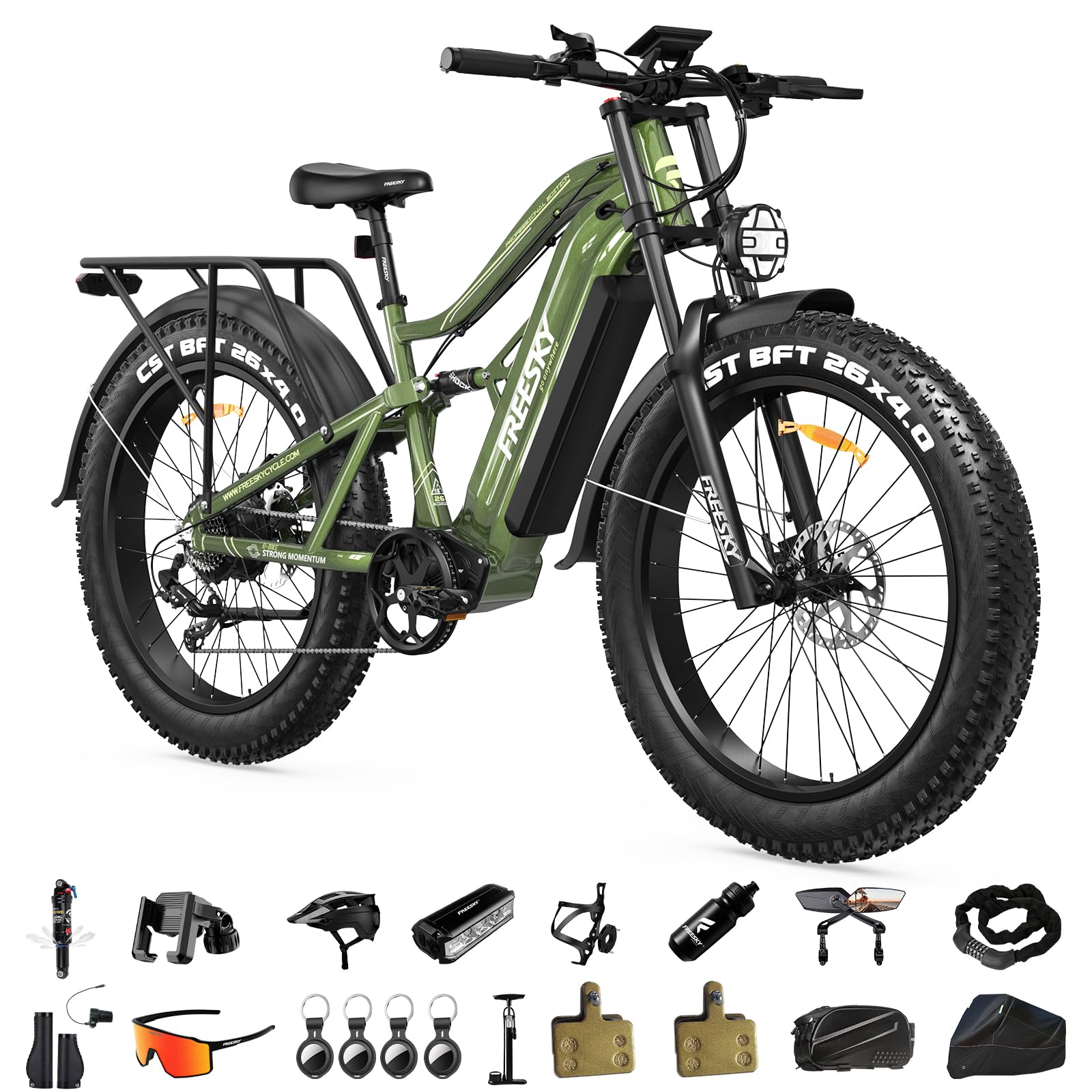
A 140-mile BAFANG-powered tourer built to carry gear, not just a rider.
The Swift Horse Ultra is the range champion on this list. A 4000W BAFANG motor produces up to 150Nm of torque and speeds up to 38+MPH, paired with a removable 48V 35Ah LG-cell battery rated for up to 140 miles of pedal-assist range. That is the longest stated range of the five — well past the BIGNIU’s 38 miles and the Aipas M1 Pro’s 85. Premium LG cells are pitched for more charge cycles and consistent output over time, and the battery holds 1680 watt-hours of energy.
Built for cargo and touring, it carries up to 400 lb and supports optional accessories for hunting trips, delivery work, and camping. Suspension is a dual-crown hydraulic fork with rear air suspension, and 26″×4″ fat tires soak up pavement, gravel, and dirt trail. The drivetrain is a hub drive with a twist-grip shifter and dual assist modes — pedelec (pedal-triggered assist) and throttle-on-demand. It ships with a big accessory bundle: a 10-piece riding set, 4 tracker tags, DNM pneumatic shock absorbers, and a spare twist throttle. Those accessories ship separately from the bike, so do not expect them all in one box.
Owners most often cite the hand-welded frame and solid feel, then battery life that beats the rated range. Performance across varied terrain comes up too. Power delivery is tuned for a smooth, natural pedal response rather than an abrupt surge.
The trade to accept: at 400 lb, this payload rating sits below the 500 lb of both the Aipas M1 Pro and the BIGUODIR AWD. A very heavy rider packing serious cargo should size against that gap.
Point this at: the long-distance rider, camper, or cargo hauler who needs 140 miles between charges more than 500 lb of load headroom.
Look past it if: your combined body-and-cargo weight runs close to or past the 400 lb limit.
Know the Specs
Peak Versus Rated Wattage
Peak power is the burst a motor delivers for a few seconds on a climb or hard start; rated power is the steady figure it holds all ride. A bike quoted at 6000W peak is not pulling that continuously. When you compare two bikes, keep peak against peak and rated against rated, or the numbers lie to you.
Watt-Hours and Real Range
Multiply volts by amp-hours to get watt-hours, the total energy the battery stores. A 48V 35Ah pack holds 1680 Wh; a 52V 35Ah pack holds 1,820 Wh. Higher watt-hours tends to mean more range, but terrain, rider weight, speed, and assist level swing the real number widely. That is why two bikes with similar packs advertise very different mileage.
Torque and Climb Angle
Torque in Nm is twisting force at the wheel, and it is what moves a heavy XL bike up a grade. A motor with 150Nm will out-climb one with 110Nm every time. Climb angle in degrees is the practical result — a dual-motor rig rated for 40° or 45° handles terrain a 23° single-motor bike cannot touch.
Payload and Frame Material
Payload is the total rated load the frame and wheels carry. High carbon steel and aluminum alloy both appear in this category; steel tends to be heavier, aluminum lighter. Check the rider height window and the payload together, because a frame that fits but is under-rated for your weight is a safety problem, not a comfort one.
Common Questions
What actually makes an electric bike an XL frame?
Can a heavier rider ride a 400 lb payload bike safely?
How long does it take to charge an XL electric bike?
Is a dual-motor e-bike better than a single motor for hills?
What does the peak wattage figure on an e-bike listing mean?
Do fat tires on an XL e-bike make it slower on pavement?
How much assembly is required when an XL e-bike arrives?
Are the batteries on these bikes removable and certified?
What is the difference between pedal assist and throttle on these bikes?
The Bottom Line
For most tall riders, the xl electric bike winner is the Aipas M1 Pro because its 5’5″ to 7’2″ fit window and 500 lb payload cover the widest range of big riders, and it charges faster than the dual-motor options. If you want to conquer steep grades and loose terrain, grab the FREESKY Warrior Ultra with its dual 130Nm motors and 40° rating. And for long-distance touring and cargo, the FREESKY Swift Horse Ultra with its 140-mile range is the one to reach for. Riders with the steepest routes have one more reason to act: the BIGUODIR AWD pairs a 45° climb rating with all-wheel traction that no other pick here offers.
How we choose
We do not accept paid placement. Every pick is matched to a real buyer and a real use-case; we do not hands-on test units.
Sources
Specifications: manufacturer listings and product documentation. Review insights: verified customer reviews, as of November 2026. Pricing: not shown on this page (it changes often); check the current price via the retailer link.
As an Amazon Associate, Tactical Gear Guy earns from qualifying purchases. This does not affect which products we feature.