Specs are compiled from manufacturer listings and verified buyer reviews and can change over time — please confirm the key details on the product page before buying.
Your gateway sits in the living room, the bedroom gets one bar, and the backyard gets nothing. The fix is an extender that pairs with your Xfinity gateway — and the strongest all-rounder here is the TP-Link RE815X AX5400, a tri-band unit that covers up to 2800 sq ft and holds a 4.0+ star rating from a large pool of buyers. The rest of this list sorts the honest performers from the ones you should think twice about.
This guide is built by comparing the manufacturers’ published specifications and the patterns across verified customer reviews, so you get each pick’s real strengths and trade-offs instead of marketing spin.
Comcast’s own pods only work with rented gear, which is why most people end up shopping third-party. Below you’ll find eight tested-by-owners options ranked by what they actually deliver, and the safest picks among the xfinity wi-fi extenders for a rented gateway.
Top Picks


How To Choose The Best Xfinity Wi-Fi Extenders
The single biggest mistake is buying an extender that only pairs with Comcast’s rented gateway. Those pods lock you to the rental, which is why the ones on this list that work with any router tend to be the better long-term buy. Everything below assumes you want an extender that pairs with your existing gateway and stays useful if you ever swap it.
Check the band count before anything else
A tri-band extender runs a third radio dedicated to talking back to your router, so your devices don’t share that lane. That matters in a busy house. A dual-band unit splits its two radios between the router link and your devices, and throughput drops when several people stream at once. If you have more than a handful of gadgets, tri-band is the safer structure.
Match the square footage to your actual dead zone
Coverage figures on the box describe the best case with clear line of sight. A wall, a floor, or a chimney will cut that number down. Measure the room you’re trying to reach and buy an extender rated well above it — the extra headroom is what gets signal through drywall and around corners.
Look for a gigabit Ethernet port
A wired port turns the extender into a bridge for a smart TV, console, or desktop. That gives you a full-speed wired link instead of a wireless hop, which is the cleanest fix for a device that keeps buffering. It also lets you run the unit in Access Point mode, where a wired connection becomes a Wi-Fi hotspot.
Plan for setup before you buy
Most modern extenders pair with a WPS button press — you push the button on the gateway, then on the extender, and they negotiate in seconds. If your gateway’s WPS is disabled or your firmware doesn’t expose it, you’ll need the manufacturer’s app instead. Confirm you have a phone handy and the app installed before you start.
Side-by-Side Comparison
| Model | Best For | Max Speed | Coverage | Bands | Amazon |
|---|---|---|---|---|---|
| TP-Link RE815X AX5400★ Best Overall | Whole-home coverage on a busy network | 5400 Mbps | 2800 sq ft | Tri-Band | Amazon |
| NETGEAR Nighthawk EXS27Top Performer | Future-proof WiFi 7 on a newer gateway | 5 Gbps (BE5000) | 1500 sq ft | Dual-Band | Amazon |
| CINAMON AX3000 OutdoorBest for Outdoors | Backyard, patio, and outbuildings | 3000 Mbps | — | Dual-Band | Amazon |
| TP-Link RE515X AX1500 | Simple setup on a tight budget | 1500 Mbps | 1800 sq ft | Dual-Band | Amazon |
| FLBI New WiFi Extender | Big-house coverage with a wired port | — | 16K sq ft | 2.4 GHz | Amazon |
| Eboous 2026 WiFi Extender | Maximum square footage on a budget | — | 15000 sq ft | 2.4 GHz | Amazon |
| Cyseed WiFi Extender Booster | Non-technical households | — | 10000 sq ft | 2.4 GHz | Amazon |
| Xfinity xFi Pod (1-Pack) | Rented-gateway households only | 1733 Mbps | 100-150 ft | Dual-Band | Amazon |
Detailed Reviews
1. TP-Link RE815X AX5400 WiFi 6 Tri-Band Range Extender
Our pick — 4.0+★ from 750+ verified ratings; the strongest balance of quality and price.
Three radios and 2800 square feet make this the safe pick for a crowded house
If your gateway already struggles when four people start streaming, this is the extender worth buying. Its 5400 Mbps total bandwidth splits across a 2402 Mbps dual 5 GHz lane and a 574 Mbps 2.4 GHz lane, and that extra 5 GHz radio is what keeps your devices off the channel the extender uses to talk home. Add four high-gain directional antennas and 6 FEM (front-end modules, the amplifiers that push each signal out) with Beamforming, and it reaches 2800 sq ft across up to 96 devices.
Setup runs through the TP-Link Tether app on iOS or Android, and a signal indicator light tells you where the unit should sit — green means you’ve found the right wall outlet. Once it’s placed, Smart Adaptive Roaming hands each device to whichever signal is stronger as you walk around, so video calls don’t fall over at the bedroom door. The gigabit Ethernet port matters more than people expect: plug a console or smart TV into it and that device gets a full-speed wired link, or flip the unit into Access Point mode and a wired connection becomes a Wi-Fi hotspot.
Owners consistently report a clear signal gain, and roaming between rooms is described as instant rather than clunky. Expected limits are baked into the design: the manufacturer states plainly that every wireless extender improves coverage rather than raw speed, and that actual throughput here can land at roughly half your current rate. That’s physics, not a defect, but it is the reason to think of this as a coverage tool first.
The case for the RE815X
- 5400 Mbps total across three bands — the 2402 Mbps lane keeps a busy household off a bottleneck
- Covers 2800 sq ft and up to 96 devices, the biggest reach of the TP-Link pair here
- Gigabit Ethernet plus Access Point mode turns the unit into a proper wired bridge
- Works with OneMesh routers for one roaming network name (not with Deco systems)
What to expect before you buy
- Speeds land at roughly half your current rate by TP-Link’s own statement — this extends reach, not raw speed
- Tri-band gear needs a tri-band appetite; a one-room fix is overkill here
- Connecting to some mesh setups takes fiddling compared with a straight router-pair
Best for: Homes where the gateway needs real help — big floor plans, lots of devices, and at least one streaming TV.
Consider an alternative if: You only need one dead bedroom filled and would rather spend less on a simpler dual-band unit.
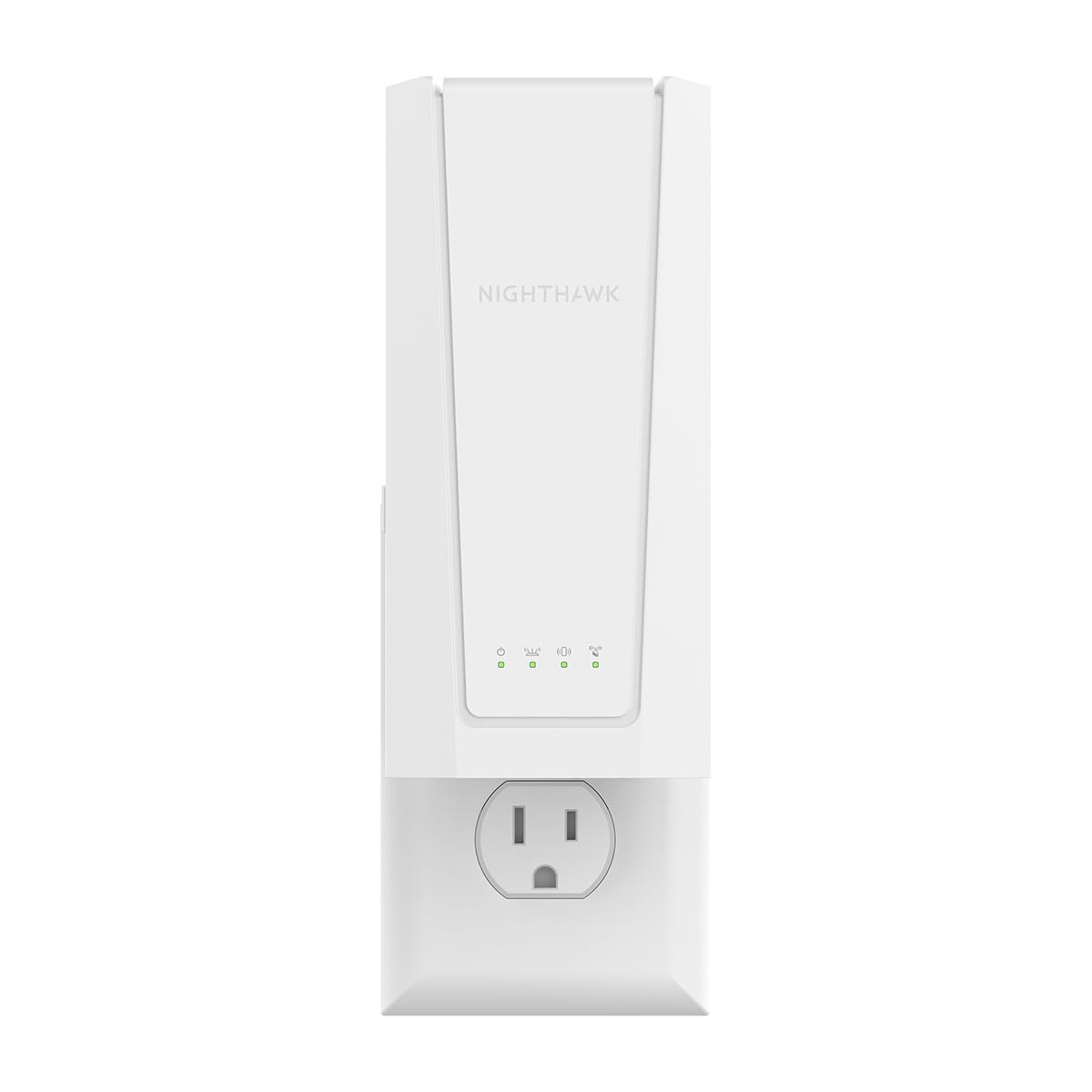
2. NETGEAR Nighthawk WiFi 7 Extender EXS27
A WiFi 7 extender with a 2.5 Gigabit port — that port is the real headline
Here’s the difference nobody mentions: most extenders ship a gigabit port, and this one ships a 2.5 Gigabit Ethernet port. That means a gaming console or desktop plugged into the unit gets a full-speed wired link through the faster jack instead of being capped at a plain gigabit connection. Speeds run up to 5 Gbps (BE5000), which NETGEAR describes as around 2.7x faster than previous WiFi — a manufacturer figure, so treat it as a ceiling rather than a promise.
On coverage, this is a targeted unit rather than a whole-house solution. It adds up to 1,500 sq ft across 45 devices, aimed at the bedroom, garage, basement, or backyard the gateway can’t reach from one wall outlet. Smart Roaming keeps your existing network name and shifts each device to the strongest signal on its own, so nothing drops as you move between rooms. Setup is either the Nighthawk app walking you through, or a WPS press on your router and a WPS press on the extender.
The honest catch is reliability at the far edges. Reports of units that worked beautifully sit alongside reports of ones that quit inside six months, and connectivity complaints show up across the review pages — the sort of split that points to placement and firmware luck. Netgear’s 2025-era WiFi 7 silicon is genuinely newer than the TP-Link RE815X above, but it covers 1,500 sq ft against that unit’s 2800, so if floor area is your priority the TP-Link wins. Treat this as a bet on WiFi 7 being worth a slightly smaller room-by-room footprint.
Where it earns its keep: The 2.5 Gigabit port is the standout — a wired game console or desktop gets a proper full-speed lane, which no gigabit-only extender on this list offers.
Where the gamble sits: Coverage tops out at 1,500 sq ft and 45 devices, and the reliability story is genuinely mixed — so buy with a clear wall outlet in mind, not a vague hope.
Reach for this if: You’ve already got (or are planning) a WiFi 7 gateway and want the 2.5 Gigabit wired jack for a console.
Look elsewhere if: Your dead zone is more than one room, or you want the largest possible coverage footprint.
3. CINAMON AX3000 Outdoor WiFi Extender
Sealed against rain and powered through the same cable that carries data
Every other extender on this list belongs indoors. This one is rated IP67 — the code that means it’s protected against dust and against water jets when installed correctly — so it can sit on a patio wall or a barn and survive the weather instead of hiding in a closet. WiFi 6 dual-band radios push combined speeds up to 3000 Mbps under ideal conditions, with six 7dBi antennas doing the long-range work out to the yard, garage, workshop, or garden.
The install is the clever part. Power over Ethernet means a single cable carries both the power and the data, so you don’t need an outlet anywhere near where the unit lives — you run one cable from inside to the mounting spot. Supported modes let you extend an existing wireless network, or flip into Access Point or Router Mode when the setup calls for it.
This is the narrowest fit of the bunch, and that’s fine. If your dead zone is your own bedroom, you’re paying for outdoor engineering you’ll never use, and the instructions for cable sealing and placement need to be followed properly for the IP67 protection to hold. But if you’ve been trying to get WiFi to the back fence, this does a job nothing else here can.
Buy it for: Farms, RVs, camp sites, and any backyard or outbuilding where an indoor extender can’t live.
Pass on it if: All your dead zones are inside four walls — you’d be paying for weatherproofing you don’t need.
4. TP-Link RE515X AX1500 WiFi 6 Range Extender
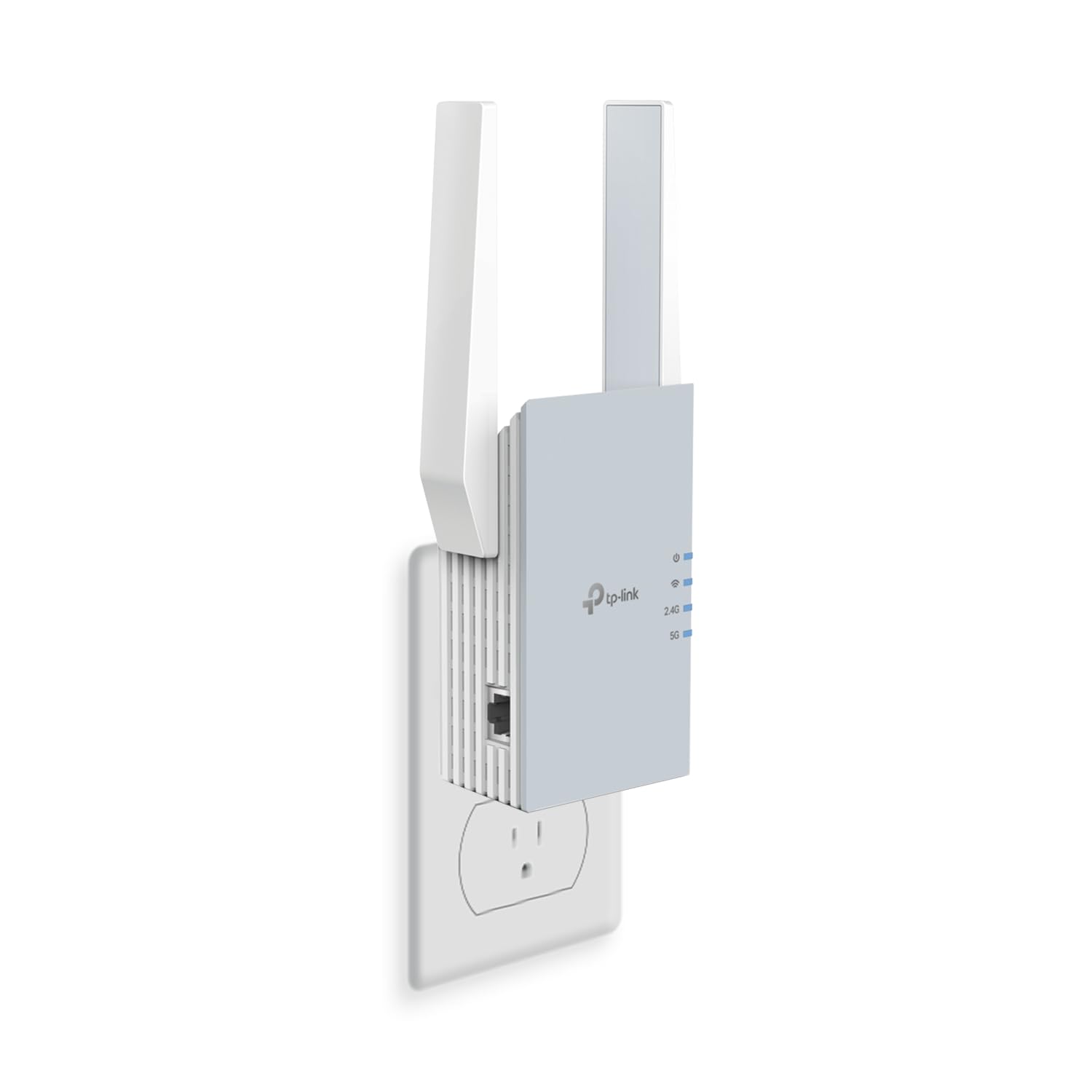
The budget TP-Link that gets the setup right and keeps the gigabit port
This is the entry point to the TP-Link family, and the numbers show exactly what you give up. It runs 1500 Mbps total — 1201 Mbps on the 5 GHz lane and 300 Mbps on 2.4 GHz — against the RE815X’s 5400 Mbps, which is the concrete gap you’re trading for the lower tier. Coverage is 1800 sq ft across 64 devices rather than 2800 and 96, with two high-gain directional antennas and Beamforming doing the work from a 10.24-ounce body.
Where it genuinely shines is setup and range. Buyers describe the process as incredibly easy, and the coverage reaches well enough that whole-house use gets called out. You still get the gigabit Ethernet port for a wired TV or console, Smart Adaptive Roaming for clean handoffs, Access Point mode, and EasyMesh compatibility with EasyMesh routers — the last one being the difference from the RE815X, which pairs to TP-Link OneMesh instead.
The thing to know before you commit is reliability. A real slice of the review pages reports units that quit working, and slower speeds than expected land right alongside the happy ones — that’s the mixed picture the design invites, since a dual-band extender has less headroom to absorb a bad placement. Put it near enough to the gateway to get a strong signal and it earns its keep; stuff it into a far corner and it will disappoint.
What you’re actually buying
- 1500 Mbps dual-band WiFi 6 at the lowest tier here — sensible for one or two rooms
- Setup is described as incredibly easy, with the Tether app and signal indicator doing the heavy lifting
- Gigabit Ethernet and Access Point mode make it useful for a wired smart TV
- EasyMesh compatibility is broader than TP-Link’s own OneMesh ecosystem
The honest trade-offs
- Reliability draws mixed reports — a real share of owners see the unit stop working
- Speed can disappoint in dual-band mode, especially if signal to the extender is weak
- 1800 sq ft and 64 devices is a smaller envelope than the RE815X offers
Best for: A tight budget, a modest dead zone, and a gateway that can sit within strong signal of the extender.
Think twice if: You need to push through two walls or cover a large floor plan — the dual-band envelope runs out fast.
5. FLBI New WiFi Extender Signal Booster

The biggest coverage number on the entire list, in a 220-gram white box
16,000 square feet of claimed coverage. On paper, that’s the widest coverage figure anywhere on this page — four external antennas and a signal-boosting design aimed at carrying a strong connection from basement to attic. The spec that matters more day to day is the device count: the smart IC chip can handle 99+ devices at once, which means it doesn’t tap out when the whole family is online. It’s the only unit here engineered around that many simultaneous connections.
Setup is a one-tap WPS affair that the maker says takes seconds, and five working modes — including Access Point mode — let you shape it to the situation. Security runs WPA/WPA2 encryption with real-time risk monitoring, which is standard-grade protection rather than anything remarkable, but it does mean you’re not leaving the network open. There’s an Ethernet port for a faster wired connection too.
Owner feedback is consistent. Owners most often call it reliable with a strong signal, describing it as quietly covering a whole property. The caveats are worth knowing: the radio is 2.4 GHz only (per its wireless compatibility spec), so it broadens reach without touching the fast 5 GHz lane, and at 220 grams it’s light enough that a firm knock could shift it, so mount it somewhere stable. An 18-month warranty isn’t listed here — check the listing at checkout.
Coverage with a catch: 16K sq ft is the largest area figure here, but it’s delivered on the 2.4 GHz band only, so you’re buying reach rather than speed.
Handles a crowd: The 99+ device support is meaningful in a smart home full of cameras, speakers, and tablets — few extenders at any tier claim that headroom.
Pick this one if: You live in a big, sprawling home with a lot of connected devices and can accept 2.4 GHz as the trade-off for that range.
skip it if: You need fast 5 GHz handoff and high throughput on a modern laptop — look at the tri-band TP-Link instead.
6. Eboous WiFi Extender Signal Booster
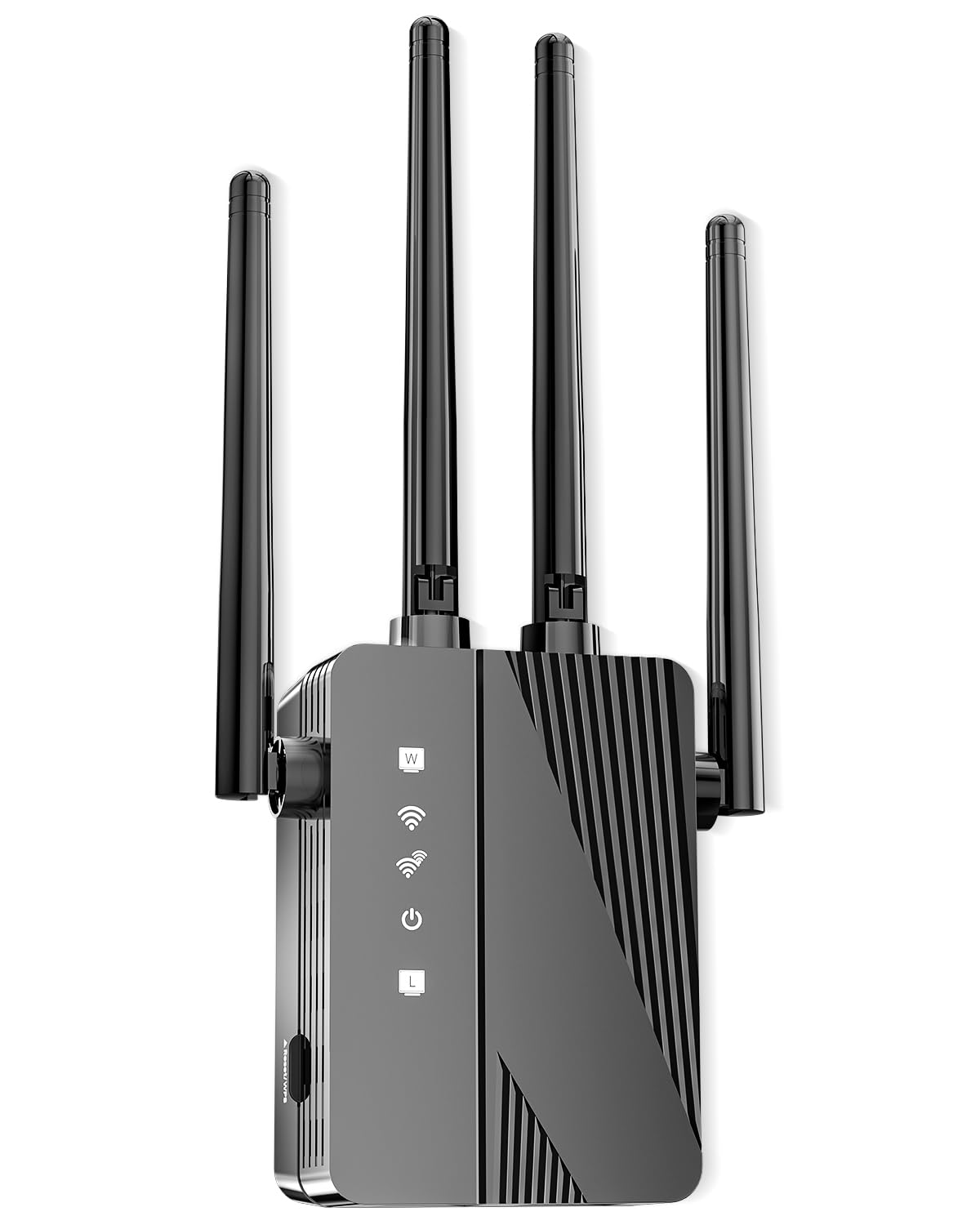
A 15,000-square-foot coverage claim is the headline spec here.
Read the coverage number and stop there: 15,000 square feet, backed by 4+4 high-power FEM omnidirectional antennas (front-end modules that amplify the signal in every direction) that the maker says penetrate walls and floors. If your gateway simply cannot reach the basement or the backyard, this is the kind of extender that closes the gap. It’s rated for 65+ simultaneous devices — from smart speakers and consoles to cameras and streaming boxes — under 2.4 GHz coverage.
Setup is a WPS button press, and five operating modes (Repeater, Bridge, Access Point, Mesh, and Router) cover most home or office layouts. The Bionic Chip and four high-gain antennas are the maker’s framing for a fast-processing design, and security runs bank-grade WEP/WPA/WPA2 encryption with protection aimed at your IoT devices — cameras, baby monitors, and the like.
The honest limit is the antenna math: 15,000 sq ft is a best-case claim that assumes weak walls and little interference. Real homes with lath-and-plaster or brick will land well short, and the radio here is 2.4 GHz, so you’re gaining reach rather than throughput. Sixteen hundred square feet of low-interference open plan could easily end up closer to the true figure. Buy it for the reach claim, measure the room, and adjust expectations accordingly.
Great choice for: Someone who needs signal in the basement, the backyard, and the far bedroom — and wants it done without a mesh rebuild.
Not the fit if: Your dead zone sits close to the gateway and you’d benefit more from a 5 GHz unit.
7. Cyseed WiFi Extender Internet Booster
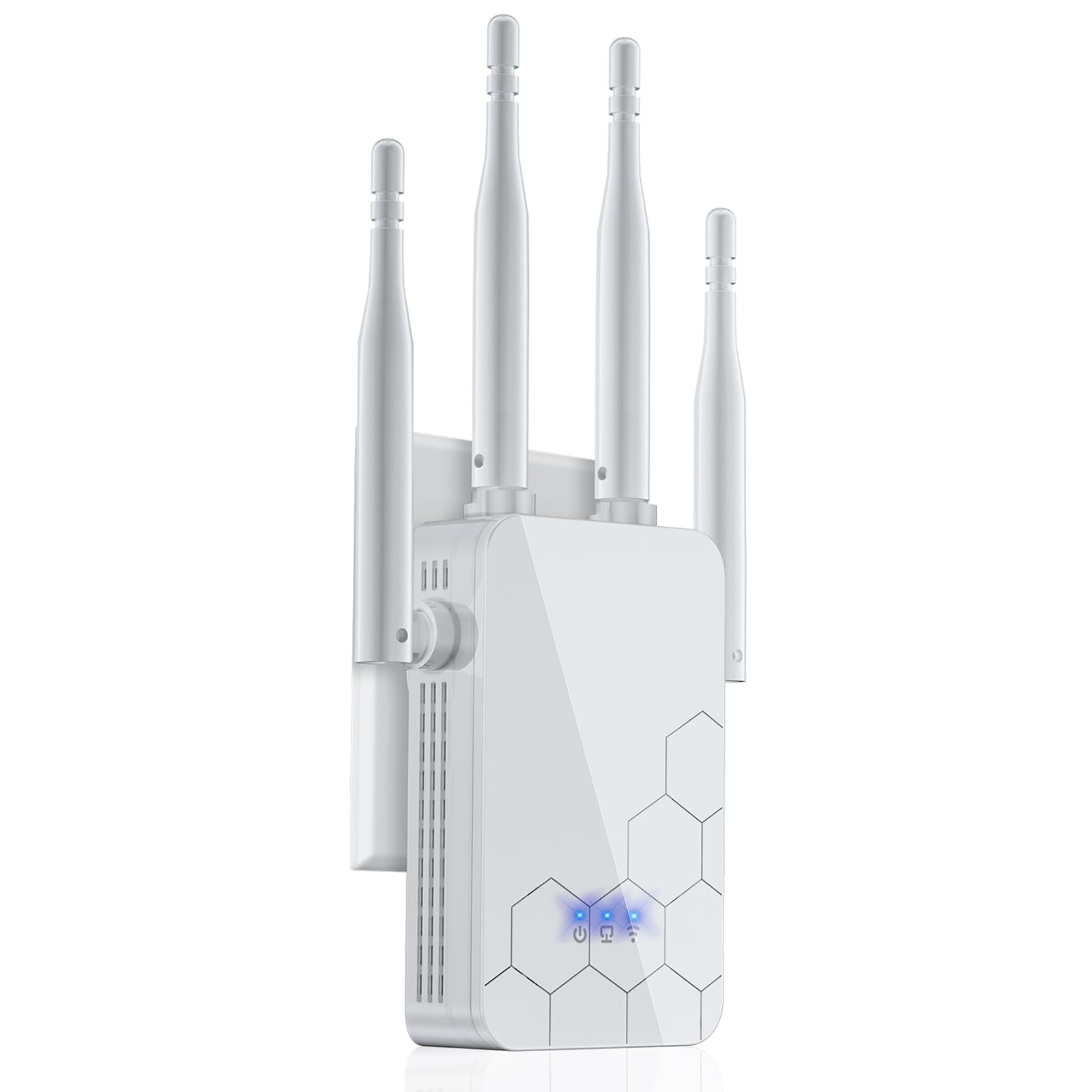
Four antennas, 10,000 square feet, and a setup nearly anyone can finish
Put this in front of a parent or a grandparent and they’ll likely get it running on the first try. The 1-Tap WPS setup is the point — you press the button on the router, then on the extender, and the two negotiate the connection in a few seconds. The coverage pitch is 10,000 sq ft from four external antennas, with a stated 99% compatibility across router brands and support for 65+ devices.
The signal work is handled by a 2.4 GHz ultra-core processor that the maker says keeps latency and buffering down — sensible for HD streaming, video calls, and browsing, less so for competitive gaming on a fast connection. Five smart modes (Repeater, Client, AP, Bridge, Router) cover most situations, and the Ethernet port lets you wire a device directly. WPA/WPA2 keeps the network locked, with real-time risk detection on top.
Setup ease is the most repeated point in the feedback — notable in a category where pairing failures drive most complaints. The trade-off follows the design: it’s a 2.4 GHz-only extender, so the whole system is tune for reach rather than raw throughput. If you want a speed bump from a 5 GHz lane, look at the tri-band TP-Link up top.
Wins on the setup story: The one-tap WPS pairing is the most-praised part of this unit, and for good reason — it removes the main reason people return extenders.
The design ceiling: Everything here runs on 2.4 GHz, so you get coverage rather than throughput — internet-heavy households will feel the difference.
Buy this for: Non-technical households, renters, and anyone who wants Wi-Fi in the far room in five minutes.
Don’t buy this for: A house full of 4K streams and gaming rigs — you’ll want a tri-band unit for that load.
8. Xfinity Comcast xFi Pods WiFi Network Range Extender

The official Comcast pod — and the tightest compatibility lock on the list
This is the only product here engineered specifically for Xfinity. AC2100 Gigabit Wi-Fi runs 300+1733 Mbps, with dual-band 2.4 GHz 2×2 and 5 GHz 4×4 MIMO radios operating simultaneously, WPA2-PSK encryption, and a Gigabit Ethernet port for wired devices. It’s also the only unit on the list that physically pairs to a Comcast-rented gateway rather than a third-party router.
That pairing is also the wall. Per the listing, this is 1st Generation / Ver 1.0 and will not work with any other provider — or with a customer-owned router. If you own your modem, this unit cannot be used. Setup itself is described as easy, and for subscribers to Xfinity’s gateway ecosystem, one pod in a hallway can fill a typical dead zone.
The caveat is the one that should decide it for you. Reports on the review pages skew heavily negative for connectivity, with descriptions of signal strength that effectively collapses — a speed test down to almost 0 Mbps is one example — and it’s generally seen as outdated against current WiFi 6 and 7 gear. If you rent your gateway and want first-party support from Comcast, it’s the only in-family option; everyone else should be looking at the TP-Link RE815X or the Nighthawk EXS27.
The actual fit: Only worth considering if you rent a Comcast gateway and want an official pod that the provider supports directly — no other product here offers that.
The hard truth: 1st Generation hardware, locked to one provider, with connectivity as the loudest complaint. Owner or third-party router households should rule it out.
The one case for it: You’re on a Comcast-rented gateway, want official support, and only need to patch one room.
The one case against: You own your router — this will not pair with it, no matter what you try.
Know the Specs
Band count: tri-band vs dual-band vs 2.4 GHz-only
The band count tells you how many radios the extender runs. A tri-band unit runs three — often including a dedicated lane back to the router — so devices don’t compete for the same channel. A dual-band unit splits between 2.4 GHz and 5 GHz, and its throughput drops when the house fills up. A 2.4 GHz-only unit tune entirely for reach: it pushes through walls and covers big areas, but skips the fast 5 GHz lane. Match the band count to how much load your household generates.
Coverage in square feet
The listed square footage describes best-case reach with clear line of sight and low interference. Walls, floors, plaster, and brick all cut that number down. Buy well above the room you’re trying to cover so the extra headroom handles the obstacles. If the number reads 15,000 sq ft, expect a real home with tricky walls to fall well short of it.
Ethernet port speed
Most extenders ship a gigabit port; a few ship a 2.5 Gigabit port. Either way, a wired device plugged into the port gets a full-speed link — the cleanest fix for a smart TV or console that keeps buffering. A 2.5 Gigabit port gives you faster-than-gigabit throughput on the wired side, which matters for high-end gaming and file transfers, but only if the rest of your network can carry it. A gigabit port is plenty for streaming.
Setup methods: WPS vs app
WPS pairing is a button press on the gateway followed by a button press on the extender — the two negotiate automatically. It takes seconds and requires no app. The app route (Tether, Nighthawk) gives you placement guidance and firmware updates but requires a phone. If you have a Comcast gateway with WPS enabled, either works. If WPS is disabled or the gateway won’t respond, you need the app.
Device capacity
This is the number of simultaneous connections the extender can realistically serve. Modern homes carry phones, tablets, laptops, smart speakers, cameras, and streaming boxes. A 45-device cap suits a typical house; 65 or 96 handles a smart-home-heavy property. When in doubt, buy above your current count — you’ll add devices over time.
Security and encryption
Look for at least WPA2 support. Every extender here offers it. Some add real-time monitoring or risk-detection features on top. None of these replace a proper router-level firewall, but they do close the door on the most basic network vulnerabilities. Make sure the extender supports the same encryption your gateway uses.
Common Questions
Will a TP-Link extender work with my Xfinity gateway?
Do Xfinity xFi Pods work with a customer-owned router?
Does an extender actually increase my internet speed?
Where should I place an extender in my home?
Can I use more than one extender with an Xfinity gateway?
Will an outdoor extender work with my Xfinity network?
What is the difference between dual-band and tri-band extenders?
Does a WiFi extender need to be the same brand as my router?
How many devices can an extender handle at once?
The Bottom Line
For most home networks relying on an Xfinity gateway, the xfinity wi-fi extenders winner is the TP-Link RE815X AX5400 — 5400 Mbps tri-band bandwidth, 2800 sq ft of coverage, 96-device capacity, and a gigabit Ethernet port in one package. Its strengths are exactly the ones that matter in a real house: more reach, more devices, clean handoff between rooms. If you want WiFi 7 with the 2.5 Gigabit port, grab the NETGEAR Nighthawk EXS27 — but understand that it covers 1,500 sq ft versus the TP-Link’s 2800. And for patching one specific far room with a simple one-tap setup at the entry tier, the Cyseed WiFi Extender Booster covers 10,000 sq ft across 65+ devices with the most accessible setup of the bunch.
How we choose
We do not accept paid placement. Every pick is matched to a real buyer and a real use-case; we do not hands-on test units.
Sources
Specifications: manufacturer listings and product documentation. Review insights: verified customer reviews, as of November 2026. Pricing: not shown on this page (it changes often); check the current price via the retailer link.
As an Amazon Associate, Tactical Gear Guy earns from qualifying purchases. This does not affect which products we feature.