Specs are compiled from manufacturer listings and verified buyer reviews and can change over time — please confirm the key details on the product page before buying.
If your console keeps dropping its connection in the far room, the fix is not a new router — it is the right extender. You want one that grabs a weak signal and rebroadcasts it strong enough for a stable match. Below are the extenders that actually hold an Xbox connection, ranked by real coverage, real throughput, and what buyers live with day to day.
This guide is built by comparing the manufacturers’ published specifications and the patterns across verified customer reviews, so you get each pick’s real strengths and trade-offs instead of marketing spin.
A weak signal in the back bedroom usually means a dropped round, so here is how to pick the Xbox Wi-Fi Range Extender that keeps your console locked on.
Top Picks

How To Choose The Best Xbox Wi-Fi Range Extender
The mistake most console owners make is buying an extender for speed. Every wireless extender is built to spread coverage, not raise the speed your provider gives you. What you want is a strong, stable signal where the Xbox sits — and a signal that survives walls.
Match the extender to your router, not just your console
An extender has to talk to your router first, then to your Xbox. If your router is an older dual-band model, a dual-band extender keeps things compatible. If you already run a Wi-Fi 7 router, a Wi-Fi 7 extender can use MLO (Multi-Link Operation, which combines bands for steadier throughput). Check your router’s band support before you buy.
Look for a wired port for the console
Most extenders here carry a Gigabit Ethernet port — one carries a 2.5 Gbps port. Running a cable from the extender to the Xbox removes wireless jitter from the last stretch entirely, which matters more for a shooter than raw bandwidth.
Read coverage claims with walls in mind
Square-foot figures assume open space. In a house with floors and brick, expect less. Place the extender roughly halfway between router and console, not at the far wall, so it can hear the router clearly and still reach the room.
Side-by-Side Comparison
| Model | Best For | Coverage | Data Transfer Rate | Devices Supported | Amazon |
|---|---|---|---|---|---|
| TP-Link RE815X AX5400★ Best Overall | Big homes with heavy device counts | 2800 Sq. Ft | 5400 megabits_per_second | 96 | Amazon |
| TP-Link RE223BE BE3200 | Wi-Fi 7 on a mid-range budget | 2400 Sq. Ft. | 3200 megabits_per_second | 64 | Amazon |
| NETGEAR Nighthawk EXS27 | Wi-Fi 7 gaming with many devices | 1500 sq ft | 5 gigabits_per_second | 45 | Amazon |
Detailed Reviews
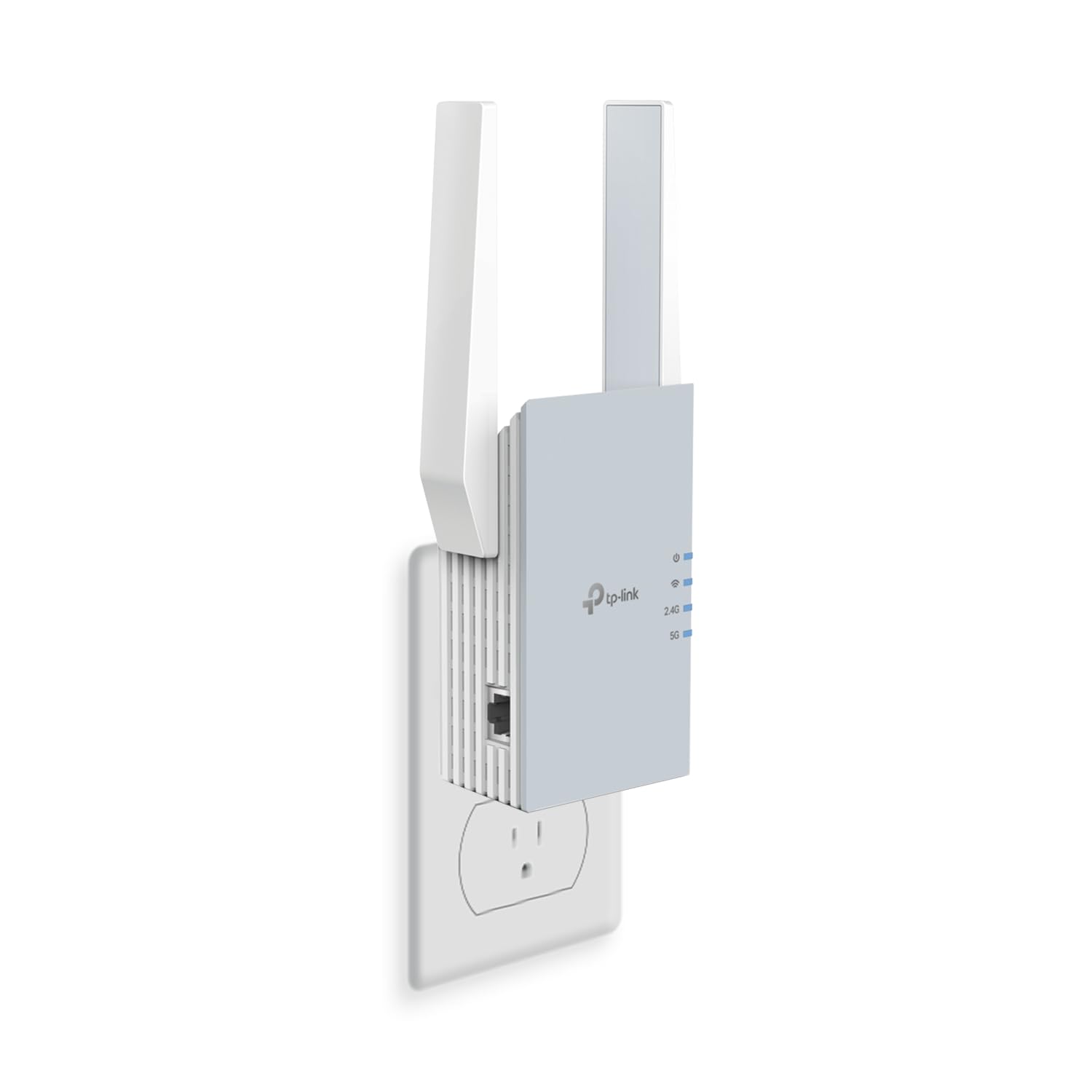
1. TP-Link RE815X Range Extender
Our pick — 4.0+★ from 750+ verified ratings; the strongest balance of quality and price.
The tri-band workhorse that holds a whole house of devices without buckling
The number that carries this pick is 2800 — up to 2800 Sq. Ft of coverage, the widest single-unit figure on this list. That is the room count an Xbox in a converted basement or far bedroom actually needs. Its 5400 megabits_per_second total bandwidth splits across two 5 GHz lanes (up to 2402 Mbps) and a 2.4 GHz lane (574 Mbps), so the console can sit on a clean channel while phones and TVs use the other.
Buyers consistently praise the signal strength, reporting that download and upload speeds rise noticeably across the house. The tri-band design is the reason: a dedicated 5 GHz path keeps latency lower during a match than a dual-band unit juggling everything at once.
The catch is honest. TP-Link is clear that actual speeds land at 50% or less of your current rate, because every extender improves coverage, not speed. Connectivity shows up as mixed in the feedback, so placement matters — use the app’s signal indicator rather than guessing. If you want a no-thought-required Wi-Fi 7 gaming unit, look up the list; for sheer device headroom, this is the one.
tri-band throughput
- 2800 Sq. Ft of coverage — the widest here
- 96-device capacity, the largest in the lineup
- Tri-band with a Gigabit Ethernet port for a wired Xbox
- OneMesh expands an existing TP-Link router’s network
wall placement matters
- Won’t raise your raw internet speed
- Does not work with Deco mesh systems
- Mixed feedback on connectivity if placed too far from the router
large homes: large homes with many connected devices that need one unit to cover a lot of ground.
weak signal areas: if you run a Deco mesh — this extender isn’t built for that ecosystem.
2. TP-Link RE515X AX1500 WiFi 6 Range Extender w/Ethernet Port
The plug-in that gets a console online in under ten minutes
The EAX12 covers up to 1,200 sq. ft for up to 15 devices, which is the smallest capacity on this list — a 6.4x gap against the RE815X’s 96. It sits at 14.4 ounces on the outlet. If you have one Xbox and a couple of phones in a far bedroom, that headroom is plenty; a houseful of smart gear it is not.
Setup is what buyers praise most. The Nighthawk app walks you through it, or you press WPS on both router and extender, and buyers report it running in under 10 minutes. The Nighthawk keeps your existing network name and hands each device to the strongest signal as you move room to room, so the Xbox doesn’t need manual reconnecting.
It works with any router from Xfinity, Spectrum, AT&T, Cox, or Verizon — no locked ecosystem. WPA3 security covers every device. The 1.6 Gbps (AX1600) rate with a Gigabit Ethernet port is enough for one console over a wired link. Fifteen devices is the ceiling, so a bigger household should step up.
small apartments: you want the least fiddly path to getting one console stable in a back room.
multi-floor homes: a busy home with more than a handful of gadgets — 15 devices is the cap.
3. TP-Link RE223BE Range Extender

The first step into Wi-Fi 7 without paying top-tier money
Wi-Fi 7 on a budget is the pitch, and the specs back it: 3200 megabits_per_second across a 5 GHz band (up to 2594 Mbps) and 2.4 GHz band (up to 688 Mbps), covering up to 2400 Sq. Ft for 64 devices. Pair it with a Wi-Fi 7 router and it can use MLO — Multi-Link Operation, which combines bands to cut latency and steady the connection. That is a real advantage for console play.
Buyers praise the fast setup first and the extended reach second. The Tether app handles configuration, and the signal indicator tells you where to place it. Beamforming through four antennas steers signal where it counts.
Be clear on the limits. It does not support the 6 GHz band — this is a dual-band unit. Connectivity feedback is mixed, with some reporting frequent disconnections, so keep it within a sensible distance of the router and consider the Ethernet port for the console. EasyMesh works with compatible routers, but not with Deco systems.
wifi 7 dual-band
- Wi-Fi 7 with MLO for lower latency when paired to a Wi-Fi 7 router
- 2400 Sq. Ft and 64 devices
- Quick app setup
limited antenna count
- No 6 GHz band support
- Mixed connectivity feedback — placement is key
- Not built for Deco mesh
new phone owners: a Wi-Fi 7 router owner who wants the newer standard on a mid-range budget.
legacy devices: if your router is Deco — mesh compatibility isn’t there.
4. TP-Link RE403BE Range Extender
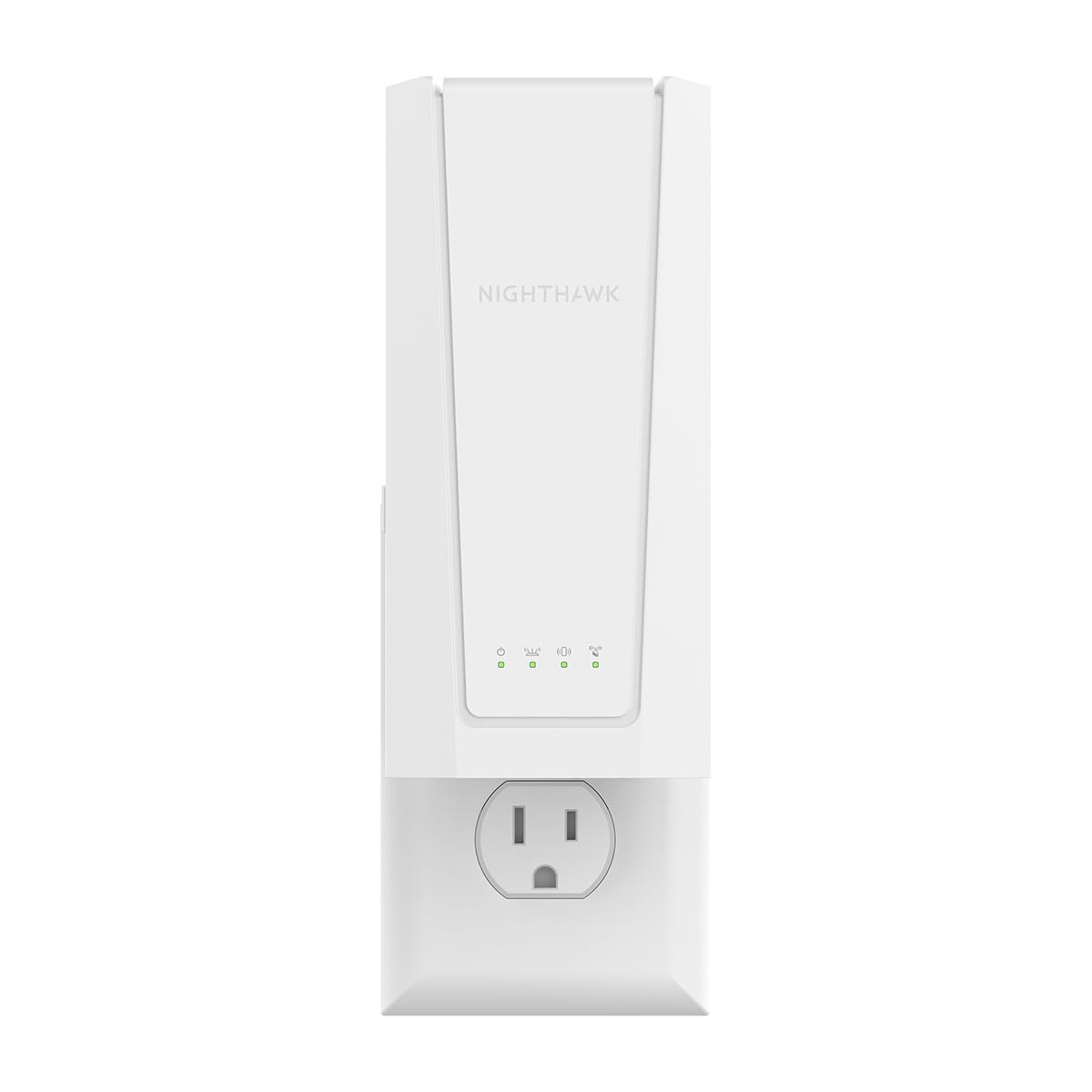
Wi-Fi 7 headroom for a houseful of screens, with a 2.5G port for the console
This is the top-tier NETGEAR in the group: up to 5 Gbps (BE5000) for up to 45 devices across 1,500 sq. ft, with a 2.5 Gigabit Ethernet port. NETGEAR rates it roughly 2.7x faster than its previous-generation extenders. The 45-device capacity dwarfs the EAX17’s 20 and the EAX12’s 15, so a full household of phones, TVs, and consoles shares the load without starving the Xbox.
Plug a smart TV, game console, or desktop straight into the 2.5G port for a full-speed wired link. Smart Roaming keeps your single network name intact as devices move. For console play, that wired path is the surest way to cut the jitter that ruins a match.
Coverage equals the EAX17 at 1,500 sq. ft — the upgrade here is the newer standard, higher throughput, and the faster wired port, not more area. If your rooms are already covered and you want the newest standard with a fast console cable, this is the pick. If area is the problem, match coverage first.
early adopters: gamers already on or moving to Wi-Fi 7 who can wire the console to a 2.5G port.
tight budgets: you are paying for the newer standard — if you just need more square feet, coverage matches the EAX17.
Know the Specs
Data transfer rate and band layout
The megabits_per_second figure is the total throughput the extender can shuttle across its bands. A tri-band unit like the RE815X splits that across two 5 GHz lanes and one 2.4 GHz lane, so devices don’t all fight for one channel. More lanes generally mean steadier latency for a console while other devices stream.
Coverage in square feet and device count
Coverage figures assume open space, so walls and floors cut them down in practice. The device count is the other half — an extender rated for 15 devices shares its bandwidth across fewer gadgets than one rated for 96. For an Xbox plus a small household, 15 can be fine; for a full smart home, aim higher.
The Ethernet port speed
Most extenders here carry a Gigabit (1000 Mbps) port, while the RE403BE carries a 2.5 Gbps port. Cabling the console to that port removes wireless jitter from the final stretch. If your internet plan runs above a gigabit, the faster port is the one that won’t bottleneck the wired link.
Wi-Fi generation and MLO
Wi-Fi 6 units work with the vast majority of routers. Wi-Fi 7 units add MLO (Multi-Link Operation), which combines bands to lower latency and improve reliability — but only when paired with a Wi-Fi 7 router. Buy Wi-Fi 7 for future-proofing, and expect full benefits once the router matches.
Common Questions
Will a Wi-Fi extender lower my Xbox ping?
Do I need Wi-Fi 7 for an Xbox?
Will the extender work with my Xfinity or Spectrum router?
Why does my speed drop after adding an extender?
Can I use two extenders at once?
Does the extender need its own network name?
Where should I place the extender for a console in a far room?
Do these extenders support 6 GHz?
Will an extender work with a TP-Link Deco mesh?
Is a wired connection from the extender worth it?
The Bottom Line
For most console owners, the xbox wi-fi range extender winner is the TP-Link RE815X AX5400 because its 2800 Sq. Ft coverage and 96-device capacity leave room for the console and everything else in a busy home. If you can wire the Xbox and want the fastest port, grab the TP-Link RE403BE with its 2.5 Gbps Ethernet. And for a Wi-Fi 7 gaming setup with a houseful of screens, the NETGEAR Nighthawk EXS27 is the one to reach for. Whichever you pick, put it where it hears the router clearly — that placement decision does more for a stable match than the model number.
How we choose
We do not accept paid placement. Every pick is matched to a real buyer and a real use-case; we do not hands-on test units.
Sources
Specifications: manufacturer listings and product documentation. Review insights: verified customer reviews, as of November 2026. Pricing: not shown on this page (it changes often); check the current price via the retailer link.
As an Amazon Associate, Tactical Gear Guy earns from qualifying purchases. This does not affect which products we feature.