Specs are compiled from manufacturer listings and verified buyer reviews and can change over time — please confirm the key details on the product page before buying.
Rear paddles change how you play because your thumbs never leave the sticks. They let your index and middle fingers fire face buttons without your thumbs ever leaving the sticks — so you can aim and jump in the same moment. The catch is that paddle controllers vary wildly: some pack four paddles with remap profiles, others squeeze two back buttons onto a standard shell. This guide separates the paddle controllers with real rear inputs from the ones that only add a “pro” label.
This guide is built by comparing the manufacturers’ published specifications and the patterns across verified customer reviews, so you get each pick’s real strengths and trade-offs instead of marketing spin.
Below you’ll find the paddle count, trigger type, and stick technology laid out side by side, plus the honest gripes that show up again and again in owner feedback. Every pick here is a genuine Xbox Series X controller with paddles, so you can compare the best Xbox Series X controller with paddles on the specs that actually decide matches.
Top Picks
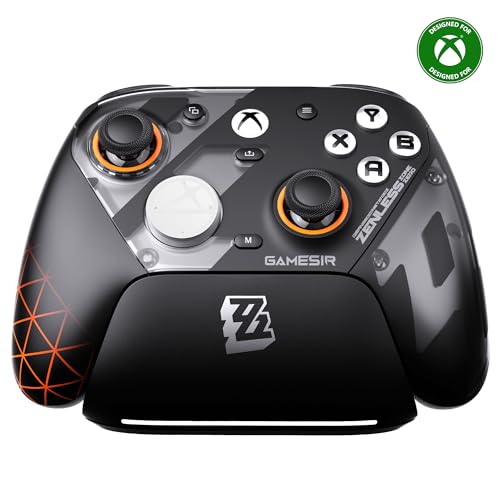
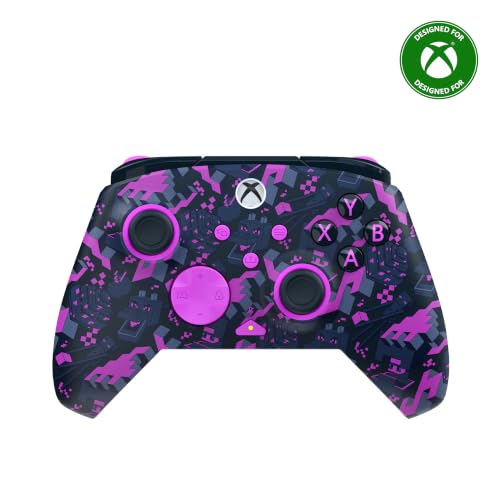

How To Choose The Best Xbox Series X Controller with Paddles
A paddle controller earns its price only if the paddles land under your middle fingers without a reach. Paddles that force a stretch go unused within a week. Start there, then work through the rest of this list.
Paddle count and placement
Two back buttons cover the most common need: jump and crouch without moving your thumbs. Four paddles give you a full extra layer of inputs for competitive shooters, but only if the paddles are shaped so you can tell them apart by feel. Lockable paddles — the kind you can switch off — are handy when a game doesn’t need them and you keep brushing them by accident.
Thumbstick technology: TMR versus Hall Effect
Standard analog sticks wear down and start drifting — the cursor creeps when you are not touching the stick. TMR (tunnel magnetoresistance) and Hall Effect sticks both use magnetic sensing instead of physical contact, so there is nothing to wear out in the same way. TMR is the newer of the two and is pitched as more accurate while drawing less power.
Trigger stops and dual-mode triggers
A trigger stop shortens how far the trigger travels before it registers, which cuts the delay between your decision and the shot. Some controllers let you switch between a short micro-switch trigger for shooters and a full-range analog trigger for racing games. That dual-mode switch is the most useful feature for players who jump between shooters and racing games.
Wired versus wireless, and polling rate
Polling rate is how often the controller reports its position to the device, measured in Hz. A 1000Hz rate means it reports far more often than a standard controller, which tightens input latency. On most of these controllers the high polling rate only works on PC — Xbox consoles run their own tune rate.
Side-by-Side Comparison
| Model | Best For | Rear Inputs | Stick Type | Connection | Amazon |
|---|---|---|---|---|---|
| GameSir G7 Pro★ Best Overall | All-round value | 4 remappable (2 back buttons + 2 mini bumpers) | Mag-Res TMR | 2.4G wireless / wired | Amazon |
| Turtle Beach RematchMinecraft Edition | Minecraft fans | 2 mappable back buttons | TMR | USB transmitter / Bluetooth | Amazon |
| SCUF Valor Pro WiredTournament Wired | Tournament wiring | 4 embedded paddles | Hall Effect | USB-C wired | Amazon |
| ASUS ROG Raikiri II | Battery marathon | 4 programmable rear buttons | Anti-drift TMR | 2.4GHz / Bluetooth / USB-C | Amazon |
| Razer Wolverine V3 Pro | Mouse-click inputs | 4 back buttons + 2 claw bumpers | Hall Effect | 2.4GHz wireless | Amazon |
| SCUF Valor Pro Wireless | Style and remaps | 4 rear paddles | Anti-drift TMR | Wireless / Bluetooth / wired | Amazon |
| Razer Wolverine V4 Pro | High polling rate | 4 mouse-click back buttons + 2 claw bumpers | Capacitive anti-drift | 2.4GHz / Bluetooth / USB-C | Amazon |
| ProControllers Elite 2 Custom | Full accessory kit | 4 paddles | Interchangeable caps | Wireless | Amazon |
Detailed Reviews
1. GameSir G7 Pro Wireless XBOX Controller
Our pick — 4.0+★ from 2,000+ verified ratings; the strongest balance of quality and price.
The paddle controller that spreads its extra inputs across two spots your fingers already rest.
Four remappable buttons on one controller is where the value sits. GameSir splits them into two mini bumpers (R5/L5) and two lockable back buttons (R4/L4), so you get a rear-button layer without losing the shoulder fingers you already use. Owners consistently talk about this one as the best controller they have owned, and the premium build quality sits at the centre of that feedback — it is compared favourably to elite-tier controllers in the review pages.
Two features carry you through long sessions. The 1200mAh built-in battery (a 1200 milliamp-hour battery, which is the power it holds) is a real figure, and the smart auto start-stop charging station means you drop the controller on the dock and it stops drawing power on its own — so you are never guessing whether it is full. Around that sits a three-part magnetic swappable faceplate and two extra D-pads included in the box, so you can change the look and the grip without buying anything extra.
The trigger setup is the standout. You get Hall Effect triggers (magnetic sensors that never wear out from friction) and micro triggers (short-travel switches) in a single controller, with a smooth switch between them — short travel for a shooter, full analog travel for a racing game. The ABXY buttons use optical micro switches and the D-pad uses a mechanical micro switch, so every press lands with a crisp, tactile click. What really wins people over is the ergonomics: the design fits comfortably in hands and is praised for exactly that, with extensive programming through the GameSir Nexus app covering gyro settings (motion controls), stick curve adjustments, and button-to-mouse mapping. The one recurring gripe is that the 1000Hz polling rate (how often the controller reports to the PC, 1000 times a second) only applies on PC — Xbox consoles run their own tune rate, so console-only players pay for a feature they cannot use.
Where the money goes
- Four remappable inputs: two mini bumpers plus two lockable back buttons
- Switchable Hall Effect and micro triggers in one pad
- 1200mAh battery with auto start-stop charging dock
- TMR sticks pitched for near-zero drift
- Optical micro switch ABXY and mechanical micro switch D-pad
Know before you commit
- 1000Hz polling rate works on PC only, not on Xbox consoles
- Two of the four extra inputs are mini bumpers, not true rear paddles
- App-based tuning adds a setup step before you play
Go for this: you want four extra inputs, drift-resistant sticks, and a charging dock without paying elite-tier money.
Think twice: you play console only and want all four extra inputs in true paddle form.
2. Turtle Beach Rematch Wireless RGB Gaming Controller
An officially licensed Minecraft pad that hides real competitive hardware under the blocky paint job.
At 8.48 ounces this is the lightest controller on this list — noticeably lighter than the ASUS ROG Raikiri II at 9.6 ounces, which matters over a long session because your wrists carry less. The build is officially licensed by both Xbox and Mojang, so the Minecraft artwork is genuine rather than a sticker job, and the customizable RGB lighting lets you set the glow to match your setup.
Two mappable quick-action back buttons handle the paddle job. They are not four, so this is not the pick for a player who wants a full extra input layer, but two covers jump-plus-crouch comfortably. Under the shell you get ultra-sensitive TMR thumbsticks (tunnel magnetoresistance sensors that resist drift) and Hall-Effect hair triggers (magnetic triggers with a short pull) with 3-way trigger stops — the stops are the useful part, letting you shorten trigger travel for faster response when you need it and leave it long when you want control.
Connection options are broader than most. You get wireless play on Xbox and Windows 10/11 PCs via the USB transmitter, plus Bluetooth (BLE) for compatible Android mobile and streaming devices. There is a built-in rechargeable battery with a 10ft USB-C play-and-charge cable, so you can keep playing while it tops up, and a 3.5mm audio jack with patented on-board audio controls. Dual rumble motors and impulse triggers round out the feel. The trade-off worth naming: two back buttons is a smaller extra-input layer than the four-paddle competition in the same price zone.
Why the lighter shell matters: comparing it directly, the 8.48-ounce body sits against the ASUS ROG Raikiri II at 9.6 ounces, and over a four-hour session the difference in wrist fatigue is real.
The honest gap: two back buttons versus four paddles elsewhere on this list, so competitive shooters wanting a full extra layer should look harder.
Made for: Minecraft players who also want 3-way trigger stops and a light shell.
Look past it: you need four rear paddles for a shooter loadout.
3. SCUF VALOR PRO Wired Performance Xbox Controller
Four paddles built into the shell, wired for zero dropouts, and it shows in the button count.
Paddle count is where SCUF justifies itself. This controller carries 24 buttons — against 10 on the ASUS ROG Raikiri II, a difference that tells you how far the input layer goes. The four embedded rear paddles can be configured up to 16 functions, so a single paddle can hold a whole sequence instead of one button. That 16-function paddle remapping is the feature competitive players pay for.
The feel is what carries the rest. Quality is the thing owners praise most, with a large body of feedback pointing to it as the standout strength, and the ergonomics follow close behind — 13 years of expertise behind the performance grip, plus wraparound bumpers with more surface area for faster movements. Instant Triggers eliminate trigger pull entirely, shaving the milliseconds between decision and shot.
Practical details round it out: a USB-C wired connection so there is no wireless dropout to think about, audio controls to change volume on the fly, and up to three remapping configurations saved behind a flick of a switch. Hall Effect thumbsticks (magnetic sensors that resist wear) keep drift away. Honest note on the smaller print — connectivity draws mixed feedback from owners, with some reporting disconnects, and reliability and stick drift each get mixed marks rather than uniform praise. Wired play is the setup that sidesteps the first concern.
The spec that decides it: 24 buttons versus the ASUS ROG Raikiri II’s 10 — that is the clearest picture of how much extra input the SCUF shell offers.
Trade-off to weigh: mixed reports on connectivity and reliability mean this is a pick for players who like wired certainty rather than wireless freedom.
Pick this if: you want four true embedded paddles and instant triggers with a cable, no dongle.
Pass if: you need wireless flexibility or you swap controllers between rooms.
4. ASUS ROG Raikiri II Xbox Wireless Gaming Controller
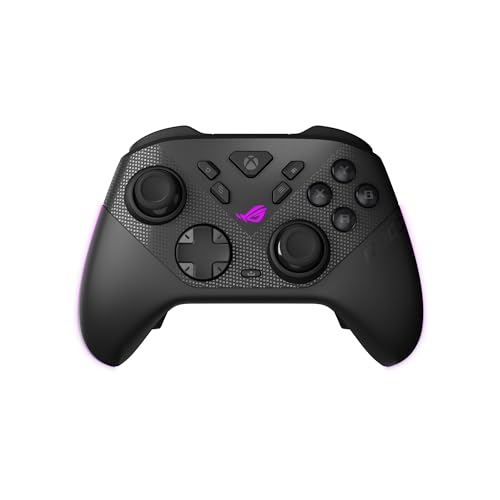
A marathon battery, three ways to connect, and a case that charges it while it sits inside.
At least 30 hours of 2.4GHz wireless play on a single charge is the headline — and that figure comes with the RGB lighting, audio, and vibration switched off, which is worth knowing before you plan a weekend around it. Three connection modes give you real flexibility: low-latency 2.4GHz RF (a dedicated wireless link), Bluetooth, or wired USB-C, with certified support for Xbox over USB-C and 2.4GHz RF. The 2.4GHz leg is boosted by ROG SpeedNova wireless technology.
For PC players, the 1000Hz polling rate applies in both wired and 2.4GHz wireless modes, so you are not forced into a cable to get the low-latency benefit. Four fully programmable rear buttons sit in an ergonomic layout, and dual-mode triggers switch between micro-switch triggers with short travel and TMR sensor triggers with full travel. The anti-drift TMR joysticks are pitched as more accurate than Hall Effect while consuming less power, which ties back to that battery figure.
The accessories bundle is unusually complete: a portable protective case that supports charging the controller while it is inside, a charging stand, and two detachable joystick caps. Small touches land too — micro-switch buttons across the D-pad, ABXY, rear buttons, and bumpers, plus a skin-friendly anti-slip grip for stability. The catch is in owner feedback: quality and stick movement draw real praise, but build quality splits opinion between well-built and flimsy, and connectivity complaints come up. At 9.6 ounces it is also the heavier side of this list, sitting above the 8.48-ounce Turtle Beach Rematch.
What earns its place
- At least 30 hours of 2.4GHz wireless play per charge
- 1000Hz polling in both wired and 2.4GHz wireless on PC
- Case charges the controller while it is inside
- Dual-mode triggers: micro-switch short travel or full TMR travel
The realistic caveats
- 30-hour figure assumes RGB, audio, and vibration are off
- Build quality splits owner opinion rather than drawing uniform praise
- Heavier at 9.6 ounces than the Turtle Beach Rematch at 8.48 ounces
Suits you if: battery anxiety is your problem and you want one pad across PC, Xbox, and Bluetooth.
Skip the assumption: that the 30 hours applies with every feature turned on — it does not.
5. Razer Wolverine V3 Pro Wireless Gaming Controller
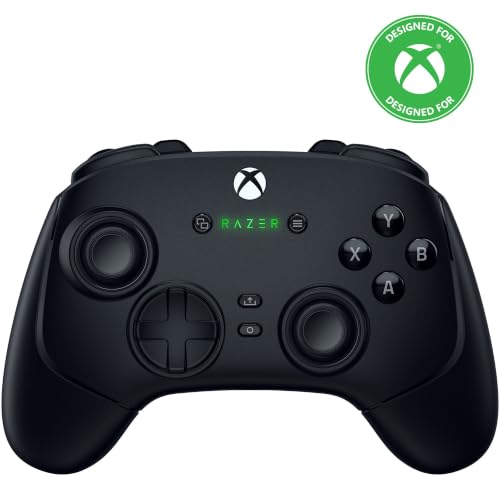
Four mouse-click back buttons in the handles, plus two claw bumpers on top — six inputs total.
The pitch here is actuation feel. Four back buttons are built into the ergonomic, rubberized handles using the same click mechanism found in Razer’s top gaming mice, then topped with two claw grip bumpers. That makes six remappable inputs on a shell with 22 buttons. Pro HyperTriggers let you set instant actuation with zero travel time or drop back to ultra-precise analog control, and integrated haptic vibrations come through the trigger pull itself.
Hall Effect precision thumbsticks sit at the centre of the control story — pitched as more accurate than traditional sticks and smoother, lighter, and more durable thanks to anti-friction rings and pro-grade materials. Also inside: Razer Mecha-Tactile action buttons that combine the speed of microswitches with the cushioned feel of a rubber membrane, and an 8-way floating D-pad. HyperSpeed Wireless runs the 2.4GHz connection through a USB Type A dongle, and a PC Tournament Mode open up 1000Hz polling over a wired connection.
It ships with a custom carrying case that holds the controller and accessories, including two replaceable thumbstick caps and a 10 ft cable. Weigh it honestly, though: at 14.72 ounces this is the heaviest controller on the list, and buyers report mixed connectivity experiences with the pad randomly disconnecting from Xbox. Durability of the D-pad comes up as a concern too. What wins people over is the quality and tactile feel — the Hall Effect sticks and mouse-click buttons are the parts buyers single out.
Six inputs, one trade-off: the extra claw bumpers give you more reach than a standard four-paddle layout, but 14.72 ounces is a lot of controller to hold through a long session.
Straight talk on reliability: disconnects on Xbox and D-pad durability keep this from being a blind recommendation.
The right call for: players who want mouse-click back buttons and trigger haptics and do not mind the weight.
Reconsider if: you play long handheld sessions or you need rock-solid wireless on Xbox.
6. SCUF VALOR PRO Wireless Performance Controller

The wireless version of the Valor shell, with four paddles and a smoke finish that hides fingerprints.
Four rear paddles are the core here, and instant triggers eliminate trigger pull to shave the milliseconds between thought and action. If you play on PC, a 1k Hz polling rate open up over the wired connection. The anti-drift TMR sticks carry the same drift-resistant pitch as the rest of this list, and the 24-button count matches the wired Valor — so the extra inputs are not trimmed for the wireless version.
Connectivity is the flexible part: switch between low-latency wireless, Bluetooth, or ultra-fast wired. The company says the connection stays stable across all three, which is the claim worth testing in your own room rather than trusting outright. Three remapping configurations save behind a flip of a switch, and the audio control system changes volume levels on the fly without a menu. Swappable faceplates and thumbsticks let you change the look, and the performance grip plus wraparound bumpers handle the feel side.
Owners love the ergonomics — the shell is described as smooth and responsive in hand — and the pad draws the kind of praise reserved for a favourite controller. The problem is connection consistency: random disconnections and trouble pairing to iOS devices come up often enough to be a pattern rather than a fluke. If you plan to lean on Bluetooth to an iPad, test that pairing early. For Xbox and PC play, the wired and 2.4GHz legs are the safer bet.
The honest read: ergonomics and paddle feel are the strengths, and the four-paddle layout is fully intact in wireless form.
The one thing to check on day one: pairing behaviour on your own Xbox, PC, and any iOS device you want to use.
Best matched to: players who loved the Valor shape and want it untethered with a smoke finish.
Think again if: iOS pairing is part of your plan, or you have no patience for connection troubleshooting.
7. Razer Wolverine V4 Pro Wireless Controller

Eight thousand reports per second on PC — the polling-rate ceiling of this entire list.
Up to 8000 Hz HyperPolling on PC is the number that separates this from everything else here. Every other controller on this list tops out at 1000Hz where it offers a high polling rate at all. Eight thousand is a different order of input reporting, and it pairs with Razer HyperSpeed Wireless for the 2.4GHz connection. If you play competitive multiplayer on PC and notice input lag, 8000 Hz polling is the spec you are paying for.
The control hardware backs it up. Capacitive anti-drift thumbsticks (contactless sensors that resist wear) use contactless sensors for reliable accuracy and smoother tracking, which is the right approach for consistent aiming in FPS and sports titles. Four removable mouse-click back buttons plus two claw grip bumpers give you six configurable inputs, and Razer Pro HyperTriggers switch between instant mouse-click trigger activation and full-range analog control — so the same pad works for a shooter and a racing sim.
Fit and feel are adjustable: interchangeable thumbstick caps, a magnetic faceplate, four onboard profiles, and customization through Razer Synapse 4 and the Razer Controller app. The dimensions land at 6.17 inches wide by 4.14 inches high, close to the SCUF Valor Pro’s 6.02 by 4.21 inches, so the footprint is familiar rather than oversized. Weighing 14.72 ounces puts it at the heavy end alongside the Wolverine V3 Pro. Think of it as a PC-first competitive pad that also plays on Xbox Series X|S.
The number that decides it: 8000 Hz versus the 1000Hz ceiling elsewhere on this list — if you are not playing on PC, you cannot use the difference.
Who this is not for: couch players who want a light pad, given the 14.72-ounce body.
Worth it for: PC competitive players chasing the lowest possible input latency with six mappable buttons.
Not worth it for: console-only players, who never see the 8000 Hz benefit.
8. Elite 2 Custom Controller

A clear-shell Elite Series 2 build that arrives with a full box of spare sticks, paddles, and D-pads.
What you unpack is the reason this one stands apart. Alongside the controller you get a durable carrying case, six thumbsticks (2 standard, 2 classic, 1 tall, 1 wide dome), four paddles, two D-pads (standard and faceted), a thumbstick adjustment tool, a charging dock, and a USB-C cable. That is a complete tuning kit rather than a controller with one spare cap thrown in.
The base is a genuine Elite Series 2 — ProControllers states it uses only brand-new Elite Series 2 bases for its custom designs, then adds an exclusive front shell before a testing phase and careful packaging. The clear finish is the visual hook, and appearance draws real praise in owner feedback alongside build quality. Quality is the aspect buyers single out most, with the clear shell’s looks close behind.
Set expectations realistically on the rest. Value for money divides opinion — some consider it worth the outlay, others find it very expensive for what is, underneath, a standard Elite Series 2 with a new shell. Reliability has drawn negative feedback too, including a report of the left thumbstick not registering. This is a premium-priced pick for someone who wants the clear look and the full accessory spread in one box, not the cheapest route to four paddles.
What you are paying for: the complete kit — six sticks, four paddles, two D-pads, a case, and a charging dock in one purchase.
Fair warning on value: value and reliability both draw mixed-to-negative marks, so buy this for the look and the kit, not the bargain.
Reach for this if: you want an Elite Series 2 base with a clear shell and every spare part included up front.
Look elsewhere if: you want the lowest-cost path to four paddles or you need certainty on long-term reliability.
Know the Specs
TMR and Hall Effect Thumbsticks
Both replace the physical contact in a standard analog stick with magnetic sensing, so there is nothing to wear down the way a traditional potentiometer does. TMR (tunnel magnetoresistance) is the newer technology and is pitched as more accurate while drawing less power — which matters on a wireless controller because it stretches battery life. Hall Effect is the more established of the two. Either way, the practical benefit is the same: you avoid the slow creep of stick drift that pushes your aim off target.
Polling Rate in Hz
Polling rate is how many times per second the controller reports its position to the console or PC. A 1000Hz rate means 1000 reports per second; 8000 Hz means 8000. More reports means the device sees your input sooner, which tightens latency. On nearly every controller here the high figure applies on PC only — Xbox consoles run their own tune rate. Check this before paying extra for a headline polling number.
Trigger Stops and Dual-Mode Triggers
A trigger stop shortens how far the trigger has to travel before the input registers, which speeds up the response. Dual-mode triggers take that further by letting you switch between a short micro-switch trigger for shooters and a full-range analog trigger for racing and sports games. If you rotate between shooters and racing games, this switch replaces a second controller.
Paddle Versus Back Button
Paddles sit on the back of the shell where your middle fingers rest. Back buttons can be placed similarly, but some controllers use mini bumpers near the shoulders instead. Both let you fire an action without lifting your thumb from the stick. Count matters: two covers jump and crouch, four lets you build a fuller loadout — but only if the placement is comfortable enough that you actually use them.
Common Questions
Do paddle controllers work on Xbox Series X without any setup?
How many rear paddles do I actually need?
Is TMR better than Hall Effect for stick drift?
Will the 1000Hz or 8000Hz polling rate work on my Xbox console?
Can I use a paddle controller on PC as well as Xbox?
Do the paddles get in the way if I do not use them?
How long does the battery last on a wireless paddle controller?
Are the Razer back buttons real paddles or something else?
Should I buy the wired or wireless version of the same paddle controller?
What comes in the box with a premium custom controller?
The Bottom Line
For most people buying a xbox series x controller with paddles, the GameSir G7 Pro is the one that makes the most sense — four remappable inputs, switchable Hall Effect and micro triggers, TMR sticks, and a charging dock that handles itself, all as an officially licensed Xbox pad. If battery life is your deciding spec, the ASUS ROG Raikiri II’s at least 30 hours and tri-mode connection is the better fit. And if you play competitively on a PC and want the lowest input latency available here, the Razer Wolverine V4 Pro’s up to 8000 Hz HyperPolling (reports to your PC up to 8000 times a second) is the reason to stretch.
How we choose
We do not accept paid placement. Every pick is matched to a real buyer and a real use-case; we do not hands-on test units.
Sources
Specifications: manufacturer listings and product documentation. Review insights: verified customer reviews, as of November 2026. Pricing: not shown on this page (it changes often); check the current price via the retailer link.
As an Amazon Associate, Tactical Gear Guy earns from qualifying purchases. This does not affect which products we feature.