Specs are compiled from manufacturer listings and verified buyer reviews and can change over time — please confirm the key details on the product page before buying.
For most people, the HyperX CloudX is the safest wired headset for an Xbox controller. If you want to spend as little as possible and still get a mic that carries your voice, grab the Turtle Beach Recon 50. Every other pick here is a variation on those two ideas — one ear instead of two, a boom mic you can flip up, or drivers tuned specifically for footsteps. The rest of this page explains which of those variations actually matters for your setup.
This guide is built by comparing the manufacturers’ published specifications and the patterns across verified customer reviews, so you get each pick’s real strengths and trade-offs instead of marketing spin.
Wired is the whole point here: no charging, no pairing, no dropouts mid-match. Below you will find the practical differences between nine corded options, including driver size, cable length, and mic design, so you can match one to your own Xbox One controller.
Every pick on this list plugs straight into a controller jack and works as an xbox one wired headset without any adapter, dongle, or software setup required.
Top Picks


How To Choose The Best Xbox One Wired Headset
Buying a corded headset for an Xbox controller is simpler than it looks, because most of the decision is made for you the moment you check the port. Newer Xbox One and Xbox Series X|S controllers have a round 3.5mm hole in the bottom edge — that is the jack these headsets use. Older Xbox One controllers without that hole need a separate adapter and will not work with most of the picks here.
Check the controller jack before anything else
A headset with a 3.5mm plug is a one-plug job: it carries both your game audio and your microphone signal through a single cable. That means no USB dongle, no battery, and no pairing screen. If your controller has the round jack, any headset on this page plugs in and works within seconds. If it does not, look at an adapter first — the headset choice comes second.
Decide between one ear and two
A one-ear chat headset leaves your other ear open to the room, which is why people use them for party chat, online classes, and call-center style work. A full over-ear pair seals both ears and gives you the directional audio that footsteps and reload sounds rely on. If you play shooters seriously, go over-ear. If you mainly talk to friends while half-watching a stream, one ear is genuinely more comfortable.
Match the driver size to what you play
Driver size is the width of the speaker inside each cup, measured across in millimeters. A 40mm driver is the common mid-size and gives a balanced sound that handles voices well. A 50mm driver moves more air and generally pushes more bass and more room-filling sound, which helps in big, loud games. Neither size is inherently better — a well-tuned 40mm can beat a sloppy 50mm — but the number tells you roughly how much low-end punch to expect.
Look hard at the microphone, not the cups
Your teammates hear the mic, not the drivers, so the microphone design matters as much as the audio. Three designs show up here: a detachable boom mic that comes off entirely for music listening, a flip-to-mute boom that mutes when you swing it up, and a short fixed mic. A flip-to-mute mic is the easiest to live with mid-match, because you never have to find a button while something is chasing you.
Side-by-Side Comparison
| Model | Best For | Driver Size | Cable Length | Mic Design | Amazon |
|---|---|---|---|---|---|
| HyperX CloudX★ Best Overall | All-round Xbox pick | 5.3 cm (53mm) | 3 feet | Detachable noise-cancelling boom | Amazon |
| Turtle Beach Recon 50Budget Powerhouse | Budget multiplatform play | 40mm | — | Adjustable high-sensitivity boom | Amazon |
| HyperX CloudX Stinger 2 CoreLicensed Comfort | Official Xbox license on a budget | 40mm | — | Swivel-to-mute noise-cancelling | Amazon |
| Logitech G432 | Surround sound on PC and Xbox | 50mm | — | 6mm flip-to-mute boom | Amazon |
| EKSA Fenrir S | Glasses-friendly long sessions | 50mm | — | 120-degree rotatable noise-cancelling | Amazon |
| SteelSeries Arctis 1 | Travel and multi-platform use | — | 3 meters | Detachable ClearCast noise-cancelling | Amazon |
| Razer BlackShark V2 X (Xbox) | Light weight, long tournaments | 50mm | — | Cardioid boom | Amazon |
| RIG R5 Spear PRO HX | Competitive FPS audio | 40mm graphene | 1.5 meter | 6mm flip-to-mute | Amazon |
| arVin One Ear Headset | Party chat on a single ear | 50mm | 5.9 feet | Fixed rotating boom (120°) | Amazon |
Detailed Reviews
1. HyperX CloudX, Official Xbox Licensed Gaming Headset
Our pick — 4.5+★ from 7,000+ verified ratings; the strongest balance of quality and price.
The safest corded bet for an Xbox pad — licensed, comfortable, and built to survive marathon nights.
Start with the licence, because it is the reason this one sits at the top. Microsoft tested the CloudX and confirmed it works with Xbox controllers that have a 3.5mm headset jack — the round hole in the bottom edge of the pad. That means you plug the cable in and you are done, with no adapter in between.
The comfort story is the aluminium frame paired with memory foam ear cushions. Aluminium flexes rather than snaps at the hinge, which is the part that usually fails on a headset you pull on and off twenty times a session. The memory foam seals around your ears so the bass hits properly, and the closed cups mean your game audio does not leak into the room at night.
Audio comes from a 5.3cm dynamic driver — the speaker inside each cup, roughly two inches across. Big cups like this push the enhanced bass HyperX advertises, so explosions and engine noise land with weight. The mid and high detail stays clear enough that voices and gunfire do not blur together in a firefight.
Two design choices earn their keep. The noise-cancelling boom mic detaches completely, so the CloudX doubles as a plain pair of headphones for music or a podcast. The braided cable resists the daily tug-of-war that kills thinner cords. In-line audio controls sit on that cable for volume and mic mute, so you thumb a slider instead of opening the console guide.
Where it earns the crown
- Official Xbox licence means plug-and-play on 3.5mm controllers
- Aluminium frame holds up to constant on-and-off handling
- Detachable noise-cancelling mic turns it into a normal headphone
- Braided cable and in-line volume/mute both built for daily abuse
Where you should pause
- The 3-foot cable is short — fine at a desk or couch, tight across a big room
- Some owners hear an echo of their own voice through the mic
- Needs a controller with the built-in 3.5mm jack
Buy this when: you want one corded headset that handles competitive audio and casual music without fuss.
Measure your setup first: at 3 feet the cable is the shortest on this page, so a couch-to-console distance is where it works best.
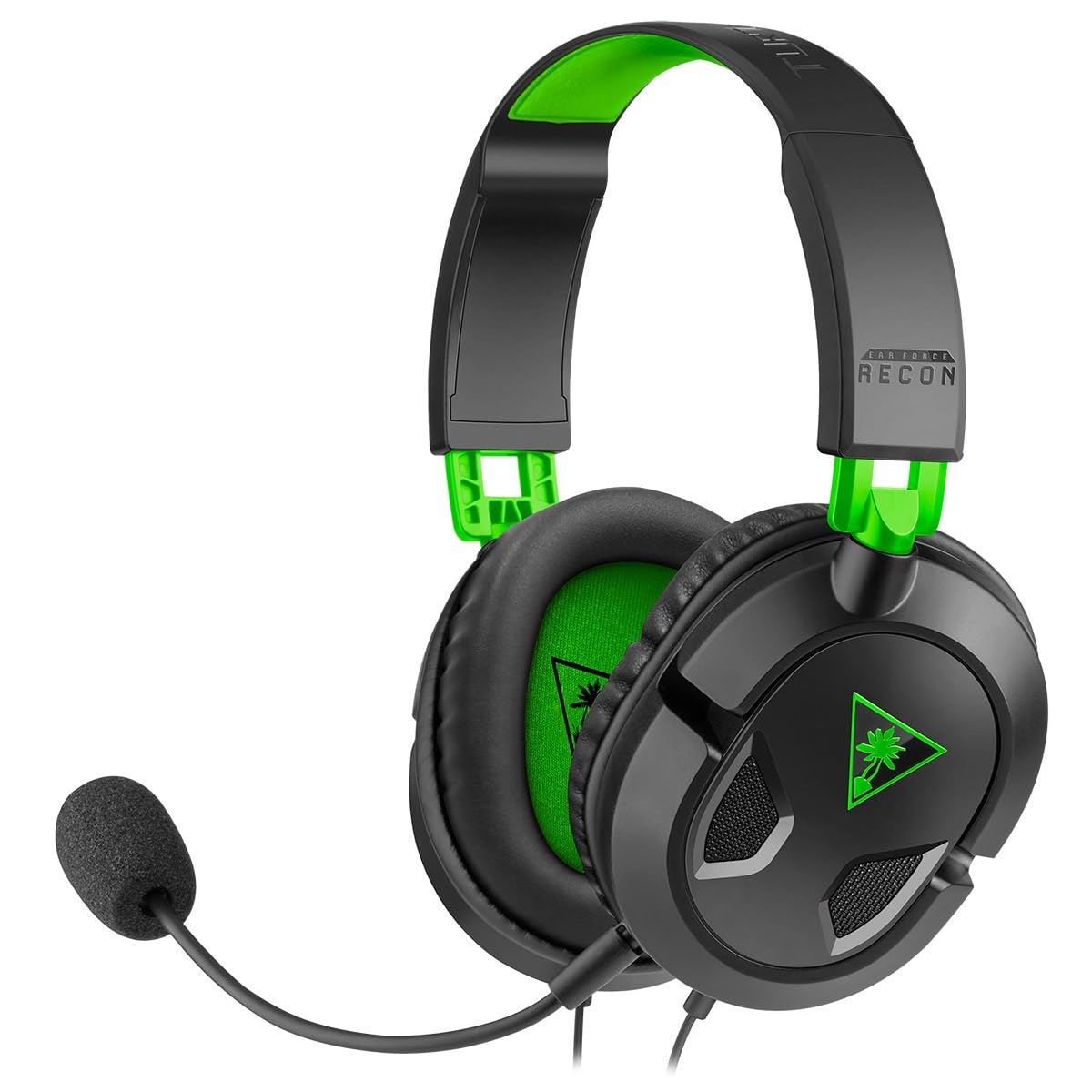
2. Turtle Beach Recon 50 Wired Multiplatform Gaming Headset
The most heavily reviewed headset here, and the cheapest way to get clear 40mm game audio.
If the budget end of this list has a proven name, it is this one. The Recon 50 is the most heavily reviewed headset here by a wide margin, and the consensus is upbeat on the thing that matters most in a firefight: sound quality. Owners describe clear, punchy game audio from the 40mm speakers — the mid-size driver that keeps voices crisp instead of drowning them in bass.
What it gives up is build polish. Amazon’s own read of the reviews splits on quality, and the pattern is honest: the plastic feels lighter and cheaper in the hand than a HyperX or a SteelSeries, and it can flex more than you would like. That is the trade-off at the entry tier — you are paying for audio, not armour. Treat it kindly and it holds up; yank it off by the earcup and you shorten its life.
The practical wins are the adjustable high-sensitivity mic, which picks your voice up without you leaning in, and the in-line controls for volume and mute. It also reaches beyond Xbox — PS5, PS4, PC, Mac, and mobile/tablet devices all work through the same 3.5mm plug, which makes it a smart second headset to keep in a bag.
The value read: a 40mm driver and a high-sensitivity mic at the lowest price on this page — buy it for the audio and accept the lighter plastic.
The honest catch: build quality is the most-discussed topic in the reviews and it lands mixed, so this is a fit for careful owners rather than headset-tossers.
Reach for this if: your budget is tight and you play across Xbox, PC, and PlayStation with the same pair.
Look elsewhere if: you want a metal frame that shrugs off daily abuse — that is the CloudX above.
3. HyperX CloudX Stinger 2 Core Wired Gaming Headset for Xbox
Mute by flipping the mic up — no button hunt while something is chasing you.
The Stinger 2 Core shares the Microsoft licence with the CloudX above, so it connects straight to an Xbox One or Series X|S controller through the 3.5mm port. It is the lighter, simpler sibling: soft ear cushions, a flexible mic, and the same plug-and-play promise without the aluminium frame.
The mic is the reason to pick this one over its bigger brother. It is a swivel-to-mute design, which means you swing the boom up and the mic goes silent — a physical mute you can feel without looking. That is a small thing that saves you in a firefight when a teammate needs quiet and your hands are busy.
Audio runs through 40mm directional drivers tuned for console play, so the bass carries explosions and footsteps both. Onboard volume controls sit on the headset itself, so you never dive into system menus to nudge the level. The catch worth naming: some buyers report the audio and longevity disappoint, and the durability side of the reviews reads mixed. It is a headset to treat with care rather than throw in a bag.
Why it fits: official licensing, a swivel mute you can operate blind, and onboard volume — three things that remove friction from a party-chat session.
Keep in mind: this is a lighter build than the CloudX, so durability is the honest trade-off at this tier.
Go here if: you want to mute instantly by muscle memory and stay inside the Xbox ecosystem.
Pay more for: the CloudX if you want an aluminium frame and a detachable mic instead.
4. Logitech G432 Wired Gaming Headset
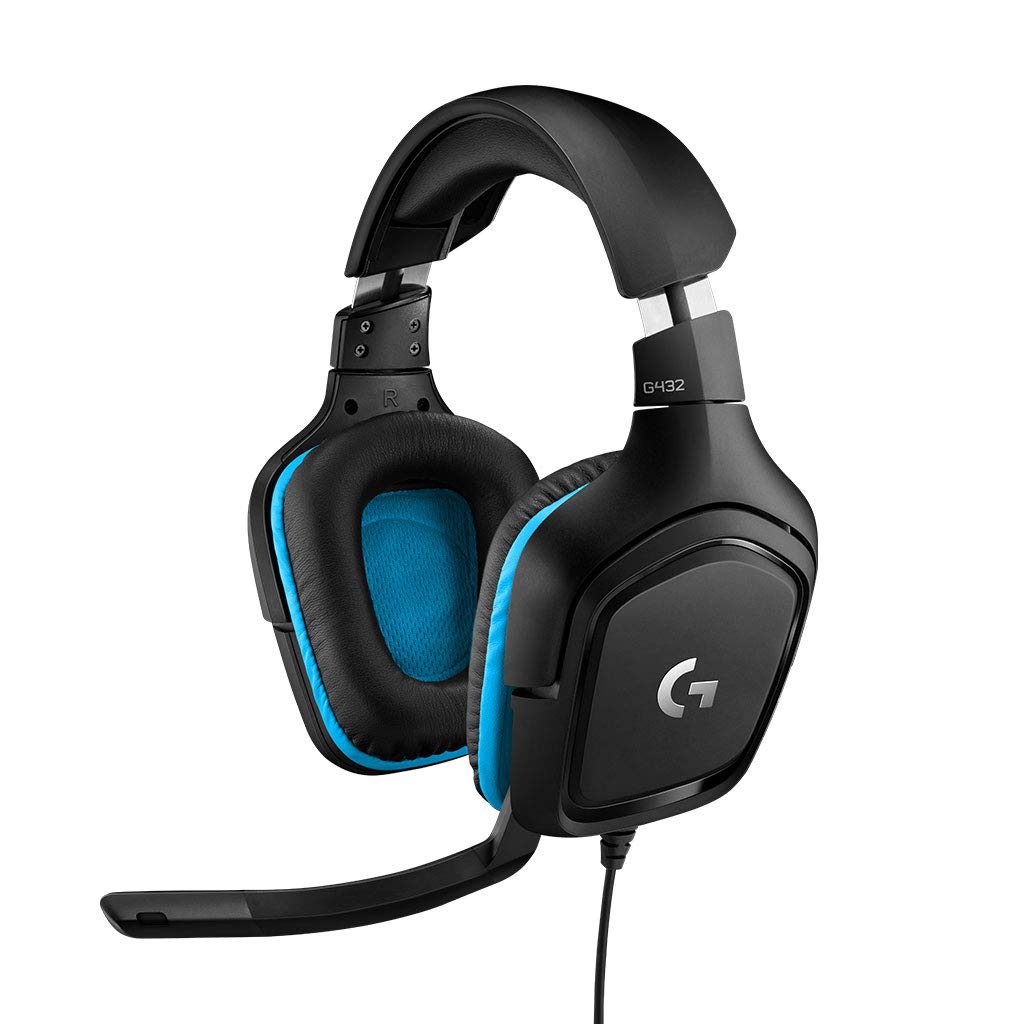
Big 50mm drivers plus DTS surround — the pick for pinpointing where a shot came from.
Where the HyperX pair leans on comfort, the G432 leans on positional audio. Its 50mm drivers are large, and they pair with DTS Headphone:X 2.0, a surround format that places enemies behind you and above you rather than just left and right. The catch is that this surround mode needs Logitech’s G HUB software, so the full effect lives on PC. On an Xbox controller you get the solid stereo the drivers put out, not the surround layer.
The microphone is a 6mm boom that mutes when you flip it up — a bigger element than most, and one built to keep your voice loud over gunfire. Ear cups rotate up to 90 degrees, so the headset lies flat in a bag or on a shelf. The leatherette pads and headband are light enough for long sessions and shaped to keep pressure off your ears.
Comfort is the honest split point. Reviews run the full range here, from delighted to genuinely uncomfortable, which usually depends on head shape and the leatherette pads trapping heat. If you run hot around the ears, a mesh-covered set suits you better. Also worth knowing: some owners mention the headset giving out after a few months, so the longevity story is mixed.
What the G432 does well
- 50mm drivers give you big, bass-forward game audio
- DTS Headphone:X 2.0 surround places enemies directionally on PC
- 6mm flip-to-mute boom mic keeps you audible over gunfire
- Ear cups swivel 90 degrees to lie flat for storage
Where it gets fiddly
- Surround audio needs Logitech G HUB software — PC-only benefit
- Leatherette pads run warm and feel uncomfortable to some owners
- Durability reports are mixed over the long haul
The right buyer: a PC-first player who also wants something that works on an Xbox pad, and who values positional audio above all.
The honest limit: if you want the surround layer on console, you are buying the stereo version of this headset instead.
5. EKSA Fenrir S Gaming Headset

Deep, soft ear cushions built with glasses in mind — because pressure on your frames ruins long sessions.
If you wear glasses and a headset normally leaves you with sore temples after an hour, this is the pick to look at first. The Fenrir S pads are oversized and deliberately deep, and EKSA calls them glasses-friendly — the cushion gives around the arm of your frames rather than pinning it against your skull.
You get punchy bass and clear positional detail from a 50mm driver — the largest size on this page alongside the Logitech G432. The microphone rotates through 120 degrees so you can park it right where your mouth is. Its unidirectional pickup (a mic that listens mainly in one direction) is aimed at cutting background noise so teammates hear you, not your room.
Two things stand out for the money. EKSA backs the headset with a 24-month warranty and round-the-clock support, which is unusually long at this tier. The specific catch in the reviews is noise: some customers note a strong echo, particularly with the mic cranked up, and sound quality is the split point overall. Dial the mic gain down rather than up and you avoid most of it.
Comfort-first call: oversized, deep cushions plus a 120-degree mic that reaches your mouth no matter your head shape — this one is built around people who wear frames.
Second thought: the werewolf styling and green shell is a love-it-or-not look, so this is the loudest design on the list.
Best served: long-session players with glasses who want cushion depth over everything else.
Turn down the mic: if you hear complaints about echo, that is the adjustment to make first.
6. SteelSeries Arctis 1 Wired Gaming Headset

Detachable mic, fold-flat cups, and a 3-meter cable that reaches across a whole room.
Space and flexibility are the Arctis 1’s two selling points. Its cable runs 3 meters, which is long enough to stretch from a console across a room to the couch. Fold-flat earcups and a detachable ClearCast microphone mean it packs down into a bag for a trip or a friend’s place without the boom snagging on everything. If you want to plug it into a PC, a PS4, or a Switch, the universal 3.5mm connector handles all of them.
The desktop look is deliberate — the low-profile shell passes as a normal pair of headphones with the mic pulled off, not a glowing gaming rig on your head. An adjustable steel-reinforced headband holds the fit and resists the loosening that plastic frames suffer over time. The ClearCast mic carries natural-sounding clarity, and SteelSeries notes it is Discord certified.
The reviews are split on how long it lasts. Sound quality draws warm words, and plenty of owners call it clear and worth the money. But reliability is the honest caveat here too — some report it quitting after a few months, so this is not the headset to throw in a bottom-of-the-bag pile. Treated as a lightweight travel set rather than a battle tank, it earns its place.
Standout spec: that 3-meter cable is the longest here by a wide margin, and it is the difference between a desk-only headset and one you can use from the sofa.
The trade-off: a fold-flat, low-weight frame trades some ruggedness for portability, so it suits careful travel rather than rough handling.
Choose this for: multi-platform use and travel, where the long cable and fold-flat shell do the heavy lifting.
Think twice: if you want one headset that survives being tossed around — the aluminium-framed CloudX handles that better.
7. Razer BlackShark V2 X (Xbox) Wired Headset

At 250 grams you forget it is on — built for the fifth hour of a tournament night.
Weight is the number that decides whether you keep a headset on through a long session, and this Razer comes in at 250 grams. Compare that to a metal-framed design and the difference is real by hour three: no hot spot on the crown, no ache behind the ears. Thick headband padding and synthetic-leather memory foam cups add to that, sealing your ears and cutting outside noise with passive isolation rather than software.
The 50mm TriForce drivers are the audio centrepiece — Razer splits each driver into three zones to tune highs, mids, and lows separately, which pushes clearer treble and stronger bass at once. A cardioid microphone (a pickup pattern that favours your voice and rejects sound from behind and beside you) handles chat, and its flexible boom bends into position in front of your mouth.
It plugs into the Xbox Series X|S through the 3.5mm jack and reaches other platforms through the same connector. Closed cups and passive isolation make it a quiet-room companion as much as a party-chat set. The one thing to understand before buying: this is a newer Xbox-specific release, so there is not much owner history to lean on — the case for it rests on the spec sheet, the 250g shell, and Razer’s driver design rather than a long review trail.
The case for it
- 250g weight is the lightest build in this line-up
- TriForce 50mm driver splits tuning across highs, mids, and lows
- Cardioid mic rejects noise from behind and beside you
- Closed cups give passive noise isolation with no software
Worth knowing
- A newer Xbox release with limited owner feedback so far
- Synthetic-leather cups can warm up over long sessions
- Positional surround depends on the platform’s own support
Made for: players who game for hours and feel every gram by the end of the night.
Pay attention to: the closed leather cups — great for isolation, warmer than mesh if you run hot.
8. RIG R5 Spear PRO HX Wired Gaming Headset

Graphene-coated drivers tuned for footsteps, plus a year of Dolby Atmos in the box.
This is the pick for someone who plays shooters to win. The R5 Spear PRO HX is officially licensed for Xbox Series X, Series S, Xbox One, and Windows PC. Its 40mm graphene-coated drivers are the technical hook — a graphene layer stiffens the driver so it distorts less. RIG puts that distortion at under 0.5 percent harmonic distortion, which in practice means footsteps and reloads stay distinct rather than smearing together when a fight gets loud.
The tuning backs that up. The frequency response stretches from 20 Hz to 40kHz, a wide range that gives it headroom to render quiet details, and the sound signature is lifted in the upper mid-range specifically to push game-critical cues forward. A 6mm flip-to-mute microphone covers chat, and the included one-year Dolby Atmos for Headphones code adds spatial height — though Atmos needs a compatible Xbox or Windows device, the free Dolby Access app, and a Microsoft account.
What owners respond to is the sound, which the reviews rate as excellent, and the sense that it outperforms pricier rivals. The catch is the cable: the in-box audio lead is 1.5 meters, shorter than the 3-meter Arctis 1 above and the room-crossing runs some players want. It also carries the smallest review base of the full-size picks here, so this is an early-adopter choice on a strong spec sheet.
The detail that sells it: graphene-coated 40mm drivers with under 0.5% harmonic distortion and a 20 Hz–40kHz range — an audio-first build aimed squarely at hearing a footstep before it kills you.
Also in the box: a one-year Dolby Atmos for Headphones code, so the spatial audio is included rather than an upsell.
Suits you if: competitive shooters are the main course and you want every audio cue pulled forward.
Check the reach: 1.5 meters of in-box cable is short for a long couch-to-console run.
9. arVin One Ear Headset with Mic for Xbox One

One ear on the chat, one ear in the room — the long-cable chat headset for party play.
Some players do not want both ears sealed. If you are on party chat while someone else is in the room, or you jump between talking and listening to everything around you, a one-ear chat set is the more comfortable tool. This arVin headset puts a single 50mm driver over your left ear and leaves the right side open — the design makes it easy to hold a conversation and follow the game at once.
The cable is the standout number. At 5.9 feet it is double the cable on the HyperX CloudX at 3 feet, and that extra length reaches from a controller to a seat across the room without a tug. The high-elastic memory foam cup and wider adjustable headband are built for long wears, and the open-ear design means your other ear never gets stuffy.
The controls sit right on the cable — a volume wheel and a mute button — so you can silence the mic without touching the console. Where this pick demands caution is reliability and volume. The reviews are genuinely split: some say it works well and sounds clear, others report it quitting after about a month and note low volume that is hard to be heard through. Treat it as a light-use chat headset rather than a primary one, and its low price reflects that.
The useful edge: a 5.9-foot cable gives you reach no over-ear here matches, and one open ear keeps you present in the room.
The caution: durability and mic volume are the split points in the reviews, so it is best for light, casual chat rather than daily competitive play.
Best for: party chat, online classes, and folks who need to hear the room while they talk.
Not the pick if: you want rich directional audio — a single open ear cannot seal you in.
Know the Specs
Driver size (the speaker width)
This is the diameter of the speaker inside each earcup, measured in millimeters. A 40mm driver is the common size and keeps voices and mid-range detail clear; a 50mm driver moves more air and pushes more bass and volume. Bigger is not automatically better, since a well-tuned 40mm can sound cleaner than a loose 50mm — but the number tells you whether to expect a lean, chat-friendly tone or a big, punchy one.
Cable length and the 3.5mm jack
The cable is what makes a wired headset reliable — no battery, no pairing, no dropouts. Length decides where you can sit relative to the controller: a 3-foot lead suits a desk, a 3-meter lead crosses a room, and a 5.9-foot lead splits the difference for a couch. The 3.5mm jack is the round connector on the Xbox controller; if your pad has it, the headset plugs right in.
Microphone design
Three patterns show up in this category. A detachable boom comes off entirely so the headset doubles as normal headphones. A flip-to-mute boom silences the mic when you swing it up, so muting is a physical motion you can do without looking. A fixed or rotating short mic is the compact option on one-ear chat sets. What your teammates hear depends on this part more than on the cups.
Passive noise isolation and surround audio
Passive isolation simply means closed earcups physically block outside sound — no software involved. Surround audio, like DTS Headphone:X 2.0 or Dolby Atmos for Headphones, is a processing layer that places sounds around you, and it usually needs either a PC app or a supported console with an activation code. The closed cups work everywhere; the surround effect depends on the platform you plug into.
Common Questions
Will any of these wired headsets work with an older Xbox One controller?
Do I need a chat adapter or a dongle to use these with an Xbox One controller?
Is a 40mm driver or a 50mm driver better for Xbox gaming?
Can I use a one-ear chat headset for competitive gaming?
Do these headsets need charging or a battery?
What does a flip-to-mute microphone actually do?
Will DTS Headphone:X 2.0 or Dolby Atmos surround work on my Xbox?
Are these headsets comfortable over glasses?
Do all of these headsets have an inline volume control?
Is a wired headset a better choice than wireless for Xbox One?
The Bottom Line
For most people, the xbox one wired headset that makes the least sense to overthink is the HyperX CloudX — the official Xbox licence means it plugs into a 3.5mm controller and works, its aluminium frame survives daily handling, and its mic detaches for music. If your budget is the deciding factor, the Turtle Beach Recon 50 delivers 40mm audio and a high-sensitivity mic for the least money of any pick. And if competitive shooters are the whole reason you are buying, the RIG R5 Spear PRO HX is the one to reach for, with graphene-coated drivers tuned to push footsteps forward.
One honest nudge before you buy: the CloudX wins on build and the detachable mic, the Recon 50 wins on price and multiplatform reach — pick by budget and both will serve you.
How we choose
We do not accept paid placement. Every pick is matched to a real buyer and a real use-case; we do not hands-on test units.
Sources
Specifications: manufacturer listings and product documentation. Review insights: verified customer reviews, as of November 2026. Pricing: not shown on this page (it changes often); check the current price via the retailer link.
As an Amazon Associate, Tactical Gear Guy earns from qualifying purchases. This does not affect which products we feature.