Specs are compiled from manufacturer listings and verified buyer reviews and can change over time — please confirm the key details on the product page before buying.
You want one TV that makes your Xbox One S look the way it was meant to: a sharp 4K picture, smooth HDR, and no lag getting between you and the controller. What separates them is HDMI port count for your console and streaming stick, peak brightness for a sunlit room, and input lag.
This guide is built by comparing the manufacturers’ published specifications and the patterns across verified customer reviews, so you get each pick’s real strengths and trade-offs instead of marketing spin.
Below you’ll find the ports, panel refresh rates and HDR formats that actually matter for console play, sorted so you can match a screen to your room and your setup. Here’s which sets actually earn a spot as the best Xbox One S 4K TV for your living room.
Top Picks

How To Choose The Best Xbox One S 4K TV
Start with what the console actually feeds the screen. Your Xbox One S outputs a 4K signal at up to 60Hz and supports HDR10, upscaling games from lower internal resolutions, so any set here will look good on paper. The real sorting happens in the ports and the panel, because those decide whether you get smooth motion, clean HDR, and enough inputs for everything you own.
Check the HDMI ports before anything else
Your Xbox One S needs just one HDMI input, but a soundbar, a cable box and a streaming stick can eat the rest fast. Four HDMI inputs gives you room to plug the console in directly and still have a spare for a soundbar. HDMI 2.1 ports matter more if you plan to add a newer console later, since they carry higher frame rates and features like auto low latency mode (ALLM) — a setting that flips the TV into game mode the moment your console sends a signal.
Panel refresh rate defines how smooth games feel
A 60Hz panel refreshes the picture 60 times a second, which is fine for most Xbox One S games. A native 120Hz or 144Hz panel refreshes faster, so fast camera pans and sports action stay sharper and screen tearing is reduced when variable refresh rate (VRR) is on. VRR lets the screen match its refresh to the frame rate the console is sending, so stutter and tears calm down.
Local dimming and brightness decide HDR quality
Mini-LED backlights divide the screen into hundreds of small zones that brighten and dim independently. More zones means deeper blacks next to bright objects and less “blooming,” the halo of light that can smear around a bright subtitle on a dark scene. Up to 500 local dimming zones on some sets here keeps dark scenes looking dark without washing out highlights.
Smart platform and inputs you’ll live with daily
Google TV, Roku, Fire TV and Samsung’s own menu each gather your apps on one home screen. Consider which remote you actually want to pick up and whether voice control saves you typing. Also check for a headphone jack or optical audio out if you use an older soundbar, and confirm the stand depth if you’re putting the set on a narrow console table.
Side-by-Side Comparison
| Model | Best For | Screen Size | Panel Refresh | Backlight | Amazon |
|---|---|---|---|---|---|
| Samsung 50-Inch Neo QLED QN90F★ Best Overall | Bright rooms and premium gaming | 50 inches | Up to 4K 165Hz VRR | Neo QLED (Mini LED) | Amazon |
| Philips 50-Inch 7985 Series AmbilightBest Ambience | Ambient lighting and Roku fans | 50 inches | 120 PMR | QLED | Amazon |
| Samsung 65-Inch M70H SeriesBiggest Screen | Big screen on a mid-range budget | 65 inches | DLG 120Hz | Mini LED | Amazon |
| Hisense 50″ E7 Cinema Series | High refresh gaming and Dolby Vision | 50 inches | Native 144Hz | Hi-QLED Mini-LED | Amazon |
| TCL 55 Inch T7 Series | Big 4K screen with Google TV | 55 inches | 120Hz | Direct LED | Amazon |
| iFFALCON 55″ 55U85 MiniLED | Four HDMI 2.1 ports for consoles | 55 inches | Native 144Hz / VRR up to 240Hz | Mini-LED with local dimming | Amazon |
| TCL 50″ QM64L QD-Mini-LED | Deep contrast and Onkyo sound | 50 inches | Native 144Hz | QD-Mini LED | Amazon |
| Sony 50 Inch BRAVIA 2 II | PlayStation 5 owners and Sony processing | 50 inches | Motionflow XR | Direct LED | Amazon |
Detailed Reviews
1. Samsung 50-Inch Class Neo QLED 4K QN90F Series
Our pick — 4.5+★ from 350+ verified ratings; the strongest balance of quality and price.
The glare-free screen that keeps your game readable with sunlight pouring onto it.
The QN90F solves the problem most living rooms create for a TV: light bouncing off the glass and washing out dark scenes. Its glare-free coating tackles reflections head-on, so a window or a lamp behind you stops smearing shadows into grey. The NQ4 AI Gen2 processor runs 128 neural networks, which are decision-making layers that analyze each scene, then boost brightness and upscale lower-resolution content to 4K so old shows and streams look sharper.
For your Xbox One S, the useful number is VRR gaming at up to 4K 165Hz. VRR is variable refresh rate, a feature that syncs the screen’s refresh to the console’s frame rate to cut tearing and stutter. The 165Hz ceiling leaves room to spare, and the processor also smooths fast-moving balls and on-screen text so sports and cutscenes stay clean. Brightness is where this set separates from the cheaper picks: the processor pushes highlights so detail survives in sunlit scenes.
Sound holds up better than most, with Object Tracking Sound Lite and Dolby Atmos placing effects around the room without a soundbar. It’s the crowd favorite here at 4.5+ stars across 350+ ratings, with quality and picture quality the traits owners praise most. A few owners find the smart interface and some functionality menus less intuitive than they’d like, so budget a short settling-in period for the Google-free Samsung menu.
What earns it the crown
- Glare-free screen holds contrast in bright rooms
- VRR gaming at up to 4K 165Hz for smooth console play
- 128-neural-network processor upscales older content to 4K
- Object Tracking Sound Lite with Dolby Atmos built in
Where it asks more of you
- Premium-tier price sits above every other pick here
- Samsung’s smart menu can take some getting used to
Go for it if: your room gets bright and you want the sharpest, most reflection-resistant 50-inch picture for console and streaming.
Think twice if: a simpler remote and a lower starting tier matter more than glare control to you.
2. Philips 50-Inch Class 7985 Series QLED Ambilight Roku TV
Rear LEDs that paint the wall in the same colors as your game, night after night.
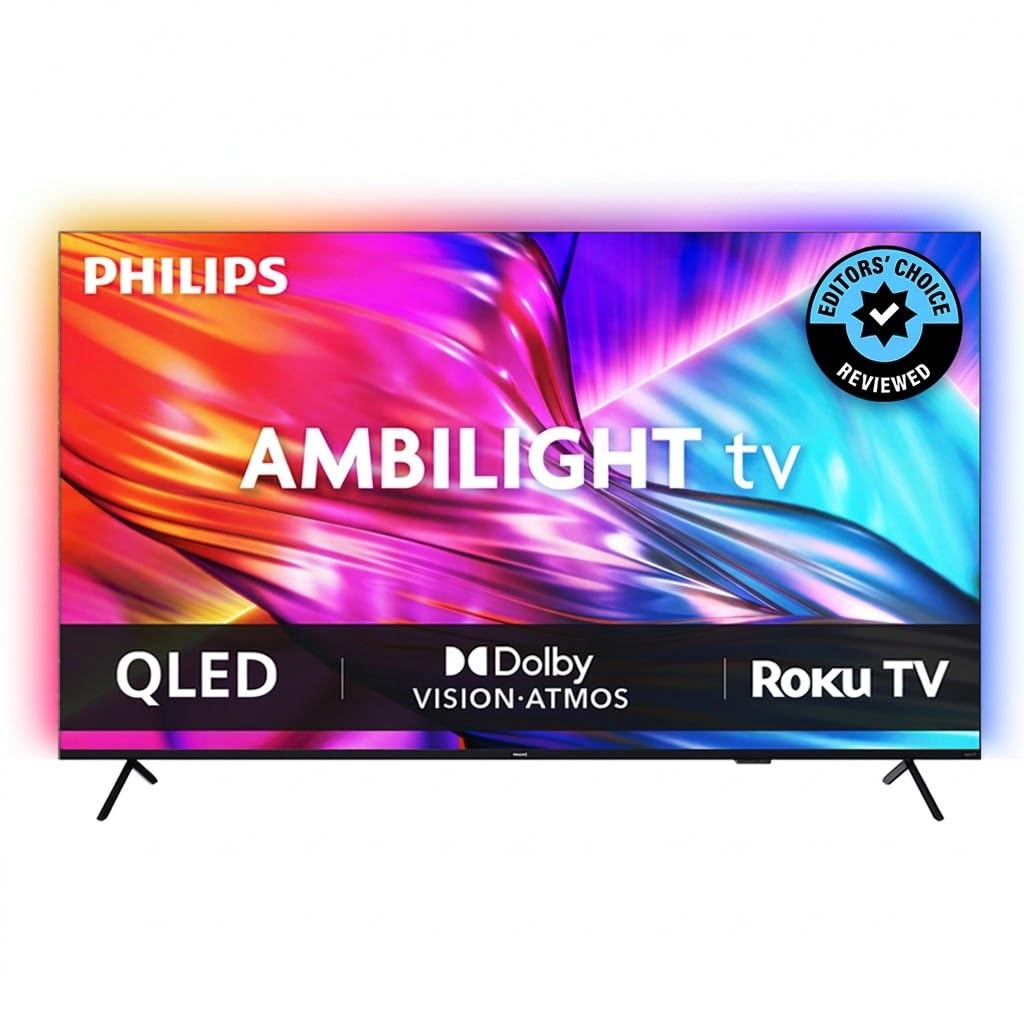
Ambilight is the reason to look here. Built-in rear LEDs read the 50-inch screen and project matching color onto the wall behind it, so the picture spills past the bezel. There’s a Follow Audio mode that pulses the light with your music and a static glow that stays on after the TV is off, which turns a dark corner into a soft lamp. In a dim room the wall glow genuinely widens the picture beyond the bezel.
The panel itself is 4K QLED at 3840 x 2160, and quantum dot color widens the range of reds, greens and blues. Dolby Vision, HDR10 and HLG each tune compatible content automatically, and 120 PMR smooths sports motion. Two built-in speakers with Dolby Atmos place effects around the room, and HDMI 1 carries eARC so a soundbar or AV receiver sends audio back cleanly. Four HDMI inputs cover a console, a cable box, a soundbar and a streaming stick at once.
Roku runs the show here, with Netflix, YouTube, Prime Video and Disney+ on one home screen plus 500+ free live channels for news and movies. Picture quality and build quality are the two things buyers score highest, and easy setup is right there with them. One connectivity quirk worth knowing: this set’s Bluetooth is version 5, while the 65-inch Samsung M70H above runs Bluetooth 5.3, so newer Bluetooth audio gear may pair more smoothly with that one. The 43.7 x 28.3 x 11.0 in footprint with the stand is worth measuring against your console table before it ships.
Why it stands out: the ambience is the star. Ambilight turns the wall into part of the picture, and Roku’s 500+ free channels keep the set useful without a subscription stack.
One honest note: the 120 PMR motion rating is a processing figure rather than a native 120Hz panel, so hardcore competitive gamers may want one of the native 144Hz sets below.
Pick this one when: you watch in a dim room and want the screen to feel twice its size against the wall.
Pass it over when: competitive gaming motion is the whole point and you want a native high-refresh panel instead.
3. Samsung 65-Inch Class M70H Series Mini LED 4K Smart TV
Sixty-five inches of Mini-LED contrast for a living room where the couch sits far back.
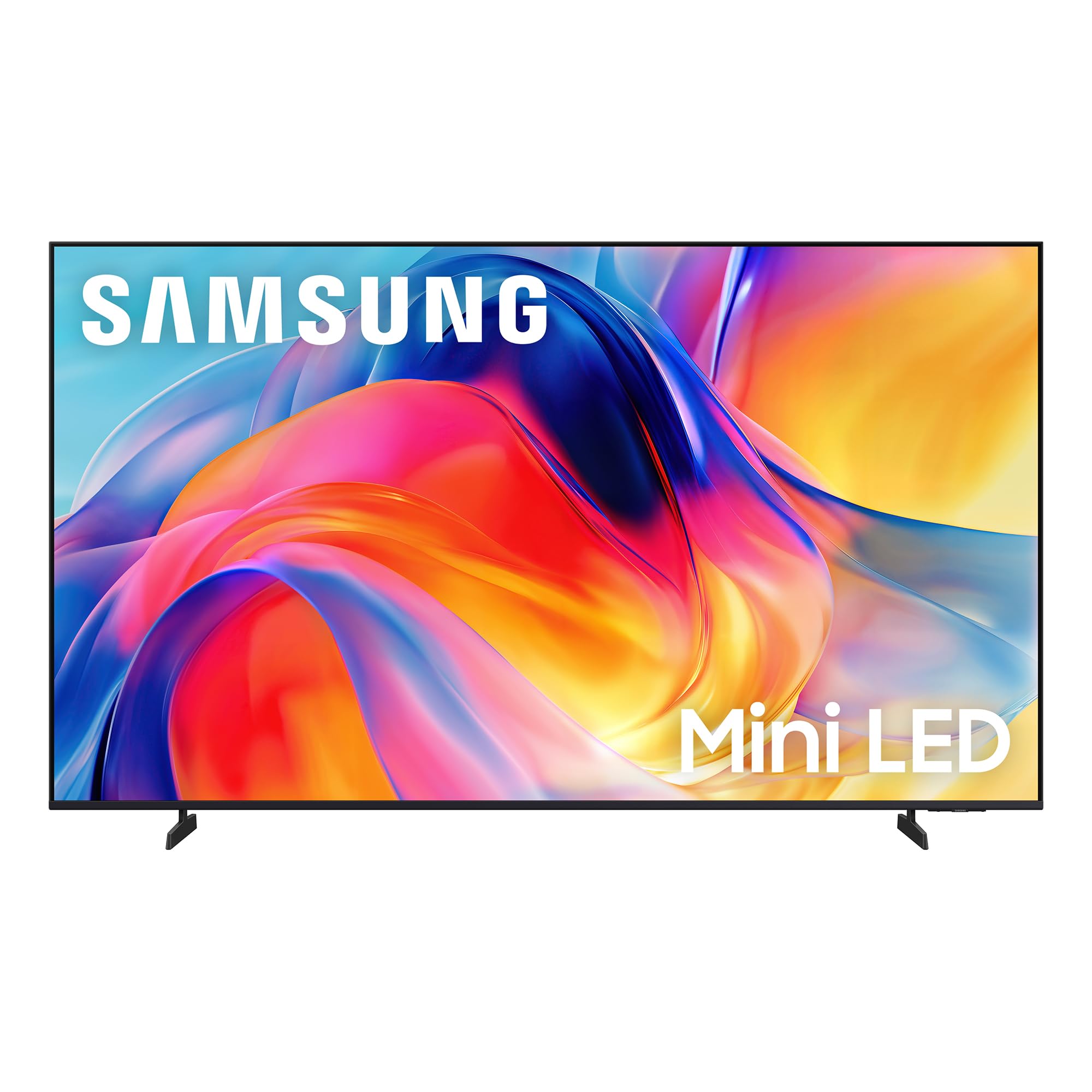
If your sofa is across a long room, the 65-inch M70H puts more picture between you and the wall than any 50-inch set here. Mini LED backlighting drives brighter highlights and deeper blacks, and Samsung’s Supreme Mini LED Dimming sharpens contrast so bright objects sit cleanly against dark backgrounds. A pure color spectrum delivers one billion true-to-life colors, and Mini LED HDR widens the range further than traditional HDR sets.
Motion is handled by Motion Xcelerator with DLG 120Hz, which analyzes and tune the refresh rate for sports and games. For soccer specifically, Soccer Mode claims 40% clearer motion and 30% more vibrant greens for the turf, which is a manufacturer figure worth treating as a marketing claim rather than a lab result. Gaming Hub pulls your console, cloud services and gaming apps into one screen, and 2,700+ free streaming options include 750+ subscription-free channels on Samsung TV Plus.
Owners prize the picture first and the value second, with setup earning steady praise. It’s the all-around quality that keeps ratings strong across a large base. Reliability is the mixed note in the data, and the remote draws the most criticism of anything on this set — plan on a cheap universal remote or a phone app if buttons matter to you. Bluetooth 5.3 matches the QN90F above, and 80 kilowatt-hours per 1,000 hours of annual energy use keeps running costs predictable.
Reasons to size up
- 65-inch Mini LED panel for long viewing distances
- One billion colors with Mini LED HDR
- 2,700+ free streaming options, 750+ channels on Samsung TV Plus
- Gaming Hub gathers console and cloud games
Where it falls short
- The bundled remote is the weakest link in owner feedback
- Reliability feedback is mixed, so buy from a seller with a clear return path
Worth it for: a big room where a 50-inch screen would feel small from the couch.
Skip it for: a tight space or a desk setup — 65 inches needs elbow room and a wide stand.
4. Hisense 50″ E7 Cinema Series Hi-QLED Mini-LED Fire TV
A native 144Hz panel that holds fast camera shots together frame by frame.
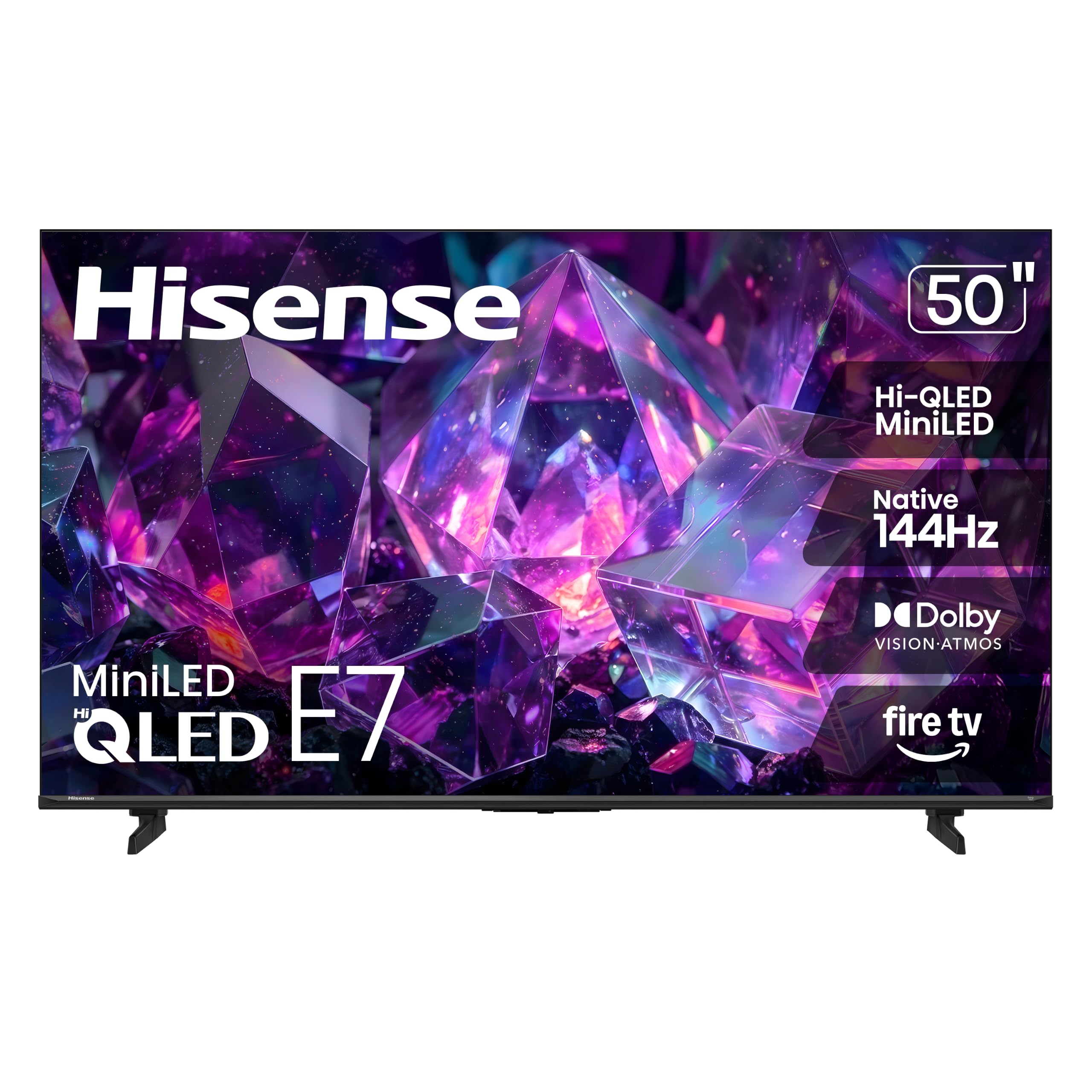
Native 144Hz is the headline, and it’s a real panel spec rather than a processing label. High refresh keeps fast movement fluid and sharp, which reduces blur during gameplay and live sports. Pair it with AI Smooth Motion and MEMC (motion estimation, which predicts where objects move between frames) and rapid camera pans stay easy to follow. Mini-LED backlighting uses thousands of precise light zones to push deeper shadows and brighter highlights across the screen.
The HDR stack is the deepest in this lineup: Dolby Vision IQ, HDR10+ Adaptive, HDR10 and HLG all supported, plus Dolby Atmos for room-filling sound. Dolby Vision IQ reads your room’s light and adjusts the picture automatically, so you’re not diving into menus at dusk. Filmmaker Mode preserves the original aspect ratio, color, frame rate and sound for movies, and the AI Light Sensor tracks ambient light to keep brightness comfortable at any hour. An AI Sports Mode recognizes sports content and boosts motion and crowd audio on its own.
Crisp picture, deep contrast and strong sound are what buyers call out, and brightness gets its own share of credit. The honest caveat is reliability: the data shows a mixed record on units that stop working unexpectedly, which is the trade-off you accept at this tier. Bluetooth 5.4 here is the newest version in this lineup — newer than the Philips 7985’s Bluetooth 5 and the Samsung M70H’s 5.3 — so recent Bluetooth headphones and speakers pair with the least fuss.
The gaming case: native 144Hz plus Dolby Vision and Atmos is a serious combo for console and PC play on a 50-inch screen.
The honest catch: reliability is the mixed signal in owner feedback, so keep the receipt close and test every input in the first week.
Made for: gamers who want the smoothest native 144Hz motion and the widest HDR support at 50 inches.
Not ideal for: buyers who want the calmest long-term reliability record in this group.
5. TCL 55 Inch T7 Series 4K 120Hz QLED Google TV
Fifty-five inches of QLED color and a 120Hz panel that won’t punish your wallet.
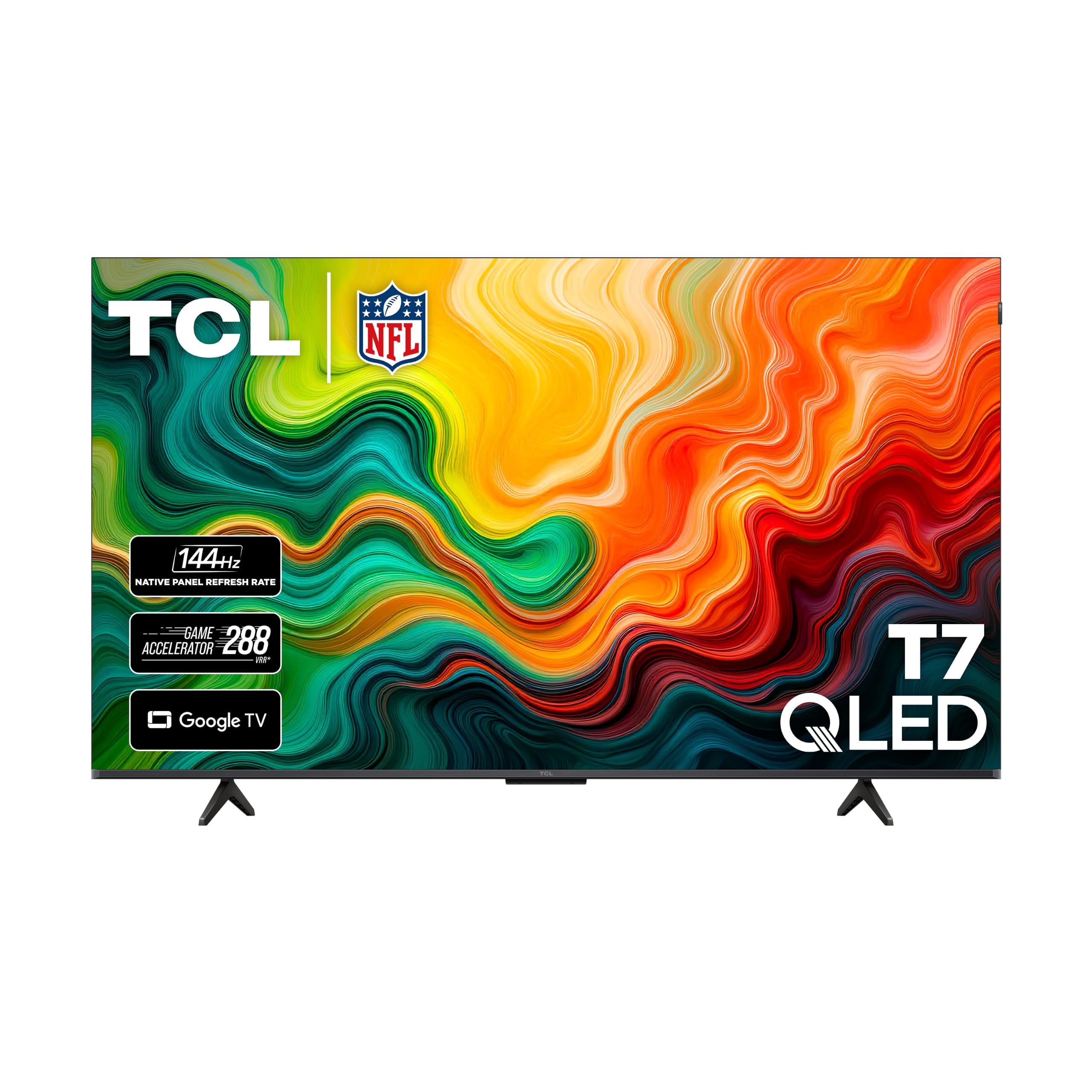
Value is the whole pitch, and the T7 backs it with real hardware. A 120Hz panel refreshes the picture 120 times a second, versus 60 times a second on a standard 60Hz set, so action movies, fast games and live sports keep their edges. QLED quantum dot color covers nearly the entire DCI-P3 color space, which is the range of colors filmmakers master in, so reds and greens look richer. The TCL AIPQ Pro processor tune color, contrast and clarity for 4K HDR content, and HDR PRO+ supports Dolby Vision, HDR10+, HDR10 and HLG.
Four HDMI inputs include one with eARC for a soundbar or receiver, and there’s a 240Hz variable gaming refresh rate mode for smoother play. Dolby Atmos handles spatial audio for movies and games, and Google TV gathers your apps on one screen with Chromecast and Apple AirPlay 2 built in for casting from a phone. Voice control works with Amazon Alexa, Google Assistant and Apple HomeKit, and Wi-Fi 5 keeps streaming steady.
High quality and vivid picture are the top two things buyers report, with value, sound and easy setup all earning praise. The recurring gripe is units that shut off at random — treat that as the trade-off at this tier and buy from a seller with easy returns. Compared with the Hisense E7 above, this T7 gives you 55 inches to the E7’s 50, which suits a longer viewing distance. If you want 55 inches without climbing into the premium tier, this is the balance point.
What you’re getting
- 120Hz QLED panel at a budget-friendly tier
- Dolby Vision and HDR10+ support across major formats
- Google TV with Chromecast and AirPlay 2
- Four HDMI inputs, one with eARC
What to keep in mind
- Some sets power off unpredictably, per owner reports
- Direct LED backlight, not the zone-by-zone control of Mini LED
Reach for this if: you want a 55-inch 4K HDR screen for console play without climbing into the premium tier.
Look elsewhere if: you sit close enough that a 50-inch set fits your wall just fine.
6. iFFALCON 55″ 55U85 MiniLED Smart TV
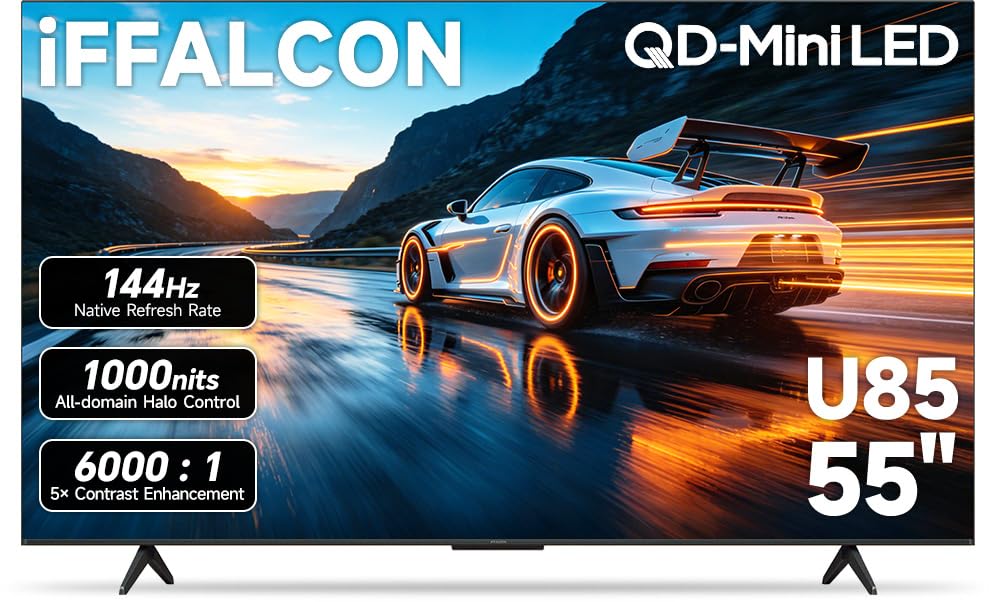
Four HDMI 2.1 ports so your console, PC and soundbar all stay plugged in at once.
Most sets here give you one or two high-bandwidth ports. This one gives you four HDMI 2.1 inputs: two run 4K at 144Hz for next-gen consoles and gaming PCs, two more handle 4K at 60Hz for streaming boxes or Blu-ray players. Auto Low Latency Mode (ALLM) switches the TV into game mode the instant your console powers on, so you’re never diving into menus mid-match. The native 144Hz panel supports VRR from 4K at 48–144Hz and up to 240Hz, with FreeSync Premium Pro cutting screen tearing and lowering input lag.
Brightness and contrast are serious: up to 1,000 nits of HDR luminance, local dimming, and a 6,000:1 contrast ratio. A 2.1-channel audio system pairs 2x15W tweeters with a 20W woofer, and eARC on HDMI 4 passes lossless audio to an external soundbar. The HDR roster includes Dolby Vision IQ, Dolby Vision Gaming, HDR10+ and IMAX Enhanced, and Google TV with Alexa and Google Assistant handles the apps.
Buyers rate picture and value highest here, and complaints are quieter than most — a strong record across a smaller base. When comparing, remember the 6,000:1 contrast ratio (a measure of how deep blacks and bright whites can get): it’s a real, stated figure, while other sets in this group list contrast only as “High.” There’s also built-in hotel mode with IR blaster (a remote-control signal sender) and IP control (network-based control), which sounds niche but makes sense for an Airbnb or a small office display.
The port advantage: four HDMI 2.1 inputs make this the easiest set to live with if you’re juggling a console, a PC and a soundbar.
Worth confirming: a 55-inch panel needs a room wide enough to back up from it, and the hotel-grade extras are bonus, not the reason to buy.
Pick it for: a multi-device gaming and office setup that needs the most ports in this lineup.
Look elsewhere for: a compact 50-inch footprint if your wall space is tight.
7. TCL 50″ QM64L High Contrast QD-Mini-LED Fire TV
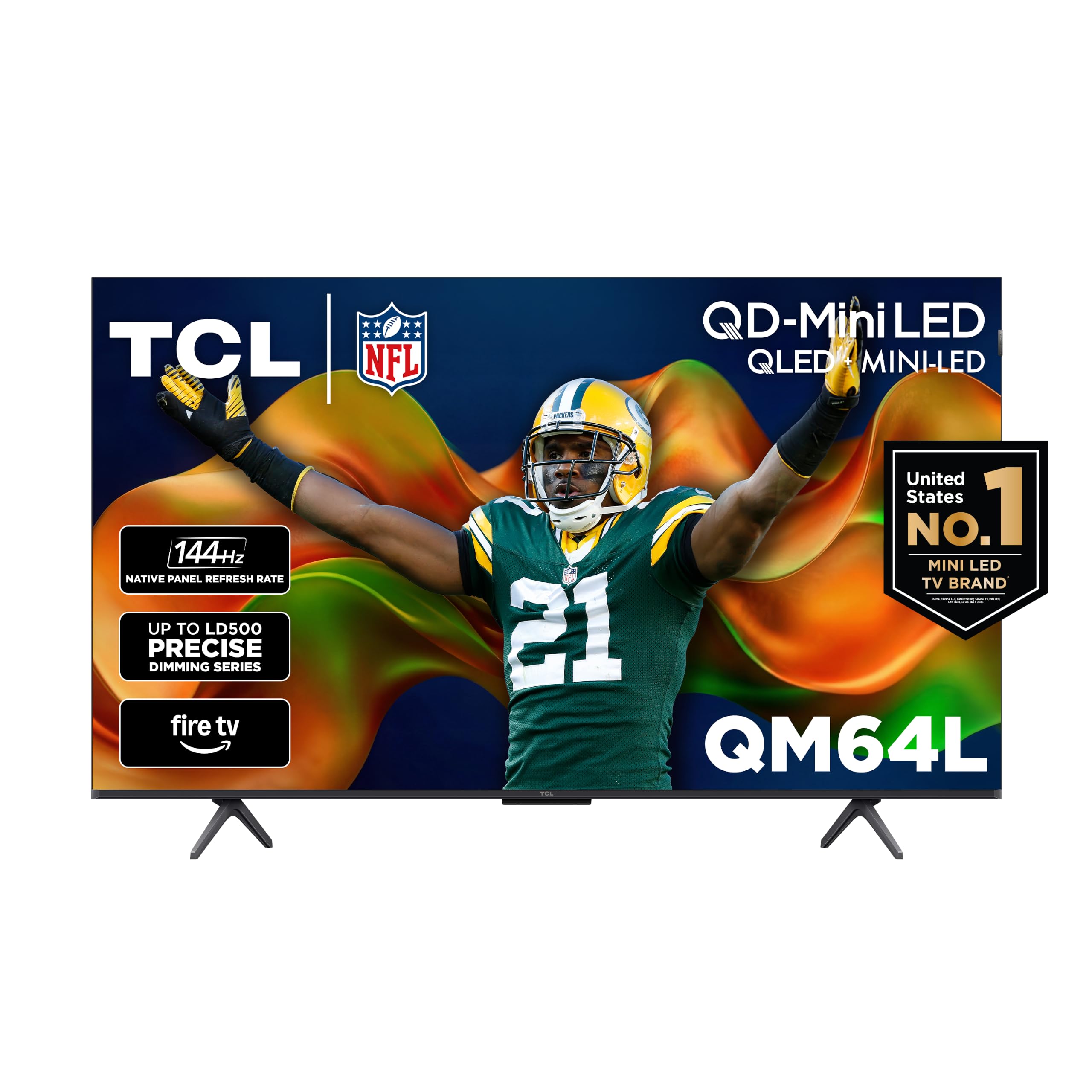
Up to 500 dimming zones carve bright highlights out of deep black backdrops.
Zone control is the story here. Up to 500 local dimming zones with TCL Halo Control Technology tune the backlight in small patches, which reduces blooming around bright objects. The payoff is bright highlights and deeper blacks without the burn-in risk premium displays can carry. Enhanced QLED Color delivers up to 1.07 billion colors, and the AiPQ Pro Processor tune color, contrast and clarity across movies, streaming, sports and games.
Gaming gets taken seriously: native 144Hz, Motion Rate 480, VRR, ALLM and Game Accelerator combine for responsive play. The bezel-less design keeps the frame thin so more of what you see is picture. Audio is a bigger deal than usual thanks to an Onkyo 2.1 system with a 20W subwoofer, so dialogue and bass fill the room without a soundbar. Dolby Atmos, dedicated DTS, Dolby Vision, HDR10+ and HLG round out the format support, and Fire TV with Alexa+ handles voice search and app access.
Buyers are most impressed by lightning brightness and vivid colors, with value climbing right behind. Setup is quick and the picture holds up against far costlier sets for gaming. The data does show a glitch note — some units act up after a while — so treat that as the fit consideration. One spec to watch: the listing shows the display refresh rate at 120Hz (how many times per second the screen updates) in the specs table and 144Hz Native in the display technology field, so confirm the exact panel figure with the seller if native 144Hz is decisive for you.
Why contrast wins: up to 500 local dimming zones is the most zone control you’ll see named in this lineup, and it shows in dark-scene detail.
The thing to know: the spec sheet lists the refresh rate two ways, so verify which figure applies before you buy for 144Hz.
Ideal for: movie nights and gaming where dark scenes with bright highlights deserve proper zone control.
skip it if: overall reliability matters more than contrast — the glitch reports are a real risk at this tier.
8. Sony 50 Inch BRAVIA 2 II LED 4K HDR Google TV
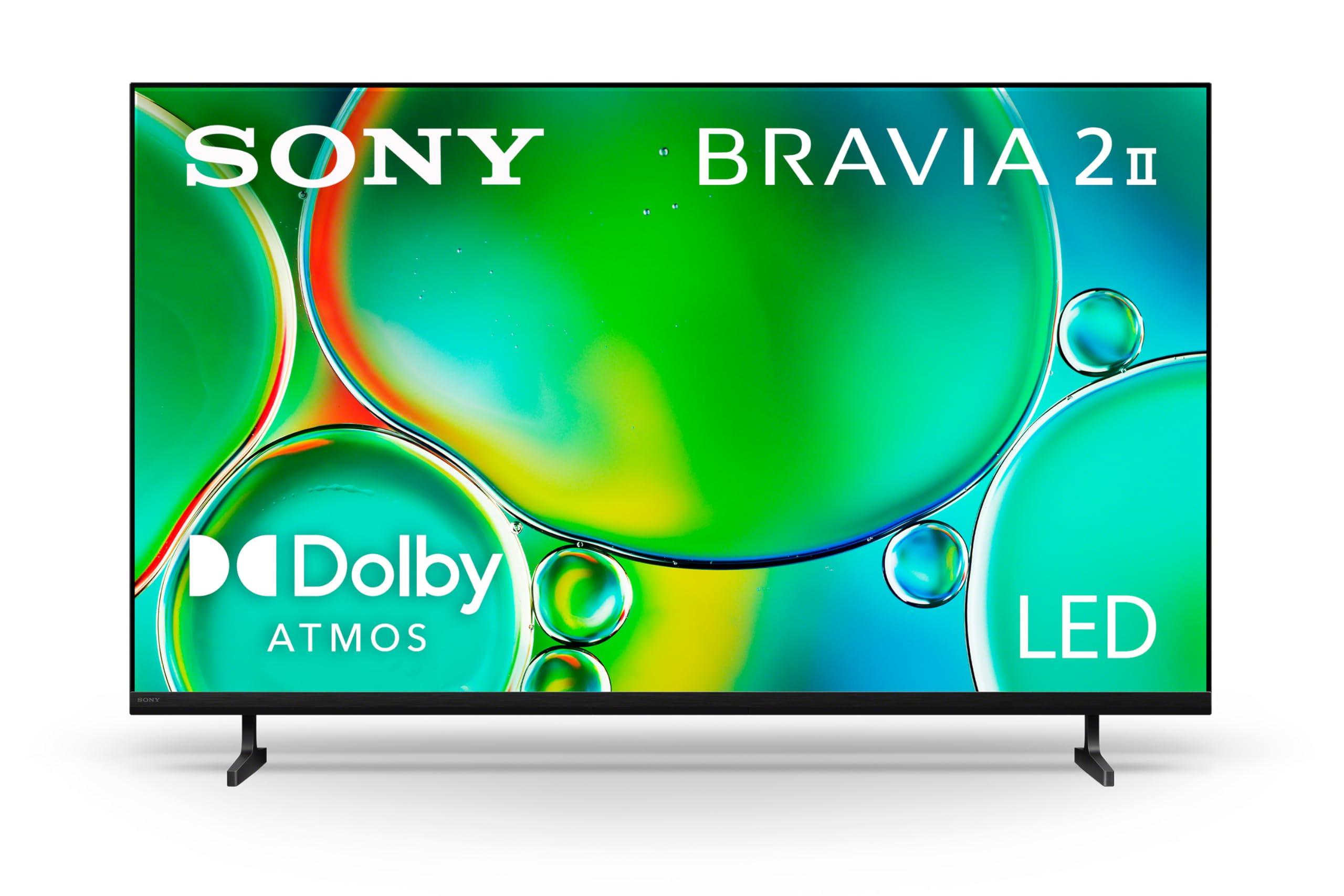
Sony’s X1 processor pulls fine texture out of old footage and every app in one place.
The 4K Processor X1 is the reason this set belongs on the shortlist: it drives rich color and sharp detail from a standard direct LED panel, so you get a lifelike picture without Mini-LED hardware. 4K XR-Reality PRO upscales all your content toward near-4K, bringing back lost texture in older streaming and broadcast shows. Motionflow XR handles blur in fast sports and action movies, and color stays natural across a wide array.
Sony’s gaming extras lean toward PlayStation, but an Xbox One S benefits too. Auto HDR Tone Mapping and Auto Genre Picture Mode tune picture quality for gaming, and the Game Menu puts all your picture settings in one place. Google TV gathers every streaming app on one screen with Apple AirPlay 2 and Google Cast support, and the Sony Pictures CORE app bundles movies. An Eco Dashboard keeps energy settings together, and the set draws 114 watts.
Owners describe a crisp, high-quality upgrade with easy setup and good value, and color quality draws specific praise for making old black-and-white films look cleaner. The reliability note is the one to weigh — a few units fail right out of the gate, so test yours during the return window. Bluetooth 5.3 keeps wireless accessories simple, and the 35-inch base width means you need a solid, wide stand underneath.
What makes Sony different
- 4K Processor X1 and XR-Reality PRO upscaling
- Auto HDR Tone Mapping and Game Menu for console play
- Google TV with AirPlay 2 and Google Cast
- Sony Pictures CORE movies included
What to prepare for
- Direct LED panel, not Mini LED, so contrast is not the headline
- Some units fail early, so open and stress-test it in the first week
Match with this if: you want Sony’s processing and a Google TV setup that favors PlayStation owners.
Keep looking if: peak black levels and zone dimming top your list and Sony’s panel falls behind the Mini-LED sets here.
Know the Specs
4K resolution and HDR10
4K means 3840 x 2160 pixels — four times the pixel count of a 1080p set — so fine textures and thin lines stay visible. HDR10 is a static high dynamic range format (a fixed brightness and contrast map) that tells the screen how bright and dark each scene should get. The Xbox One S supports both, so these are the floor for a matching TV. Every set in this guide clears 4K and HDR, but the ones that add Dolby Vision or HDR10+ can tune brightness scene by scene instead of once per movie.
Refresh rate and VRR
Refresh rate is how many times per second the screen redraws the image. A native 144Hz panel redraws faster than a 60Hz one, which keeps fast pans and sports cleaner. Variable refresh rate (VRR) lets the panel match its timing to the frame rate the console sends, cutting tearing and stutter. Look for the native figure in the specs, not just a processing number like Motion Rate 480, because processing smooths motion after the fact while native rate is the hardware ceiling.
Mini-LED and local dimming zones
A Mini-LED backlight uses many small LEDs behind the panel that dim independently, and those zones decide contrast. More zones means blacks stay black next to bright objects and blooming (the glow that smears around subtitles) is reduced. Up to 500 zones is the highest count stated in this lineup. A direct LED set uses a simpler backlight, so it can still look good but won’t control dark scenes as tightly.
HDMI ports, ALLM and eARC
HDMI 2.1 ports carry higher frame rates and formats than older HDMI 2.0, which matters if you add a newer console or gaming PC later. Auto Low Latency Mode (ALLM) flips your console into game mode automatically, and eARC (enhanced audio return channel) sends high-quality audio back to a soundbar or AV receiver from one cable. Four HDMI inputs is the most in this group, which helps when a console, a streaming stick and a soundbar all need a slot.
Common Questions
Does the Xbox One S actually output 4K on these TVs?
Do I need HDMI 2.1 for an Xbox One S?
Which size should I choose, 50 inches or 55 inches or 65 inches?
Is a native 144Hz panel better than 120Hz for console gaming?
What does local dimming actually do for picture quality?
Can I use a soundbar instead of the built-in speakers?
Why do some reviews mention TVs that stop working?
Do these TVs support Dolby Vision, and does it matter for an Xbox One S?
How high should I mount a TV for gaming?
Is Mini-LED worth it over standard LED for console gaming?
The Bottom Line
The clear winner for most rooms is the Samsung QN90F, because its glare-free screen and 4K 165Hz VRR gaming keep the picture readable on sunny afternoons without sacrificing console smoothness. If you watch in a dim room and want the wall to glow with the action, the Philips 7985 and its Ambilight make the screen feel bigger than its size. For a multi-console setup, the iFFALCON 55U85 gives you four HDMI 2.1 ports to plug everything in at once.
The QN90F tops this lineup on picture quality, and its glare-free coating is what makes that hold up in a sunlit room. Buy it before you build the game room around a screen that can’t do 4K HDR at 60fps.
How we choose
We do not accept paid placement. Every pick is matched to a real buyer and a real use-case; we do not hands-on test units.
Sources
Specifications: manufacturer listings and product documentation. Review insights: verified customer reviews, as of November 2026. Pricing: not shown on this page (it changes often); check the current price via the retailer link.
As an Amazon Associate, Tactical Gear Guy earns from qualifying purchases. This does not affect which products we feature.