Specs are compiled from manufacturer listings and verified buyer reviews and can change over time — please confirm the key details on the product page before buying.
Here is the short answer: the Samsung T7 Shield is the safest buy for most Xbox owners, because it pairs a 1,050 MB/s transfer rate with an IP65 rating (a score that means it shrugs off dust and water spray) and a rugged shell. Buying an external SSD for an Xbox is mostly about two things — whether the console will actually recognize the drive, and whether your games still load quickly once they live on it. This guide answers both before you spend anything.
This guide is built by comparing the manufacturers’ published specifications and the patterns across verified customer reviews, so you get each pick’s real strengths and trade-offs instead of marketing spin.
Not every drive on this list is fast enough for current-generation game files. A few are best treated as overflow space for older titles. Below you will find the drives worth plugging into an Xbox console today, from 1TB value picks to a 2TB option. The table below breaks down the best Xbox External SSD choices by real transfer speed and console fit.
Top Picks


How To Choose The Best Xbox External SSD
An Xbox will happily recognize almost any external SSD you plug into a rear USB port. The real question is what you can do with it once it is connected. Load a drive with the wrong speed rating and your current-generation games may not run directly from it — they become cold storage you shuffle files onto.
Match the transfer speed to how you actually play
Transfer speed is quoted in MB/s, meaning megabytes moved per second. A 550 MB/s drive will copy a large game file far more slowly than a 2,000 MB/s drive. Fast drives also load levels and textures snappier, which is the whole point of buying one instead of a spinning hard drive.
The catch is that quoted speeds assume a matching port and cable. USB 3.2 Gen 2×2 is the fastest common standard here, and it can reach 2,000 MB/s. If your console or cable only supports the older USB 3.2 Gen 2 standard, a Gen 2×2 drive drops down to slower numbers — so the cable in the box matters as much as the drive.
Don’t overlook the physical build
A portable SSD rides in a bag or a pocket, so a metal or rugged shell earns its keep. An IP65 rating means the drive is sealed against dust and survives water spray from any direction — worth having if the drive travels between rooms or houses. Drop protection is measured in feet, and it tells you how far a fall the drive is designed to survive.
Capacity and cable fit
1TB holds a decent library of games and media; 2TB gives you room to stop deleting titles to make space. Check the cable end too. A 2-in-1 USB-C and USB-A cable covers more devices, while a plain USB-C cable needs a console or adapter that matches it.
Side-by-Side Comparison
| Model | Best For | Capacity | Transfer Speed | Connection | Amazon |
|---|---|---|---|---|---|
| Samsung T7 Shield★ Best Overall | Everyday Xbox owners | 1TB | Up to 1,050 MB/s | USB 3.2 Gen 2 | Amazon |
| SSK External SSDBudget Champion | Budget file storage | 1TB | Up to 550 MB/s | USB 3.2 | Amazon |
| OSCOO External SSDTop Performer | Fast pocket-sized storage | 1TB | Up to 2,100 MB/s | USB 3.2 Gen 2 | Amazon |
| SanDisk Extreme | Speed plus encryption | 1TB | Up to 2,000 MB/s | USB | Amazon |
| Lexar SL500 | Slim metal build | 1TB | Up to 2,000 MB/s | USB 3.2 Gen 2×2 | Amazon |
| Crucial X9 | Simple plug-in drive | 1TB | Up to 1,050 MB/s | USB 3.2 Gen 2 | Amazon |
| Samsung T9 | Heavy-duty speed | 1TB | Up to 2,000 MB/s | USB 3.2 Gen 2×2 | Amazon |
| KIOXIA EXCERIA PLUS G2 | Room for a big library | 2TB | Up to 1,050 MB/s | USB 3.2 Gen 2 | Amazon |
Detailed Reviews
1. Samsung T7 Shield Portable SSD 1TB
Our pick — 4.5+★ from 16,000+ verified ratings; the strongest balance of quality and price.
The drive that survives a backpack and still loads games fast.
The first number to care about here is 1,050 MB/s — that is how fast this Samsung can read data, which translates into noticeably quicker game loads than a slower drive. It uses PCIe NVMe technology inside, which is the same engine type found in laptop SSDs, so files move at speed rather than crawling. Samsung also rates it at up to 1,000 MB/s for writes, so saving and copying are nearly as brisk as reading.
What makes this the safest pick for an Xbox, though, is the toughness. The IP65 rating means dust cannot get in and water spray from any angle slides off. Samsung rates it for falls up to 9.8 feet, so a slip off a shelf or out of a bag is not a disaster. At 1TB you have real room for a library, and the palm-sized shell slips into the console’s USB port without crowding the shelf.
It is built for current consoles too — Samsung lists the Xbox Series X and Series S as compatible models right alongside PC, Mac and phones. The trade-off worth knowing: it tops out at USB 3.2 Gen 2, not the faster Gen 2×2, so it trails the 2,000 MB/s drives on this list. For Xbox duty that gap rarely bites, because the console’s own ceiling is close to what this drive delivers. The other honest catch is that some owners call it pricey for a 1TB drive — but the performance and build are what you are paying for.
Where it earns its keep
- IP65 dust and water rating suits a drive that travels
- 1,050 MB/s read delivers quick game loads
- Rated for drops up to 9.8 feet
- Confirmed support for Xbox Series X and Series S
What to weigh up
- USB 3.2 Gen 2 only, so it lags the 2,000 MB/s drives
- Costs more than the entry-level 1TB picks
Top of the pile for: anyone who moves a drive between console and desk and wants it to survive the trip.
Hold off if: you chase the highest possible transfer figure and need Gen 2×2 speed.
2. SSK External Hard Drive 1TB Portable SSD
A 27g starter drive with a 2-in-1 USB-C and USB-A cable and no setup.
At 27g this thing practically disappears in a bag, and the 2-in-1 USB-C and USB-A cable means you are never hunting for the right adapter. Plug it into an Xbox or a laptop and it just works — no software install, no setup screens. It reads at up to 550 MB/s and writes at up to 500 MB/s, which SSK says makes it roughly ten times faster than an old USB 2.0 stick for shifting big photos and video files.
That is the key contrast with the Samsung above: 550 MB/s versus 1,050 MB/s is a real gap in how fast a game file moves across. For stashing a media library or archiving old titles, the SSK is honest value. For playing current-gen games directly from the drive, its ceiling is lower and you may notice the wait when you copy something big. A small LED blinks during transfers so you can see when it is safe to unplug — a small touch that helps avoid yanking it mid-copy.
The shell is plastic, and SSK is not pitching this as a rugged drive for the outdoors. Setup is the part people love: it works straight from the start, and several buyers use it as an everyday backup drive for a computer as comfortably as for a console.
Best budget angle: the 2-in-1 cable and plug-and-play nature make this the closest thing to a no-brainer for overflow storage.
Reach for this if: you want cheap, roomy storage for media and older titles.
Look elsewhere if: you plan to run demanding current-gen games straight off the drive.
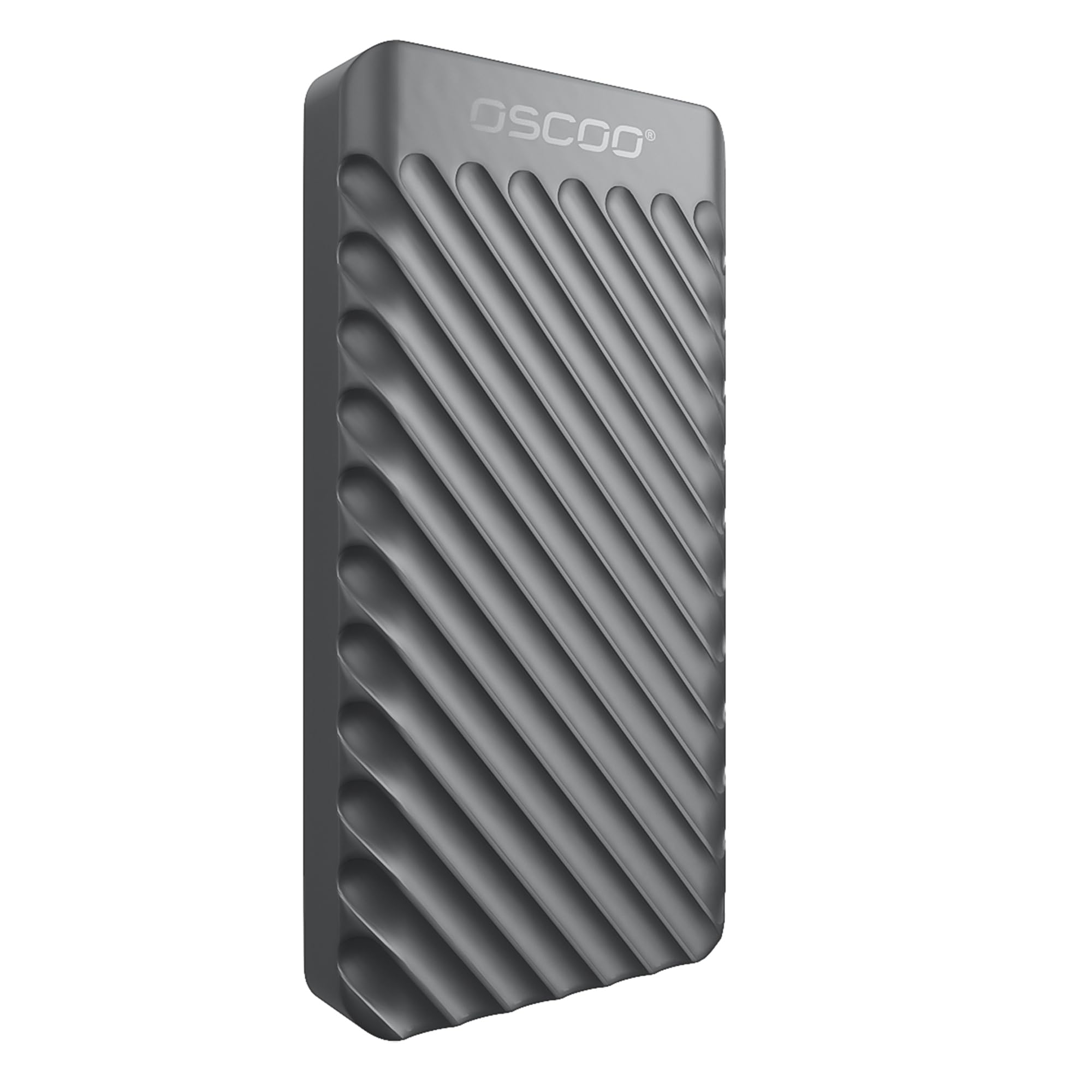
3. OSCOO 1TB External SSD, Up to 2100MB/s
The highest speed rating here at 2,100 MB/s, aimed at creators and big game files.
2,100 MB/s is the number that defines this drive, and it sits at the very top of what this roundup offers. That figure applies under ideal conditions — the maker states it needs a USB 3.2 Gen 2×2 or Thunderbolt 4/5 connection to hit it, and older ports will pull it down. The drive uses NVMe with premium NAND flash, which is the chip type that keeps large file transfers moving without stalling.
Its durability pitch is stronger than the price suggests: an aluminum shell with water- and drop-proof protection, plus SMART monitoring (a self-check system that reports drive health) and error correction. A 0.03 lb weight and an ultra-slim body mean it drops into a pocket or a controller case and you forget it is there.
Two things to keep honest. First, OSCOO warns that usable space will read about 7–10% under the 1TB label, because systems count storage differently — that is normal, not a fault. Second, the listing leans toward PlayStation in its console compatibility notes, and while the maker lists broad device support, the Xbox fit is less clearly spelled out than on the Samsung or Lexar drives. It reads and writes quickly, and that is the impression owners consistently leave.
The draw: top-tier 2,100 MB/s speed in a drive small enough to lose in a coat pocket.
Worth checking first: confirm the console support you need before committing, since the listing emphasizes other platforms.
Good match for: creators who move 4K footage between a camera and a laptop.
Check the port path if: you own an older Xbox that cannot feed a Gen 2×2 connection.
4. SANDISK 1TB Extreme Portable SSD
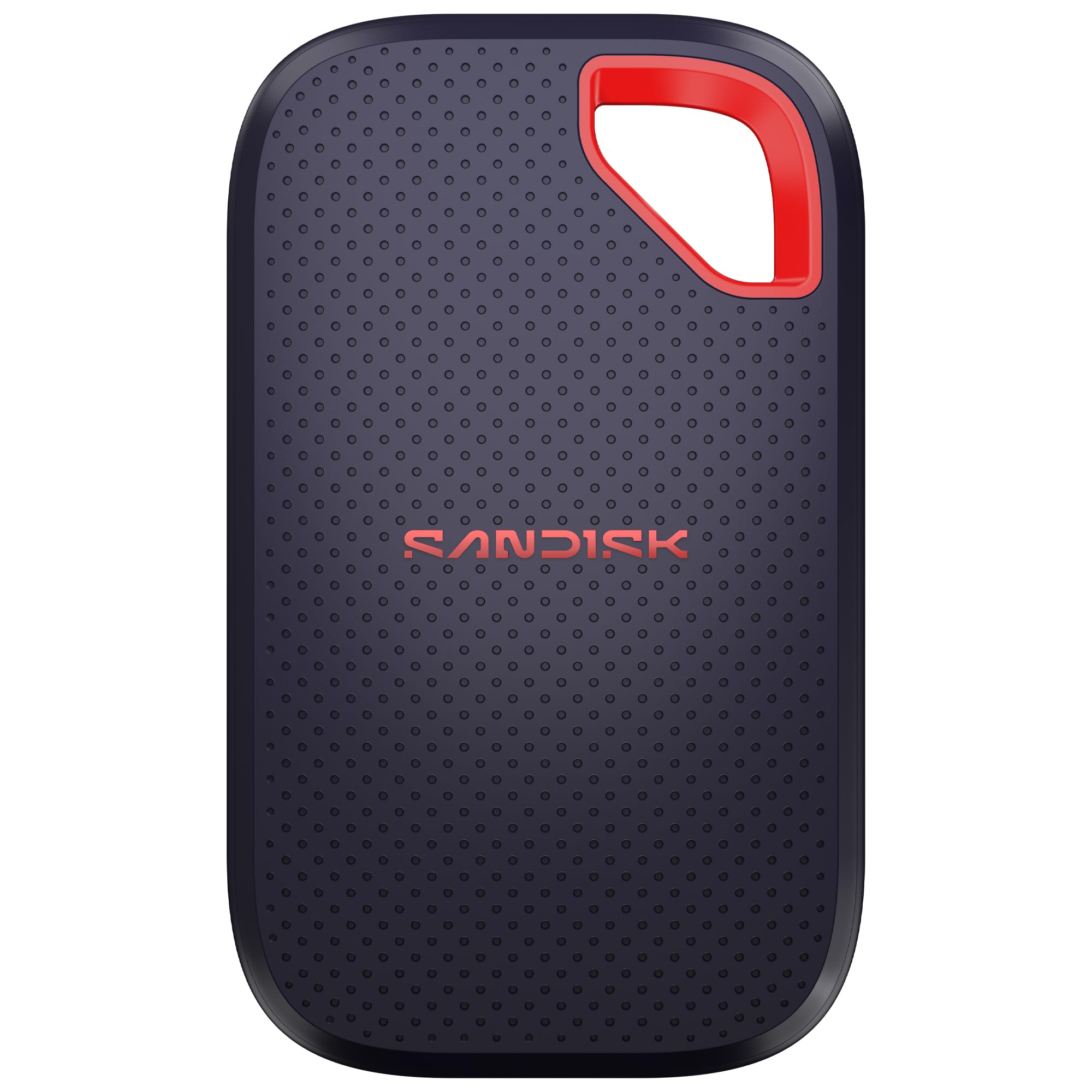
Roughly 3.6x the read speed of the SSK, with IP65 sealing and 256-bit AES encryption.
SanDisk quotes up to 2,000 MB/s here, and the comparison to the budget SSK above is stark — 2,000 MB/s against 550 MB/s is roughly a 3.6x gap in raw transfer rate for this drive. The maker claims you can move 1,000 high-res photos in under 60 seconds at that speed, which is the kind of pace that matters if you juggle large game files or video edits.
The build backs up the speed. An IP65 rating matches the Samsung T7 Shield’s protection, and SanDisk rates it for drops up to 3m. The body is pocket-sized, so it fits in a small bag without taking up real space. It also carries 256-bit AES encryption (a secure lock on the drive’s contents) with password protection — useful if you carry game saves or project files around and want them locked up if the drive goes missing.
Where it gives ground: the console compatibility note in its spec sheet points at PlayStation 5 rather than Xbox, so verify it shows up on your specific console before you rely on it for game storage. Speed and reliability are what people write about most, and the sense that it is a strong drive for the money sits alongside a note that it is not the cheapest way to buy 1TB.
Why it stands out: 2,000 MB/s speed plus password encryption and a sealed, drop-rated shell.
Pick it when: you want fast transfers and a locked-down drive for private files.
Think twice if: you need Xbox support spelled out plainly rather than left to a device check.
5. Lexar 1TB SL500 External SSD

A slim metal drive that reads at 2,000 MB/s and lists Xbox Series X support outright.
What wins people over with the SL500 is the combination of speed and a genuinely thin metal body. It reads at up to 2,000 MB/s and writes at up to 1,800 MB/s over USB 3.2 Gen 2×2 — one of the higher write figures on this list, which matters when you are saving gameplay clips rather than just reading files. Lexar is upfront that Macs and systems that do not support Gen 2×2 will run slower, so the number depends on your port.
Uniquely among the fast drives here, Lexar lists the Xbox Series X as a compatible console outright. That takes the guesswork out of the Xbox question. A thermal control design keeps temperatures in check even at top speed, so a long transfer should not force the drive to throttle down.
The honest limit is the cable and port dependency: to feel the full 2,000 MB/s you need a Gen 2×2 path, and a plain USB 3.2 Gen 2 port will pull it down to more ordinary speeds. Storage capacity gets plenty of positive attention, and the room for video and photo files is consistently the standout. If you want fast and Xbox-confirmed in one slim package, this is a strong fit.
The short version: slim metal build, 2,000 MB/s reads, and an explicit Xbox Series X compatibility note.
Best paired with: anyone who values a metal body over a plastic one and wants console support stated plainly.
Keep in mind: full speed needs a Gen 2×2 port, otherwise you get a lower, still-respectable rate.
6. Crucial 1TB X9 External SSD

A no-frills 1TB drive that matches the Samsung’s 1,050 MB/s read figure over USB 3.2 Gen 2.
The X9 delivers up to 1,050 MB/s over USB 3.2 Gen 2, the same read figure as the Samsung T7 Shield that tops this list. That puts it in solid territory for game loads and quick transfers. It is a portable solid-state drive at 1TB, so no moving parts and no spinning platters to worry about when it rides in a bag.
Where the listing gets thin is the detail. Crucial’s own description is bare, and the compatibility notes point at desktop computers and the Nintendo Switch rather than an Xbox. There is no IP rating or drop figure spelled out the way there is on the Samsung and SanDisk drives. The shell is described only vaguely. So while the speed and capacity read well, you get less reassurance on durability and console fit than the more thoroughly documented picks.
New reports are also light on this model, which means less owner feedback to lean on. If you want a straightforward 1TB Gen 2 drive and do not need the rugged extras, the X9 covers the basics. If an explicit Xbox compatibility statement matters to your purchase, one of the other drives here spells it out more clearly.
Suits buyers who: want a plain, fast-enough 1TB drive and do not need weatherproofing.
Consider the alternatives if: you want console fit and drop protection clearly stated.
7. Samsung T9 Portable SSD 1TB

Samsung’s step up from the T7 Shield, rated for sustained 2,000 MB/s read and write.
The T9 doubles the read figure of its T7 Shield sibling — up to 2,000 MB/s on USB 3.2 Gen 2×2, versus the Shield’s 1,050 MB/s. Better still, Samsung pitches sustained read and write speeds of up to 2,000 MB/s, which means a long game install or a giant file push should not slow to a crawl partway through. A Dynamic Thermal Guard manages heat so the drive keeps its pace during heavy use instead of throttling.
Durability reads well on paper: Samsung lists rugged build rated for drops up to 9.8 ft, and AES 256-bit hardware encryption (a lock built into the drive itself, not just software). Magician software handles firmware updates and drive-health monitoring. Console support is spelled out for both Xbox Series X and Series S, so it slots into either current Xbox.
Two honest notes. Compatibility is a mixed story — some owners find it works smoothly with MacBook Pro and iPad Pro, while others say their device did not recognize it, so verify on your own hardware early. And some feel it is expensive for 1TB. What people consistently praise is the speed and the compact size — it is roughly the size of a thick credit card, so it vanishes into a pocket.
Why gamers lean toward it
- Sustained up to 2,000 MB/s read and write suits big transfers
- Dynamic Thermal Guard keeps speed steady under load
- Listed for both Xbox Series X and Series S
- AES 256-bit hardware encryption built in
The honest counterpoints
- Device recognition is a mixed experience for some
- Costs more than the entry-level 1TB drives
The one to grab if: you push huge files regularly and need speed that holds up.
Do a quick test first if: you run it with a device known for fussy USB support.
8. KIOXIA EXCERIA PLUS G2 Portable SSD 2TB

The only 2TB drive here, in a shock-resistant aluminum shell with USB-C and USB-A cables.
If capacity is your worry, this is the only 2TB drive on the list. That doubles the room of each 1TB pick, which means far fewer delete-to-install decisions. Reads top out at 1,050 MB/s and writes at up to 1,000 MB/s over USB 3.2 Gen 2 — the same speed bracket as the Samsung T7 Shield at the top, but with twice the space to fill.
KIOXIA builds it on its own BiCS FLASH 3D memory, made in Japan, with an aluminum housing and a shock-resistant design. With no moving parts, there is less inside to break when the drive travels. It ships with both a USB-C to USB-C and a USB-C to USB-A cable, so you are covered whether your console or laptop wants the newer or older connector. Xbox Series X and Series S are both listed as compatible.
The catch is speed versus the fastest drives here: 1,050 MB/s is solid, but a Gen 2×2 drive like the T9 or Lexar will read up to 2,000 MB/s. So this is the pick for capacity over outright pace. You also pay the most of the group for that 2TB of space. KIOXIA’s SSD utility manages the drive and applies 256-bit AES hardware encryption for password protection.
The case for it: 2TB of room for a big library, dual cables, and a shock-resistant metal body.
Made for: the gamer who keeps running out of space and wants to stop deleting titles.
Not the pick for: anyone who prioritizes the highest transfer speed over capacity.
Know the Specs
Transfer Speed (MB/s)
This is how much data the drive moves per second, measured in megabytes. A 550 MB/s drive copies a large game file far more slowly than a 2,000 MB/s drive, and it loads levels less briskly. Faster is better for playing directly from the drive; slower is fine for archiving old titles. The quoted figure only holds with a matching port and cable, so a fast drive on a slow port will fall short of its rating.
USB Generations
USB 3.2 Gen 2 is the common fast standard and typically caps around 1,050 MB/s. USB 3.2 Gen 2×2 doubles that ceiling to around 2,000 MB/s, but it needs a port that supports it. Plug a Gen 2×2 drive into a plain Gen 2 port and it drops to the slower rate. Always check the cable in the box matches the port you plan to use.
IP Rating and Drop Protection
An IP65 rating means the drive is sealed against dust and survives water spray from any direction. Drop protection is quoted in feet or meters and tells you how far a fall the drive is designed to take. These matter for a drive that lives in a bag or travels between rooms; a desk-bound drive can skip them.
Capacity
1TB holds a solid library of games plus media. 2TB doubles it and lets you stop deleting titles to make room. Note that usable space often reads a little under the label, because systems count storage differently — the OSCOO listing is upfront that this can be around 7–10%. That gap is normal across all drives.
Common Questions
Can an Xbox run games directly from an external SSD?
Will my SSD work on both Xbox Series X and Series S?
Is a USB 3.2 Gen 2×2 drive worth it over Gen 2 on an Xbox?
Does the cable really change transfer speed?
What does the IP65 rating mean on the Samsung T7 Shield and SanDisk Extreme?
Is 2TB worth it over 1TB for game storage?
Why does my 1TB drive show less than 1TB of space?
Do these drives support password encryption?
Will a portable SSD get hot during long transfers?
Are these SSDs compatible with a phone or a camera too?
The Bottom Line
For most Xbox owners, the xbox external ssd winner is the Samsung T7 Shield, because its 1,050 MB/s reads, IP65 sealing and 9.8-foot drop rating handle both game loads and real-world travel. If you push big files and want speed that holds, the Samsung T9 doubles the read rate to 2,000 MB/s with heat management to match. And if capacity is what keeps you deleting games, the 2TB KIOXIA EXCERIA PLUS G2 gives you twice the room of any other drive here. One last honest nudge: the T7 Shield is the crowd favorite at 4.5+ stars across 16,000+ owners, and that track record is the reason it takes the top spot rather than the fastest drive on paper.
How we choose
We do not accept paid placement. Every pick is matched to a real buyer and a real use-case; we do not hands-on test units.
Sources
Specifications: manufacturer listings and product documentation. Review insights: verified customer reviews, as of November 2026. Pricing: not shown on this page (it changes often); check the current price via the retailer link.
As an Amazon Associate, Tactical Gear Guy earns from qualifying purchases. This does not affect which products we feature.