Specs are compiled from manufacturer listings and verified buyer reviews and can change over time — please confirm the key details on the product page before buying.
You want your Xbox gameplay on YouTube or Twitch without your own TV turning into a slideshow. That is the whole job of an Xbox capture card with HDMI — it splits your console’s signal so the game stays smooth on your screen while a clean copy records to your PC. The tricky part is that cheap splitters choke on 4K and high refresh rates, so you need to match the card’s passthrough spec to your display. This guide covers nine cards that all handle an Xbox HDMI input, with the real strengths and limits of each.
This guide is built by comparing the manufacturers’ published specifications and the patterns across verified customer reviews, so you get each pick’s real strengths and trade-offs instead of marketing spin.
Some cards make you drop your game to 1080p just to record it, and others pass 4K straight through untouched. Below you’ll find the one that fits how you actually play — the honest shortlist for the best Xbox capture card HDMI setup you can plug in today.
Top Picks

How To Choose The Best Xbox Capture Card HDMI
Start with one question: what does your TV or monitor need to see while you play? The card passes your console’s signal through to that screen, and it also records a separate copy to your PC. If those two jobs don’t line up with your gear, you’ll feel the compromise in the first match.
Passthrough versus capture resolution
Passthrough is the live picture going to your own display — this is the one that has to stay smooth. Capture is the recorded copy heading to OBS, and it can be lower resolution without hurting your play. A card that passes 4K HDR through while recording at a lower spec keeps your TV looking sharp. Check both numbers before you buy.
Your Xbox output and refresh rate
An Xbox Series X can push high refresh rates, and a card built on older HDMI 2.0 may cap what reaches your TV. If you’re on a 120Hz display, look for a card whose passthrough spec lists that mode. HDMI 2.1 cards are the ones that advertise the highest refresh figures, while HDMI 2.0 cards tend to top out lower on passthrough.
The recording software you already use
Every card here works as a plug-and-play device in OBS, but a few add their own utility for audio mixing and video settings. If you already have a streaming workflow, favor a card that lists OBS compatibility and needs no driver install. A built-in mic input on the card means one less piece of gear on your desk.
Side-by-Side Comparison
| Model | Best For | Passthrough | Max Capture | Interface | Amazon |
|---|---|---|---|---|---|
| Elgato HD60 S★ Best Overall | Simple 1080p streaming | 1080p60 | 1080p60 | USB 3.0 | Amazon |
| Zeroffi 4K Capture CardBudget Champion | Budget 4K60 recording | 4K60 HDR / 1440p144 / 1080p240 | 4K60 / 1440p144 / 1080p240 | USB 3.1 Type-C | Amazon |
| PORTTA DX20RCompact Pick | Compact 4K60 capture | 4K60 / 2K144 / 1080p240 | 4K60 / 2K144 / 1080p240 | USB 3.0 Type-C | Amazon |
| Osee GoStream M2 | Two-source switching | 1080p60 | 1080p60 | USB 3.0 Type-C | Amazon |
| EVGA XR1 Pro | HDR passthrough with mixer | 1440p144 HDR / 4K60 HDR | 1440p60 / 4K30 | USB 3.1 | Amazon |
| AVerMedia Live Gamer Ultra 2.1 | High-refresh HDMI 2.1 play | 4K144 HDR/VRR / 1440p240 / 1080p360 | Up to 4K144 MJPEG (Windows) | USB-C 10Gbps | Amazon |
| ASUS TUF CU4K30 | Rugged portable capture | 4K HDR at 60 Hz | 4K30 / 2K60 / 1080p120 | USB 3.2 Type-C | Amazon |
| Elgato 4K Pro | Internal 8K60 passthrough | 8K60 | 4K60 HDR10 / 1080p240 | HDMI 2.1 (internal PCIe) | Amazon |
| AVerMedia Live Gamer Ultra GC553 | Reliable 4K60 HDR passthrough | 4Kp60 HDR | 4Kp30 / 1440p60 / 1080p120 | USB 3.1 Type-C | Amazon |
Detailed Reviews
1. Elgato HD60 S Capture Card
Our pick — 4.5+★ from 25,000+ verified ratings; the strongest balance of quality and price.
The 1080p60 card that made console streaming plug-and-play, with near-zero passthrough lag.
If your goal is a clean 1080p60 stream with almost no fuss, this is the card that set the standard. It records at 1080p60 (60 frames per second, the smooth look most viewers expect) and passes that same picture to your TV so the game you’re playing feels live. Elgato’s Instant Gameview technology keeps that passthrough at ultra-low latency, meaning the gap between your controller and the screen stays near zero.
Where it earns its keep is the workflow. Flashback Recording lets you slide back in time to grab a moment you forgot to save, and Unlimited Capture means hours of footage can roll straight to your hard drive without hitting a cap. It’s a compact box too — just 2.95 x 4.41 x 0.75 inches — so it tucks behind your console without stealing desk space. Against the EVGA XR1 Pro, which measures 10 x 8 x 6 inches, this is a far smaller footprint on your setup.
The catch is honest and simple: this is a 1080p card, not a 4K one. Owners are broadly happy with how reliably it does its one job, which is why a 4.5+ star rating has held up over years of streaming. But it won’t pass a 4K signal to a 4K TV, so if your Xbox Series X is feeding a big 4K panel, look elsewhere in this list. Just check the software list first — it asks for Windows 10 with a 4th-gen quad-core i5 or better and 4 GB of RAM.
What works in its favor
- Ultra-low-latency passthrough keeps your own TV looking live while you record
- Flashback Recording saves the moment after it happens
- Small 2.95 x 4.41 x 0.75-inch body disappears behind your console
- Plug-and-play in OBS, Twitch and YouTube with no driver hunt
Where it stops short
- Caps out at 1080p60, so no 4K passthrough for a 4K TV
- Wants a reasonably current PC — 4th-gen i5 and 4 GB RAM minimum
Buy this if: you stream at 1080p and want the most proven, simplest card on the shelf.
Keep looking if: your setup runs a 4K display and you want that resolution passed through untouched.
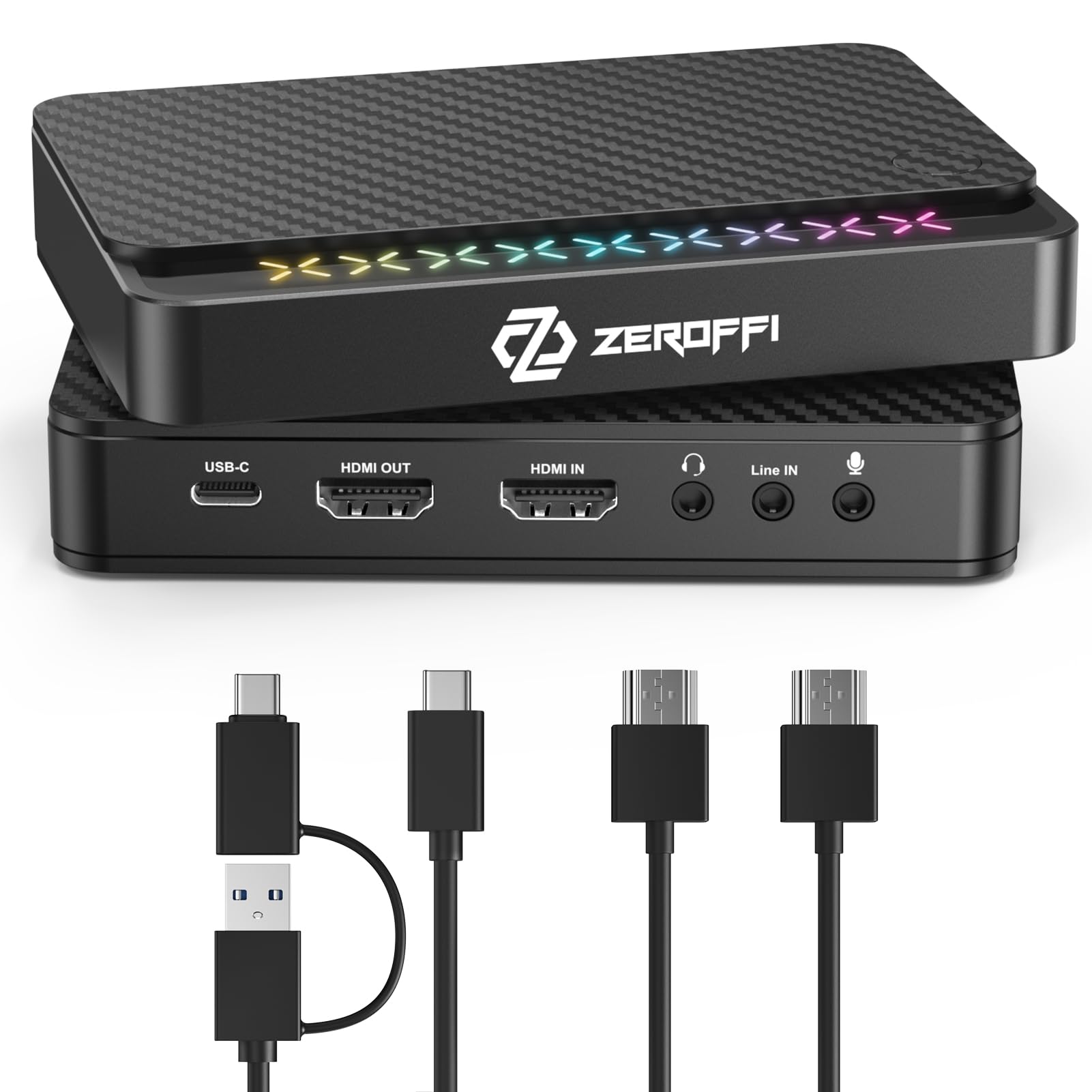
2. Zeroffi 4K Capture Card for Streaming
Budget box that passes 4K60 HDR, 1440p144 and 1080p240 through to your display.
Here’s the surprise: this entry-level card passes 4K60 HDR, 1440p144 and 1080p240 through to your display. That means your Xbox can feed a high-refresh monitor at 1440p and 144 frames per second while the card still records a clean copy. It also records at those same high figures — 4K60, 1440p144 or 1080p240 — so the separation between your live screen and the saved file is thin. It connects over a USB 3.1 Type-C interface, which is the fast version of the modern USB plug.
A built-in 3.5mm microphone and line-in input lets you capture game sound and your voice together, so you don’t need a separate sound card. That’s the piece most budget cards skip, and it’s here. Setup is plug-and-play on Windows and Mac, and it works in OBS, Twitch Studio, XSplit and Zoom.
One thing to plan around: HDCP protection blocks recording of copy-protected video, which includes streaming sticks like Fire TV and Roku and Blu-ray players. That won’t touch your Xbox gameplay, but it does rule out using this as a video ripper. On PlayStation you’d switch HDCP off in the console’s HDMI settings before it works.
Where the money went: the spec sheet punches above its budget badge — 4K60 HDR passthrough and a mic input are features premium cards charge far more for.
The honest trade: it’s a newer listing, so the long-term track record is thinner than the Elgato or AVerMedia cards here. That’s the value case in one line: you take a chance on a newer name to get 4K60 features at an entry-level tier.
The smart-money move: grab this if you want 4K60 passthrough and a mic jack without climbing into premium territory.
Hold off if: you need a decade of proven reliability behind the badge before you plug into your console.
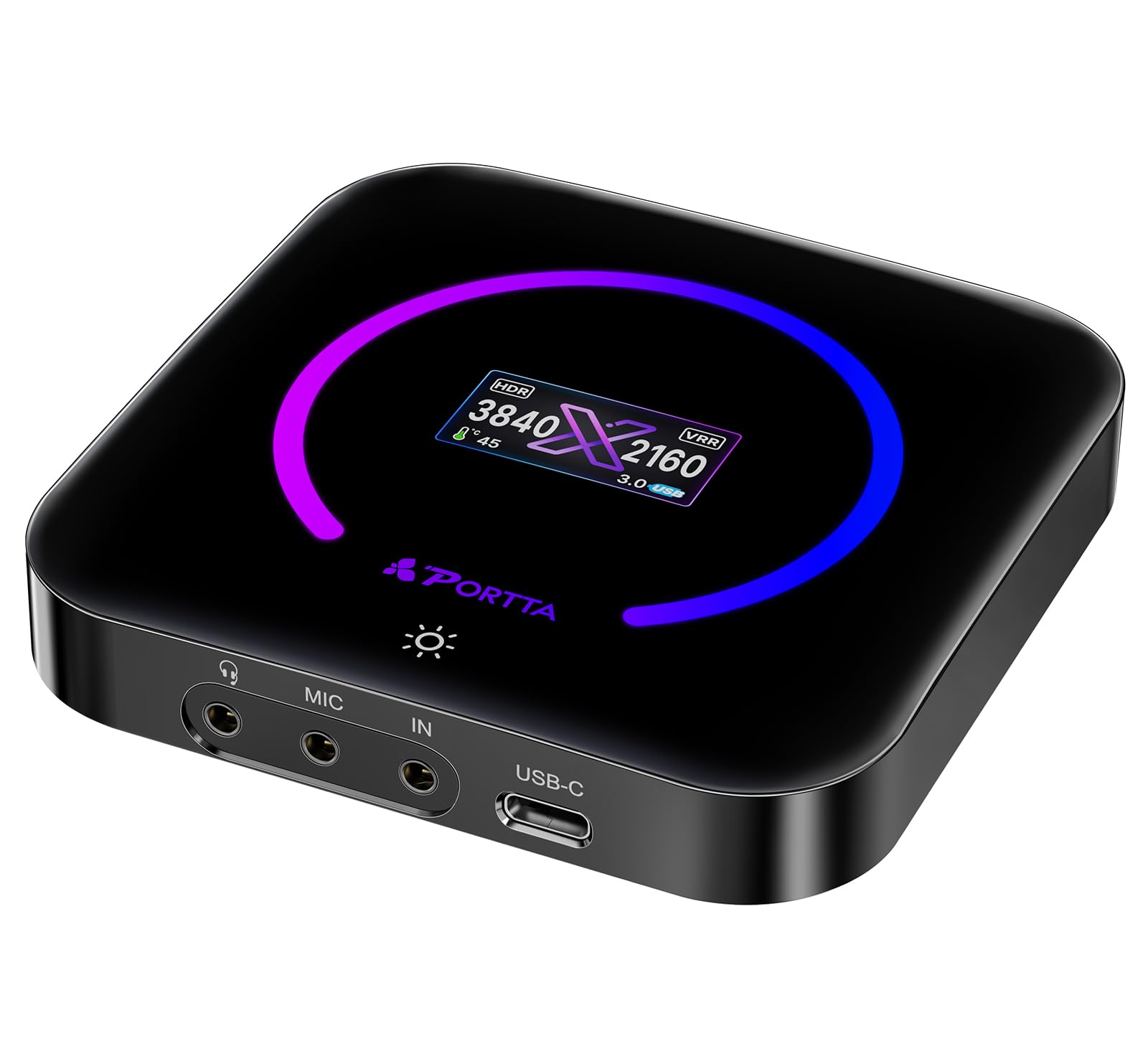
3. PORTTA DX20R HDMI Video Capture Card
A 68 g box that captures 4K60 and passes VRR and HDR through to your monitor.
What VRR does (Variable Refresh Rate) is match your monitor’s refresh to the game’s frame rate so the picture stops tearing. PORTTA builds that into both the capture and passthrough here, alongside HDR for richer contrast. Capture runs at 4K60, 2K144 or 1080p240, and it supports YUY2, NV12 and RGB24 formats for clean color in your recordings.
It’s light enough to tuck in a bag at 68 g, and the plug-and-play design works on Windows, macOS and Linux without a driver install. A smart switch handles display and ring-light control — hold it for 2-3 seconds — and there’s a desktop utility called PORTTA CapHub for tweaking video settings, mixing audio, updating firmware and managing EDID (the handshake that tells your display what signals it can accept) and VRR modes.
The following is worth knowing before you buy: for the small user base that has reviewed it so far, the card’s core function is what stands out — it’s recognized cleanly in OBS and treated as a solid USB capture adapter. Those reviews are thin compared to the bigger names here, so treat it as a promising newcomer rather than a battle-tested veteran.
Setup in practice: plug the HDMI in, run USB to your PC, and OBS sees it without chasing drivers — the kind of first-night experience that keeps you streaming instead of troubleshooting.
The trade-off to weigh: a newer, lighter-reviewed option, so the reliability story is shorter than the Elgato HD60 S or the AVerMedia cards. The spec list, though, is genuinely premium for its size.
Best fit for: a compact desk or travel bag where 4K60 and VRR passthrough both matter.
Think twice if: you want years of user feedback behind your purchase before you commit.
4. Osee GoStream M2 Capture Card, Dual 4K HDMI Input

Two 4K60 HDMI inputs and a physical switch button, so you cut between console and camera on one card.
Two 4K60 HDMI inputs on one box is the reason to look here. You can run your Xbox on one input and a camera or second console on the other, then flip between them with a physical switch — no second capture device. It records and outputs at 1080p60, with the frame rate following your UVC settings, and it sends that output to a TV, projector or laptop over USB-C.
A built-in 3.5mm microphone and audio input/output port lets you plug a headset or mic and layer your voice over the game sound. It also handles PIP and PBP effects (picture-in-picture and picture-by-picture, meaning one small window over the game or two windows side by side) with 4 PBP layouts and 4 zoomable PIP layouts. At 0.41 kg it stays portable, and USB 3.0 carries the data with low latency so your real-time game screen reaches your TV or laptop without a noticeable delay.
No drivers, no external power — it’s plug-and-play on Windows, Android, macOS and Linux, and works with OBS, VLC, Skype, Zoom, XSplit and Potplayer. Owners tend to be happy with the build: the quality of the hardware is the standout, and dual outputs plus ease of use come up as well. Compatibility is the softer spot, so confirm your specific platform before you rely on it for a big stream.
The dual-input trick: switching between two cameras mid-stream from one card is the feature most cards here simply don’t offer, and the 4K60 HDMI inputs handle up to 4K sources on both.
What it gives up: it’s a 1080p60 recorder, so the saved file won’t be 4K — that’s the price for the dual inputs and switcher controls at this tier.
Designed for: streamers juggling two sources — a console plus a camera — who want switching built in.
Not for you if: every recording has to come out in 4K.
5. EVGA XR1 Pro Capture Card, 1440p/4K HDR

A physical dial on the card itself for balancing game and voice audio mid-stream.
The calling card here is tactile: a built-in audio mixer you control with a dial and customizable RGB LEDs to match your setup. Audio balance on most cards means digging through software mid-stream; here you reach over and turn a knob. It passes 1440p at 144Hz HDR and 4K at 60Hz HDR through to your display, and captures at up to 1440p60 or 4K30.
It’s certified for OBS and genuinely plug-and-play — no driver install required — and it wants a USB 3.1 interface and an HDMI-compatible device. There’s a 2 Year Limited Warranty behind it. The chassis is big and chunky at 10 x 8 x 6 inches and 0.45 kg, which is a real spread compared with the compact Osee GoStream M2 at 0.41 kg and a far smaller body. Plan for that chunkier box on your desk.
Capture quality is what buyers rate highest here, with the low latency and the styling also earning praise. Video quality draws a split response — some find it great, some report low resolution — so set your recording expectations around what the card actually outputs. Value gets argued both ways. Keep the capture spec in mind: 4K tops out at 30 frames per second.
For the desk-bound streamer: the mixer dial and RGB make this feel built for a permanent setup, not a travel bag.
The watch-out: recording at 4K30 is the ceiling, so fast-motion 4K footage can look less fluid than a 60fps capture. The bigger body is the other trade.
Reach for this if: you want hands-on audio mixing and a branded-certified OBS experience on a stationary rig.
Look elsewhere if: desk space is tight or you need 4K60 recording.
6. AVerMedia Live Gamer Ultra 2.1 Capture Card

HDMI 2.1 in and out, passing 4K144 HDR/VRR, 1440p240 or 1080p360 to your display.
This is the card for high-refresh players. HDMI 2.1 passthrough carries up to 4K144 HDR/VRR, 1440p240 or 1080p360 to your display, so an Xbox Series X on a fast monitor isn’t throttled by the capture box. On the recording side it captures up to 4K144 MJPEG on supported Windows PCs through AVerMedia Streaming Center, while macOS tops out at 4K60 with HDR capture reserved for Windows. A note: monitors using DSC (a compression trick some displays rely on) may limit 4K passthrough to 4K120.
The connectivity is USB-C at 10Gbps, and the card pairs with Windows, Mac or iPad for PS5, Xbox Series X/S, Nintendo Switch 2 and PC. Dual 3.5mm four-pole ports capture headset and gamepad audio, with 5.1-channel audio for compatible Windows workflows — that’s surround sound, useful when you’re mixing party chat with game sound. It runs through an OBS plugin or Streaming Center, and the RGB supports Windows Dynamic Lighting.
Buyers find it quick to set up and handy as a recording companion — a second monitor you can capture from. Audio is the mixed signal, with audio sync complaints sitting alongside praise for the 4K 60fps streaming. The pattern says: expect great passthrough, and be ready to nudge audio sync in your software.
The headroom story: 4K144 passthrough and 1080p360 leave room for whatever frame rate your monitor can show, which is more than the EVGA XR1 Pro’s 1440p144 ceiling offers.
The catch: the top capture rates depend on a supported Windows PC, so Mac users get a lower ceiling.
Built for: high-refresh HDMI 2.1 setups where 1440p240 or 4K144 passthrough is the whole point.
Go a different route if: you’re on a Mac and need the highest capture rates, or you want zero audio fiddling.
7. ASUS TUF Gaming Video Capture Card (CU4K30)

An alloy shell built for a backpack, passing 4K HDR at 60 Hz through to your TV.
If your setup moves — tournament to tournament, room to room — the durable alloy outer shell is the reason this card earns its spot. It passes video through at up to 4K HDR at 60 Hz while capturing up to 4K at 30 Hz, 2K at 60 fps or Full HD at 120 fps for high-quality streams. The split between passthrough and capture is the key spec to read here.
Plug & Play UVC means you connect to any PC over USB 3.2 Type-C and start streaming with no extra drivers or utilities, and it’s certified for OBS Studio. Controller and headset connections let you route team comms audio to your audience — a nice touch when you’re playing with friends and want the chat in the stream. At 423 g it’s a solid, weighty box rather than a featherweight.
Performance is the trait buyers rate highest, with ease of use close behind, so the setup experience lives up to the plug-and-play promise. Functionality and picture quality draw split reactions, and latency and audio quality get mixed notes as well — worth setting modest expectations if you need pinpoint, low-latency audio capture. The 4K30 recording ceiling is the spec most likely to catch you out.
Reasons it earns a spot
- Alloy shell takes travel and knocks better than a bare plastic box
- 4K HDR passthrough at 60 Hz keeps your TV looking sharp while you capture
- Certified for OBS and truly plug-and-play over USB 3.2 Type-C
- Controller and headset pass-through lets viewers hear team comms
Set expectations here
- 4K recording tops out at 30 fps — fast motion won’t be as fluid as 60fps
- Heavier at 423 g, so it’s a desk weight rather than a pocket extra
Choose it when: the card lives in a bag and takes knocks between sessions.
Pick something else if: you need 4K60 recording for fast-motion gameplay.
8. Elgato 4K Pro Internal Capture Card, 8K60 Passthrough

An internal PCIe card that passes 8K60 straight to your display while capturing 4K60 HDR10.
This one goes inside your tower rather than onto your desk. The HDMI 2.1 in/out carries an 8K60 passthrough to your display while capturing in 4K60 HDR10, with recording up to 240fps in 1080p for high-frame-rate clips. VRR passthrough keeps screen tearing away, and ultra-low latency keeps your broadcast in sync with gameplay.
An internal card means no clutter and a direct run from your console to your desktop, which suits a permanent setup. It pairs with any app — OBS, Streamlabs, Twitch Studio, Restream, Zoom, Teams — and streams to YouTube, Twitch, Discord or Facebook Gaming. Dual PC setups are supported too, so a two-machine rig can share it.
What buyers like most is the overall quality and the easy install, with the video output itself drawing a split response. Passthrough lag is close to nothing, but stutters that show up at intervals are the recurring gripe, and monitor signal loss comes up too. Some find the value fair and others less so, and Linux users hit compatibility walls. That said, it’s an impressive spec sheet for the price tier.
The spec headline: 8K60 passthrough is the highest on this list, and 1080p240 recording gives high-frame-rate players room the Elgato HD60 S never had.
What to know: it needs an open slot inside your PC, and the intervals-between-stutter and signal-loss notes are the honest trade for the ceiling it offers.
Best for: a permanent desktop build that wants the highest passthrough resolution available here.
Skip if: you’re on a laptop, on Linux, or want a card you can unplug and carry.
9. AVerMedia Live Gamer Ultra GC553 – 4K60 HDR Pass-Through

4K60 HDR passthrough, low latency, and a long track record behind it.
The GC553 passes 4K at 60 frames per second with HDR through to your display, so your Xbox Series X game looks its best on your TV while the card records separately. Recording caps at 4K30, 1440p60, 1080p120 or 1080p60 HDR, so plan your saved file around that. Ultra-low latency lets you play essentially off your PC monitor with next to no delay.
Small and light at 4.43 x 2.6 x 1.02 inches and 4.16 ounces, it sits easily beside a console. In the box you get an HDMI 2.0 cable and a USB Type-C to Type-A cable, plus a CyberLink PowerDirector 15 product key for editing. The system requirements note are a Windows 10 x64 machine with an Intel Core i5-4440 or above and an NVIDIA GTX 660, and for 4K, HDR or high-frame-rate recording only NVIDIA graphics cards are supported.
The user base is large and steady, and it earns its reputation for ease of use — it’s often described as the card to beat. Compatibility is where it draws a split: it works well with OBS, but some buyers find it doesn’t work with Mac. Check that against your platform before you commit.
Why it’s the safe pick: 4K60 HDR passthrough plus low latency is the combination that matters most, and this card delivers both in a light, compact body.
The caveat to hold: 4K recording is 30fps, and if you stream on Mac you’re better served elsewhere. On a Windows PC with an NVIDIA card, the fit is clean.
Good match for: a Windows PC with NVIDIA graphics where 4K60 HDR passthrough is the priority.
Not for: Mac-based streamers or anyone who needs 4K60 recording.
Know the Specs
Passthrough vs Capture Resolution
Passthrough is what reaches your own screen — the version you play on, so it must stay smooth and lag-free. Capture is the recorded copy, and it can be lower than passthrough. A card that passes 4K60 HDR through while capturing 4K30 keeps your TV sharp while saving a slightly less fluid file. Read both numbers, because they are two separate jobs.
HDMI 2.1 vs HDMI 2.0
HDMI 2.1 is the newer standard and carries higher refresh figures, which is why the Live Gamer Ultra 2.1 reaches 4K144, 1440p240 or 1080p360 passthrough while HDMI 2.0 cards top out lower. If your monitor and console support 120Hz or more, an HDMI 2.1 card is the one that won’t throttle it. On a 60Hz screen, HDMI 2.0 is plenty.
VRR and HDR
VRR (Variable Refresh Rate) matches your display’s refresh to the game’s frame rate to stop tearing. HDR (High Dynamic Range) adds contrast and color range. Cards here vary: some pass both through, some support HDR capture only on Windows. Check which mode you need for both the live picture and the saved file.
USB Interface Speed
USB 3.0, 3.1 and 3.2 Gen 2 are the fast USB ports that carry a full high-resolution video stream to your PC. A USB 3.2 Gen 2 Type-C connection, for example, moves data at 10Gbps. A slower port can bottleneck capture, so match the cable and port on your PC to the card’s spec.
Common Questions
Will an Xbox capture card lower the picture on my TV while I record?
Do I need HDMI 2.1 for Xbox Series X capture?
Can I use a capture card with a Mac?
Why won’t my capture card record a streaming stick or Blu-ray player?
What is the difference between passthrough resolution and capture resolution?
Do I need a separate sound card for party chat?
Is an external card or an internal card better for Xbox streaming?
What kind of PC do I need to run these capture cards?
Can a capture card also switch between two cameras?
Will my capture card work in OBS without extra software?
The Bottom Line
For most Xbox streamers, the best xbox capture card hdmi setup starts with the Elgato HD60 S because it does one job — clean 1080p60 capture with lag-free passthrough — more reliably than anything else here, and its long-running 4.5+ star standing backs that up. If you want 4K60 passthrough and a mic input without a premium price, the Zeroffi 4K Capture Card punches well above its tier. And for high-refresh play on an HDMI 2.1 monitor, the AVerMedia Live Gamer Ultra 2.1 is the one that keeps your 1440p240 display fed. Pick the card that matches your display’s top resolution, and you’ll never feel the capture box holding your game back.
How we choose
We do not accept paid placement. Every pick is matched to a real buyer and a real use-case; we do not hands-on test units.
Sources
Specifications: manufacturer listings and product documentation. Review insights: verified customer reviews, as of November 2026. Pricing: not shown on this page (it changes often); check the current price via the retailer link.
As an Amazon Associate, Tactical Gear Guy earns from qualifying purchases. This does not affect which products we feature.