Specs are compiled from manufacturer listings and verified buyer reviews and can change over time — please confirm the key details on the product page before buying.
You want to record or stream your Xbox 360 games without a blurry, stuttering mess — and the fix is picking a capture card that passes the picture through untouched while recording a clean 1080p 60FPS file. The short answer: most Xbox 360 players should start with the Swudloe C7-01. It is the crowd favorite at 4.0+ stars across 600+ ratings, it takes a 4K 30Hz signal in, and it captures at 1080p 60FPS over a real USB 3.0 connection. Below you get the full picture on seven cards that all work with an Xbox 360, sorted by what each one is actually good at.
This guide is built by comparing the manufacturers’ published specifications and the patterns across verified customer reviews, so you get each pick’s real strengths and trade-offs instead of marketing spin.
Some cards here record straight to a USB stick with no computer at all, while others are built for OBS and Twitch. The trick is matching the card to how you actually play, and this breakdown of the xbox 360 capture card market sorts seven of them by what each does best.
Top Picks

How To Choose The Best Xbox 360 Capture Card
The Xbox 360 outputs its picture over HDMI, and every card on this list accepts that signal. What separates them is what happens after the signal goes in — whether the card passes a lag-free image to your TV while it records, and whether it needs a computer to work at all.
Pass-through versus capture-only
A pass-through port lets the card send the game picture straight to your TV while it records a copy to your PC. You keep playing on the big screen with no delay in your controls. Cards without a pass-through force you to watch the game inside your recording software, which can feel slightly behind your button presses.
Recording to a drive or to a PC
Some cards are stand-alone recorders. You plug a USB flash drive into the card, press a button, and the gameplay saves as a file — no computer needed. Others are built to feed a laptop running OBS or similar software for live streaming. Decide which workflow matches your room before you buy.
Resolution and frame rate
Many cards accept a 4K input but record at 1080p 60FPS, which is plenty for the Xbox 360’s own output. The number to watch is the capture figure, not the input figure. A card that captures 1080p at 60FPS keeps fast motion smooth instead of smearing it.
Side-by-Side Comparison
| Model | Best For | Capture Resolution | Connection | Pass-Through | Amazon |
|---|---|---|---|---|---|
| Swudloe C7-01★ Best Overall | Most people | 1080p 60FPS | USB 3.0 | 4K 30Hz | Amazon |
| Mirabox HSV3202Best for Beginners | Beginner streamers | 1080p 60FPS | USB 3.0 | 4K loop-out | Amazon |
| Pyle PHDRCB48 | Simple PC recording | 1080p | USB 3.0 | HDMI | Amazon |
| MYPIN HD Game Recorder | No-PC recording | 1080p | USB | — | Amazon |
| SDTNOVA SDI/HDMI | SDI camera work | 1080p 60FPS | USB 3.0 | Dual sync | Amazon |
| ASUS TUF CU4K30 | High frame rate streaming | 4K 30 / 1080p 120 | USB 3.2 Type-C | 4K HDR 60Hz | Amazon |
| j5create JVA06 | Two-console setups | 1080p 60Hz | USB-C | Dual HDMI | Amazon |
Detailed Reviews
1. Swudloe Capture Card
Our pick — 4.0+★ from 600+ verified ratings; the strongest balance of quality and price.
The do-everything card that keeps your TV picture live while your PC grabs the clean copy.
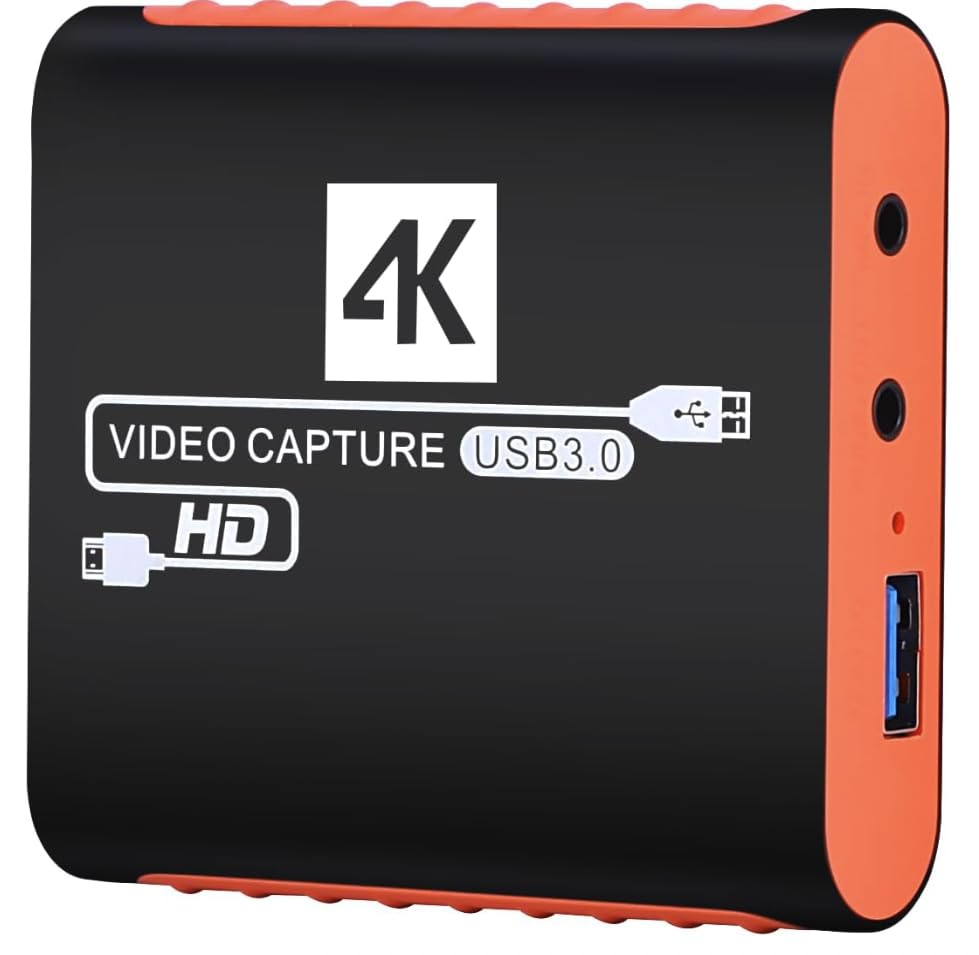
What makes this the pick for most people is the pass-through: it accepts a 4K 30Hz input and sends it to your TV with zero latency while it records a 1080p 60FPS copy over USB 3.0. For your Xbox 360 that means you play on your normal TV with no delay in your controls, and the file that lands on your PC is smooth at 60 frames a second. The 0.17 kg body is light enough to sit behind a TV without sagging the cable.
Setup is genuinely plug-and-play: no drivers, no external power, and your PC detects it the moment you connect it. The card runs on a real USB 3.0 protocol chipset (the fast USB standard that carries video without lag), needs no drivers or external power, and your PC detects it automatically the moment you plug it in. A 3.5mm mic-in port (the standard small headphone-style jack) lets you add commentary from a headset or microphone while you play — a nice touch at this tier. It does not record party chat, so keep that in mind if your friends’ voices are part of the show.
It works across Windows, Mac OS, Unix and Android, and lists the Xbox 360 alongside the Xbox One, PS5, Switch and DSLR cameras as compatible sources. OBS recognizes both audio and video cleanly. The honest trade-off: your stream quality still depends on your PC and your OBS settings, but the hardware side is handled.
Where owners have found it shines
- Genuine USB 3.0 chipset delivers a true 1080p 60FPS capture
- Zero-latency 4K 30Hz pass-through keeps the TV picture live
- No drivers, no power brick — detected automatically
- 3.5mm mic-in for adding your own commentary
What to weigh before buying
- Does not record party chat, so teammates’ voices stay out of the file
- USB 3.0 output is capped at 1080p 60FPS rather than 4K
Reach for this if: you want one card that plays live on your TV and records clean 1080p 60FPS to a PC for OBS, Twitch or YouTube.
Pass if: your goal is keeping the whole party chat in the recording.
2. Mirabox USB3.0 4K HDMI Video Capture Card, 1080P 60FPS
A compact, standardized little box that treats your first stream as the goal, not an afterthought.
The first thing you notice is the size and weight: at 105 g it slips into a laptop bag and mounts behind a monitor without complaint. Mirabox built this one for people taking their first steps into streaming — the card is described as stylish, compact and standardized, and it plugs in with no driver install at all. You get input up to 4K and capture at 1080P 60Hz, with a zero-latency HDMI pass-through port that lets you watch the game live while you broadcast.
Performance is where the picture gets more honest. Buyers report mixed results — it works well for a lot of people and less well for others. Treat it as a card that suits straightforward 1080p setups rather than a guaranteed universal fix. Audio is the recurring weak spot: owners mention the sound sometimes fails to pass through and can come out in mono (single-channel audio) on some setups. If crystal audio is your whole reason for buying, run a quick test early while you can still return it.
You can check your PC against the published requirements before you buy. The card needs a 64-bit Windows 7/8/10 machine (the 64-bit version of Windows handles more memory), a 4th-generation quad-core Intel Core i5 or equivalent, integrated Intel HD or NVIDIA GeForce GTX 600-series graphics or better, 4 GB RAM, and a built-in USB 3.0 port. That is more detail than most cards give you, and it tells you straight whether your PC qualifies.
Suits the starter setup: a laptop with a USB 3.0 port and a 1080p monitor is all this card asks for, and the published hardware checklist means you can confirm your machine matches before you buy.
The audio caveat: the mixed reports center on sound dropping or coming through in mono, so budget a short test window after it arrives.
Reach for this if: you are new to OBS and Twitch and want a light, driver-free card to learn on.
Look elsewhere if: your plans hinge on flawless stereo audio capture.
3. PyleUsa Capture Card Device

Pyle’s understated recorder that converts what it captures into a digital file while playing live.
It barely takes up space behind your screen. At 2.08 ounces this is one of the lightest cards here, and its shape is the most compact of the bunch — the Pyle measures 0.67 x 2.21 x 3.75 inches against the Swudloe’s 0.75 x 2.95 x 3.15 inches. It records in full HD 1080p (1920 x 1080 pixels) with HDMI pass-through support (the signal still reaches your TV while you record), and after the recording it converts the file into a digital format so the footage is ready to edit or upload.
Streaming works the way you would want: the card plays and records at the same time, letting you broadcast to YouTube or social media while the file saves in parallel. Pyle lists the Xbox 360 alongside the Xbox One, PS4, PS3, Wii U, Blu-ray players and set-top boxes as usable sources, so the 360 sits comfortably in its supported list.
The system requirements set a clear floor: an Intel Core i5 processor or above and 4 GB of RAM or above. That is worth checking against your machine before you commit, because this card leans on your PC to do part of the work. If your PC clears the Core i5 and 4 GB RAM bar, it handles a record-then-convert workflow without extra software.
The practical angle: simultaneous play and record plus digital file conversion covers the whole loop from playing to sharing in one box.
Check your specs first: the Intel Core i5 and 4 GB RAM requirement is a real threshold, so confirm your machine clears it.
Built for: a PC owner who wants to capture and convert gameplay files in one step.
Think twice if: your computer falls below an Intel Core i5 or 4 GB of RAM.
4. MYPIN 1080P HDMI Video Capture Card HD Game Recorder

Plug in a flash drive, hit one button, and your 360 match is saved with no computer in sight.
This is the odd one out in the best way: it does not stream at all. Instead it captures 1080p gameplay and saves it straight to a FAT32 USB flash drive or external hard drive. That means it is not built for OBS Studio, VLC or YouTube live — the maker is explicit about that. If your goal is simply to save your Xbox 360 matches, this is the cleanest path on the list.
Recording is a single button press to start and another to stop, and it saves videos directly to the drive without any adjustment. It supports up to 128G for a USB drive and 2TB for a hard drive on an MBR partition, and it works with both USB 3.0 and USB 2.0.
There is a microphone input for adding your own commentary, but it only accepts a 3.5mm TRS standard microphone headset and it does not record party chat. The honest catch: recording occasionally fails, and since this card runs without a PC there is no screen feeding back what is happening. Check your drive after each long session until you trust it.
Why it earns a spot
- Records to a USB drive or external HDD with no PC needed
- One-touch start and stop for easy saving
- Supports up to 128G flash drives and 2TB hard drives
The realities to accept
- Will not work with OBS, VLC or YouTube streaming
- Mic input only accepts a 3.5mm TRS headset
Reach for this if: you want to archive 360 matches to a flash drive with zero software setup.
Look elsewhere if: you plan to livestream to Twitch or record through OBS.
5. SDTNOVA SDI & HDMI Dual Input & Dual Output Video Capture

The broadcast-grade box that treats SDI cameras and your Xbox 360 with identical seriousness.
This card carries a 360MB/s transmit bandwidth over USB 3.0, which is the sort of throughput a professional workflow wants. It handles both HDMI and SDI inputs and outputs simultaneously, capturing HDCP 1080P at 60FPS in a compatible YUV422 format for game streaming and recording. What wins people over most here is raw functionality — dual HDMI and SDI in and out at 360MB/s, with the quality feedback to back it up.
Lossless input is the headline: the card takes uncompressed HDMI video straight into a computer with no encoding, so the footage stays original rather than squeezed. It is UVC-compatible and works with no driver install, with a driver included for Windows to keep plug-and-play smooth. The 9.6-ounce metal build is the price of the SDI hardware inside; the compact Mirabox weighs 105 g.
It lists the Xbox 360 among its compatible sources alongside the Xbox One, PS4 and Wii U over unencrypted HDMI, and it works with Big-name software like VLC, Wirecast and Adobe Flash Media Live Encoder. The honest limit: this is built around camera work and SDI, so a plain 360 streaming setup is paying for capability it may never need. For anyone also running an SDI camera, though, the dual input earns its place.
Where it leads: simultaneous HDMI and SDI in and out at 360MB/s is a level of throughput the simpler cards do not reach.
The honest cost: the SDI hardware and metal body make it heavier and pricier than a pure console recorder needs to be.
Built for: streamers who also run an SDI camera and want one card to handle both sources.
Think twice if: your only source is an Xbox 360 and you want the simplest option.
6. ASUS TUF CU4K30 Capture Card

ASUS brings certified OBS support and 120FPS headroom to a capture box built like a tank.
The number that stands out is 120 frames per second at Full HD, paired with 4K up to 30 fps and 2K up to 60 fps capture. It passes through 4K HDR at 60 Hz while offloading the capture separately, so your TV picture stays crisp while the box records. The alloy outer shell keeps it durable over time in a slim footprint — at 423 g it is heavier than a bare capture stick, but it is built to survive long streaming sessions.
ASUS made the software side easy. It is certified for OBS Studio, so it works smoothly across streaming platforms, and the plug-and-play UVC design connects to any PC with a USB 3.2 Type-C port with no extra drivers or utilities. Controller and headset connections let audio from your team comms be shared with your audience, which is a useful extra for anyone broadcasting their 360 sessions.
Buyers praise responsiveness and easy setup most; picture quality, latency and value draw mixed opinions. Picture quality, latency and value draw mixed opinions, so treat it as a high frame-rate specialist rather than a flawless all-rounder. Its requirements are specific: a USB 3.2 Type-C port on your PC and enough power to handle your chosen resolution and frame rate.
The draws
- Captures Full HD up to 120FPS with 4K and 2K options
- Certified OBS Studio compatibility from the start
- 4K HDR 60Hz passthrough for the live TV picture
- Alloy shell built for long sessions
The trade-offs
- Needs a PC with a USB 3.2 Type-C port
- Heavier at 423 g than a simple capture stick
Reach for this if: you want certified OBS support and 120FPS capture with 4K HDR passthrough.
Look elsewhere if: your laptop has no USB 3.2 Type-C port.
7. j5create JVA06 Capture Card

Two HDMI inputs, six screen layouts, and one box for the streamer juggling more than a console.
Most cards here take one source; this one takes two. The JVA06 has dual HDMI inputs for capturing two channels at once, each in uncompressed 1080p 60Hz through HDMI 1.3a. It offers six screen mode configurations including PIP (picture in picture) and PBP (picture by picture), so you can show your 360 gameplay beside a second feed or a camera without extra software gymnastics.
Audio gets unusual attention: you can pull sound through HDMI or add external audio with a 3.5mm mic-in and speaker-out jack, and there are three individual audio mixer on/off switches with three channel volume indicators. Full HD video and audio record and play back through USB-C 3.1 Gen1, so modern laptops connect straight in. The compact body measures 2.51 x 5.3 x 0.72 inches.
It also passes 60W of power delivery through to your connected device, which is handy when your laptop is powering the whole rig. The catch is that all this is built for two-source productions — if you have a single Xbox 360 and one screen, you are paying for inputs you may not use. For a stream with a console and a camera at once, the dual HDMI earns its keep.
Where it earns its keep: two HDMI inputs with PIP and PBP layouts (picture-in-picture and picture-by-picture, so two feeds share one screen) plus three audio mixer switches — something the single-input cards here cannot do.
Weigh the scenario: one console and one screen leaves the second input idle.
Built for: streamers running a console and a second source at the same time.
Think twice if: you only capture one Xbox 360 feed and never use a camera.
Know the Specs
Capture Resolution and Frame Rate
This is the size and speed of the file your card actually records, and it is different from what the card can accept. A card might take a 4K input but still save at 1080p 60FPS. The frame rate — in FPS, or frames per second — matters for fast motion: 60FPS keeps action smooth, while a lower rate can smear it. For the Xbox 360’s own output, 1080p at 60FPS is the practical target.
Pass-Through and Latency
A pass-through port sends the game signal straight to your TV while the card records a copy. Latency is the delay between your button press and what you see, and a zero-latency pass-through keeps that delay out of your play. Cards with a 4K 30Hz pass-through let you play live on the big screen without watching the recording software. Without one, you watch the game inside your PC and can feel slightly behind.
USB 3.0, UVC and YUV422
USB 3.0 is the fast connection that carries 1080p 60FPS video without choking. UVC means the card is recognized as a standard camera device, so no driver is needed for plug-and-play. YUV422 and YUY2 are video formats that describe how colour data is carried — they translate to clean, uncompressed-looking footage rather than a squeezed image. All of these keep setup simple and picture quality high.
Recording to a Drive vs a PC
Some cards save directly to a USB flash drive or external hard drive with no computer at all, pressing one button to record. Others feed a PC running OBS for live streaming. The drive method is simpler and portable but cannot stream; the PC method is more flexible but needs a computer and software. Pick based on whether your goal is archiving matches or broadcasting them.
Common Questions
Will a capture card work with the Xbox 360’s HDMI output?
Do I need a computer to record my Xbox 360 gameplay?
What is the difference between pass-through and capture resolution?
Can a capture card record party chat voice audio?
What PC specs do I need for a 1080p 60FPS capture card?
Does a capture card add lag to my game while I play?
Can I plug a microphone into the capture card for commentary?
What does it mean when a card is certified for OBS?
Which card should I pick if I want to stream and record at the same time?
What is the most important spec to compare on these cards?
The Bottom Line
For most Xbox 360 players, the xbox 360 capture card winner is the Swudloe C7-01 — it passes through at 4K 30Hz (3840 x 2160 pixels at 30 frames per second) with zero latency while it records a clean 1080p 60FPS file over USB 3.0, and it is the crowd favorite here for good reason. If you would rather skip the computer entirely and save matches to a flash drive, grab the MYPIN HD Game Recorder. And for streaming a console alongside a camera at once, the j5create JVA06 is the one to reach for with its dual HDMI inputs and picture-in-picture layouts.
How we choose
We do not accept paid placement. Every pick is matched to a real buyer and a real use-case; we do not hands-on test units.
Sources
Specifications: manufacturer listings and product documentation. Review insights: verified customer reviews, as of November 2026. Pricing: not shown on this page (it changes often); check the current price via the retailer link.
As an Amazon Associate, Tactical Gear Guy earns from qualifying purchases. This does not affect which products we feature.