Specs are compiled from manufacturer listings and verified buyer reviews and can change over time — please confirm the key details on the product page before buying.
Your X99 board runs an LGA 2011-3 socket, and that older mounting pattern is exactly where most cooler shopping goes wrong. Plenty of listings say “universal” but quietly leave 2011-3 off the bracket list. The four picks below all explicitly list 2011-3 or 2011-v3 support, so you can buy without measuring a hole spacing and hoping. Short answer: the CoolerMaster MasterLiquid ML240L RGB V2 is the safest all-round buy, the Thermalright Aqua Elite 360 V3 is the best cooling-per-dollar for a big X99 chip, the be quiet! Pure Loop 2 FX 360mm is the quietest of the group by its own rating, and the Dracaena.io 120mm is the one to grab when your case has no room for a big radiator.
This guide is built by comparing the manufacturers’ published specifications and the patterns across verified customer reviews, so you get each pick’s real strengths and trade-offs instead of marketing spin.
Cooling an X99 build is mostly about radiator surface and bracket honesty, not brand badges. Below you get plain-English specs, a scannable table, and a straight answer on which of these four to buy for your case and your chip.
Every pick here lists LGA 2011-3 support, so this x99 cpu cooler radiator shortlist is filtered for fit first and thermal headroom second.
Top Picks
How To Choose The Best X99 CPU Cooler Radiator
X99 is an older platform, but the chips that sit on it still throw real heat when you load every core. The cooler you pick has to clear two hurdles before anything else matters: it must physically mount on LGA 2011-3, and it must move enough heat to keep a multi-core chip out of throttle territory. Everything after that is a trade between radiator size, fan noise, and how much space your case gives you.
Start with the bracket, not the badge
LGA 2011-3 uses its own mounting pattern, and it is not the same as the newer LGA 1700 or 1200 holes. Look for “2011-v3,” “2011-3,” or “2011 Square ILM” written directly in the compatibility list. All four coolers here name it, which is why they made the cut. A cooler that lists only 1151 or 1200 will not bolt down without a separate bracket.
Match radiator size to your case, then to your heat load
A 120mm radiator (one fan’s worth of surface) is the compact choice and the easiest to squeeze into a small chassis. A 240mm radiator doubles that surface, and a 360mm triples it. More surface generally means the fans can spin slower for the same result, which is how you get quieter cooling. Measure your case’s radiator mounts before you fall for a big three-fan unit.
Read cfm, rpm, and dBA together
Airflow is measured in cfm (cubic feet per minute — how much air the fan pushes). Fan speed is rpm (revolutions per minute). Noise is dBA (decibels, the loudness you hear). A fan that pushes high cfm at low rpm is the quiet choice. A fan that needs high rpm to move air will get loud fast. On an X99 build that idles a lot but spikes under load, PWM control (fans that slow down when the chip is cool) is the feature that keeps the room calm.
Pump lifespan and seal quality are the long game
An all-in-one liquid cooler is only as good as its pump. Hydraulic and magnetic bearings are the two designs aimed at longer, quieter pump life. Seal materials like EPDM (a rubber compound used in the fittings) are there to resist leaks over years of heating and cooling. On a workstation that runs all day, that longevity matters more than a few degrees of peak cooling.
Side-by-Side Comparison
| Model | Best For | Radiator Size | Max Fan Speed | Noise Level | Amazon |
|---|---|---|---|---|---|
| CoolerMaster MasterLiquid ML240L RGB V2★ Best Overall | Most X99 builds | 240mm | 1800 rpm | 30 db | Amazon |
| Dracaena.io 120mm AIO | Small cases | 120mm | 2400 rpm | 28.8 db | Amazon |
| Thermalright Aqua Elite 360 V3 | Big heat loads | 360mm | 1500 rpm | 25.6 db | Amazon |
| be quiet! Pure Loop 2 FX 360mm | Quiet-focused builds | 360mm | 1800 rpm | 34 db | Amazon |
Detailed Reviews
1. CoolerMaster MasterLiquid ML240L RGB V2
Our pick — 4.5+★ from 9,500+ verified ratings; the strongest balance of quality and price.
The crowd favorite that nails X99 fit and cooling at a mid-range price.
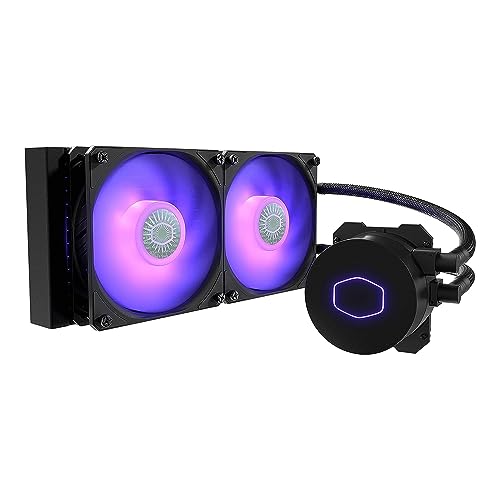
Here is the pick for a typical X99 build that needs real cooling without a three-fan radiator. The MasterLiquid ML240L RGB V2 pairs a 240mm radiator with a third-generation dual-chamber pump — two separated chambers inside the pump that keep the liquid moving more efficiently. That combination is what makes it the safest all-rounder on this list. CoolerMaster also lists 2011-v3 in its compatibility line, so the bracket question is settled before you order.
Airflow lands at 62 cfm across two PWM fans, and those fans top out at 1800 rpm. Higher airflow at a controlled speed means the radiator sheds heat without the fans screaming. At 30 db, it is the middle of the noise field here — quieter than the be quiet! unit, but louder than the Thermalright. Buyers praise its cooling most: it holds temperatures under sustained load, which is what a hot X99 chip demands.
The trade-off is the lighting and the mounting. RGB is listed, but the fan colors do not always match the settings you dial in, so treat the lighting as decoration rather than a guarantee. Mounting is described as mixed, and one practical wrinkle: the LGA 1700 bracket ships as a separate kit, so confirm the 2011-3 hardware in the box before you start. Weighing 1340 g, it is a substantial unit — expect to hold it in place while you thread the screws.
What earns its top spot
- 240mm radiator and third-generation dual-chamber pump handle sustained X99 heat
- LGA 2011-v3 explicitly listed, so the bracket fits without guesswork
- 62 cfm airflow at 1800 rpm keeps cooling strong at a moderate fan speed
- 30 db noise sits comfortably between the louder and quieter picks here
What to plan around
- RGB fan colors do not always match your chosen setting
- Mounting is described as mixed — allow extra time for the bracket
- 1340 g is the heaviest body on this list
Reach for this if: you want a proven 240mm cooler with 2011-v3 support and a fair mid-range price.
Think twice if: you have a 360mm mount and a very hot chip — the Thermalright gives you more radiator surface for less noise.
2. Thermalright Aqua Elite 360 V3

Three fans, a tripled radiator, and the lowest noise number of the group.
The number that jumps out is 66.17 cfm from three TL-C12b-S V2 fans. That is more airflow than the CoolerMaster above pushes at 62 cfm, and it comes from a 360mm radiator instead of a 240mm one. More surface plus more airflow is the combination that lets this cooler run the fans slowly. Those fans top out at 1500 rpm with PWM control, so they speed up only when the chip heats up and settle down when it does not.
Slower fans at 1500 rpm is a big part of why the noise figure lands at 25.6 db — the lowest here. Compare that to the be quiet! unit at 34 db and you can see the direction this pick leans. The Stably-FDB magnetic stabilization bearing is designed to stop the fan blades from wobbling, which further reduces noise and stretches fan life. Buyers praise its cooling and build quality most, and they describe the install as easy. The fans arrive pre-mounted on the radiator, and an included fan hub saves you from running out of headers.
Here is the honest catch: a 360mm radiator needs a case that actually has a 360mm mount, and smaller mid-towers often do not. If your chassis only takes a 240mm, this pick is out before cooling even enters the conversation. The 1500 rpm ceiling also means less peak brute-force airflow than a faster-spinning fan could deliver, though the extra radiator surface largely covers for it. This is the pick for a big X99 chip in a case with room to breathe.
Why it leads on noise: three 120mm fans spinning at 1500 rpm with a magnetic-stabilized bearing produce 25.6 db while still moving 66.17 cfm, so the radiator does the work the fans would otherwise have to.
Where it fits: a full or mid tower with a 360mm mount and a hot multi-core X99 processor. Without that space, look down the list.
Best for: high-heat X99 builds in a roomy case where low noise is the priority.
Not for: compact chassis limited to a 240mm radiator mount.
3. Dracaena.io 120mm AIO CPU Cooler
The compact escape hatch when your case leaves no room for a big radiator.
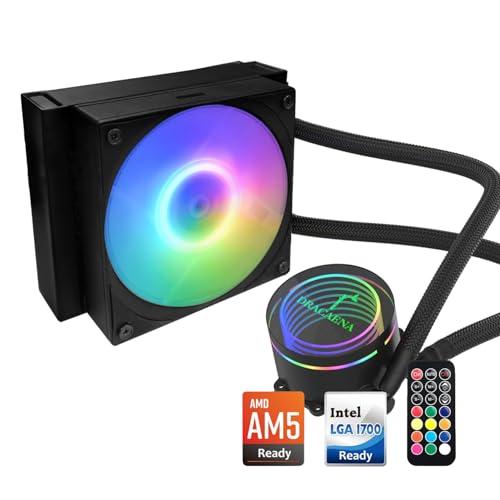
Space is the whole reason this one exists. The Dracaena.io uses a single 120mm radiator with an aluminum frame and copper cold plate, sized to slot into small cases that cannot take a 240mm or 360mm unit. It is rated to handle up to 180W TDP — the rough heat output the cooler is built to dissipate. That ceiling is what makes it a sensible fit for a modest X99 chip and a risky one for a heavily loaded multi-core monster. Its compatibility line names LGA 2011-V3 directly, so the mounting is covered.
Weight tells the compact story: 500 g against the CoolerMaster’s 1340 g, so it hangs light on the board. The hydraulic bearing pump runs at 2400 rpm with a stated 40,000-hour lifespan, a durability figure that matters on a workstation left running for years. Noise is officially 28.8 db, and the fan moves 30–65 cfm across a 500–2200 rpm range. Owners describe it as very quiet and several degrees cooler than the cooler it replaced, and its ARGB lighting suits a small build.
The recurring complaint is installation and the instructions: this is not the plug-and-play unit in this group, and the paperwork is described as a weak point. Take your time with the bracket and the included controller. A 120mm radiator also has the least surface of the four, so it is the least suited pick to a high-wattage X99 chip pushed hard. For a small-form-factor build with a moderate processor, though, it is the practical answer.
The size case: a 120mm radiator and 500 g body make this the only pick here built for tight clearances.
The honest limit: 180W TDP is its stated ceiling, so treat a very hot multi-core chip as a stretch.
Pick this one when: your case only accepts a single-fan radiator and your X99 chip runs at moderate heat.
Look elsewhere when: you need to tame a high-wattage CPU or you want a fuss-free first install.
4. be quiet! Pure Loop 2 FX 360mm

A three-fan radiator tuned for a decoupled, vibration-damped pump.
A 360mm radiator with three Light Wings 120mm PWM high-speed fans is the headline here. Those fans are built for high air pressure to push through a dense radiator, and they carry ARGB lighting on top. be quiet! also lists 2011(-3) Square ILM in its Intel compatibility line, so this mounts on your X99 board. It tops out at 1800 rpm, giving it more fan-speed headroom than the Thermalright’s 1500 rpm ceiling.
Where this cooler makes its case is the pump. A doubly decoupled PWM pump is designed to isolate vibration from your chassis — a big deal if your desk picks up a low hum you cannot unhear. The included ARGB-PWM hub syncs up to 6 ARGB components and PWM fans, which helps when your board is short on headers. Buyers praise its cooling most, and they also call out the easy installation. At 34 db it is the loudest number in this comparison, though that figure sits opposite the Thermalright’s 25.6 db by the manufacturer’s own spec.
Noise is the honest question mark. Reviews split on noise — some find it genuinely quiet, others say it gets loud under load — and fit and value draw mixed reads too. That tells you the experience depends heavily on your case airflow and how hard you drive the chip. It also weighs 2.6 kg, the heaviest radiator body here, so plan for its mass on the mount. If you value a vibration-isolated pump and a hub for your ARGB fans, this is a strong fit; if a low noise floor above all else, the Thermalright has the edge on paper.
Arguments for it
- 360mm radiator with three high-pressure PWM fans moves serious air
- Doubly decoupled pump targets vibration and chassis hum
- ARGB-PWM hub syncs up to 6 components from one spot
- 2011(-3) Square ILM listed on the Intel compatibility line
The fine print
- 34 db is the highest rated noise level of the four picks
- Noise feedback is genuinely split — dependent on your build and load
- 2.6 kg body asks for a sturdy mount and careful handling
Your match if: you want a three-fan radiator with a vibration-damped pump and an ARGB hub to tie your fans together.
Your mismatch if: your top priority is the lowest possible noise number — that is the Thermalright’s territory.
Know the Specs
Socket Support and LGA 2011-3
Your X99 board uses the LGA 2011-3 socket, and the cooler’s bracket list must name it — look for “2011-v3,” “2011-3,” or “2011 Square ILM.” A cooler that lists newer sockets but leaves 2011-3 off will not bolt down. Check this before anything else, because no amount of cooling performance helps a radiator you cannot mount.
Radiator Size and Surface
Radiator size is the amount of metal the fans blow through: 120mm is one fan’s worth, 240mm is two, and 360mm is three. More surface lets the fans spin slower for the same cooling, which usually means less noise. The catch is space — a 360mm radiator needs a case that actually has the mount.
cfm, rpm, and dBA
cfm (cubic feet per minute) is how much air the fan pushes. rpm is how fast it spins. dBA is the noise you hear. High cfm at a modest rpm is the quiet setup; high rpm to get airflow gets loud. PWM lets the fans slow down when the chip is cool, which keeps a workstation calm at idle.
TDP Ratings and Pump Lifespan
A TDP rating (like 180W) is the heat load the cooler is built to handle — a rough ceiling, not a guarantee. Pump lifespan numbers, such as a 40,000-hour rating, estimate how long the pump bearings should last. Hydraulic and magnetic bearing designs aim at both quieter running and longer pump life.
Common Questions
Will these coolers actually fit my LGA 2011-3 X99 motherboard?
Is a 120mm radiator enough for an X99 CPU?
Which of these four is the quietest?
Do I need a 360mm radiator or is a 240mm fine for X99?
What does the cfm number on a cooler fan actually tell me?
Will a 360mm radiator fit in a mid-tower case?
How long does an AIO liquid cooler pump last on a workstation?
Do these coolers include the ARGB and fan headers I need?
Is a higher TDP rating always better for an X99 chip?
Will the RGB lighting match what I set in software?
The Bottom Line
For most X99 builds, the x99 cpu cooler radiator winner is the CoolerMaster MasterLiquid ML240L RGB V2 because it pairs a 240mm radiator and third-generation dual-chamber pump with an explicit 2011-v3 bracket listing — the balance of cooling, noise, and fit that suits a typical build. If you have a full tower and want the lowest rated noise, grab the Thermalright Aqua Elite 360 V3 at 25.6 db. And for a compact chassis, the Dracaena.io 120mm is the one to reach for. Whichever you pick, confirm the 2011-3 bracket in the box before you tear the build apart — that single checklist item saves the most frustration.
How we choose
We do not accept paid placement. Every pick is matched to a real buyer and a real use-case; we do not hands-on test units.
Sources
Specifications: manufacturer listings and product documentation. Review insights: verified customer reviews, as of November 2026. Pricing: not shown on this page (it changes often); check the current price via the retailer link.
As an Amazon Associate, Tactical Gear Guy earns from qualifying purchases. This does not affect which products we feature.