Specs are compiled from manufacturer listings and verified buyer reviews and can change over time — please confirm the key details on the product page before buying.
You bought into Fujifilm’s X mount for the colors and the size, and now you want one zoom that stays on the camera. The catch is that X mount zooms split into three jobs. A fast standard zoom suits people and low light. A long telephoto suits wildlife and sideline sports. A wide zoom suits interiors and vlogging. Pick the wrong one and you will either miss the shot or leave the lens in the bag. Below, nine of them are sorted by the job they actually do, in plain terms you can compare at a glance.
This guide is built by comparing the manufacturers’ published specifications and the patterns across verified customer reviews, so you get each pick’s real strengths and trade-offs instead of marketing spin.
You will see which zoom is fastest, which one covers the most distance, and which trade-offs (weight, aperture, stabilization) each one forces you to accept. Every pick below is a genuine Fujifilm X mount zoom, vetted against the spec sheet before it earned a slot in this round-up of X Mount Zoom Lenses.
Top Picks


How To Choose The Best X Mount Zoom Lens
Start with the job, not the spec sheet. Ask yourself where the lens will spend most of its life: indoors at f/2.8, on a tripod at 300mm, or squeezed into a bag for travel. Then read the three things below, because they decide whether a zoom feels right or gets sold within a month.
Aperture: the f-number is your low-light budget
A lower f-number lets in more light and blurs the background more. A constant f/2.8 zoom holds that bright opening across the whole zoom range, so your exposure does not shift as you zoom in. A variable zoom like f/3.5-5.6 gets darker as you zoom in to the long end, which is fine in daylight and punishing indoors. If you shoot people, events, or dim rooms, a constant f/2.8 is the spec that keeps the shutter speed usable.
Zoom range and the APS-C crop factor
Fujifilm’s X-series bodies use an APS-C sensor, which crops the field of view compared to full frame. Fujifilm publishes the 35mm-equivalent figure on most of these lenses, so a 16-55mm behaves like a 24-84mm and a 70-300mm behaves like a long telephoto reaching far past 300mm in full-frame terms. Pick the range that matches your most common subject distance, then let the equivalent figure tell you what you will actually frame.
Weight and stabilization go together
A bright constant-aperture zoom uses more glass, and that glass has mass you carry all day. Optical stabilization (image stabilization built into the lens, so it works with any X-series body) buys back handheld sharpness when the lens gets heavy. On the long telephotos here, stabilization matters more than a fraction of an f-stop, because camera shake at 300mm ruins more shots than one stop of aperture ever will.
Side-by-Side Comparison
| Model | Best For | Focal Length | Max Aperture | Weight | Amazon |
|---|---|---|---|---|---|
| Fujifilm XF16-55mmF2.8 R LM WR★ Best Overall | All-day standard zoom | 16-55mm (24-84mm equiv.) | Constant f/2.8 | — | Amazon |
| 18-50mm F2.8 DC DN | C for Fuji XBest for Travel | Travel and walk-around | 18-50mm (29-80mm equiv.) | Constant f/2.8 | 285 g | Amazon |
| 10-18mm F2.8 DC DN for X MountBest Wide Angle | Wide interiors and video | 10-18mm | Constant f/2.8 | 260 g | Amazon |
| Sigma 17-40mm F1.8 DC | Art | Low light and subject blur | 17-40mm | Constant f/1.8 | 1.2 pounds | Amazon |
| Sigma 16-300mm F3.5-6.7 DC OS | One-lens do-everything | 16-300mm | f/3.5-6.7 | 1.4 pounds | Amazon |
| Fujifilm XF70-300mmF4-5.6 R LM OIS WR | Wildlife and sports | 70-300mm | f/4-5.6 | 580 g | Amazon |
| Fujinon XF55-200mmF3.5-4.8 R LM OIS | Portraits and events | 55-200mm (83-300mm equiv.) | f/3.5-4.8 | 580 g | Amazon |
| Fujinon XF50-140mmF2.8 R LM OIS WR | Fast telephoto on a deadline | 50-140mm (76-214mm equiv.) | Constant f/2.8 | — | Amazon |
Detailed Reviews
1. Fujifilm XF16-55mmF2.8 R LM WR
Our pick — 4.5+★ from 350+ verified ratings; the strongest balance of quality and price.
The constant f/2.8 standard zoom that covers wide rooms to tight portraits on one body.
If your camera is going to wear one lens for most of the year, this is the one. The 16-55mm gives you a 24-84mm full-frame field of view, which covers wide rooms, group shots, and tight portraits without changing lenses. The aperture stays at f/2.8 across the whole range — constant, not variable — so your exposure and background blur do not shift as you zoom. The lens quality is what wins people over here, with the glass, the aspherical and ED elements, and the sharp wide-open images all pulling in the same direction.
Fujifilm built this to survive a job. It carries 14 sealing points, dust resistance, and operation down to -10 degrees, so drizzle and cold mornings are not an emergency. The Nano-GI coating (an anti-reflective layer that stops flare) keeps contrast up when the sun is in frame, and the nine rounded aperture blades keep background blur circular instead of chunky. Autofocus is fast and the build feels like it will outlast the body it sits on.
The honest follow-up question is weight. The same glass and sealing that make it tough also make it heavy, and that is a real cost if your camera is on a neck strap all afternoon. A ballpark note: the Sigma 10-18mm weighs 260 g and the XF55-200mm weighs 580 g — this Fujifilm sits in the same neighborhood as the heavier of those, so plan on a good strap or a small sling.
Where it pulls ahead
- Constant f/2.8 across 16-55mm keeps exposure and blur stable as you zoom
- 14 sealing points and -10 degree operation handle rain and cold
- Sharp wide open with Nano-GI coating for flare control
What you give up
- Heavy for a standard zoom — expect a strap rather than a pocket
- Premium glass asks a premium price, and some feel it is a stretch
Reach for this if: you want one bright, sealed zoom for events, travel, and family work on an X-series body.
Keep looking if: you shoot all day on foot and want the lightest bag possible — that is where the compact Sigma below earns the slot.
2. 18-50mm F2.8 DC DN | C for Fuji X Mount
A 285 g constant f/2.8 standard zoom that lives in a day bag without weighing you down.
Here is the trade that makes this lens worth a look. You get a constant f/2.8 across the whole 18-50mm range (a 29-80mm equivalent field of view), which is the same bright opening the heavy standard zoom above delivers. What you save is mass: this one comes in at 285 g, so it lives on the camera instead of dragging your shoulder down. For a weekend trip or a street walk, that is the difference between carrying a camera and leaving it at the hotel.
Image quality holds up to the price. The optics are sharp and clear corner to corner, and owners who shoot video on it come away impressed with how well it behaves. The 18-50mm span covers most everyday subjects — street scenes, friends, food, a bit of landscape — and the compact size means it slides into a small bag without a second thought.
The trade-off to know about is reach and sealing. You get no weather resistance listed here and no stretch past 50mm, so a downpour or a distant bird will ask for a different lens. That is a fair swap for portability, but it is a swap.
The compact math: 285 g with a constant f/2.8 is a combination the larger standard zooms cannot match — the Sigma is noticeably lighter than the Fujinon XF55-200mm at 580 g while still staying bright across the range.
Pick it for: travel, vlogging, and street work where bag space and shoulder stamina decide what goes with you.
Move on if: you need long reach or rain protection built into the lens barrel.
3. 10-18mm F2.8 DC DN for X Mount
The ultra-wide that makes small rooms look big without a tripod.
Interiors, landscapes, and vlogging all want the same thing: a wide view with straight lines. This 10-18mm zoom delivers that at a constant f/2.8, with low distortion across the range as the standout strength. When you shoot a hotel room, a small office, or a tight street corner, distortion is the tell that ruins a wide shot — this lens keeps it under control.
Rooms and vlog frames both need a wide view, and this lens delivers it. Fujifilm’s crop sensor (a smaller sensor that multiplies the focal length) pushes the wide end wider still, so the short focal length (a wide-angle zoom by design) is a strong match for interiors and content creation. The stepping motor (a quiet focus drive) keeps focus smooth when video is rolling. At 260 g the lens stays light — it is the smallest and lightest ultra-wide zoom Sigma makes for APS-C (Fujifilm’s crop sensor size), which matters when you handhold it above your head for a vlog angle.
One spec to plan around: no in-lens image stabilization on this one. That is fine for f/2.8 daylight and most handheld video, but slow shutter work in dim interiors will want a steady hand or a body with stabilization. The other limit is reach — 18mm is as tight as it goes, so portraits are not its job.
Strong on the wide end
- Low distortion across the whole focal range
- 260 g and a compact build that travels easily
- Constant f/2.8 keeps interior shots feasible handheld
Limits to plan around
- No image stabilization in the lens
- Ultra-wide only — no telephoto reach at all
Suits: content creators and landscape shooters who need a wide, straight view without hauling a tripod.
Not the one if: you shoot people and want compression and blur — that is a telephoto job.
4. Sigma 17-40mm F1.8 DC | Art for Fuji X, Black

An f/1.8 constant zoom that lets you shoot after the sun quits.
Nobody else on this list goes this bright. A constant f/1.8 across 17-40mm is over two stops faster than an f/4-5.6 zoom like the XF70-300mm, which means you can keep the shutter speed up in a dim pub or a night street scene without cranking ISO. That aperture also blurs backgrounds harder, so portraits and close subjects separate cleanly from what is behind them. The Art badge here means Sigma’s premium optics, and the lens quality leads the praise it draws, with sharpness and fast focus close behind.
The focusing is driven by an HLA motor (Sigma’s high-response linear actuator, a fast and quiet focus drive), so it locks on quickly and stays quiet. The 17-40mm range covers a lot of ground — owners describe it as serving the great majority of their everyday needs — and the build feels solid in the hand. This is the pick for someone who wants their standard zoom to also double as a low-light lens.
The catches are honest ones. There is no image stabilization in the lens, so you will lean on your technique or your body’s stabilization when the light is really low. And at 1.2 pounds it is heavier than the compact 285 g standard zoom above — the extra glass that buys f/1.8 has to weigh something. For a night-and-weekend shooter, that is a fair trade; for a mountain hiker, it is a consideration.
The aperture headline: a constant f/1.8 across the zoom range is the spec that earns its spot here, putting roughly two stops more light at your disposal than a variable f/4-5.6 telephoto.
Best match for: available-light shooters, event photographers, and anyone who wants f/1.8 blur without carrying a bag of primes.
Think twice if: you backpack long distances — 1.2 pounds is real weight on a long trail.
5. Sigma 16-300mm F3.5-6.7 DC OS Contemporary Lens

Wide to long telephoto in one barrel — the trip you pack only once.
This is the one-lens answer to a two-lens problem. The 16-300mm span starts wide enough for landscapes and street scenes and extends far enough that a distant subject fills the frame without a second lens in the bag. No other pick here covers that much distance in one barrel — the XF70-300mm reaches 300mm but starts at 70mm, while this Sigma starts back at 16mm.
Optical stabilization (image stabilization built into the lens) helps at the long end, where camera shake gets amplified. That is the spec that makes a superzoom usable handheld at 300mm — without it, a lot of long-end shots would come back soft. The lens is a Contemporary-series Sigma, which means the everyday rather than the exotic: good practical optics in a single travel-friendly barrel.
What you accept for that range is the aperture. At the long end it darkens to f/6.7, so an overcast afternoon or an indoor event will push your ISO up. And at 1.4 pounds it is on the heavier side of this group — the Sigma 17-40mm Art above weighs 1.2 pounds by comparison.
Why the range wins
- 16-300mm covers wide through super-telephoto in one lens
- Optical stabilization steadies the long end handheld
- Fewer lens swaps when you travel light
The honest costs
- Aperture narrows to f/6.7 at 300mm, so low light gets tough
- 1.4 pounds — weight you feel on a long day
Take it if: you want to travel with one lens and refuse to miss either the wide scene or the distant detail.
Pick a different pick if: most of your shooting happens indoors or at night, where the aperture will fight you.
6. Fujifilm XF70-300mmF4-5.6 R LM OIS WR Lens

Long glass that stays sharp and sealed when the subject is far away.
For wildlife, sideline sports, and the far side of a lake, this is the range that earns its keep. The 70-300mm span reaches far past a standard zoom, and the 17-element, 12-group optical design (including one aspherical and two ED elements) is built for sharpness at the long end where most telephotos soften. Optical stabilization is onboard, which is the spec that keeps a 300mm handheld shot from blurring out.
Fujifilm sealed the barrel in 10 locations and rates it for dust, splash, and low temperatures, so a dusty trail or an unexpected drizzle is not the end of the day. It stays reasonably light for a telephoto at 580 g, matching the XF55-200mm’s weight while reaching further, and the Super EBC coating helps hold contrast when you shoot into the light.
The honest limit is the aperture range. At f/4-5.6 it darkens toward the long end, so a dawn wildlife shoot will want a steady hand and the stabilization working for you. This is not a fast f/2.8 lens and does not pretend to be — it is the reach specialist, not the low-light specialist.
Reach with control: the 70-300mm range and in-lens optical stabilization are the pair that matter here — long glass you can actually handhold on a hike rather than mount on a tripod.
Right for: nature, wildlife, and sports shooters who need distance and weather sealing in one barrel.
Wrong for: indoor events where a constant bright aperture matters more than telephoto reach.
7. Fujinon XF55-200mmF3.5-4.8 R LM OIS

The event and portrait zoom that flatters faces and handles low indoor light.
This is the zoom that quietly does the human-side work. The 55-200mm range is an 83-300mm equivalent, which puts flattering compression on portraits and lets you stand back at an event rather than crowd the subject. Tack-sharp photos across the focal lengths are what owners talk about, and Fujifilm rates image stabilization at 4.5 stops, which keeps the 200mm end handheld-sharp in a dim reception hall.
It weighs 580 g, so it is not a featherweight, but the range and the linear-motor autofocus (a fast, quiet focus drive) make it a solid one-lens option for portraits, landscapes, and a bit of sport. The 62mm filter thread is note if you already own filters — you can screw them straight on. Fujifilm lists a minimum focus distance of 1.10m for the close-up end of its range, which keeps you a comfortable working distance from a face.
The trade-off is that aperture, which darkens as you zoom toward 200mm. And at 580 g it is the same weight as the XF70-300mm above, but with less reach — you trade distance for that tighter, brighter portrait compression.
Why the human subjects love it: sharp photos from 55mm through 155mm plus 4.5-stop stabilization make handheld portraits and event candids reliable, not accidental.
Worth choosing when: portraits, weddings, and events are on the calendar and you want reach without the superzoom’s weight.
Skip the upgrade if: you already own the 18-135mm and rarely shoot past 135mm.
8. Fujinon XF50-140mmF2.8 R LM OIS WR
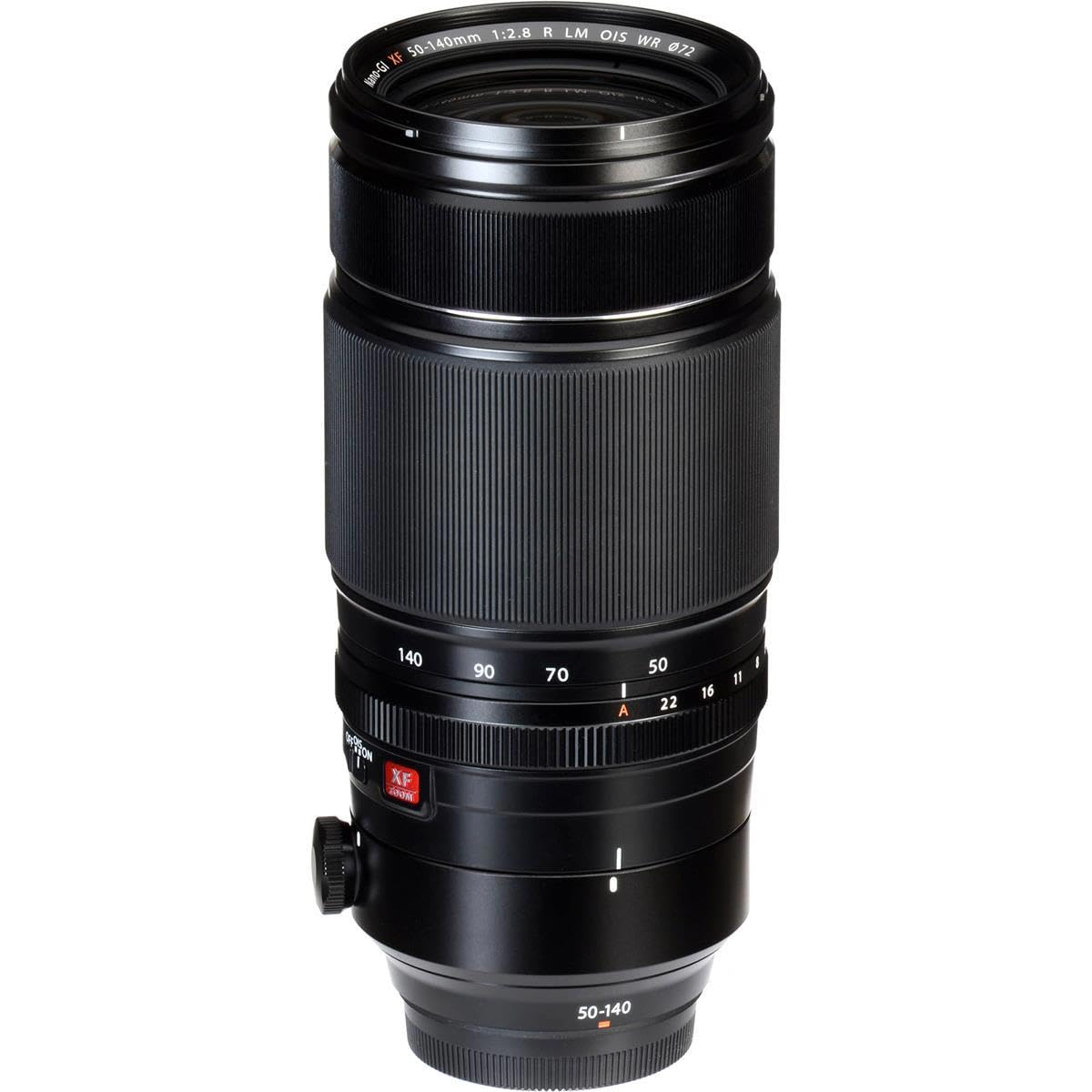
The pro telephoto that holds f/2.8 across the range and locks focus fast.
Wedding photographers and sideline shooters reach for this one for a reason. The 50-140mm range (76-214mm equivalent) is joined by a constant f/2.8 that never dims as you zoom — the combination you want when the light is dropping and the moment is one-time only. Sharpness is the quality that gets praised most, and with five ED and one Super ED element plus Nano-GI coating, it delivers portraits with shallow depth and smooth blurred backgrounds.
Focusing is a triple linear motor — fast, and snappy enough that it keeps up with moving subjects. Image stabilization helps at the long end, the barrel is dust- and water-resistant and rated for low temperatures, and the tripod collar means a heavy lens balances properly on a support. Owners who shoot it for paid work treat the price as money well spent.
The catches are weight and a bit of noise. Packing a constant f/2.8 telephoto into a barrel this capable means mass you feel on a long day, and the focus mechanism is not silent — which only matters if you shoot quiet ceremonies. Compared with the XF55-200mm above, the 4.5-stop helper lens gives more reach for less weight; this one answers with a constant bright aperture instead.
Built for working shooters
- Constant f/2.8 across 50-140mm keeps exposure and blur fixed
- Triple linear motor focuses fast on moving subjects
- Five ED and one Super ED element plus Nano-GI coating for sharp, clean images
- Dust, water, and low-temperature resistance with a tripod collar
The weight-and-quiet trade-off
- Heavy enough to notice over a long day
- Focus noise is not silent — plan around quiet ceremonies
Top choice for: event, wedding, and sports pros who need a bright telephoto and fast focus.
Look elsewhere if: budget or travel weight points you toward the lighter 55-200mm instead.
Know the Specs
Constant vs variable aperture
Aperture is written as f/number, and a smaller number means a wider opening that lets in more light. A “constant” f/2.8 keeps that same opening all the way through the zoom, so exposure and background blur stay steady as you zoom. A “variable” zoom like f/3.5-6.7 starts wider at the short end and darkens as you zoom in, which is why a superzoom gets harder to shoot in low light at its longest reach. If you shoot dim interiors or events, a constant bright aperture is the spec to protect.
Focal length and APS-C crop
The focal length in millimeters tells you the field of view: a lower number is wider, a higher number is more telephoto. Fujifilm’s X-series bodies use an APS-C sensor, which crops the frame compared to full frame, so manufacturers publish a 35mm-equivalent figure — a 16-55mm behaves like a 24-84mm, and a 70-300mm reaches far past 300mm in full-frame terms. Pick the focal range that matches your subject distance, then use the equivalent figure to know what you will actually frame.
Optical stabilization (OIS)
Image stabilization built into the lens moves an element to counteract your hand shake, so slow shutter speeds stay sharp. The benefit grows with focal length: a 300mm shot amplifies shake, which is why long telephotos lean on stabilization more than wide lenses do. Look for the claimed stop count — a higher figure means more shake compensation in theory — and remember it only helps with still subjects, not a moving one.
Weather sealing and durability
“Weather resistant” on an X mount lens usually means seals at the mount and along the barrel. Fujifilm lists a seal count on some barrels (14 sealing points on the XF16-55mm, 10 on the XF70-300mm), which is a rough indicator of how thoroughly it is gated against dust and moisture. Low-temperature ratings matter if you shoot in the cold. Sealing helps in drizzle and dust, but it is not a promise to survive a dunking — value it as extra margin, not invincibility.
Common Questions
Will a Fujifilm X mount zoom fit my X-T or X-S body?
Is a constant f/2.8 zoom better than a variable f/3.5-5.6 zoom?
Do I need in-lens image stabilization for a telephoto zoom?
How does the APS-C crop change the focal length I should buy?
What does the f/1.8 constant aperture give me over f/2.8?
Are weather-resistant X mount lenses safe to use in rain?
Can I shoot handheld at 300mm without a tripod?
Which X mount zoom is best for video recording?
Is a superzoom like the 16-300mm sharp enough for real work?
What is the difference between the 55-200mm and the 50-140mm f/2.8?
The Bottom Line
For most people shopping the x mount zoom lenses, the Fujifilm XF16-55mmF2.8 R LM WR is the clear winner. It pairs a constant f/2.8 (the same bright aperture at every zoom setting) with 14 sealing points (weather seals that keep out dust and moisture) and sharp wide-open images. It also holds 4.5+ stars across hundreds of buyer ratings. If you want to travel lighter, the Sigma 18-50mm f/2.8 at 285 g keeps the bright aperture while shedding weight. For low light and night shooting, the Sigma 17-40mm Art’s constant f/1.8 has no rival in this group. If you need distance, the Fujifilm XF70-300mm reaches the far end with optical stabilization (a system that steadies the shot) and weather sealing. The Sigma 16-300mm instead covers both ends of the range in a single barrel.
Whichever way you lean, match the lens to the job you shoot most: bright aperture for interiors and people, long reach for wildlife and sport, wide and light for travel. One honest nudge — the XF16-55mm earns its position on both number and consistency, and if you can live with the weight it will be the lens you keep on the body.
How we choose
We do not accept paid placement. Every pick is matched to a real buyer and a real use-case; we do not hands-on test units.
Sources
Specifications: manufacturer listings and product documentation. Review insights: verified customer reviews, as of November 2026. Pricing: not shown on this page (it changes often); check the current price via the retailer link.
As an Amazon Associate, Tactical Gear Guy earns from qualifying purchases. This does not affect which products we feature.