Specs are compiled from manufacturer listings and verified buyer reviews and can change over time — please confirm the key details on the product page before buying.
You want a WWI helmet that looks right on a shelf or feels right on your head, and the shell material and liner size decide which you get. Steel gives you the weight and feel of the real thing; leather gives you a showpiece for a costume. Whether you plan to display it, wear it at a reenactment, or hand it to a kid for a history project, shell material and liner size decide whether you are happy or disappointed.
This guide is built by comparing the manufacturers’ published specifications and the patterns across verified customer reviews, so you get each pick’s real strengths and trade-offs instead of marketing spin.
Reproduction steel shells vary a lot in gauge, liner construction, and paint finish, and those three details are what separate a display piece you keep from one you resell. Here is how to read those details before you buy the best WWI helmet for your shelf, your kit, or your costume.
Top Picks


How To Choose The Best WWI Helmet
You are shopping in a small, strange corner of the market: 1914-1918 headgear that is almost always a reproduction. Nobody is selling you battlefield surplus. So the real question is not “is it original” but “is this replica built well enough to wear, display, or both.” Three things answer that.
Shell material and gauge
A steel shell with a stated gauge tells you how substantial the helmet is in the hand. An 18 gauge steel shell, like the one on the US M1917 Brodie below, is the kind of build that feels like a helmet rather than a prop. A leather-and-brass Pickelhaube is a different object entirely — decorative, lighter, and built for costume and display rather than for weight on your head.
Liner and stated head size
The liner is what your head actually touches, and it is where most disappointment lives. Look for a stated hat size or a head circumference in centimeters, because a liner reproduced “exactly like the original” may be a size that only suits some buyers. A helmet listed with a circumference range, like 56-60 cm, tells you whether it will sit on you at all before it arrives.
Paint, finish, and how you will store it
Reproduction paint is the most common weak point on a steel shell — it can scuff and flake if the helmet gets knocked around. If the piece is going on a shelf, that barely matters. If it is going into a kit bag or a trunk, plan on a cloth cover and a dry spot. Leather helmets need the same treatment: keep them out of direct sun and dust them with a clean cloth.
Side-by-Side Comparison
| Model | Best For | Shell Material | Stated Size / Fit | Weight | Amazon |
|---|---|---|---|---|---|
| US WW1 M1917 Brodie Helmet★ Best Overall | All-round display and wear | 18 gauge steel | Liner size 7.5 | 2.4 pounds | Amazon |
| French M15 Adrian HelmetFrench Icon | French kit and insignia fans | Steel | 7 7/8 / 63 hat size | — | Amazon |
| AnNafi Pickelhaube Spike Helmet | Costume, LARP, theatre | Real leather with brass | 67 cm inner circumference | 1.2 pounds | Amazon |
| German WWI M16 Stahlhelm | Heavy display piece | Steel | Large | 5.2 pounds | Amazon |
| ANQIAO French M1915 Infantry | Budget French replica | Steel | 56-60 cm circumference | 900 g | Amazon |
Detailed Reviews
1. US WW1 M1917 Brodie Helmet Doughboy Helmet
Our pick — 4.5+★ from 100+ verified ratings; the strongest balance of quality and price.
A handcrafted 18 gauge steel Brodie that is designed to be the original, not a toy version of it.
The dish-shaped Brodie is the helmet most people picture when they hear “WWI,” and this one is built to earn that picture. The shell is 18 gauge steel — a thickness that gives the helmet real heft and a solid ring when you set it down — and it is handcrafted rather than stamped out of thin sheet. At 2.4 pounds it is heavy enough to feel like a genuine piece of kit on a shelf, yet nowhere near the load you would carry all day.
Buyers praise the overall build quality first and the paint finish second — this is the reproduction that looks right from across the room and holds up in close inspection. The liner is reproduced to match the original and listed at size 7.5, and it is an officially licensed World War Supply product rather than an anonymous copy. The blue-grey-era green shell and buckle closure complete a piece that photographs well and displays better.
Uber honest caveat: fit is the one thing that splits opinion, because a 7.5 liner is a fixed size and it will not suit every head. If you have never checked your hat size, measure first — this is not a helmet you size after the fact. The paint is also a finish to protect, so avoid tossing it in with loose tools or metal kit.
What earns its keep
- 18 gauge steel shell with a handcrafted build that feels substantial in the hand
- Liner reproduced to match the original, listed at a size 7.5
- Licensed World War Supply product with a green Brodie-style finish
What to plan around
- Fixed 7.5 liner size — measure your head before ordering
- Paint is a finish worth protecting from knocks and rubbing
Take this one: if you want one WWI helmet that works equally well on a display shelf and on your head at a reenactment.
Hold off: if you are between sizes or need a helmet that adjusts, because the liner here is a fixed 7.5.
2. French M15 Adrian Helmet
The French helmet with the front badge, in the early blue-grey paint soldiers actually wore.
If you are building a French impression rather than an American or German kit, the Adrian is the shape you want. It has a steel shell with a leather liner and the French insignia on the front, and the paint is the blue-grey of the early-issue helmet — a detail that reads correctly the moment you put it beside a period photo. The maker notes it was issued to French troops from WWI until the 1930’s, so it suits a wide spread of French impression kits.
Fit is spelled out more clearly here than on most replicas: the liner measures 25 inches around, which the maker converts to a 7 7/8 or 63 hat size. That is a larger head size, and it makes this a straightforward buy if you already know you wear a big hat. Unlike the fixed 7.5 liner on the Brodie above, this one is aimed squarely at the larger end of the range, so a small or medium head will swim in it.
The trade-off is straightforward and worth stating plainly: at 63, this is one of the larger stated sizes on this list, and a buyer with an average head will find it roomy. The upside is a helmet that a big-headed reenactor can actually wear without pinching.
Where the money goes: a steel shell, a leather liner, a front insignia, and the early blue-grey paint — the four things that make a French impression read as French.
Size check first: 25 inches of liner is a 7 7/8 or 63 hat size, so confirm your own measurement before you commit.
Best match: French-impression reenactors and display collectors who want the Adrian shape and the early blue-grey finish.
Look elsewhere: if you wear a small or medium hat, since the stated liner is a 7 7/8 / 63.
3. AnNafi WWI & II German Pickelhaube Hessen Spike Helmet
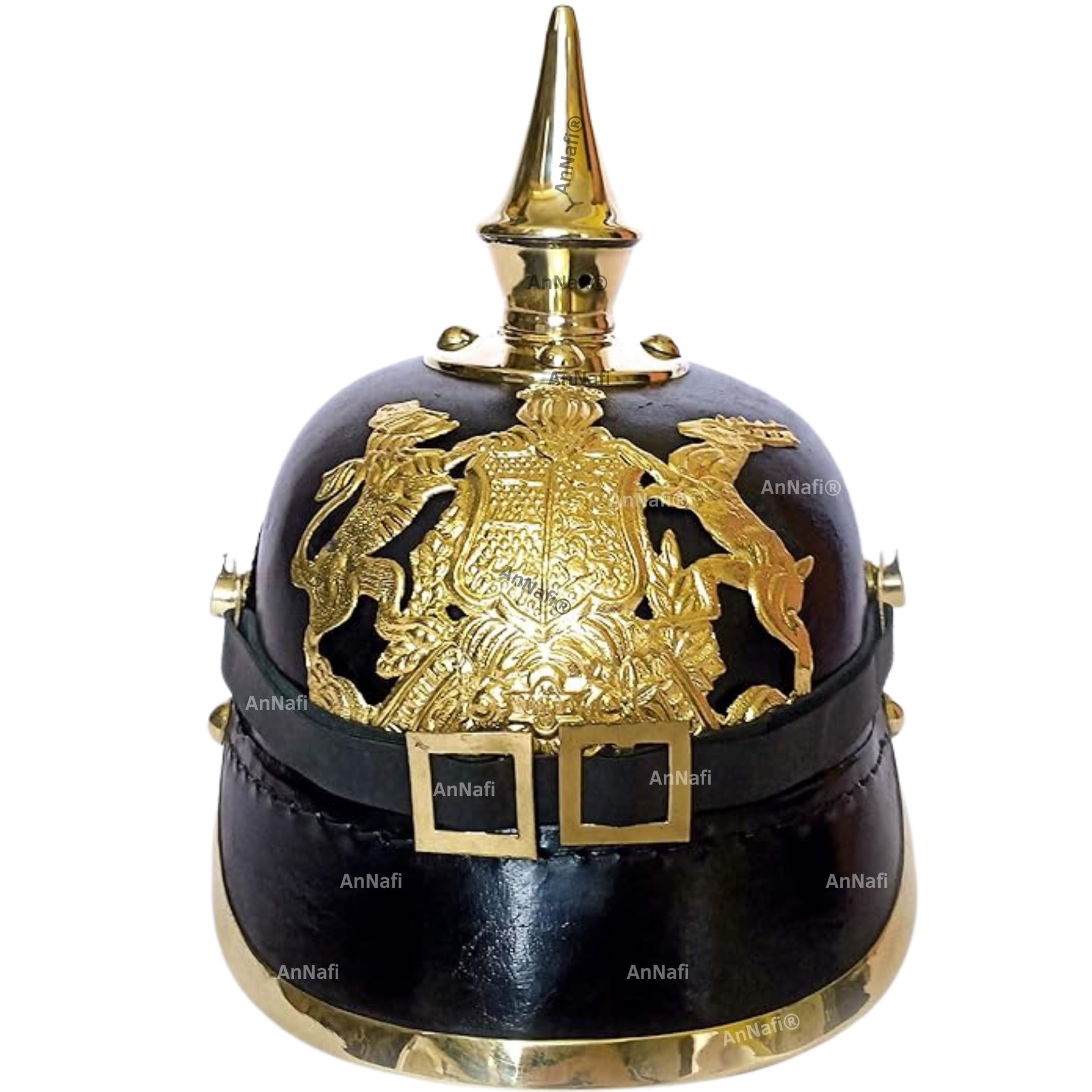
Leather, brass, and a spike — built for the stage and the photo booth, not the field.
This is the outlier on the list, and that is the point. Instead of a steel shell, the Pickelhaube is made of real leather with solid brass accents, and at 1.2 pounds it is light enough to wear through a full evening of theatre or LARP without a sore neck. Compare that with the German M16 Stahlhelm further down at 5.2 pounds — the same era, a completely different object on your head.
The measurements are published, which is rare in this bracket: a 67 cm inner circumference, 20 cm ear to ear, and 24 cm front to back. The maker says it fits a normal adult head and lists it as fully wearable for adults rather than kids, and the brass fittings are hand-tooled. It is aimed at costume, theatre, LARP, and display — think party costume, movie dress, or a striking shelf piece in an office or study.
Your honest limitation is durability of the wrong kind. Leather and brass look rich, but this is a decorative reproduction rather than a steel shell you can knock about. The maker’s own care notes tell the story — wipe it with a clean cloth, keep it dust-covered, and store it dry and out of sunlight. If you need a helmet to survive a muddy event, pick steel. If you need one that looks the part on camera, this is it.
Why buyers reach for it
- Real leather shell with solid hand-tooled brass fittings
- 1.2 pounds — light enough to wear all evening
- Stated dimensions: 67 cm inner circumference, 20 cm ear to ear, 24 cm front to back
Where it stops
- Decorative build, not a steel shell for rough handling
- Needs dry, shaded storage and regular dusting to stay sharp
Worth it for: costume, theatre, LARP, and anyone who wants a brass-and-leather showpiece on a shelf.
Not the one: if you expect a steel helmet to absorb knocks and mud at a live event.
4. German WWI M16 Stahlhelm Steel Helmet

A 5.2-pound steel Stahlhelm copied from an original in a private collection.
Weight is the headline here, and it is not a small number. At 5.2 pounds this steel shell is a genuine load compared with the 1.2-pound leather Pickelhaube above, and even beside the 2.4-pound Brodie it feels like a different class of object. That heft is exactly what a display collector wants — a Stahlhelm that sits on the shelf and looks like it came off a battlefield rather than out of a costume shop. The shell is copied from an original M1916 in the IMA collection.
The liner is the detail that makes it feel authentic in the hand: a correct three-tongue leather liner with a leather band and removable pads, plus a genuine leather chinstrap. It is listed in size Large and marked adjustable, which gives you some room to work with. Buyers notice the overall build quality first and the period look close behind — it is a historically styled replica that photographs convincingly.
The recurring gripe is the paint. Owners find it fragile and prone to scuffing easily, so treat this as a display piece and not a helmet to bang around in a kit bag. Handle it by the rim, keep it away from hard edges, and the finish will hold far better.
The case for the weight: 5.2 pounds of steel with a three-tongue leather liner and removable pads is the most convincing display piece on this list.
The finish caveat: the paint scuffs easily, so a shelf spot beats a gear bag every time.
Pick it for: a serious German-impression display where a heavy, believable shell matters more than portability.
Think twice: if you plan to wear it for hours or haul it to events — 5.2 pounds adds up fast.
5. ANQIAO WWI French Steel Helmet M1915

A French infantry shell with a real leather liner, shaped from an original and priced at the entry tier.
For a first French helmet, this ANQIAO replica does the basics right. The shell is steel and shaped to match a genuine original, and the liner and chinstrap are both made of thick genuine leather in brown — a step up from the padded fabric you sometimes find in this bracket. At 900 g (about 2 pounds) it is light enough to wear for a full afternoon without the neck ache that the 5.2-pound Stahlhelm above will hand you.
The fit is stated as a range rather than a single size: it suits a head circumference of 56-60 cm. That is genuinely useful, because it tells you before you buy whether it will sit on your head. If your measurement falls in that band, this is one of the more predictable buys on the list. The listing describes the fittings as correct metal accessories taken from an original helmet, and the medium size keeps it simple.
The honest note is that this is a no-frills reproduction — you are getting a steel shell and a leather liner, and the listing runs light on detail beyond that. If you need a numbered hat size or a specific insignia, check carefully before you commit. If you need a wearable French helmet with real leather against your head, it delivers.
The value read: a steel shell, thick genuine leather liner, and a leather chinstrap at the entry tier — the parts that matter are not skimped.
The size reality: a 56-60 cm stated range covers a lot of heads, but confirm your own number because it is a range, not a fit guarantee.
Go here for: a first French infantry replica where a steel shell and real leather liner matter most.
Skip if: you need a specific insignia or numbered hat size spelled out — this listing stays lean on the extras.
Know the Specs
Shell gauge and material
Gauge is the thickness of the steel, and on a reproduction it is the difference between a helmet that feels solid and one that dents in a bag. An 18 gauge shell is on the substantial side. Leather and brass helmets are decorative builds — light, comfortable, and made for display and costume rather than impact. Decide which of those two objects you actually want before you compare anything else.
Liner size versus head circumference
Two measurements show up on these listings: a hat size like 7.5 or 7 7/8, and a head circumference in centimeters, like 56-60 cm or 67 cm. A circumference range is the friendlier number because you can measure your own head and compare directly. A single hat size is a fixed commitment, and it is the most common reason a buyer ends up with a helmet that does not sit right.
Stated weight
Weight tells you how the helmet will behave on your head and on a shelf. Light leather replicas sit in the 1.2-pound zone and are built for costume. Steel shells run heavier, and a 5.2-pound shell is a display piece more than a thing you wear for hours. If you plan to wear it at an event, weight matters as much as look.
Paint and finish care
Reproduction paint can scuff and flake when a steel helmet is knocked around, so treat the finish as something to protect. A cloth cover and a dry, shaded storage spot go a long way. Leather helmets need the same discipline — dust them with a clean cloth and keep them away from direct sunlight.
Common Questions
Is a WWI helmet safe to wear for reenactment?
How do I work out my size before buying a WWI helmet?
What is the difference between a Brodie, an Adrian, and a Stahlhelm?
Is a Pickelhaube a WWI combat helmet?
Why does the German M16 Stahlhelm weigh so much more than the leather helmets?
Will the paint on a steel replica helmet scratch off?
Can I display a WWI helmet outdoors?
Should I buy a French or German helmet for my first replica?
Are these helmets actually made of steel?
Do I need to oil or treat a leather helmet liner?
The Bottom Line
For most people chasing the wwi helmet look, the US WW1 M1917 Brodie is the one to take home. Its 18 gauge steel shell (about 1.2 mm thick) and original-pattern liner make it work on both a shelf and a head — and it carries 4.5+ stars from 100+ buyers. If it is the French silhouette you are after, the French M15 Adrian gives you the front insignia and the early blue-grey paint at a stated 7 7/8 / 63 fit (a large head size). And if the helmet is strictly for costume, theatre, or LARP, the AnNafi Pickelhaube at 1.2 pounds is the one to reach for.
How we choose
We do not accept paid placement. Every pick is matched to a real buyer and a real use-case; we do not hands-on test units.
Sources
Specifications: manufacturer listings and product documentation. Review insights: verified customer reviews, as of November 2026. Pricing: not shown on this page (it changes often); check the current price via the retailer link.
As an Amazon Associate, Tactical Gear Guy earns from qualifying purchases. This does not affect which products we feature.