Specs are compiled from manufacturer listings and verified buyer reviews and can change over time — please confirm the key details on the product page before buying.
You want a WW2 American helmet that looks right on a shelf and holds up in the yard, and the short answer is this: buy one with a real steel outer shell and a plastic inner liner you can actually adjust. That combination is what separates a display piece from a flimsy costume lid that dents the first time it touches pavement. Everything below is judged on that one split-shell build, plus the net cover, chin strap and head size it ships with.
This guide is built by comparing the manufacturers’ published specifications and the patterns across verified customer reviews, so you get each pick’s real strengths and trade-offs instead of marketing spin.
The M1 style is the shape everyone pictures when they think of the European and Pacific theater, from the steel pot to the netting slung over it. These six reproductions each nail a different part of that picture, and this breakdown of the ww2 american helmet options tells you which one matches your head and your plans.
Top Picks


How To Choose The Best WW2 American Helmet
A reproduction M1 helmet lives or dies on two things: what the outer shell is made of and whether it fits your skull. Get those wrong and no amount of convincing netting will save it. Get them right and the helmet does its job as a display piece, a reenactment lid, or an airsoft shell that takes a knock without folding.
Steel outside, plastic inside — the split that matters
The real M1 was two helmets in one: a steel outer pot that took the impact and a lighter inner liner that sat on your head. Almost every replica here copies that split, with an unpolished steel outer shell and a hard plastic inner. That unpolished finish is deliberate — it takes paint and scuffs like the wartime original instead of shining like a car hood. When a listing calls the inner shell “plastic,” that is the liner, not a cheap shortcut. The shortcut to watch for is a helmet where both layers are plastic and only the paint pretends otherwise.
Measure your head in centimeters first
These helmets quote fit in centimeters, not hat sizes, and the ranges are narrow. One lid fits 55~61 cm, another 59~63 cm, and those few centimeters decide whether the steel rim sits just above your eyebrows or rests on your ears. Wrap a soft tape around your head at forehead level, just above the ears, and write the number down before you shop. If you land at the top of one helmet’s range, size up rather than squeeze — a steel pot that pinches is miserable within minutes.
Net cover, cat-eye band, chin strap — what you actually get
The netting over the shell is the single biggest visual cue that says “WW2” to anyone looking at it. Most of these ship with a canvas chin strap and a net cover already fitted, and a few add the cat-eye band — the strip of fabric with reflective eye shapes worn around the helmet. None of that changes how the helmet fits, but it does change how convincing it looks hanging on a wall. Check the listing for whether the strap is canvas or webbing, because a stiff retainer is the most common functional gripe across these replicas.
Side-by-Side Comparison
| Model | Best For | Shell Material | Head Fit (cm) | Stated Weight | Amazon |
|---|---|---|---|---|---|
| GPP Perfect WWII US Army M1 Replica★ Best Overall | Most buyers overall | Steel outer, plastic inner | 59~63 cm | 3.3 pounds | Amazon |
| WWII US M1 Steel Shell with Net CoverBudget Champion | Tight budgets | Steel outer, plastic inner | 55~61 cm | — | Amazon |
| WW2 US M1 Steel Field Green with Net Cover | Fitting the most head sizes | Steel outer, plastic inner | 56~61 cm | 1.5 kg | Amazon |
| M1 Helmet US Army WW2 Replica with Cat Eye Band | Kit completeness | Steel outer, ABS inner | 55 – 62 cm | 3.3 pounds | Amazon |
| Perfect WW2 US Army M1 Replica by LUCKYYAN | Wall display | Steel outer, plastic inner | 56~61 cm | 3.5 pounds | Amazon |
| WW2 US Airborne M1C Jump Version | Airborne reenactors | Metal outer and inner | — | 3.8 pounds | Amazon |
Detailed Reviews
1. GPP Perfect WWII US Army M1 Green Helmet
Our pick — 4.5+★ from 450+ verified ratings; the strongest balance of quality and price.
The widest head fit here, on the steel shell most owners trust first.
Start with the number that decides everything: 59~63 cm. That is the widest head circumference range on this list, and it makes the GPP the safest bet for an adult who wants the steel rim to sit level rather than perched on top. The outer shell is genuinely steel with an unpolished surface, so it scuffs and takes paint the way a wartime pot should. The inner is hard plastic, which is what lets the whole thing come in at 3.3 pounds.
That weight figure is where the GPP separates from the paratrooper pick. The Airborne M1C runs 3.8 pounds, so you are carrying half a pound more steel and hardware there — real if you plan to wear it through a full reenactment day, easy to forget if it lives on a shelf. Meanwhile this one is easier on the neck than the LUCKYYAN M1 at 3.5 pounds. The unpolished finish is also why it is sold as a DIY painting project: you can stencil, net and weather it into whatever unit you are recreating.
Construction quality is what reviewers mention first and most, with the period look a close second. It reads as the real thing from a few feet away. That said, the netting is the part to fidget with carefully, since keeping it snugly fixed is the recurring gripe, and some owners find the 1.5 kg heft heavier than expected once it is actually on their head.
Why it earns top spot
- Fits 59~63 cm — the broadest head range in this lineup, so more adults get a proper sit.
- Real steel outer shell with an unpolished finish that takes paint and wear naturally.
- Sold as a DIY painting base, so you can finish it to your own unit and theater.
- Includes the helmet cover and eye belt, ready to fit from the start.
Where it asks a little back
- 3.3 pounds is fine on a shelf and noticeable on your head after an hour.
- The netting needs deliberate fitting to stay put — treat the cover as something to adjust, not forget.
- Unpolished steel will surface-rust if you store it damp.
Your best all-rounder: Anyone with a head between 59 and 63 cm who wants the most convincing steel pot for display or yard use.
Think twice if: You want a helmet that holds its net without any fiddling, or you need a smaller fit.
2. WWII US WW2 M1 Helmet Steel Shell with Net Cover Chin Strap
The cheapest steel M1 here, and the tightest fit of the bunch.
The ANQIAO M1 is the entry-level pick, and it makes no secret of it. It is the cheapest helmet on this list, it comes with a webbing cover and strap already fitted, and it uses the same two-part plan as the rest: steel outer shell, unpolished surface, hard plastic liner inside. For airsoft and paintball — both of which the maker lists as intended uses — that is exactly the spec you want, because you are going to get it dirty anyway.
Here is the catch, and it is a fit catch rather than a build one. The sizing tops out at 55~61 cm, and the GPP above starts at 59 cm and reaches 63 cm. That gap matters: this one runs roughly 7 cm narrower at the top end, so it is made for smaller skulls and the fit is where opinions split. If you measure above 61 cm, this is simply not your helmet. If you measure in the middle of the range, it is the best bargain here.
Reviewers consistently praise the steel shell and paint finish, and report it shrugs off knocks without denting. Where it slips is the chin strap hardware — the retainer has limited give, so tightening it properly is fiddly. Also worth knowing: the weight gets mixed feedback, so judge the heft against what you would wear a full day versus hang on a wall.
The honest read: Spend the least, get a real steel shell that does the airsoft job and looks the part. Just measure first — the 55~61 cm window is the narrowest of the M1 group and the one reason to walk away.
Reach for this if: You are kitting out for airsoft or paintball and your head sits mid-range in centimeters.
Look elsewhere if: You need the sizing headroom a larger adult requires, or a strap that adjusts freely.
3. WW2 US M1 Helmet Steel Field Green

A 56~61 cm fit with the eye belt and netting already in the box.
Most people buying a reproduction M1 want it to look like the helmet from the photographs, and this ANQIAO field green version is built around exactly that. The outer shell is steel with the same unpolished treatment, the inner is plastic shaped like the wartime liner, and it ships with both a cover and an eye belt. At 1.5 kg it is heavy duty in the literal sense, a lid with real mass to it. The fit range is 56~61 cm — slightly more room than the budget pick at the bottom end.
Appearance is the headline. The field green shade under the netting is the most-praised detail of this helmet by a wide margin. Compare that to the M1C Airborne at 3.8 pounds and this one feels more manageable on the neck while still reading as steel in the hand. The repaint-friendly unpolished surface means you can add unit markings without sanding anything down first.
Now the trade-off. The liner is the weak link — the inside construction draws mixed reports, and the plastic inner is where a few owners notice wear sooner than they expected. The heft also draws mentions, so if a light helmet matters, weigh that against the solid steel feel. Neither of those wrecks the buy; both simply tell you this is a display-and-outdoor-games lid rather than a piece of kit you throw in a truck bed.
What it does well: The field green steel shell with netting is the look most buyers are chasing, and it arrives complete with eye belt and cover.
The part to size up honestly: The inner liner is the component that wears, so treat the inside gently and check the fit before you commit.
Good match for: Reenactors and collectors who want the classic field green M1 look with the eye belt included.
Not the one if: You want a liner built to shrug off years of hard handling.
4. M1 Helmet US Army WW2 Replica

The one with the adjustable ring, the safety buckle and the lot.
No other helmet on this list hands you this much hardware in a single box. You get the steel shell with an unpolished surface, an ABS hard plastic inner helmet, and then a full accessory run: canvas chin strap, mesh, cat eye strap, extra strap, safety buckle and an adjustable inner ring. That adjustable ring is the piece that actually changes the daily experience — it lets you dial the fit in around your head rather than hoping a fixed range lands right. Sizing spans 55 – 62 cm, so it covers a wide spread of adults.
Inside, the helmet uses EPS and nylon — EPS being the dense foam bead material you find in bicycle helmets — which the maker describes as strong and soft at once. At 3.3 pounds it lines up with the GPP, so the weight is squarely in the middle of this group, well under the 3.8-pound Airborne M1C. Whether you hang it up, wear it for an outdoor game, or use it as a movie prop, the kit is designed so you are not hunting for a missing strap afterward.
The honest note is that this is the least-proven pick on the list, carrying the fewest owner ratings of the M1 models. That is not a knock on the helmet — the spec sheet is the fullest here — it just means you are buying on the build rather than on a long track record. If a complete, adjustable kit matters more to you than a bigger review history, this is the sensible stop.
What the box gives you
- Adjustable inner ring plus safety buckle — you tune the fit instead of accepting a fixed size.
- Cat eye band, mesh, canvas chin strap and spare strap all included.
- Steel outer shell with an unpolished, paint-ready finish.
- 55 – 62 cm range covers a wide span of adult heads.
What to weigh before buying
- The smallest review pool of the M1 replicas here, so fewer owner experiences to lean on.
- EPS foam and nylon inside means a softer liner, not a steel one.
- Adjustable hardware is one more thing to set correctly before it sits right.
Built for the kit-minded buyer: Anyone who wants every strap, band and buckle supplied and an adjustable ring to fine-tune the fit.
Pass if: You would rather buy on a long owner track record than on the fullest accessory list.
5. Perfect WW2 US Army M1 Green Helmet

The steel pot people instinctively reach out and knock on.
The LUCKYYAN replica is built for the person who wants a helmet that feels like the genuine article in the hand. Real steel outer shell, unpolished surface, plastic inner liner, and a 1.5 kg stated weight that puts it right where a wartime pot should feel. At 3.5 pounds on the listing it sits slightly above the 3.3-pound GPP, and below the Airborne M1C. The fit range is 56~61 cm, matching the other mid-size M1 shells here.
What this helmet does best is sell the period look. The netting and decals over the steel do the work, and the shell itself is solid enough that it takes knocks without complaint. Praise centers on authenticity: it captures the period silhouette rather than a modern tactical one. It is listed for historical reenactment, outdoor activities and collection, which tells you the maker expects it to be seen as much as worn.
The catch is the fit. Head size draws disagreeing opinions, so the 56~61 cm range is a guide and not a guarantee — measure carefully and expect to fine-tune the strap. It is also the heaviest of the standard M1 shells at 3.5 pounds, which is a virtue on a shelf and a burden on a long walk. For a display piece or a weekend event, that trade is entirely reasonable.
The pitch, plainly: Buy it for the period look and the substantial steel feel — it sells the wartime illusion better than any other M1 here.
Before you commit: Check your circumference against 56~61 cm, and go in expecting to adjust the chin strap to get a settled fit.
Claim it if: You want the most convincing shelf-and-reedit piece and accept a bit of strap fiddling for it.
Leave it if: A light helmet for long wear is the priority.
6. WW2 WWII US Airborne M1C Helmet
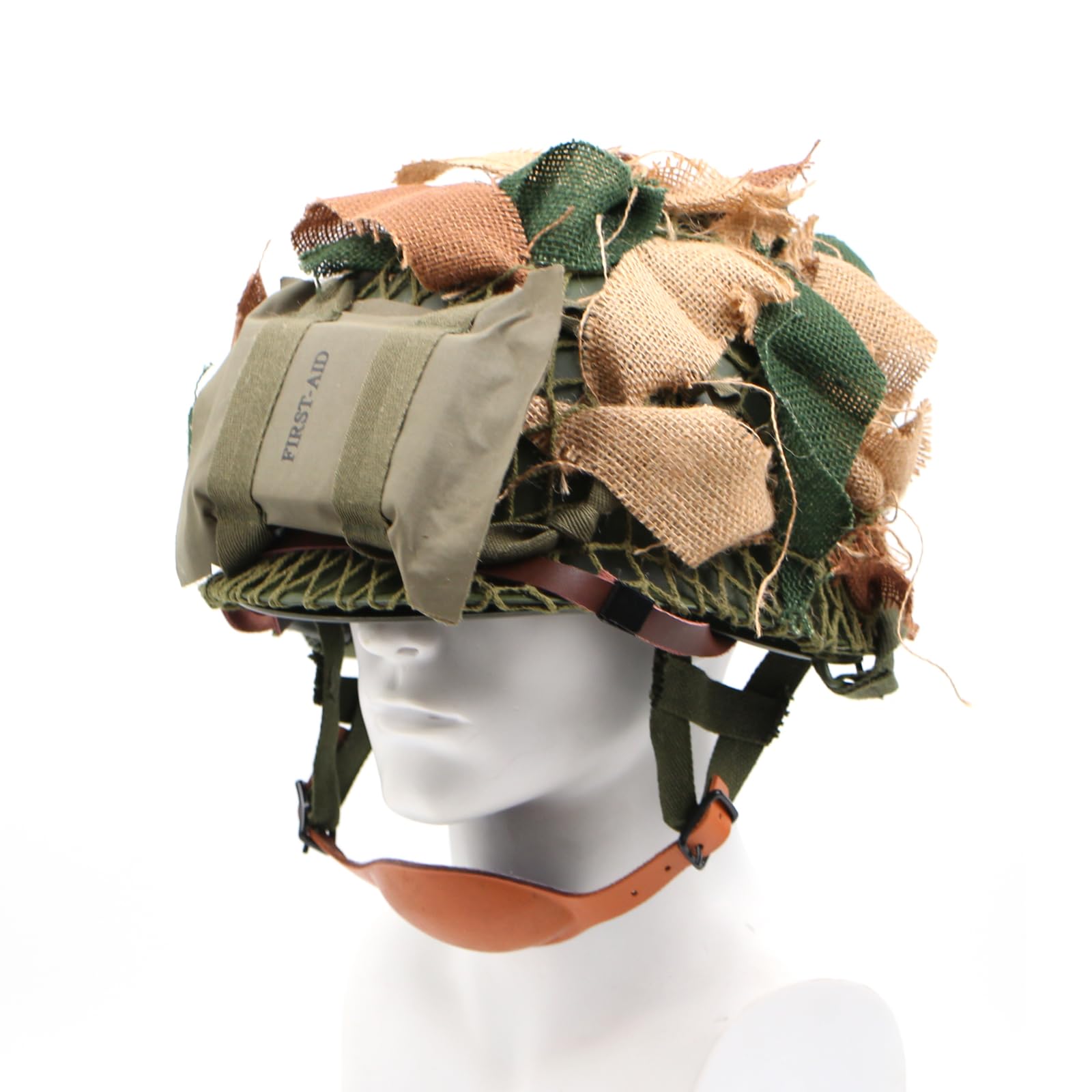
The paratrooper version — heavier steel, camouflage net, first aid pouch.
This is the specialist of the group. The 506th Parachute Infantry jump version recreates the airborne M1C rather than the standard infantry pot, and it carries the accessories to match: a camouflage net and a first aid pouch, plus an adjustable strap. The outer metal carries a camouflage finish meant to sit in wood, jungle or other outdoor ground. It comes in at 3.8 pounds, the heaviest helmet here and the weight you are choosing deliberately when you pick the airborne build over the standard M1 at 3.3 pounds.
What it gets right is the impression. The shell reads as genuinely combat-worn, and reviewers describe the build as very well made from the right material. If you are assembling a 101st Airborne display or a jump-helmet reenactment set, the silhouette and the camouflage netting are the details that sell it to anyone who knows the period.
The practical limit is the sizing. This one is listed as a single XX-Large with no centimeter fit range quoted, so there is no published head circumference to check yourself against before you buy. That is the one real hesitation on an otherwise strong specialist pick — you cannot confirm the fit from the page the way you can with the other five.
Why airborne collectors want it: A genuine M1C jump configuration with camouflage net and first aid pouch, built to look combat-worn.
The question to resolve first: With no published centimeter fit range, confirm the head size before ordering.
Right for the reenactor: Airborne-focused collectors who want the 506th jump version with the camouflage net and pouch.
Not the one if: You need a published fit range, or you want the lightest steel pot you can get.
Know the Specs
Shell Material and the Unpolished Finish
The outer shell is the part that takes the abuse, which is why nearly every replica here uses steel with an unpolished surface. Steel gives you real heft and a finish that accepts paint, stencils and wear marks. The unpolished treatment means the metal looks period-correct rather than glossy. The inner shell — plastic or ABS or EPS — is the liner that meets your head, and it is what keeps the whole helmet from being a solid steel bowl. When you see a listing describe a two-part construction, that is the wartime system being reproduced, not a cost-cutting trick.
Head Circumference and Weight
Fit is quoted in centimeters for a reason: these are single-size helmets pretending to fit everyone, so the range tells you who is actually served. A quote of 55~61 cm and a quote of 59~63 cm are not interchangeable — the second suits a larger skull and will swim on a small one. Weight, meanwhile, is the other number to take seriously. A stated weight around 3.3 pounds is comfortable on a shelf and tolerable on the head; a heavier airborne build trades comfort for authenticity. Neither number is right or wrong, but both decide whether you enjoy wearing the helmet or just looking at it.
Common Questions
Is a WWII US M1 helmet replica safe to wear for airsoft?
How do I measure my head for a WW2 American helmet in centimeters?
What is the difference between the standard M1 and the Airborne M1C?
Why is the outer shell steel but the inner liner plastic?
What is the eye belt or cat eye band that comes with some of these helmets?
How should I keep a steel replica helmet from rusting?
Can I adjust the fit inside a WW2 American helmet replica?
Are these helmets heavy enough to wear all day at a reenactment?
Is a steel shell or a lighter replica better for a display collection?
The Bottom Line
For most buyers, the ww2 american helmet to start with is the GPP Perfect WWII US Army M1 Replica — it pairs the widest head range on the list, 59~63 cm, with a real steel shell and a DIY-ready finish, and it holds 4.5+ stars across 400+ ratings. If you want every strap, band and buckle in the box plus an adjustable ring, the M1 with Cat Eye Band is the fuller kit. And for the airborne reenactor, the M1C Jump Version delivers the 506th look with its camouflage net and first aid pouch.
Whichever you pick, measure your head in centimeters first. That single number rules out half the mistakes buyers make with these steel pots.
How we choose
We do not accept paid placement. Every pick is matched to a real buyer and a real use-case; we do not hands-on test units.
Sources
Specifications: manufacturer listings and product documentation. Review insights: verified customer reviews, as of November 2026. Pricing: not shown on this page (it changes often); check the current price via the retailer link.
As an Amazon Associate, Tactical Gear Guy earns from qualifying purchases. This does not affect which products we feature.