Specs are compiled from manufacturer listings and verified buyer reviews and can change over time — please confirm the key details on the product page before buying.
Most people shopping for a WW1 war helmet get burned by the same mistake: they buy on shell shape and find out about the liner afterwards. The shell is the part you see in photos. The liner is the part that decides whether you can actually wear the thing for an afternoon of reenacting, a display shelf, or a costume party. This guide sorts the replicas by which era helmet they copy, what the shell is made of, and how the interior is built, so you can pick the one that suits the job you have in mind.
This guide is built by comparing the manufacturers’ published specifications and the patterns across verified customer reviews, so you get each pick’s real strengths and trade-offs instead of marketing spin.
Below you will find Brodie, Adrian, Stahlhelm, and Pickelhaube replicas broken down by shell gauge, liner construction, and head-size fit. Every entry here is a World War I pattern rather than a later or fantasy helmet, which makes this a genuinely useful shortlist of the best WW1 war helmet options for collectors and reenactors alike.
Top Picks


How To Choose The Best WW1 War Helmet
The first decision is not brand and it is not finish. It is which nation’s helmet you actually want on your head, because the four main patterns wear completely differently. A Brodie sits like a shallow dish on top of your skull. An Adrian wraps lower around the sides. A Stahlhelm comes down over the ears and the back of the neck. A Pickelhaube is a stiff leather shell with a spike on top, and it does not flex the way steel does.
Pick the pattern before you pick the product
A US M1917 Brodie and a French M1915 Adrian are both steel, but the Adrian carries a front insignia and a blue-grey finish that reads clearly as French. The German M16 Stahlhelm is the one with the distinctive coal-scuttle silhouette and the three-tongue leather liner. Knowing which silhouette you are after narrows the field fast, because most replicas only copy one of them well.
Read the liner spec, not just the shell spec
Head size is where most returns happen. Look for a stated circumference or a stated hat size rather than the word “one size”. A helmet listing a range like 56 to 60 cm tells you far more than one that simply says it fits adults. If the listing gives a fixed inner measurement, measure your own head with a soft tape before you order, because a leather liner has almost no give.
Decide whether it is for wearing or for the shelf
A display helmet can be heavier, stiffer, and less forgiving, because nobody is strapping it on for six hours. A wearable helmet needs a soft liner, an adjustable band, and a chinstrap that actually buckles. Be honest with yourself about which one you need, because a shelf piece can be heavy and stiff while a wearable one needs a soft liner and a buckled chinstrap.
Side-by-Side Comparison
| Model | Best For | Pattern | Shell / Outer | Stated Fit | Amazon |
|---|---|---|---|---|---|
| US WW1 M1917 Brodie Helmet★ Best Overall | Wearing at events | US Brodie | 18 gauge steel | Liner size 7.5 | Amazon |
| French M15 Adrian HelmetFrench Display Pick | French impression display | French Adrian | Steel | 25″ liner, 7 7/8 / 63 | Amazon |
| German WWI M16 Stahlhelm | German kit authenticity | German M16 | Steel | Large | Amazon |
| Imperial German Spiked Pickelhaube Officer | Officer impression | Prussian Pickelhaube | Leather and brass | US 7 to 7 1/2 (56-62 cm) | Amazon |
| AnNafi German Pickelhaube Steel | Costume and LARP | Prussian Pickelhaube | 20 gauge steel and brass | 25.12″ inner circumference | Amazon |
| ANQIAO WWI French M1915 Infantry | Wearable French repro | French M1915 | Steel | 56-60 cm | Amazon |
| Medieval Replicas Prussian Brass Spike | Budget display piece | Prussian Pickelhaube | Leather and brass | 58 cm inner | Amazon |
Detailed Reviews
1. US WW1 M1917 Brodie Helmet Doughboy Helmet
Our pick — 4.5+★ from 100+ verified ratings; the strongest balance of quality and price.
A 2.4-pound steel Brodie with a real size 7.5 liner, built for wearing rather than shelf duty.
The M1917 Brodie is the one to start with if you plan to have the helmet on your head for an event. At 2.4 pounds it sits light on the neck, and that matters across a full day of reenacting or a long walk in kit. The shell is 18 gauge steel (a measure of steel thickness — lower numbers mean thicker, heavier metal), handcrafted as a replica of the original pattern. The liner is reproduced the same way the original was built and listed at size 7.5, so you know roughly where your head needs to land before you order.
What wins people over is the build itself, and by a clear margin. Buyers gravitate to the overall quality and construction, and the paint finish draws its own following — the green shell reads properly period rather than toy-like. Authenticity rounds it out, with the Brodie shape and licenced World War Supply branding doing the work of a genuine reproduction rather than a costume knockoff. For a helmet you will actually wear, this is a very solid baseline.
Here is the catch, and it is the same catch you will hit on almost every steel replica: the liner fit is the one part of the build that divides people. Amazon’s own read of the reviews notes the fit gets mixed feedback, with the liner running tight for some wearers. If your head runs large, measure first and treat the stated 7.5 as a hard ceiling rather than a suggestion. Everything else about the helmet — the 18 gauge shell, the paint finish, the Brodie shape — holds up well.
What earns it the top spot
- 18 gauge steel shell built to the original Brodie pattern
- 2.4 pounds — noticeably lighter than the German M16 Stahlhelm at 5.2 pounds
- Green paint finish is a consistent bright spot in what owners say
- Licensed World War Supply product with a reproduced original-style liner
Where it asks you to be careful
- Fit feedback is mixed — the liner is tight for some head sizes
- Listed as one size with a fixed 7.5 liner, so there is little adjustment room
Reach for this if: you want a wearable American Brodie and your head sits at or below a size 7.5.
Think twice if: you need an adjustable band, because this liner is fixed.
2. French M15 Adrian Helmet
The Adrian with the French insignia already on the front, painted in the blue-grey of early issue.
If your impression is French, this is the shape you want, and the details are already done for you. The shell is steel with a leather liner, and the front carries the French insignia rather than a blank plate. The paint is blue-grey, matched to the early issue French helmet rather than the later repaint tones. It is a replica of the M15 Adrian (the helmet France issued from World War I through the 1930s), so it also suits a slightly later interwar impression if you work that angle.
Fit is unusually well documented here, which is rare in this category. The liner measures 25 inches around, which the maker lists as a 7 7/8 hat size or 63. That is on the generous side. For anyone who has been squeezed by tight liner sizing elsewhere on this list, the Adrian is the friendlier option. Measure your own head to confirm you land near that figure, and you should be in good shape.
The honest trade-off: the Adrian silhouette is less forgiving on display than a Stahlhelm or a Brodie. It is a lower dome, so it can read as a simple bowl on a shelf unless you light it from the right angle. If your goal is a wall display that stops people, the German or the Brodie patterns have more visual presence.
Who it beats: any tight-fitting steel replica for a larger head — the 25-inch liner is the most accommodating on this list.
Who should look elsewhere: anyone who wants the helmet to be a conversation piece on the shelf, where the low dome does less work.
3. German WWI M16 Stahlhelm Steel Helmet

A 5.2-pound steel Stahlhelm with the correct three-tongue leather liner, copied from an original.
Here is the weight reality: this helmet is 5.2 pounds, more than double the 2.4 pounds of the US M1917 Brodie above. That is not a flaw — it is what a full steel Stahlhelm copies. The shell was copied from an original Stahlhelm M1916 in the IMA collection, and it carries the genuine supple leather liner and chinstrap of the period. The three-tongue liner, with its leather band and removable pads, is the detail German kit collectors look for first.
Owners tend to zero in on the quality of the build, and for good reason. The shape is right, the liner is right, and it photographs well on display. This is the helmet for a German impression, and a gear-correct one at that. The adjustable three-tongue liner also gives it a small amount of give that a fixed liner does not.
The recurring gripe: the paint. It scuffs and wears more easily than owners expect, so treat the finish with some care and avoid knocking it against hard surfaces when you transport it. A repaint is simple enough if you are so inclined, but it is worth knowing before you buy. The build quality itself is not the issue here.
Best job for it: a German WWI impression or a display piece where the three-tongue liner and steel shell need to be visibly correct.
The trade-off to accept: the weight, at 5.2 pounds it asks more of your neck than the Brodie, and the paint scuffs more easily than some owners expect.
4. Imperial German Spiked Pickelhaube Officer Helmet

Brass eagle plate, removable spike, and an adjustable liner that spans US 7 to 7 1/2.
The Pickelhaube (literally “point” or “pickaxe” hood — the spiked helmet worn by German military, fire, and police forces in the 19th and 20th centuries) is the most recognizable headgear of the era. This one is handcrafted of genuine leather with authentic brass hardware. You get the Prussian eagle helmet plate, chinstrap clutches, peakmount, and a removable spike. The soft leather liner is adjustable, and the listing gives a real range: US 7 at 56 cm up to US 7 1/2 at 62 cm.
A removable spike is a small thing that makes a big difference in practice. You can display it spiked and wearing-correct, then detach it for transport or for a safer shelf spot. The adjustable liner means it covers a wider span of heads than a fixed steel liner, which is why it suits a shared kit or a role that changes hands. Attention to detail is the recurring note — the brass fittings and the eagle plate are what the helmet sells on.
Two honest caveats: fit and value both draw some mixed feedback. The adjustable liner sizes adults well, but the helmet is not built for young children, so do not plan on it as a kid’s costume piece. Some owners also find it on the expensive side for what it is, which is fair given that leather and brass replicas cost more to build than a plain steel shell.
Pick it when: you want a Prussian officer’s Pickelhaube with correct brass fittings and a liner that adapts across adult sizes.
The honest limit: it is a collectible display-and-impression piece, not a rough-and-tumble field helmet, and the price reflects the leather and brass build.
5. AnNafi German Pickelhaube Military Helmet
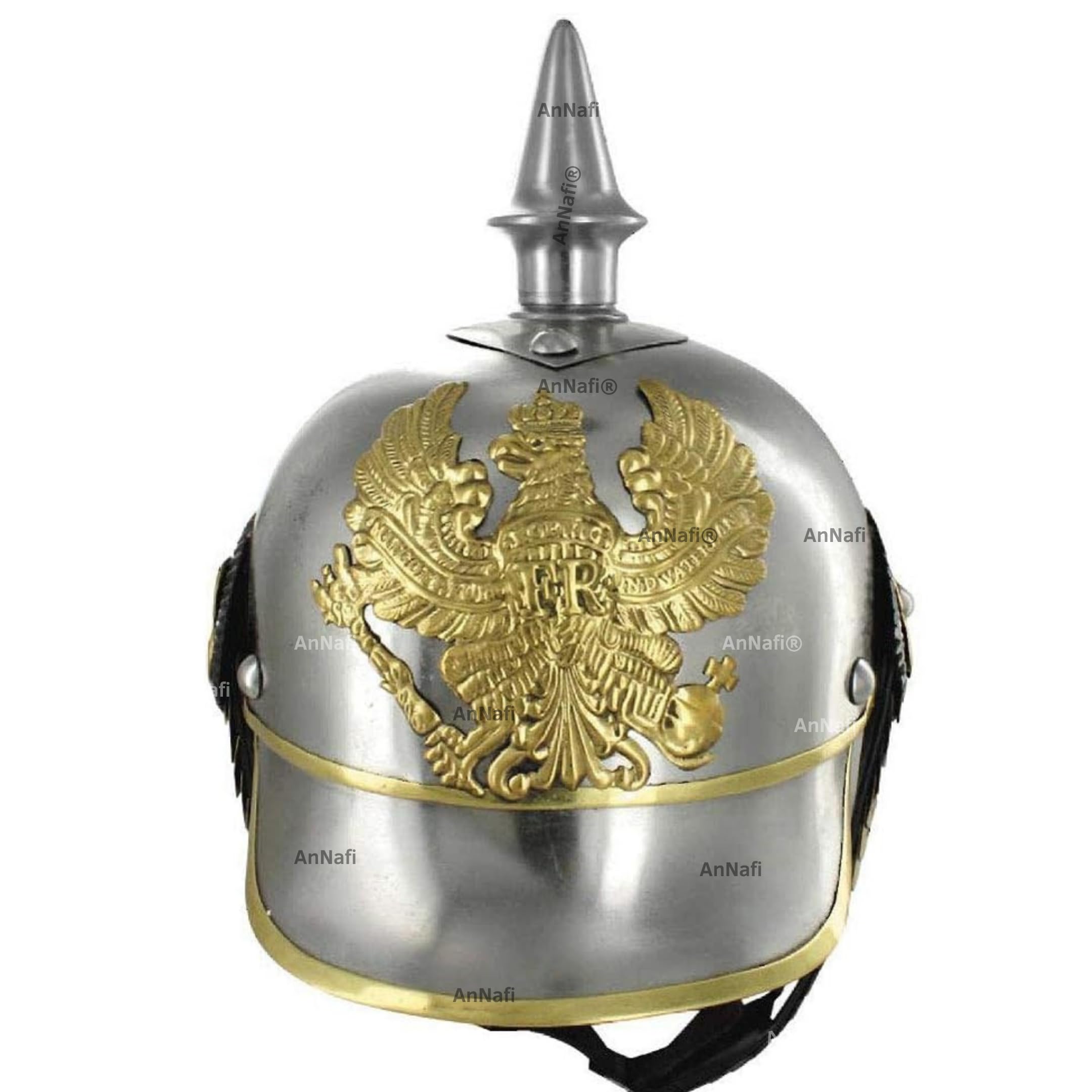
A steel Pickelhaube at 1.16 kg with hand-tooled solid brass accents and a full adult fit.
Same spiked German silhouette, different build. The AnNafi is made from 20 gauge steel and brass rather than leather, with 100% hand-tooled solid brass accents and a historically accurate design. At 1.16 kg it is lighter than you might expect for a steel shell, which makes it easier to wear across a party or a LARP session. The internal circumference is 25.12 inches, with an 8-inch side-to-side diameter and a 12.50-inch front-to-back diameter, so it fits a normal adult head.
The selling point here is where it is meant to go. This is a fully wearable replica for adults, and the maker positions it squarely at costume parties, historical reenactments, and role-playing games. It also works as a decorative piece for an office or home collection. The adjustable strap gives it some give at the chin line, and there is a 30-day money-back guarantee against manufacturing defects. If your plan involves a Halloween party or a theatre production rather than a museum-grade display, this is the lighter of the two spiked helmets on this list and the easier one to wear all evening.
Where it earns its place: for the weight. At 1.16 kg this steel Pickelhaube is nearly double the 0.66 kg of the leather Medieval Replicas spike on this list, so the AnNafi sits heavier on the neck. That extra mass is exactly the point of the steel shell, so weigh your priorities accordingly.
Reach for this if: the helmet will be seen at a distance, in costume or LARP use, where a steel shell and brass detailing read strongly under lights.
Consider the lighter leather Pickelhaube instead: if you will be wearing the spike for hours at a stretch.
6. French Steel Helmet M1915

A 900-gram steel French M1915 with a thick brown leather liner and a genuine leather chinstrap.
What sets this one apart is the interior. Most helmets in this range give you a basic liner, but here you get a thick genuine leather liner in brown and a chinstrap made of real leather. Both are the sort of details that separate a stay-on display piece from a helmet you can wear confidently. The shell is steel, shaped from an original helmet with the correct metal accessories, and the head circumference fits 56 to 60 cm, which covers medium through large adult heads without needing an adjustable band.
At 900 grams it sits between the featherweight Brodie and the 5.2-pound German M16 in your hand. That is heavy enough to feel substantial, light enough to keep on through a long impression day. The buckle closure keeps the chinstrap secure. One thing worth noting: unlike the Roman-numbered French M15 Adrian on this list, this French M1915 reproduction comes without the front insignia, so check your impression’s reference photos before you count on it for a uniformed display.
Best suited to: reenactors who want a French M1915 they can genuinely wear, with a real leather liner and a genuine leather strap.
Worth knowing: it comes without the front insignia, so display-focused French impressions may prefer the Adrian above.
7. German Prussian Helmet Brass Spike Leather Pickelhaube
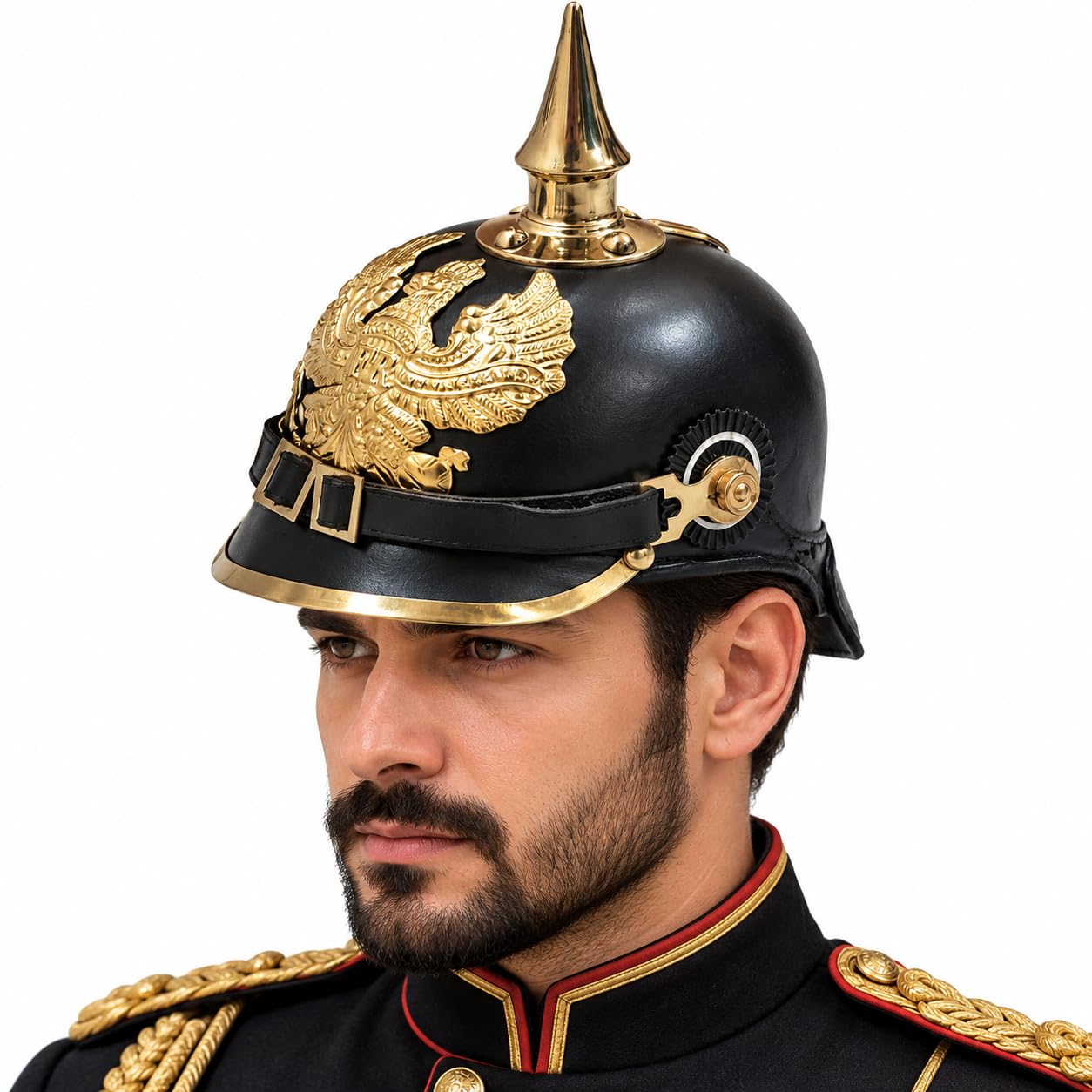
A 0.66 kg leather Pickelhaube with brass fittings, priced for the first-time buyer.
If you are testing the waters on WW1 headgear, this is the entry point. The shell is leather, all fittings are brass, and the whole helmet weighs 0.66 kg — light enough to forget you are wearing it. That is also a fair bit lighter than the AnNafi steel spiked helmet above at 1.16 kg, so if weight on the neck is your worry, the leather route is the kind one. The inner circumference is listed at 58 cm, with an inner liner for comfort wear, and the product is marked customizable with ventilation.
Two things keep it honest. First, the construction is leather with brass fittings, and the appearance is where it shines — buyers describe it as a good-looking replica with strong detail, which is exactly what you want from a shelf piece. Second, the fixed 58 cm inner circumference is narrow; that is a tight fit for larger heads, so measure before you buy and expect limited give.
The budget reality: at this tier you are buying shape and finish, not museum-grade materials. The leather and brass build is respectable for the price, and it displays well. If you need a helmet that survives hard field use, look upward on this list. If you need a first Pickelhaube to hang on the wall, this does the job without a big outlay.
Best first Buy: a first Prussian Pickelhaube for display or light costume use, where the light 0.66 kg shell and brass fittings do the visual work.
Save it if: your head circumference runs well above 58 cm, because the fixed inner measurement leaves little room to spare.
Know the Specs
Steel Gauge and Shell Material
Gauge is a measure of steel sheet thickness, and in replica helmets it tells you how the piece will feel. A thinner shell is lighter and easier to wear; a thicker shell is heavier but holds its shape better on a shelf. Material matters too — leather shells flex with use, while steel shells keep a fixed shape. Neither material is better across the board; leather and steel are both period-correct in the right helmet.
Liner Construction and Head Circumference
The liner is the interior band that sits against your head, and it is what makes a helmet wearable. Look for a stated circumference in cm or a stated hat size. A fixed-size liner has little give, while an adjustable one covers a range of heads. If the listing gives you a real circumference in cm or a hat size, measure your own head against it before ordering, because a leather liner has almost no give.
Weight in Grams and Pounds
Weight is the spec that decides how long you can wear the helmet. A leather Pickelhaube is usually much lighter than a full steel shell, and that difference is noticeable over an afternoon. For a shelf display, weight barely matters. For reenacting or costume wear, it is the number to check first.
Authenticity Details: Insignia, Brass, and Paint
The small details sell the replica: a front insignia, brass fittings, the correct paint tone, a removable spike. A correct front insignia, solid brass fittings, and the right paint tone are what separate a convincing piece from a toy. Check the listing for specifics like blue-grey paint on a French helmet or solid brass accents on a Pickelhaube, and know which details your impression calls for.
Common Questions
Are these helmets real World War I antiques or reproductions?
How do I know which head size to order?
Can I wear a steel Stahlhelm for a full day of reenacting?
What is the difference between a Pickelhaube and a Stahlhelm?
Do these helmets come with a chinstrap?
Will steel replica helmets rust if I store them in a garage?
Can I display a WW1 helmet on a wall without a stand?
Are the brass fittings on a Pickelhaube real brass or plated?
Which helmet is better for a costume party than for display?
Do I need to oil or condition a leather Pickelhaube?
The Bottom Line
For most buyers, the best WW1 war helmet here is the US WW1 M1917 Brodie. Its 18 gauge steel shell, 2.4-pound weight, and real size 7.5 liner make it the one you can wear without thinking about it. If the silhouette you need is German, the German WWI M16 Stahlhelm gets the three-tongue liner and steel shell right, just accept the 5.2 pounds. For a French impression that needs a front insignia, the French M15 Adrian has the blue-grey paint and the roomiest liner on this list. And if you want to test the water before investing more, the Medieval Replicas leather Pickelhaube gives you the spiked look at the lowest weight and the lowest risk.
How we choose
We do not accept paid placement. Every pick is matched to a real buyer and a real use-case; we do not hands-on test units.
Sources
Specifications: manufacturer listings and product documentation. Review insights: verified customer reviews. Pricing: not shown on this page (it changes often); check the current price via the retailer link.
As an Amazon Associate, Tactical Gear Guy earns from qualifying purchases. This does not affect which products we feature.