Specs are compiled from manufacturer listings and verified buyer reviews and can change over time — please confirm the key details on the product page before buying.
You have a driveway, a private lane, or a lot exit that drivers keep turning into the wrong way, and no amount of paint or pleading fixes it. The sign is the fix. But most “Do Not Enter” signs sold online are thin stamped aluminum that dents on the first hard wind and loses its shine within a season. The one thing that actually stops a wrong-way driver is reflectivity — the sign has to bounce headlights back at a driver who is already moving.
This guide is built by comparing the manufacturers’ published specifications and the patterns across verified customer reviews, so you get each pick’s real strengths and trade-offs instead of marketing spin.
We break down plate thickness, sheeting grade, and mounting so the sign you hang is still legible years from now. Below you will find the strongest options for a dependable wrong way sign that holds up outside.
Top Picks
How To Choose The Best Wrong Way Sign
A wrong-way sign has one job: be readable by someone already in motion, in the dark, in the rain. That changes what matters. Size and sheeting grade do more work than font weight, and plate thickness decides whether the sign is still flat on the post after a winter of wind.
Reflective sheeting grade is the real decision
Engineer-grade reflective sheeting is the common baseline on traffic signs — it returns light to the driver but with less punch than higher grades. High-intensity prismatic film is a step up: one pick here uses film the maker describes as 3x brighter than engineer grade, so a driver catches the sign from farther away. If your wrong-way spot is a dark ramp or an unlit lane, that brightness difference is the whole point.
Plate thickness in mils
Mils are thousandths of an inch, so 63 mil is a hair over one-sixteenth of an inch of aluminum. Thicker plate resists denting and stays flat bolted to a post, which keeps the face angled correctly at oncoming traffic. Thinner aluminum still works fine for a sheltered wall mount but will oil-can and flap in open wind.
Staked yard sign or genuine road sign
Corrugated plastic signs on metal ground stakes are a different product class. They suit a private drive, a temporary closure, or a construction detour where you need to move the sign often. They are not built for vehicle-speed approaches, and they are single-sided. Match the build to the setting before you compare anything else.
Side-by-Side Comparison
| Model | Best For | Face Size | Plate / Material | Sheeting | Amazon |
|---|---|---|---|---|---|
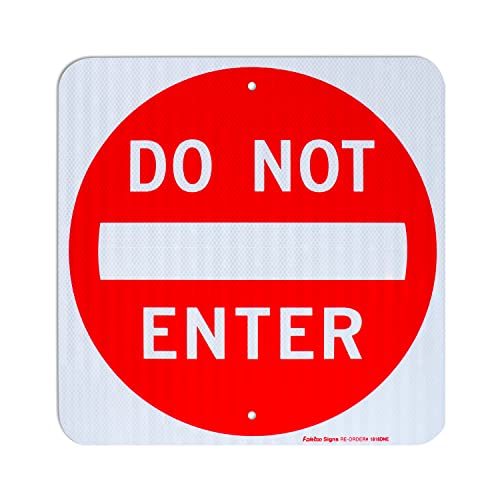
| Faittoo 18×18 Do Not Enter★ Best Overall | All-round driveway and lot sign | 18″ x 18″ | Engineer grade reflective aluminum | 3M Engineer Grade | Amazon |
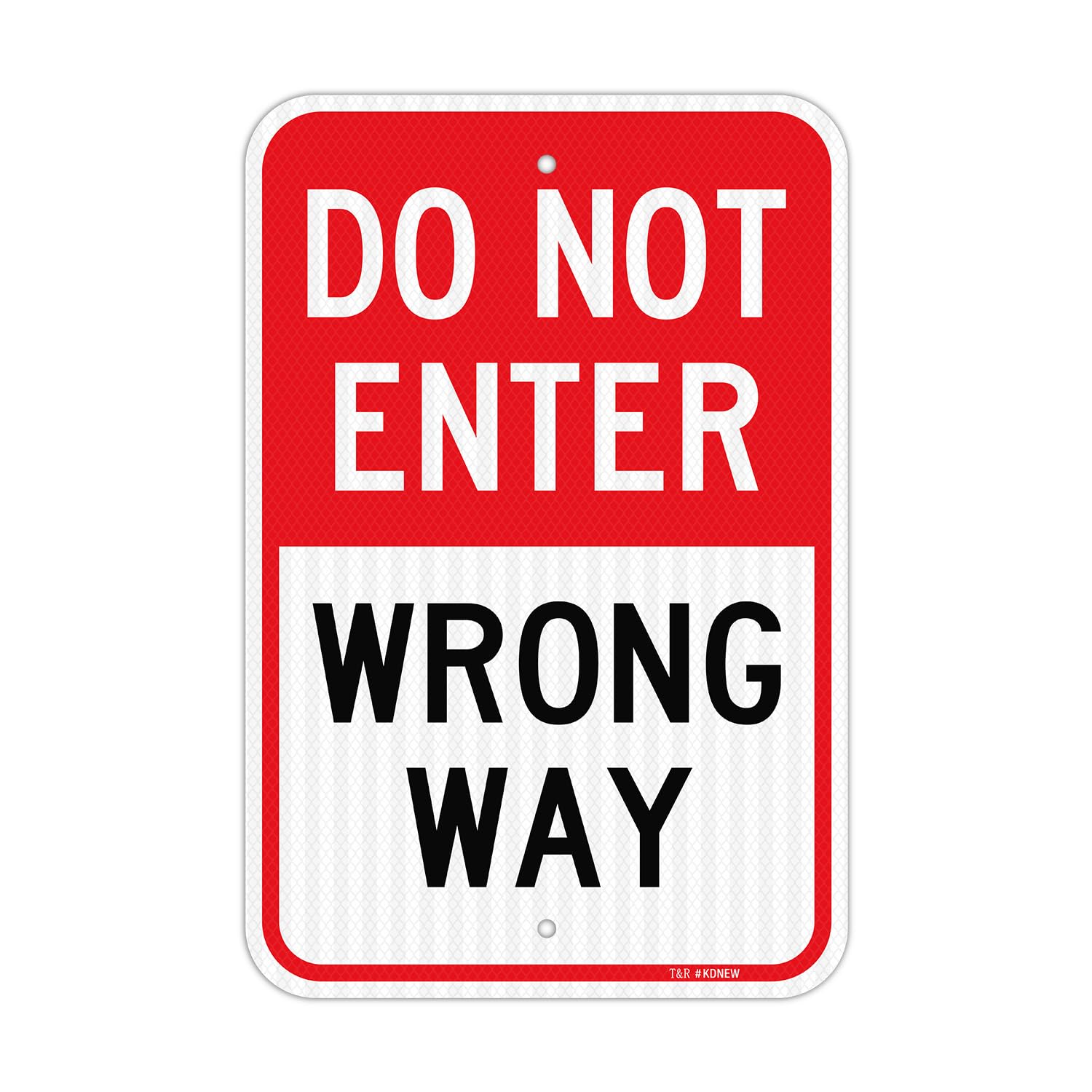
| T&R 18×12 Do Not Enter Wrong WayBudget Standard | Tight budget, standard post mount | 18″ x 12″ | Rust-free aluminum | Engineer Grade Reflective | Amazon |
| SmartSign 18×12 63 mil | DOT-spec private road signing | 18″ x 12″ | 63 mil aluminum | 3M Laminated Engineer Grade | Amazon |
| OLANZU 24×18 Prismatic | Dark ramps and exit-only lanes | 24″ x 18″ | 60 mil aluminum | High Intensity Prismatic | Amazon |
| NMC TM133J WRONG WAY | Municipal-grade lane control | 24″ x 18″ | 0.080 in. aluminum | Heavy duty reflective | Amazon |
| Venicor 2PC with Stakes | Temporary closures and private drives | 17″ x 13″ | Corrugated plastic | UV fade-resistant ink | Amazon |
Detailed Reviews
1. Faittoo Do Not Enter Sign 18×18
Our pick — 4.5+★ from 450+ verified ratings; the strongest balance of quality and price.
The square 18-inch face that gives a wrong-way driver the cleanest read at speed.
Eighteen inches by eighteen inches is the number to start with. That square format gives the red field and white “DO NOT ENTER” bar more area than a 18×12 rectangle, which means bigger letters from the same mounting point. Built from engineer-grade reflective aluminum, the plate faces down rust and bending, and the 3M sheeting bounces headlights back so the message reads even when the light is poor. It is the crowd favorite for a reason: 4.5+ stars across 400+ ratings, with reviewers praising the build quality above all.
Mounting is genuinely flexible. Rounded corners with two pre-drilled holes top and bottom let you hang it on a post, wall, fence, or pole — with tape, screws, nails, zip ties, or wire. Note that the attachment hardware is not included, so plan your fasteners before it arrives. The face is printed portrait-orientation, so measure your post height against the lettering before you commit to a spot.
The honest catch: the plate is thinner than the heavy road-grade signs further down this list, and that shows up in the hand. If you need a sign that survives a highway-speed approach or a hard hit, step up to the 63 mil SmartSign or the NMC. For a driveway, a private lane entrance, or a lot exit where cars move slowly, this is the smartest balance of price and durability on the page.
What earns its keep
- 18″ x 18″ square face puts more red and white area toward oncoming traffic
- 3M engineer-grade reflective sheeting keeps it legible in low light and headlights
- Rounded corners and two pre-drilled holes fit posts, walls, fences, and poles
- Rust-resistant aluminum that resists bending
Worth knowing before you buy
- Thinner plate than road-grade signs — not built for highway-speed hits
- Mounting screws, nails, and zip ties are not included
- Portrait orientation only
Reach for this if: you want one sign that covers a driveway, private lane, or lot exit with a big readable face and reflective night visibility.
Look elsewhere if: your approach is at vehicle speed or takes regular impact — a thicker plate is the better match.
2. T&R Do Not Enter Wrong Way Sign 18″ x 12″
A compact 18×12 patch of reflective aluminum that treats the post as the plan.
Start with what the maker publishes: engineer-grade reflective sheeting on heavy-duty rust-free aluminum, rated for up to 10 years of outdoor service life. That lifespan claim sits on corrosion resistance, UV protection, waterproofing, and fade resistance — the four things that actually kill a sign left outside. The black-and-red-on-white color set is chosen to make the sign easy to pick out, and this one swaps “DO NOT ENTER” for the full “Do Not Enter Wrong Way” text plus an up arrow, which reads as a directional instruction, not just a prohibition.
Unlike the 18×18 Faittoo above, this is a landscape 18×12 panel — the same 18-inch length as the SmartSign. That shape suits a horizontal post run or a wall where a square would crowd the mounting. Two pre-drilled holes top and bottom take screws, zip ties, or nails. Hardware is excluded, so buy fasteners separately.
The trade-off is straightforward. A smaller face means the lettering shrinks with it, and at 18 inches across it is not the sign for a long, fast approach. It is the sensible pick for a private drive, a rear gate, or a small lot where you want reflective aluminum without spending more than you need to.
Best matched to: a quiet private lane, a rear service gate, or a compact lot entrance where a horizontal 18×12 panel fits the mounting you already have.
Fair warning: the lettering scales down with the smaller face, so give it a close mounting distance rather than a long approach.
The short version: reflective aluminum with a stated 10-year outdoor life for very little outlay — a solid first wrong-way sign.
Think twice about: long sight lines, where the bigger 24-inch faces below win on legibility.
3. SmartSign Do Not Enter – Wrong Way Metal Sign

The one built to a published road-sign standard, right down to the laminate.
Sixty-three mil is the spec that matters here. That is a hair over one-sixteenth of an inch of rustproof aluminum — a step above the 60 mil OLANZU by a sliver. SmartSign uses official 3M reflective engineer-grade film and 3M inks, and states the signs meet DOT requirements for outdoor parking and traffic use. If your sign has to satisfy an inspector, a property manager, or a hoa, that paper trail is why this one exists.
The laminate is the detail most buyers miss. A clear UV laminate shields the graphic from water, chemicals, UV rays, and abrasion, and it lets you wipe graffiti off without destroying the print. Corners are rounded and burr-free, with 3/8-inch punched and pre-cleared holes that bolt straight to U-channel posts, galvanized square or round posts, wooden posts, and chain-link fences. SmartSign rates the outdoor service life at 10 years.
Where it falls short of the 24-inch OLANZU and NMC below is face size — 18×12 is a mid-size panel, not a wide one. On a broad ramp or a multi-lane exit you will want the larger face. On a single-lane driveway or a compact parking restriction, 18×12 with this plate thickness is exactly right.
Why this holds up: 63 mil aluminum plus a UV laminate plus 3M film is the combination that keeps a face flat and a graphic clean through years of sun and rain, and a graffiti wipe-down does not strip the print.
The limitation to plan around: it is an 18×12 face, so it favors close single-lane approaches over wide, fast exit ramps.
Pick this when: the sign needs to meet DOT-style requirements or survive serious weather, and you want a documented road-grade build.
Not for: wide multi-lane ramps where a 24-inch face is the honest minimum.
4. OLANZU Metal Do Not Enter Wrong Way Sign 24×18

Prismatic film that throws headlights back harder than engineer grade ever will.
The headline is the sheeting, not the size. OLANZU uses high-intensity prismatic film that the maker describes as 3x brighter than engineer grade. That brightness means a driver catches the sign and corrects sooner — which is the entire reason you are hanging a wrong-way sign in the first place. Pair it with a 24×18 face and you have the widest, most reflective panel here short of the NMC, and that face area difference versus the 18×12 SmartSign is what a wide exit ramp actually needs.
Sixty mil rust-free aluminum is thick enough to hold its shape on a post through wind and weather, per the maker. UV-resistant ink over that plate resists sun, rain, and freeze. Orientation is portrait, mounting is wall-type, and one piece ships flat. Note the maker’s own framing: this is a road sign, not a small indoor plaque, so it wants outdoor hardware and a real post or wall.
The honest limit is mounting flexibility. With no published hole-pattern detail and a wall-mount spec, this one assumes you are bolting to a flat surface or a post you have already set up. If you need something you can pull up and move tomorrow, the staked Venicor below is the better tool.
Where it pulls ahead
- High-intensity prismatic film the maker rates at 3x brighter than engineer grade
- 24×18 face gives the widest readable panel before you hit full municipal pricing
- 60 mil rust-free aluminum resists bending through wind and weather
- UV-resistant ink fights fading through sun, rain, and freeze
Before you order
- Wall-mount spec with no published hole layout — plan your own hardware
- Fixed installation, so not suited to temporary or relocatable use
Go this route if: your wrong-way problem sits on a dark ramp, an exit-only lane, or an unlit private road where headlight reflectivity decides whether a driver sees it.
Keep looking if: you need to move the sign between sites — a fixed post sign does not travel well.
5. NMC TM133J WRONG WAY Traffic Sign

Heavy enough to hum in the wind, and sized like an actual lane-control sign.
Weigh this in your hand and you know: 3.7 pounds of aluminum, at 0.080 inches thick, measuring 24 inches wide by 18 inches high. That is a full road-sign blank, and the mass is what keeps a big face flat on the post instead of cupping toward oncoming traffic. The legend is white “WRONG WAY” text on a red base — a direct instruction rather than a do-not-enter prohibition — and the bold letters sit on contrasting colors so the text reads at distance even in poor lighting.
The NMC Sign Muscle coating is the detail that separates it from a plain sheet. A UV-cured clear coat bonds to the face and protects the text and image against fading, scratches, scuffing, and graffiti, and it is claimed to boost color and clarity at the same time. Predrilled holes sit on radius corners for mounting on a wall or post. Landscape orientation spreads the lettering wide, which is how this sign is meant to be read.
Two things to know. It is the widest and heaviest pick here, and the brand’s municipal traffic-signage pedigree shows in the build — but that build is overkill for a private drive you never expect a truck to hit. The other is the legend itself: WRONG WAY and DO NOT ENTER are different messages. Use this where you are directly countering drivers coming at you head-on in the wrong direction.
The weight argument: at 3.7 pounds and 0.080 inches, this face holds its plane where thinner plates flutter, and the coating keeps the legend crisp against sun, scratching, and graffiti.
An honest sizing note: it is the largest, heaviest option on the list, so it earns its keep on a real lane, not a decorative driveway marker.
Built for: a lane where drivers genuinely come at you the wrong way and the sign must read as official traffic control.
Overkill for: a short private drive where a lighter reflective panel does the same job for far less.
6. Venicor 2PC Do Not Enter Wrong Way Sign

Two staked signs you can drop into the grass in the time it takes to read this.
Everything here is about speed and being temporary. You get two 17×13 corrugated plastic signs and two metal ground stakes, and no tools are needed — slide the sign onto the stake and it is up. That is the right answer for a one-week road closure, a party detour, or a private drive where you occasionally need to block an entrance and then clear it. Corrugated plastic with UV fade-resistant ink is weatherproof, waterproof, wind resistant, and tear proof, so a season in the elements does not shred it.
The one thing to plan around is that these are single-sided. Big bold letters face one direction only, so if traffic can approach from two sides you need to position them back to back or pick a metal sign that faces its audience. The plastic build is also a whole different class from the aluminum panels above — this is a marking and directing tool, not a permanent road fixture.
The pair nature is the quiet advantage. Two signs for the price of one sticker means you can block a driveway at both the street and the inner gate, or set them across a wide closure without buying twice. If your need is genuinely permanent, the money is better spent on the Faittoo, SmartSign, or OLANZU above.
What it handles: temporary closures, event detours, and private-drive blocking, where two staked signs go up in seconds and come down just as fast.
The gap to note: single-sided printing means one direction of visibility per sign — position them accordingly.
For the quick job: a two-pack of staked plastic signs that needs no tools, no hardware, and no planning beyond where to plant them.
Skip the plastic route if: the sign has to stay put for years in weather — aluminum is the durable answer.
Know the Specs
Sheeting Grade: Engineer Grade vs High Intensity Prismatic
Reflective sheeting is the layer that sends a headlight beam back to the driver. Engineer-grade sheeting is the common baseline — it works, it is widely used on parking and private signs, and it keeps a message legible at night. High-intensity prismatic film is a brighter grade; one pick here uses film the maker describes as 3x brighter than engineer grade, meaning headlights hit it and bounce back with more force and from farther. On a dark, unlit approach, that is the difference between a driver seeing the sign in time and seeing it when they are already in the wrong lane. Choose the brighter sheeting where speed or darkness is the risk.
Plate Thickness and Material: mils, inches, and aluminum
Sign plate thickness is measured in mils — thousandths of an inch — or in decimal inches. The picks here run from 60 mil aluminum (just under one-sixteenth of an inch) up to 0.080 inches on the NMC. Thicker plate resists denting, stays flat bolted to a post, and does not flap in wind. Aluminum is chosen because it does not rust; corrugated plastic is the other option, and while it resists tearing and weather, it is a temporary marker rather than a road fixture. Pick thickness by what the sign will face: wind and weather want mass, a sheltered wall mount does not need it.
Mounting: pre-drilled holes, corners, and hardware
Round or square, every sign here except the staked pair relies on pre-drilled holes. The cuts vary — two holes top and bottom on the Faittoo and T&R, 3/8-inch punched and pre-cleared holes on the SmartSign, radius-corner holes on the NMC. That hole layout tells you what the sign was designed to bolt to: U-channel posts, galvanized posts, wooden posts, chain-link fence, wall, or pole. Most of these do not include screws, zip ties, or nails, so plan the fasteners as part of the purchase. Pre-cleared holes also save you drilling a coated panel and inviting rust.
Legends: DO NOT ENTER vs WRONG WAY
These are two different instructions, not two names for one sign. “DO NOT ENTER” is a prohibition — it stops a driver before they commit. “WRONG WAY” is a direct correction — it tells a driver already heading the wrong direction to turn around. Most one-way lane control posts use both together, but when you buy a single sign, read what the panel actually says. Some picks here carry the full “Do Not Enter Wrong Way” text; the NMC carries only WRONG WAY; the Faittoo and SmartSign carry DO NOT ENTER. Match the legend to where the mistake happens.
Common Questions
Does a Do Not Enter sign legally have to be reflective?
What is the difference between engineer grade and high intensity prismatic film?
How thick should a wrong way sign be for outdoor use?
Will a Wrong Way sign survive being left outside through winter?
Do these signs come with screws or mounting hardware?
Can I mount a wrong way sign on a wooden fence or chain-link fence?
Is a staked plastic sign or an aluminum sign better for a private driveway?
Should I buy a DO NOT ENTER sign or a WRONG WAY sign?
How do I clean graffiti or scuffs off an outdoor sign?
What size wrong way sign do I need for a driveway versus a road?
The Bottom Line
For most drivers the wrong way sign winner is the Faittoo 18×18 — a square reflective face that beats the smaller 18×12 panels on readability, backed by 400+ owner ratings and an aluminum build that holds up on a post through weather. If your wrong-way spot is a dark ramp or an exit-only lane, the OLANZU 24×18 gives you the wider face plus prismatic film the maker rates 3x brighter than engineer grade, which is the brightness that stops a moving driver. Where the sign must meet DOT-style requirements or survive a hard life, the SmartSign 63 mil with its laminated 3M face is the one to reach for. A quiet nudge: the Faittoo carries 400+ ratings, the most of any sign here, which makes it the safe first buy.
How we choose
We do not accept paid placement. Every pick is matched to a real buyer and a real use-case; we do not hands-on test units.
Sources
Specifications: manufacturer listings and product documentation. Review insights: verified customer reviews, as of November 2026. Pricing: not shown on this page (it changes often); check the current price via the retailer link.
As an Amazon Associate, Tactical Gear Guy earns from qualifying purchases. This does not affect which products we feature.