Specs are compiled from manufacturer listings and verified buyer reviews and can change over time — please confirm the key details on the product page before buying.
If you want to track your blood oxygen overnight without a plastic clip pinching your fingertip, the short answer is this: buy the Wellue Checkme O2 Ultra if you want the longest run time, or the EMAY SleepO2 if you want a proven all-night recorder. Other wrist-worn oximeters are worth owning too — just for narrower jobs. This guide lines up seven of them so you can match the device to your actual reason for wearing it.
This guide is built by comparing the manufacturers’ published specifications and the patterns across verified customer reviews, so you get each pick’s real strengths and trade-offs instead of marketing spin.
Here you will see how battery hours, sensor accuracy, alert behavior, and report exports actually differ from one wrist unit to the next. These are sports and aviation tools, not medical devices, so plan accordingly.
Skip the marketing copy and use this breakdown to choose the wrist worn pulse oximeter that fits how you sleep, train, and fly.
Top Picks

How To Choose The Best Wrist Worn Pulse Oximeter
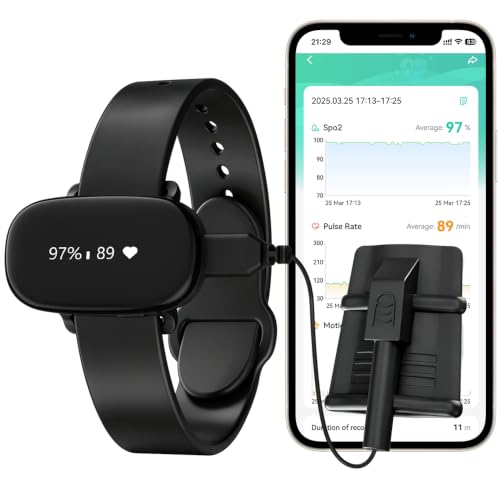
A wrist oximeter does a different job than the fingertip clip at a clinic. It sits on your wrist (usually with a small ring sensor on one finger) and records your blood oxygen and heart rate while you sleep, fly, or train. Choosing well is mostly about matching three things to your routine: how long it runs, how it stores that data, and how loudly it warns you.
Hours matter before features do
Continuous recording burns battery, so look at the continuous-recording number, not the standby figure. A unit rated at 12 hours will cover most single nights. One rated far higher changes how often you recharge — the Wellue here is rated at 100 hours of continuous use, while the EMAY SleepO2 is rated at 12 hours.
How readings are captured and stored
Most of these units sample every 4 seconds. Built-in memory lets the device record without a phone nearby, which matters if you don’t want Bluetooth running all night. Check how many data groups the device holds before it overwrites — some hold 4 sets, and the oldest gets replaced by the fifth.
Alerts, screens, and comfort
An alert threshold is the oxygen level you choose at which the device beeps or vibrates to wake you. Set it in the app before your first night. On the hardware side, a soft silicone sensor and a stretchy band decide whether you can sleep through the night with it on, and a rotating display decides whether it works on either wrist.
Side-by-Side Comparison
| Model | Best For | Continuous Battery | SpO2 Range / Accuracy | Data Storage | Amazon |
|---|---|---|---|---|---|
| EMAY SleepO2★ Best Overall | Proven all-night recorder | 12 hours | Not stated | Built-in (phone-free) | Amazon |
| MugaTree Wrist OximeterAlert Specialist | Alerts and PDF sharing | 14 hours | ±2% | Via Bluetooth app | Amazon |
| Vibeat OxyU | Auto-start simplicity | 12 hours | 70-100% range | 4 groups on device | Amazon |
| OxyU Ring Sensor | Smallest ring sensor | 12 hours | Not stated | 4 groups on device | Amazon |
| Wellue Checkme O2 Ultra | Marathon battery life | 100 hours | 70-100% range | 4 sets of 12-hour data | Amazon |
| Withings ScanWatch Nova | All-day wearable watch | 30 days (watch) | On-demand SpO2 | Watch + app | Amazon |
Detailed Reviews
1. EMAY SleepO2 Wrist Pulse Oximeter
Our pick — 4.0+★ from 550+ verified ratings; the strongest balance of quality and price.
The one that logs a full night of SpO2 and pulse to built-in storage, no phone required.
Some wrist oximeters need a Bluetooth link to a phone to keep anything. The SleepO2 does not. It has its own built-in storage and logs your SpO2 (blood oxygen saturation, the percentage of oxygen your blood is carrying) and your pulse rate through the night without a smartphone nearby — so a dead phone battery never costs you your data.
Rechargeable and rated for 10 hours of continuous recording on a full charge, which covers an ordinary night’s sleep. The body weighs 20 g, and the patented finger probe is silicone and ultra-soft, so you are not fighting a hard clip while you try to drift off. The app shows live readings while it is recording, so you can peek at a number mid-night without breaking the recording.
What wins people over is accuracy — overnight readings owners say stack up against medical equipment, plus minute-by-minute sleep data. For a device with this shelf presence, it is the crowd favorite at 4.0+ stars across 570+ ratings. The honest catch: this is a sports and aviation tool, not a medical device, so treat every reading as a training and travel data point. And it is a recorder first — do not buy it expecting a built-in screen alarm to wake you.
What earns it the top spot
- Records overnight SpO2 and pulse rate with no phone connected.
- Ultra-soft silicone finger probe and a 20 g body for all-night wear.
- Overnight readings owners say stack up against medical equipment, with minute-by-minute sleep data.
Where it asks patience
- Rated 10 hours of continuous recording, so the longest nights may need a mid-charge.
- Built for sports and aviation use only, not medical use.
Reach for this if: you want a phone-free overnight recorder you can trust for altitude training, travel, or sleep tracking you review the next morning.
Look elsewhere if: you need a marathon multi-night run time — that is the Wellue’s job.
2. MugaTree Wrist Pulse Oximeter with APP Report
Every-4-second tracking with a built-in alert that wakes you when oxygen slips.
If the reason you want a wrist oximeter is the warning as much as the record, start here. The MugaTree samples your SpO2 and heart rate every 4 seconds through the night, and its built-in alert gently wakes you when your oxygen falls below the threshold you set. That threshold lives in the app, so you choose how sensitive it is.
Sensor accuracy is rated at ±2% for oxygen and pulse, and the rechargeable battery supports 14 hours of continuous monitoring on a single charge — enough for a full night with room left over. Reports come out of the app as PDF or JPG files, so you can hand a screen-free summary to a coach, a trip partner, or your own notes. Trend charts run over days, weeks, or months.
The comfort side is a soft silicone band designed for wearing all night without nudging you awake. The catch: this is a newer listing with a thinner track record than the EMAY — 3.5+ stars across a small batch of ratings — so read its reviews with a little more patience. It is also sports and aviation only, never a substitute for a medical assessment.
Best at: turning oxygen data into a portable PDF you can actually share, with a 14-hour run time that outlasts the EMAY SleepO2’s 12-hour rating.
Trade-off to know: the alert is the star of the show here, so if you want a silent overnight recorder with no beeps, the EMAY or Wellue suit you better.
Who it beats for: altitude trekkers and pilots who want to be woken by a threshold crossing and carry the evidence home in a PDF.
Who should pass: anyone who wants a fully silent recorder and no alarm to fuss with.
3. Vibeat OxyU Wrist Blood Oxygen Monitor
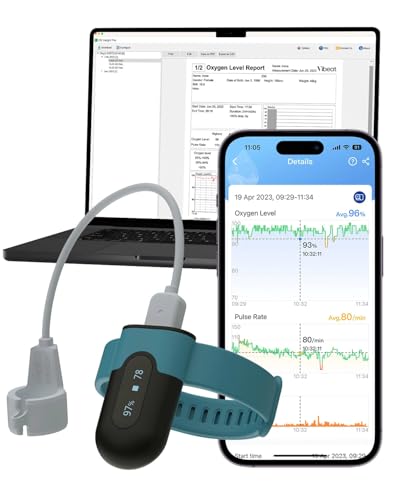
Put it on and it starts recording — no button press, no menu.
Some people do not want an app before their first reading. The OxyU simply starts monitoring once it is worn, and a turn of the wrist wakes the screen to show your numbers. It tracks oxygen saturation, heart rate, and body motion using infrared sensing, with a measuring range of 70-100% SpO2 and a 12-hour battery on a full charge.
When your oxygen falls below a threshold — adjustable between 80% and 95% in the app — the device vibrates and the app beeps. Data is collected every 4 seconds, and the ViHealth app handles export in PDF, CSV, or Binary, with a PC report option for managing the record on a desktop. The on-device memory holds 4 groups of data at up to 10 hours each; the oldest group is overwritten by the fifth, so upload to the app promptly after each session.
The catch is the record behind it. At 3.0+ stars it is the least-loved pick on this list, and the review base is thin, so go in with clear expectations and check the return window. It is the older OxyU build — the ring-sensor cousin below has the larger review base and scores higher.
Why it’s on the list: automatic start and a wake-on-turn screen make it the least fussy option for a first-time wrist oximeter owner.
The catch: the 4-group memory caps each set at 10 hours, so a long flight or a split-shift sleep needs two syncs to be safe.
Pick it for: the set-it-and-wear-it crowd who want readings without learning an app first.
Leave it for: buyers who want the strongest review record — the OxyU056 with the ring sensor is a better bet.
4. OxyU Wrist Pulse Oximeter with Finger Sensor

The smallest silicone ring sensor of the bunch — built to disappear on your finger.
Comfort over a whole night is decided at the fingertip, and this OxyU makes a real pitch there. The maker calls it the lightest, smallest silicone ring sensor for continuous tracking — a real change if a hard plastic clip is what has kept you from sleeping with an oximeter on.
It records your blood oxygen, heart rate, and body motion for up to 12-16 hours once charged, moving to the ViHealth app in unlimited storage. Data lands every 4 seconds and exports as PDF, CSV, or Binary, with PC software for the full record. The on-device memory holds 4 groups of 10 hours each, and the first set is overwritten by the fifth — so sync after every session.
The instructions matter more here than on some other wrist units: keep your hand warm, relaxed, and positioned below the heart level, stay still, and take readings before or after exercise rather than mid-session. The catch is that mixed feedback shows up in the record — some units work flawlessly while others have had trouble from the start, so check yours on arrival. Sports and aviation only, as always.
What it brings to the wrist
- Lightest, smallest silicone ring sensor for all-night continuous wear.
- 12-16 hours of tracking with unlimited app storage.
- Export as PDF, CSV, or Binary plus a PC report option.
What to watch
- Mixed owner experience — check the unit works straight from the start.
- Readings need a warm, still, relaxed hand below heart level to be dependable.
Go this way for: the best shot at all-night comfort from a small silicone ring, with the larger review base of the two OxyU builds.
Think twice if: you want the safest, longest-proven record — the EMAY SleepO2 has the strongest accuracy reputation on this list.
5. Wellue Checkme O2 Ultra Wrist Pulse Oximeter
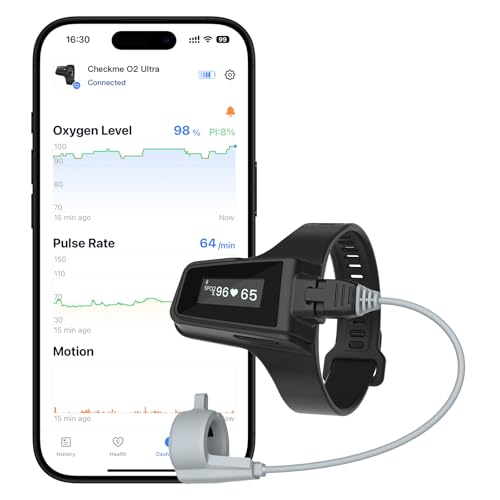
A 100-hour endurance burner that turns a weekend charge into weeks of tracking.
The number that does the heavy lifting here is 100 hours of continuous use from a single charge — compared with 12 hours on the EMAY SleepO2. Put plainly, that is the difference between charging every night and charging roughly once a week for a short nightly session. A full top-up takes just 2 hours over the magnetic charging cable.
Accuracy is where it earns its place in the conversation: the sensor is rated for real-time continuous readings across a 70-100% SpO2 range, and owners single out accuracy as its standout trait. Storage holds 4 sets of 12-hour data, so you can record without a phone glued to your wrist and sync to the Vihealth app later for the full graphical trends. Reminders fire as either an audible alert or a vibration when oxygen or pulse drops below the thresholds you set on the device or in the app.
Bluetooth sync to the Vihealth app is the intended path for reviewing data, and the recurring gripe is on the PC side — the Windows application can have trouble connecting to the device. Wristband fit and secure wear are the other thing to check on arrival, so test the band on your wrist before your first overnight run. It is a larger, higher-scoring buy than its OxyU neighbors at 3.5+ stars across a wider review base, and it stays a sports and aviation device, not a medical one.
The defining spec: 100 hours of continuous battery life — that is roughly eight times the 12-hour EMAY SleepO2 rating, and the reason to pick this over the others.
Where it stumbles: the Windows app connection is the weak link in the chain, so plan to sync to the phone app first and use the PC side as a bonus.
Right for: anyone who hates charging nightly, wants both vibrate and audible alerts, and needs on-device storage for phone-free nights.
Wrong for: buyers who need a rock-solid PC workflow — that is the one part owners have had trouble with.
6. Withings ScanWatch Nova

A steel watch first, an oximeter when you ask it to be one.
Every other pick here is a dedicated tracker. The ScanWatch Nova is a hybrid watch in stainless steel with a buckle clasp that happens to measure blood oxygen — on demand for a spot reading, and overnight to track breathing disturbances. If you refuse to wear a plastic band to bed, this is the pick that gets you the data without the look.
It covers far more than SpO2: 24/7 heart rate with high and low notifications, overnight heart rate variability, and 24/7 temperature tracking through a TempTech24/7 module for a baseline body temperature and its fluctuations. Sleep gets duration, light and deep sleep time, interruptions, regularity, and a Sleep Quality Score. Activity tracking auto-recognizes 40+ activities, uses heart rate zones and a VO2 max fitness estimate, and adds connected GPS.
The battery is rated at 30 days with a 2-hour charge time and a 0.19 amp-hour cell — so you charge it monthly, not nightly. The catch: continuous overnight oxygen is not the same story here as the dedicated recorders. SpO2 is framed as on-demand measurement plus overnight breathing-disturbance tracking, not the every-4-second SpO2 record the Wellue and EMAY deliver. It is a committed investment for a watch you wear daily, not a sleep-lab stand-in.
What you gain wearing it daily
- Stainless steel case and band with a 30-day battery rating for monthly charging.
- Heart health, overnight HRV, temperature, sleep, and VO2 max in one device.
- Looks and works like a real watch, on the wrist all day and night.
What you trade away
- Overnight SpO2 is on-demand plus breathing-disturbance tracking, not every-4-second recording.
- A premium-budget commitment compared with the dedicated trackers here.
The one for you if: you want a daily-wear watch with SpO2 and temperature as part of a broad health picture, not just an overnight recorder.
Save your money if: continuous minute-by-minute overnight SpO2 is the whole reason you are shopping — the EMAY and Wellue do that job better.
Know the Specs
Continuous Battery (Hours)
This is how long the device records before it needs a charge, not how long it sits on a shelf. A 12-hour rating covers one full night for most sleepers. A rating like the Wellue’s 100 hours covers roughly a week of short sessions. Look for the continuous figure specifically, because daily charging wears on you fast if you track every night.
Sampling Interval
Most wrists here record a reading every 4 seconds. That is the number that decides how detailed your overnight picture is — a 4-second interval catches dips a fingertip spot-check would never see. A sparser interval can miss short desaturation (a brief oxygen dip) events between readings.
SpO2 Range and Accuracy (±)
The percentage range is the band where the sensor is rated to read. Many here are rated for a 70-100% SpO2 range; a ±2% accuracy figure means a reading can sit within two points of the true value. Below a rated range, treat a reading as a hint rather than a number.
On-Device Data Storage
Built-in storage lets the device record with no phone nearby. Some units hold 4 groups of 10 or 12 hours each, and the oldest group gets overwritten by the fifth — so sync to the app after each session or you lose the earliest record. Unlimited app-side storage is common; device memory is finite.
Alert Threshold and Vibration
The threshold is the oxygen or pulse level you choose at which the device beeps or vibrates to wake you. Ranges vary — one model here allows an 80% to 95% custom window. Set it before your first night, and test the alert in daylight so you know what it feels like before it matters.
Finger Sensor Type
A clip probe, a soft silicone ring, or a silicone finger sleeve all touch the same fingertip. The material and shape decide whether you can sleep through the night with the sensor on. Rings tend to feel less bulky; soft silicone handles sweat better than hard plastic. None of these should be worn tight.
Common Questions
Does a wrist oximeter need a phone connected all night to record?
Can I wear a wrist oximeter on either wrist?
Is a wrist oximeter a medical device I can rely on for diagnosis?
How accurate is the SpO2 reading compared with a fingertip clip at the clinic?
How long does the battery actually last on continuous recording?
What happens when the device memory fills up on a wrist oximeter?
Will the oxygen alert wake me if my levels drop during sleep?
Do I need a subscription to export reports from a wrist oximeter?
Can I use a wrist oximeter for high-altitude or flight monitoring?
The Bottom Line
For most people, the wrist worn pulse oximeter winner is the EMAY SleepO2 because it records a full night of SpO2 and pulse rate to built-in storage with no phone required, and it earns the strongest accuracy reputation on this list. If you want the longest run time and want to stop charging nightly, grab the Wellue Checkme O2 Ultra with its 100-hour battery. And for a watch you wear all day with SpO2 as part of a wider health picture, the Withings ScanWatch Nova is the one to reach for. The EMAY is not the highest-numbered pick on this page, but it is the most-recommended one for overnight recording — worth trusting when you see the gap between its accuracy feedback and the rest.
How we choose
We do not accept paid placement. Every pick is matched to a real buyer and a real use-case; we do not hands-on test units.
Sources
Specifications: manufacturer listings and product documentation. Review insights: verified customer reviews, as of November 2026. Pricing: not shown on this page (it changes often); check the current price via the retailer link.
As an Amazon Associate, Tactical Gear Guy earns from qualifying purchases. This does not affect which products we feature.