Specs are compiled from manufacturer listings and verified buyer reviews and can change over time — please confirm the key details on the product page before buying.
Here is the short answer: if you want a wrist watch with compass and GPS you can actually trust deep in the backcountry, the Garmin Instinct 3 AMOLED is the safest buy on this shelf. It holds 4.5+ stars across 900+ owners, runs 18 days on a charge, and pairs a 3-axis compass (accurate even when your wrist is tilted) with multi-band GPS (a steadier fix in tree cover). Everything else on this list trades off price, screen size, and how tough the build is. The real problem is not finding GPS and a compass — plenty of watches list both. It is finding a compass that stays accurate when your phone is dead and the trail sign is gone.
This guide is built by comparing the manufacturers’ published specifications and the patterns across verified customer reviews, so you get each pick’s real strengths and trade-offs instead of marketing spin.
A wrist watch with GPS gives you satellite positioning on your arm; the compass tells you which way you are facing once you know where you stand, and the altimeter and barometer add elevation and pressure. Below you will find the models worth strapping on for your next trip out, sorted by what each one does best. My picks for the best wrist watch with compass and GPS are the ones that keep working when the signal and the battery are all you can count on.
Top Picks


How To Choose The Best Wrist Watch with Compass and GPS
The trap is a watch that says “GPS” and “compass” on the box but leans on your phone for the actual work. A true standalone navigator holds its own fix and points north without a tether. Start with these four checks and you will skip most of the regret.
Compass type: 3-axis versus flat sensors
A 3-axis compass reads direction even when the watch is not held flat, which is the state your wrist is usually in when you are scrambling. A flat 2-axis sensor wants a level surface to be accurate. On a slope or in thick brush, 3-axis is the one that answers.
GPS bands and satellite systems
Multi-band GPS (a receiver that locks more than one frequency at once) holds a fix better in tree cover and canyon walls than a single-band receiver. Satellite support like GPS, GLONASS and Galileo widens the sky you can see. Both matter more than a bigger screen when the trail is tight.
Battery days and GPS hours
A watch that lasts 18 days in smartwatch mode can still burn out in a single long GPS session, so check the GPS-mode hours separately. If you plan multi-day trips, battery days and GPS hours are two different numbers to weigh. This is where the AMOLED and solar displays split the field.
Side-by-Side Comparison
| Model | Best For | Battery (days) | Compass & Sensors | Best For Terrain | Amazon |
|---|---|---|---|---|---|
| Garmin Instinct 3 AMOLED★ Best Overall | All-round backcountry | Up to 18 | 3-axis compass, barometric altimeter | Mixed trails and daily wear | Amazon |
| Garmin fēnix 7X Pro Sapphire SolarPremium Pick | Multi-day expeditions | — | Multi-band GPS with SatIQ, 3-axis compass | Alpine and remote terrain | Amazon |
| WalkerFit Military Smart Watch | Three-strap value | Up to 15 | Compass, altimeter, barometer | Hiking and hunting | Amazon |
| CARBINOX Blaze | Rugged on a budget | Up to 15 | Compass, altimeter, barometer | Training and worksites | Amazon |
Detailed Reviews
1. Garmin Instinct 3 AMOLED 45mm
Our pick — 4.5+★ from 900+ verified ratings; the strongest balance of quality and price.
The outdoor watch that answers the compass question without touching your phone.
The 3-axis compass here is the whole reason to buy it. That means it reads which way you are facing even when your wrist is tilted at a scramble, so the direction still shows when the trail disappears under snow or brush. A barometric altimeter handles elevation by air pressure, so you get a height reading instead of guessing whether the next ridge is 200 or 600 feet up. Multi-band GPS with SatIQ (Garmin’s tech that juggles satellite signals and battery on the fly) keeps the fix steady without draining the watch flat.
Battery life is what Garmin Instinct 3 does best in the field — up to 18 days in smartwatch mode on a 350 mAh lithium-ion cell. That 350 mAh looks modest next to some rivals, but the 18 days is the number you feel: a week of hiking without hunting for an outlet. The display is a 1.2-inch AMOLED, so text and maps read crisply in dim light, and the 45 mm fiber-reinforced polymer case with a metal-reinforced bezel takes knocks without turning into a brick. A built-in LED flashlight with variable intensities and strobe modes covers the walk back to camp after dark.
Where the Instinct 3 wins buyers over is that it does not pretend to be a smartwatch that happens to go outdoors. It is an outdoor instrument that also shows notifications. The catch: AMOLED drains faster than older transflective screens, so if you want weeks of always-on display and seldom plug in, the monochrome sensor-heavy options below stretch further. But if you want one watch that reads cleanly, holds a fix, and points north reliably, this is the safest pick on the page.
Where it earns its keep
- 3-axis compass plus barometric altimeter keep direction and elevation honest on tilted, uneven ground.
- Multi-band GPS with SatIQ holds a fix in tree cover and tune battery at the same time.
- 18 days of battery (350 mAh) means a full trip without a charger.
- Built-in LED flashlight with strobe modes beats fumbling for a headlamp at dusk.
Where you feel the limit
- AMOLED has the best readability but drains faster than a transflective screen; expect to top up on long trips.
- Health metrics are estimates — Garmin notes this is not a medical device.
Put it on if: you want one watch to navigate by on the trail and still look decent at work the next morning.
Look elsewhere if: you need to go weeks between charges — the solar models below go further.
2. Garmin fēnix 7X Pro Sapphire Solar
A 51 mm titanium-shelled expedition watch that charges from the sun and carries its own map.
If the Instinct 3 is the smart everyday outdoors choice, the fēnix 7X Pro is the one for the long haul. Its Power Sapphire solar charging lens pulls energy from sunlight for weeks of battery life in smartwatch mode, so on a multi-day route you are not rationing screen time. The case is a 51 mm fiber-reinforced polymer shell wrapped in a titanium bezel and rear cover, built to take a scrape against rock without firing up the compass app wondering how much tread you have left.
The navigation half is where this earns its premium spot. Multi-band GPS with SatIQ plus a 3-axis compass and barometric altimeter give you position, heading, and elevation together, and preloaded TopoActive maps keep you on the trail with Up Ahead prompts when a fork sneaks up. A built-in LED flashlight with variable intensities and strobe modes is a real addition at dusk. What people praise most is the build quality — this feels like a tool, not a toy — and battery life follows right behind.
The honest wrinkle: the 1.4-inch display on a 51 mm case is a big wrist presence, and topo maps plus a touchscreen add menu depth. Screen quality and all-round functionality are the mixed notes in the feedback, mostly meaning the interface is deep rather than broken. For a serious navigator who wants one watch for alpine days and week-long trips, that depth is a benefit you grow into.
Maps matter more than app counts: preloaded TopoActive maps and Up Ahead prompts beat any sports-mode tally when the trail splits in fading light. The 51 mm case is honest wrist weight, so try one on if you have a small wrist before committing.
The solar reality: the sapphire solar lens adds weeks of smartwatch-mode life, but it still expects direct sun — a week under tree cover leans on the charger, not the sky.
Built for: hikers, climbers, and map-first navigators who want a titanium-shelled GPS instrument with preloaded TopoActive mapping.
Weigh this: the 51 mm case is large on a smaller wrist and the menu system is deeper than a casual wearer needs.
3. Garmin fēnix® 8 – 51 mm, Solar, Sapphire (Renewed)
A 1.96-inch sunlight-readable AMOLED and dual-frequency GPS at a mid-range footing.
The Edge makes its case with a spec sheet that would look out of place on a budget watch. Dual-frequency GPS (L1+L5, two satellite frequency bands the watch reads together) works across 6 satellite systems, so a fix in deep timber or a canyon is more dependable than a single-band receiver manages. A compass, altimeter, and barometer round out the ABC sensor set for off-grid hiking, hunting, and field work. The 1.96-inch AMOLED hits 1000 nits — bright enough to read a bearing in direct sun.
Battery is a strong point for the price: up to 25 days per charge in basic watch mode on a 500 mAh cell, and a full recharge in about 2 hours on the magnetic charger. The 26.2-centimeter rubber strap is the longest band on this list, which matters if you wear gloves or have a bigger wrist. Functionality is what buyers value most, and the durable build to military-standard toughness with Corning Gorilla Glass and stainless steel bezel meets that expectation.
The honest split is on connectivity and long-term value. The 15-day battery average is the listed figure, which sits below the 25-day basic-mode claim — the difference is how much screen and GPS you use. Some buyers flag connection dropouts and value for money as the weak spots; others say it does exactly what it promises. For an outdoor watch at this tier, it is a fair bet if you want size and brightness.
What the spec sheet delivers
- 1.96-inch AMOLED at 1000 nits is the biggest, brightest screen here.
- Dual-frequency L1+L5 GPS across 6 satellite systems for tighter fixes.
- 500 mAh cell, up to 25 days in basic watch mode, and a 2-hour recharge.
- 5ATM and IP69K sealing with Gorilla Glass and stainless bezel.
Where it asks patience
- Connectivity and value for money are the mixed notes in buyer feedback — pair it carefully and expect occasional reconnects.
- The 15-day average battery life is well below the 25-day basic-mode figure once GPS and the bright screen get used.
Good fit for: a hunter or field worker who wants a big, bright, dual-frequency GPS screen without going flagship.
Set expectations: treat the 25-day battery as a basic-watch-mode ceiling, not a GPS-week number.
4. Military Smart Watch Built-in GPS

The only watch here that ships with three bands and a 550 mAh cell.
Battery is where this watch separates itself: a 550 mAh cell gives 24 hours of continuous GPS tracking, up to 15 days of normal daily use, and 30 days of standby. That is the biggest battery capacity on the page, and 24 hours of GPS without a charge is what makes an overnight or off-grid trip workable. Fast charging refills the cell in about 2 hours. Standalone GPS with a high-precision positioning chip tracks route, distance, and pace without a phone, and the built-in altimeter, barometer, and compass cover elevation, air pressure, and direction for hiking, hunting, and climbing.
The display is a 1.43-inch AMOLED at 466×466 resolution behind impact-proof, high-hardness glass. It holds up to direct sunlight, which means the compass heading and route stats stay legible with the sun behind you. The zinc alloy frame, stainless steel base, and scratch-resistant glass form the tough part of the build, and a 5ATM (50 m) rating lets you swim with it. It pairs with both Android and iOS for calls, texts, and notifications, and a built-in mic and speaker take Bluetooth calls from the wrist.
You get three quick-release straps (straps you can swap without tools), so you can wear the metal band to work and switch to silicone for training. The trade-off: Android and iOS syncing is a convenience, not a guarantee the link to your phone stays flawless, and the three-strap kit adds bulk to the box. Still, for an everyday and outdoors watch with the largest battery on the page, it is a smart buy at this price tier.
The value case in one line: it packs a 1.43-inch AMOLED, a 550 mAh battery, standalone GPS, and three straps for less than the premium picks — that combination does not repeat on this list.
Straps do the flexing: a metal band and two silicone straps let it go from the office to a muddy trailhead without buying extra bands.
Worth it if: you want the biggest battery and three bands at a lower tier than the Garmin picks.
Know before you buy: it leans on the smartphone link for notifications and calls, so it is a convenience companion rather than a phone-first navigator.
5. CARBINOX Blaze Rugged Smart Watch for Men, GPS, Round
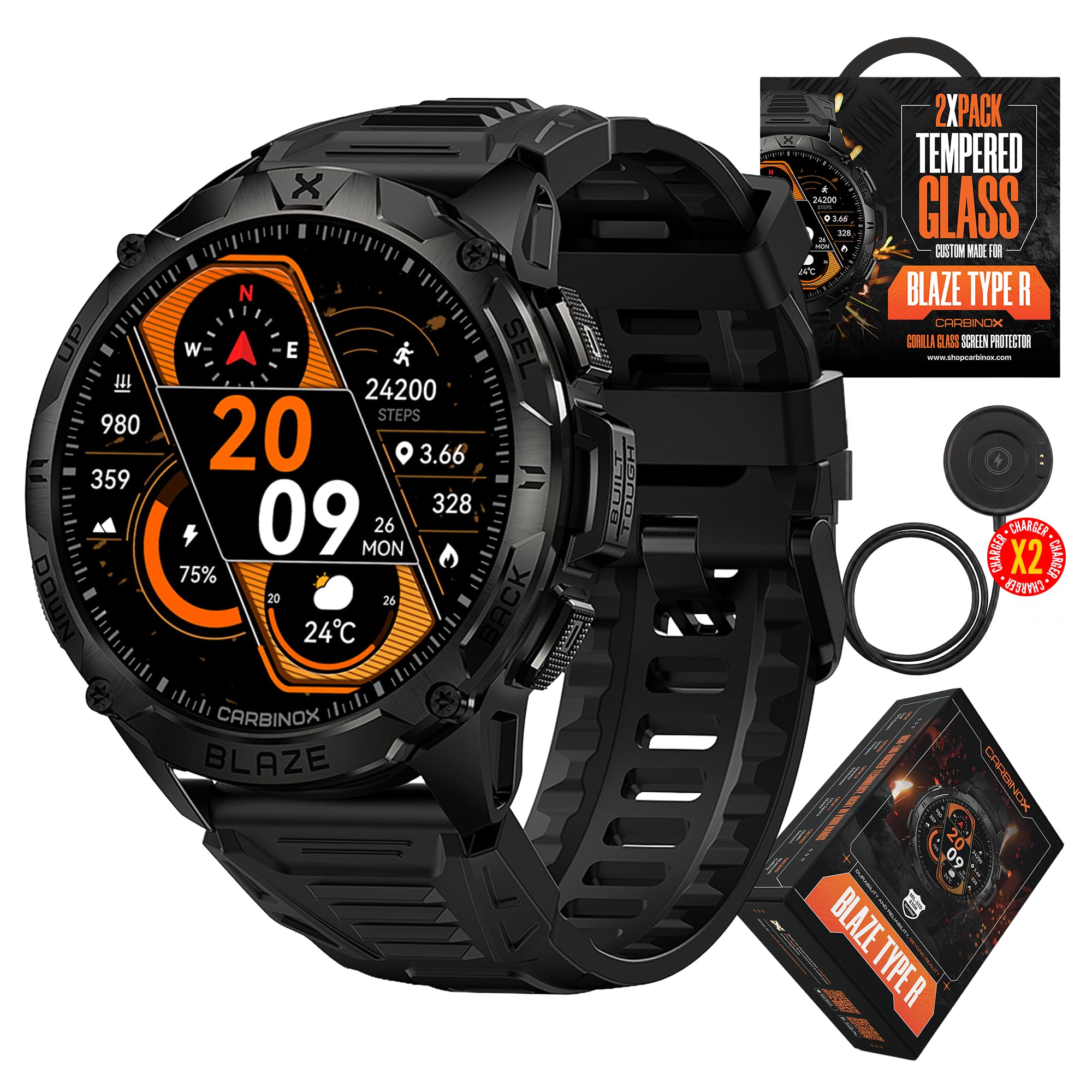
A Gorilla Glass workhorse with a dual GPS system and IP69K sealing.
For a training and worksite watch, the Blaze hits the key outdoor numbers. A dual GPS system tracks routes phone-free across 7 outdoor modes, and the smart compass, altimeter, and barometer keep direction and elevation honest when the trail turns. The build is MIL-STD-810H tested (a military standard for drop, dust, and impact survival), with an alloy steel case and Gorilla Glass, and IP69K sealing means it shrugs off water jets and mud. The 480 mAh battery stretches up to 15 days in typical use, and the 22 mm quick-release strap swaps without tools.
The screen is a Gorilla Glass AMOLED with a 480 mAh battery behind it, and the 26.2-centimeter band is long enough to fit over a glove or a thick wrist. It also makes and receives Bluetooth calls with a built-in speaker and mic, so you can take a call without digging out the phone. What buyers praise most is the quality feel — the “beast of a watch” description is not far off. Battery life and ease of use round out the approval.
The honest note: reliability and value for money are the mixed areas buyers report. Some units stop working inside a week, while most owners mention a solid experience; with 750+ ratings on the listing, the overwhelming majority have a working watch. Watch the return window if you are hard on gear, and it is a reasonable pick for the training-heavy user who wants the rugged look without flagship cost.
Built for training days
- MIL-STD-810H tested and IP69K sealed against water jets, mud, and drops.
- Dual GPS system plus smart compass, altimeter, and barometer across 7 outdoor modes.
- 480 mAh cell, 15 days of typical use, 26.2 cm band swaps via quick-release.
- AMOLED screen behind Gorilla Glass reads clearly in daylight.
The trade-off to weigh
- Reliability and value for money are the mixed notes in feedback — most owners are happy, but a small number report early failures.
- The 7 outdoor GPS modes are a subset of the sports-mode counts on the pricier picks.
Matches up with: the gym-and-jobsite buyer who wants a rugged GPS watch with a compass under a budget-tier spend.
Watch out for: the occasional early-failure report — verify the seller’s return policy and register the watch early.
Know the Specs
3-Axis vs Flat Compasses
A 3-axis compass reads direction from any angle, which matters when your wrist is tilted. That is why the Garmin Instinct 3, fēnix 7X Pro, and fēnix 8 models all list it. A flat 2-axis compass needs the watch held level to be accurate, which is a problem when you are scrambling over rocks. The compass heading also depends on calibration — rotate the watch a few times to reset it when you have not worn it in a while.
Multi-Band GPS and Satellite Systems
Multi-band GPS reads more than one satellite frequency at once, which tightens the fix in tree cover and between canyon walls. Satellite support for GPS, GLONASS, and Galileo gives the watch a wider spread of signals to draw from. You will find both on the premium picks and on the CARBINOX Edge via L1+L5. A single-band receiver is fine open-sky; the difference shows up under cover.
Battery Days vs GPS Hours
Smartwatch-mode battery life and GPS-mode battery life are two different numbers, and the gap can be large — 18 days in smartwatch mode does not mean 18 days of tracking. Check the GPS-mode hours for multi-day trips. Solar charging can top up the battery, but it needs direct sun at a high level to matter. A 24-hour continuous GPS window like the WalkerFit’s is the number to prioritize if you track routes overnight.
AMOLED vs Transflective Displays
AMOLED screens (like the 1.43-inch on the WalkerFit or the 1.96-inch on the CARBINOX Edge) are crisp and bright but draw more power. Transflective or solar-friendly displays lean on sunlight and stretch battery life further. If you read maps in bright sun, the nits rating tells you how legible it stays — the Edge is rated at 1000 nits. If you want weeks between charges, favor the solar models.
Common Questions
Will a GPS compass watch still navigate without cell service?
How accurate is a wrist compass on a GPS watch?
Can I swim with a watch that has GPS and a compass?
How long does the battery last with GPS running all day?
Is a solar GPS watch worth it if I hike in forest?
Do these watches work with both Android and iPhone?
What is the difference between 2-axis and 3-axis compass on a watch?
How often should I calibrate the compass and barometer?
Can a budget GPS watch replace a dedicated GPS device?
Will the watch’s flashlight drain the battery?
The Bottom Line
For most people who want a wrist watch with compass and GPS that answers the compass question with confidence, the Garmin Instinct 3 AMOLED is the one to buy. It gives you a 3-axis compass, multi-band GPS with SatIQ (a mode that picks the strongest satellite signals to save battery), and 18 days of battery, with 4.5+ stars behind it. If you want the flagship map-first experience and a titanium shell, the Garmin fēnix 7X Pro Sapphire Solar is the natural upgrade. And if you want the biggest battery and three straps at a lower tier, reach for the WalkerFit Military Smart Watch — its 550 mAh cell (the battery capacity rating) is the largest on this list. One nudge: the Instinct 3 is the crowd favorite with a real track record, but the call is yours between battery endurance and the premium map set. Either way, buy once, calibrate at the trailhead, and keep a paper map in the pack.
How we choose
We do not accept paid placement. Every pick is matched to a real buyer and a real use-case; we do not hands-on test units.
Sources
Specifications: manufacturer listings and product documentation. Review insights: verified customer reviews, as of November 2026. Pricing: not shown on this page (it changes often); check the current price via the retailer link.
As an Amazon Associate, Tactical Gear Guy earns from qualifying purchases. This does not affect which products we feature.