Specs are compiled from manufacturer listings and verified buyer reviews and can change over time — please confirm the key details on the product page before buying.
If you have ever snapped a fresh battery into a watch and then spent ten minutes trying to get the case back to click shut with your thumbs, you already know why a wrist watch press exists. The short answer: buy the press with more dies than you think you need, because die fit decides whether the back seats. A press with the wrong snap-on mould sits crooked on the crystal and will not seat the back.
This guide is built by comparing the manufacturers’ published specifications and the patterns across verified customer reviews, so you get each pick’s real strengths and trade-offs instead of marketing spin.
Below are seven picks sorted by how well each one closes a case without marking the glass — the short version of the wrist watch press search that actually ends with a sealed case back.
Top Picks

How To Choose The Best Wrist Watch Press
A watch press is a simple machine, which is exactly why the small differences decide the outcome. You are pressing a case back or a crystal into a metal shell with a few hundred pounds of squeeze, and the die sitting between the ram and the glass is all that spreads that force. Get the die wrong and you crack the crystal or leave the back sitting proud. Get the die right and the back seats on the first press.
Start with die range, not with the frame
The dies (the plastic or nylon moulds that cup the watch) come in paired sizes, usually written as two numbers like 38/36mm. One side of the die holds the case, the other side pushes the back. A press rated for 18mm up to 50mm covers the overwhelming majority of everyday wristwatches, from a slim dress watch to a chunky field watch. If you own a rectangular or square-dial watch, check that the kit includes square dies before you buy — round dies will not seat a rectangular back evenly.
Screw handle versus push handle
A screw-type press turns a threaded handle to build pressure gradually, so you can stop the instant the back seats. A straight push handle applies force as you lean on it, which is quicker but easier to overdo on a thin crystal. Screw-down wins for anyone working on a watch they care about, because you feel the resistance build instead of guessing.
What the dies are made of
Nylon and ABS plastic dies are the standard because they are softer than the crystal they press against. Metal dies exist for heavy workshop duty, but they demand a cloth layer between die and glass. Many kits ship with a small cleaning cloth for exactly this reason — lay it over the crystal and you add a buffer against scratches.
Side-by-Side Comparison
| Model | Best For | Die Count | Press Type | Weight | Amazon |
|---|---|---|---|---|---|
| MMOBIEL Watch Press Set★ Best Overall | Everyday battery swaps | 12 nylon dies | Push handle | 1.08 pounds | Amazon |
| TICFROG 18-Die Press SetMost Versatile | Round and rectangular backs | 18 ABS dies | Screw ram | — | Amazon |
| TICFROG 12-Die Press Set | Full starter toolkit | 12 ABS dies | Screw ram | — | Amazon |
| SE JT-12WP Press Set | Dome and flat crystals | 12 nylon dies | Handle press | 2.4 pounds | Amazon |
| ValueHall Cast Iron Press | Snap-back cases | 12 dies | Handle press | 1.08 pounds | Amazon |
| 20-Die Screw Press Set | Wide size coverage | 20 dies | Screw handle | 3.57 pounds | Amazon |
Detailed Reviews
1. MMOBIEL Watch Press Set
Our pick — 4.0+★ from 1,500+ verified ratings; the strongest balance of quality and price.
The do-it-all press that handles almost any back you hand it, from slim dress watches to chunky field models.
Twelve nylon dies is the number that earns this press the top spot. That set covers paired sizes running from 18mm up to 50mm, which is the full spread of everyday wristwatches on a typical dresser. The dies snap on and off the tool, so switching from a 38/36mm back to a 30/28mm one takes a moment rather than a wrestling match. Nylon is the material doing the protecting here — it is softer than the crystal, so it does not mark the glass on contact.
What wins people over is how quickly the job goes once the right die is seated. Buyers report the full routine — pop the back, swap the battery, press the back home — takes around 15 minutes from start to finish. The frame itself is cast metal, so it has enough heft to stay planted while you press down. At 1.08 pounds it is lighter than the SE set (2.4 pounds), which makes it easier to tuck into a drawer.
The catch is documentation. The kit ships light on written instructions, so if you have never closed a case back before, you will be working from a video rather than the box. A few owners also report the press feeling less sturdy than expected under a hard squeeze, so treat a stiff back with patience instead of leaning on the handle. Neither point spoils the tool — it simply rewards someone who has watched one five-minute tutorial before opening the box.
Where It Pulls Ahead
- 12 nylon dies covering 18mm through 50mm covers nearly every watch you own
- Full battery swap and case closing run about 15 minutes
- Cast metal body stays put while you press, at 1.08 pounds
- Nylon dies are soft against the crystal and snap on quickly
What To Know First
- Instruction sheet is thin — plan on a tutorial video for your first attempt
- Firm-feeling squeeze; add a cloth layer if your crystal is thin
Reach for this if: you want one press on the shelf that fits every watch in the house without hunting for a second die set.
Plan around this: the light paperwork means your first press should be a watch you do not mind learning on.
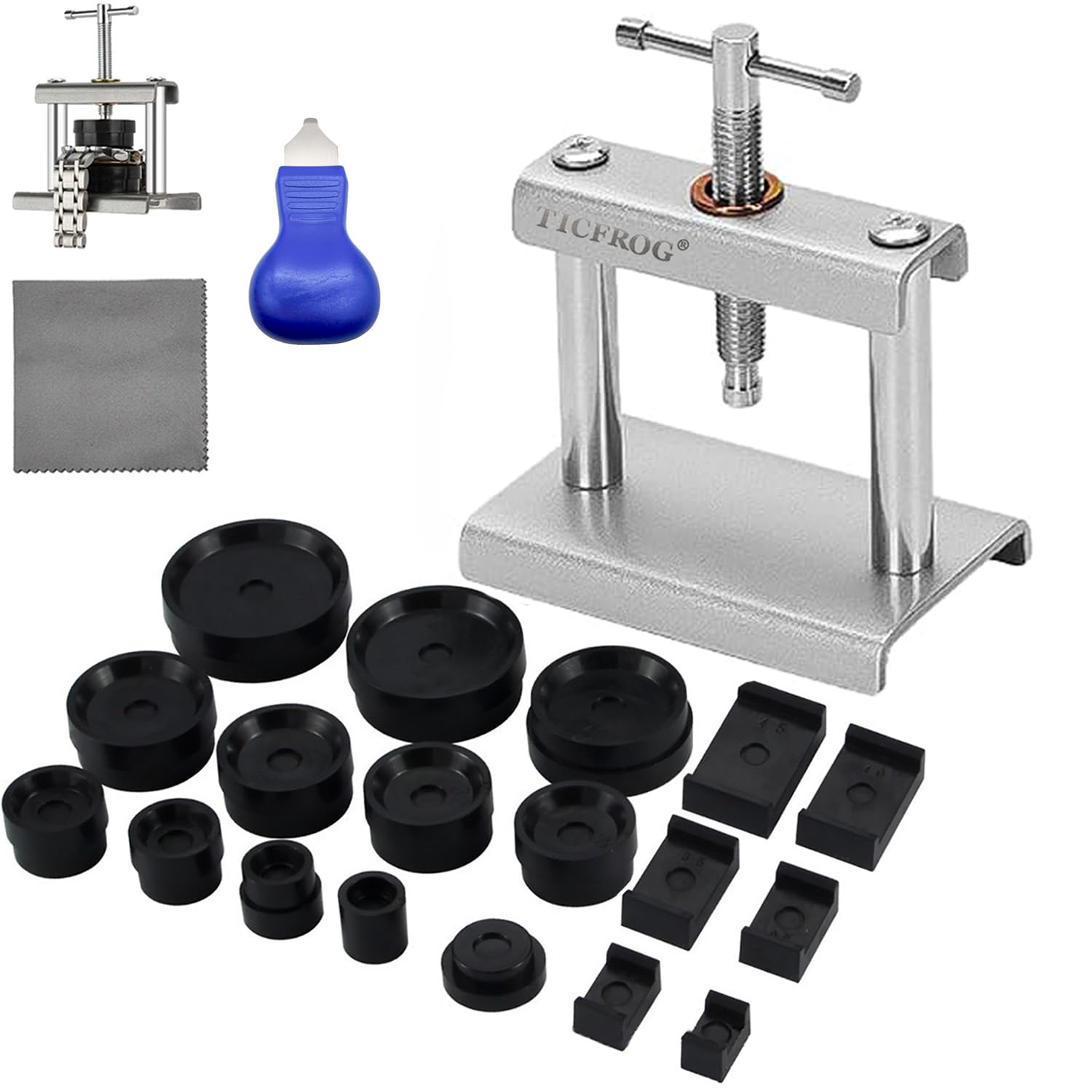
2. TICFROG 18-Die Watch Press Tool Set
Eighteen dies and a screw ram — the kit that finally handles rectangular and square case backs.
Most presses stop at round backs. This one carries 18 ABS plastic dies built to fit both round and rectangular watch backs, so that square-dial watch sitting in your drawer is no longer a jeweler-only job. The plastic is the buffer that prevents scratches, and the included 18cm cloth can sit between the glass and the die for extra insurance.
Pressure control is the second thing that separates this press from a bare push-handle tool. You turn the top handle, which drives a smooth ram screw and builds force gradually instead of all at once. That lets you stop the moment the case back seats and reduces the chance of cracking the glass. The kit arrives as a full repair set — press tool, case opener, and cleaning cloth — so opening and resealing happens with the same box open.
Quality is the theme that holds up best when you put hands on it. The body is solid metal, and the ABS dies seat cleanly without wobble. Use is straightforward too: pick the mould, center the watch, turn the handle gently. The one thing to keep in mind is size reference — with 18 dies to sort, it pays to lay them out in number order before you start, because a mismatched pair is the fastest way to seat a back crooked.
Versatility payoff: Rectangular and square backs are the rare case here — this press covers shapes the round-die competition leaves out.
Where it asks patience: Eighteen dies need sorting before use, and the manual is the place to learn the sequence rather than guesswork.
The deciding case: you own a rectangular or square watch and want one press that does not force you to hand it to a shop.
The honest trade: more dies means more sorting — organize them by size once and the rest is quick.
3. TICFROG 12-Die Watch Press Tool Set

A whole repair drawer in one box — press, opener, spring bar tool and tweezers together.
This is the version to grab if you are starting from nothing. Beyond the press and its 12 ABS round dies, the kit adds a watch case opener, a spring bar tool, tweezers, and an 18cm cleaning cloth. That is the full cycle covered — pry the back off, pull the old cell, fit the new one, then screw the case back down. The soft cloth does double duty as a scratch barrier under the die and as a wipe for the watch and your glasses afterward.
Functionality is where it proves itself, and the toughest backs are the real test. The ram screw lets you dial in force with a turn of the handle, so stiff case backs that resist a thumb press still seat. The smooth pressure also means the back can snap into place without damage when you center it correctly. Solid metal in the frame plus ABS dies keeps the tool steady while you work.
Twelve dies rather than 18 is the sizing limit worth naming — round backs only here, so a rectangular watch needs the 18-die sibling above. Everything else lines up: adult-suitable kit, carbon steel opener, black-and-metal trim. For a first press and a full set of tools in one purchase, this is the cleaner buy.
Full-kit value: Opener, spring bar tool, tweezers and cloth come in the same box as the press — the whole battery routine is covered.
The one limit: Round dies only, so rectangular and square case backs are out of reach with this set.
Pick this for: a first press purchase where you also want the opener and tweezers rather than buying them separately.
Know before you buy: if any watch in your collection is rectangular, step up to the 18-die version instead.
4. SE JT-12WP 12-Piece Watch Press Tool Set

Heavier, steadier, and built for fitting glass — the workshop-style press with conical dies.
The feature that sets this press apart is the die shape. The conical dual-side dies are cut to handle both dome and flat watch crystals, which is a step beyond closing a plain case back. Non-marring nylon keeps those delicate parts safe from scratches and cracks while you press. Snap-on dies and a smooth handle make crystal fitting and back pressing both doable with the same tool.
Weight tells you who this is built for. At 2.4 pounds it is more than twice the heft of the MMOBIEL press (1.08 pounds), and that mass is what keeps the frame dead still on the bench while you work. For a hobbyist or a working watchmaker, the extra weight reads as stability rather than burden. It is the press you leave set up on a mat instead of tossing in a bag.
Buyers who love it love the function, and crystal work is where it earns the keep. The honest caveats are fit and feel: some watch backs need a specific die pairing, and getting the lower die to seat right takes attention. The instruction sheet is thin, so a first-timer should plan the sequence before pressing. When the dies line up, a back closes cleanly; when they do not, no amount of force helps.
Why Crystal Work Suits It
- Conical dies handle both dome and flat crystals
- Non-marring nylon protects glass from scratches and cracks
- 2.4 pounds of cast body holds steady on the bench
- Snap-on dies swap without fuss between sizes
What Demands Attention
- Lower die seating needs care — a mismatched pair will not close the back
- Instructions are thin for a first-time user
Suits you when: crystals are part of the job — dome or flat glass fitting is exactly what these dies are shaped for.
Look elsewhere when: you want a light press to stash in a small drawer; this one is a bench fixture.
5. ValueHall Cast Iron Watch Press Set

Cast iron bones with a plastic touch where it counts — sturdy frame, gentle dies.
Cast iron is the whole pitch here. The frame is built from it, which gives the press a planted, sturdy feel during a squeeze. The 12 assorted dies span 50/48 down to 20/18mm in the familiar paired sizes, and they are smooth ABS plastic rather than metal — so they press against the watch without scratching or marking it. The dies snap on and off quickly, so you are not fiddling with screws to change sizes.
It knows exactly what it is for: closing snap-back type watch-cases, installing crystals, and seating bezel rings. That is the bread-and-butter of home watch repair, and the iron frame means the press does not wander while you push down. At 1.08 pounds it stays light enough to shift off the bench when the job is done, unlike the heavier 2.4-pound SE press.
The trade-off is honest and worth stating. Iron is strong but heavier presses of this class still reward a centered die over a fast hand, and a snap-back that will not sit means the die pair is wrong rather than the frame. Fit the dies, confirm the watch is level, then press. Done in that order, the cast iron does precisely what it promises.
Frame you can trust: Cast iron body plus twelve ABS dies covering 50/48 down to 20/18mm — the workhorse combination for snap-back cases.
What to check: Confirm the die pair before pressing; a snap-back that fights you is a seating problem, not a frame problem.
Good match for: snap-back case work, crystal installs, and bezel seating on everyday watches.
Worth noting: the iron frame is solid but not light — plan a permanent spot on the bench rather than a shelf shuffle.
6. 20-Die Screw Press Set

Twenty dies for the widest size spread here — and square shapes on top of round.
Twenty dies is the headline, and the spread is genuinely broad. Round pairs run 18/20 up to 48/50mm, two extra round dies cover 16/16 and 20/25mm, the square sizes cover 20 through 45mm, and a 37/45mm pair rounds out the set. If you repair watches across a range of case shapes and diameters, that variety means fewer jobs that simply will not fit your press.
The body is a mix of stainless steel and aluminium, built to be taken apart and reassembled quickly for repair work. Both the upper and lower threads are M6, compatible with the 5500A and 5500C, so dies from those standards swap in. You apply pressure by tightening the upper handle, which gives you full control over how much force lands on the crystal or the back. The face-down configuration lets you see the case back closing as you turn.
Weight and setup are the honest notes. At 3.57 pounds this is the heftiest press in the group and will not be moving around much. The procedure rewards a light hand too: pick a die bigger than the crystal for the lower socket, a die smaller than the back for the upper, lay a cloth under the crystal, and press lightly. Follow that sequence and 20 dies cover almost anything you bring to the bench.
Coverage above all: Round, square, and extra-size dies reach cases the 12-die kits leave out entirely.
The careful step: Getting the die-to-socket pairing right before you press is what keeps a crystal intact.
Best when: your repair box holds watches of many shapes and diameters and you want one press to reach all of them.
Skip if: you work on a single watch once a year — the setup care here is more than a one-off job needs.
Know the Specs
Die sizes and how to read them
Dies are listed as a pair of numbers like 38/36mm, meaning the outer and inner cup diameters in the same mould. One side cradles the case and the other presses the back. A press that fits 18mm up to 50mm covers nearly every wristwatch you will hand it. Rectangular or square backs need square dies to seat level — round dies will only work on round watches.
Screw ram versus push handle
A screw ram turns a threaded handle so pressure builds gradually, letting you stop the instant the back seats. A straight push handle applies force as you lean, which is faster but easier to overdo on a thin crystal. Screw types are the safer call for any watch you care about, since you feel the resistance rather than guessing how hard you pushed.
Why the dies are nylon or ABS
Nylon and ABS are softer than the crystal they press against, so they absorb the load without marking the glass. Metal dies exist for heavy workshop duty, but they need a cloth layer between die and crystal. That is why many kits include a cleaning cloth — lay it over the glass and it acts as a scratch buffer while you press.
Case backs a press will not close
A press is built for snap-back and press-fit cases plus crystal fitting. Screw-down case backs with threaded collars, and case backs sealed with gaskets that need a specific seating tool, are a different job. Check your watch’s back type first — a press does excellent work within its range and nothing outside it.
Common Questions
Will a watch press work on a rectangular or square case back?
How many dies do I actually need for one watch?
What is the difference between a screw press and a push-handle press?
Can a watch press crack the crystal?
Do I need a case opener as well as a press?
Is a heavier press better for watch repair?
What are M6 threads and why do they matter?
Can I fit a new crystal with a watch press?
Does a watch press come with instructions?
Will a press scratch my watch case or glass?
The Bottom Line
For most people, the wrist watch press that earns its place is the MMOBIEL Watch Press Set — twelve nylon dies up to 50mm and a cast metal frame cover nearly every watch on a dresser, and it holds 4.0+ stars across 1,700+ ratings. Choose the TICFROG 18-die kit instead if a rectangular watch sits in your collection. And for collectors who want eyes on the case back while the screw turns, the Semme Screw Type Closer is the bench tool to reach for.
Whichever you pick, the die pair matters more than the frame. Sort your dies by size, confirm the watch sits level, and press gradually — that routine turns a five-minute battery swap into something you do yourself.
How we choose
We do not accept paid placement. Every pick is matched to a real buyer and a real use-case; we do not hands-on test units.
Sources
Specifications: manufacturer listings and product documentation. Review insights: verified customer reviews, as of November 2026. Pricing: not shown on this page (it changes often); check the current price via the retailer link.
As an Amazon Associate, Tactical Gear Guy earns from qualifying purchases. This does not affect which products we feature.