Specs are compiled from manufacturer listings and verified buyer reviews and can change over time — please confirm the key details on the product page before buying.
If you want the tool that gets spring bars out of a stubborn lug without scratching the case, the Bergeon 6767-F is the one to buy. It has a 0.80mm pointed end and a 1.30mm fork end, and that fork is the part that actually grips a spring bar instead of skating off it. The rest of this page covers six other pin removal tools, including budget alloy sets and a couple of plier-style options, so you can match the tool to the watch you actually own.
This guide is built by comparing the manufacturers’ published specifications and the patterns across verified customer reviews, so you get each pick’s real strengths and trade-offs instead of marketing spin.
The main thing to understand is that pin removal covers two different jobs, and they need different tips. A link-removal punch pushes a friction pin out of a bracelet, while a spring bar tool has to catch the tiny flange on a spring bar. Here is the breakdown behind the best wrist watch pin removal tool picks, sorted by job first and budget second.
Top Picks


How To Choose The Best Wrist Watch Pin Removal Tool
Most people buy the wrong tool for the job and then blame the tool. Before you pick anything, work out whether you are pushing out a bracelet pin or releasing a spring bar — the two tasks use different tips, and a tool that does one perfectly can be useless at the other.
Match the tip to the pin
A spring bar is a hollow tube with a spring-loaded nub at each end, and you release it by catching the flange with a small fork. That is why the Bergeon 6767-F carries a 1.30mm fork end alongside its 0.80mm pointed end. A link punch is the opposite: a straight hardened pin that pushes a friction bar through a bracelet link, which is why punch sets come in 0.7mm, 0.8mm and 0.9mm so you can match the hole diameter.
Look at what the tip is made of
The single most common failure in this category is a bent or snapped tip. Alloy pins bend under side load; hardened steel pins hold their shape. If a listing gives you three spare needles, that is often a quiet admission that tips break. Steel sets with replaceable ends — and a maker who sells those ends separately — are the safer long-term buy.
Reach matters more than you think
A short punch gives you less control when you are working on the underside of a bracelet, and a long handle keeps your knuckles clear of the case. The Bergeon 6767-F runs 5 1/2 inches overall, which is long enough to keep your hand back from the lugs. Mini hand tools around 3 inches store easily in a drawer but give you less leverage and a shorter sight line on the pin.
Handle grip and the cost of a slip
One slip with a steel tip puts a scratch straight across a polished lug, and you cannot undo that. A knurled non-slip handle — the crosshatched texture you see on the alloy punch sets — keeps the tool from rotating in your fingers mid-push. A bare metal handle is fine in dry hands and less fine when you are holding a watch case steady. If your watch has drilled lugs or a drilled-through spring bar, a fork tool or a plier-style tool that grabs the bar from both sides is more forgiving than a single pointed tip.
Side-by-Side Comparison
| Model | Best For | Tip Setup | Type | Weight | Amazon |
|---|---|---|---|---|---|
| Bergeon 6767-F★ Best Overall | Spring bar swaps | 0.80mm point / 1.30mm fork | Fork and point tool | 1.45 oz | Amazon |
| Watch Band Link Remover (Brrnoo)Budget Starter | Tight budgets | 3 alloy needles | Link punch | 1.41 oz | Amazon |
| Hemobllo Link Removal Kit | Mixed repair jobs | 0.7 / 0.8 / 0.9mm punches | Punch set plus spares | 2.72 oz | Amazon |
| YUYTE 3-Piece Punch Set | Grip on slippery pins | 0.7 / 0.8 / 0.9mm punches | Link punch set | 0.07 kg | Amazon |
| TICFROG Spring Bar Tool Kit | Measuring pin width | 2 fork + 2 needle tips | Fork, needle and ruler | 1.45 oz | Amazon |
| Bergeon 7230 | Band thickness changes | Replaceable 0.80mm pin | Pin puller with spacers | 0.63 oz | Amazon |
| Freejoy Spring Bar Plier Kit | Tight-tolerance lugs | U-1.6 / U-1.4 / U-1.0mm, V-0.8mm | Plier with 8 pins | 2.65 oz | Amazon |
Detailed Reviews
1. Bergeon 6767-F Watch Spring Bar Tool
Our pick — 4.5+★ from 650+ verified ratings; the strongest balance of quality and price.
Two tips, one long stainless handle, and the fork that actually catches a spring bar.
Start with the numbers on the business end, because they explain everything else. One side is a 0.80mm pointed tip for pushing, the other is a 1.30mm fork tip that straddles the spring bar flange and pulls it back into the lug. The handle runs 5 1/2 inches overall, so your fingers sit well clear of the watch case while the tip does the fine work. It arrives as a 1.45 ounce tool in a 7.44 x 2.01 x 0.91 inch package — compact enough to live in a desk drawer, long enough to feel like a real instrument in hand.
The threading on those tips is the detail that matters long-term. Both ends share the same thread, so the pointed and forked tips interchange, and replacement ends are sold separately under product numbers 6767.02 and 6767.03. That turns a worn tip into a cheap swap instead of a whole new tool. Bergeon also lists a slightly different pointed tip body under 6767-B that uses the same tip diameter, and a larger forked tip under 6767-A — useful if your bracelets run wider. The hardened Swiss Made steel and clean machining are what keep the tips true instead of bending like alloy.
Here is the honest limit. This is a spring bar tool, not a bracelet punch. It will not push a friction link pin out of a steel bracelet — that job belongs to the 0.7/0.8/0.9mm punch sets further down this page. The 1.30mm fork is also narrow, so an unusually fat spring bar on a vintage piece may want the wider 6767-A tip. For drilled lugs and modern Seiko and Rolex style cases, though, the tip size lands right.
Where it earns its keep
- 0.80mm point and 1.30mm fork cover both pushing and catching a spring bar
- Interchangeable threaded tips mean a replacement end, not a replacement tool
- 5 1/2 inch handle keeps your knuckles off the case
- Swiss Made steel that holds its edge instead of bending
What to know before you buy
- It is a spring bar tool only — no punch needle for bracelet link pins
- The 1.30mm fork may be too narrow for oversized vintage spring bars
Reach for this if: you swap straps or bracelets with spring bars and want one tool that will outlast the watch it services.
Look elsewhere if: your actual job is pushing steel link pins out of a bracelet — you need a punch set, not a fork.
2. Watch Band Link Remover 3pcs Alloy Pin Punch Set
A pocket-sized pusher that takes links out of a bracelet without a trip to the shop.
If you have one bracelet that needs a link out and you would rather not pay someone to do it, this is the entry point. It ships with three alternative needles so you have a spare when one dulls, and the knurled non-slip handle — the crosshatched grip — gives your fingers something to hold while you push. At 1.41 ounces it disappears into a drawer, which means you will actually find it the next time a band feels loose.
The three needles let you match a slightly different hole size instead of forcing one pin at everything. The 3-needle setup means you can match a slightly different hole size rather than forcing one pin at everything. The honest catch is durability: the alloy tips can bend if you lean on them or push at an angle, so keep the tool square to the pin and let steady pressure do the work. That is a fair trade at the entry-level tier — treat it as the occasional-job tool it is, not a daily workhorse for a repair bench.
It is sized for the one-off job: shorten a bracelet once, then leave it in the drawer. Watch adjusters are one of those things you need once, briefly, and then never think about again — this kit is sized for exactly that pattern. Its alloy needles will not survive a tight-tolerance luxury bracelet, so keep it for fashion watches and quartz beaters. For a fashion watch, a quartz beater, or a strap you just want shorter this afternoon, it does the job.
Best used for: one-off link removal on a modest bracelet when you want to do it yourself instead of driving to a jeweller.
The trade-off: the alloy needles will bend under side load, so a steady square push matters more here than on a steel set.
Worth it when: you want the cheapest working answer for a single bracelet adjustment and you will use it gently.
Pass it by when: you are adjusting several watches a month — the tips will not keep up with that pace.
3. Hemobllo Watch Link Removal Kit
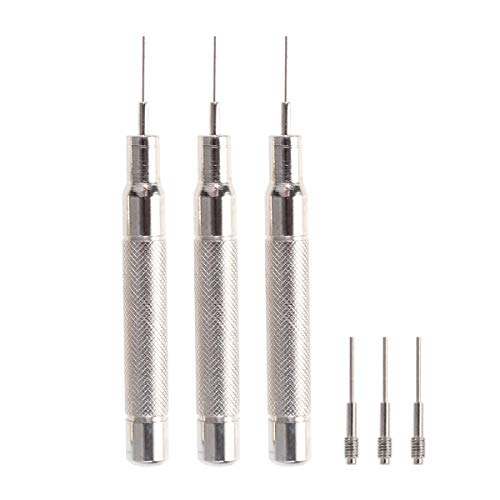
Three punch sizes plus spares, built to open case backs as well as shrink a bracelet.
This kit gives you three separate punching needles at 0.7mm, 0.8mm and 0.9mm, plus spare needles in the set. That range covers the common pin diameters across men’s watches, fashion watches and quartz models, so you pick the size that slides into the hole instead of squeezing the wrong one through. The needles themselves are steel and hard material, which is the difference between a tool that holds its point and an alloy one that folds.
Where it goes further than a single-purpose punch is the job list. Hemobllo lists it for link removal, opening watch backs, adjusting bands, changing batteries and replacing gaskets — so it covers the small maintenance tasks that otherwise mean a trip to a service counter. It is listed as compatible with stainless steel, titanium, gold and plastic, so it is not limited to one bracelet material. Compact at 3.07 x 0.39 x 0.39 inches, it stores in a drawer or repair bag without taking up room.
The weight is where it separates from the featherweight tools in this list: at 2.72 ounces it is the heaviest punch-style kit here. That is a real trade-off — heavier than the alloy pin set alongside it — but a bit of mass in the handle is what lets you push a stubborn pin straight instead of fighting the tool. Size it correctly and it feels planted; size it wrong and it is just a small heavy thing in a drawer. It is a good match for someone building a first repair kit rather than a bench professional with a full driver set.
Pick this for: a starting repair drawer that needs punch sizes and case-back duty in one small tool.
Skip the upgrade if: you only ever shorten bracelets — a single punch set covers that with less bulk.
4. YUYTE 3-Piece Alloy Pin Punch Set 0.7mm 0.8mm 0.9mm

The knurled grip here is the whole point — it is what stops a slip across a polished lug.
Three steel punches at 0.7mm, 0.8mm and 0.9mm, each in a knurled non-slip handle. Slipping is how lugs get scratched, and a handle that stays put is cheap insurance.
What it removes is worth spelling out, because “pin removal” covers a lot: it handles bracelet link pins on metal bands, and the maker lists it for riveting watch and jewellery items too. The three needle sizes let you step down to a finer punch when a thin pin needs it, rather than forcing a fat one through a small hole. The set is alloy and metal, so it belongs in the gentle-use bracket — same family of tool as the budget pusher above, with a better grip and one extra needle.
The YUYTE wins on handle texture. The Brrnoo set above also lists a knurled handle, but the YUYTE calls out clean grain and an anti-slip design as its defining feature — the right priority for a tool that lives or dies on control. Three separate punches instead of three interchangeable needles in one body means no threading to work loose mid-job. For a bracelet with a stiff pin, the extra mass in three handles helps you keep the punch square. What it will not do is reach a recessed spring bar — that needs a fork tip, not a straight punch.
Why the grip sells it: a knurled, non-slip handle stops the tool twisting mid-push, which is exactly how lug scratches happen.
Where it stops: three straight punches do not touch a spring bar — this is a bracelet and rivet tool.
Choose it for: bracelet link work where control and a non-slip hold matter more than having every accessory.
Rethink it if: you plan to swap straps with spring bars — buy a fork tool instead.
5. TICFROG Professional Spring Bar Tool Kit with Built-In Ruler
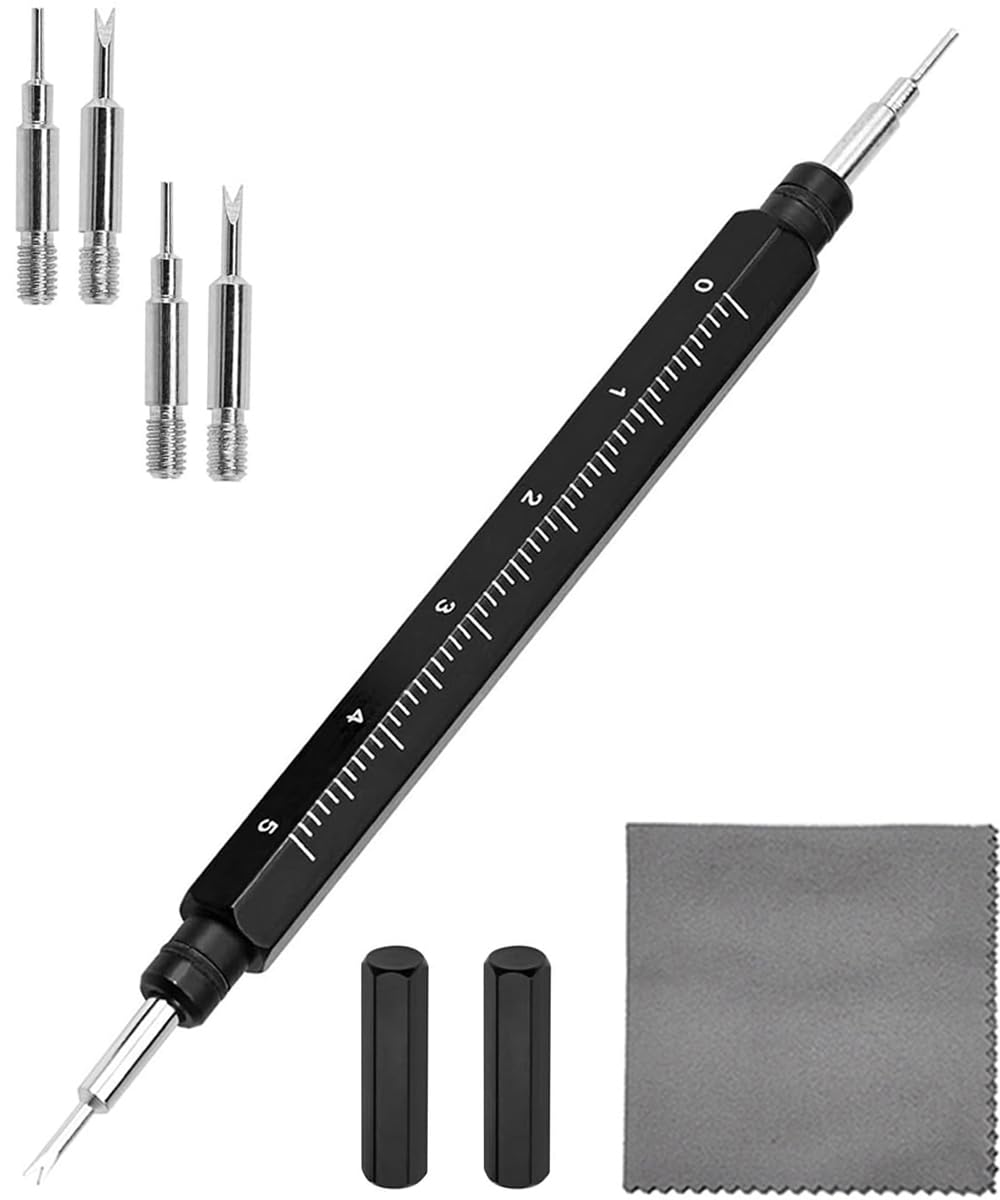
A spring bar tool with a ruler printed on the handle, which solves a problem most tools ignore.
The engraved ruler on the handle lets you measure band width and pin length before ordering a replacement. It lets you measure band width and pin length before you order a replacement, so you are not guessing at the number you need. Around that, TICFROG includes a spring bar tool, two Y-needle (fork) tips, two I-needle (straight) tips, and an 18cm cleaning cloth. The fork grabs the spring bar from the inside of the lug; the straight needle pushes the bar end where you can reach it from outside.
Package footprint is the slimmest in this article. It arrives in a 5.28 x 3.7 x 0.43 inch pack at 1.45 ounces, which makes it the flattest kit here to slide into a travel pouch or a drawer. Four replacement tips is more than most single-tool kits give you, so when a tip dulls you are not out of luck. The cleaning cloth is a small thing, but sweat is corrosive to a case, and TICFROG’s double-sided fleece version is washable and meant for daily wipe-downs. The brand is a small watch-accessories maker founded in 2021, so this is a newcomer’s kit rather than an established name.
For tight-tolerance bracelets the fork tip is the tool that matters, and the two Y-needle spares give you room to keep one sharp. It handles strap replacement across mechanical, quartz, electronic and belt watches per the listing. The label on the box says “professional,” but judge it on the tips: the engraved ruler is the genuinely useful differentiator, and the 4-tip count is what keeps it in service. If you only ever remove one link from one bracelet, a bare punch set is simpler. If you own several watches and want to measure before you buy straps, this earns its spot.
Great fit for: someone with several watches who wants to size straps correctly before ordering and needs spare fork tips on hand.
Less useful if: your only task is one stubborn bracelet link — a plain punch set does that without the extras.
6. Bergeon 7230 Watch Strap Pin Removal Tool

A dedicated pin puller for bands up to 22mm wide, with spacers for three band thicknesses.
This is a single-purpose tool, and it is honest about that. One replaceable pin at 0.80mm pulls the strap pin, and it ships with a spacer that fits three different band thicknesses so the tool sits flat against the band instead of wobbling. Bergeon rates it for watch bands up to 22mm wide, which covers most standard straps. At 0.63 ounces and packed in 3.62 x 2.95 x 0.83 inches, it is the lightest and one of the smallest tools here.
The three thickness spacers let the pin seat at the right depth on a thin leather strap and a thick steel band without levering against the case. If you change bands on more than one watch, the tool needs to sit at the right depth on a thin leather strap and a thicker steel band without levering against the case. Three thickness positions give you that. The replaceable pin is Bergeon part 7230-G08, so a worn or snapped pin can be swapped rather than ending the tool’s life. On paper, that is a sensible design from a maker with a long history in watch tools.
The complication is durability in real use. This tool draws a lot of mixed and negative feedback on material and how long it lasts, with the pin and the plastic-and-metal build called out repeatedly. Treat it as a light-duty puller: use it for occasional band changes at home, push gently, and do not lean on it like a bench tool. A collector running through several straps a month will want something with a heavier steel body. The spacers and the replaceable pin are worth having if you change straps on one or two watches and you handle the tool with care.
The design that works: 3 thickness spacers let the pin seat correctly on both leather and steel bands up to 22mm.
Use it like what it is: a light-duty puller — the pin and body do not take heavy pressure, so go gently.
A good match for: occasional strap changes on a couple of watches, where the thickness spacers and replaceable pin earn their place.
Better to look on: if you are changing bands every week — the build does not stand up to that rhythm.
7. Freejoy Spring Bar Plier Tool Kit with 8 Alloy Steel Pins

Squeeze both sides of a spring bar at once instead of fighting one lug at a time.
Plier-style tools attack the spring bar from both ends simultaneously, which is why they suit lugs that a single pointed tip cannot reach from outside. Freejoy ships 8 pins in four sizes: U-1.6mm, U-1.4mm, U-1.0mm and V-0.8mm. The U-shaped tips wrap the spring bar nub, and the V-tip works thinner bars. The body is 316L stainless steel with aluminium alloy and brass plating, around 9.6cm long, and the tool weighs about 43g packed in a 4.17 x 2.91 x 0.79 inch box. The maker lists it as applicable to lug-type steel belt disassembly on a large cross-section of watches.
The reason to want one is reach: it compresses the spring bar from both ends when a single tip works blind inside a snug lug. With a conventional tool, a snug lug — especially one with a drilled bar you cannot see from the outside — makes you work blind. A plier grabs both sides, so the bar compresses rather than you digging at one flange. That is what makes it handy for tight-tolerance steels. It also skips the problem of a straight punch slipping across the lug, because the tips are seated either side of the bar rather than pushed against one spot.
Two cautions come with the format. The first is that a plier-style tool is harder to learn — there is a knack to aligning both tips before you squeeze, and the review pages reflect that some people never get comfortable with it. The second is tip strength: the pins are the weak point, and they can bend if you force a seized bar. Work slowly and use the right tip size, and the tool does what it is made for. The most expensive pick here, it earns that only if tight lugs are your regular problem rather than a one-time chore.
Why the plier shape helps
- Grabs the spring bar from both ends at once instead of one flange at a time
- 8 pins in four sizes (U-1.6, U-1.4, U-1.0, V-0.8mm) cover thin and thick bars
- 316L stainless steel, aluminium alloy and brass plating in the body
- Around 9.6cm long and about 43g, so it stays controllable in the hand
What you give up
- There is a learning curve — aligning both tips before squeezing takes practice
- The pins are the weak point and can bend if you force a seized bar
- Premium tier, so it only makes sense for regular tight-lug work
The pick for: bracelets with tight or drilled lugs where a single tip works blind and a both-sides grab is the only clean way in.
Not the pick for: a first tool — the squeeze-and-align technique needs a little practice before it feels natural.
Know the Specs
Fork vs. Punch Tips
A fork tip (sometimes called a Y-needle) has a small V-shaped notch that straddles the flange on a spring bar so you can pull the bar back into the lug — this is the tip you need for strap changes. A straight punch (an I-needle) pushes a pin through, and on a bracelet punch set it comes in 0.7mm, 0.8mm and 0.9mm so you can match the hole. Buying the wrong one is the most common mistake: a fork will not push a link pin, and a punch will not catch a spring bar.
Tip Diameter and Pin Match
The number on a punch — 0.7mm, 0.8mm or 0.9mm — is the diameter of the pin, and it has to fit the hole in your bracelet without bending on the way through. The Bergeon 6767-F splits the difference with a 0.80mm pointed end and a 1.30mm fork, while the Freejoy plier uses U-1.6mm, U-1.4mm, U-1.0mm and V-0.8mm tips to cover more spring bar sizes. Having more than one size on hand is what lets you move between a thin fashion band and a heavy steel bracelet without forcing anything.
Tip Material and Replacement Ends
The tip is the part that fails. Alloy pins bend under side load; hardened steel tips keep their shape. The Bergeon tools go further by making the end replaceable — the 6767-F takes 6767.02 and 6767.03 ends, and the 7230 pin swaps out under part 7230-G08. A tool with a replaceable tip is a long-term buy; a tool whose tips are not sold separately becomes disposable the moment one bends.
Handle, Reach and Spacers
A longer handle keeps your fingers away from the case and gives you a straight sight line on the pin — the Bergeon 6767-F runs 5 1/2 inches overall for that reason, while mini punches around 3 inches are easier to store and harder to control. A knurled non-slip handle stops the tool rotating in your grip, and band-thickness spacers (the three positions on the Bergeon 7230) keep the tool seated flat on both a thin leather strap and a thick steel band.
Common Questions
Do I need a spring bar tool or a link punch to resize a metal bracelet?
What size punch do I need for my watch band?
Will a fork tip scratch my watch lugs?
Can I change a watch battery with a link removal tool?
How do I remove a spring bar with drilled lugs?
Why do my punch tips keep bending?
Is a plier-style spring bar tool better than a fork tip?
What band width does the Bergeon 7230 handle?
Do these tools work on leather straps as well as steel bracelets?
The Bottom Line
For most people, the safest call is the Bergeon 6767-F. Its 0.80mm point and 1.30mm fork handle the spring bars on almost any watch, the interchangeable threaded tips mean a worn end is a cheap swap, and the steel holds its shape instead of bending like alloy pins do. If you only buy one spring bar tool, buy this one. If your actual job is pushing steel link pins through a bracelet, grab the Hemobllo kit for its 0.7mm, 0.8mm and 0.9mm punches and spare needles. And for tight or drilled lugs where one tip works blind, the plier-style Freejoy kit with its 8 pins in four sizes is the one to reach for.
How we choose
We do not accept paid placement. Every pick is matched to a real buyer and a real use-case; we do not hands-on test units.
Sources
Specifications: manufacturer listings and product documentation. Review insights: verified customer reviews. Pricing: not shown on this page (it changes often); check the current price via the retailer link.
As an Amazon Associate, Tactical Gear Guy earns from qualifying purchases. This does not affect which products we feature.