Specs are compiled from manufacturer listings and verified buyer reviews and can change over time — please confirm the key details on the product page before buying.
You want to know how many calories you actually burned on that walk, and you want the answer on your wrist without digging out a phone. That is the whole job. The eight watches below all count calories and steps, but they split into two very different families: battery-powered pedometer watches that need no app and no charging cable, and rechargeable smart trackers that push heart-rate and sleep data to a phone. Pick the first family if you hate fiddling. Pick the second if you want the extra health data.
This guide is built by comparing the manufacturers’ published specifications and the patterns across verified customer reviews, so you get each pick’s real strengths and trade-offs instead of marketing spin.
Some of these watches run for a year on a coin cell while others need a weekly charge, and that single difference decides who should buy which. Below you’ll find the full breakdown of every wrist watch calorie counter worth your time.
Top Picks

How To Choose The Best Wrist Watch Calorie Counter
A calorie counter watch does not measure fat burning directly. It counts your steps and your movement, then estimates calories from that. So the first thing to judge is how well the watch counts steps. A watch that fires on every hand wave gives you a big, flattering, wrong number.
Step filtering is the number that matters
Good pedometer watches ignore tiny movements that are not walking. The CIVO waits for 10 consecutive steps before it starts counting, so chopping vegetables or pushing a shopping cart does not inflate your total. The TIMEURE takes a different route, ignoring any burst of movement under 10 seconds and then adding those steps back once you keep going. Both designs are trying to solve the same problem: your arm moves all day, and only some of that movement is a step.
App or no app
This is the clearest fork in the road. The CIVO and the TIMEURE run completely standalone — no pairing, no phone, no account. You glance at the screen and read your steps, distance and calories. The rechargeable trackers in this list (the RLQA, MorePro, Bestinn, Fitbit and Garmin models) all want a phone app to show history, sleep detail and workout routes. If you want a watch, not another app, stay in the no-app group.
How you will wear it matters
Band type decides whether a watch survives daily life. Silicone handles sweat and handwashing without complaint. A stainless steel mesh bracelet looks sharper with a shirt but adds weight and needs a rinse now and then. The CIVO actually ships with both — a silicone band and a steel mesh band in the box — so you can swap by occasion.
Side-by-Side Comparison
| Model | Best For | Battery / Power | App Required | Water Rating | Amazon |
|---|---|---|---|---|---|
| CIVO Pedometer Watch★ Best Overall | No-fuss daily step and calorie counting | Battery (included), no charging | No | — | Amazon |
| TIMEURE TU-2306BNo-Charge Pick | Men who want a metal band and zero charging | CR2032, up to 12 months | No | 30M | Amazon |
| RLQA Fitness TrackerSport Mode Pick | Swim-and-run tracking on a budget | 200 mAh, 7 days | Yes | IP68 | Amazon |
| MorePro Fitness Tracker | Cycle tracking plus 120+ sport modes | 230 mAh, up to 7 days | Yes | IP68 | Amazon |
| Bestinn Smart Watch | Big screen and always-on time display | Rechargeable (up to 2 weeks per charge) | Yes | IP68 | Amazon |
| Fitbit Charge 6 | Deep calorie and workout data with GPS | Up to 7 days | Yes | — | Amazon |
| Fitbit Sense 2 | Stress and sleep insight alongside calories | 6+ days | Yes | 50 meters | Amazon |
| Garmin Instinct 2 | Rugged outdoor use on long trips | Up to 28 days smartwatch mode | Yes | 100 meters | Amazon |
Detailed Reviews
1. CIVO Pedometer Watch
Our pick — 4.5+★ from 200+ verified ratings; the strongest balance of quality and price.
A no-app pedometer watch that counts steps, distance and calories with no pairing or charging.
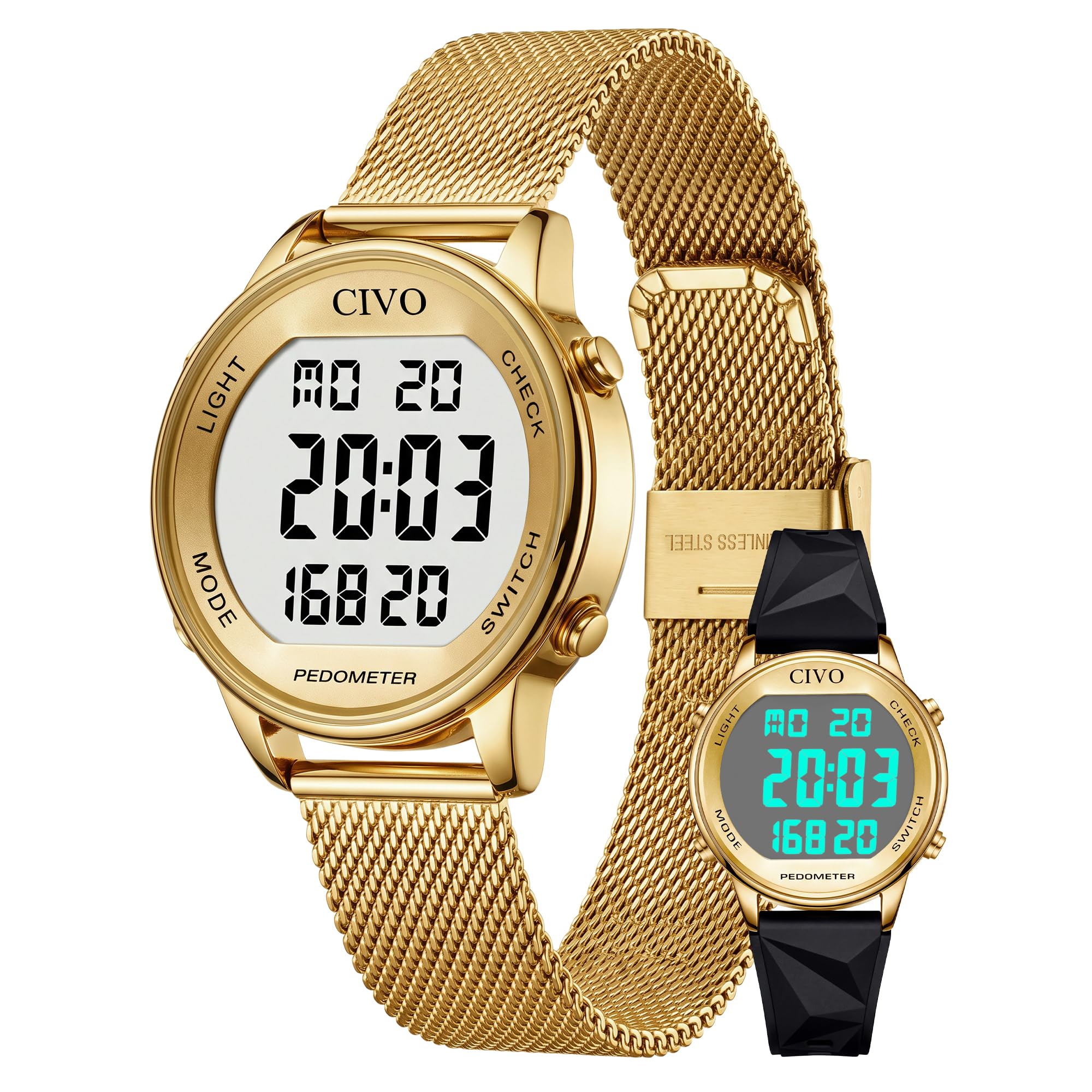
Here is the pick that wins the whole list, and the reason is almost boringly practical: it needs nothing from you. No app, no pairing, no charging cable. You strap it on and it counts steps, distance and calories in the background, then shows the numbers on a large-digit screen whenever you glance down. The 10-step filter means it waits for ten consecutive steps before it starts counting, which is how it avoids crediting you for pushing a cart around a supermarket. That single design choice is why the calorie figure stays believable.
The 4.5+ star rating across 200+ ratings is far from the biggest crowd in this article — the Fitbit Charge 6 has vastly more owners behind it — yet this CIVO holds the higher score. That is the trade: less data depth, more consistency. It also ships with two bands in the box. A 0.71 in / 18 mm silicone band weighing 1.85 oz / 52.4 g comes fitted, and a stainless steel mesh band weighing 2.63 oz / 74.5 g is included for dressing it up. Swapping between them takes the included adjustment tool and a minute of your time.
The screen is not a screen in the smartwatch sense. It is a large-number display with a soft 5-second EL backlight for reading in low light — press once, read, it fades. You also get an alarm, an hourly chime and a date display, which is more than most pedometers of this shape bother with.
What wins people over
- Zero maintenance loop — no app, no Bluetooth, no charger
- 10-step filtering cuts false counts from kitchen and shopping movement
- Two bands in the box: 18 mm silicone and a steel mesh bracelet
- Large digits plus a 5-second EL backlight for night checks
- Comes in a gift box with cleaning cloth and adjustment tool
Where it asks you to compromise
- No heart rate, no sleep data, no workout routes
- Swapping to the steel band takes a tool and a few minutes
- Strictly a step-and-calorie tool, not a health dashboard
Reach for this if: you want a wear-and-forget calorie counter and would rather not manage another app or cable.
Look elsewhere if: you want heart rate, sleep stages or GPS routes — the rechargeable trackers below do that job.
2. TIMEURE TU-2306B Men’s Pedometer Watch
A stainless-steel-mesh pedometer watch rated for up to 12 months on a single CR2032 coin cell.
You get roughly a year of walking data before you think about a battery at all, because a CR2032 coin battery (a flat, round watch battery) is rated for up to 12 months of use. That means no cradle, no cable, and no nightly ritual on the bedside table. That is the exact opposite of the rechargeable trackers further down this list.
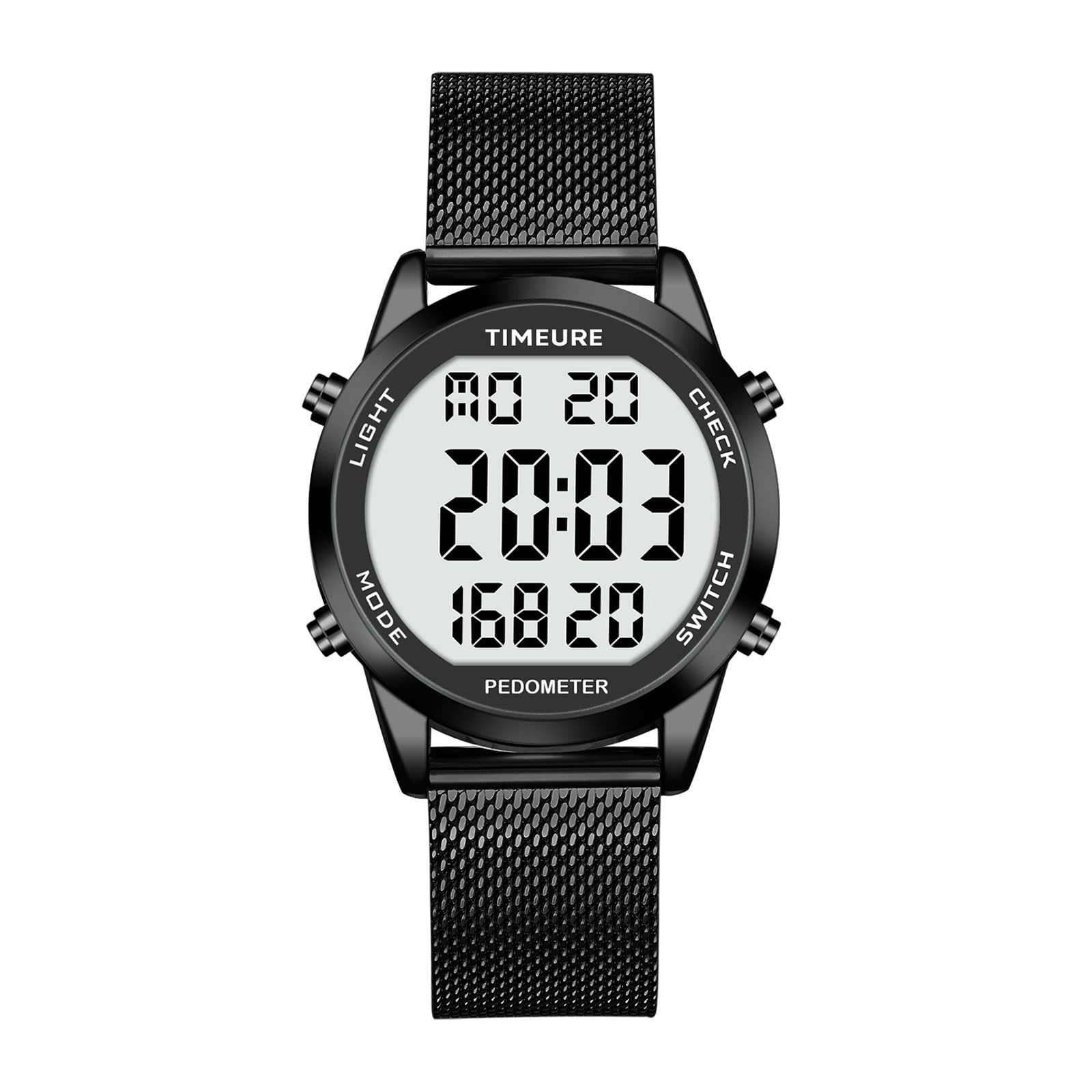
Its counting logic differs from the CIVO above. Instead of requiring ten straight steps, this one ignores any continuous movement that lasts under 10 seconds, then adds those early steps back once you keep going past the threshold. The practical effect is a watch that tolerates short bursts of hand motion without logging them as walking. Owners are split on how well that works in practice — accuracy lands in mixed territory for this model, while basic operation is what draws the most positive attention. Read that as: buy it for the simplicity and the band, and expect to sanity-check the step total now and then.
The bracelet is the other draw. The glossy metal case paired with an adjustable stainless steel mesh band and folding clasp gives it a dressier look than a rubber strap, and it fits wrists from 6.29 to 9.44 inches (160 to 240 mm). Water resistance is rated 30M, which covers handwashing, rain and brief splashes — just do not press the buttons underwater. The 5-second EL backlight, stopwatch, countdown timer, alarm and hourly chime round out a genuinely full daily toolkit for a watch with no app behind it.
The honest trade-off: step-count reliability is the recurring question mark on this one, and battery life draws a split verdict too, so treat the CR2032 rating as an estimate rather than a promise. Neither issue stops it being a capable everyday pedometer.
The short verdict: a strong fit for a man who wants a metal watch on his wrist and cannot be bothered with charging.
Worth knowing: if perfectly accurate step logs are your priority, the CIVO’s 10-step filter has the cleaner reputation.
3. RLQA Fitness Tracker with 24/7 Heart Rate and Blood Oxygen
A 1.47-inch color touchscreen that shows steps, distance, calories and real-time speed on one face.
If you want the calorie number to sit alongside heart rate and route data, this is the point where the list switches gears. A 1.47-inch full-color TFT touch screen is a real display, not a digit strip, so step count, distance, calories and real-time speed all fit on one face you can read mid-jog. It is also the narrowest strap here at 16 mm, which is note beside the CIVO’s 18 mm — a slimmer band on a smaller wrist.
Sports coverage is broad rather than specialist. Running, swimming, basketball and football all have modes, and the watch pulls GPS from your phone to map outdoor routes. Battery is a 200 mAh lithium-ion cell that charges in about 2 hours and is rated for 7 days between top-ups, which lines up with the routine of plugging it in once a week. IP68 means it shrugs off sweat and rain and survives the pool.
The extras are where it earns its place for a daily wearer. Sleep staging covers REM, light and deep sleep, there are sedentary reminders and menstrual cycle tracking, and the GloryFit app offers over 200 free watch faces or accepts your own photo. Compatibility runs to iOS 9.0+ and Android 4.4+.
Why it fits a mixed week: swimming, gym and weekend runs all get a mode, so your calorie total is not built from walking alone.
The part to accept: the 7-day battery figure assumes ordinary use, and a color touchscreen showing constant heart-rate data is the heaviest thing on a cell this size — plan on the weekly charge.
Pick this one when: you want a proper screen and sport modes and do not mind a weekly charging habit.
Not the one for: anyone who chose this list precisely to escape apps and cables.
4. MorePro Fitness Tracker
A fitness tracker that logs period, ovulation and safe days alongside steps and calories.
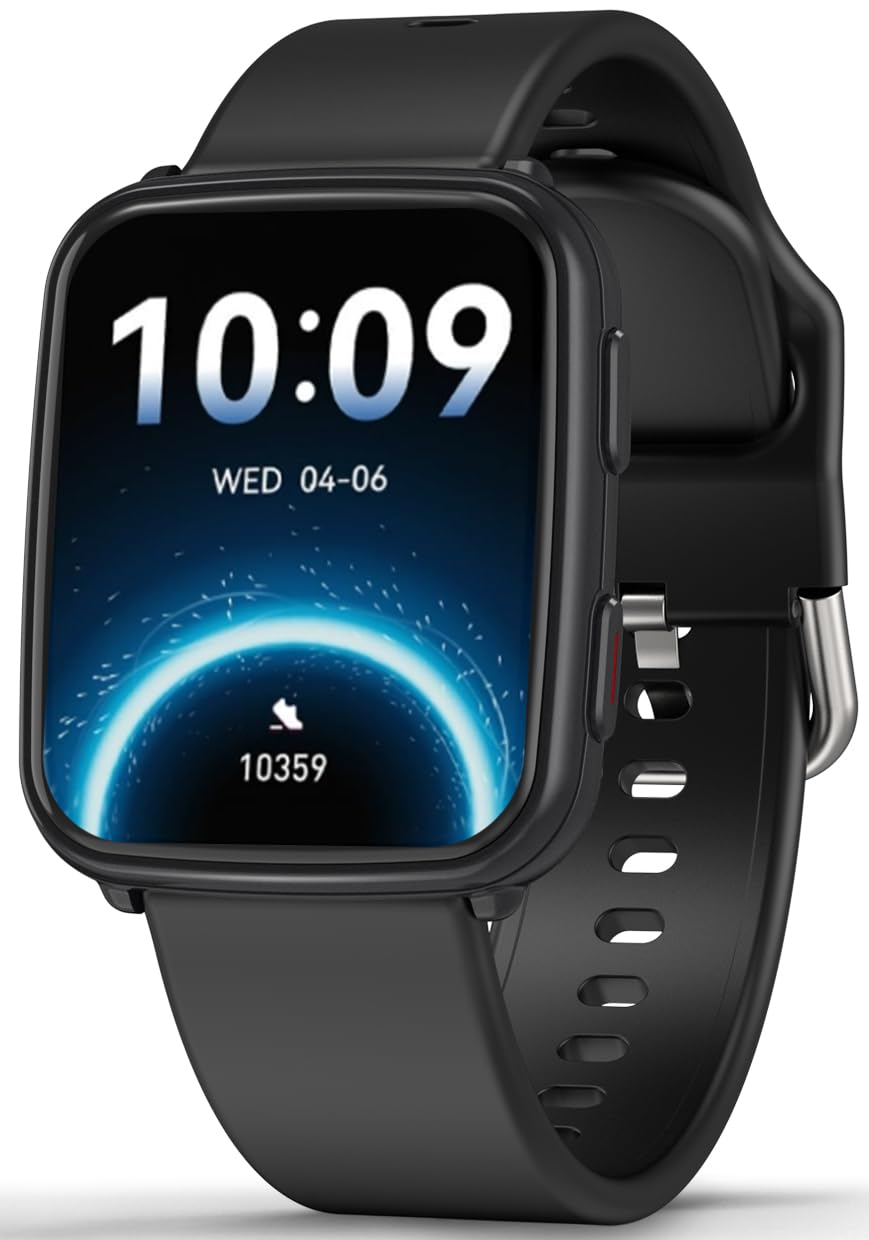
Most of the trackers here count calories and stop there. This one treats the whole month as the timeline. The built-in period tracker logs your period, safe days, ovulation window and ovulation day, and the app adds period mode, trying-to-conceive mode and pregnancy mode on top. If the reason you wear a watch on your wrist is to understand your body rather than gawk at a step count, that framing is the reason to start here.
Your daily activity is tracked properly: the built-in pedometer (a step counter) records steps, distance, calories burned, heart rate and training time in real time. And 120+ sport modes keep the calorie math tied to what you actually did rather than a generic walking estimate. Sleep is broken into deep, light and wake-ups. A 230 mAh battery (a measure of battery capacity) charges in about 2 hours and is rated for up to 7 days of normal use or 15 days on standby — the largest cell among the value trackers here, next to the RLQA’s 200 mAh.
The daily tools are the kind of thing you only notice when they are missing: call, SMS and app notifications on the wrist, sedentary and drink-water reminders, weather, music and camera control, and find-my-phone. The IP68 body handles sweat, rain and handwashing, and there are over 200 watch faces with DIY photo options. One compatibility catch: it pairs with Android 7.0+ and iOS 13.0+ phones only — not with PCs or tablets.
The everyday reality: owners describe a watch packed with features that does the core job — steps, heart rate, sleep — with easy-to-follow menus, and the battery settles into roughly a weekly charge.
Where to set expectations: the health readings are for personal awareness only, and the listing states plainly that the device is not for medical use.
Best fit for: anyone who wants cycle tracking and a wide spread of sport modes from the same watch.
Skip the pairing step if: your only device is a tablet or a desktop — this one needs a phone.
5. Bestinn Smart Watch Fitness Tracker H32

A 1.58-inch always-on display on a 27.22 g body, the largest screen in this group.
Screen size is the first thing that separates this from the other value trackers. At 1.58 inches it is the largest display in this group, and the always-on clock means time stays visible without a wrist flick.
You get a watch that looks good enough to wear every day, which is what owners talk about first. There are over 250 face options from classic analog to digital, the strap is replaceable and washable, and battery life runs as long as two weeks between charges according to the maker — the longest claimed span among the app-connected picks here. Compatibility reaches back to Android 4.4 and iOS 8.4, so older phones are fine.
The standout number: 1.58 inches of screen on a 27.22 g watch — big face, barely-there weight.
Fair warning: the two-week battery claim is the maker’s figure, and a large always-on display is the biggest drain in the category — expect real numbers to depend on how bright you run it.
Go here for: the biggest screen and the lightest feel in the value tier, with an always-on clock.
Think twice if: you want a small, discreet watch face — this is the opposite of subtle.
6. Google Fitbit Charge 6 Fitness Tracker

A slim band that pairs calorie burn with Active Zone Minutes, Daily Readiness and built-in GPS.
This is the tracker for someone who wants the calorie number to come with context. Active Zone Minutes tell you how hard you were working, not just how much you moved, and Daily Readiness turns sleep and activity into a single score for the day. Built-in GPS means routes are mapped without carrying your phone, and 40+ exercise modes plus automatic exercise tracking mean the watch often starts logging before you remember to.
Where this model diverges from the CIVO and TIMEURE is the daily charge question. The battery verdict across owners is genuinely split — some are happy with the runtime, some find themselves reaching for the cable every day — and the same split shows on step accuracy versus GPS accuracy. Durability is the topic that drags hardest on this model’s reputation, so treat it as a watch to look after rather than a beater.
The Google side is a real advantage if you use those tools. Linking the Charge 6 to compatible gym machines like treadmills and ellipticals streams your heart rate onto the machine’s display, Google Maps gives turn-by-turn directions on your wrist, and Google Wallet handles tap-to-pay. YouTube Music controls work from the band too. A three-month Google Health Premium trial is included, with the subscription sold separately after that.
What you are really paying for: depth — GPS routes, zone minutes, stress scores and machine-linked heart rate all in a slim silicone band.
The catch to weigh: battery and durability reviews pull in different directions, so this is a pick for someone who wants the data and will treat the hardware gently.
Worth it if: you train with purpose and want GPS and zone data, not just a step total.
Probably not for: anyone who wants to charge once a month and forget it — the no-app picks up top do that far better.
7. Fitbit Sense 2 Health and Fitness Smartwatch

A smartwatch that adds cEDA stress scores, ECG and SpO2 readings to basic calorie burn.
You get calorie burn as a basic feature, but what the Sense 2 adds is a stress reading built from cEDA — a sensor that picks up changes in your skin’s electrical conductance, one of the body’s physical responses to stress — plus a daily Stress Management Score. An ECG app (a heart-rhythm check) for atrial fibrillation assessment and irregular heart rhythm notifications sit alongside SpO2 (blood-oxygen tracking) and a health metrics dashboard. If you bought a calorie counter to understand your whole day, this is the broadest picture on the list.
The honest counterweight is reliability. Quality is the most-discussed topic on this model and it lands mixed rather than glowing — great for some, disappointing for others. Battery follows the same pattern: some owners get days out of a charge, others report a single day. Durability is the weakest signal of the three, with reports of units giving out after about 1.5 years.
Where it shines is the full-day package. Sleep stages and a Sleep Score, a smart wake alarm and do-not-disturb mode make it a better bedside companion than a pedometer. Built-in GPS with a workout intensity map and a Daily Readiness Score cover training. It takes on-wrist Bluetooth calls and texts, runs Amazon Alexa, and holds Google Wallet and Maps. Water resistance reaches 50 meters versus the TIMEURE’s 30M, and battery is rated 6+ days.
What it does that others cannot: daily stress scoring, ECG assessment and a sleep score in one body.
What to accept going in: this is the least consistent performer in the premium tier, so buy it for the stress and sleep features and keep your expectations on longevity measured.
Choose this if: stress and sleep insight matter as much as the calorie count, and you like Alexa on your wrist.
Rather avoid if: you want a watch that simply keeps running — the Garmin below is built for exactly that.
8. Garmin Instinct 2, Camo Edition
Up to 28 days in smartwatch mode and multi-GNSS positioning for trips off the grid.
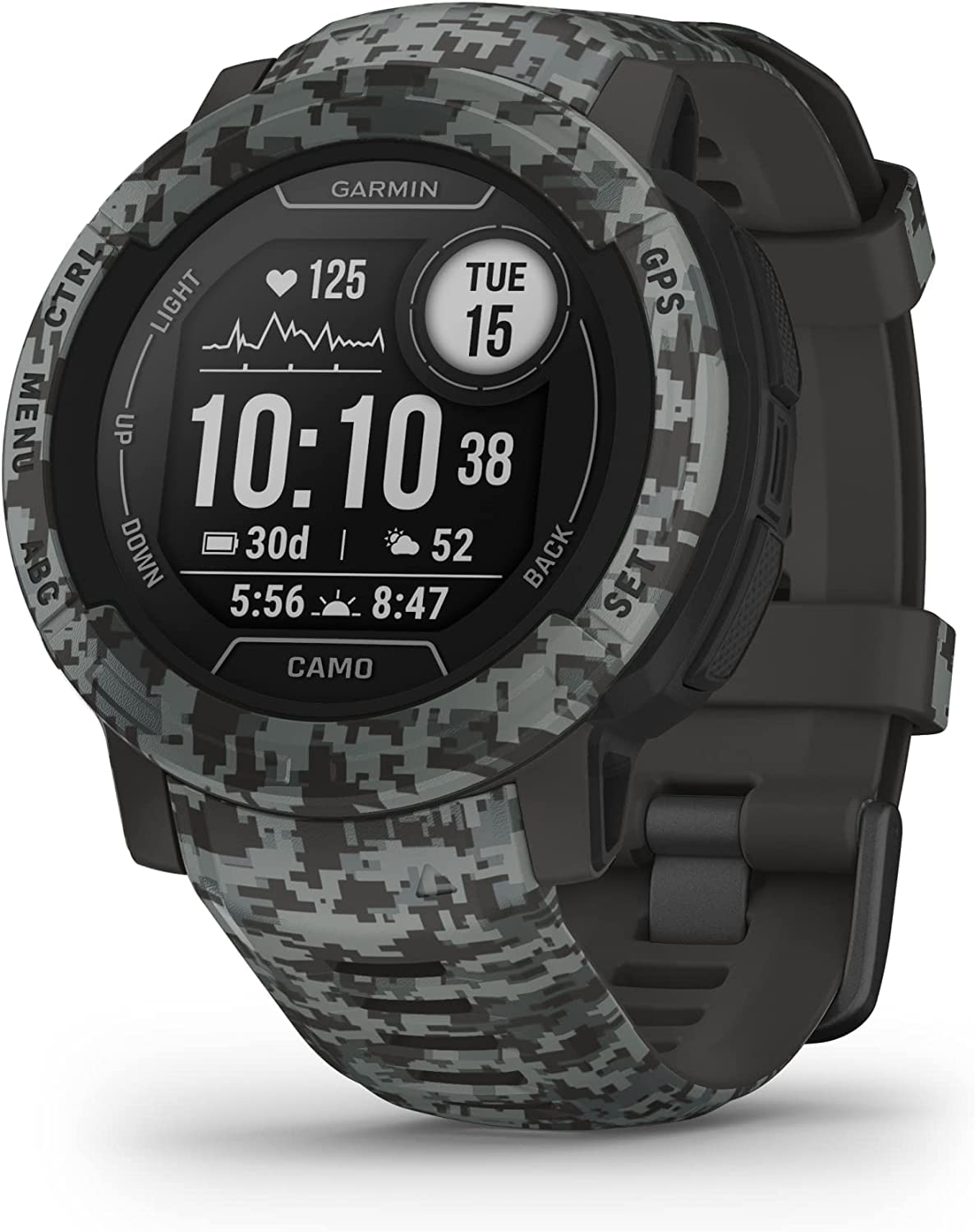
For anyone who walks where the map runs out, the battery figure is the whole story. Up to 28 days in smartwatch mode, or up to 30 hours in GPS mode, means you can head out for a multi-day trip and never think about a charger. Compare that with the 6+ days of the Sense 2 or the 7 days of the Charge 6 and the gap is obvious.
The body is built to match. It is water-rated to 100 meters and rated thermal- and shock-resistant, with a fiber-reinforced polymer case and scratch-resistant Corning Gorilla glass. Multi-GNSS support pulls position from GPS, GLONASS and Galileo together, which matters in canyons and dense hills where one system alone can struggle. TracBack routing walks you back along the path you came, and a 3-axis compass plus barometric altimeter handle navigation without a phone.
You get calorie burn through all-day health monitoring — heart rate, sleep, Pulse Ox (blood-oxygen tracking), respiration, Body Battery energy monitoring and intensity minutes — plus built-in sports apps for running, biking, swimming and strength training with VO2 Max (a measure of aerobic fitness) and other training metrics. Owners single out the software and the feature set as what they like most. Battery is the mixed note: great for many, though shorter than the headline for some. Garmin also states plainly that Pulse Ox is not available in all countries and that the device estimates activity and metrics rather than serving as a medical device.
The mic-drop spec: up to 28 days in smartwatch mode and a 100-meter water rating — nobody else here touches either number.
The caveat: battery life reviews split between great and shorter-than-advertised, so treat 28 days as the best case rather than the everyday norm.
Made for: hikers, trail runners and anyone whose watch has to keep up on a trip with no outlet in sight.
Overkill for: a walk around the neighborhood — the CIVO does that job without an app or a charge.
Know the Specs
Step Filtering and Calorie Accuracy
A calorie counter cannot weigh your food or measure your metabolism. It counts movement and estimates from there. That is why step filtering matters so much: a watch that credits every arm swing inflates your calorie total. The CIVO waits for 10 consecutive steps before counting. The TIMEURE ignores movement bursts under 10 seconds and then adds those steps back once you continue. Both approaches try to separate real walking from kitchen prep.
Battery Type and Charging Routine
Two families exist here. Coin-cell watches — the TIMEURE runs on a CR2032 rated for up to 12 months — need no cable, ever. Rechargeable trackers hold lithium-ion or lithium-polymer cells rated in milliamp-hours (mAh), a measure of capacity: the RLQA’s 200 mAh and the MorePro’s 230 mAh both charge in about 2 hours and are rated around 7 days. The Garmin sits apart with up to 28 days in smartwatch mode.
Water Resistance Ratings Explained
A 30M rating like the TIMEURE’s covers handwashing, rain and brief splashes — do not press buttons underwater. IP68, used by the RLQA, MorePro and Bestinn, means the watch is sealed against dust and survives being submerged. The Sense 2 goes to 50 meters and the Garmin Instinct 2 to 100 meters. Higher ratings mean more protection, not a license to dive, so match the number to what you actually do.
App or No App
A no-app watch stores your steps, distance and calories on the device and shows them on screen. That is the CIVO and the TIMEURE. An app-connected tracker pushes data to your phone so you can see history, sleep stages and GPS routes — everything from the RLQA and MorePro up to the Garmin. Neither is better; the right answer depends on if you want a watch or a dashboard.
Common Questions
How accurate is a wrist watch calorie counter compared with a treadmill readout?
Do any of these watches work without a phone or an app?
How long does the battery actually last on a calorie tracking watch?
Can I swim or shower with these watches?
Will a 16mm or 18mm band fit my wrist?
Are the heart rate and blood pressure readings medical grade?
Do I need to carry my phone for GPS route tracking?
Which is better for everyday walking, a pedometer watch or a fitness tracker?
Does the CIVO’s 10-step filter mean it misses short walks?
Which phones do these watches work with?
The Bottom Line
For most people, the winning wrist watch calorie counter is the CIVO Pedometer Watch because it counts steps, distance and calories with a 10-step filter (it ignores fewer than 10 steps in a row), needs no app and no charging, and ships with both a silicone and a steel mesh band. If you want a metal bracelet and a coin cell that lasts up to 12 months, the TIMEURE TU-2306B is the natural next stop. And for anyone whose watch has to survive a multi-day trip, the Garmin Instinct 2 with its 28-day battery and 100-meter water rating (swim-proof to 100 meters) is the one to reach for.
How we choose
We do not accept paid placement. Every pick is matched to a real buyer and a real use-case; we do not hands-on test units.
Sources
Specifications: manufacturer listings and product documentation. Review insights: verified customer reviews, as of November 2026. Pricing: not shown on this page (it changes often); check the current price via the retailer link.
As an Amazon Associate, Tactical Gear Guy earns from qualifying purchases. This does not affect which products we feature.