Specs are compiled from manufacturer listings and verified buyer reviews and can change over time — please confirm the key details on the product page before buying.
You want a blood pressure number you can trust without rolling up a sleeve and wrestling an arm cuff every morning. A wrist monitor solves that — it wraps on in seconds and inflates right at your wrist. The catch is that wrist units are far more sensitive to fit and body position than arm cuffs, so picking the right one matters more, not less. This guide sorts the real differences: cuff range, memory, power source, and where each model actually holds up in daily use.
This guide is built by comparing the manufacturers’ published specifications and the patterns across verified customer reviews, so you get each pick’s real strengths and trade-offs instead of marketing spin.
A wrist monitor only helps if the cuff actually fits your wrist. So fit comes first, then memory and power, then if you need app syncing at all. Those are the things that separate a monitor you keep using from one that ends up in a drawer — and the best wrist type bp monitor picks below are ranked on exactly that.
Top Picks


How To Choose The Best Wrist Type BP Monitor
A wrist monitor is only as good as its cuff fit. Wrap it on and the band has to sit snug against bare skin at the wrist, not loose, not over a sleeve. If the cuff is too small or too big for your wrist, the inflate-and-measure cycle can return a number that looks real but isn’t. So the first thing you check is the printed cuff range, not the feature list.
Start with the cuff range versus your wrist
Most wrist units in this group list a range like 5.3″–8.5″ or 4.92″–8.46″. Measure your wrist circumference with a soft tape before you buy. If you fall outside a monitor’s stated band, that model is not for you — an arm-style cuff is the honest alternative. A model like the Smartheart, which fits 5.5″–7.6″, is narrower than the LotFancy’s 5.3″–8.5″ and will not suit a larger wrist. That’s not a defect; it’s a fit boundary.
Wrist position and the heart-level rule
A wrist reading depends on holding the cuff at heart level during the measurement. Rest your forearm on a table so the monitor sits level with your heart, keep still, and don’t talk. Some models add a resting or heart-level indicator that lights up when you’re positioned correctly — the Beurer BC57 does this, and the OMRON 7 Series flags a heart-level indicator too. Use it. It’s the single biggest thing you can do to make a wrist reading consistent.
Memory, users, and how you’ll actually track
Memory counts split two ways: total readings versus readings per user. The Oklar stores up to 240 readings across two users, the LotFancy stores 120 combined for two users, and the Beurer BC57 holds 60 readings for two users for 120 total spaces. If two people share the monitor, per-user memory keeps the trend lines separate. If it’s just you, a single-user-style 60-reading store is usually enough for a doctor’s visit printout.
Power: AAA batteries versus built-in rechargeable
Most wrist monitors run on 2 AAA batteries, and some ship with them included — the PARAMED, the Beurer, the A&D, the iHealth, and the OMRON all include batteries. The LotFancy and the generic 120-set model do not, so budget for two AAAs on day one. The Oklar takes a different route with a built-in rechargeable battery and a Type-C cable, which means no battery swaps but a charging adapter you supply yourself.
Side-by-Side Comparison
| Model | Best For | Cuff Fit | Memory | Power | Amazon |
|---|---|---|---|---|---|
| LotFancy Wrist BP Monitor★ Best Overall | Voice readouts for low vision | 5.3″–8.5″ | 120 readings, 2 users | 2 AAA (not included) | Amazon |
| PARAMED Automatic Wrist BP MonitorMost Portable | Carry-anywhere kit with case | 5.3″–7.6″ | 90 readings | 2 AAA (included) | Amazon |
| Oklar Wrist BP MonitorTop Performer | Rechargeable, dual-user tracking | 4.92″–8.46″ | 240 readings, 2 users | Rechargeable, Type-C | Amazon |
| Windray 120-Set Wrist BP Monitor | Category color-coded readings | Adjustable, wide range | 120 readings, 2 users | 2 AAA (not included) | Amazon |
| Smartheart Wrist BP Monitor | Faster inflate-time readings | 5.5″–7.6″ | 60 readings, 2 users | Batteries included | Amazon |
| iHealth Pulse Wrist BP Monitor | App syncing with Apple Health | 5.5″–7.7″ | 199 readings per user | 2 AAA (included) | Amazon |
| Beurer BC57 Wrist BP Monitor | Resting indicator for positioning | 5.3″–7.7″ | 60 readings, 2 users | 2 AAA (included) | Amazon |
| A&D Medical UB-525 | Compact, single-user tracking | 5.3″–8.5″ | 60 readings | 2 AAA (included) | Amazon |
| OMRON 7 Series Wrist BP Monitor | Advanced Averaging accuracy | 5.3″–8.5″ | 90 readings | 2 AAA (included) | Amazon |
Detailed Reviews
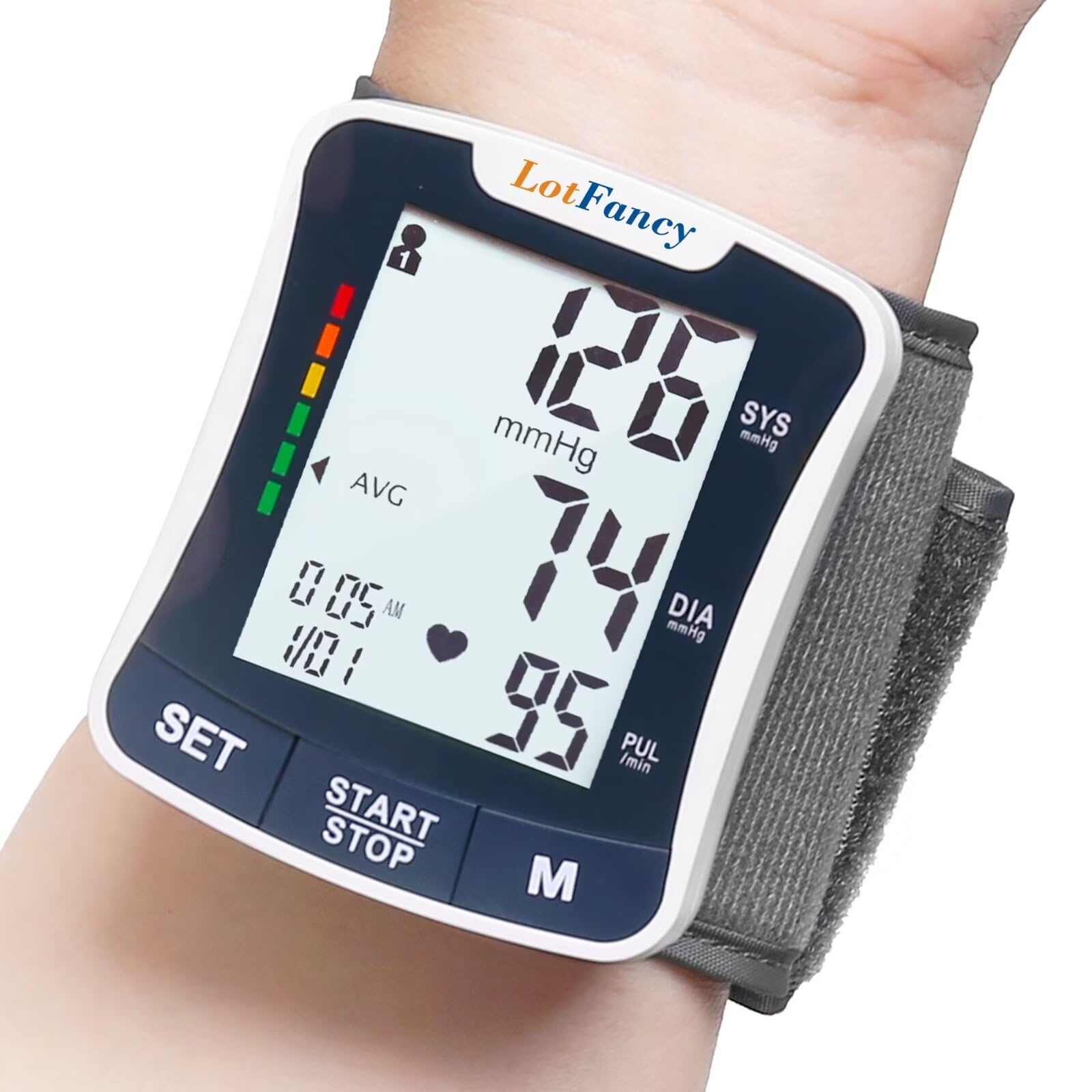
1. LotFancy Wrist Blood Pressure Monitor with Voice Broadcast
Our pick — 4.0+★ from 650+ verified ratings; the strongest balance of quality and price.
The one that talks back — spoken systolic, diastolic, and pulse numbers when the screen is too small to squint at.
If your eyes or your hands make tiny LCD numbers a chore, this monitor reads the result out loud. It announces systolic, diastolic, and pulse values in English, so you hear the reading before you ever look at the display. The cuff spans 5.3″–8.5″, which covers a wide spread of adult wrists, and it inflates and deflates on one touch — no manual pumping, no fiddling. Two users share 120 stored readings with date and time stamps, so couples can keep separate trends.
What wins people over is the build quality — that is the single attribute owners praise far more than anything else, with roughly 70 calling it out positively. The speed and simplicity of one-touch measuring get their own steady stream of approval too. It is the crowd favorite in this group at 4.0+ stars across 600+ ratings, and it holds that score while costing less than most of the field. That combination — plain reliability plus spoken results — is why it takes the top spot.
The honest catch is accuracy, and buyer feedback splits on it: the readings satisfy plenty of owners but leave others doubting. Some of that depends on wrist position and cuff tightness, which a wrist monitor punishes hard. The spoken English also divides people — a few find the voice hard to follow. Hold your wrist at heart level and it is an easy everyday tool. skip it if you want spoken numbers in a language other than English.
What earns the top spot
- Voice announces systolic, diastolic, and pulse — no screen-straining needed.
- 5.3″–8.5″ cuff fits a broad range of adult wrists.
- 120 stored readings split across 2 users with date and time stamps.
- One-touch automatic inflate and deflate keeps daily checks quick.
Where it asks for care
- Accuracy feedback splits both ways — technique and cuff snugness matter.
- Runs on 2 AAA batteries that are not in the box.
- The spoken English is hard to follow for a few owners.
Ideal for: anyone who wants the result spoken aloud and a wide cuff range in one budget-friendly unit.
Think twice if: you need a cuff beyond 8.5″ or you’d rather read than listen — a silent large-display model serves you better.
2. PARAMED Automatic Wrist Blood Pressure Monitor Kit
A grab-and-go kit that slides into a purse with batteries already inside.
This one is built for throwing in a bag and forgetting about until you need it. The set arrives complete with a carrying case and 2 AAA batteries, so there’s no first-day scavenger hunt. The large LCD numbers are easy to read at a glance — the kind of big digits that don’t require reading glasses. It stores 90 readings, which is plenty for a single user tracking a trend between appointments.
It travels without fuss: it fits in a purse, and owners consistently note how much easier the wrist-cuff wrap is than an arm cuff. The kit measures 3.94 x 3.94 x 3.94 inches and weighs 8 ounces — noticeably bulkier and heavier than the rechargeable Oklar at 3.03 x 2.55 x 2.63 inches and 3.59 ounces, so plan to carry it in a case rather than a pocket. Memory is 90 readings versus the Oklar’s 240, a 2.7x gap in stored history.
The cuff tops out at 7.6″, narrower than the 8.5″ reach of the LotFancy and the OMRON. If your wrist runs large, check that 5.3″–7.6″ band before you commit. It also carries an irregular heartbeat detector, so an off-rhythm reading gets flagged rather than silently logged. A complete travel kit with case and batteries included, ready for careful home checks.
Travel-ready by design: a durable case plus 2 AAA batteries in the box means this works the day it lands, and the 90-reading memory covers a single user comfortably.
The sizing boundary: 5.3″–7.6″ is the narrowest cuff here alongside the Smartheart and the iHealth — a large wrist will need a different model entirely.
Reach for this if: you want a complete travel kit with a case and batteries included and a wrist that lands inside 5.3″–7.6″.
Look elsewhere if: your wrist is over 7.6″ or you want more than 90 readings stored between downloads.
3. Oklar Wrist Blood Pressure Monitor (Rechargeable)
The memory champion — 240 readings across two users, with a rechargeable battery that ends the AAA habit.
The standout here is the built-in rechargeable battery with a Type-C cable. No hunting for AAAs, no battery door to lose — plug it in and it’s ready, though you do supply the charging adapter yourself. A typical measurement runs on a 35-second cycle, and the device powers itself off after 60 seconds idle, which is a small touch that saves the charge. The cuff adjusts from 4.92″ to 8.46″, the widest low end in this group, so small wrists that slip out of a 5.3″ cuff still get a snug fit.
Memory is where it pulls clear of the pack: 240 readings across two users, versus 90 single-user readings on the PARAMED, a 2.7x difference in stored history. The large LED backlit screen keeps the numbers legible in a dim bedroom, and the voice broadcast helps when eyesight is poor — both adjustable or switchable off via the SET and MEM buttons. Rechargeable power removes the AAA swap, and that friction-free routine is what keeps a daily monitor in use.
Two things to size up. The rechargeable route means a dead unit is a charging wait, not a quick battery swap — keep the cable where you can find it. And the 35-second cycle is quick, but it is a wrist reading, so heart-level positioning still rules the accuracy. For most people this is the most forward-looking pick in the mid-range group.
The two-user advantage: 240 readings split across two users with a wide 4.92″–8.46″ cuff makes this the pick for a couple who both want their own trend line.
The charge-trade trade-off: a Type-C charge replaces AAA swaps, but the adapter is not included and a flat unit means waiting rather than swapping.
Suits: couples tracking two sets of numbers and anyone tired of buying AAA batteries.
Less ideal for: a single user who wants no charging routine — the battery-powered A&D or OMRON keeps you going with a fresh pair of AAAs.
4. Windray Wrist Blood Pressure Monitor (120-Set)

Color-coded results — the monitor shades each reading green, yellow, or red so you know the zone at a glance.
This one leads with interpretation rather than raw numbers. A hypertension classification indicator shades each reading green for average, yellow for light, and orange or red for middle-to-heavy — so you don’t have to remember where your number lands on a chart. One-button operation runs the whole measurement, and it stores 120 readings across two users, overwriting the oldest when memory fills. An adjustable wide-range cuff is built for varied wrist sizes.
The design is genuinely pocketable — it’s the lighter, smaller style that slips into a travel bag. That convenience comes with a caveat you need to hear plainly: accuracy feedback on this model skews negative, with several owners reporting readings they didn’t trust, and a few noting it won’t shut off after three minutes. That is not a reason to write off the whole category — it is a reason to treat this as an entry-level unit that demands careful setup, correct battery polarity, and heart-level positioning every single time.
Read the instructions before your first check. The manufacturer flags battery polarity and posture as the leading causes of off results, and this is the model where that advice bites hardest. If you simply want a color cue and don’t mind being disciplined about technique, it’s a budget-friendly entry point. If you want confidence without the fuss, spend up the line to the Oklar or the OMRON.
What it brings to the table
- Green/yellow/orange/red indicator translates the reading instantly.
- 120 readings stored across two users before the oldest is overwritten.
- Light, pocketable build for travel and daily carry.
What a buyer should know
- Accuracy feedback leans negative — correct posture and battery polarity are essential.
- A few buyers report it failing to power down after three minutes.
- 2 AAA batteries are not included.
Best for: the disciplined budget buyer who wants a color-coded read and will follow the setup guide.
Skip if: you want a set-and-go unit with a strong trust track record — the OMRON 7 Series or Oklar are the safer calls.
5. Smartheart Adult Wrist Digital Blood Pressure Monitor

It reads your pressure while the cuff is still inflating, so your arm spends less time squeezed.
Most monitors inflate, wait, then measure. This one takes the reading during inflation, which shortens the whole cycle and cuts the time your arm sits under pressure. That shorter squeeze is a small comfort win you notice by the second or third daily check. Two memory banks hold 60 measurements each, with a date and time stamp and a last-reading average to spot a trend without scrolling. A hypertension indicator and an irregular heartbeat icon give you a quick visual read.
The built-in convenience is the fully automatic inflate-and-deflate with a single button, and the LED backlit display holds up in low light. The kit is complete from the start — monitor with attached cuff, storage case, batteries, English and Spanish instructions, a results log, and a 3-year limited warranty, the longest coverage listed here. Reading the setup steps once saves battery and cuff-fit headaches later. The cuff fits 5.5″–7.6″, so a larger wrist falls outside its range and would be better served by an arm-style monitor.
Where this one divides people is accuracy and power delivery — some owners find it spot-on, others report readings that are way off, and a handful hit battery-life trouble. That split on accuracy and battery life is the main caveat on an otherwise well-equipped kit. With careful heart-level technique, it holds up as a mid-tier daily monitor.
Comfort on the squeeze: reading during inflation is the practical reason to pick this over the standard inflate-then-measure crowd — faster results, less arm compression.
Genuine caution, sized honestly: the accuracy and battery feedback runs mixed, so treat the 5.5″–7.6″ cuff fit and clean battery seating as non-negotiable, not optional.
Worth it for: anyone who dislikes a long squeeze and wants a full kit with the longest warranty in this group.
Not the one if: your wrist is over 7.6″ — check the fit range first, because there’s no adjusting it.
6. iHealth Pulse Bluetooth Wrist Blood Pressure Monitor
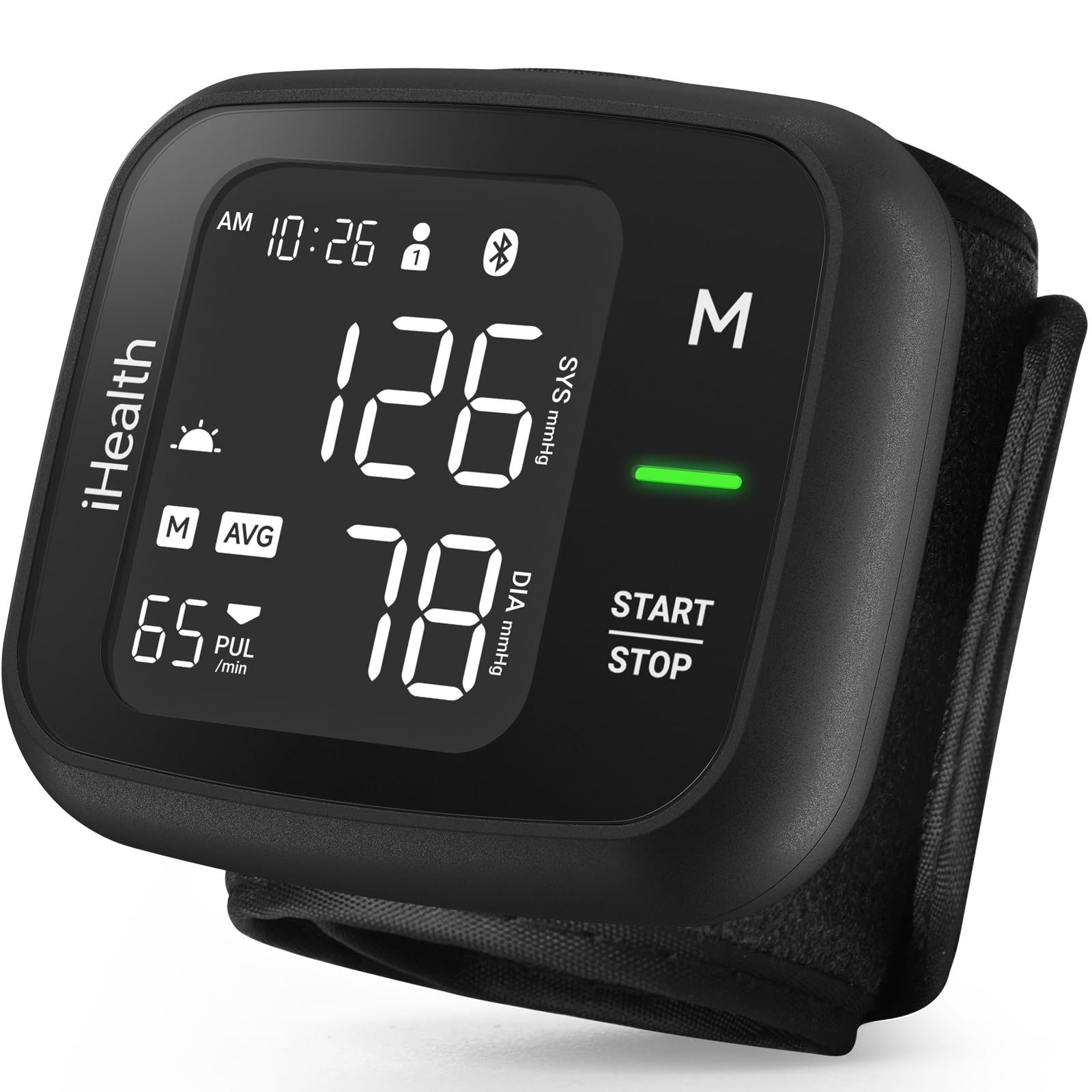
Syncs to your phone through the free iHealth app — including Apple Health and Google Fit.
For anyone who wants their numbers in one place instead of a paper log, this is the app-forward pick. Built-in Bluetooth pushes each reading to the free iHealth MyVitals app for iOS and Android, where it stores unlimited data, tracks trends, and lets you share results. It also connects with Apple Health and Google Fit, so readings live alongside your other health data. Two users each keep up to 199 readings on the device itself, so history is reviewable even without the app.
The on-device smarts are thoughtful: a color-coded BP indicator, irregular heartbeat detection, a recent three-reading average, and a morning average that helps you compare morning-to-morning. The build quality is the attribute owners praise most, with about 31 of them calling it out positively. It also represents solid value for a Bluetooth-capable wrist unit. The cuff fits 5.5″–7.7″, and the roomy 199-readings-per-user store beats most non-syncing models at the same tier.
The catch to weigh is connectivity — the app pairing draws real complaints, with some reporting it simply doesn’t connect. Reliability and accuracy feedback also split both ways. When the Bluetooth works, it’s a tidy tracking tool; when it doesn’t, you fall back on the on-device display, which still works fine. Treat the app as a bonus you’d like, not the sole reason to buy.
What makes it worth a look
- Bluetooth sync to iHealth MyVitals plus Apple Health and Google Fit support.
- 199 readings stored per user, reviewable without the app.
- Color-coded indicator, irregular heartbeat detection, and morning averages.
What to weigh first
- App pairing and connection issues come up in the feedback.
- Accuracy and reliability feedback is genuinely mixed.
- The 5.5″–7.7″ cuff won’t fit larger or very small wrists.
Good match for: a tech-comfortable user who wants readings pushed into Apple Health or Google Fit.
Look past it if: you don’t need an app and want your money in the cuff and display instead.
7. Beurer BC57 Bluetooth Wrist Blood Pressure Monitor

A resting indicator lights up when you’re actually settled — a check against measuring in a hurry.
Wrist readings go wrong most often because people measure before they’re at rest. The BC57 addresses that directly: an indicator illuminates on the screen once you’re in a rested position, and you wait for it before the reading is taken. It’s a small nudge that makes a real difference to consistency. A large color-coded screen shows each reading and shades it by risk so you can interpret it quickly, and a plastic storage case comes in the box.
Memory covers 60 readings for two users, 120 total spaces, and readings sync to your phone via Bluetooth through the HealthCoach app, so you’re not hand-logging results. An irregular heartbeat detector sounds an alarm if it flags an off-rhythm beat, and the monitor measures heart rate alongside pressure. The cuff adjusts from 5.3″ to 7.7″. At 3.39 ounces it’s one of the lighter units here, and the 2 AAA batteries are included. The device also advises measuring with your wrist at heart level and waiting at least five minutes between repeated checks — follow that and the readings settle down.
The honest snag is Bluetooth. Connectivity draws clear criticism, with pairing and app connection problems showing up repeatedly, and accuracy and value feedback lands mixed too. The resting indicator and big screen are the genuine reasons to buy; the app is the part that may frustrate. Buy it for what happens on the cuff, not the phone.
Positioning help built in: the resting indicator plus a color-coded risk screen make this a strong pick for someone who tends to measure too fast.
The app is the weak link: pairing and connectivity complaints are frequent enough that you should not count on the HealthCoach sync working smoothly.
Pick this for: the resting-position check and the color-coded display that make consistent technique easier.
Don’t pick it for: app tracking — the Bluetooth connection is where it falls short.
8. A&D Medical UB-525 Wrist Blood Pressure Monitor
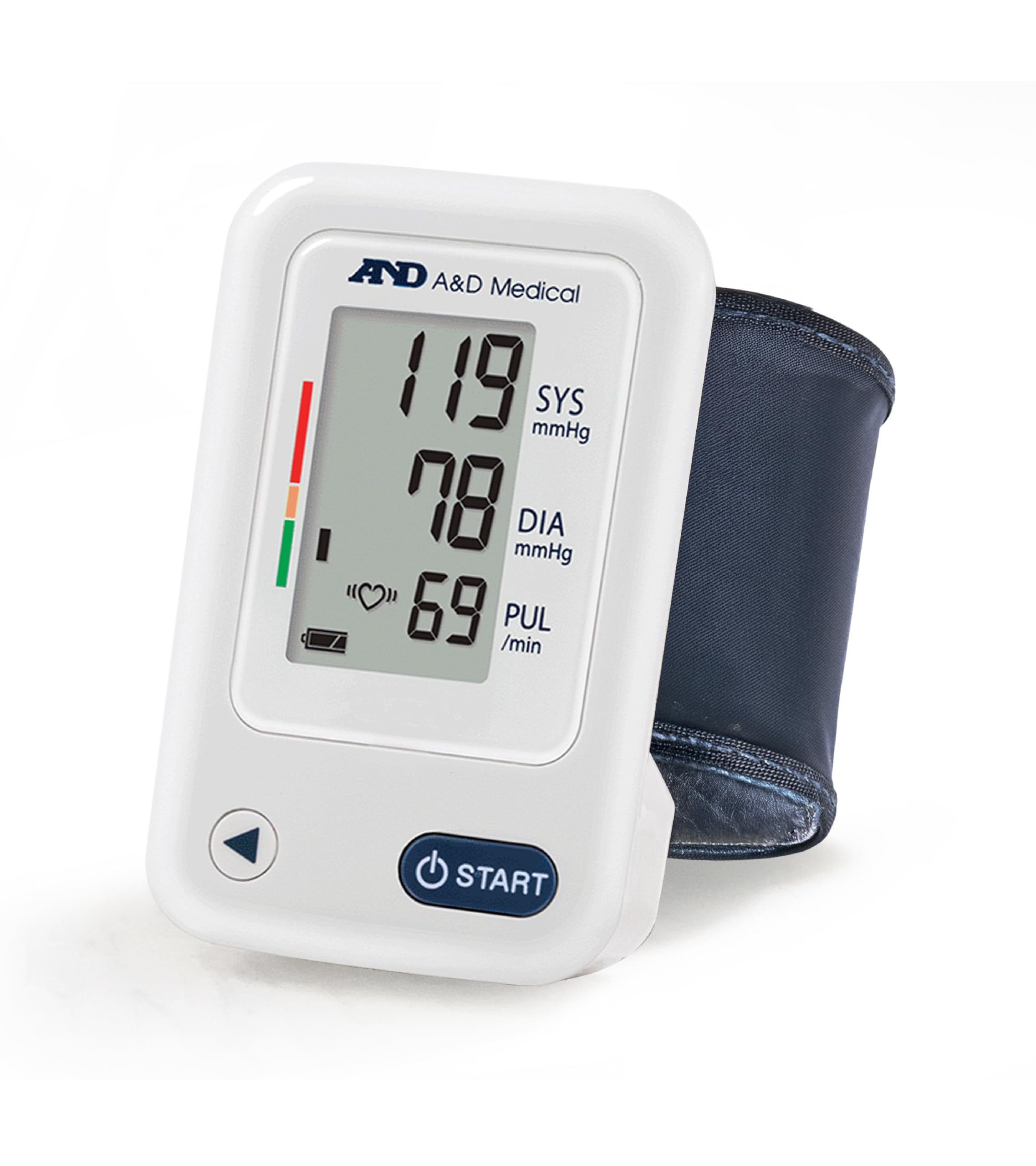
A light, single-user workhorse with oversized digits and a wide cuff — build quality is what people notice.
If you want a monitor that does one thing cleanly — one button, big numbers, no app required — this is the quiet contender. The LCD uses oversized digits for pulse, systolic, and diastolic, so a glance tells you everything without glasses. The cuff fits 5.3″–8.5″, one of the wider ranges here, and gentle inflation keeps each check comfortable. It stores and recalls up to 60 readings so you can compare pressure and pulse over time.
Fit and comfort are the quiet appeal: it’s a light, compact unit — 3.2 ounces — that travels easily. If you want your numbers logged in an app, the A&D Heart Track App is available free for iOS and Android, but the on-device 60-reading memory means you don’t have to use it. For a single user who checks daily and doesn’t want a phone in the loop, that combination is the whole point.
Weigh two things. Accuracy and reliability feedback runs mixed — some owners get spot-on results, others report high readings or a unit that stops working. And the 60-reading memory is lean next to the Oklar’s 240, so heavy double-user tracking isn’t its job. Used by one person with careful heart-level positioning, it’s a clean, light, well-built daily tool.
Choose it for: a light, wide-cuff unit with oversized digits and no app required — ideal for single-user daily checks.
Pass if: you share the monitor with a second person or want more than 60 stored readings — that memory fills fast.
9. OMRON 7 Series Wireless Wrist Blood Pressure Monitor
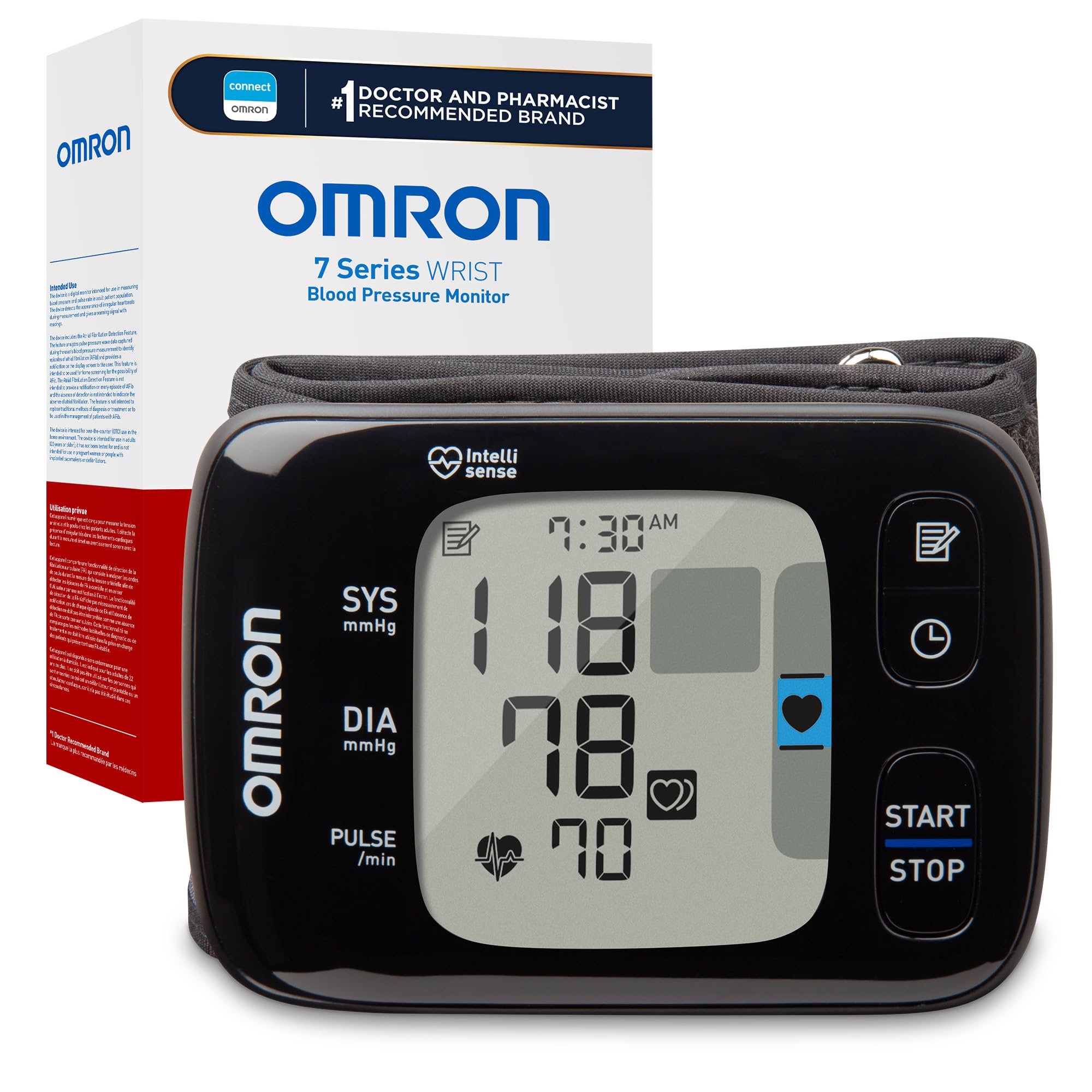
The averaging specialist — it reads up to three times in ten minutes and averages them into one number.
Single readings wobble. The OMRON 7 Series counters that with Advanced Averaging Technology, which automatically computes the average of up to 3 readings taken within a 10-minute period — so the number you write down is steadier than a one-shot result. It stores up to 90 readings, and a Hypertension Indicator alerts you when a reading is improve. This is the premium pick in the group, and its accuracy approach is the reason.
The convenience layer is real: the free OMRON connect app syncs via Bluetooth to store unlimited readings, track trends, and share reports — compatible with Apple Health and Google Fit. It’s ready to use on arrival with an attached cuff that fits 5.3″–8.5″, a storage case, a quick start guide, and two AAA batteries. OMRON markets itself as the doctor- and pharmacist-recommended brand for home monitors — a manufacturer claim, not an independent guarantee. At 3.17 ounces it’s light enough to carry between home and work without weighing down a bag.
Two things to be clear about. It’s the priciest model here, so pay the premium for averaging and app support — not because the cuff fit is wider, since several cheaper units reach the same 8.5″. And a wrist reading still depends on heart-level positioning; an average of three sloppy readings is still sloppy. Set up a steady resting routine, then let the averaging do its work. This is the pick for someone who wants the fewest doubts about their number.
The accuracy approach: averaging up to 3 readings within a 10-minute window turns a jittery single result into a calmer number, which is the strongest reason to step up to this model.
The premium you’re paying: it costs more than the Oklar and the A&D while matching them on cuff range — you’re buying the averaging and the OMRON connect app, so make sure both matter to you.
Best suited to: someone who wants the steadiest single number and app-based trend tracking they can share with a doctor.
Skip the upgrade if: you’re happy with a single reading per check and no phone — the Oklar or A&D cover that for less.
Know the Specs
Cuff circumference versus your wrist
The cuff range tells you who the monitor is for. A model stated at 5.3″–8.5″ fits most adult wrists; a 5.5″–7.6″ model is tighter and leaves out larger wrists. Measure your wrist with a soft tape and stay inside the printed band. An out-of-range cuff is the most common reason a wrist reading comes back skewed, so treat this number as the deciding spec, not a footnote.
Memory count and user banks
Read the memory figure carefully — it can mean total readings or readings per user. 60 readings for two users is 120 total, while 240 readings across two users gives each person far more history. More memory means more trend you can show a doctor. If two people share the unit, confirm each has a separate bank so the averages don’t mix.
Battery versus built-in rechargeable
2 AAA batteries are the standard, and some kits include them. A rechargeable unit swaps battery hunting for a Type-C charge, but a flat unit means waiting rather than swapping in fresh AAAs. Either works; pick the one that matches your routine. If the monitor travels in a bag for weeks, spare AAAs are easier to trust than a charger you left at home.
Averaging and irregular heartbeat detection
Averaging takes several readings over a short window and gives you one steadier value, which smooths out the wobble of any single measurement. An irregular heartbeat detector flags an off-rhythm beat during the reading so you can mention it to a clinician. Both are interpretation aids on top of the raw number — useful, but they don’t replace measuring with your wrist at heart level.
Common Questions
Is a wrist blood pressure monitor as accurate as an arm cuff?
How do I know if the cuff will fit my wrist?
Should I measure with my wrist at heart level?
Can two people share one wrist BP monitor?
Do I need Bluetooth on a wrist blood pressure monitor?
How long should I wait between repeated measurements?
Does a wrist monitor use batteries or a charger?
What should I do before taking a wrist reading?
What does the color-coded reading indicator mean?
What is an irregular heartbeat detector on a BP monitor?
The Bottom Line
For most people, the best wrist type bp monitor is the LotFancy Wrist Blood Pressure Monitor because it pairs spoken results, a wide 5.3″–8.5″ cuff, and two-user memory in one budget-friendly unit — and it holds the top score of the group. If you want rechargeable power and the most stored history, grab the Oklar Wrist Blood Pressure Monitor with its 240 readings and Type-C charge. And if you want the steadiest number and app syncing, the premium OMRON 7 Series Wrist Blood Pressure Monitor averages up to three readings into one. Whichever you pick, remember the cuff range and heart-level position rule the outcome more than any feature — size your wrist first, then buy.
How we choose
We do not accept paid placement. Every pick is matched to a real buyer and a real use-case; we do not hands-on test units.
Sources
Specifications: manufacturer listings and product documentation. Review insights: verified customer reviews, as of November 2026. Pricing: not shown on this page (it changes often); check the current price via the retailer link.
As an Amazon Associate, Tactical Gear Guy earns from qualifying purchases. This does not affect which products we feature.