Specs are compiled from manufacturer listings and verified buyer reviews and can change over time — please confirm the key details on the product page before buying.
If your wrist aches the day after pressing, the fix is usually a wrap that is either too short to hold tension or too stiff to wear comfortably. Longer wraps buy you more support, elastic-heavy wraps keep your hand free to move, and a padded guard is the only thing that saves your forearms from kettlebell contact. Below you will find the models that hold up on each of those jobs, sorted by what they actually do best.
This guide is built by comparing the manufacturers’ published specifications and the patterns across verified customer reviews, so you get each pick’s real strengths and trade-offs instead of marketing spin.
Every wrap below differs in length, stiffness and closure, so the choice hinges on whether you press, pull or swing. Here is how to match each one to the lifts you actually do, so you buy the right wrist protector for gym work once.
Top Picks


How To Choose The Best Wrist Protector for Gym
A wrap that is too short for your pressing load or too stiff for your kettlebell work gives you nothing at the bar. A short, soft wrap will not hold tension under a heavy bench press, and a stiff competition wrap on a kettlebell clean just digs into your forearm. Match the wrap length and stiffness to the lift and the support lands on the joint instead of fighting your hand.
Length decides how much support you can build
A wrap works by layering tension around your wrist, so the length of the strap is your support ceiling. A 12-inch wrap gives you a couple of turns and a little stability — enough for overhead work and general lifting. An 18-inch wrap gives you noticeably more turns and lets you crank tightness up for pressing. A 20-inch wrap sits at the long end for amateurs. More length also means more wrap time between sets, so lifters who train in fast circuits often drop down a size on purpose.
Stiffness versus elasticity
Stiff wraps freeze the wrist in place, which is what a max-effort bench press wants. Elastic-heavy wraps let the hand flex naturally, which suits pushups, overhead pressing and cross-training. If you have ever cut the circulation off mid-set, you want the elastic version. Competitive powerlifters usually want the stiff one.
Thumb loop, belt loop, or none
A thumb loop anchors the first turn so you can pull the wrap tight one-handed. A belt loop system does the same job without a loop over the thumb, which avoids any rubbing during high-rep work. No loop at all means the wrap is fully free but takes a moment more to start.
When a guard makes more sense than a wrap
Kettlebell work hits the back of your wrist against the bell, which a compression wrap cannot cushion. A padded guard with inserts absorbs that contact. It is a different tool, not a better one — pick it only if your training involves swings, cleans or snatches with a bell resting on your forearm.
Side-by-Side Comparison
| Model | Best For | Length | Material | Closure | Amazon |
|---|---|---|---|---|---|
| Rogue Fitness Wrist Wraps, Short 12″★ Best Overall | All-round lifting | 12″ (30cm) | 40% Elastic, 10% Polyester, 50% Cotton | Thumb loop | Amazon |
| Fitgriff Wrist Wraps (18″)Best Value | Bench press and pushups | 18″ | Cotton blend | Industrial Velcro | Amazon |
| Harbinger Pro 20-Inch WristWrapsLong-Wrap Pick | Long-wrap support | 20″ | Synthetic | Hook and loop | Amazon |
| Bells of Steel BellGuard | Kettlebell contact | One size | Fabric with plastic inserts | Slip-on | Amazon |
| Gymreapers Weightlifting Wrist Wraps | Competition lifting | 18″ | Polyester/Elastic | Hook and loop | Amazon |
| PR Personal Record Heavy Duty Wraps | Heavy pressing | 18″ | Cotton, Elastic, Polyester | Hook and loop | Amazon |
| TuffWraps 16″ | Fast-paced training | 16″ | Cotton, Polyester Blend | Hook, loop | Amazon |
| Harbinger Wrist Supports | Wrist stability | One size | Neoprene | Steel buckle and hook & loop | Amazon |
| Bauerfeind Sports Wrist Strap | Adjustable pressure | S/M | 3D AirKnit | Elastic loop | Amazon |
Detailed Reviews
1. Rogue Fitness Wrist Wraps Short 12″
Our pick — 4.5+★ from 850+ verified ratings; the strongest balance of quality and price.
The short wrap that lifts like a long one without drowning your hand.
Twelve inches (30cm) means a couple of clean turns around the joint, so you get stability at the bar but your hand still opens and closes between sets. That is the balance most gym-goers are chasing. The material mix of 40% elastic, 10% polyester and 50% cotton is the reason it works — the cotton holds the tension while the elastic gives just enough to avoid that dead, bloodless feeling mid-press.
Set against the long-wrap pick in this list, the Rogue is dramatically shorter: 12 inches versus the Harbinger Pro’s 20 inches. That is real support you are giving up, and on a max-effort squat you will feel the difference. What you buy back is speed. Fewer turns means you wrap and go instead of fiddling for a minute during a circuit. The three-size lineup (12″, 18″ and 24″, all in 30cm, 45cm and 60cm) also lets you size up if you later decide you want more tension.
This is the model people come back to for general lifting, Olympic lifting and overhead work — the flexibility is the point. The wraps are sold in pairs, they close with hook-and-loop, and the whole pair weighs 3.52 ounces, so there is nothing bulky sitting in your gym bag. The honest limit: the lighter, shorter build will not feel as locked-in as a stiff competition wrap under a very heavy bench.
Where it pulls ahead
- Twelve inches of wrap gives support without killing hand mobility.
- Cotton-forward blend holds tension across a full set.
- Available in 12″, 18″ and 24″ so you can scale support to your lifting.
- Sold as a pair at 3.52 ounces total — nothing to notice in the bag.
What you give up
- Shorter than the 20-inch Harbinger, so less total wrap tension available.
- Will not lock a wrist as rigidly as a stiff comp-grade wrap.
Buy this if: you want one wrap that handles overhead pressing, Olympic lifts and general gym work without hand fatigue.
Pick the long option instead if: you squat and bench heavy and want maximum tension at the joint.
2. Fitgriff Wrist Wraps 18″
Eighteen inches of cotton support for bench days, pushup finishers and kettlebell carries.
Bench press is where this wrap earns its keep. The 18-inch length gives you enough turns to build real tension, and the cotton exterior sits comfortably against skin. The elastic blend conforms to your wrist rather than fighting it, so the wrap stays snug through reps instead of loosening halfway. Clear left and right indicators on the wraps mean you stop guessing which one goes where — small thing, but it speeds up your setup when you are already under the bar.
The durability story is the reinforced stitching and the industrial Velcro closure. That combo matters because most wraps fail at the closure, not the fabric. The 18-inch size also lands in a useful middle ground: longer than the 12-inch Rogue for more pressing support, and easier to wrap than a 20-inch strap for people with smaller hands.
Weight is where this one feels different. At 4.6 ounces it is heavier than the 3.52-ounce Rogue, so you are carrying a touch more fabric, though both vanish in a gym bag. The comfort angle shows up in real routines — pushups without wrist pain, and steadier support during kettlebell carries and pull-ups. The honest note: the wrap leans toward soft support rather than rigid locking, so it is not the pick for a competition squat.
Who it fits: general lifters, home-gym owners and anyone pressing or doing bodyweight work who wants a forgiving wrap at a budget-friendly price.
The catch: if you want the wrist completely immobilized under maximal load, this is a support-first wrap, not a stiff competition strap.
Worth grabbing: for the lifter who wants dependable pressing support and a comfortable feel during everyday training.
Look past it if: your goal is a rigid lock for heavy squats and bench competition attempts.
3. Harbinger Pro 20-Inch WristWraps with Thumb Loop
Twenty inches of synthetic wrap when you want the joint held, not hinted at.
The number that sets this apart from every other wrap here is 20 inches. Compared with the 12-inch Rogue, that extra length gives you a much longer strap to work with, which translates into more turns and more adjustable tension at the wrist. The thumb loop is the practical part — it holds the first turn in place so you can pull the wrap tight one-handed with your other hand. Pressers tend to like it for exactly that reason.
The synthetic fabric is firmer than cotton blends, and that firmness is what makes the 20-inch length usable rather than floppy. The hook-and-loop closure lets you dial in tightness set by set. Fit is where this wrap shines; the adjustable tension means a large-handed lifter and a smaller-wristed lifter can both find a secure wrap without it slipping. One item per pack, so a full pair means ordering the set that ships as a pair.
The honest headline: durability is the most-discussed topic in the reviews, and the feedback is genuinely split rather than unanimous praise. Some owners train it hard for years without a problem, while others see wear at the closure sooner than they would like. That is not a dealbreaker for a budget-friendly wrap — but if you plan to wrap and unwrap five days a week, treat it as a consumable and expect to replace it eventually.
The standout: a full 20 inches of synthetic wrap with a thumb loop, giving more wrap turns than any short model here.
Honest trade-off: durability feedback is mixed, so heavy daily users may outlast the wrap.
Reach for it if: you press heavy and want the extra length to build a genuinely tight wrap.
Think twice if: you train twice a day and need a wrap that holds up for years of daily abuse.
4. Bells of Steel BellGuard Wrist Sweatband

The only pick here built to take the bell’s impact instead of squeezing your wrist.
If your training involves kettlebells resting on your forearm during cleans and snatches, this is the one wrap that addresses the actual problem. The plastic inserts inside the pad absorb the shock where the bell would otherwise bruise you. It pulls on and off like a standard sweatband, so it is a two-second job, and the sweat-absorbent fabric handles the other side of the problem — a slick forearm mid-set.
One size fits all, so there is no measuring, and you get a pair in the pack. The catch is that this is not a compression wrap at all. It does not build tension around the joint the way the Rogue or the Fitgriff does. If you are pressing a barbell, the BellGuard offers almost nothing — this is a contact cushion, not a stability strap. Anyone doing heavy cleans with a bell is the exact buyer this suits.
For anyone juggling multiple movements, the practical answer is to own both: this guard for the kettlebell portion and a wrap for the barbell portion. That is the honest read on a single-purpose product. Training purely with kettlebells? This is the right tool.
Its job: cushioning the forearm against kettlebell contact and soaking sweat during repeated cleans.
Its limit: zero compression support for barbell lifts; it is a guard, not a wrap.
The right tool for: kettlebell lifters, casual and competitive, who bruise their forearms on cleans and snatches.
Not the right tool for: barbell pressing or squatting, where you want joint stability rather than padding.
5. Gymreapers Weightlifting Wrist Wraps (IPF Approved)

IPF Approved, 18 inches, built for lifters who actually compete.
The IPF seal matters if you plan to step on a platform. “IPF Approved” means the International Powerlifting Federation has cleared this wrap for competition use, which is the one label that matters for a meet. At 18 inches it is long enough to build real tension at the wrist but short enough to stay within competition limits — a longer wrap would not be allowed for squat, bench and deadlift at sanctioned events.
The proprietary elastic is the engineering story. It allows you to wrap as tight or as loose as you want without cutting circulation, which is the hardest balance to strike. A wrap that only goes tight is useless mid-training; this one lets you dial it down between heavy sets. The reinforced thumb loops hold the wrap in place during the setup, which matters when you are grinding a max bench.
For anyone pressing with serious weight, this is the model that gets the job done across strength training, powerlifting, bodybuilding and cross training. The 18-inch length is the practical size for comp work — long enough to lock the joint, short enough to be legal. The catch with IPF-approved wraps is the stiffness they need to deliver; if you are after soft, elastic support for high-rep accessory work, a lighter wrap will feel more natural.
Why competitors favour it
- IPF Approved, so it is cleared for sanctioned powerlifting meets.
- 18-inch length hits the balance between support and competition legality.
- Proprietary elastic lets you tighten without shutting off blood flow.
- Reinforced thumb loops hold against the setup pressure.
The other side
- Comp-grade stiffness is not what you want for soft support in accessory work.
- Built for pressing and competition; high-rep bodyweight work will feel overbuilt.
Step up if: you are training for a powerlifting meet and need a wrap that is approved and holds up under heavy presses.
Stay with the softer wraps if: your training is mostly high-rep accessory work and you want forgiving support.
6. PR Personal Record Heavy Duty Premium Wrist Wraps

Three inches wide and eighteen long, with stiffness that takes heavy presses seriously.
The dimensions are the pitch. At 3 inches wide and 18 inches long, this wrap covers more of the wrist than a slim strap, so the pressure is spread across the joint instead of sitting on one strip of skin. The extra-wide hook-and-loop closure locks the tail of the wrap down and stays put while you press. For a heavy bench session, that width and wide closure make it feel more planted than a skinny wrap.
Left and right labels on the wraps tell you which way each goes, which is a small touch that keeps pressure even across both wrists. Reinforced stitching and the mix of cotton, elastic and polyester are there to resist fraying through repeated use. The wrap is designed and tested by Larry Wheels, and that is the marketing face of the product, not a spec you can weigh. The stiffness the wrap needs to protect during max-effort reps is also the main trade-off.
Buyers report the wrap saving their wrists during lifting, but several find it very stiff out of the package and some wrists find the 18-inch sizing loose. The most-discussed topic is quality, which comes back strongly positive — the material feels durable in hand. Several owners find the wrap very stiff out of the package and need a bit of use to break it in. Fit is the other variable, with some wrists finding the 18-inch sizing a little loose depending on how tightly you wrap.
For heavy pressers: the 3-inch width and extra-wide closure give more planted coverage than a narrow strap.
Break-in needed: stiffness is the honest complaint, so expect a few sessions before it feels natural.
Put it in the bag if: you press heavy and want a wide wrap that holds tightness through a long set.
Choose a softer wrap if: you want instant comfort and have no patience for breaking in a stiff strap.
7. TuffWraps 16″ Wrist Wraps with Belt Loop Tightening System

Sixteen inches, no thumb loop, and a belt-style system that tightens fast.
The design choice here is the belt loop tightening system. Instead of a thumb loop, you thread the wrap through a belt-style loop and pull, which lets you adjust tightness fast between sets. The trade is that some lifters find the system takes a session or two to get used to. Once it clicks, the wrap adjusts quicker than a loop-over-thumb wrap and avoids any thumb irritation during high-volume work.
At 16 inches it sits between the 12-inch Rogue and the 18-inch Fitgriff, so the support level is middle-of-the-road. That makes it a fit pick for cross-training and circuit work where you do not need a locked-out wrist, but you do want steady support during pressing and pulling. The Core model’s balanced stiffness makes it a genuine option for CrossFit and functional fitness, where you might go from a press straight into a pull or a swing.
Interestingly, the wrap is built for fast adjustment, and owners find it easy to put on once they are familiar with the belt loop. The recurring note is the stiffness at first use — several owners describe it as very stiff before it softens. Fit is the thing that wins here: once adjusted, the wrap holds a neutral wrist position through a set, which is exactly what you want under a loaded bar.
Standout feature: the belt loop tightening system makes on-the-fly adjustment quicker than a thumb-loop wrap.
Get past: the wrap runs stiff at first, so budget a couple of sessions to break in the feel.
Good for: CrossFit and strength-training lifters who change wraps mid-session and want fast adjustment.
Not for: anyone who wants a thumb loop as the anchor and dislikes re-learning their wrap method.
8. Harbinger Wrist Supports, One Size, Black

A non-stretch wrist support with a steel buckle that holds rigidity, not elasticity.
This is the most rigid support on the list. The non-stretch design is exactly what it sounds like — the fabric does not give, so the wrist stays in its supported position. The extra-wide 2-inch stabilizing strap runs through a steel tensioning buckle, which customizes the fit with far less give than a hook-and-loop-only wrap. The full 6mm neoprene cuff adds a cushioned layer against the skin.
The result is a wrist support that stabilizes rather than flexes. A lifter with a weaker wrist that needs to be held in position under load will find it more effective than an elastic wrap. One size, fully adjustable, so it fits a broad range of hands. The buckle closure is a different solution to the same problem the wraps solve, and for some wrists it holds tighter.
The honest caveat is comfort. The neoprene cuff and the buckle closure keep the wrist held steady, and some owners find that firmness uncomfortable after a long session. Fit is variable too — the one-size sizing is a bit small on some hands. Still, the stand-out trait is stability: for anyone needing a firm brace-like hold rather than a wrap that flexes, this is the option that delivers it.
What stands out: the non-stretch strap and steel buckle create a level of rigidity no elastic wrap here can match.
Bear in mind: that firmness reads as uncomfortable to some, so break it in before a max-effort set.
Choose it for: a wrist that needs a firm, brace-like hold during heavy lifting.
skip it if: you prefer a soft wrap you can flex naturally under the bar.
9. Bauerfeind Sports Wrist Strap, 3D AirKnit Fabric, S/M
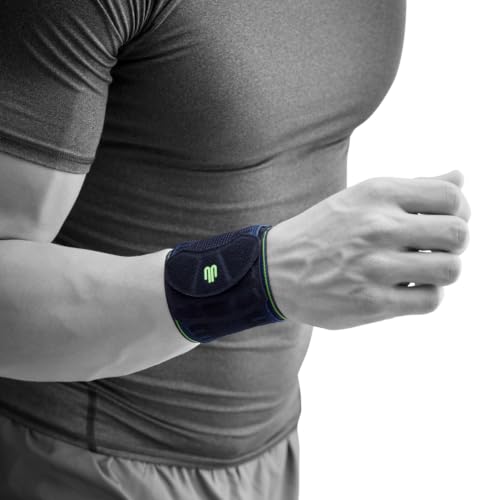
A breathable compression strap you tighten with a loop, not a wrap you wind.
The 3D AirKnit fabric is the reason to look here. It is light, breathable and washable, so you are not wrapping a heavy cotton strap around a sweating wrist mid-workout. The design allows air to flow through the fabric, which matters on long training days. The compression strap tightens with an elastic loop, letting you adjust pressure to exactly what your wrist wants — a different mechanism from the wrap-and-tuck approach on everything else here.
Where this earns its premium placement is the adjustability. You set the pressure you want, then it stays there. The strap holds a stable position during tennis, lifting and cross-training rather than loosening after a few reps. The fabric also does not need to be wrapped around multiple times, so setup is fast. Made in Germany, with a size range of S/M, so a hand that fits the range gets a precise fit.
Fit is the variable that decides whether this works for you. The S/M sizing means a larger wrist may find it snug, and the price sits at the premium end — it is the most expensive support here. If you are a smaller-wristed lifter who wants a breathable, adjustable compression strap rather than a heavy wrap, this is the one. If you need the rigid lock of a wider wrap, the Gymreapers is the better fit.
Premium pick: breathable 3D AirKnit fabric with an elastic pressure loop you can set exactly.
The trade-off: the S/M-only sizing is a snug fit for larger wrists, and it is the most premium-priced support here.
Look here if: you want breathable, adjustable compression for tennis, CrossFit and lighter lifting.
Otherwise pick a wider wrap: if you need maximum rigidity for heavy squats and bench presses.
Know the Specs
Length (12″, 16″, 18″, 20″)
Length is your support ceiling. A 12-inch wrap gives a couple of turns for light support. An 18-inch wrap gives more turns and more adjustable tension for pressing. A 20-inch wrap is at the long end for amateurs — more tension available, but also more wrap time between sets. If you train fast circuits, a shorter wrap usually works better.
Material and elasticity
Cotton holds tension firmly, elastic stretches under load, and polyester adds durability. A cotton-forward blend (like the Rogue’s 40% elastic, 10% polyester, 50% cotton) holds well without shutting off circulation. A synthetic wrap is firmer and gives a more rigid hold. A nylon-and-neoprene brace sits at the rigid end with a non-stretch strap.
Closure type
Hook-and-loop is common and adjustable mid-set. A steel tensioning buckle holds a firmer fit than hook-and-loop alone. A belt loop system tightens fast without a thumb loop. A slip-on guard with plastic inserts is the simplest, and it is meant for cushioning, not for tension.
IPF Approval
The International Powerlifting Federation approves wraps for competition use. If you plan to lift at a sanctioned meet, an IPF Approved wrap is the one that will not be rejected at the platform. Non-approved wraps are perfectly fine for training — they just cannot be used in competition.
Common Questions
What length wrist wrap should a beginner buy for gym use?
Do wrist wraps help with pushups and bodyweight work?
What does IPF Approved mean on a wrist wrap?
Do wrist wraps help kettlebell cleans and snatches?
How tight should I wrap my wrists?
Can I use a wrist wrap if I have a sensitive or injured wrist?
What is a thumb loop on a wrist wrap and do I need one?
How long should wrist wraps last?
Does the fabric of a wrist support matter?
Can I wear a wrist support for tennis as well as lifting?
The Bottom Line
The best overall wrist protector for gym work is the Rogue Fitness Wrist Wraps, because the 12-inch length gives real support while keeping your hand mobile. For most lifters, 12 inches is enough tension for overhead work without the wrap time of a 20-inch strap. If your training is built around heavy pressing and competition, the Gymreapers wraps are the ones to buy — IPF Approved and 18 inches long. And for kettlebell work, the Bells of Steel BellGuard is the pick to reach for, since the plastic inserts absorb the bell’s impact where a wrap cannot.
How we choose
We do not accept paid placement. Every pick is matched to a real buyer and a real use-case; we do not hands-on test units.
Sources
Specifications: manufacturer listings and product documentation. Review insights: verified customer reviews, as of November 2026. Pricing: not shown on this page (it changes often); check the current price via the retailer link.
As an Amazon Associate, Tactical Gear Guy earns from qualifying purchases. This does not affect which products we feature.