Specs are compiled from manufacturer listings and verified buyer reviews and can change over time — please confirm the key details on the product page before buying.
If you want one answer before you read anything else: buy the Shearwater Peregrine. It pairs a full-color screen with a 30-hour dive battery and two buttons you can work in cold-water gloves, and it is the strongest all-round pick here. But the Peregrine is not automatically right for everyone. A technical diver who needs trimix and gradient factors should look at the Teric. A diver who wants one watch for the gym and the reef should look at a Garmin. And a diver on a careful budget can spend far less and still get a solid Bühlmann computer. What follows explains which is which, in plain terms, without the marketing noise.
This guide is built by comparing the manufacturers’ published specifications and the patterns across verified customer reviews, so you get each pick’s real strengths and trade-offs instead of marketing spin.
Dive computers are safety gear, so the spec sheet matters more here than in almost any other category. This breakdown sorts the fixed details — algorithm, air integration, battery hours, and screen type — so you can match a watch to the diving you actually do. That is the whole job of this comparison of wrist dive computers.
Top Picks


How To Choose A Wrist Dive Computer
Most buyers start by comparing screen brightness, then buy on looks. That is the wrong order. The screen is what you notice on the boat; the algorithm and the modes are what you live with underwater. Get those two right first, then let the screen and the strap decide the tie-break.
Start With The Algorithm, Not The Screen
The algorithm is the calculation the computer runs to work out how long you can stay down and how slowly you need to come up. A Bühlmann ZH-L16C computer lets you adjust gradient factors — a pair of numbers that make the decompression schedule more or less conservative. If you dive the same profile every weekend and follow a guide, a fixed, simple algorithm is fine. If you plan your own decompression or dive mixed gas, you want the adjustable version and a clear menu to change it.
Decide if you want Air Integration
Air integration means the computer reads your tank pressure from a small transmitter screwed into your first stage, so the remaining air shows on your wrist instead of on a hose gauge. Hoseless models here can pair with several transmitters, which is what a technical or group diver needs. The trade-off is one more battery to watch and one more thing to pair before you splash. If you dive a single tank recreationally and already trust your gauge, you can save the complexity.
Match The Modes To Your Diving
Air and nitrox cover most recreational diving. Trimix and multiple-gas support only matter once you go deeper or technical. Freediving and gauge modes matter to a different crowd entirely. Be honest about which of these you actually dive this season, because you pay for modes you will never open.
Check Battery Life In Dive Mode
Battery figures for these watches come in two very different flavours: hours in dive mode and days in everyday watch mode. Dive-mode hours are the number that matters on a liveaboard, where charging between dives is awkward. Read the dive-mode figure first and treat the smartwatch figure as a bonus.
Side-by-Side Comparison
| Model | Best For | Display | Battery (Dive Mode) | Air Integration | Amazon |
|---|---|---|---|---|---|
| Shearwater Peregrine★ Best Overall | Most divers, all-round | Full color | Up to 30 hours | No | Amazon |
| Cressi DonatelloBest Value | Simple recreational use | LCD | — | No | Amazon |
| Mares Puck 4Best Entry Pick | Entry-level multigas | Segment LCD | — | No | Amazon |
| Garmin Descent G1 | Dive plus fitness tracking | Monochrome | Up to 25 hours | No | Amazon |
| SCUBAPRO Luna 2.0 AI | Hoseless air integration | LCD, LED backlight | — | Yes | Amazon |
| Mares Quad Ci | Color screen plus five transmitters | 8-color MIP | Up to 20 hours | Yes, up to five | Amazon |
| SUUNTO Ocean | Training watch plus underwater route tracking | 1.43″ AMOLED touchscreen | Up to 40 hours | Yes, with tank pod | Amazon |
| Shearwater Teric | Technical and trimix | LCD | — | Optional transmitters | Amazon |
| Garmin Descent Mk2i | Multi-tank air integration | 1.4” color | Up to 80 hours | Yes, up to five tanks | Amazon |
| Garmin Descent Mk3i | Biggest feature set | 1.4” AMOLED | — | Yes, up to eight divers | Amazon |
Detailed Reviews
1. Shearwater Peregrine Dive Computer
Our pick — 4.5+★ from 450+ verified ratings; the strongest balance of quality and price.
A full-color screen, a 30-hour dive battery and two steel buttons you can find by feel.
The Peregrine is the pick for the diver who wants one watch to do almost everything well. Its full-color display puts depth, time, and gas on one bright panel you can read without stopping to squint. The two-button layout and a state-aware menu (the screen shows only the options that make sense at that moment) mean you are not memorizing a control tree. And its 900 milliamp-hour lithium-ion battery charges from a wireless charging station that comes in the box, so there is no port to flood or cap to lose on a wet deck.
What wins Peregrine owners over most is the two-button ease of use, closely followed by how readable the color screen is underwater. Owners describe a large, bright panel that shows everything at a glance, and they single out the water-activated auto-on — the watch wakes when it gets wet, so you are not fumbling for a button on the roll. The Bluetooth connection and customizable display let you rearrange what sits on the main screen, which matters if you dive a fixed routine and want your numbers in the same place every time.
The catch is the one you would expect from a color screen this size: it is a recreational and nitrox tool, not a trimix computer, and there is no air integration. If you plan decompression on mixed gas, the Teric below is the correct upgrade. If you just want your tank pressure on your wrist, the SCUBAPRO Luna 2.0 covers that. For the vast majority of recreational divers, though, this is the nitrox computer that does the job without a learning curve.
What Stands Out
- Full-color screen with the readability divers talk about first
- Two-button, state-aware menu is easy to work in gloves
- Wireless charging station included, so no exposed port
- Built-in NDL planner and decompression planner
- Multi-gas modes and Bluetooth to your phone
Where It Stops Short
- No air integration for tank pressure on the wrist
- No trimix support for technical profiles
- Color screen drains the charge faster on high brightness
The short answer: buy this one unless you have already outgrown nitrox diving — it is the crowd favourite, holding 4.5+ stars across 400+ ratings.
But know this: you give up air integration, so plan to keep a gauge on your hose.
2. Cressi Donatello Dive Computer
One button, two worlds — scuba and freediving in a single cheap wrist unit.
The Donatello is the budget pick for the diver who does not want to think about menus. A single button runs the whole thing, so there is nothing to mis-press when your hands are thick with gloves and the surface is choppy. It also carries a freediving gauge mode, which lets a breath-hold diver use the same watch they wear on scuba — the one feature that makes this stand out at its price. Its 320 milliamp-hour lithium manganese dioxide battery sits well under the Peregrine’s 900 milliamp-hour cell, which is worth knowing if you dislike charging.
Buyers report it performing across dive sites on several continents, and the build quality comes in for repeated praise. What is not settled is the interface. Some divers find the single-button navigation easy and clean, others say the menu flow is not intuitive to learn. That split is the honest picture: it is simple in concept, but it takes a dive or two to get fluent before you trust it in low visibility.
Two smaller points a careful buyer will care about. There is no GPS, so nothing is geotagged automatically. And the IR link to your phone or computer means a line-of-sight transfer rather than a wireless one, which is fine for logging at the end of the day but less slick than Bluetooth. Neither affects the dive itself. Both affect how much admin you do after it.
Who this suits: the diver on a careful budget, or the freediver who wants one watch for both styles without spending premium money.
The learning curve: the single button takes a couple of dives to feel natural, and the IR log transfer is not instant.
Reach for this if: you dive air and nitrox recreationally and want freedive mode without a second watch.
Look elsewhere if: you want a menu that feels obvious on the first dive, or you need air integration.
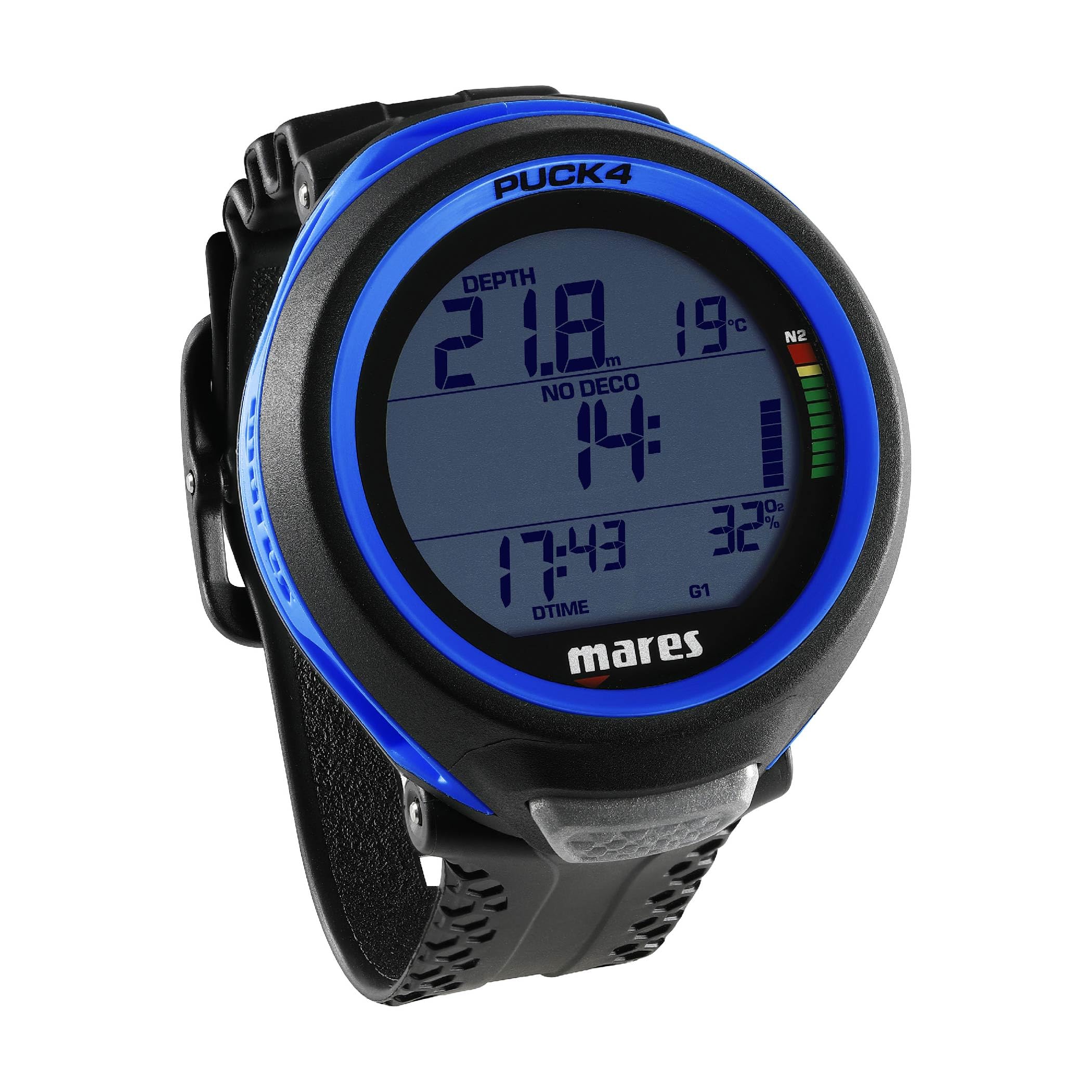
3. Mares Puck 4 Wrist Dive Computer
A technical diver’s starter box: adjustable algorithm and three gases on a modest budget.
This is where a diver begins to think like a technical diver without paying technical prices. The Puck 4 runs the Bühlmann ZH-L16C algorithm with adjustable gradient factors, so you can dial your decompression schedule more or less conservative depending on the dive. It also handles up to three gases — air, nitrox, and a bottom timer — which is more gas flexibility than most entry-level computers offer. A decompression planner and a digital logbook come built in, and the segment display uses chip-on-glass technology to stay readable with large numbers at depth.
Bluetooth connectivity makes the log side painless; you push your dive data to the Mares app rather than keying anything in by hand. The one-button interface keeps the underwater operation simple, and the resettable average depth is a practical touch for anyone working a reciprocal profile. A temperature rating of 6 °C tells you it is rated for cold water, so it will not flinch on a British or Pacific Northwest dive.
The honest limit is the display. It is a segment screen, not a color panel, so it reads clearly but plainly — no colorful safety-stop cues or graphical gas bars. If you have been spoiled by the Peregrine’s color screen above, this will feel basic. The payoff for that simplicity is the gas handling and the algorithm control, which are what actually extend a technical diver’s useful dive time.
Why It Earns A Place
- Adjustable gradient factors on a Bühlmann ZH-L16C algorithm
- Three-gas support including bottom timer
- Built-in decompression planner and digital logbook
- Bluetooth to the Mares app for logging
- Rated down to 6 °C for cold-water dives
Where It Gives Ground
- Plain segment display, no color
- Single button takes practice for new users
The fit: a diver stepping into nitrox and light tech who wants algorithm control before spending premium money.
The trade: you accept a plain-to-read screen in exchange for gas flexibility.
4. Garmin Descent G1, Rugged Dive Computer, Slate Gray

The dive computer that also counts your runs and tracks your sleep.
Pick the G1 if you want a dive computer you never take off. It marks surface entry and exit points with GPS, GLONASS, and Galileo support, so you can see where you started and ended a dive — a genuinely useful tool for repeat-site navigation. It tracks over 30 built-in sports apps and advanced training features, and the sapphire lens and silicone bands are built for daily wear rather than a life in a dive bag. Battery runs up to 25 hours in dive mode, 21 days in smartwatch mode, and 26 hours in GPS mode.
What owners like most is how much the watch does for the price — it is the value play in the Garmin range and the one that makes a case for owning a single watch. The monochrome display is the compromise, but the size comes in for positive comment, so it sits comfortably on most wrists rather than swallowing them. The dive logging changes hands here: up to 200 dives stored on the wrist and reviewed in the Garmin Dive app, which is the smoother system on this list than the Cressi’s IR line-of-sight transfer.
Battery life is the aspect Garmin’s own buyer base is least united on, so treat the dive-mode figure as the number to plan around, not the smartwatch figure. Freediving, spearfishing, and technical modes are all covered, so this one watch spans a lot of diving styles. What it does not do is show your tank pressure — there is no air integration — so a hose gauge stays on your regs.
The single number that decides it: 25 hours in dive mode is long enough for a liveaboard week of recreational diving without a charger hunt.
Worth the compromise: the monochrome screen is plainer than the Puck 4’s plainest segments would suggest, but you trade color for GPS and a phone app that handles your logs.
Best for: the diver who wants fitness tracking, GPS entry points, and dive logging in one everyday watch.
Not for: the diver who wants a color display or air pressure on the wrist.
5. SCUBAPRO Luna 2.0 Air Integrated Wrist Dive Computer
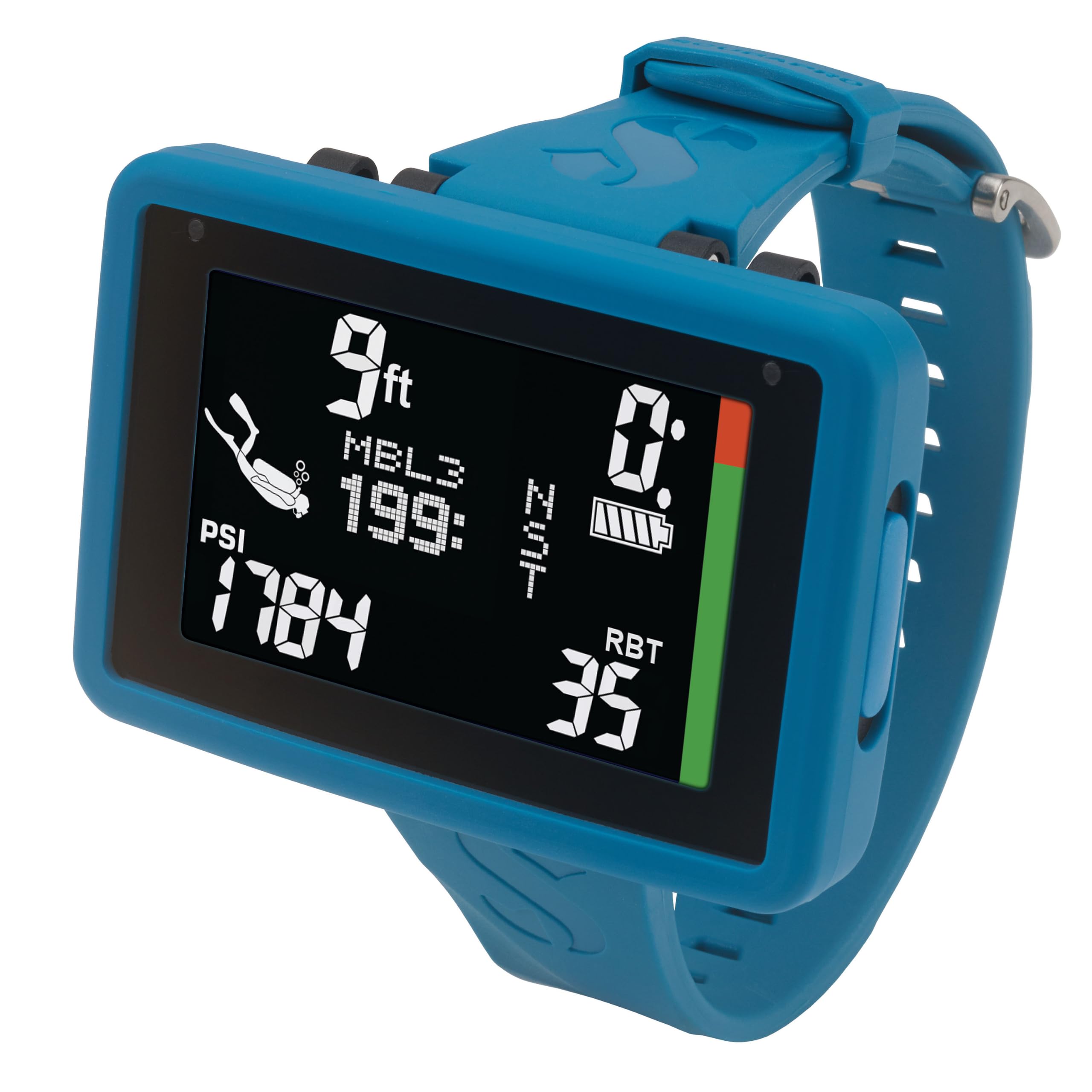
Hoseless tank pressure on your wrist — the whole point of the Luna 2.0.
If you want your air on your wrist without a hose, this is the straightforward answer. The Luna 2.0 monitors tank pressure wirelessly and calculates a true remaining bottom time (RBT) based on how hard you are breathing, which is a smarter figure than a raw pressure number on a hose gauge. The screen is a wide, high-contrast black and white LCD with large characters and a bright LED backlight, so it reads in dim water, and the slim thermoplastic housing uses oil fill technology for reliable performance. Two buttons run the menus.
You get two algorithm options — the predictive multi-gas Bühlmann ZH-L16 ADT MB PMG, or the ZH-L16 with gradient factor — so you can pick the more conservative or more liberal schedule to suit your diving. Nitrox compatibility is built in, the silicone strap and buckle are conventional and comfortable, and Bluetooth gets your logs onto a phone, tablet, or PC. The EU spare part availability of 7 years is a quiet reassurance that this is a long-term piece of kit rather than a disposable gadget.
The catch is the small things that come with any air-integrated system: you need to pair the transmitter before each dive, and the pressure reading is only as good as that pairing. There is no GPS, and this is a recreational and nitrox setup rather than a trimix technical tool. For a diver who wants to look at their wrist instead of a console, those trade-offs are easy to accept.
The Case For It
- Wireless air integration with true remaining bottom time
- High-contrast LCD with large characters and LED backlight
- Two algorithm options including gradient factor control
- Bluetooth logging to phone, tablet, or PC
- Slim oil-filled housing, 7-year EU spare part availability
Good To Know
- Transmitter pairing is an extra pre-dive step
- No GPS geotagging
- Recreational and nitrox focus, not trimix
The pick for you if: you hate hose routing and want tank pressure and RBT on your wrist from a trusted dive brand.
Know before you buy: air integration here means one more pairing ritual before every dive, and no GPS.
6. Mares Quad Ci Wrist Dive Computer

Five transmitters, eight colors, and a digital compass — this is the group diver’s color pick.
The Quad Ci earns its spot with an 8-color MIP display (a reflective screen that stays readable in bright sun), so you get color cues without going full smartwatch. That color shows your dive data at a glance. A full-tilt digital compass with a built-in stopwatch turns navigation and timing into a wrist job, not a separate instrument. The customizable Bühlmann ZH-L16C algorithm (a decompression formula you can tune) lets you set gradient factors to taste. Air, nitrox, and trimix modes cover everything from a shallow reef to a decompression dive. If you want a simple air-only computer, this is more watch than you need.
Air integration is where this one goes further than most: it can pair with up to five transmitters, showing real-time tank pressure and saturation levels color-coded for quick reading. If you dive a rebreather support setup or a multi-tank configuration, that many transmitters is a real advantage over the two or three typically offered. Bluetooth to the Mares app brings firmware updates and dive profile analysis, and up to 20 hours of dive time per charge covers a normal trip between chargers.
The honest trade is the display technology. MIP is a low-power reflective screen, so it is easier on the battery than an AMOLED panel but less vivid than the SUUNTO Ocean’s luminous touchscreen. It is also a comparatively new-to-market watch, so there is less long-term owner history to lean on than the established Peregrine or Teric. Neither point is a flaw — both are decisions about how much you value screen pop versus battery endurance.
Who it wins for: the diver who runs more than one tank and wants color-coded pressure and trimix support in one watch.
The honest trade: a reflective MIP screen is battery-friendly but less vivid than the AMOLED competition.
The fit: group divers and light technical divers who want five-transmitter flexibility and a compass in the same watch.
Think twice if: you want the sharpest possible screen, or you want a watch with years of owner feedback behind it.
7. SUUNTO Ocean Dive Computer, GPS Multisport Watch

The watch that logs your dive route in 3D and then paces your marathon.
If your weekends mix a reef dive with a long run, the SUUNTO Ocean is built for you. It runs a 1.43″ color AMOLED touchscreen with a Dive UI designed for underwater readability, and it supports freediving, snorkeling, mermaid diving, and single- and multi-gas diving with air and nitrox. The advanced Bühlmann 16 GF algorithm and wireless tank pod compatibility let you follow multiple tank pressures and gas consumption on the watch, with mandatory alarms. Sapphire crystal and stainless steel give it a 100 m water resistance and a 60 m measurement range.
Battery and navigation are where this one pulls ahead of the G2. Up to 40 hours in dive mode, up to 26 days standby, and up to 12 days of daily use with all-day heart rate give you a lot of headroom, and a fast charge brings it to full in about an hour. A dual-band GNSS system (two satellite frequencies for a steadier position fix) and global offline maps let you navigate to a dive site above water. Underwater route tracking is the newest trick: you can save your dive route in 3D to the Suunto app and share it afterwards. More than 95 preset sports modes and an AI Coach that reads hundreds of parameters make it a serious training watch too.
The honest note is that this is the most multi-sport-focused of the dedicated dive computers here, so if your only sport is diving, you are paying for capability you may not use. It also leans on the tank pod for air integration, which is a separate piece of hardware. But for the diver-triathlete, it is the most complete one-watch answer on this list.
Standout spec: 40 hours of dive-mode battery and a one-hour fast charge make it the endurance pick of the bunch.
A fair caveat: air integration depends on a tank pod you buy separately, so factor that into how you plan the purchase.
Best for: the diver who trains across several sports and wants one watch that maps a dive route and logs a run.
Skip if: you only dive and want the simplest, cheapest tool for the job.
8. Shearwater Research Teric Dive Computer
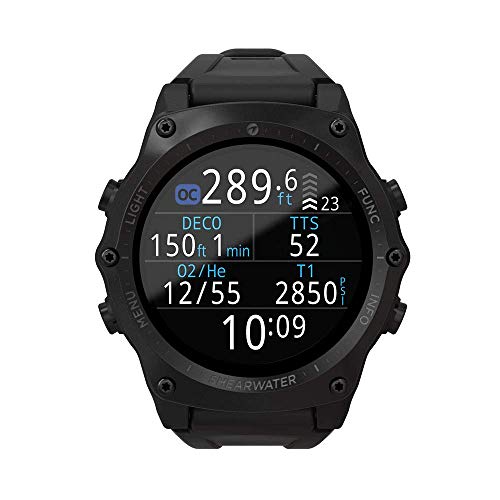
A trimix decompression computer in a wristwatch case — the technical diver’s tool.
This is the watch for the diver who plans their own decompression and dives mixed gas. The Teric runs a Bühlmann ZHL-16c algorithm with configurable gradient factors, so your schedule is yours to set. It supports Open-Circuit, Fixed PO2, Gauge, and Freediving modes, plus optional wireless tank pressure transmitters for air integration. Switchable audible and vibration alerts let you choose how the watch gets your attention — handy when a beep is lost in a hood or a regulator. A 316 stainless bezel and buttons give it a rugged feel, and a 22 mm strap with the extender included fits over a drysuit cuff.
The screen is what owners talk about most. It is super bright with different brightness settings, and the display is easy to read with an interface that snaps to set on menus, so you are not spinning through options. The color cues help deeper work too: safety stop shows in green, so a glance tells you whether you are clear. It weighs 40 g, which keeps it from feeling heavy on the wrist through a long day of diving, and upgradeable firmware means the watch gains features over its life rather than being frozen at purchase.
What you give up is easy readability in bright, simple terms — the LCD screen is not the vivid AMOLED you would get from a smartwatch-style Garmin, and there is no GPS. But a technical diver is buying algorithm control and alerts, not screen flair. If that is you, this is the shortest path to a computer that will follow you into trimix.
Built For Deep Work
- Bühlmann ZHL-16c with configurable gradient factors
- Trimix and nitrox decompression in a wrist form factor
- Switchable audible and vibration alerts
- Open-Circuit, Fixed PO2, Gauge, and Freediving modes
- Upgradeable firmware, stainless bezel and buttons
Trade-Offs To Weigh
- LCD screen, not a vivid AMOLED panel
- No GPS
- Tank transmitters are optional extras
The call: if you plan decompression on trimix, this is the computer to own, from the same brand as the Peregrine but built for deeper work.
The cost: you trade smartwatch screen pop and GPS for algorithm depth.
9. Garmin Descent Mk2i Dive Computer

Eighty hours of dive-mode battery and five-tank air integration in a titanium case.
Up to 80 hours in dive mode is the longest dive-mode figure on this list, which makes the Mk2i the endurance pick for a diver who lives aboard for a week or more. Up to 16 days in smartwatch mode means it keeps going as an everyday watch between trips. The 1.4” color sunlight-readable display is 36% larger than the previous model, so the read is easy in bright surface light. It pairs with the Descent T1 transmitter (sold separately) for integrated pressure monitoring on up to five tanks via the SubWave sonar data network. That shows remaining air time and air consumption rate for you and other divers within a 10-meter range. The catch: the tank transmitter costs extra, so budget for it if you want air integration.
What wins Mk2i owners over is the titanium build and the breadth of dive data it tracks. The titanium case with a black band looks and feels premium, the accuracy of the readings gets noticed, and the sheer amount of data it tracks will satisfy anyone who likes numbers. Dive logging holds up to 200 dives on the wrist with review in the Garmin Dive app. Six dive modes, multi-GNSS support, and ABC sensors including an underwater compass cover every part of the dive from entry to exit, though GPS tracking does not work underwater.
The trade is weight and breadth of complexity. This is a big, capable watch that asks you to learn its menus, and the five-tank air integration depends on a transmitter you buy separately. If you dive a single tank and never look past the main screen, the simpler Peregrine is a calmer choice. If you want the most dive battery and the most tank flexibility, this is the one.
The number that matters: 80 hours of dive-mode battery is the longest here, and up to 16 days in smartwatch mode keeps it on your wrist between trips.
Worth knowing: air integration requires the separate Descent T1 transmitter, so budget for that hardware.
Pick this if: you dive liveaboards, run multiple tanks, and want the longest dive-mode battery going.
Not for you if: you want a simple main screen and no transmitter add-on.
10. Garmin Descent Mk3i, Watch-Style Dive Computer, 51mm

Diver-to-diver messaging up to 30 meters — this is the group-diving flagship.
The Mk3i is the watch for the buddy team or expedition that wants the most connected dive possible. Its SubWave sonar lets divers exchange preset messages up to 30 meters and monitor tank pressures and depth for up to eight divers within a 10-meter range when paired with the Descent T2 transceiver (sold separately). A 1.4” AMOLED display under a scratch-resistant sapphire lens in a 51 mm titanium bezel makes it the biggest and sharpest screen here, and a 200-meter dive-rated case with metal leakproof inductive buttons handles technical and freediving modes. A built-in LED flashlight with red and white light and variable intensities is a small but genuinely useful extra for low-light entries.
What wins Mk3i owners over is the range of dive features and how reliably they work, plus up to 25 days of battery in smartwatch mode. The DiveView maps cover bathymetric depth contours and more than 4,000 dive sites, so you can find your way to a site and orient at depth, with multi-band GPS for surface accuracy. A dive-readiness tool weighs sleep, exercise, stress, and jet lag into advice on whether you are prepared for the next dive, and up to 200 dives can be stored and shared through the Garmin Dive app.
The honest caveat sits with long-term durability confidence — some owners express concern about how well it holds up over years of hard use, which is fair for a watch with so much glass and electronics in it. Treat it as premium gear that wants a rinse and a case, not a beater. The other caveat is price-to-feature: you pay for group sonar and dive-site maps, so if you dive solo and local, the simpler Mk2i covers the basics for less.
What Pushes It Ahead
- SubWave diver-to-diver messaging up to 30 meters
- Monitors up to eight divers within a 10-meter range
- 1.4” AMOLED with sapphire lens, 200 m dive rating
- Built-in red and white LED flashlight
- DiveView maps with more than 4,000 dive sites
What To Keep In Mind
- Group sonar features rely on the separate T2 transceiver
- Long-term durability is the open question buyers raise
- You pay for capability a solo local diver will not use
The fine print: the group features depend on the T2 transceiver, and long-term durability is the thing to keep an eye on.
Know the Specs
The Decompression Algorithm
The algorithm is the maths that decides your no-stop time and your ascent schedule. Bühlmann ZH-L16C, ZH-L16 with gradient factors, and the ZH-L16 ADT MB PMG are versions of the same family, and the ones with adjustable gradient factors let you make the schedule more or less conservative. For a recreational diver following a guide, a fixed algorithm is fine. For a technical diver planning their own decompression, gradient factor control is the feature to check first.
Air Integration And RBT
Air integration means a small transmitter on your first stage sends tank pressure to the watch, so your remaining air shows on your wrist instead of a hose gauge. The better systems go a step further and calculate a true remaining bottom time (RBT) from your breathing rate, which is a live estimate rather than a raw pressure number. Hoseless models here pair with anywhere from one to eight transmitters, which matters if you run multiple tanks or dive in a group.
Display Types Explained
A segment LCD shows fixed digits and reads plainly with very low power draw. A MIP display is reflective and stays readable in bright sun while sipping battery. An AMOLED panel is the bright, colorful type, easy on the eye but harder on the charge. A full-color LCD like the Peregrine’s sits between them. None of these is better in every way — the choice is between vividness and endurance.
Battery Life And Charging
Read two numbers, not one. Dive-mode hours tell you how many dives you get between charges; smartwatch-mode days tell you how long it lasts as an everyday watch. A wireless charging station, like the one included with the Peregrine, removes the risk of a flooded port. Fast charging, as on the SUUNTO Ocean, can top a watch up between dives in about an hour.
Common Questions
Do I really need a dive computer, or is a dive table enough?
What is the difference between a dive computer and a dive watch?
Can a wrist dive computer work with nitrox?
How does air integration work without a hose?
Is the Shearwater Peregrine good enough for technical diving?
What does gradient factor mean?
Will a dive computer work as an everyday watch?
How long does a dive computer battery last between charges?
Do I need a separate transmitter for air integration?
Can I dive with a computer that is rated for 10 ATM?
The Bottom Line
For most divers, the wrist dive computers winner is the Shearwater Peregrine because it nails the balance — a bright full-color screen, a 30-hour dive battery, wireless charging, and a two-button menu you can work with gloves on. It handles air and nitrox dives with a two-button menu and a built-in decompression planner, without a trimix learning curve. If you spend most of your bottom time on trimix and plan your own decompression, get the Shearwater Teric, the same family’s technical workhorse with configurable gradient factors and switchable alerts. And for the diver who wants one watch for the gym, the GPS entry point, and the reef, the Garmin Descent G2 is the one to reach for, with its 1.2” AMOLED display and 10 ATM dive rating.
The honest nudge: the Peregrine holds 4.5+ stars across 400+ owner ratings, the strongest owner record on this list. Buy for the diving you actually do — air and nitrox, trimix, or everyday wear — and you will not need to upgrade for years.
How we choose
We do not accept paid placement. Every pick is matched to a real buyer and a real use-case; we do not hands-on test units.
Sources
Specifications: manufacturer listings and product documentation. Review insights: verified customer reviews, as of November 2026. Pricing: not shown on this page (it changes often); check the current price via the retailer link.
As an Amazon Associate, Tactical Gear Guy earns from qualifying purchases. This does not affect which products we feature.