Specs are compiled from manufacturer listings and verified buyer reviews and can change over time — please confirm the key details on the product page before buying.
Buying a wrist cuff is mostly a fit decision, not a brand decision. Your cuff has to match your wrist circumference, your wrist has to sit level with your heart, and the display has to be readable without your glasses on. Get those three right and a mid-range cuff beats a premium one worn loose. Below are nine wrist models worth considering, sorted by what each one actually solves.
This guide is built by comparing the manufacturers’ published specifications and the patterns across verified customer reviews, so you get each pick’s real strengths and trade-offs instead of marketing spin.
Each pick below names the wrist size it fits, the memory it holds and the everyday situation it suits, so you can shortlist two or three before you commit.
Top Picks


How To Choose The Best Wrist Blood Pressure Cuff
A wrist cuff wraps a band around your wrist and inflates it to sense how hard your blood pushes against the artery wall. That is a smaller, more mobile version of the upper-arm cuff you see in a clinic. Because the band sits further from your heart, wrist placement matters more, not less. Here is what to check before you buy.
Start with wrist circumference, not ratings
Every monitor lists a cuff range, such as 5.3″ to 8.5″ (that is the smallest and largest wrist the band will close snugly around). Measure your wrist with a soft tape just below the wrist bone. A cuff that is too loose reads low; one that pinches reads high. If your wrist falls outside a model’s range, that model is simply not for you — no firmware or technique fixes it.
Decide how many people are tracking
Two-user memory keeps a couple’s trends in separate banks. A monitor with 120 readings split across 2 users gives each person 60 slots with date and time stamps, so trends stay separated. A single-user machine means everyone’s numbers pile into one list. If you are buying for one person only, memory capacity is a nice-to-have, not a deciding factor.
Weigh batteries against a built-in rechargeable cell
AAA-powered monitors are simple: swap the cells and keep going, no cable to lose. A built-in rechargeable model charges over Type-C, which you may already carry for your phone. Both work fine at home. For travel, decide whether you would rather pack spare AAA batteries or a charging cable.
Look at what the screen tells you beyond the two numbers
An irregular heartbeat icon flags a rhythm that does not look regular during the reading. A colour-coded risk indicator sorts your result into a band so you do not have to remember thresholds. A resting indicator tells you whether you are sitting still enough to record. None of these replace a doctor, but they make the day-to-day routine easier to follow correctly.
Side-by-Side Comparison
| Model | Best For | Wrist Cuff Range | Stored Readings | Power | Amazon |
|---|---|---|---|---|---|
| LotFancy Wrist Blood Pressure Monitor★ Best Overall | Spoken readings for low vision | 5.3″–8.5″ | 120 (2 users) | 2 AAA (not included) | Amazon |
| PARAMED Automatic Wrist MonitorBest Value Kit | Travelling with a full kit | 5.3″–7.6″ | 90 | 2 AAA (included) | Amazon |
| Oklar Wrist Blood Pressure MonitorMost Storage | Two users, no battery swaps | 4.92″–8.46″ | 240 (2 users) | Rechargeable, Type-C | Amazon |
| windray Wrist Blood Pressure Monitor | Colour-coded risk bands | Not listed | 120 (2 users) | 2 AAA (not included) | Amazon |
| A&D Medical UB-543 | App logging alongside the device | 5.3″–8.5″ | 60 per user | 2 AAA (included) | Amazon |
| Smartheart Wrist Digital Monitor | Fast readings during inflation | 5.5″–7.6″ | 60 per user | Batteries included | Amazon |
| Beurer BC57 Bluetooth Monitor | Phone syncing to an app | 5.3″–7.7″ | 60 per user | 2 AAA (included) | Amazon |
| A&D Medical UB-525 | Compact everyday carry | 5.3″–8.5″ | 60 | 2 AAA (included) | Amazon |
| OMRON Gold Wireless Wrist Monitor | Morning-spike tracking with app reports | 5.3″–8.5″ | 200 per user | 2 AAA (included) | Amazon |
Detailed Reviews
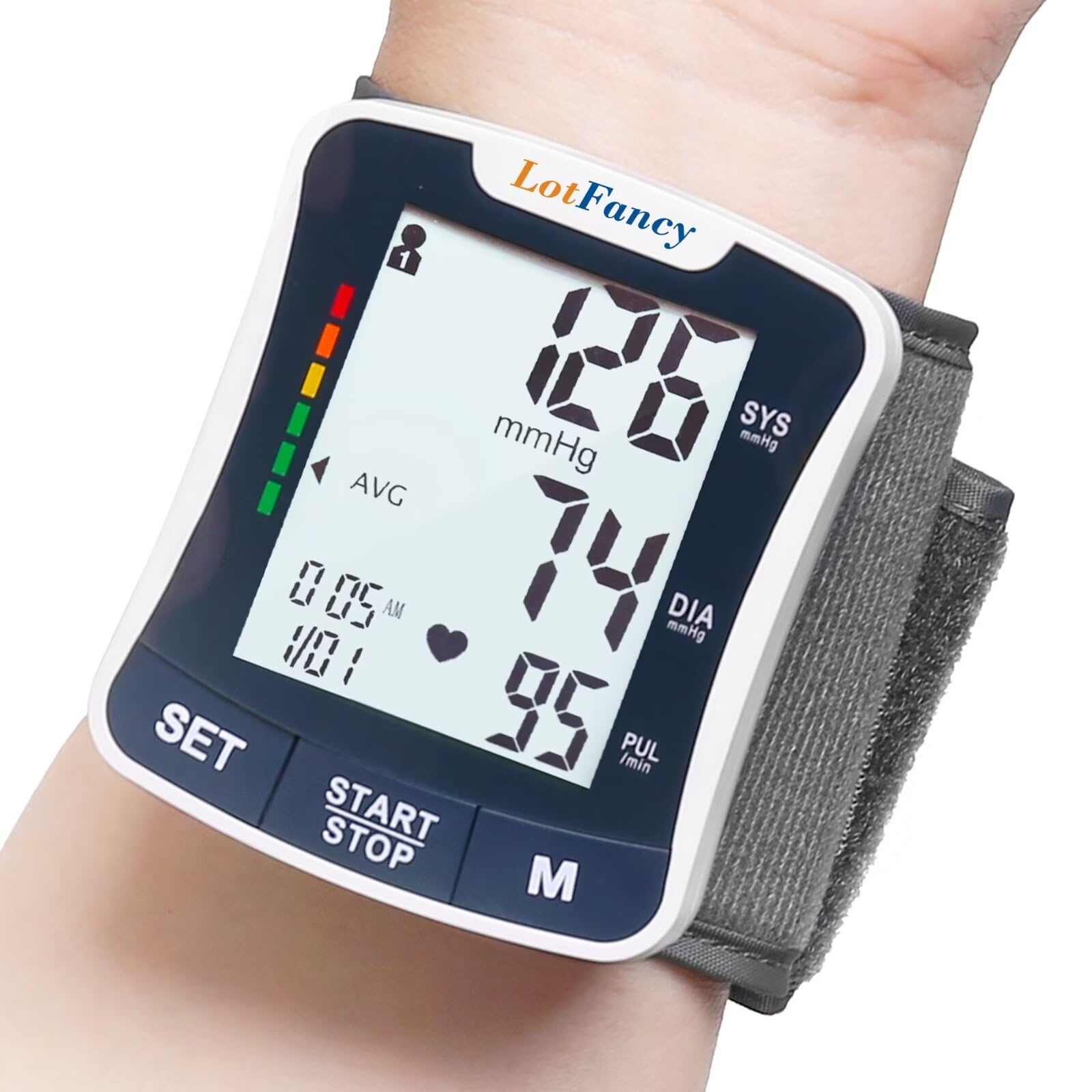
1. LotFancy Wrist Blood Pressure Monitor
Our pick — 4.0+★ from 650+ verified ratings; the strongest balance of quality and price.
Speaks your numbers out loud, so you never have to squint at a small screen
The LotFancy earns the top slot on the strength of a 5.3″ to 8.5″ cuff — that band of sizes covers a lot of adult wrists, which is the single most common reason a wrist monitor gets returned. It stores 120 combined readings with date and time stamps across two users, so a couple can keep separate trails without buying two devices.
What wins people over is the build quality, which draws more praise than any other trait by a wide margin. The talking readout is the second headline: you squeeze, and the monitor announces your systolic, diastolic and pulse values out loud. Pair that with the backlit LCD and you have a device that works in a dim bedroom at 6 a.m. without fumbling for a lamp.
Set expectations on the voice itself — the spoken English is clear enough for most, but a handful find the phrasing hard to follow, and readings are the one area where opinion splits. Sit still, keep the cuff at heart level and repeat a bad result after a couple of minutes. Buy it for the big backlit numbers and the talking readout, not for pinpoint repeatability.
What earns it the crown
- The 5.3″–8.5″ cuff swallows wrist sizes the narrower bands leave out
- Voice readout of systolic, diastolic and pulse means no screen-staring
- 120 readings split across 2 users with date and time stamps
- Large LCD stays legible in a dark room
The honest caveats
- 2 AAA batteries are not in the box — buy them the same day
- The spoken English is not universally loved
- Readings are the split-opinion part; treat a repeat as standard practice
Reach for this if: you want the widest wrist fit here plus spoken results, and you are monitoring with a partner.
Look elsewhere if: the voice feature means nothing to you and you would rather not stock AAA batteries.
2. PARAMED Automatic Wrist Blood Pressure Monitor
A complete kit on day one — cuff, case and batteries already in the box
Nothing is more annoying than unboxing a health device and discovering the cells are missing. The PARAMED ships with 2 AAA batteries, a durable carrying case, a quick start guide and a manual, so you can take a reading minutes after it arrives.
It holds 90 readings in memory and carries an irregular heartbeat detector plus a large LCD with oversized digits. Owners consistently describe it as easier to manage than an upper-arm cuff, and the compact shell slides into a purse or a travel bag without a second thought. The manual’s own guidance is worth reading once: measure before you eat, drink, smoke or exercise, sit with your back supported, and wait at least 2 minutes between repeated readings.
The trade-off is physical size. At 8 ounces it is the heavier of the two kit options compared here, and its 3.94 x 3.94 x 3.94 inch body is chunkier than the Oklar’s 3.03 x 2.55 x 2.63 inches. The cuff range is also the narrowest listed, stopping at 7.6″.
Kit value, plainly: a case and batteries included at the entry tier is a real convenience, and 90 readings is enough for regular single-person tracking.
Measure first: if your wrist runs larger than 7.6 inches, this cuff will not seat correctly — check the range before anything else.
Buy it when: you want a grab-and-go kit with a case, and your wrist sits inside 5.3″–7.6″.
Pass on it when: portability by weight and bulk is your priority — the compact options further down carry smaller shells.
3. Oklar Wrist Blood Pressure Monitor
The rechargeable lightweight that stores 240 readings across two users
Memory is where the Oklar separates itself: 240 readings across two users, against 60 on the A&D Medical UB-543. If you are tracking every morning for months on end, that extra headroom means you go far longer before old entries start rolling over.
It is also the lightweight of the bunch at 3.59 ounces, and its built-in rechargeable cell charges over a Type-C cable — the same cable your phone likely uses. A full measurement runs 35 seconds and the unit shuts itself off after 60 seconds of inactivity. The large LED screen is backlit for night readings, and a voice broadcast can be turned down or muted using the SET and MEM buttons.
Quality and ease of use are the two themes that come through strongest in owner feedback, with the backlit readability and the all-day convenience close behind. Two honest points: battery life divides opinion, and inconsistent readings with the occasional error message show up often enough to warrant taking a second measurement when a number looks off. The 4.92″–8.46″ cuff range is the widest here, so slender wrists have a genuine option.
Standout spec: 240 readings for two users, paired with the widest cuff range at 4.92″–8.46″.
The catch: a charging adapter is not in the box, so you supply your own Type-C wall plug or charge from a laptop.
balance: two people logging daily readings who want a rechargeable unit (no battery swaps) and a cuff that fits small wrists.
Not your pick: if you dislike app-free charging setups or expect flawless single-shot readings every time.
4. windray Wrist Blood Pressure Monitor

One button, then it colour-codes your result green through red
Not everyone wants to memorise which number counts as improve. The windray prints a colour next to your reading — green for an average number, yellow for light hypertension, orange or red for middle to heavy hypertension — based on international guidelines. That colour cue is the pitch, and it saves a first-time buyer from memorising thresholds.
At 4.16 ounces with a 3.15 x 2.76 x 1.22 inch shell, it disappears into a bag, and one-button operation means there is nothing to configure before a measurement. The 120-reading memory splits across 2 users, with the oldest entry overwritten once the slots fill. Two AAA batteries are required and not supplied.
Where it asks for patience is consistency. Opinions on reliability divide sharply, and inaccurate readings come up more than on the picks above — the manufacturer’s own guidance points to posture and movement as the usual culprits. Install the cells the right way round, sit still, do not talk, and take a repeat if a figure surprises you.
Worth it for: anyone who wants a colour cue instead of remembering thresholds, in the smallest shell on this list.
Think twice if: you need airtight repeatability — budget Tier-2 monitors always reward careful technique.
5. A&D Medical UB-543 Wrist Blood Pressure Monitor
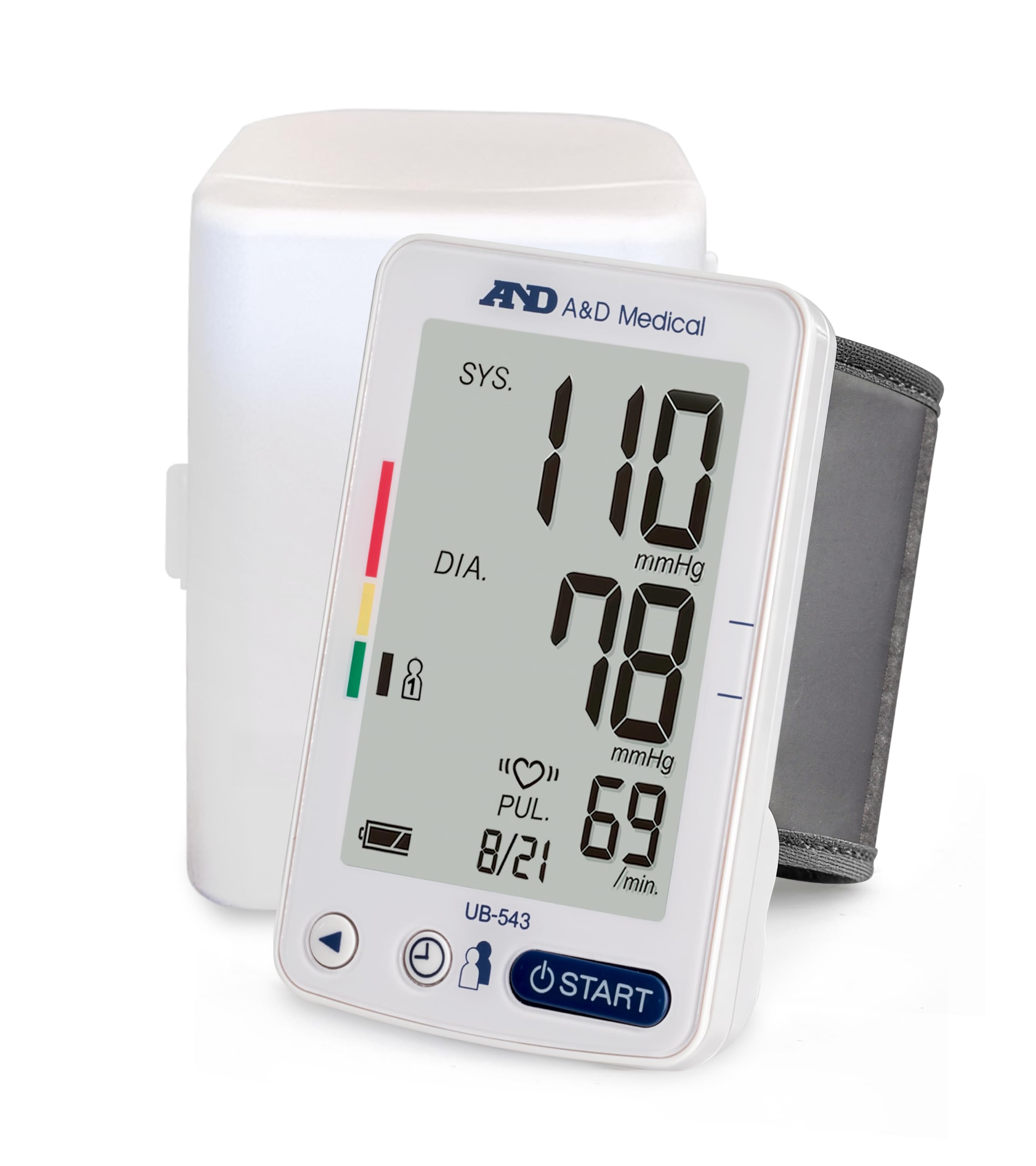
A 5.3″–8.5″ cuff backed by an app that logs without limit
The 5.3″ to 8.5″ band is the same generous range as the LotFancy, so larger wrists are covered. Onboard it holds 60 readings per user for 2 users and averages all measurements, which gives you a smoothed trend rather than a single spike to worry about.
The A&D Heart Track app is the differentiator: you manually log and track unlimited measurements on your phone, and the free app runs on iOS 12.0 or later and Android 5.0 or above. Reliability is the theme owners respond to most positively, with one-button operation and oversized LCD digits close behind. Batteries are included, along with a carry case and quick start guide.
Compare the memory count and the gap is stark — 60 readings per user here against 240 total on the Oklar, so heavy daily loggers will hit the ceiling sooner. Accuracy is also the mixed part of the picture, with the odd wildly-off result reported. The app absorbs some of that frustration by giving you a place to note and compare readings over weeks rather than relying on the device list alone.
What the app buys you: unlimited manual logging on iOS or Android, which suits anyone who likes a phone-based record instead of scrolling a device screen.
The honest limit: 60 readings per user is the smaller memory tier, and it is not a Bluetooth auto-sync — you log entries yourself.
Choose it for: a household of two that prefers a phone-based health record and needs the broader wrist range.
Skip it for: months of untouched automatic history — the storage here tops out quickly.
6. Smartheart Wrist Digital Blood Pressure Monitor

Takes the reading while the cuff is still inflating, so your arm is squeezed for less time
Most monitors inflate, hold, then measure. The Smartheart measures during inflation, which shortens the window your arm spends under pressure. For anyone who finds the squeeze uncomfortable, that alone is a reason to look here.
Two memory banks hold 60 measurements each with date and time stamps, plus a last-reading average. The LED backlit display is easy to read, and the unit ships with a hypertension indicator and an irregular heartbeat icon so you can see where a result lands at a glance. Everything comes in one box — monitor with attached cuff, storage case, batteries, instructions in English and Spanish, quick start guide, an FAQ and a results charting log, plus a 3-year limited warranty.
The cuff is the restriction: 5.5″ to 7.6″ is a narrower window than the 5.3″–8.5″ bands on the top pick, and Smartheart itself says a wrist outside the range should move to an arm-style cuff. Quality and battery life are the two areas that draw mixed reactions, so treat the warranty and the included charting log as the safety net they are meant to be.
Best match: a mid-range wrist size (5.5″–7.6″) and a buyer who dislikes a long, tight squeeze.
Wrong fit: larger or very slim wrists, which fall outside the cuff and belong on an arm monitor.
7. Beurer BC57 Wrist Blood Pressure Monitor

A resting lamp that tells you when to press go, then beams the number to your phone
Wrist monitors live or die on placement, and Beurer tackles it with a resting indicator. A resting indicator lights up only when you are settled in the right position — you wait for the icon before recording. That small nudge is the most useful feature on this device for a beginner.
Bluetooth pairing sends readings to the HealthCoach app, so you stop writing numbers on paper. On-device the BC57 stores 60 readings for 2 users, 120 total, and shows a colour-coded risk indicator alongside a large screen. An irregular heartbeat alarm sounds if the monitor detects a rhythm issue. The adjustable cuff covers 5.3″ to 7.7″, and it weighs 3.39 ounces with a plastic storage case in the box.
Now the part to weigh honestly: Bluetooth connectivity is the most-discussed negative in owner feedback, with pairing troubles recurring, and value is questioned too. Readings divide opinion as well. If you want the app to just work every time, this is the riskiest pick in the lineup — buy it for the resting indicator and accept that the sync may take patience.
Why it stands apart: the resting indicator is a genuine technique aid, and the irregular-heartbeat alarm is a useful second set of eyes on a reading.
Where it stumbles: Bluetooth pairing is the recurring frustration, so treat phone sync as a bonus rather than the reason to buy.
Pick it for: a buyer who values guided positioning over phone integration, on a wrist between 5.3″ and 7.7″.
Leave it if: reliable auto-sync to an app is a must-have — the pairing record here is uneven.
8. A&D Medical UB-525 Wrist Blood Pressure Monitor
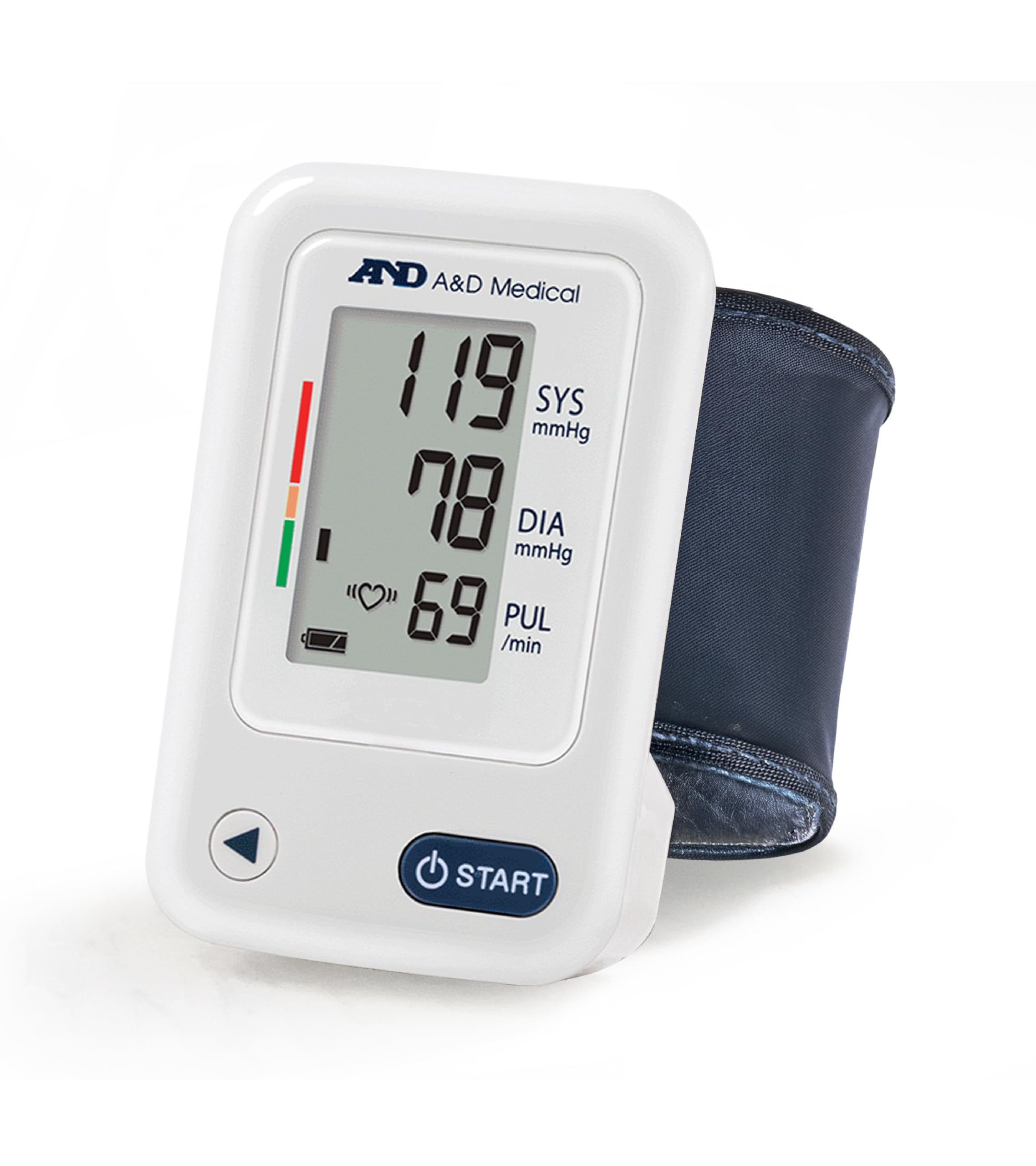
The lightest body on this list at 3.2 ounces, with the same wide cuff as A&D’s upper model
The UB-525 is the lightest and thinnest monitor here at 3.2 ounces. It weighs 3.2 ounces — lighter than the 3.39-ounce Beurer and the 3.59-ounce Oklar — and its 3.66 x 0.78 x 2.44 inch profile is thin enough to slide into a jacket pocket. The cuff range matches its sibling at 5.3″ to 8.5″.
One-button operation, a large digital LCD showing pulse rate with systolic and diastolic numbers, and 60 stored readings make it a straightforward daily tracker. The A&D Heart Track app is available for manual logging on iOS 12.0 or later and Android 5.0 or above, and two AAA batteries are in the box.
Quality is the positive most owners gravitate to. Reliability and accuracy are the split-opinion areas, with some units reported to stop working and high readings noted. The memory is also the smaller tier at 60 readings total — the Oklar stores 240 — so this suits someone who checks regularly but does not archive years of history on the device.
Right for: travel-first buyers who want the lightest, thinnest monitor and a wide 5.3″–8.5″ cuff.
Not for: long-term archive keepers — 60 readings fills up fast at one check per day.
9. OMRON Gold Wireless Wrist Blood Pressure Monitor
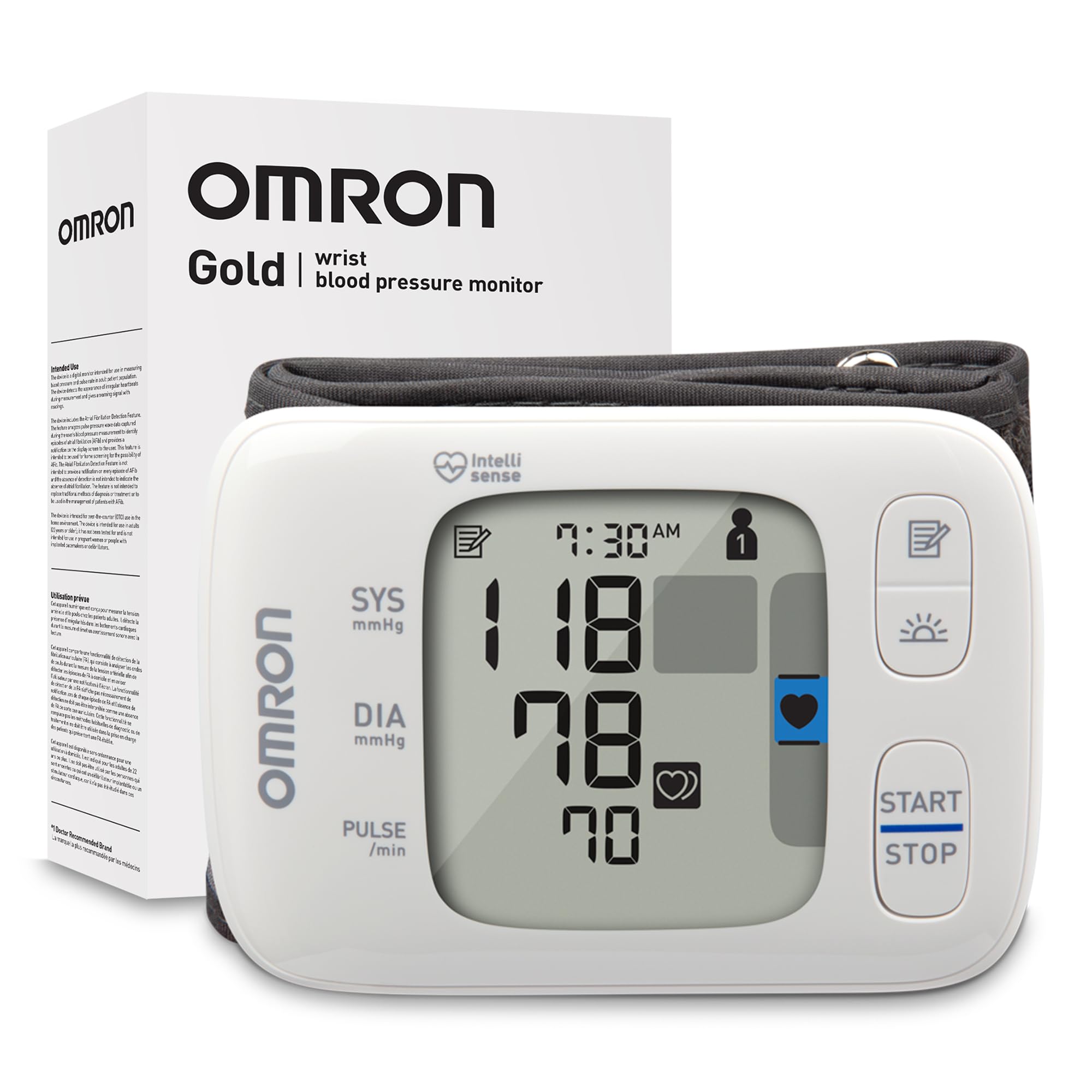
Built for the person watching morning numbers, not just a single reading
The High Morning Average Indicator is the feature that separates the OMRON Gold from everything else here. It checks for morning blood pressure spikes, which is the reading most home monitors never isolate because people check in the evening instead. Paired with 200 readings per user across two users, you get the deepest history in this lineup.
The free OMRON connect app stores unlimited readings over Bluetooth, tracks trends and lets you share reports with a doctor. It works with Apple Health and Google Fit. An Irregular Heart Beat Indicator flags rhythm issues during a routine measurement. The attached cuff fits 5.3″ to 8.5″, and the box includes a case, manual, quick start guide and two AAA batteries.
Accuracy and reliability are the split-opinion areas — stellar for many, consistently off for others, which is the nature of wrist placement. That makes technique the deciding variable: wrist at heart level, still body, same time each day. Price aside, this is the most feature-dense wrist monitor here, and it carries the maker’s claim of being the brand most recommended by doctors and pharmacists.
What justifies the top tier
- 200 stored readings for each of two users — the deepest memory here
- Morning average indicator targets a window most monitors ignore
- Bluetooth sync to OMRON connect, plus Apple Health and Google Fit
- Irregular heartbeat icon and a 5.3″–8.5″ cuff in the box
What you are accepting
- Readings are the split-opinion element, as on every wrist unit
- The app is where the real value sits — a phone-averse buyer pays for features they will not use
The verdict: the most complete wrist monitor here if you want morning-spike tracking and doctor-shareable app reports.
Your trade-off: you are paying for software and a morning indicator, so a basic home user will not open up what the extra tier buys.
Know the Specs
Cuff range in inches
The cuff range is the smallest and largest wrist circumference the band will close snugly around, written as two numbers like 5.3″–8.5″. It is the first spec to check, because a cuff that does not close correctly cannot give a usable reading no matter what the electronics do. Measure your wrist with a soft tape just below the wrist bone. Narrower ranges (5.5″–7.6″ on the Smartheart, 5.3″–7.6″ on the PARAMED) exclude larger wrists, while the Oklar’s 4.92″–8.46″ band reaches slimmer arms.
Stored readings and user banks
Memory is listed as readings per user, or as a combined total across two users. A monitor with 120 readings for 2 users gives each person 60 slots; a 240-reading unit doubles that. Date and time stamps let you compare one morning to the next, and an averaging function smooths out single spikes. If you are tracking one person, the smaller memory tier is plenty. If two people share the device, per-user separation matters as much as the total.
Battery versus rechargeable
AAA-powered monitors need the cells swapped when they drain. Rechargeable units use a built-in Lithium Ion cell charged over a Type-C cable. Neither is better in absolute terms — it is a habit question. If you already carry a Type-C cable, a rechargeable model means no battery drawer. If you prefer simple swaps and long shelf life between trips, AAA wins. Note which models include batteries and which expect you to supply them.
Reading aids: resting, irregular beat and risk colour
A resting indicator lights when you are settled enough to record. An irregular heartbeat icon or alarm flags a rhythm that does not look regular during the measurement. A colour-coded risk indicator (green, yellow, orange, red) maps your result to a band so you do not have to remember thresholds. These aids do not diagnose anything — they simply help you take a cleaner reading and notice when something looks unusual.
Common Questions
Will a wrist cuff fit my arm if I have a larger wrist?
Is a wrist monitor as accurate as an upper-arm cuff?
How many readings should I store for tracking?
Do I need to buy batteries separately?
What does the irregular heartbeat icon actually do?
Can two people share one monitor?
Is the rechargeable Oklar a better buy than a AAA model?
How should I sit when using a wrist cuff at home?
Does a colour-coded display replace knowing the numbers?
What is the A&D Heart Track app and do I need it?
The Bottom Line
For most buyers, the wrist blood pressure cuff winner is the LotFancy Wrist Blood Pressure Monitor, because it pairs the widest 5.3″–8.5″ cuff with spoken readings and 120 stored measurements for two users. If you want a rechargeable unit with the biggest memory, the Oklar stores 240 readings and recharges over Type-C. And for morning-spike tracking with doctor-shareable app reports, the OMRON Gold is the one to reach for. Measure your wrist before you pick — a cuff outside your range cannot give a usable reading.
How we choose
We do not accept paid placement. Every pick is matched to a real buyer and a real use-case; we do not hands-on test units.
Sources
Specifications: manufacturer listings and product documentation. Review insights: verified customer reviews, as of November 2026. Pricing: not shown on this page (it changes often); check the current price via the retailer link.
As an Amazon Associate, Tactical Gear Guy earns from qualifying purchases. This does not affect which products we feature.