Specs are compiled from manufacturer listings and verified buyer reviews and can change over time — please confirm the key details on the product page before buying.
You want a heart rate number you can trust mid-run, not a guess that lags behind your actual effort. The watch has to hold the optical sensor flat against your wrist, keep a signal through sweat, and still be alive after a week of training. This guide covers nine wrist-based watches that do that job, from hybrid designs you charge rarely to GPS units built for multi-day treks.
This guide is built by comparing the manufacturers’ published specifications and the patterns across verified customer reviews, so you get each pick’s real strengths and trade-offs instead of marketing spin.
The optical sensor only reads accurately when the strap holds it flat, and the battery and GPS decide whether it lasts your longest session. Here is how the strongest wrist-based heart rate watches stack up for training, hiking, and everyday wear.
Top Picks

How To Choose The Best Wrist-Based Heart Rate Watches
A wrist sensor reads your pulse by shining light into the skin and watching how the blood beneath it moves. That means the sensor cannot fix a loose strap, and it cannot fix a wrist that is too hairy or too cold for a clean signal. Most complaints about “inaccurate heart rate” trace back to fit, not hardware.
The strap is half the sensor
You want the watch to sit high on the forearm and stay put when you swing your arm. Bands that are too loose let light leak in underneath, which is exactly where readings fall apart. Silicone is the common material here because it grips skin and does not slide under sweat — every pick on this list uses it except one fluoroelastomer band.
Smartwatch battery vs GPS battery
Manufacturers quote two different numbers and they are not interchangeable. The Garmin Forerunner 570, for example, runs up to 11 days in smartwatch mode but drops to 18 hours once GPS is running. If you hike with tracking on, the GPS figure is your real budget. If you mostly wear it to the office, the smartwatch figure is the one that matters.
What HRV, readiness, and cardio load actually tell you
HRV (heart rate variability) measures the tiny gaps between heartbeats and is used alongside sleep and training load to estimate recovery. Readiness scores and cardio load both build on that. Treat them as training guidance rather than medical data — Garmin states plainly that its metrics are a close estimation, not a clinical reading, and the Fitpolo blood oxygen feature is labeled for non-medical use.
Side-by-Side Comparison
| Model | Best For | Display | Battery (Watch / GPS) | Water Rating | Amazon |
|---|---|---|---|---|---|
| Garmin Forerunner 570, 47mm★ Best Overall | Runners chasing recovery data | AMOLED touchscreen | 11 days / 18 hrs GPS | — | Amazon |
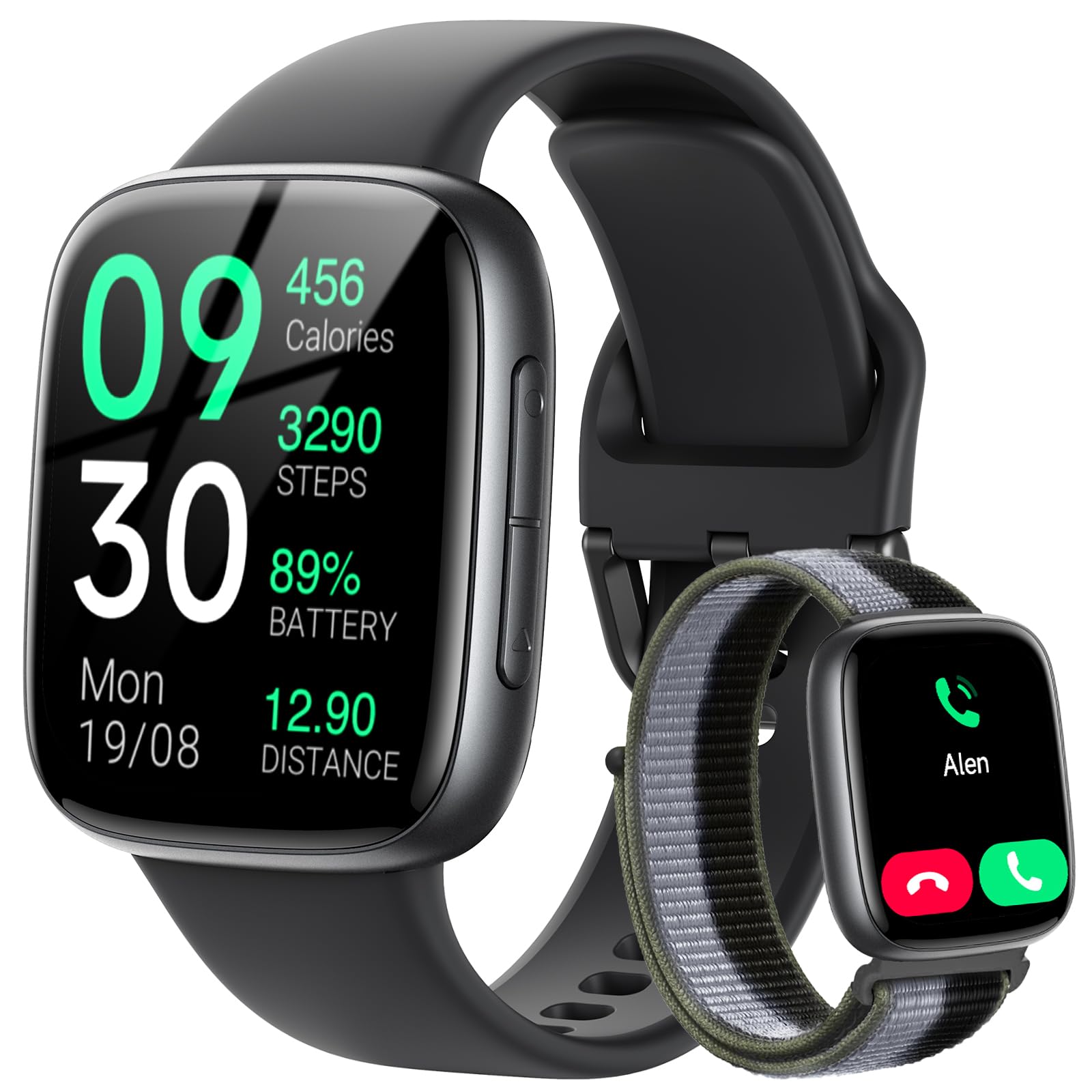
| Samsung Galaxy FIT 3 [40MM]Budget Champion | Android users on a tight budget | 1.6″ AMOLED | 13 days | 5ATM & IP68 | Amazon |
| Fitpolo Smart Watch 1.85″Biggest Screen | Big screen on a small budget | 1.85″ AMOLED | 10 days | 3ATM | Amazon |
| Withings ScanWatch Light | Dress wear with hidden sensors | Hybrid analog | 48 hrs listed | — | Amazon |
| Polar Street X | Gym-first hybrid training | AMOLED | 10 days / 43 hrs GPS | 50 m | Amazon |
| Garmin Instinct 3 AMOLED 45mm | Rugged outdoor wear | 1.2″ AMOLED | 18 days | — | Amazon |
| Google Pixel Watch 3 (41mm) | Pixel owners who want Fitbit coaching | 41mm AMOLED | 24 hours | — | Amazon |
| Samsung Galaxy Watch5 Pro 45mm | Route tracking on rough ground | Sapphire AMOLED | — | — | Amazon |
| Amazfit T-Rex 3 Pro | Multi-day treks and diving | 1.5″ AMOLED, 3000-nit | 27 days | 10ATM / dive to 45m | Amazon |
Detailed Reviews
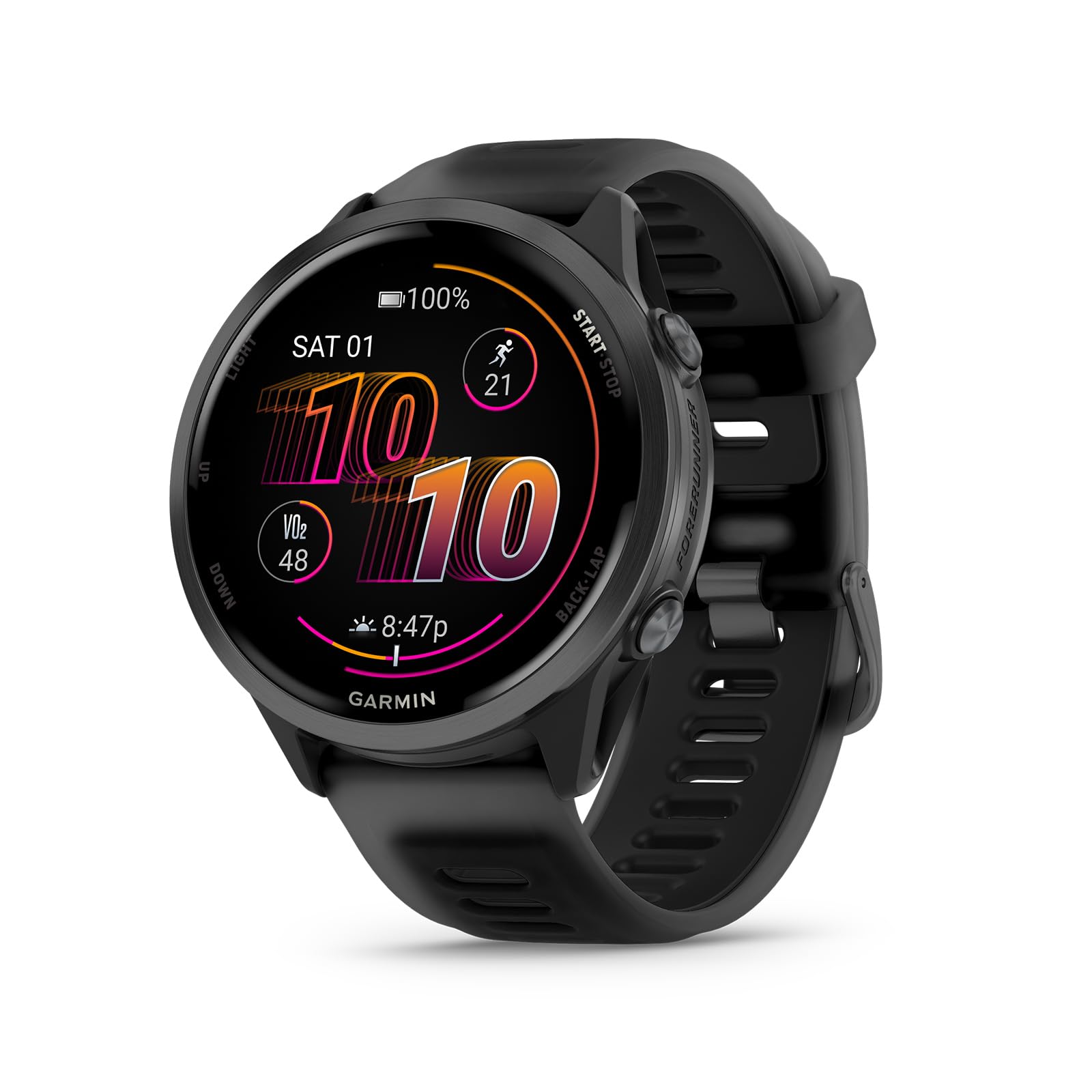
1. Garmin Forerunner® 570, 47mm, Aluminum, Black
Our pick — 4.5+★ from 600+ verified ratings; the strongest balance of quality and price.
The running watch that reads your pulse and then tells you whether to push or back off.
Here is the pickup for anyone who trains on a schedule and wants the watch to make the call on hard days. Garmin builds the top pick around a 47mm aluminum case with an AMOLED touchscreen plus physical buttons — the screen gives you bright, glanceable stats, and the buttons mean you can still pause a lap with wet hands. That combination of bright screen and physical buttons is what owners praise most, ahead of any single metric.
The training readiness score pulls from sleep quality, recovery, training load, and HRV status to tell you whether you are primed to go hard. HRV status and VO2 max feed a training status view that labels your block as productive, peaking, or strained. You also get personalized daily suggested workouts, a morning report with sleep and recovery, an evening report with tomorrow’s workout, and 30+ built-in activity profiles covering triathlon, track run, and open-water swimming. When you get home, a 300 mAh lithium-ion cell refills the watch, and the wrist strap runs 22 millimeters wide — the same width as the Amazfit T-Rex 3 Pro.
Battery is where this one quietly outruns most of the field: up to 11 days in smartwatch mode and 18 hours in GPS mode. Owners routinely get 9 or 10 days between charges, and the long stretches of wear mean the sensor stays on your wrist instead of on a nightstand. The catch is the honest one for a training-first watch: value for money is the split topic on this listing, and this is the priciest pick on the list. You pay for the coaching layer, not just the pulse readout.
What earns the top spot
- Training readiness draws on four separate signals — sleep, recovery, load, and HRV — so the number reflects your whole week, not just your last mile.
- Up to 11 days in smartwatch mode and 18 hours in GPS mode means you charge roughly once a week, not nightly.
- Built-in microphone and speaker let you take calls from your wrist when the watch is paired to your phone.
- 30+ activity profiles cover triathlon and open-water swimming, so one watch handles a full multi-sport block.
- Incident detection and Assistance send your live location to emergency contacts during select outdoor activities.
What to weigh before you commit
- This is the most expensive watch in this lineup, and value for money is the one aspect owners split on.
- Some buyers question the reliability side of the picture, so buy from a seller with a clear return path.
- 18 hours in GPS mode is your real budget on long ultras — you will need a charge strategy for anything past that.
Buy it for: anyone whose week is built around training blocks and who wants recovery guidance, not just a pulse number.
Hold off on: occasional wearers — the coaching layer and the premium price only pay off if you use it daily.
2. Samsung Galaxy FIT 3 40MM
A tiny band that swims, sleeps, and tracks your pulse for the price of a mediocre gym day pass.
Android users who want the basics done well should start here. The Galaxy FIT 3 pairs a 1.6-inch AMOLED screen with a 40mm body that stays out of the way under a shirt cuff, and it handles everyday wear with 5ATM and IP68 ratings — swim-ready and dust-resistant, in Samsung’s own wording. Inside, the 208 mAh battery is listed for up to 14 days of use, which is a far cry from the daily-charge routine most smartwatches force on you.
Sensor duty is covered by heart rate, SpO2 (blood oxygen), sleep coaching, and snore detection, with 101+ workout modes and auto detection for common sessions. One honest constraint: this international model works with Android devices only, does not support Samsung Pay, and will not connect to an iPhone or iOS device at all. If you are on a Pixel or a Galaxy, that trade-off costs you nothing.
Battery is the split vote on this one, and worth calling out plainly. Some wearers see several days per charge, while others end up plugging in every three days — screen brightness and always-on habits move that number a lot. Compared with the Fitpolo, the FIT 3 gives you a smaller 208 mAh cell against the Fitpolo’s 350 mAh, but the FIT 3 lists up to 13 days of rated life versus the Fitpolo’s 10. Fit matters too: the band measures 21 centimeters, which suits most wrists but will feel short on a large forearm.
Where it wins: at well under half the price of the flagship trainers on this list, you still get a bright AMOLED face, sleep coaching, and swim-ready 5ATM protection. It covers heart rate, SpO2, sleep coaching, and 101+ workout modes for well under half the price of the flagship trainers.
The honest snag: charging cadence is unpredictable — plan for three days in the worst case rather than two weeks in the best.
Reach for this if: you carry an Android phone and want pulse, sleep, and swim tracking in the lightest possible package.
Look elsewhere if: you are on an iPhone — this model simply does not pair with iOS.
3. Fitpolo Smart Watch
The watch that spends its budget on screen real estate and battery, not on branding.
Look at the numbers first. The 350 mAh cell inside the Fitpolo outstrips the Samsung Galaxy FIT 3’s 208 mAh, and the 1.85-inch AMOLED display is the largest panel in this entire lineup. That screen is rated for readability in direct sunlight, which is the difference between squinting at your pace on a noon run and actually seeing it. Fitpolo also throws in two bands, so you can swap for a different look without buying anything extra.
Health tracking covers heart rate, blood oxygen (labeled non-medical use), sleep quality, and stress, with 120+ exercise modes and phone-GPS syncing for steps, calories, and distance. Bluetooth calling and a built-in voice assistant let you answer a call or fire off a reply while your hands are full. Water resistance sits at 3ATM — fine for splashes, rain, and sweat, but not for a swim. The 26.4-centimeter band is the longest here, well past the 21 centimeters on the Galaxy FIT 3.
Appearance is what earns the praise on this listing, and the price-to-feature ratio follows close behind. Real-world runtime, though, comes in shorter than the headline: the box says up to 7–10 days, and wearers tend to land at four to five days per charge. That is the gap to know about before you buy. The plastic case also keeps it light but does not feel like the aluminum of the Garmin above.
Why it stands out: a 1.85-inch AMOLED panel and a 350 mAh battery in the same budget-priced body is the whole pitch, and the screen is genuinely the biggest by size on this list.
The trade to accept: 3ATM means you take it off for swimming, and the real charge interval runs about four to five days.
Best matched to: buyers with larger wrists who want a big, bright face and Bluetooth calling without spending flagship money.
Not the one for: swimmers or anyone who needs a genuinely waterproof rated watch.
4. WITHINGS ScanWatch Light

A watch that hides its sensors behind actual hands and a stainless steel case.
If you want heart rate tracking without strapping a glowing rectangle to your wrist, this is the one. The ScanWatch Light uses a 37mm stainless steel case, an analog face, and a grey fluoroelastomer band that reads as jewelry rather than gym gear. The analog face and stainless steel case are what buyers praise most, and the hybrid design means nobody can tell it is a tracker from across the room.
The practical side is where it earns its keep for light users. Buyers report going weeks between charges, which lines up with a watch this stripped-down — no always-on AMOLED panel eating power. Step tracking and resting heart rate both work well for daily wear, and the companion app is described as simple to navigate. It works with Android and iPhone alike, and the FSA & HSA eligibility note makes it easy to file if your plan allows it.
Now the honest part, because this watch is a different animal from the rest of the list. Functionality, step tracking, and connectivity all come in mixed rather than settled, and durability and accuracy are the weakest areas — the stainless steel look does not come with a rugged rating. The listed battery figure of 48 hours on the spec sheet also sits oddly against the weeks-long real-world reports, so treat runtime as “charge it rarely, not never.” For a step-count-and-pulse watch with a real face, it works. For a serious training tool, it does not pretend to be one.
The case for the hybrid
- Stainless steel case and analog face mean it reads as a dress watch, not a fitness gadget.
- Owners go weeks between charges, so it lives on your wrist rather than on a dock.
- Works with both Android and iPhone, unlike the Galaxy FIT 3’s Android-only limit.
- Step tracking and resting heart rate both function well for everyday use.
What the hybrid costs you
- Durability and accuracy are the weakest aspects on this listing — it is not a rough-wear watch.
- Step tracking and functionality split between “gets the job done” and “doesn’t work properly.”
- No AMOLED training readouts, no GPS training metrics, and no recovery coaching layer.
Suits you if: tracking your pulse quietly matters more than seeing live pace on your wrist.
Think twice if: you need precise distance, gym metrics, or a watch that shrugs off knocks.
5. Polar Street X
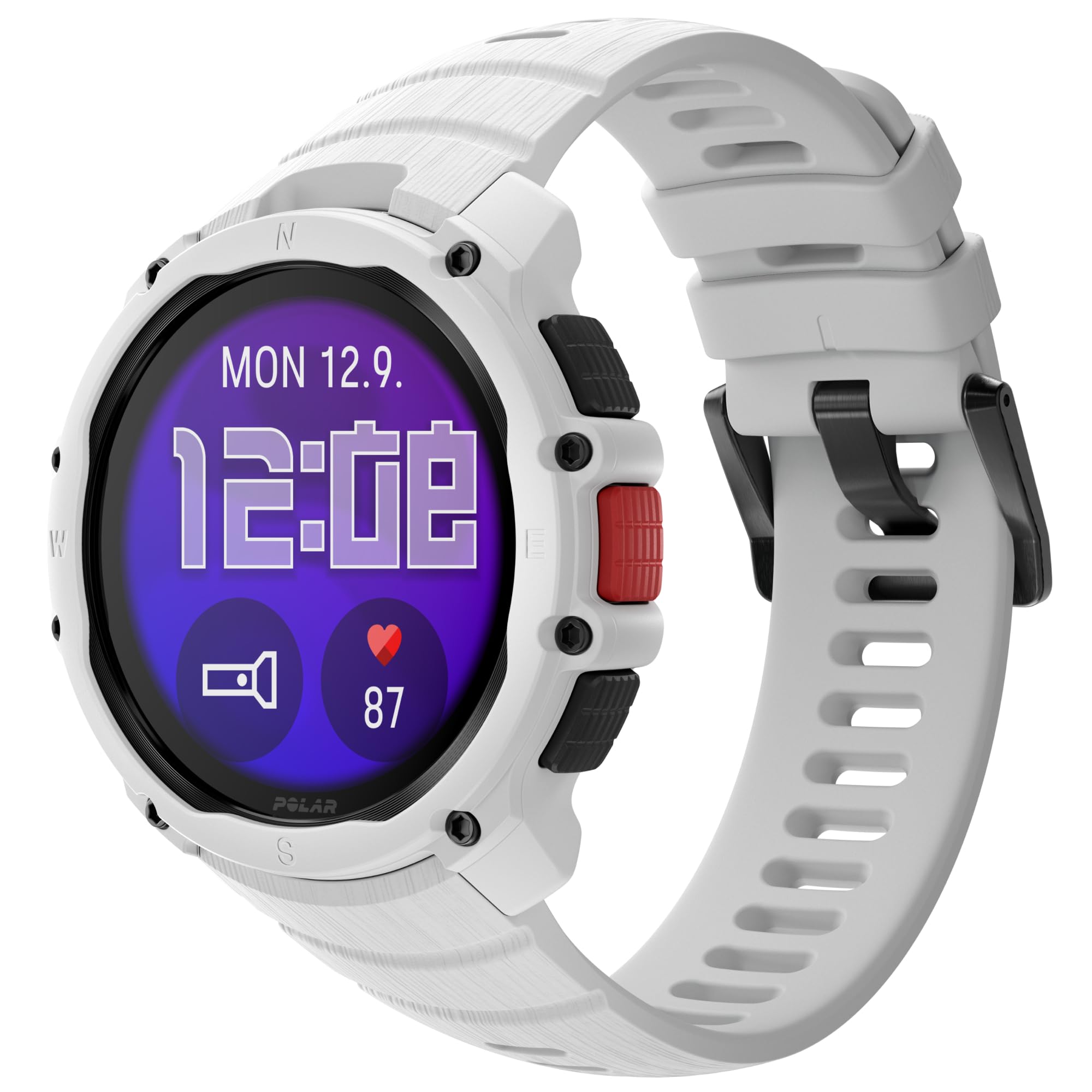
Forty-eight grams of AMOLED running watch built for hybrid athletes, not just road runners.
At 48 grams, this is the watch you forget you are wearing by mile three. Polar pairs that light body with an AMOLED display, physical buttons, and shock-resistant construction rated to 50 meters of water resistance — deep enough for pool swims and rain, and tough enough for gym floors. GPS handles distance, pace, and performance, with route guidance and back-to-start navigation for city runs where you wander a wrong turn.
The sensor side is straightforward: a wrist-based optical heart rate monitor gives real-time effort data with no chest strap. That matters if the strap is the reason you stopped tracking. You get 170+ sport profiles covering strength, HIIT, and cycling alongside running, so a single watch follows you from the track into the weight room. Battery is rated up to 10 days in normal use and 43 hours in GPS tracking, and the USB-C charging cable comes in the box.
The honest limit is the evidence base: this is a newer model with a small review pool, so you are leaning on the spec sheet more than on years of owner experience. There are no offline maps — the spec sheet lists map types as “No map” — so route guidance is point-to-point, not a full topographic display. Memory storage is listed at 32 MB, which tells you this is a training tool rather than a media device. The Garmin Forerunner 570 above has the deeper app ecosystem; this one wins on 48-gram weight and gym-to-road versatility.
What it does best: 48 grams on the wrist, 170+ sport profiles, and 50 m water resistance make it the most versatile gym-and-road hybrid here.
Know before you buy: no offline maps, and this is a newer model with less owner history behind it.
Made for: lifters who also run and want one light watch that covers both without a chest strap.
Pass if: you need offline topographic maps for backcountry navigation.
6. Garmin Instinct 3 AMOLED 45mm

The one that keeps a 1.2-inch AMOLED alive for 18 days and still carries its own light.
Eighteen days. That is the number that defines the Instinct 3 — it runs that long in smartwatch mode on a 350 mAh lithium-ion cell. Compare that with the 11 days of the Forerunner 570 and the gap is real for anyone who hates chargers. The trade for that runtime is a 1.2-inch AMOLED panel and a 45mm fiber-reinforced polymer case with a metal-reinforced bezel, which reads tougher than it is pretty.
Navigation is where the extra money goes. You get multi-band GPS with SatIQ technology, a 3-axis compass, and a barometric altimeter — the tools that matter when the trail forks and your phone has no bars. Health monitoring includes wrist-based heart rate, advanced sleep tracking, and Pulse Ox (Garmin notes Pulse Ox is not available in all countries and is not a medical device). The built-in LED flashlight runs variable intensities and strobe modes, which is genuinely useful when you are packing up before dawn.
Buyers praise the 18-day battery first and the heart rate and exercise accuracy second, which holds up over long sessions. Ease of use is the one split area, which is fair for a watch this feature-dense: Garmin’s menus reward a bit of learning time. At 20.4 centimeters, the silicone band is shorter than the Fitpolo’s 26.4, so wide-wristed wearers should check the fit. If the Forerunner is a coach, this one is a compass-and-torch field tool.
Where the money lands: 18 days of rated runtime, multi-band GPS with SatIQ, an altimeter, and a strobe-capable LED light in one polymer case.
The one adjustment: the menu system takes a week to learn, and the band runs shorter than some larger wrists prefer.
Right for: hikers and trail runners who want GPS tools and a flashlight with almost no charging routine.
Wrong for: anyone who wants a slim, dress-friendly profile or instant menu familiarity.
7. Google Pixel Watch 3 41mm

Fitbit’s running brains wrapped in a 41mm aluminum case, with LTE so your phone can stay home.
The pitch here is coaching depth. Fitbit’s advanced running features let you build custom run workouts, get real-time guidance mid-run, and see advanced form tracking. Readiness uses sleep, resting heart rate, and heart rate variability to tell you whether to train or recover, and cardio load measures how hard your heart is working so you can spot under- or over-training. Google AI then turns your goals and past runs into personalized run recommendations, which is the layer that separates this from a plain step counter.
The 41mm AMOLED screen is described by Google as twice as bright and 10% larger than before, and that brightness matters when you glance at pace in open sun. LTE is built in, so runs do not require a phone in your pocket. The 340 battery capacity supports the listed 24-hour battery life, and the watch charges quickly enough that topping up in the morning is not a chore. Setup and connectivity with Pixel phones are the easy wins — this is a watch that wants to live inside Google’s world.
Two things to walk in knowing. Daily charging is the expectation, not a bug — 24 hours of battery is the spec, so plan a nightly routine. And some owners find it expensive for what it delivers, so this is the pick for a Pixel owner who wants Fitbit’s coaching ecosystem specifically. Compare it to the Samsung Watch5 Pro below and you will see the trade: this one gives you more running guidance, that one gives you tougher materials.
What you are buying: Fitbit running analysis, readiness scoring, cardio load, and a daily target, all on a screen that stays legible in sunlight.
What it asks back: a nightly charge and a premium outlay, so it only makes sense if you use the coaching daily.
Pick it if: you carry a Pixel or Android phone and want structured run coaching with LTE freedom.
Think again if: you want multi-day battery or you are outside the Android ecosystem.
8. SAMSUNG Galaxy Watch Pro 5 45mm

Sapphire glass and a titanium case for people who take watches places they should not go.
Materials first, because that is the whole point of the Pro badge. Samsung uses a titanium case and sapphire crystal glass that it describes as 2x stronger, built for hiking and rock climbing rather than desk duty. Inside, an improved curved Samsung BioActive Sensor sits closer to your skin, which is the physical fix for the loose-fit problem that ruins wrist readings. Body composition analysis reads body fat, skeletal muscle, body water, basal metabolic rate, and BMI right off your wrist.
Training features are serious. Auto Workout Tracking picks up running, rowing, and swimming within minutes, with more than 90 exercises available to log manually — HIIT included. GPS route tracking follows GPX-format routes, and Track Back guides you to your starting point with voice or vibration turn-by-turn cues. Advanced sleep coaching analyzes your sleep stages and builds habits from the patterns. LTE is built in, so the watch works without your phone nearby.
Battery is the honest caveat. Some wearers report three days and 20 hours on a charge while others find it poor, so your runtime depends heavily on how much LTE and GPS you run. Connectivity is another area to check before buying: this is a US model that works with Samsung Galaxy phones and other Android smartphones, and there are scattered reports of trouble with Verizon LTE and Apple iPhone compatibility. Functionality is the strength; the caveats are on the periphery.
Built for rough ground
- Titanium case and sapphire crystal glass rated 2x stronger for climbs and trail work.
- Curved BioActive Sensor sits closer to the skin for a more stable heart rate read.
- GPS route tracking with GPX support and Track Back turn-by-turn guidance to your start point.
- Body composition data — body fat, skeletal muscle, body water, BMR, and BMI — measured on the wrist.
Check these before ordering
- Battery life splits hard: some see three days and 20 hours, others find it poor.
- Verizon LTE and iPhone compatibility both come up as connectivity friction points.
- Android-only pairing, so iPhone users are out.
The right call for: Android users who want a watch that survives rock, sweat, and long routes with route guidance built in.
Keep shopping if: you are on iPhone or Verizon LTE and need guaranteed carrier pairing.
9. Amazfit T-Rex 3 Pro Smart Watch, 1.5″ AMOLED Sapphire Glass
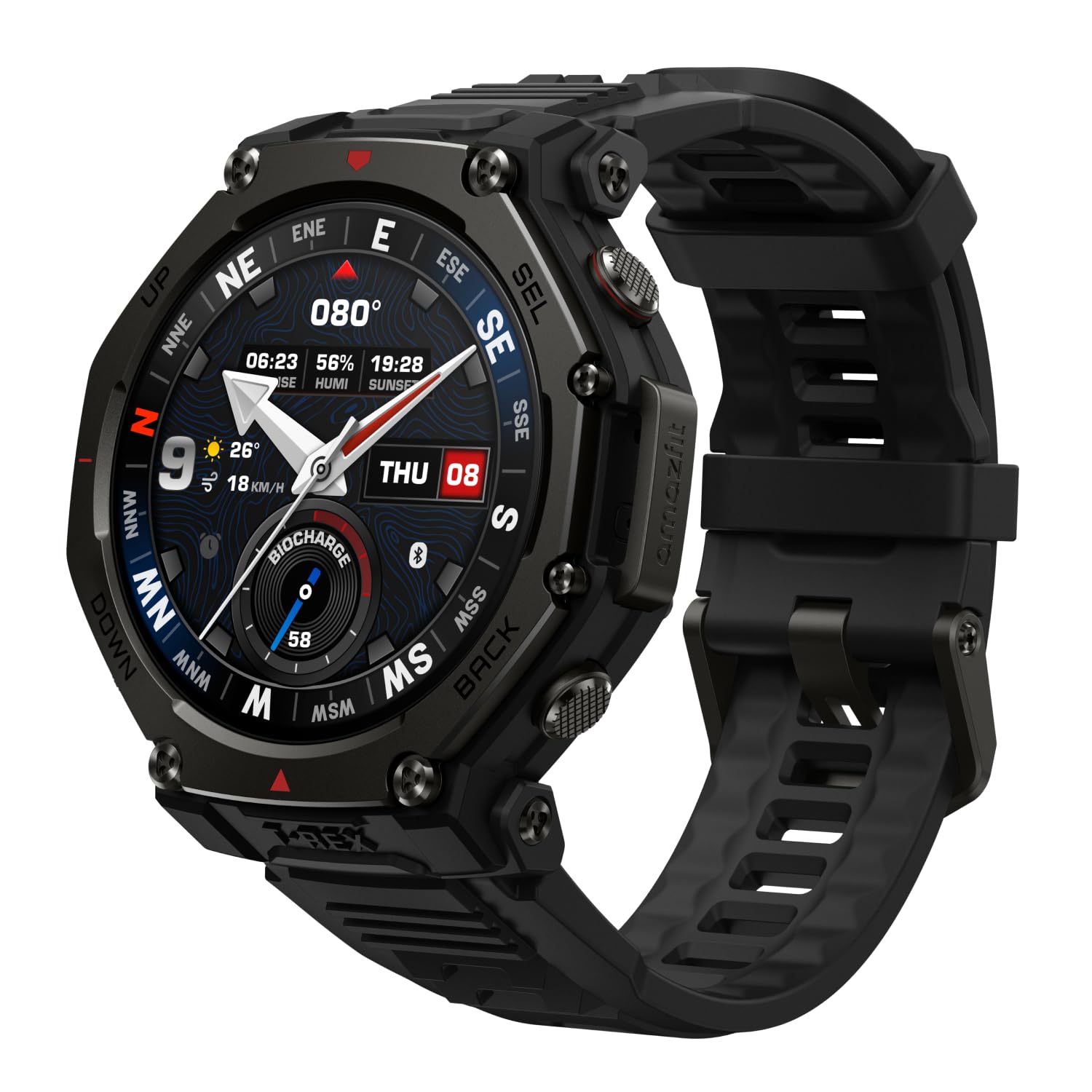
A 700 mAh battery and a dive rating, for trips where the charger stays in the car.
Two numbers tell this story. The T-Rex 3 Pro carries a 700 mAh lithium-polymer cell rated for up to 27 days, which is nearly double the 350 mAh in the Garmin Instinct 3 and enough for a multi-day trek with the GPS running part of the time. It also carries a 10ATM rating and a diving certification to 45 meters — the deepest water rating on this list by a wide margin, past the Polar Street X’s 50 meters of resistance.
The display is a 1.5-inch AMOLED panel rated at 3000 nits behind sapphire glass, with a titanium alloy bezel and buttons, and the watch comes in 48mm or 44mm body sizes. Offline maps include POI search, auto rerouting, round-trip route creation, and detailed ski maps. GPS uses dual-band support across six satellite systems for tracking under tall buildings and dense tree cover. There are 180+ sport modes plus HYROX training, a two-color flashlight with a turbo mode and SOS signal, and Bluetooth calls with a built-in speaker and mic.
The BioTracker sensor handles heart rate, and Amazfit pairs it with the Helio Strap for a 24-hour training and recovery system — note that the strap is a separate piece, not included in the box. Charging takes 3 hours on the magnetic base, and the package notably ships without a USB Type-C cable. Buyers praise the 27-day battery endurance first, then the GPS and heart rate accuracy, with ease of navigation close behind. Despite the offline maps and 180+ sport modes, owners still find the setup friendly.
The headline: 27 days of rated runtime, a 3000-nit sapphire-covered display, offline maps, and a 45 m dive certification make this the most expedition-ready pick here.
The fine print: the Helio Strap is a separate purchase, and the box ships without a USB Type-C cable.
Choose this for: multi-day treks, ski trips, and anyone who measures a watch in weeks of battery, not days.
skip it if: you want a compact 41mm profile — this is a 48mm or 44mm body with map features you may never open.
Know the Specs
Battery Capacity (mAh) and Battery Life (days)
Capacity measured in mAh is the size of the fuel tank; the day figure is how far that tank stretches in real use. A 700 mAh cell in the Amazfit T-Rex 3 Pro is rated for up to 27 days, while a 208 mAh cell in the Galaxy FIT 3 is rated for up to 14 — the panel size, screen brightness, and GPS use all change the math. Always ask which mode the day figure refers to, because GPS tracking drains far faster than smartwatch mode.
Water Resistance Ratings (ATM and IP)
ATM is a pressure rating, not a depth rating you should test. A 3ATM watch handles splashes, rain, and sweat but comes off for swimming. 5ATM plus IP68, as on the Galaxy FIT 3, is swim-ready and dust-resistant. 10ATM with a dive certification, as on the T-Rex 3 Pro, is built for actual water work. Match the rating to what you do, not to what sounds safest on the box.
Optical Heart Rate and Sensor Placement
An optical sensor shines light into the skin and reads the blood movement beneath it. That is why contact matters more than the chip: a curved sensor that sits close to the skin, like the BioActive design on the Galaxy Watch5 Pro, and a snug silicone strap do more for accuracy than a spec sheet claim. Cold hands, tattoos over the sensor, and loose bands are the common causes of a reading that lags your effort.
GPS Modes and Training Metrics
Single-band GPS works fine on open roads. Multi-band GPS with a system like SatIQ, on the Garmin Instinct 3, holds position better near tall buildings and tree cover while managing battery. Training metrics such as readiness, HRV status, and cardio load are built from your sleep and heart rate history; they are estimates meant to guide training, not medical data. The Forerunner 570 states this plainly on its own listing.
Common Questions
How tight should a wrist heart rate watch be for a reliable reading?
Will the Samsung Galaxy FIT 3 work with an iPhone?
What is the difference between smartwatch mode and GPS mode battery life?
Do I need a chest strap if my watch already tracks heart rate on the wrist?
Can I swim with a 3ATM watch like the Fitpolo?
What does HRV status actually measure on a training watch?
Which watch here has the longest battery life for a multi-day trek?
Do these watches need a monthly subscription for heart rate tracking?
Is a hybrid watch like the ScanWatch Light as accurate as an AMOLED sports watch?
Can two people share one wrist heart rate watch comfortably?
The Bottom Line
For most people chasing a reliable wrist readout plus real training guidance, the Garmin Forerunner 570 is the one to buy — 11 days of smartwatch battery, 18 hours in GPS mode, and a readiness score built from sleep, recovery, load, and HRV. If a light, hybrid-friendly build matters more and you train inthe gym as much as the road, the Polar Street X covers 170+ sport profiles at just 48 grams. And for multi-day treks where the charger stays home, the Amazfit T-Rex 3 Pro runs up to 27 days on a 700 mAh cell with a 45-meter dive rating.
How we choose
We do not accept paid placement. Every pick is matched to a real buyer and a real use-case; we do not hands-on test units.
Sources
Specifications: manufacturer listings and product documentation. Review insights: verified customer reviews, as of November 2026. Pricing: not shown on this page (it changes often); check the current price via the retailer link.
As an Amazon Associate, Tactical Gear Guy earns from qualifying purchases. This does not affect which products we feature.