Specs are compiled from manufacturer listings and verified buyer reviews and can change over time — please confirm the key details on the product page before buying.
If you are buying a first or second pair of youth wrestling shoes, the ASICS Matflex 7 is the safest pick for most families — its construction quality is the most consistently praised of anything in this roundup. Everything else here trades something away: some save you money, some suit a wide foot better, and one is the lightest-feeling option on the mat. Below you get all five in plain terms so you can pick the right pair in one pass instead of ordering three and returning two.
This guide is built by comparing the manufacturers’ published specifications and the patterns across verified customer reviews, so you get each pick’s real strengths and trade-offs instead of marketing spin.
Youth wrestling shoes live or die on two things: whether the lace ends stay put during a scramble and whether the shoe actually fits the foot you are buying for. The picks below were chosen with both of those in mind, and this breakdown of the wrestling shoes for youth covers fit, grip and how each pair holds up.
Top Picks


How To Choose The Best Wrestling Shoes for Youth
The mistake most parents make is buying a youth wrestling shoe the way they buy a school sneaker — by look and by the size number on the box, instead of by lace security, sole shape and a measured foot. A wrestling shoe is a piece of mat equipment. It has to grip a vinyl surface, keep laces out of the way, and let a small foot feel the floor. Get lace security, a thin flat sole and a measured fit right and the brand barely matters.
Start with lace security, not color
Loose lace ends on a wrestling mat are a real hazard — they get stepped on, they tangle, and a ref will stop the match. Look for a shoe that hides the lace ends once tied. Some use an elasticized lace retention cover, which is a stretchy flap that swallows the bow. For a young wrestler, a lace cover that keeps the bow off the mat matters more than any logo.
Then check the sole shape
A wrestling outsole should be thin, flat and grippy so the foot reads the mat. A “zero drop” sole means the heel and the toe sit at the same height, which keeps a young wrestler flat-footed and balanced instead of tipped forward. A thick, cushioned running-style sole feels soft in the store but mutes the mat feedback a wrestler needs for grip and balance.
Size for the foot, not the number
Youth wrestling sizing is inconsistent across brands — some run a full size small and some run true. Measure the foot against the brand’s own chart before you order. If your child has a wide foot, look for a shoe that specifically says the toe box was widened, because a narrow wrestling shoe will pinch and cause them to wrestle distracted.
Weigh support against feel
High-top wrestling shoes wrap the ankle and help against rolling during lateral movement. Low-top shoes feel lighter and freer. Neither high-top nor low-top is wrong — it depends on how much ankle hold your wrestler still needs. A young wrestler who is still learning stance work usually benefits from the extra ankle wrap.
Side-by-Side Comparison
| Model | Best For | Style | Stated Weight | Lace Security | Amazon |
|---|---|---|---|---|---|
| ASICS Kid’s Matflex 7★ Best Overall | Most young wrestlers | Low-top | 1.44 pounds | — | Amazon |
| Sisttke Kids Wrestling ShoesWidest Toe Box | Wide feet | Low-top | — | — | Amazon |
| ASICS Kid’s Snapdown 4 | Ankle wrap and grip | High-top | 1.44 pounds | Lace-up closure | Amazon |
| adidas Boy’s HVC | Budget mat workhorse | Low-top | 12 ounces | Elasticized lace retention cover | Amazon |
| KEFUWU Wrestling Boxing Boots | Ankle support on a budget | High-top | — | — | Amazon |
Detailed Reviews
1. ASICS Kid’s Matflex 7 Grade School Wrestling Shoes
Our pick — 4.5+★ from 750+ verified ratings; the strongest balance of quality and price.
The pair that gets the fundamentals right and has the deepest owner track record behind it.
The Matflex 7 is the easy recommendation because build quality is what it wins on, and it wins by a wide margin over anything else here. A breathable mesh underlay keeps the inside from turning into a swamp during a long practice, while supportive overlays on the outside hold the foot steady through shots and sprawls. Underfoot, an E.V.A sockliner — that is a molded foam insole — adds cushioning so your kid is not landing hard on a thin mat every rep.
The comparison worth knowing: this shoe measures 12.44 x 7.75 x 4.75 inches, against 14 x 9 x 5 inches for the adidas HVC. Same 1.44-pound stated weight for the ASICS pair. Think of that as a closer-fitting shell around a small foot, which is exactly what you want in a shoe built to feel the mat.
What wins people over is the overall construction, and comfort sits right behind it as the second thing that keeps coming up. The honest caveat is fit — this is the most-discussed topic on the listing and it splits both ways, with some families finding it true and others finding it snug. Order from the size chart with a measured foot, and treat the first wear as a break-in rather than a perfect glove fit.
What earns it the top slot
- Construction quality is the standout — it is what the listing is known for
- Breathable mesh underlays keep a hot gym from cooking small feet
- E.V.A sockliner foam gives real underfoot padding on a firm mat
- Supportive overlays add side stability during takedowns
Where it can bite you
- Fit is split — measure the foot before ordering, do not guess the size
- Durability feedback is not universal praise, so check seams through the season
Go with this one: a first-time youth wrestler who needs a shoe that holds up to weekly practices without fuss.
Think twice: if your child has a wide, high-volume foot — this is the snug-fitting shell of the group.
2. Sisttke Kids Wrestling Shoes
Built from the first sketch for the kid whose foot does not fit a standard wrestling last.
Most youth wrestling shoes are shaped narrow and expect the foot to deal with it. The Sisttke went the other way — the toe cap was widened at the design stage so a broad forefoot has somewhere to sit. If you have ever watched your child fight a shoe onto their foot before a match, this is the pair that ends that argument.
The sole is the other half of the story. It is thin and firm by design, which lets a young wrestler feel the mat instead of floating above it, and the rubber compound is there to give flex and traction together. It also sits zero drop — heel and toe level — which keeps a small wrestler flat and balanced in a stance. The upper is microfiber leather with mesh panels, so it breathes during a long training block.
Quality is the thing this shoe is known for, and fit follows close behind it — which is unusual, because in this category the two usually fight each other. It is also easy to get on and off, a small mercy when a coach wants everyone on the line in thirty seconds. The trade-off is honest and it comes from the manufacturer: a zero-drop, wide toe shoe is not the right pick for every sport, so keep these for the mat and school sports rather than basketball.
The wide-foot answer: a widened toe cap plus a true-to-size fit report makes this the pick if narrow wrestling shoes have been pinching your kid all season.
One thing to know: clean them with a damp cloth after each use and air dry — the maker specifically says no machine washing on these.
Made for: a young wrestler with a wide forefoot who needs room up front but still wants mat feel.
Pass on it: if you want cushioning underfoot — the firm, thin sole is deliberately unforgiving.
3. ASICS Kid’s Snapdown 4 Grade School Wrestling Shoes

The high-top that wraps the ankle and grips the mat with a circular tread pattern.
If your wrestler is still learning to move laterally without tipping, ankle wrap is worth more than low weight. This is a high-top build, and the wrapped lateral and medial structure — meaning the shoe’s side walls lock in on both the outside and inside of the foot — holds the foot securely through quick shots and escapes. Stitch-down overlays add durability where the shoe takes the most abuse.
Grip is handled by a synthetic rubber outsole with a circular pattern, aimed squarely at traction on a vinyl mat. Breathable mesh underlays work alongside the overlays so the shoe ventilates during a bout instead of trapping heat. The lace-up closure lets you dial in the fit around the whole foot rather than just the instep.
The manufacturer expects this one to handle a full season, and durability is indeed one of the things it gets credit for. What it loses points on is getting it on — feedback on ease of use splits, with some families finding it quick to slip on and others saying it is a struggle. Sizing also splits, with some reporting it runs small. Measure and size up the chart rather than ordering the school-shoe number.
The trade-off, stated plainly: you accept a high-top’s extra material and a tighter entry in exchange for ankle hold — a fair swap for a wrestler who rolls ankles.
Worth grabbing: for a competitor stepping onto the mat for real matches who needs ankle security and dependable grip.
Look elsewhere: if your child hates wrestling with a shoe and wants the lightest, freest low-top feel available.
4. adidas Boy’s HVC Wrestling Shoe

The budget workhorse with the lace cover that keeps a bow out of the scramble.
The feature that sells this shoe to a parent is the elasticized lace retention cover — a stretchy flap that swallows the tied ends. No trailing loop for a competitor to step on, and no ref stopping the match to fix it. For the money, that alone justifies the pick.
It also happens to be the light one here. Twelve ounces on the scale is the only stated weight in this roundup that sits under the ASICS pairs’ 1.44 pounds, and every ounce is one your kid carries through third-period fatigue. Synthetic suede and synthetic leather overlays keep it durable without bulk, single-layer mesh handles breathability, and the full-length outsole runs the whole length of the foot for consistent mat contact.
Fit and value are what this shoe gets most credit for, and it is the value pick of the list. The caution comes on two fronts. Sizing feedback leans small, so many families end up going up a number rather than trusting the box. And durability is a split topic — most pairs hold up, but there is a repeating note about the sole separating. Inspect the bond at the toe when the pair arrives.
Why parents reach for it
- Elasticized lace retention cover tucks the bow away — a real safety win on the mat
- Lightest stated weight of the group at 12 ounces
- Full-length outsole for consistent contact across the whole foot
The catches
- Sizing leans small — go up a size off the chart rather than the school-shoe number
- Sole separation shows up in a portion of feedback, so check the bond on arrival
Right call for: a family buying a first mat shoe who wants lace safety and light weight without stretching the budget.
Not the one: if you need maximum ankle wrap — this is a low-top and offers none of that high-top hold.
5. KEFUWU Wrestling Boxing Boots Wide
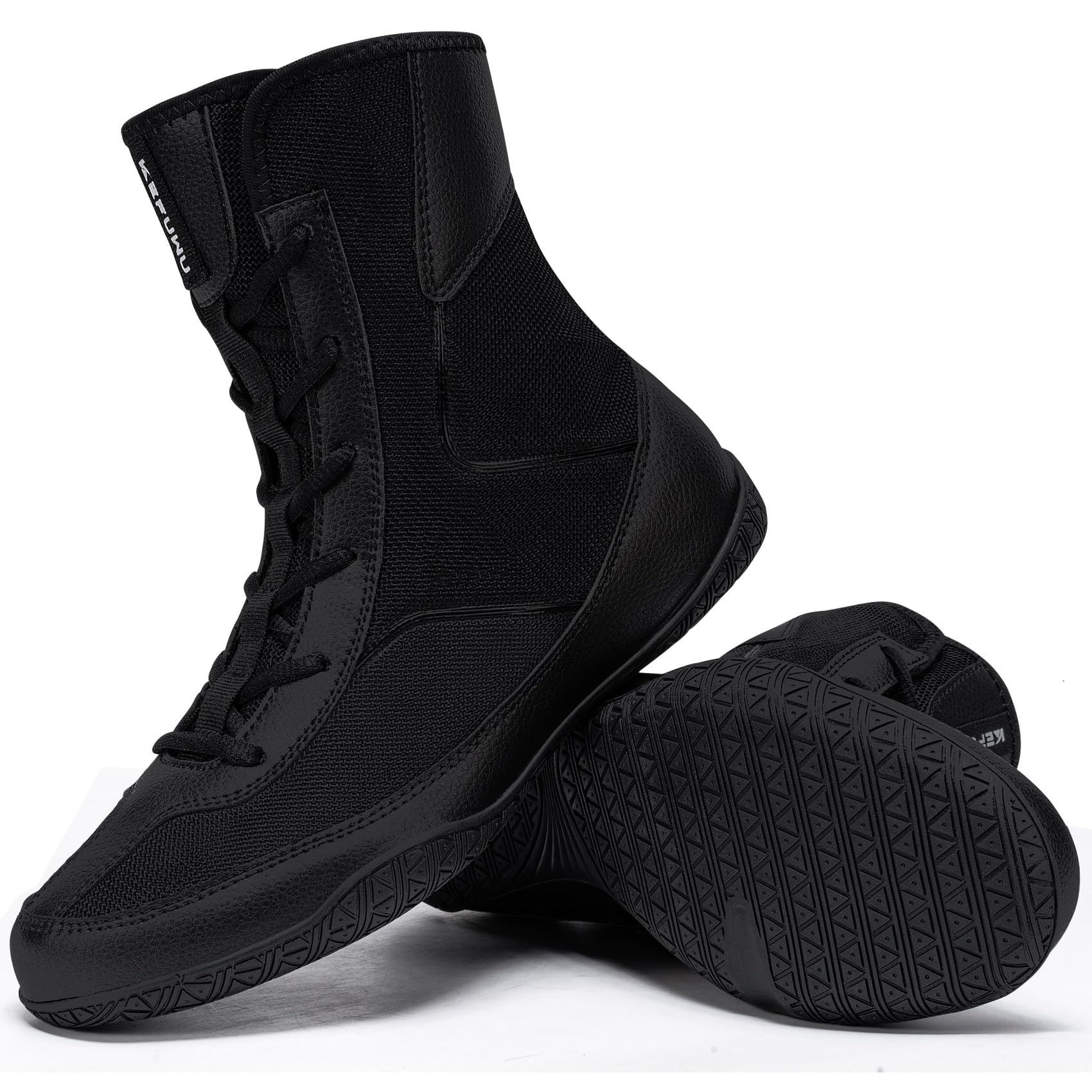
High-top ankle support and a reinforced heel cage at the lowest entry in this roundup.
This is the pair you buy when the season is starting and the budget is tight. It gives you a high-top cut with a reinforced TPU heel cage — a stiff plastic shell around the heel — plus a compression-molded collar that resists rolling during lateral sprints. That is a lot of ankle structure for an entry-level shoe.
Comfort comes from triple-layer foam padding, which is aimed at absorbing impact on throws. The upper is lightweight breathable microfiber that flexes with the foot on strikes, so it does not feel like a brick through a long practice. Ankle support is a specific point of praise here, and one reviewer’s line about the foot and ankle hold sums up why people keep it.
Quality and comfort are the two things it gets credit for, and value sits right behind. The catch is sizing — feedback splits, and a common note is that it runs about a size too big, so order down rather than assuming your normal number. If the fit lands, this is a sensible starter high-top.
Buy it if: you want a high-top with heel structure at the lowest entry point and can order the right size the first time.
Hold off: if you would rather not gamble on sizing — this one runs big for a chunk of buyers.
Know the Specs
Outsole grip and mat feel
The outsole is the bottom of the shoe that touches the mat. Wrestling outsoles are deliberately thin, flat and rubbery so the foot can read the surface. A “zero drop” sole keeps the heel and toe level, which helps a young wrestler stay balanced instead of tipped forward. A thicker, softer sole feels nice in the store but mutes the feedback a wrestler needs.
Ankle wrap and heel support
High-top wrestling shoes wrap the ankle to resist rolling during lateral movement. A reinforced TPU heel cage is a stiff plastic shell around the back of the heel that adds structure. Low-tops feel lighter and freer but offer none of that hold. The right choice depends on how much the wrestler is still learning to balance.
Lace retention and safety
An elasticized lace retention cover is a stretchy flap that holds the tied lace ends out of the way. On the mat, a loose bow is a trip hazard and a reason for a stoppage. A lace-up closure gives a custom fit, but only the cover keeps the ends where they belong.
Youth sizing and fit
Youth wrestling sizing is inconsistent between brands. Some run a full size small, others run true, and a widened toe cap helps a broad forefoot. Always measure the foot against the brand’s own chart before ordering. Getting the size right — measured against the brand’s own chart, not the school-shoe number — is the single biggest factor in whether the shoe works.
Common Questions
Will these youth wrestling shoes fit a wide foot?
Do wrestling shoes for youth run small?
What is a zero drop wrestling shoe?
Are high top or low top wrestling shoes better for a beginner?
Can my child wear wrestling shoes for boxing or MMA training?
How do I keep the laces from coming untied during a match?
How long should a youth wrestling shoe last a season?
Can I machine wash youth wrestling shoes?
Is the ASICS Matflex 7 good for a first pair?
The Bottom Line
The winner here is the ASICS Matflex 7 because it gets the construction right and does not split families on comfort. If your child has a wide forefoot, the Sisttke Kids Wrestling Shoes was widened on purpose and is the better fit. Want ankle wrap and mat grip together? The ASICS Snapdown 4 is the high-top for that. And if the budget is the deciding factor, the adidas HVC gives you light weight and a lace cover for the least money. Measure the foot against each brand’s own chart before ordering, and the right pair is obvious.
How we choose
We do not accept paid placement. Every pick is matched to a real buyer and a real use-case; we do not hands-on test units.
Sources
Specifications: manufacturer listings and product documentation. Review insights: verified customer reviews, as of November 2026. Pricing: not shown on this page (it changes often); check the current price via the retailer link.
As an Amazon Associate, Tactical Gear Guy earns from qualifying purchases. This does not affect which products we feature.