Specs are compiled from manufacturer listings and verified buyer reviews and can change over time — please confirm the key details on the product page before buying.
Your nose takes the hit in a wrestling room, and a broken one does not heal on your timetable. A good face mask has to do three jobs at once: stay put through a scramble, keep your eyes clear enough to see the shot coming, and survive contact without cracking. The short answer is that two very different designs dominate here — full headgear with a cage for live sparring, and a clear nose shield for return-to-play after an injury. Below you get both, sorted by what each one actually does well.
This guide is built by comparing the manufacturers’ published specifications and the patterns across verified customer reviews, so you get each pick’s real strengths and trade-offs instead of marketing spin.
You will see which masks are built for contact training, which ones are recovery tools, and where each one gives something up. The honest ranking below covers every option worth considering in the Best Wrestling Face Mask category.
Top Picks

How To Choose The Best Wrestling Face Mask
You are shopping for one of two things. Either you want a cage for live training, or you need to protect a healing nose while you ease back into drilling. Confusing the two is the most common buying mistake in this niche — a clear nose shield will not survive a full-speed takedown the way a padded cage shell does.
Match the mask to your contact level
Full-cage headgear wraps the skull in foam and puts a rigid grill over the face, which is what you want when people are actually grabbing your head. A clear shield is a smaller, lighter device that sits over the bridge and cheekbones and holds up fine in shooting drills, basketball, or a controlled return to the mat. Pick based on whether you expect hands on your face.
Measure your cheekbones before anything else
Shields mount across your cheekbones, so that spacing decides whether the thing sits flat or presses into your face. One shield here publishes a cheekbone range of 12 to 14.5 centimeters, roughly 4.72 to 5.71 inches. Get a soft tape across the widest point of your cheekbones and compare it to the published figure before you order anything.
Check the attachment and the strap
Some masks are standalone shields with their own elastic or hook-and-loop head strap. Others are attachments that bolt onto an existing headgear shell — the Cross Face is made for Cliff Keen headgear specifically. Know which shell you already own before you buy an add-on piece, or you will have a mask with nowhere to mount.
Side-by-Side Comparison
| Model | Best For | Style | Weight | Face Coverage | Amazon |
|---|---|---|---|---|---|
| RDX Boxing Headgear MMA Muay Thai★ Best Overall | Live sparring and grappling | Full headgear + grill | 0.5 kg | PVC grill over face | Amazon |
| BK01C Nose GuardClear Protection | Return-to-play nose protection | Clear nose shield | 0.21 kg | Nose and cheekbones | Amazon |
| Pro Nose Guard (CREGOOLIF) | Teens in multiple sports | Clear nose shield | 4.2 ounces | Nose, maxilla, brow | Amazon |
| Kids & Adults Taekwondo Karate Headgear | Youth martial arts classes | Foam helmet + clear shield | — | 360° shell + removable shield | Amazon |
| Qiancheng Nose Guard QC-L2 | Heavy sweat, long sessions | Clear nose shield | 0.09 kg | Full face front | Amazon |
| The Cross Face by Cliff Keen | Wrestlers already owning Cliff Keen gear | Add-on facial attachment | — | Both sides + forehead | Amazon |
| ProForce Thunder Padded Head Guard | Full-contact head and neck coverage | Vinyl shell + metal cage | — | Removable metal cage | Amazon |
Detailed Reviews
1. RDX Boxing Headgear MMA Muay Thai, Removable Face Grill
Our pick — 4.5+★ from 4,500+ verified ratings; the strongest balance of quality and price.
A leather shell and a rigid grill for the nights when someone is genuinely trying to grab your head.
If you train live — grappling, Muay Thai clinch work, kickboxing rounds — this is the piece that belongs in your bag. The outer shell is Maya Hide Leather, a synthetic leather that RDX says refuses to split, fray, or tear, and the whole unit comes in at 0.5 kg on your head. The grill itself is PVC, which adds a buffer in front of your face without blacking out your sight line.
Buyers keep praising the build in their feedback, and the foam layout shows why. Three slabs of attenuating foam (shock-absorbing padding) sit as a supporting layer to spread an impact across the surface instead of concentrating it, so a hard shot lands over a wider area. A Quick EZ hook-and-loop strap (a strap that fastens with fabric hooks and loops) locks the fit down so the helmet does not slide when you turn your head. For gear taking repeated abuse in the room, that matters more than any cosmetic detail.
Here is the honest catch. The grill gets the job done as a minimal buffer, but it is not a full face cage, and the appearance of a shield across the face draws jokes — some find it looks ridiculous. The field of view is also the most-criticized part of the design. Compare that to the Qiancheng shield, which goes out of its way to publish vent counts: this one is protection-first, visibility-second.
The strong points
- Maya Hide Leather shell built to resist splitting and fraying
- Triple-slab foam layer spreads impact across the surface
- Quick EZ hook-and-loop strap holds a firm, repeatable fit
- CE-certified and rated for MMA, boxing, kickboxing and Muay Thai
Where it gives ground
- The PVC grill is a buffer, not a full protective cage
- Peripheral vision is limited compared with a clear shield
- The face shield look splits opinion
Reach for this if: you spar or grapple hard and want a leather shell you can throw in a gym bag night after night.
Look elsewhere if: you want an unobstructed view of the mat — a clear nose shield serves that better.
2. BK01C Nose Guard
A clear polycarbonate panel that lets you keep playing while the nose knits back together.
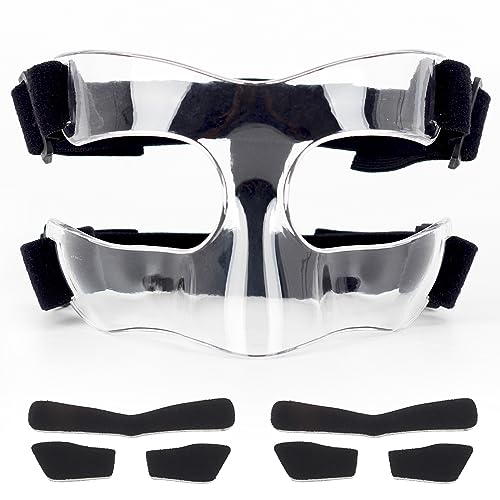
The BK01C is built around a single piece of high-strength polycarbonate — the same class of clear plastic used in impact shields — cut to sit across the nose and cheekbones. It measures 5.6 inches long by 4.1 inches wide, so it is a compact panel rather than a full face covering. Compare it to the Pro Nose Guard at 6 inches by 3.65 inches: the BK01C is shorter but broader across the cheek.
Two sets of pads come in the box, and you decide whether to stick them on or leave them loose. The side openings are there to let air move through, and the adjustable straps pull to a range of head sizes. Its real job is dispersing impact energy so a stray elbow does not land straight on the bridge of your nose.
The thing to understand before ordering is that the shield will refract light slightly, which the maker openly admits. That means your field of view shifts a little rather than staying perfectly flat — fine for shooting drills and open play, less ideal if you want a totally undisturbed sight line during close work.
Where it fits in: this is the return-to-play tool for basketball, volleyball, soccer or wrestling practice when the nose needs cover but the season has not stopped. The cheekbone measurement is the whole decision — get a soft tape across your face and compare it to the 4.1-inch panel width before you commit.
Suits: adults and teenagers easing back into a sport with a healing nose.
Think twice if: you want to take full-speed takedowns — you need the cage design, not a shield.
3. Pro Nose Guard

Four-point face cover for the player who wants one shield that follows them across sports.
Protection is the headline here, and the maker spells out the coverage: the panel is aimed at the nose, maxilla, brow bone, zygomatic bone and orbits. In plain terms, that is your whole front face — bridge, upper jaw, eyebrow ridge, cheekbone and eye socket. At 4.2 ounces on your head, it is a piece you stop noticing partway through a match.
Two sets of foam pads, black and white, swap out easily and change how the shield sits against your face. The hook-and-loop straps adjust to fit all head shapes, so slipping and shifting are the things the design is aimed at preventing. A storage bag for transport is in the box, which makes it the easier one to throw in a school bag between practices.
There is a size boundary you need to know about. The maker does not recommend this for anyone under 12, and describes the intended crowd as most adults plus teenagers 13 and up. If you are buying for a younger wrestler, the adjustable Taekwondo helmet further down is the more sensible route.
Straight read: a broad-coverage clear shield for the athlete who moves between basketball, soccer and wrestling and does not want a helmet. Measure your cheekbone spacing before you buy, because the whole piece rests on that measurement.
Good match for: teens 13 and up plus adults playing more than one sport.
Not the one for: kids under 12 or anyone with narrow cheekbone spacing.
4. Taekwondo Karate Headgear

A foam helmet that covers the whole skull, then clips on a clear shield when the class needs it.
This is the two-in-one approach: a padded helmet shell that gives 360-degree coverage, plus a removable clear polycarbonate shield for the face. Take the shield off and you have a plain sparring helmet for karate drills; clip it on and you have face cover for the contact portions. That flexibility is what makes it work for a growing kid in a class where not every session is the same.
The shell is high-density foam in a polyurethane outer, and it is dense enough to spring back rather than flatten. Multiple air vents sit around the helmet to keep air moving so you are not soaked halfway through a session. Tightness adjusts, which is the part that keeps the coverage useful as a young athlete fills out.
Two honest notes. The padding carries a polyurethane coating that gives off a strong smell when new, so air it out before the first class. And the helmet itself is listed for youth sizing — check that before you assume it fits an adult head.
What earns its place
- Full 360-degree shell coverage with adjustable tightness
- Clear polycarbonate shield pops off for plain sparring
- Multiple vents keep the head cooler during class
- Works across Taekwondo, Karate, MMA, boxing and Muay Thai
What to weigh up
- New-out-of-box odor from the polyurethane coating
- Listed as youth sizing rather than adult
Built for: a young martial artist whose class mixes light face contact with plain helmet drills.
Keep looking if: you need a hard cage for full-speed wrestling.
5. Qiancheng Nose Guard Face Shield QC-L2

Eleven vents and silicone padding for the wrestler who sweats through everything else.
At 0.09 kg this is the lightest full-face shield here, and that weight difference is real when you are turning your head constantly to track a shot. For reference, the RDX headgear above sits at 0.5 kg — this shield is a fraction of that on your face. The panel is premium polycarbonate, crack-proof and shatter-resistant, and you can wash it directly with the pads still attached.
Airflow is where the design puts its money. Eleven vents are cut into the shield itself, and the silicone pads under it carry vents too — the maker claims 80% more breathability than others. The pads are skid-resistant and cushioned, so the shield stays where you put it during activity instead of creeping across your face. An easy-adjust elastic band holds the fit.
The size range is the part you must respect: this is built for a cheekbone width of 12 to 14.5 centimeters, or 4.72 to 5.71 inches. Outside that window the shield will not sit properly, and no amount of strap adjustment fixes a poor cheek match. Note that it is also sized as large, and it is designed for facial recovery rather than as a hard cage for live wrestling.
Editor’s read: the best airflow design in this group, and the one to pick for long, hot sessions where sweat is the enemy. The cheekbone range is a hard gate — measure first.
Pick this for: adult wrestlers and athletes chasing maximum ventilation during recovery play.
The catch: it is a protective shield, not a competition cage — it will not hold up to live grappling contact.
6. The Cross Face Wrestling Headgear Facial Attachment (Black)

Not a mask on its own — the cage panel that clips onto the Cliff Keen headgear you already own.
Read the listing carefully before you order: this is a facial attachment, not a complete headguard. It is designed to bolt onto any Cliff Keen headgear, which is the whole appeal if you already have a shell you like. The piece comes with cushioning on both sides and across the forehead, plus an included white chin cup assembly for a steadier, more secure fit.
Its competition angle is the standout. The design is approved for wrestlers with documented facial injuries, which is exactly the situation where a coach asks you to cover up before you can get back on the mat. Functionality is the thing that draws approval in the feedback — it gets people through a healing period so they can keep training.
Two honest limits. The fit runs large and attaching it to headgear takes patience, so budget a session to dial it in properly. Durability is also the weak point of the design — this is a plastic outer piece that needs care, and treating it roughly shortens its life. It is an add-on for the committed wrestler, not a throw-around practice shell.
Who it serves: the wrestler with a documented facial injury who already runs Cliff Keen headgear and needs a sanctioned cage fast. Confirm your shell model before ordering.
Buy it when: you own Cliff Keen headgear and need the approved facial cage for it.
Look elsewhere when: you have no headgear shell to attach it to, or you want a standalone mask.
7. ProForce Thunder Padded Combat Head Guard with Face Cage

The vinyl warhorse with a metal cage bolted over your face and padding down the neck.
Most shields here are clear plastic panels. This one goes the other route: a vinyl shell with a removable metal face cage held on by seven hook-and-loop closures. Metal is the stiffest barrier in this group, and it is the piece you want when hard strikes are coming at your face rather than glancing blows. Three hole cutouts per ear handle ventilation and let you hear the room.
Where it stands apart from every other pick is neck coverage. Padded flaps run down the back and sides of the neck, which is an area most masks skip entirely. Protection is the standout quality here — the feedback describes solid coverage for the head and the sides of the neck rather than just the face.
The fit needs attention. It is listed as a large, and wearers split between finding it snug and finding it too small, so measure your head circumference before ordering. It is also built for martial arts sparring, not sword fencing or anything outside combat sports.
Reasons to bite
- Metal face cage is the toughest front barrier on this list
- Padded flaps cover the back and sides of the neck
- Ear cutouts give ventilation and let sound through
- Seven hook-and-loop closures hold the cage on securely
Reasons to pause
- Sizing divides wearers — some find it runs too small
- Built for combat sports rather than fencing or other uses
The right pick for: hard-sparring martial artists who want head and neck protection in one shell.
Measure first if: you are between sizes, because the fit runs small in some wearers’ hands.
Know the Specs
Cheekbone width
This is the distance across your face from cheekbone to cheekbone, and it is the number that decides whether a clear shield sits flat or digs in. Shields rest on those bones, so a panel cut for a wider face will press at the edges on a narrower one. One shield in this group publishes a range of 12 to 14.5 centimeters, roughly 4.72 to 5.71 inches — run a soft tape across your cheekbones and compare it before you order.
Shell weight in kilograms
Weight on your head becomes fatigue over a long session, so it is worth comparing. Full headgear in this group sits around 0.5 kg, while a clear nose shield can come in as low as 0.09 kg. The heavier piece gives you more shell and more impact spread, and the lighter piece keeps your head free for turning and tracking. Pick the weight that matches how long you are actually on the mat.
Vents and airflow
Vents are the cutouts that let air move through the shell and across your face while you work. A mask with more vents stays cooler and steams up less, which is why one shield here advertises 11 vents and the maker claims 80% more breathability than others. Vent cuts are also why the ear openings on a cage shell matter — they let heat out and sound in.
Cage material
You will see three barriers on this list: a PVC grill, a clear polycarbonate shield, and a metal cage. PVC is a minimal buffer against strikes. Polycarbonate is a clear, shatter-resistant plastic that lets you see through it but can refract light. Metal is the stiffest barrier and the heaviest. Match the material to the impact you expect rather than to how it looks.
Common Questions
Will a clear nose shield hold up in live wrestling?
How do I measure my cheekbones for a face shield?
Can I wear a face shield over my wrestling headgear?
Does a clear mask fog up during a match?
Is a PVC grill as protective as a metal cage?
Can a teenager wear an adult nose guard?
How do I clean a polycarbonate face shield?
Which mask covers the neck as well as the face?
Will a full headgear interfere with my peripheral vision?
Should I buy headgear or a nose guard for a healing nose?
The Bottom Line
If you want one mask that survives live training and real takedowns, the wrestling face mask that earns the top spot is the RDX Boxing Headgear. Its Maya Hide Leather shell (a synthetic leather outer), triple-slab foam layer and Quick EZ strap are built to take night after night of grappling. It also carries 4.5+ stars across 4,500+ owners, the strongest showing here. If you are healing a nose and just need clear, breathable cover, grab the Qiancheng QC-L2 with its 11 vents, so air moves through instead of trapping heat. And if you already own Cliff Keen headgear and need a sanctioned cage fast, reach for the The Cross Face.
How we choose
We do not accept paid placement. Every pick is matched to a real buyer and a real use-case; we do not hands-on test units.
Sources
Specifications: manufacturer listings and product documentation. Review insights: verified customer reviews, as of November 2026. Pricing: not shown on this page (it changes often); check the current price via the retailer link.
As an Amazon Associate, Tactical Gear Guy earns from qualifying purchases. This does not affect which products we feature.