Specs are compiled from manufacturer listings and verified buyer reviews and can change over time — please confirm the key details on the product page before buying.
The hardest part of buying a worm gear motor is that the numbers on the listing barely tell you whether it will drive your load or stall halfway through. A motor can be rated for 70kg.cm one moment and crawl under a real load the next, and every buyer learns this the hard way when a project sits half-finished. This guide cuts straight to the models that hold their torque, lock their shaft when the power cuts, and fit the small spaces these units usually live in.
This guide is built by comparing the manufacturers’ published specifications and the patterns across verified customer reviews, so you get each pick’s real strengths and trade-offs instead of marketing spin.
You will see which units hold a heavy load, which spin slow enough for fine control, and which are worth a place on your bench — the full breakdown of the strongest worm motor gear options for builders who need the drive to work the first time.
Top Picks
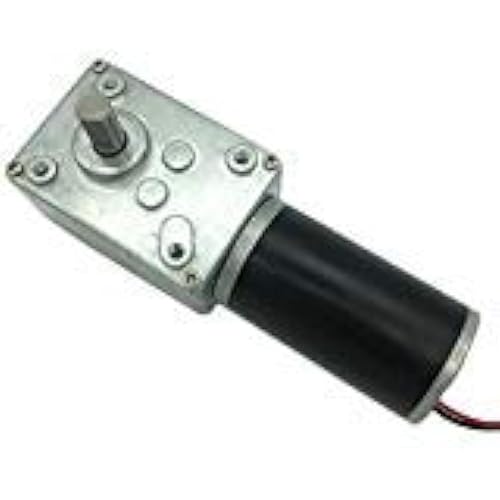

How To Choose The Best Worm Motor Gear
Buying a geared motor for a real build means deciding three things up front: how much force you need, how fast you need the shaft to turn, and whether the shaft has to stay put when you cut power. Get those three right and the rest of the listing becomes easy to read. Get them wrong and even a well-made motor will feel weak or drive your mechanism too fast.
Read torque the way the spec actually works
Torque is measured in kg.cm, which means a weight in kilograms hanging one centimeter from the center of the shaft. A 10KG.CM rating drives 10kg at that 1cm distance, but only 1kg if you hang the weight 10cm out. So a motor rated for 70kg.cm has plenty of muscle for a small arm close to the shaft, and much less for a long lever. If your driven object weighs more than the rated load, the motor slows down and can be damaged — so build in headroom.
Match the reducer ratio to your speed
Worm gearboxes trade speed for force through a reduction ratio. A deep ratio like 1:505 or 1:80 turns the output shaft slowly but lets the motor push hard, which suits safes, curtains, and slow-moving doors. A shallow ratio spins faster and suits tasks where speed matters more than raw pull. Confirm the no-load speed and the rated speed separately, because load drags the real number down.
Decide if self-locking is a must-have
Self-locking means that with no power applied, the output shaft stays fixed and cannot be back-driven. For a safe lid, a retractable screen, or a garage door, that is the whole point — the mechanism holds its position when the power drops. Wiring is often reversible by swapping the positive and negative leads, which lets you run the shaft the other way without changing hardware.
Check the shaft and the mounting space
Shaft diameter is your first fit check: 8mm and 14mm are different worlds for couplings and pulleys. Because the reducer output shaft sits vertically to the motor shaft on many of these units, the whole package stays short and fits into tight housings. Measure your available depth and confirm the mounting holes line up before you commit.
Side-by-Side Comparison
| Model | Best For | Rated Speed | Torque / Power | Voltage | Amazon |
|---|---|---|---|---|---|
| BRINGSMART 12V 16rpm★ Best Overall | Robot arms and slow hard pulls | 12 rpm rated | 70kg.cm | 12V DC | Amazon |
| Greartisan 12V 5RPMBest for Dual Output | Slow precision with two shaft ends | 5 rpm | 15Kg.cm | 12V DC | Amazon |
| Greartisan 12V 10RPM | Middle-speed pulls with one shaft | 10 rpm | 40Kg.cm | 12V DC | Amazon |
| Greartisan 12V 3RPM | Very slow, very controlled motion | 3 rpm | 12Kg.cm | 12V DC | Amazon |
| BRINGSMART 12V 12rpm | Curtains and light duty shifting | 9 rpm rated | 21 watts | 12V DC | Amazon |
| BEMONOC 50RPM Garage Door | Faster door and gate drives | 50 rpm | 6N.m / 30W | 12V DC | Amazon |
| BEMONOC 120W AC Reducer | Adjustable industrial control | 18 rpm | 345kg.cm / 120W | 110V AC | Amazon |
Detailed Reviews
1. 12V 16rpm DC Worm Gear Motor
Our pick — 4.5+★ from 150+ verified ratings; the strongest balance of quality and price.
A compact 12V motor rated at 70kg.cm that holds its shaft locked the moment power is cut.
The number that earns this motor its place on top is 70kg.cm, the rated torque (turning force), and that figure comes with a real-world meaning. It drives an object hung one centimeter from the shaft center at up to 70kg of load, but only about 7kg once that object sits 10cm out. For a robotic arm or a rotating table the BRINGSMART unit gives you force where a cheaper geared motor would stall — enough force, as owners describe it, that a compact housing does the work of a much bigger one.
Speed and current are honest, no-nonsense figures. The no-load speed is 16rpm, the rated speed drops to 12rpm under load, and the no-load current is 350mA at 12 volts DC. The rated current climbs to 1.6A when the motor is doing real work, so a modest 12V supply handles it. Inside, the reducer ratio is deep at 1:505, and the output shaft sits vertically to the motor shaft so the whole package stays short and fits a tight housing.
Self-locking is the feature that wins over builders who need a position to hold. With power removed, the output axis stays fixed, so a curtain, lid, or rotating mechanism does not sag back once you stop driving it. What owners talk about most is the build and the torque together — this is a motor that feels solid in the hand and delivers force on command. That combination of a high 4.5+ star score and well over a hundred ratings makes it the crowd favorite among serious hobby builders.
What earns it first place
- 70kg.cm of rated torque gives a compact motor genuine pushing force.
- Deep 1:505 reduction translates into slow, controlled output speed.
- Self-locking shaft holds position the instant power drops.
- 13.4 ounces of copper-wound motor that stays stable on a bench build.
Where it asks a little care
- Load beyond the rated torque slows the shaft and can damage the motor.
- Slow 16rpm no-load speed rules out fast-motion jobs.
- Sold as a bare motor, so couplings and mounts are your job.
Reach for this if: you need serious force from a small 12V package and want the shaft to stay put — robot arms, rotating tables, and slow curtain drives.
Look elsewhere if: your mechanism needs to move quickly, because 16rpm is deliberately unhurried.
2. DC 12V 5RPM Double Shafts Worm Gear Motor
A 5rpm Greartisan with an output shaft at each end, so one motor drives two mechanisms.
Start with the pace, because 5rpm is the defining trait here. At 15Kg.cm of torque and a slow 5rpm output, this Greartisan motor makes one full turn every twelve seconds. That is a genuinely careful motion for a curtain track, a small counter panel, or a display turntable where jerky speed would show. The high-precision gear design and long-carbon-brush construction keep it quiet and efficient, and the 8mm shaft diameter fits standard couplings without a fight.
What separates it from the single-shaft greartisan options above is the double shaft, one at each end, which lets you drive a load from both sides of the gearbox. If your mechanism needs a shaft out the back for a sensor or a second belt, this saves you a second motor entirely. It is a 12V DC unit and reverses simply by swapping the positive and negative leads, so you can run a mechanism open and closed without rewiring hardware. Like every genuine worm drive, it self-locks — cut the power and the output axis stays fixed.
One deliberate limit: 15Kg.cm is modest next to the 70kg.cm best-overall pick, so treat this as a light-duty drive for controlled slow work rather than a heavy puller. The double shaft is the reason to choose it, not brute strength.
Fit in the housing: because the output shaft runs vertically to the motor shaft, the whole unit stays short, which helps when a special installation size is exactly the problem you are trying to solve.
Your motor if: a slow, steady turn and a second shaft end make your build simpler — think twin-driven displays or two-sided curtain rigs.
Keep walking if: the load you are lifting needs more than 15Kg.cm of steady pull.
3. DC 12V 10RPM Single Shaft Worm Gear Motor
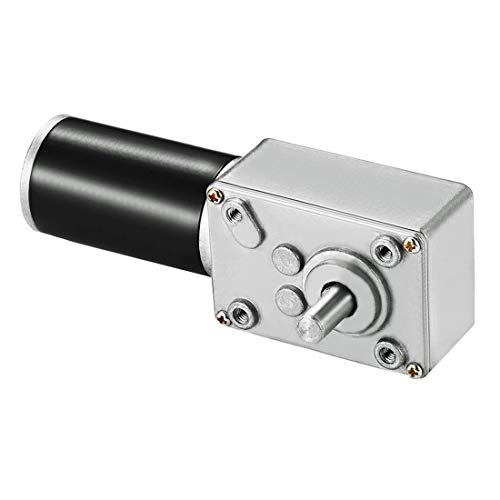
The Greartisan step-up: 40Kg.cm at 10rpm, double the force and twice the speed of the 5rpm model.
If the 5rpm double-shaft unit feels too gentle, this is the step up. It pairs 40Kg.cm of torque with a 10rpm output, so you get roughly twice the speed and over double the pushing force of the slower model at the same time. A slow but stronger crawl suits a heavier curtain, a motorized faucet, or a vending flap that has to swing with authority. The 8mm shaft keeps it compatible with common couplings, and the single output keeps the front end simple.
Construction is the same metal body and high-precision gear design as its stablemates, with long carbon brushes for service life. Reversing is a matter of flipping the positive and negative leads, and the worm drive self-locks so a lifted load does not creep when power is cut. The vertical shaft arrangement keeps the package short for tight housings. What owners like is the steadiness — this is a motor that turns decisively and stays where you leave it.
Where it gives ground: this is still a light-to-mid duty motor, and the 40Kg.cm ceiling is well under the 70kg.cm best-overall pick. Treat it as a precise force where you want controlled motion, not a winch. For automation instruments, stage lighting, or a small counter, that trade is a fair one.
The reason to pick it: it lands between slow and strong better than anything else in this group, so you are not forced to choose between a crawl and a weak pull.
Best matched to: builds that need a firm, unhurried turn — heavier curtains, motorized fixtures, automated flaps.
Skip the step up if: your load stays light and you would rather have the even slower, double-shaft option.
4. DC 12V 3RPM Double Shafts Worm Gear Motor
At 3rpm it makes one full turn every twenty seconds, the slowest output in this lineup.
Here is the head-to-head that matters: this Greartisan unit turns at 3rpm while the fastest pick in this article, the BEMONOC 50RPM garage door motor, turns at 50rpm. Same family of worm drive, wildly different jobs. At 3rpm you get an output shaft that advances almost imperceptibly, which is exactly what you want when a display, a lens, or a sensor array needs to creep into position without overshoot.
The 12Kg.cm torque is the lightest in the group, and that is the honest trade. This motor is built for control, not for pulling heavy loads. It still carries the double shafts that let you drive off both ends of the gearbox, the metal body, the long carbon brushes, and the reversible wiring that lets you flip rotation by swapping leads. And it self-locks, so whatever position you leave the mechanism in, it stays.
The case for 3rpm
- Very slow output suits fine-position work with no jitter.
- Double shafts drive two mechanisms from one motor.
- Self-locking holds an exact setting once power is removed.
- Compact vertical-shaft layout fits tight mounting spaces.
The honest trade-off
- 12Kg.cm is the lowest torque here, so it is light-duty only.
- 3rpm is far too slow if you need your mechanism to travel any real distance.
Made for: precision positioning where gently does it — turntables, aiming rigs, slow reveal mechanisms.
Not the one for: lifting loads or moving fast, where the 40Kg.cm or 70kg.cm options make far more sense.
5. 12V 12rpm DC Worm Gear Motor

A low-cost BRINGSMART 12V unit with a 12rpm no-load speed and a self-locking worm drive.
The specs read plainly: a 12V DC motor with a 12rpm no-load speed, a 9rpm rated speed, a 350mA no-load current, and a 1.6A rated current. The output shaft is 8mm, and inside the iron-bodied housing is the same micro-turbine worm arrangement that gives this family its self-locking grip. For a light-duty job — a small rotating curtain, a feeder, a game machine accessory — the speed and shaft size line up without fuss.
What earns it the budget slot is the honest balance. Owners praise the build as an absolute workhorse and confirm the self-locking shaft holds position, though some report stripped gears. But this is a motor where the torque feedback and, more tellingly, the durability are mixed — some builds report the gears stripping after a few uses. That does not make it a bad motor; it makes it a motor to size carefully. If your load sits comfortably inside its rating and the duty cycle is light, it holds up.
The trade-off is worth stating directly: treat the torque ceiling as real, not approximate. Drive a load heavier than it is rated for and you are asking for stripped gears. For a fan, a barbecue turner, or a small automation accessory, this budget pick quietly gets the job done.
The budget-friendly pick if: your mechanism is light and you want a self-locking 12V motor without spending much.
Think twice if: your load sits anywhere near the torque limit, because gear wear is the recurring story on this one.
6. PMDC Worm Geared Motor 12V 50 RPM
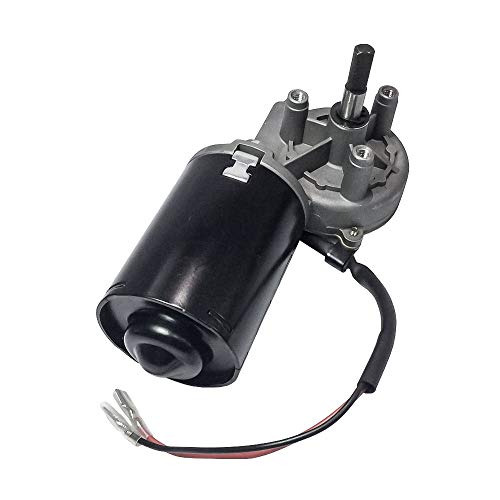
The fastest pick here at 50rpm, roughly sixteen times the 3rpm Greartisan, so a gate opens in real time.
Speed is the whole reason to pick this BEMONOC unit. A 50rpm no-load speed and a 40±10% load speed give you a motor that moves a door, a window, or a rolling gate quickly enough to be usable. It is rated at 30W and 12V DC, draws up to 3.5A under load and 1.2A at no load, and pushes 6N.m of torque. For a DIY garage door or a barbecue spit that needs a real turn per second, that is a different league from the slow worm units above.
The build is meant for installation. The shell is sturdy, and the body is small enough to slot into a limited space — 6.74 inches long by 2.44 inches across, mounted through M6 screw holes with three screws included. Rotation is CW and CCW reversible. The double flat shaft is a small detail that matters: the flats grip a coupling so it does not slip under the torque of a fast turn.
The honest question is durability under a heavy door. The 4.0+ star score on a smaller pool than the top pick reflects a newer listing, not the same watertight consensus. Match the motor to a load inside its 6N.m rating and it delivers the speed you bought it for. Oversize the load and the speed is the first thing you lose.
The fast mover if: your build is a door, gate, wiper, or roast that has to open in real time and mount in a tight cavity.
Weigh it against: the slow high-torque picks if your load is heavy rather than time-sensitive.
7. 120W 110V 18rpm AC Worm Gear Reducer Motor

A 110V AC reducer with a 0–18rpm speed controller and 345kg.cm of maximum torque.
This is a step into a different class, so the numbers deserve a slow read. It is a 110V AC motor pulling 120W, with a 1:80 reduction ratio and a 345kg.cm maximum torque. The output shaft measures 14mm — noticeably chunkier than the 8mm shafts on the DC picks — so it takes heavier couplings and drives a bigger mechanism. The self-locking worm gear structure is built for precision position control, and the internal fan with cooling holes at the rear keeps heat moving during long runs.
The feature that separates it is the speed controller. It fine-adjusts the AC motor from 0 to 18rpm (revolutions per minute) and runs it in both directions, so you get CW (clockwise) and CCW (counterclockwise) on tap. That makes it a natural fit for conveyor belts, winches, or anything that needs to start slow and hold a steady pace. High-precision alloy-steel gears do the reduction, and the whole package ships with the motor, controller, and power plug together, so there is no hunting for a matching controller.
Here is the part a buyer should weigh carefully: the 3.0+ star score is the lowest in this lineup, on a smaller set of reviews. That signals a unit where fit and expectations matter more than on the proven DC motors. Match it to an industrial job inside its 345kg.cm ceiling, on a 110V circuit, and it gives you torque and control the small motors cannot touch.
What you are really buying: torque, adjustability, and a complete kit — the speed controller and plug in the box separate it from the bare DC motors.
The pause for thought: 110V AC mains power and a 14mm shaft mean this is a fixed-installation motor, not a bench tinker, so plan your wiring and mounts around it.
Right for: industrial and heavy-duty builds needing adjustable 0–18rpm speed and serious torque from a complete kit.
Overkill for: light hobby projects already solved by the 12V DC picks, especially where a 110V supply is not on hand.
Know the Specs
Torque in kg.cm and N.m
Torque is the turning force the motor can deliver, measured in kg.cm (a weight hanging one centimeter from the shaft center) or N.m. A 70kg.cm figure drops to about 7kg if you hang the weight at 10cm instead of 1cm. Match the load to your actual lever distance, and keep some headroom — overload the motor and it slows and can be damaged.
Rated speed versus no-load speed
No-load speed is how fast the bare shaft turns with nothing attached; rated speed is the slower figure once a rated load is applied. A motor listing 16rpm no-load often runs at 12rpm under load. Always size your mechanism to the rated speed, because that is the number it holds while doing work.
Self-locking behavior
Self-locking means the output shaft stays fixed when no power is applied, so a mechanism cannot be back-driven. For safes, lifting doors, and retractable screens, this is a required feature. It also lets you hold an exact position without a brake.
Voltage, current, and wattage
Voltage tells you the supply — 12V DC for battery-style builds, 110V AC for mains installations. Current in amps (mA is a fraction of an amp) tells you how much your power supply must deliver. Wattage combines them into power. Match your supply to the motor’s rated current or it will sag under load.
Reducer ratio and gear material
The reduction ratio, such as 1:80 or 1:505, sets how much the gearbox slows the motor and multiplies force. A deep ratio gives slow, strong output. Alloy-steel and high-precision gears wear better than cheaper metal; that material is your guide to how long the motor holds up under steady duty.
Shaft diameter and mounting space
Shaft diameter, most often 8mm or 14mm, decides which couplings and pulleys fit. Many worm reducers place the output shaft vertically to the motor shaft, keeping the whole package short for tight housings. Confirm mounting holes and available depth before you buy.
Common Questions
How do I reverse the direction on a 12V DC worm gear motor?
What does self-locking actually mean in practice?
Why does my motor slow down when I attach a heavy load?
What kg.cm torque do I need for lifting a small weight?
Is a 12V DC motor better than a 110V AC one for my build?
Will an 8mm shaft fit my existing coupling?
What is the difference between no-load speed and rated speed?
Why do some worm gear motors wear out their gears?
Can I use a 120W AC reducer motor for a conveyor or winch?
Do I need a separate controller for these motors?
The Bottom Line
For most builds, the worm motor gear to start with is the BRINGSMART 12V 16rpm, because its 70kg.cm torque and self-locking worm drive tackle a robot arm or rotating table with force and hold position when the power drops. If your mechanism needs speed instead of slow force, the BEMONOC 50RPM garage door motor opens a gate or window in real time. And when you need torque, adjustable speed, and a 110V mains setup in one kit, the BEMONOC 120W AC reducer at 345kg.cm is the heavy-duty reach. The one honest nudge: the 4.5+ star BRINGSMART leads on both score and proven demand, so if you are torn, it is the safest first motor to bolt down.
How we choose
We do not accept paid placement. Every pick is matched to a real buyer and a real use-case; we do not hands-on test units.
Sources
Specifications: manufacturer listings and product documentation. Review insights: verified customer reviews, as of November 2026. Pricing: not shown on this page (it changes often); check the current price via the retailer link.
As an Amazon Associate, Tactical Gear Guy earns from qualifying purchases. This does not affect which products we feature.