Specs are compiled from manufacturer listings and verified buyer reviews and can change over time — please confirm the key details on the product page before buying.
You are standing over a stack of pressure-treated 2x10s and the saw in your hand is bogging down halfway through the cut. That stall is the reason worm drive saws still exist. A worm drive puts the motor behind the blade and drives it through a geared reduction, which turns blade speed into torque you can lean on. Pick wrong and you lug a heavy saw you did not need. Pick right and the blade tracks straight through wet pressure-treated lumber.
This guide is built by comparing the manufacturers’ published specifications and the patterns across verified customer reviews, so you get each pick’s real strengths and trade-offs instead of marketing spin.
Below you will find the models that earn their place on a framing crew, plus the lighter ones that suit a remodeler working overhead. Every pick here is a true worm drive, with the motor sitting behind the blade rather than beside it. The picks below cover the range of torque, bevel range, and blade size you will weigh when shopping for the best worm drive motor for your own cuts.
Top Picks


How To Choose The Best Worm Drive Motor
Start with the cut you make most often, because that single job decides everything else. A worm drive saw is heavier and slower-spinning than a sidewinder by design, and it repays that weight in torque you can push into thick or wet stock. Match the saw to your daily cut and the other specs sort themselves out.
Match the blade size to your heaviest cut
Blade diameter sets how deep the saw reaches in one pass. A 7-1/4-inch blade is the common framing size, and it handles dimensional lumber with room to spare. Step up to a 10-1/4-inch or 16-5/16-inch blade when you need to bury the blade in thicker stock, and accept that the saw gets heavier and harder to swing overhead.
Look hard at the bevel range in degrees
The bevel range tells you how far the foot tilts from square. A 90-degree cut is a straight crosscut, while a 45-degree angle gives you a miter for corners and hips. Saws here run from 45 degrees up to 60 degrees, and a wider range means you can cut steeper angles without flipping the workpiece.
Weigh the amp rating against the cord
The amp figure describes how much current the motor pulls, and a 15-amp motor is the standard in this class. More amps generally mean more torque under load, but a corded saw tethers you to an outlet. A cordless worm-style saw frees you from the cord at the cost of battery weight and a charger to manage.
Expect weight and plan around it
Worm drive saws sit heavy because the motor and gears hang behind the blade. If you frame walls on the ground, the rear-heavy balance costs you nothing. If you cut rafters overhead or work one-handed on a ladder, the lightest magnesium-bodied saw in this list will save your shoulders by the end of the day.
Side-by-Side Comparison
| Model | Best For | Blade Size | Motor & Bevel | Weight | Amazon |
|---|---|---|---|---|---|
| SKILSAW SPT77WML-01★ Best Overall | Everyday framing | 7-1/4 in. | 15 Amp / 53 degrees | 11.5 lb | Amazon |
| SKIL SPT77W-22Best for Motor Life | Cool-running motor life | 7-1/4 in. | 15 Amp / 51 degrees | 14.2 lb | Amazon |
| Metabo HPT C7WDMBest Value | Rafter work on a budget | 7-1/4 in. | 15 Amp / 53 degrees | 14.7 lb | Amazon |
| BOSCH CSW41 | Sightline accuracy | 7-1/4 in. | 15 Amp / 45 degrees | 15 lb | Amazon |
| SKILSAW SPT78W-01 | Big timber power | 8-1/4 in. | 15 Amp / 60 degrees | 18.5 lb | Amazon |
| SKILSAW SPT70WM-22 SAWSQUATCH | Deep one-pass cuts | 10-1/4 in. | 15 Amp / 90 degrees | 16.5 lb | Amazon |
| DEWALT DCS577X1 FLEXVOLT | Cordless jobsite freedom | 7-1/4 in. | 60V MAX* / 53 degrees | 10.9 lb | Amazon |
| SKIL SPT70V-11 | Cutting 6x stock | 16-5/16 in. | 15 Amp / — | 27.3 lb | Amazon |
Detailed Reviews
1. SKILSAW SPT77WML-01 7-1/4-Inch Circular Saw
Our pick — 4.5+★ from 2,500+ verified ratings; the strongest balance of quality and price.
The featherweight worm drive that still pulls like a full-size saw.
Eleven and a half pounds is the number that wins here. That is magnesium construction doing its job, and it means you can run this saw across a wall plate all morning without your wrist giving out. Owners keep coming back to the same theme — the build quality earns the most conversation by a wide margin, with the weight a strong second — and both point at the same thing: this saw feels like a tool that will outlast a few trucks.
The motor is a 15-amp unit, which is the standard draw in this class, and the geared worm drive converts that into enough push to rip through lumber without stalling. The Cut-Ready depth system lets you set depth for a quick measurement rather than eyeballing it. That matters when you are plunging into a floor deck and want the blade to poke through just enough. A 53-degree bevel puts it wider than the BOSCH CSW41, which tops out at 45 degrees, so you get more of the steep angles without an extra setup.
The anti-snag lower guard runs smooth on small cut-off pieces, which is the kind of detail you only notice when a guard catches and the saw kicks back. Metal handle, 7-1/4-inch blade, and the saw ships with a 24-tooth carbide blade plus a multi-function wrench. Where it gives ground: an 11.5-pound body still carries the worm drive’s rear-heavy balance, so if you are cutting overhead all day, that weight shifts into your forearms. And the crowd favorite here — 4.5+ stars across 2,500+ owners — does not carry the biggest review base in this lineup; the 16-5/16-inch SKIL has more, but this one holds the higher score.
What earns it top spot
- Magnesium body keeps it to 11.5 pounds, so fatigue stays low on long framing runs
- 53-degree bevel beats the BOSCH CSW41’s 45-degree limit for steeper cuts
- 15-amp motor with worm drive gearing holds torque through wet pressure-treated lumber
- Ships with a 24-tooth carbide blade and a multi-function wrench, so you cut the day it arrives
Where it asks for care
- The rear-heavy worm drive balance puts strain on overhead work
- Budget-tier options cannot match this torque, but they cost less to replace
Go with this if: you want one saw that rips framing lumber all day without bogging and still feels manageable in the hand.
Look elsewhere for: a dedicated overhead-cutting saw where every ounce of balance counts.
2. SKIL 7-1/4″ Worm Drive Corded Circular Saw SPT77W-22
Built around a motor that runs cool so the gears keep turning.
Here is the spec that matters on this model: the Dual-Field motor is designed specifically for saws, and the point of it is increased cooling that extends tool life. If you cut for a living and the saw sits hot between passes, that cooling path is the reason this one should keep working after the cheap models start smelling like windings.
A 14.2-pound body and a 7-1/4-inch blade keep it in the everyday framing lane. The Cut-Ready depth-of-cut system handles quick, accurate depth adjustments, and the 51-degree bevel gives you a touch more range than the 45 degrees on the BOSCH CSW41. A 24-tooth Diablo carbide blade comes in the box, which is a real blade rather than a throwaway, and the magnesium handle material keeps the grip solid without extra bulk.
The STAY TRUE guarantee covers you with a 180-day money-back offer plus a one-year limited warranty. That is the brand putting real terms behind the motor-life promise. The honest limit is weight: at 14.2 pounds this sits heavier in the hand than the 11.5-pound SPT77WML-01, so a crew cutting flat all day may not mind, but a single worker running one saw up and down a ladder will feel it. If the saw stays on the ground and the cord reaches, this is a durable choice that leans on cooling rather than brute size.
Cooling as the selling point: the motor is tuned to run cooler, which is why this pick carries the motor-life label rather than the raw-torque one.
Reach for it when: the saw lives on the ground and you want a long-service tool with a real warranty behind it — look past it if you need the lightest body for overhead work.
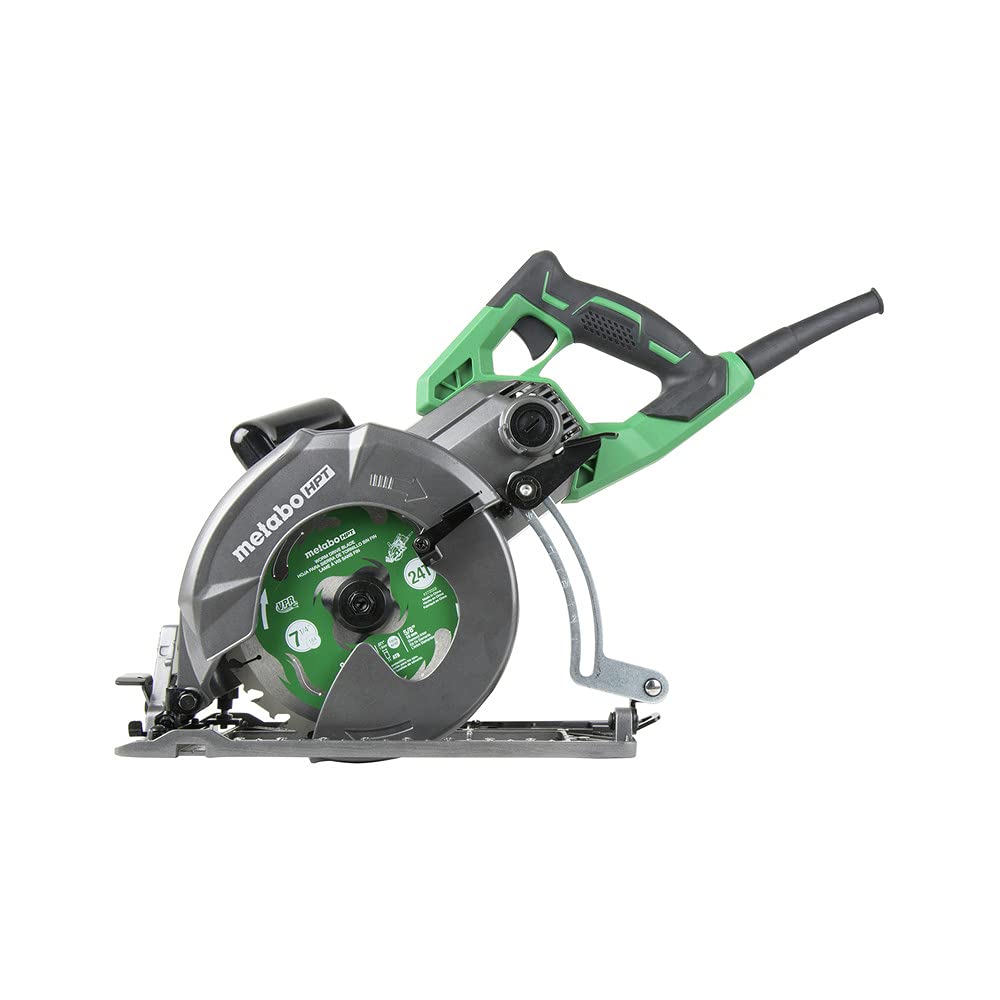
3. Metabo HPT C7WDM Circular Saw
Rafter work without paying the premium for a famous badge.
The 15-amp motor spins to 5,000 RPM at no load, and that is a useful figure to compare against the BOSCH CSW41, which lists 5,300 no-load rpm. What that difference means in practice: both will power through framing stock, and the Bosch turns the blade slightly faster while this Metabo leans on its worm gears for the grunt. If your cuts are mostly studs and rafters, you will not notice the gap.
Cut capacity is 2-3/8-inch at 90 degrees and 1-3/4-inch at 45 degrees, which is the spec that tells you whether the saw can bury itself in a stacked cut. A 53-degree bevel, 14.7-pound body, and a soft non-slip grip cover the comfort side. There is a rafter hook bolted on for hanging the saw off a beam between cuts, and it ships with a 7-1/4-inch 24-tooth VPR framing blade and wrench.
The trade-off you should know about up front is the score. This one sits at 3.5+ stars across a small rating pool of 20, which is far thinner feedback than the SKIL saws on this list. A small review base swings hard on a couple of bad deliveries, so read the entries rather than trusting the headline. The spec sheet, though, is solid: worm drive gears for long life, a 15-amp motor, and the same 53-degree bevel as the top pick.
Why rafters suit it
- On-tool rafter hook hangs the saw safely between cuts and for storage
- 1-3/4-inch cut at 45 degrees handles stacked and mitered framing cuts
- 53-degree bevel range, same as this list’s top pick
- Soft non-slip grip and 14.7-pound body stay controllable
Keep in mind
- Thin feedback pool makes it harder to judge long-term reliability
- Blade spins at 5,000 RPM, below the Bosch CSW41’s 5,300
Worth a close look if: you are outfitting a rafter crew and want worm drive gearing plus a 53-degree bevel without paying for a flagship name.
Second-guess it if: you want a large, settled review base backing the purchase.
4. BOSCH 7-1/4-Inch Worm Drive Circular Saw CSW41, Blue
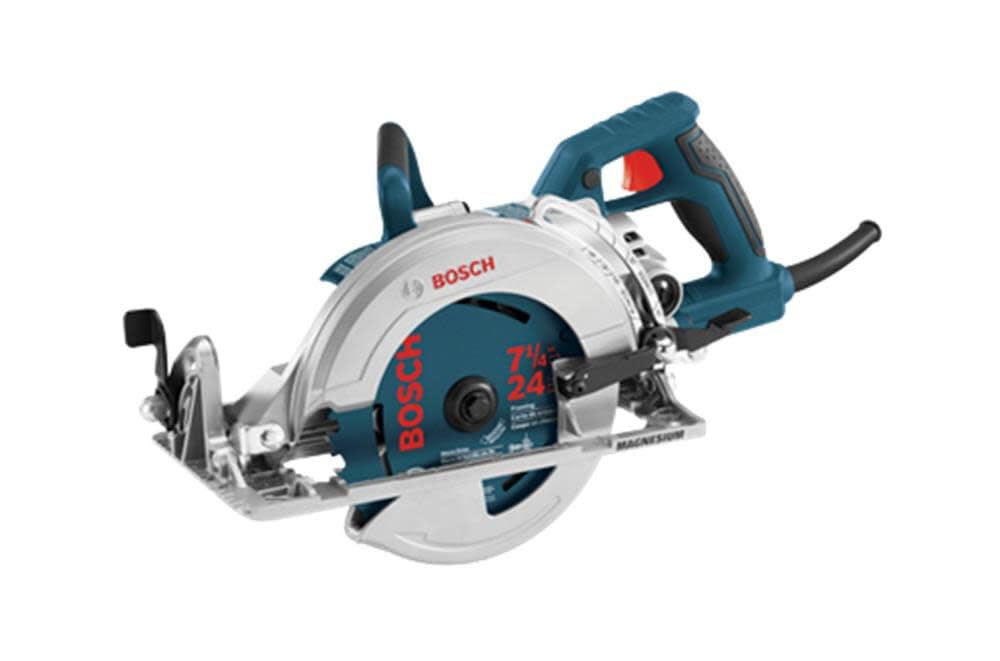
The left-side blade puts the cut line right where your eye is.
Blade on the left, handle at the back — that layout means you see the cut line without leaning over the saw. For a right-handed framer this is the classic worm drive stance, and it makes following a chalk line noticeably easier than a saw with the blade buried on the wrong side. This is one of the small handful of saws here that puts the blade left, and Bosch built the whole saw around that sightline.
The torque comes from a 15-amp motor spinning to 5,300 no-load rpm, matched with worm drive gearing. That rpm edge over the Metabo HPT C7WDM’s 5,000 is measurable and shows up as a quicker-feeling blade, though both carry enough torque to chew through decking. People who run it talk about it cutting pressure-treated deck wood like butter and chewing through old hardwood 4x4s. A multi-function wrench mounts on the saw for blade and brush changes, and there is a built-in tool hook so it hangs between cuts.
Bevel stops at 45 degrees, which is narrower than the 53 degrees on the SKIL SPT77WML-01. If steep bevel cuts are a regular part of your work, budget for that limit. Weight is the other honest note: this saw lists 15 pounds, and the review pages flag weight as a mixed point rather than a win. Magnesium construction keeps it manageable, but it is not a featherweight. The craftsmanship and power are what keep it a durable, accurate tool for the long haul.
What the layout gives you
- Left-side blade and rear handle keep the cut line in plain view
- 5,300 no-load rpm from the 15-amp motor out-spins the Metabo’s 5,000
- On-board multi-function wrench handles blade, brush, and diamond-knockout changes
- Built-in tool hook lets the saw hang safely between cuts
What to accept
- 45-degree bevel ceiling is tighter than the 53-degree SKIL saws
- 15-pound body reads heavy to some users
Pick it for: the sightline advantage — right-handed framers who care about following a line precisely.
Think twice for: steep bevel work, where the 45-degree stop leaves cuts on the table.
5. SKILSAW SPT78W-01 8-1/4-Inch Circular Saw

A 60-degree bevel and a bigger blade for the timber the small saws cannot reach.
The 8-1/4-inch blade is why you step up here. That extra reach lets the saw bury itself deeper into thick stock in a single pass, and it matters when you are working posts and beams rather than studs. The high-torque 15-amp Dual-Field motor is built for sustained power, and the die-cast aluminum motor and gear housings add durability where the saw takes hits.
Sixty degrees of bevel is the widest range on this entire list, with stops at 0 and 45 degrees. That gives you steep angles a 45-degree saw simply cannot cut. Precision-machined worm drive gears are meant to hold up over a long service life, and the anti-snag lower guard keeps small cut-offs from catching the shoe. The hitch is mass: 18.5 pounds makes this the heaviest saw here except the large-capacity 16-5/16-inch model, and weight is flagged as a negative in the feedback — some users find it a bear to hold up.
What pays you back is muscle. People who own it describe it powering through tropical hardwoods, with the worm-gear motor handling tough materials well. Quality and performance are the two things it is best known for. If you habitually cut posts, beams, and tropical hardwood, this saw earns its keep. If your work is all 2×4 and 2×6 framing, you are carrying 18.5 pounds for depth you will never use.
Where it shines: 60 degrees of bevel and an 8-1/4-inch blade stack up to the widest cutting envelope here short of the 16-5/16-inch saw.
Weigh it honestly: 18.5 pounds is a load — reach for it when the timber is thick and skip it when the work is light.
6. SKILSAW SPT70WM-22 10-1/4 In. Worm Drive

The middle-sized monster that reaches where 7-1/4 saws stop.
A 10-1/4-inch blade is not subtle. This saw exists to cut material the small framing saws can only nibble at from both sides, and at 16.5 pounds it stays lighter than the big 16-5/16-inch model. Sharp and thin saw description aside, the point here is one-pass capacity on stock that would otherwise need flipping.
The bevel spec is where you need to read carefully. Bosch lists 45 degrees on the CSW41 and SKIL lists 53 on the SPT77WML-01, but for this SAWSQUATCH the published cutting angle reads 90 degrees. Treat that as the saw’s crosscut orientation rather than a wide bevel spread — check the current listing for the bevel range if steep angles matter to your work, because the documentation here is thin.
What buyers consistently report is performance: it cuts Doug fir like butter according to the feedback, and performance is the strongest theme in the reviews. Cutting performance itself draws mixed reactions, so go in with realistic expectations rather than assuming a monster blade guarantees a monster finish. It runs on the same 15-amp category motor, wears a magnesium body for reduced weight, and carries a 4.5+ star feel across a modest pool of 80+ ratings.
Worth it when: your work involves material a 7-1/4-inch saw cannot finish in one bite.
Hold off if: you need a wide, documented bevel range — the listing details here are sparse.
7. DEWALT FLEXVOLT 60V MAX Circular Saw Kit
The cord you never have to find, wrapped in a worm-style layout.
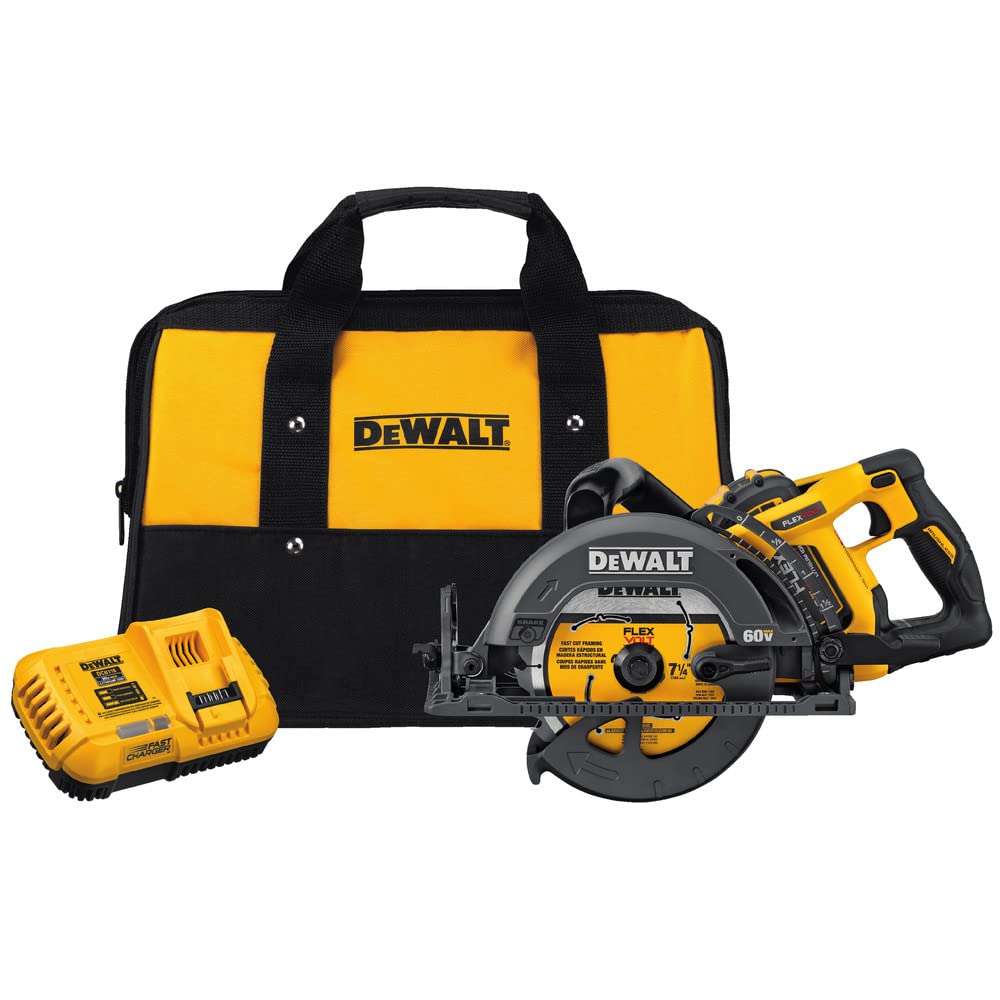
Ten point nine pounds with no cord to drag is the headline. That makes this the lightest saw on the list, beating the 11.5-pound SKIL models, and the freedom from an outlet is what makes it worth the premium. It is a worm-style saw, blade left and handle at the rear, so you get the sightline a right-handed framer expects while cutting anywhere on the site.
The kit ships complete: a DCB609 20V/60V MAX* FLEXVOLT 9.0Ah battery, a DCB118 fast charger, a 7-1/2-inch carbide blade, blade wrench, and a contractor bag. An electronic brake helps stop the blade once you release the trigger — a genuine safety edge when you are setting the saw down between cuts. The brushless motor and high-grade magnesium shoe are built for runtime and smooth cuts, and it achieves 2-7/16-inch depth of cut at 90 degrees. A 53-degree bevel with stops at 45 and 22.5 degrees covers the usual angles, and an integrated dust blower keeps the cut line clear.
The honest catch is the label: DEWALT calls it worm style, and the internals are not a worm gearbox. DEWALT aligns the blade and handle like a worm drive for the ergonomics, but the internals differ. For most framing work that distinction fades — buyers report it outperforming corded models on big cuts, and one account describes running two full days on a single charge. Weight still draws negative comments, oddly, given its 10.9-pound figure, so test the balance in hand before you commit.
Why the cordless premium pays
- 10.9 pounds, the lightest saw here, without a cord to manage
- 9.0Ah FLEXVOLT battery, fast charger, and blade all in the kit
- Electronic brake slows the blade after you release the trigger
- 2-7/16-inch depth of cut at 90 degrees with a 53-degree bevel
What to weigh before buying
- Worm-style layout only — the internals are not a worm drive gearbox
- Some users still flag the weight as an issue
Reach for this if: you need to cut where there is no outlet and want the worm-drive stance without the cord.
Pass on it if: you specifically need a true worm drive gearbox for heavy continuous torque.
8. SKIL SPT70V-11 16-5/16 In. Circular Saw

One pass through 6x lumber, no flipping the beam mid-cut.
A 6-1/4-inch cutting capacity is the whole story here. That means this saw cuts lumber up to 6-1/4 inches thick in a single pass — it handles 6x stock without you rolling the timber over and meeting the cut from the other side. For timber framing and beam work, that one spec saves real time every day.
The 15-amp Dual-Field motor is built to stay cooler for increased power, and the all-magnesium construction keeps the body durable while shaving weight where it can. A tough magnesium die-cast footplate holds accurate cuts, and the big 16-5/16-inch SKIL blade lets you cut perfectly straight from the start. It is not subtle or light: at 27.3 pounds it is the heaviest saw in this lineup by a clear margin, so treat it as a two-handed station tool rather than something you wave around overhead.
Owners rave about build quality and cutting performance — one account describes it handling 6×12 beams like butter, and the overall read is that it packs tremendous power. Size earns praise as a genuine strength, so the bulk that scares off some buyers is exactly what its fans wanted. Durability draws a mixed reaction, and weight is mixed too, which is fair given the 27.3-pound figure.
The case for it: nothing else here cuts 6x material in one pass, and the 16-5/16-inch blade does it right from the start.
Be sure you need it: at 27.3 pounds this is a bench-and-beam saw — buy it for huge stock and nothing smaller.
Know the Specs
What a worm drive actually is
A worm drive places the motor behind the blade and turns it through a worm gear — a screw-like gear that meshes with a wheel. That gearing slows the blade but multiplies torque, so the saw pushes through wet or thick lumber without stalling. The trade is weight and a rear-heavy balance, plus a blade that spins slower than a sidewinder’s.
Amps and no-load RPM
The amp rating describes current draw, and 15 amps is the standard in this class. More amps generally mean more torque under load. No-load RPM tells you how fast the blade spins with nothing in it, so a 5,300 rpm saw turns its blade quicker than a 5,000 rpm one — though gearing, not just rpm, decides how much force reaches the cut.
Blade size and depth of cut
Blade diameter sets how deep the saw reaches in one pass. A 7-1/4-inch blade is the common framing size; an 8-1/4-inch or 10-1/4-inch blade reaches deeper into thick stock; a 16-5/16-inch blade cuts lumber up to 6-1/4 inches thick in a single pass. Bigger blades mean more capacity and more weight to carry.
Bevel range in degrees
Bevel degrees measure how far the saw’s foot tilts away from a square cut. Ninety degrees is a straight crosscut; 45 degrees gives you a miter for corners. Saws here run from 45 degrees up to 60 degrees, and a wider range lets you cut steeper angles without resetting the workpiece.
Common Questions
Is a worm drive saw better than a regular circular saw?
What does the 15-amp rating on these saws mean?
How deep will a 7-1/4-inch worm drive saw cut at 45 degrees?
Can the DEWALT FLEXVOLT saw run on a standard 20V battery?
Why are worm drive saws so heavy compared with sidewinders?
What is the advantage of a 53-degree bevel over a 45-degree one?
Is a worm-style cordless saw a true worm drive?
Can a 16-5/16-inch worm drive saw cut 6x lumber in one pass?
Do these saws come with a blade in the box?
What is a rafter hook and do I need one?
The Bottom Line
For most working crews, the best worm drive motor winner is the SKILSAW SPT77WML-01 because it pairs a 15-amp motor with a 53-degree bevel and a magnesium body that holds the line at 11.5 pounds. If you need the widest bevel range for steep angle cuts, reach for the SKILSAW SPT78W-01 and its 60-degree bevel. If the outlet is never where you need it, the DEWALT DCS577X1 FLEXVOLT cuts free of the cord at 10.9 pounds.
And if your stock runs to 6x, the SKIL SPT70V-11 handles it in one pass. One honest nudge before you close the tab: the top pick carries the highest score in this lineup — 4.5+ stars — and the magnesium body is what makes it the one to grab first.
How we choose
We do not accept paid placement. Every pick is matched to a real buyer and a real use-case; we do not hands-on test units.
Sources
Specifications: manufacturer listings and product documentation. Review insights: verified customer reviews, as of November 2026. Pricing: not shown on this page (it changes often); check the current price via the retailer link.
As an Amazon Associate, Tactical Gear Guy earns from qualifying purchases. This does not affect which products we feature.