Specs are compiled from manufacturer listings and verified buyer reviews and can change over time — please confirm the key details on the product page before buying.
Buying a Worlds PC is really a bet on one part: the graphics card. Everything else in the tower — the processor, the memory, the storage — exists to keep that card fed with frames. Get the GPU right and the tower holds its frame rates for years. Get it wrong and you own an expensive box that stutters on the titles you actually play. This guide lines up eleven prebuilt towers and explains, in plain terms, which one suits which kind of player.
This guide is built by comparing the manufacturers’ published specifications and the patterns across verified customer reviews, so you get each pick’s real strengths and trade-offs instead of marketing spin.
Below you’ll find a full spec table, plain-English explainers on what each number actually does for you, and honest notes on where each tower falls short. The crowd favorite here holds 4.5+ stars across 600+ ratings, a solid track record for a mid-range prebuilt. Here is how to pick the right worlds pc without overspending on power you will never use.
Top Picks

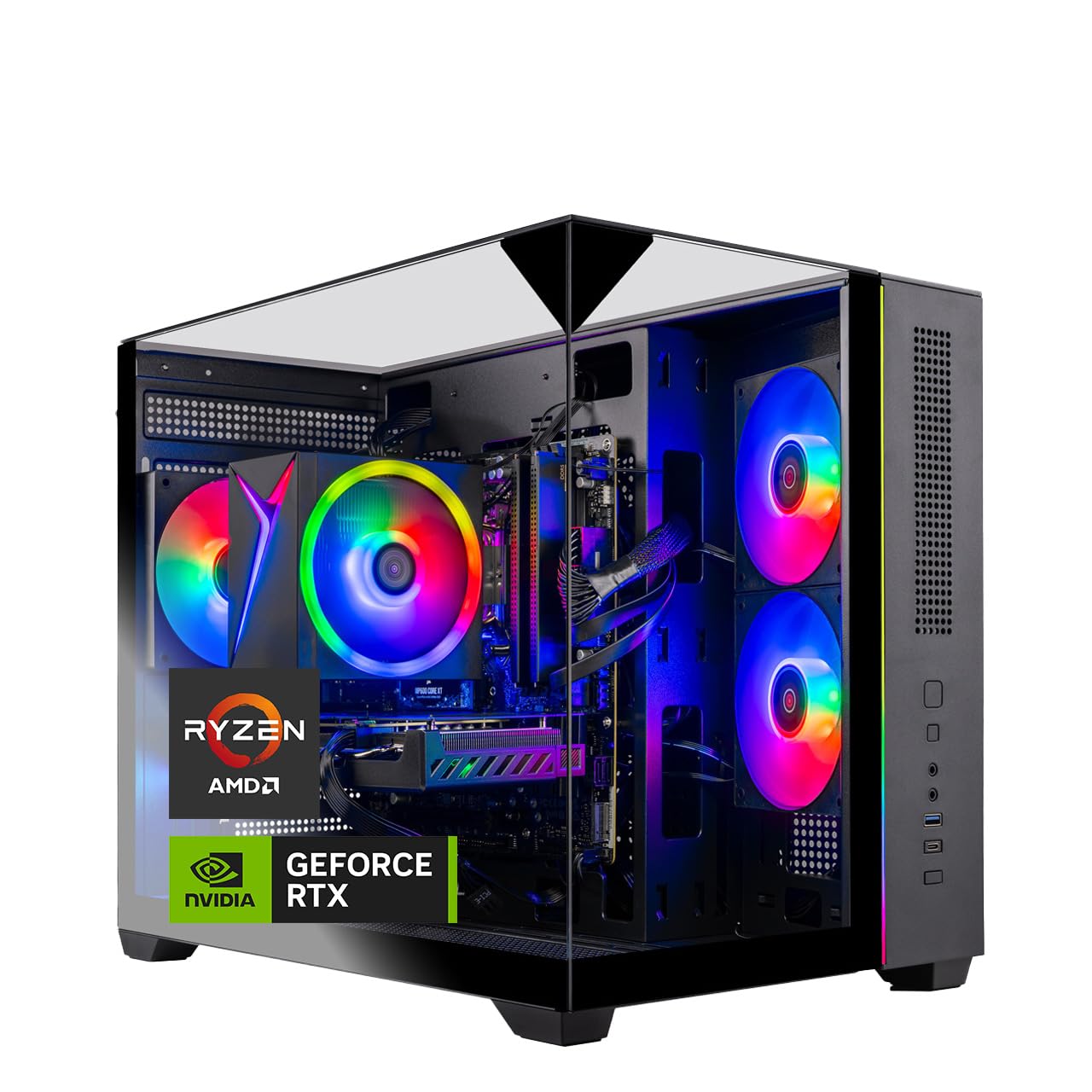
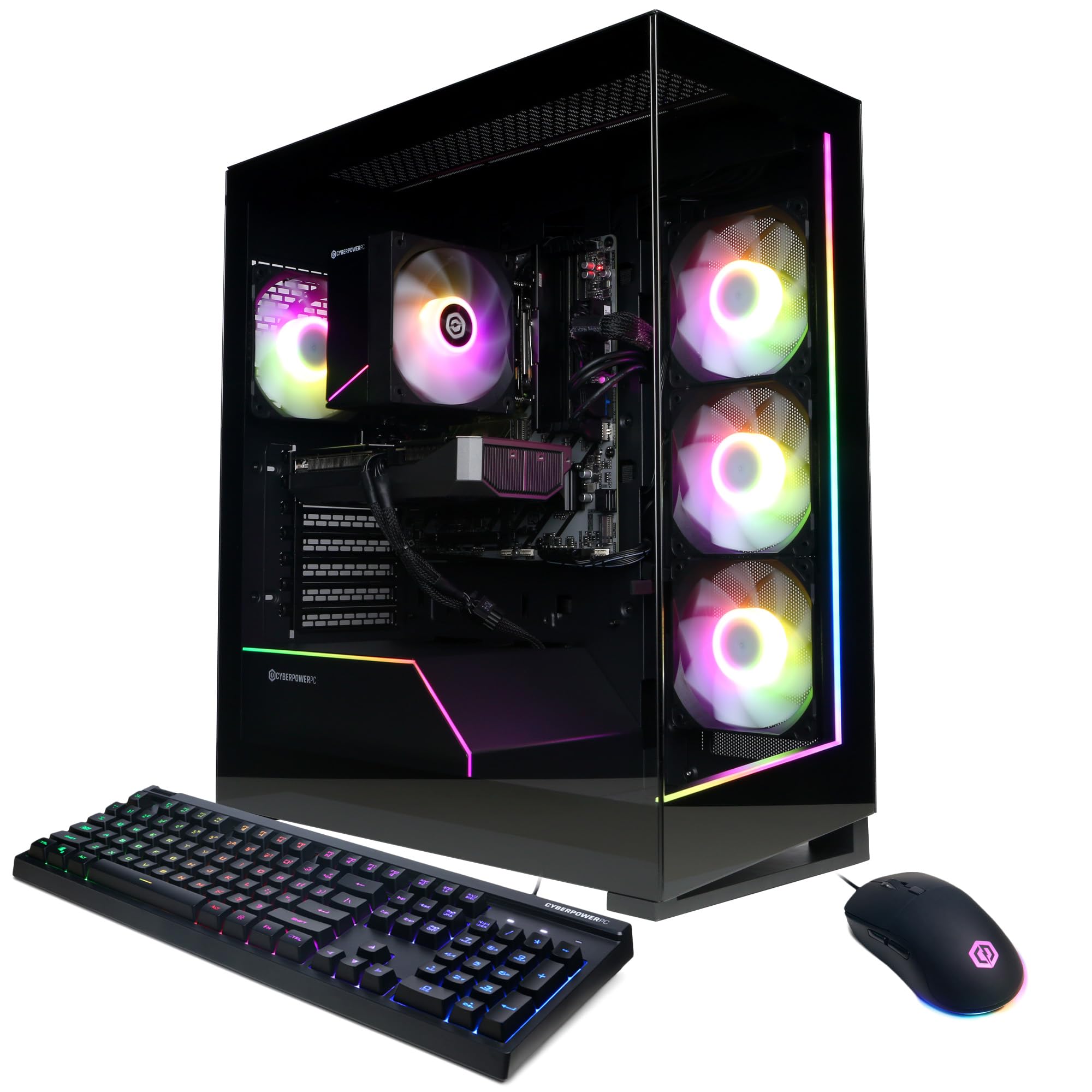
How To Choose The Best Worlds PC
Start with the screen you actually own. A 1080p monitor at 60Hz is a very different demand from a 1440p panel running at high refresh rates, and the card inside your tower should match that panel rather than the marketing on the box. Spend your budget on the card that drives those pixels.
Read the GPU before anything else
The graphics card sets your frame-rate ceiling. A card with 8GB of video memory handles 1080p comfortably today. A card with 12GB or 16GB gives you headroom for 1440p and for texture packs that keep growing. When two towers share a processor but differ on the card, the card is the deciding number.
Also check which card ports exist. Some prebuilts ship with a mix of HDMI and DisplayPort outputs — that matters if you plan to run two monitors side by side for streaming chat or spreadsheets.
Check the memory type, not just the amount
DDR5 is the newer memory generation and DDR4 is the older one. Both work, but a DDR5 board with spare slots is a better long-term bet because you can add memory later without replacing what’s already there. Look at the slot count in the listing — four slots means room to grow.
Decide whether you’ll ever open the case
Some towers are built with tool-less panels and standard parts, so swapping a card or adding a drive takes minutes. Others are tight, with proprietary layouts. If you plan to upgrade, that accessibility is worth more than an extra fan or a nicer finish.
Air or liquid cooling
An air cooler with copper heat pipes and a fan keeps most gaming processors in a safe range. A liquid loop (an AIO, or all-in-one cooler) moves heat away faster and usually runs quieter under long sessions. Neither is a guarantee of silence — case airflow and fan curves do half the work.
Side-by-Side Comparison
| Model | Best For | Graphics Card | Processor | Memory | Amazon |
|---|---|---|---|---|---|
| CyberPowerPC Gamer Xtreme VR★ Best Overall | All-round 1080p gaming | RTX 5060 8GB | Intel Core i5-13400F 2.5GHz, 10 cores | 16GB DDR5 | Amazon |
| Skytech CrystalCPU Muscle Pick | Fast CPU for the money | RTX 5060 8GB GDDR7 | Ryzen 7 5700, 4.6GHz | 32GB DDR4 3200 | Amazon |
| CyberPowerPC Ryzen 7 8700F1440p Value | 1440p on a budget | RTX 5060 Ti 8GB | Ryzen 7 8700F 4.1GHz, 8 cores | 16GB DDR5 | Amazon |
| KOTIN Gaming Desktop | Cool case, easy upgrades | RTX 5060 Ti 8GB | Ryzen 7 8700F, up to 5GHz | 16GB DDR5 | Amazon |
| Pink RGB Prebuilt Tower | Showpiece streaming rig | RTX 5060 8GB GDDR7 | Ryzen 7 5700X 3.4GHz, 8 cores / 16 threads | 32GB DDR4 | Amazon |
| HP OMEN 40L | Multi-monitor desk setup | GTX 1660 SUPER 6GB | Ryzen 7 5700X, up to 4.60GHz | 32GB DDR4 | Amazon |
| HP OMEN 45L | Heavy multitasking and storage | GTX 1660 SUPER 6GB | Intel Core i7-12700KF, 4.90GHz boost | 64GB DDR4 | Amazon |
| MSI Codex Z2 | Future-proofed 1440p | RTX 5070 12GB | Ryzen 7 8700F, up to 5.0GHz | 32GB DDR5 | Amazon |
| iBUYPOWER Element | High-refresh competitive play | RTX 5070 12GB GDDR7 | Intel Core i7 14700F, up to 5.4GHz | 32GB DDR5 RGB 4800MHz | Amazon |
| Alienware Aurora | No-compromise 4K gaming | RTX 5080 16GB GDDR7 | Intel Core Ultra 9 285, up to 5.6GHz | — | Amazon |
| STORMCRAFT Phantom | Maximum frames per second | RTX 5080 16GB GDDR7 | Ryzen 7 9800X3D, up to 5.2GHz | 32GB DDR5 6000MHz | Amazon |
Detailed Reviews
1. CyberPowerPC Gamer Xtreme VR Gaming PC
Our pick — 4.5+★ from 600+ verified ratings; the strongest balance of quality and price.
Ten cores, a 1TB Gen4 drive and the RTX 5060 — the tower that gets the basics right.
This is the pick for someone building a first serious gaming setup around a 1080p monitor, and it is the crowd favorite here at 4.5+ stars across 600+ ratings. The RTX 5060 with 8GB of video memory (the card’s own working memory for textures and lighting) is the part that matters. It handles indie titles and competitive shooters without strain, and the 10-core Intel Core i5-13400F keeps background apps and voice chat from stealing frames.
Speed is the thing that wins people over — the tower pushes high frame rates on lighter titles and stays quiet doing it, which is not something every prebuilt manages. Setup is genuinely painless: Windows 11 Home is already installed, the keyboard and mouse come in the box, and WiFi 6 plus Bluetooth 5.3 mean you can be online before you finish unpacking the monitor. Ports are generous too, with one USB-C 3.2, two USB-A 3.2, six USB-A 2.0, and a LAN jack.
Here is the honest comparison against the Skytech below: the Skytech’s processor tops out at 4.6 GHz versus 2.5 GHz here, and it carries 32GB of memory instead of 16GB. The CyberPowerPC fights back with DDR5 — the newer memory generation — and a 1TB PCIe 4.0 NVMe SSD with 20 of cache memory against the Skytech’s 2. In practice the DDR5 board is the smarter foundation for later upgrades. The catch is memory capacity: 16GB is fine for gaming plus a browser, and tight once you start streaming and editing at the same time.
What earns its place
- RTX 5060 8GB paired with a 10-core i5-13400F — balanced, no obvious bottleneck
- 1TB PCIe 4.0 NVMe SSD means games load fast and the library has room
- WiFi 6 and Bluetooth 5.3 built in, so no dongle clutter
- Quiet under load with a tempered glass side panel and custom RGB
Where it asks you to compromise
- 16GB DDR5 is the floor for gaming-plus-streaming; video editing will want more
- Memory capacity trails the Skytech’s 32GB, even though the DDR5 type is newer
Reach for this if: you want a clean, quiet 1080p tower that boots into Windows and just works, with a modern DDR5 board for later upgrades.
Look elsewhere if: you already edit 4K video or run heavy creator software alongside games — the Skytech’s 32GB will serve you better.
2. Skytech Gaming PC Desktop
Thirty-two gigabytes of memory and a 4.6 GHz boost, wrapped in triple tempered glass.
If you keep twenty browser tabs open while a game runs in the background, this tower answers that habit directly. The AMD Ryzen 7 5700 boosts to 4.6 GHz — comfortably above the CyberPowerPC’s 2.5 GHz figure — and it sits alongside 32GB of DDR4 3200 memory with heat spreaders. That headroom is what lets you game, stream, and leave Discord running without the whole machine dragging.
The graphics side is an NVIDIA GeForce RTX 5060 with 8GB of GDDR7 memory, the faster memory type, and Skytech pairs it with a high-performance air cooler and ARGB fans in the Crystal case. The 1TB NVMe M.2 SSD is the other quiet win — the listing compares it against a traditional hard drive, which in daily use means short boot times and fast level loads. Assembled in the USA, with a year of parts-and-labor coverage and free tech support, and it ships with a gaming keyboard and mouse.
What buyers single out most is the performance for the money, and several describe it as a strong starting tower. The honest split in feedback is about power — most units fire up fine, but a rare one arrives dead. That is a shipping and quality-control risk on any prebuilt, and the warranty is your recourse. Note also that the graphics card brand may vary between units, so check the card in your specific build if a particular model matters to you.
Memory advantage: 32GB DDR4 is the standout number here, and it is what separates this tower from the CyberPowerPC’s 16GB DDR5 for heavy multitaskers.
Trade-off to weigh: DDR4 is the older memory generation, so future memory upgrades stay on the older standard rather than DDR5.
Pick this one when: streaming, tab-hoarding, or running a few apps at once is normal for you and you want memory to spare.
Think twice if: you want the newest memory standard for a long-term platform — the DDR5 boards above and below will age better on that specific point.
3. CyberPowerPC Gaming PC
The RTX 5060 Ti is the step up that makes 1440p feel normal instead of ambitious.
If you have a 1440p monitor and want to actually use its resolution, this tower is where the value sits. The “Ti” on the end of the card name is the whole story: it runs a GeForce RTX 5060 Ti with 8GB of GDDR7 memory (a newer, faster type of video memory). That is a stronger card than the plain RTX 5060 in the picks above. And comparing graphics card memory directly, it carries 8GB against the HP OMEN 40L’s 6GB, so you get more headroom for high-resolution textures.
The processor is an AMD Ryzen 7 8700F with 8 cores on the B850 chipset, paired with 16GB of DDR5 and a 1TB PCIe 4.0 NVMe SSD. Connectivity is solid for a desk setup: two USB-C 3.2, four USB-A 3.2, two USB-A 2.0, a LAN port, WiFi 6, and Bluetooth 5.3. A tempered glass panel and custom RGB round out the look, and the keyboard and mouse ship in the box.
The owner consensus is straightforward — this thing runs everything thrown at it, handles demanding titles without stutter, and feels built to last. The real limitation is memory: 16GB of DDR5 is fine for gaming, and the board lives alongside the same capacity ceiling as the Gamer Xtreme VR. Creator workloads that chew through RAM will want the 32GB Skytech instead.
Worth it for: anyone stepping up to a 1440p panel who wants the stronger Ti card without leaping to premium-tier spending.
Not the one for: if 32GB of memory is your priority over card power, the Skytech above beats it on capacity.
4. Pink RGB Prebuilt Gaming Desktop PC
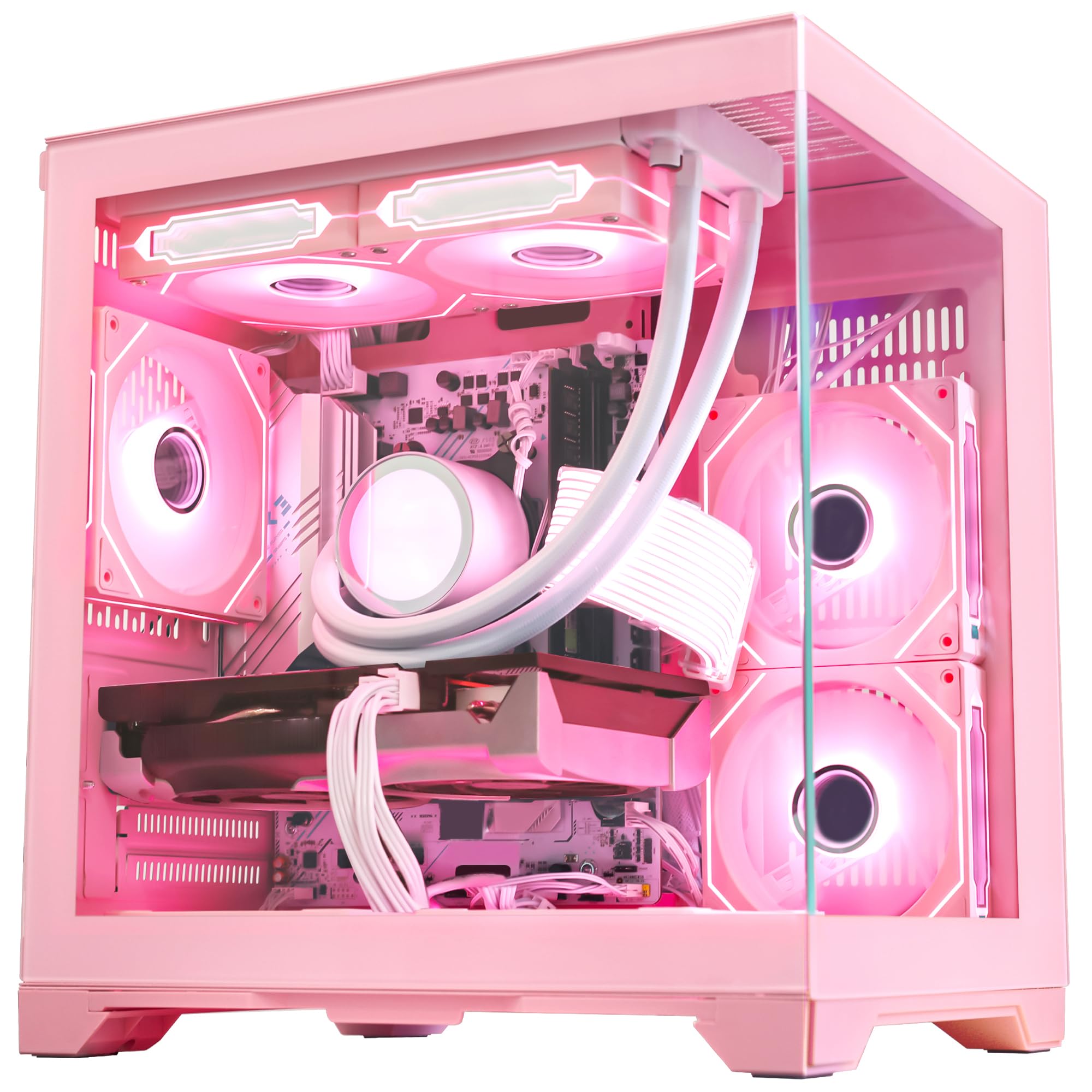
A pink case, a 240mm liquid loop and 32GB of memory — this one is meant to be seen.
Most prebuilts are black boxes. This one is not, and that is the point. The pink chassis with ARGB lighting and a 240mm AIO (an all-in-one liquid cooler that pumps coolant past the processor) is aimed at someone building a desk setup they actually want to photograph. Under the glass, an AMD Ryzen 7 5700X with 8 cores and 16 threads handles gaming plus OBS live streaming at the same time, which is exactly the workload a creator desk produces.
You get smooth frame rates in competitive titles, according to the listing, which credits the GeForce RTX 5060’s DLSS 4 support (an AI upscaling feature that renders at lower resolution and rebuilds the detail). The card has 8GB of GDDR7 memory (a newer, faster type of video memory). A 1TB PCIe SSD keeps load times short, and 32GB of DDR4 memory covers browser tabs, editors, and game launchers together. Upgrades are easy: two DDR4 memory slots, a standard PCIe GPU slot, an extra storage bay, and a 650W power supply. A one-year parts and labor warranty backs it.
Buyers report satisfaction with how it performs in games, and the appearance is a real part of the appeal if you are considering a colored case. A machine in this colorway is a deliberate style call, and the pink finish is the deciding factor either way. Worth knowing: this is the smallest listing in the group on the cooling side, and a 240mm liquid cooling loop (a sealed radiator-and-fan setup) is good, not extravagant. The 650W power supply also sets a ceiling on how ambitious a future graphics card upgrade can be.
Style that does work: the 240mm AIO liquid cooler is a genuine performance part, not just decoration, and 32GB of DDR4 keeps it capable.
Ceiling to note: the 650W power supply is worth remembering before you plan a big future card swap.
Made for: the streamer or creator who wants the tower to be part of the aesthetic and streams while gaming.
Better served elsewhere: if you want a plain black box and the lowest possible outlay for the same card class, the CyberPowerPC picks are the calmer choice.
5. KOTIN Gaming PC Desktop
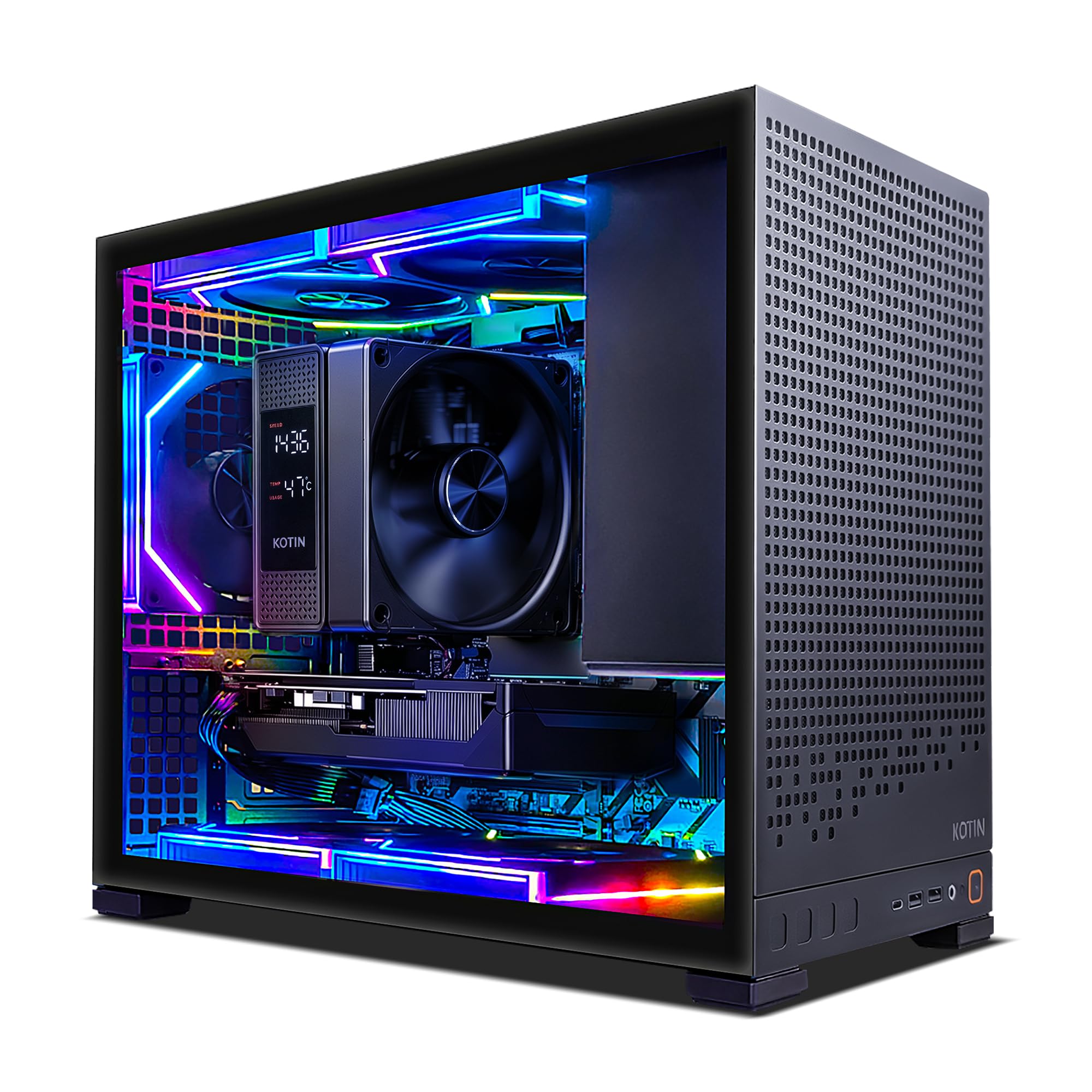
Five ARGB fans, a digital temperature readout and room to grow — built to be tinkered with.
This tower earns a spot on a short list for one reason: it is designed to be opened up later. Four DDR5 memory slots and three M.2 SSD slots mean you can expand without replacing anything already inside. The CPU air cooler uses six copper heat pipes and a digital temperature display, working with five 120mm ARGB fans to keep airflow moving through long sessions. WiFi 7 and Bluetooth cover the wireless side, and a 650W 80 Plus Gold power supply gives the parts clean power.
It runs an AMD Ryzen 7 8700F processor with a 5GHz maximum speed and a GeForce RTX 5060 Ti with 8GB of GDDR7 memory (a newer, faster type of video memory). That is the same card class as the CyberPowerPC above, with DLSS 4 (an AI upscaling feature that boosts frame rates) and ray tracing (realistic lighting effects) support noted in the listing. The 1TB PCIe Gen4 NVMe SSD (a fast, compact storage drive) shortens boot times and holds a healthy game library. It arrives assembled and tested in the USA with Windows 11 Home pre-installed and a one-year limited warranty.
One practical tip the maker puts front and center: plug your monitor into the graphics card ports on the lower back of the case, not the upper motherboard ports, or you get a blank screen. That single instruction defuses most first-boot panic. Owners describe smooth sessions in titles like GTA V and World of Warcraft and an easy setup process. If you want to start simple and add memory or storage in a year or two, this is the tower that rewards that plan.
Why it stands out
- Four DDR5 DIMM slots and three M.2 slots — rare upgrade flexibility in this class
- WiFi 7 for low-latency wireless play
- Six copper heat pipes plus five ARGB fans with a temperature display
- 650W 80 Plus Gold supply for stable power delivery
Keep in mind
- Monitor must go to the graphics card ports, not the motherboard — read the label
- VGA or DVI monitors need an HDMI/DP adapter, since this PC outputs HDMI and DP
Best for tinkerers: a buyer who wants a strong starting point and a clear path to adding memory and storage later.
Less ideal if: you never plan to open the case — the expandability you paid for would sit unused.
6. HP OMEN 40L Gaming Desktop PC
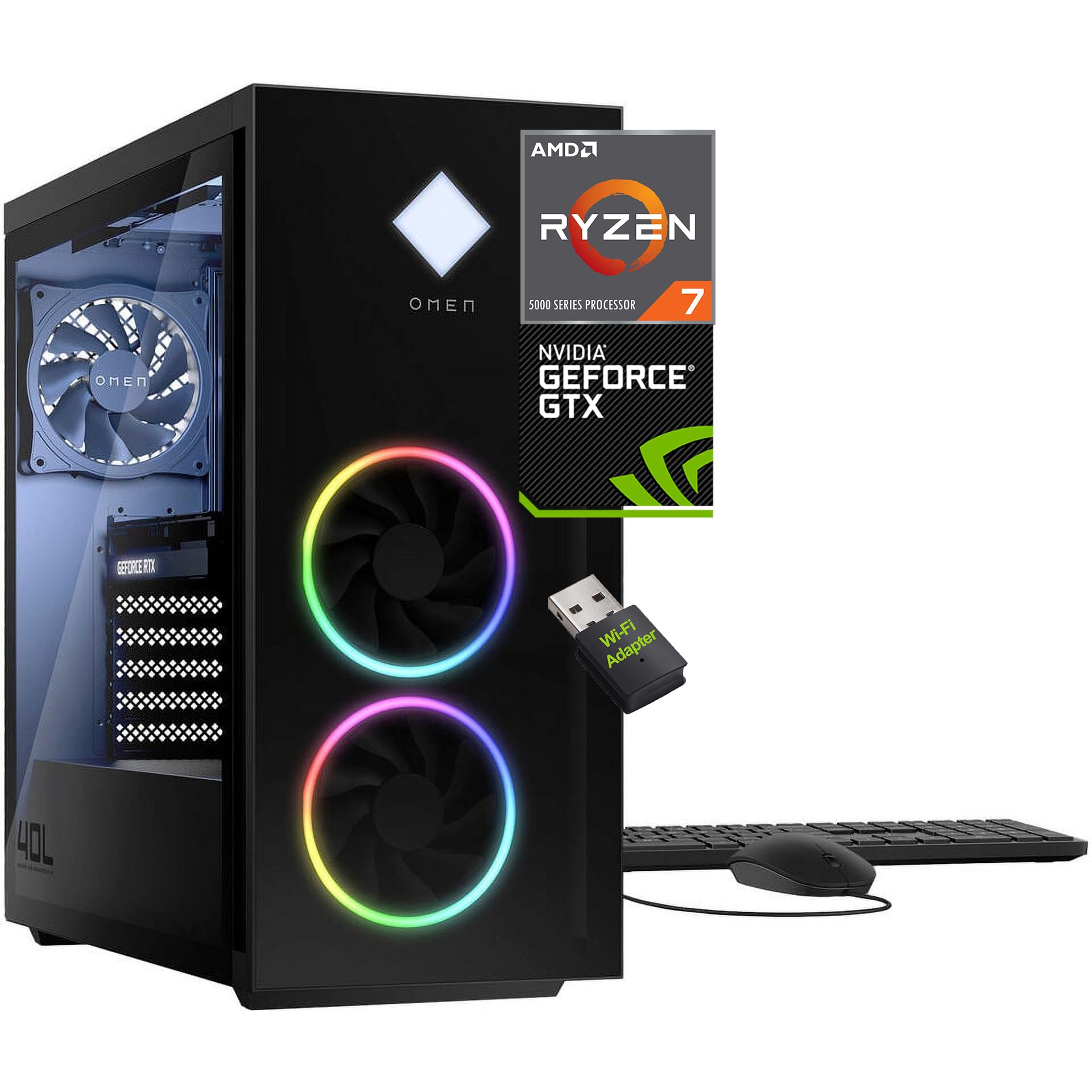
Three display outputs, tool-less panels and 32GB of memory for a full battle station.
Picture a desk with two or three monitors on it — game in the middle, chat and spreadsheet on the sides. That is where the OMEN 40L makes sense. The dedicated GeForce GTX 1660 SUPER graphics connects over DVI, HDMI, or DisplayPort, so you can build the multi-screen layout you want. An AMD Ryzen 7 5700X with 8 cores and 16 threads up to 4.60GHz and 32MB of cache carries the load, paired with 32GB of DDR4 memory and a 1TB PCIe NVMe M.2 SSD.
The chassis design is the sleeper feature. A tool-less layout makes future upgrades quick, and the active fan-sink cooling with 4-pin fan control helps hold performance under sustained load. OMEN Light Studio controls RGB effects across connected devices, OMEN Audio Control handles 5.1 surround with DTS:X Ultra, and the 600W power supply keeps it all fed. An HP wired keyboard and mouse plus a bundled wireless USB WiFi adapter come in the box.
Here is the trade-off in plain terms: the graphics card is a 6GB GTX 1660 SUPER, and the cards in the picks above carry 8GB. This tower is built for everyday work and non-demanding gaming alongside a busy multi-monitor desk, and several buyers treat it exactly that way. Newer AAA titles at high settings will ask more of the card than it can give. Buy it for the memory, the ports, and the easy-upgrade case — not as a cutting-edge gaming rig.
The memory-and-ports case: 32GB DDR4 plus a 1TB NVMe SSD and three display connection types make this a strong desk-work tower.
The honest limit: the GTX 1660 SUPER is a 6GB card, so competitive shooters and older titles are a better fit than the newest AAA releases at high settings.
Suits: a first desk that doubles as a home office, where three displays and plenty of memory matter more than the newest GPU.
Skip for: anyone whose main goal is 1440p gaming on new releases — the card class here points you to a different pick.
7. HP OMEN 45L Gaming PC
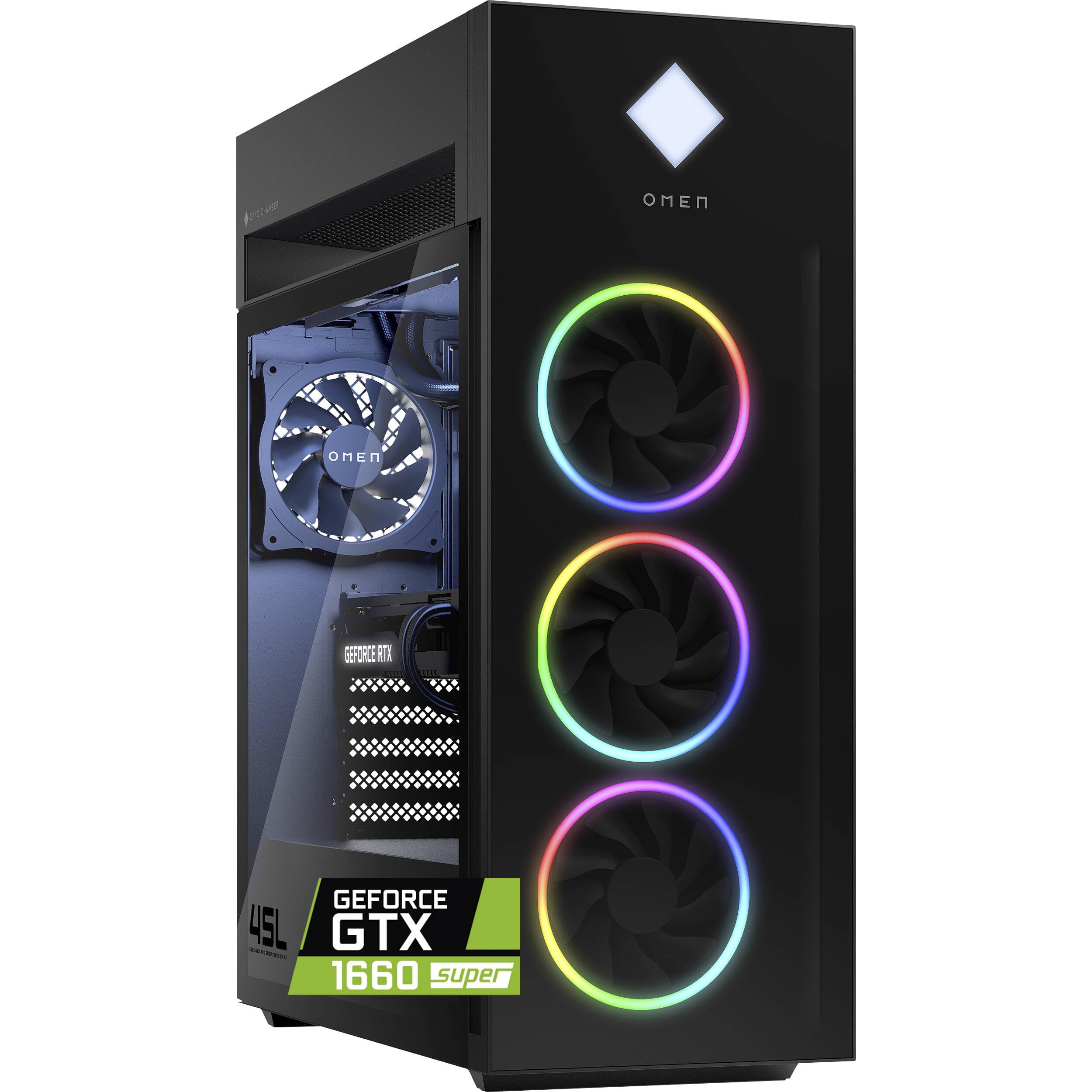
Sixty-four gigabytes and a 2TB Gen4 drive — a workstation wearing a gaming tower’s clothes.
If your day involves 3D rendering, giant video timelines, or a dozen browser windows with editor software running, the 64GB of DDR4 here is the number that matters most. 64GB of DDR4 versus the 32GB picks above, and it sits alongside a 2TB PCIe Gen4 NVMe SSD. Together they mean instant app switching, fast boots, and a huge library without shuffling files.
The processor is an Intel Core i7-12700KF with 12 cores and 20 threads boosting to 4.90GHz via Intel Turbo Boost Max 3.0, backed by 25MB of cache and the Z690 chipset. Cooling is handled by a liquid cooler in a compact MicroATX frame, and an 800W 80 Plus Gold power supply runs at a stated 90% efficiency. Connectivity is the other strength: ten USB ports total, including USB 3.2 Gen2 Type-A and Type-C, plus Gigabit Ethernet, a Wi-Fi adapter, and 5.1 surround with DTS:X Ultra.
Be clear-eyed about the card. A GeForce GTX 1660 SUPER with 6GB drives the display here, so 1080p gaming at high settings across titles like Fortnite, Valorant, Apex Legends and Call of Duty is the target. This is a multitasking and creation tower that can game, not a gaming tower first. Buyers who use it for software development and heavy work report good value from the component mix. If frames are your priority, the MSI and iBUYPOWER picks below spend the same money on a stronger card.
Choose this when: your workload is editing, rendering, or development and the 64GB and 2TB figures solve a problem you actually have.
Wrong tool if: the graphics card power matters more to you than memory and storage — plenty of towers here beat it on frames.
8. msi Codex Z2 Gaming Desktop

A 12GB RTX 5070 with a 2TB drive — the tower that stops you worrying about tomorrow’s games.
You can run modern titles at 1440p with high textures without hitting a wall, thanks to the 12GB of video memory on this graphics card. That 12GB figure is the single most important number in the whole review. It runs alongside an AMD Ryzen 7 8700F with 8 cores and 16 threads boosting to 5.0 GHz, 32GB of DDR5 memory, and a 2TB SSD — enough space that you will not be uninstalling games to make room.
The RTX 5070 is built on NVIDIA’s Blackwell architecture, and the listing frames it as a generational leap in rendering and ray tracing. In practice that means higher frame rates in the games you already own plus quieter operation — owners consistently note how quiet it runs. RGB lighting cycles through options with an MSI LED button or the MSI Center software, and Windows 11 Home is pre-installed with keyboard and mouse included.
The one thing to go in knowing is that reliability is the split point in feedback: most units run flawlessly and a minority fail early. That is a quality-control variance across the prebuilt market rather than a reason to dismiss the tower, and the return window plus warranty is how you protect yourself. Weigh it against the iBUYPOWER below, which offers a 5.4 GHz processor and a 12GB RTX 5070 for more money — the MSI is the calmer spend if you value DDR5 and don’t need every last megahertz.
Why it earns the mid-premium slot
- 12GB RTX 5070 — real headroom for 1440p and high-resolution textures
- 32GB DDR5 plus a 2TB SSD for a long life without immediate upgrades
- 8-core Ryzen 7 8700F boosting to 5.0 GHz
- Quiet under load, which many towers this powerful are not
Where to be cautious
- Early failures on a minority of units make a careful first-week test worthwhile
- Air cooling rather than liquid — fine for this CPU, but a strong case-fan setup matters
the balance for 1440p: you want a tower that will not feel outdated on modern releases for several years.
Hold off if: you rarely push past 1080p — the CyberPowerPC 5060 Ti reaches that target for less commitment.
9. iBUYPOWER Element Gaming PC
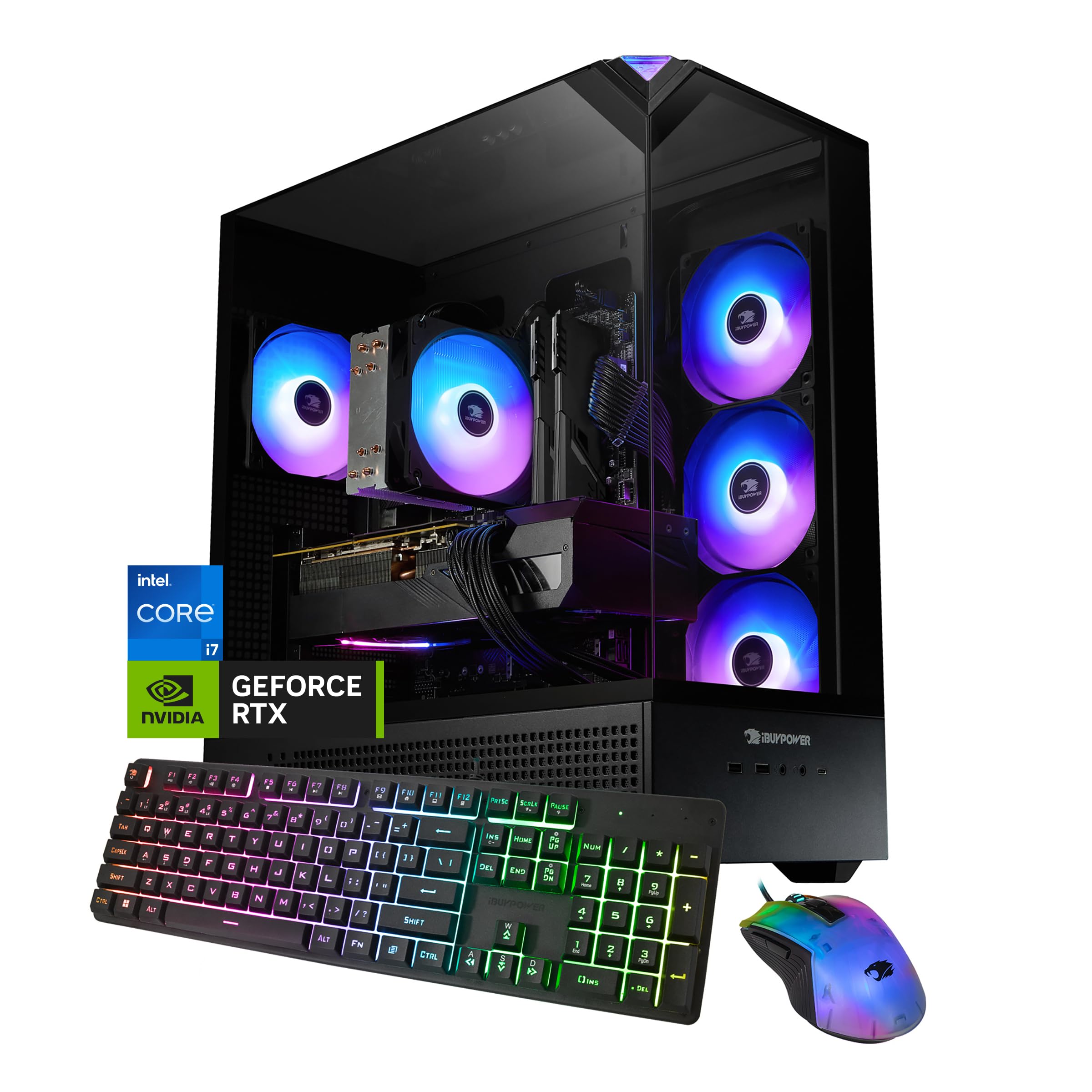
A 5.4 GHz processor and a 12GB RTX 5070, aimed squarely at high-refresh gaming.
For a competitive player on a 144Hz or faster monitor, the pairing here is the draw. An Intel Core i7 14700F boosting to 5.4 GHz — the highest processor clock in this roundup before the premium tier — sits alongside an NVIDIA GeForce RTX 5070 with 12GB of GDDR7 memory. Those two together are what push big battles in demanding games to smooth frame rates. The 32GB of DDR5 RGB 4800MHz memory keeps OBS, browser tabs, and voice chat from fighting the game for resources.
Storage is a 1TB NVMe SSD, and the case is tempered glass with 16-color RGB lighting. Connectivity includes six USB 3.1 ports and a 10/100/1000 Ethernet jack for wired play, with 802.11AC Wi-Fi built in. A gaming keyboard and RGB mouse come included, and the listing notes no bloatware plus readiness for AI workstation tasks.
Owners mention that it runs most games at 100 frames per second or more, and one favorite example is massive siege battles in Bannerlord staying smooth at high settings. The flip side in the feedback is a split on reliability and storage capacity, with a portion of owners reporting problems. Treat the first week as a test period. On raw clocks, note that the STORMCRAFT’s 9800X3D tops out at 5.2 GHz against 5.4 GHz here — this tower wins the megahertz race, though clocks alone never tell the full gaming story.
Clock speed lead: 5.4 GHz is the highest processor figure outside the premium tier, and combined with 12GB of video memory it targets high-frame competitive play.
Real caveat: the feedback splits on reliability, so plan a thorough shakedown in the return window.
Take it to the ladder: competitive players chasing frame rates on high-refresh monitors who want a proven powerhouse platform.
Look past it if: you want maximum value per frame and don’t need the fastest processor — the MSI Codex Z2 covers 1440p comfortably.
10. Alienware Aurora Gaming Desktop

A 16GB RTX 5080 under a matte basalt-black chassis with stadium lighting zones.
This is the tower for someone who wants the top tier and does not want to think about it again for years. The NVIDIA GeForce RTX 5080 with 16GB of GDDR7 memory is built on the Blackwell architecture, and 16GB of video memory is what lets a machine handle 4K textures and ray-traced lighting without compromising. Behind it sits an Intel Core Ultra 9 285 boosting to 5.6 GHz with 76 of cache — the highest clock figure in this entire group.
The chassis is matte “basalt black” with AlienFX lighting zones including stadium lighting, and the Alienware Command Center software lets you set performance modes and save custom profiles per game. Cooling runs through a 240mm heat exchanger on the optional CPU liquid cooling, which the listing says keeps temperatures low during long sessions. Dell’s 1 Year Onsite Service means they come to your home or office if a covered hardware issue can’t be fixed remotely — a service tier none of the other towers here offer.
One expectation to reset before you buy: cooling feedback is mixed, and the liquid cooling is listed as optional rather than standard on every configuration. Some builds run cool, others don’t. Check exactly which cooling your unit ships with before you commit. On performance and build quality, the tower delivers what the specs promise — the quiet operation is a recurring theme. What you’re paying for is the card class and that onsite support, not value per frame.
For the buyer who wants the top: 4K gaming, streaming, and multi-hour creation sessions where the RTX 5080 and onsite service justify the premium.
Overkill if: your monitor is 1080p or 1440p — the MSI Codex Z2 delivers the resolution you’ll actually use for far less.
11. STORMCRAFT Phantom RTX 5080 Gaming PC
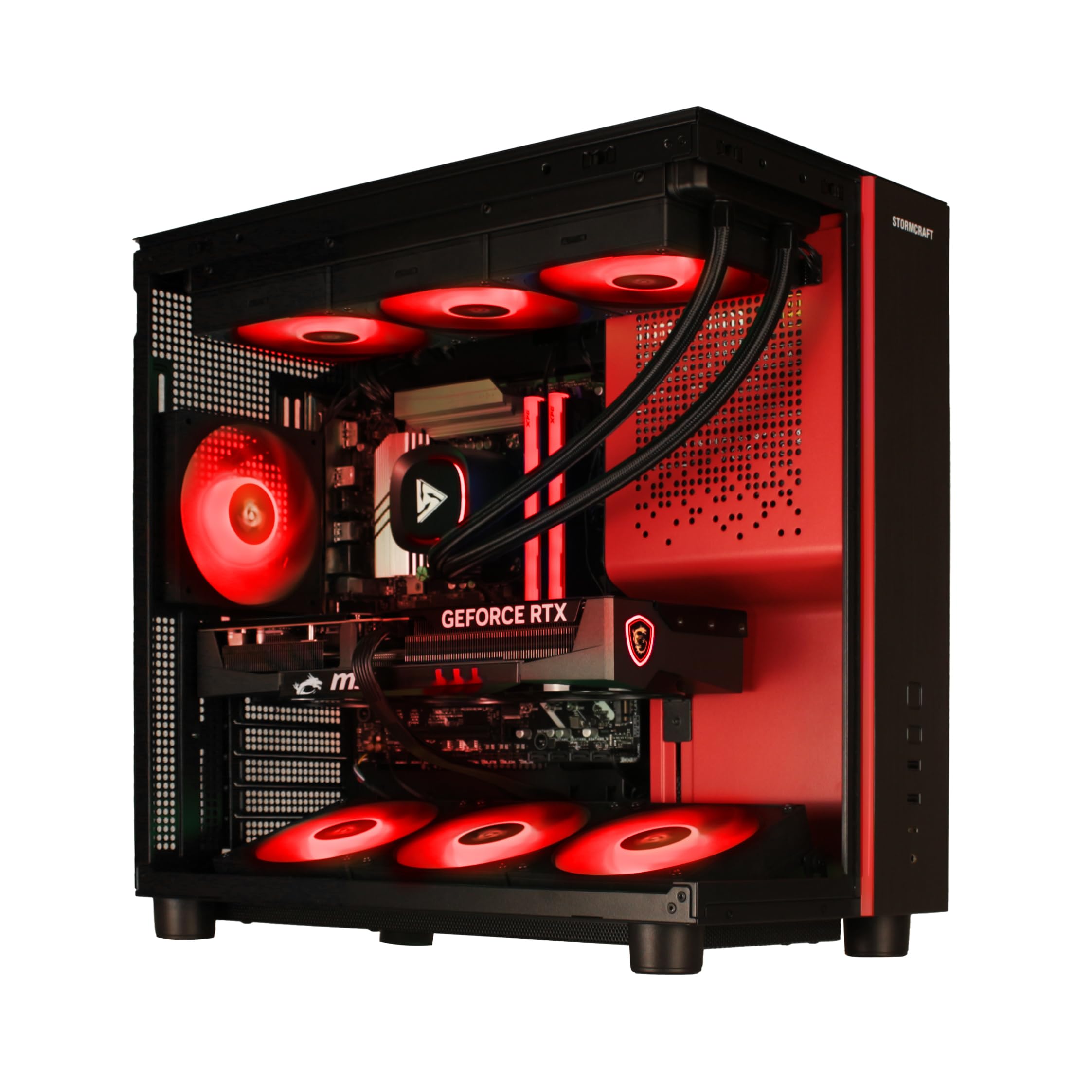
The gaming-first processor, a 360mm liquid loop and 850W of Gold-certified power.
If frame rates are your religion, the AMD Ryzen 7 9800X3D is the part to know. It has 8 cores and 16 threads and maxes out at 5.2 GHz, and the listing pairs it with 96MB of cache — a huge buffer that keeps frame rates high when a game is bouncing between tasks. It sits with an RTX 5080 with 16GB of GDDR7 memory and a 256-bit memory interface, the same card class as the Alienware, alongside 32GB of DDR5 6000MHz RGB memory and a 2TB NVMe Gen4 SSD.
Cooling is where this tower separates itself: a 360mm AIO liquid cooler (a bigger radiator than the 240mm loops above, which moves more heat) paired with seven ARGB system fans. An 850W Gold-certified power supply backs the whole build — more headroom than the 650W units in the mid-range picks. The Phantom case measures 17″ x 9.25″ x 17″, so confirm it clears your desk or shelf before ordering. It is assembled in California and comes with 2 years of parts coverage, 3 years of labor, 1 year of shipping, and free lifetime technical support.
What buyers highlight is that it outperforms expectations and sets up quickly — the plug-and-play experience is a genuine relief at this price point. It is also the highest-rated tower in the whole roundup, at 4.5+ stars across 30+ ratings, which counts for something even at this smaller review volume. If you want a strong gaming-first platform with the cooling and power already handled, this is the most complete gaming build here.
The gaming casestrong>
- 9800X3D with 96MB cache — the gaming-first processor choice
- 360mm AIO plus seven ARGB fans for sustained cooling
- 850W Gold supply and 2TB Gen4 SSD, no immediate upgrade needed
- 2 years parts, 3 years labor, lifetime tech support
Before you commit
- A 17″ x 9.25″ x 17″ case is a large footprint — measure your space first
- The smallest owner base in the group, so long-term patterns are still forming
Built for frame chasers: players who want the gaming-first processor and 16GB card class with cooling and power already solved.
Not necessary for: a 1080p desk where the 5060-class towers above deliver everything you’d notice.
Know the Specs
Video memory (VRAM) on the graphics card
VRAM is the card’s own working space for textures and lighting data. More of it lets a game load sharper art without the card running out of room. An 8GB card covers 1080p well and handles 1440p with sensible settings. A 12GB or 16GB card gives you room for higher-resolution textures and ray-traced lighting. When you compare towers, treat VRAM as the first number you check.
Processor speed versus core count
The GHz figure is how fast each core works; the core count is how many jobs run side by side. A 10-core chip at 2.5 GHz and an 8-core chip at 4.6 GHz are aiming at different things — one for steady multi-app work, one for quick single-task responses. Games lean on both. Streaming, editing, and browser stacks lean harder on core count and cache. Neither number alone tells you which is faster.
DDR5 versus DDR4 memory
These are memory generations. DDR5 is newer, and boards built for it usually offer a longer upgrade path. DDR4 is mature and often appears in higher capacities for the same spend. What matters most for daily use is the amount — 16GB handles gaming plus a browser, and 32GB or 64GB is where multitasking and editing stop being a worry. Check the slot count too, since empty slots mean room to add later.
Air cooling versus a liquid AIO
An air cooler is a metal heatsink with fans bolted to the processor. An AIO is a sealed loop that pumps coolant to a radiator, and the radiator size — 240mm, 360mm — tells you how much heat it can shed. A bigger radiator generally means quieter operation under long sessions. Air cooling is simpler and has fewer parts that can fail. Either can work well if the case moves air properly.
Power supply rating and wattage
The wattage is the ceiling on how much power the parts can draw. The rating — 80 Plus Gold, for instance — describes efficiency, meaning how much of the wall power becomes usable output rather than waste heat. A 650W unit suits a mid-range card. An 850W unit leaves room for a bigger graphics card later. If you plan to upgrade the GPU, the supply is the part that decides whether you can.
SSD speed and interface
The SSD is your storage, and the interface — PCIe Gen4 or Gen3 — sets its speed tier. A Gen4 drive boots Windows quickly and shortens level loads. Capacity decides how many large games you can keep installed at once. A 1TB drive covers a solid library; 2TB means you stop uninstalling to make room. When a listing says NVMe M.2, it means the drive plugs straight into the board rather than wiring in like an older drive.
Common Questions
Will a prebuilt Worlds PC let me upgrade the graphics card later?
Is 16GB of RAM enough for gaming and streaming at the same time?
What is the difference between an RTX 5060 and an RTX 5060 Ti?
Do I need 12GB or 16GB of video memory for 1440p gaming?
My new PC powers on but shows no picture — what is wrong?
Is liquid cooling worth it over an air cooler in a gaming tower?
How much SSD space do I need for a modern game library?
What should I check in the first week after a prebuilt arrives?
Is a faster processor more important than a faster graphics card for gaming?
Can I use a Worlds PC for video editing and streaming as well as gaming?
The Bottom Line
For most players, the worlds pc winner is the CyberPowerPC Gamer Xtreme VR because it balances a modern RTX 5060 8GB card, a 10-core i5-13400F, DDR5 memory, and a 1TB Gen4 SSD in a quiet, cleanly built tower. If you want memory to spare for streaming, grab the Skytech with its 32GB. And for a clear step up to 1440p, the MSI Codex Z2 pairs a 12GB RTX 5070 with 32GB of DDR5 for a tower that will not feel outdated anytime soon.
Wherever you land, buy on the card class and the memory capacity first, and treat everything else as finish. The tower with the right GPU and enough memory will serve you for years; the one with the prettier case and a weaker card will not keep up. That is the one spec worth slowing down for.
How we choose
We do not accept paid placement. Every pick is matched to a real buyer and a real use-case; we do not hands-on test units.
Sources
Specifications: manufacturer listings and product documentation. Review insights: verified customer reviews, as of November 2026. Pricing: not shown on this page (it changes often); check the current price via the retailer link.
As an Amazon Associate, Tactical Gear Guy earns from qualifying purchases. This does not affect which products we feature.