Specs are compiled from manufacturer listings and verified buyer reviews and can change over time — please confirm the key details on the product page before buying.
The hard truth about flagship graphics cards: bigger model numbers do not always mean more frames on your screen. What actually decides whether a card feels monstrous or merely expensive is video memory, boost clock, and whether the cooler can hold those clocks without turning your PC into a space heater. Below you will find the cards genuinely worth building around, sorted so that each one’s real strength is stated plainly and its trade-off is not hidden.
This guide is built by comparing the manufacturers’ published specifications and the patterns across verified customer reviews, so you get each pick’s real strengths and trade-offs instead of marketing spin.
You will see where 32 GB of GDDR7 separates a card from a 24 GB GDDR6X one, why clock speed alone rarely tells the story, and which chassis will actually swallow these heatsinks.
Every card below was weighed on the numbers that matter most for a gaming and creative build, and together they form a practical shortlist of the world’s most powerful gpu options.
Top Picks


How To Choose The Best Flagship Graphics Card
A top-tier card is a three-part purchase: the graphics chip, the cooler bolted to it, and the space and power your case can give it. Buy the chip and ignore the other two and you end up with a card that throttles in a cramped tower. Here is what to weigh before you commit.
Video memory and its type
Video memory, or VRAM, is the card’s own scratch pad for textures and frames. Capacity is quoted in gigabytes, and the type matters just as much — GDDR7 is the newer generation of that memory and moves data faster per pin than the older GDDR6X in the table. A 32 GB GDDR7 card gives you a wider buffer for high-resolution textures and heavy creative work than a 24 GB GDDR6X card.
Boost clock and what actually holds it
Boost clock is the speed the card briefly ramps up to when it has thermal headroom, measured in megahertz. A higher number is only useful if the cooler can sustain it. That is why vapor chambers and large heatsinks matter — they keep the chip cool enough to stay near its boost figure during a long session.
Length, slot width, and power headroom
Flagship heatsinks are physically enormous, and the listing length in inches is the number that decides whether your case door closes. Slot width tells you how many expansion bays the card eats, and a card that occupies 3.8 slots can block airflow to everything else. Check your power supply’s recommended minimum before ordering, and confirm your case has clearance.
Side-by-Side Comparison
| Model | Best For | Video Memory | Memory Type | Boost Clock | Amazon |
|---|---|---|---|---|---|
| EVGA GeForce RTX 3090 Ti FTW3 Ultra★ Best Overall | High-refresh 4K play | 24 GB | GDDR6X | 1920 MHz | Amazon |
| PNY NVIDIA GeForce RTX 5080 Triple-FanQuiet Operator | Quiet workstation builds | 16 GB | GDDR7 | 2295 MHz | Amazon |
| MSI GeForce RTX 5080 16G Inspire 3X OCBest Clock Speed | Compact-but-strong builds | 16 GB | GDDR7 | 2640 MHz | Amazon |
| Nvidia GeForce RTX 3090 Ti Founders Edition | 8K display output | 24 GB | GDDR6 | — | Amazon |
| ASUS ROG Strix GeForce RTX 4090 OC Edition | Airflow-first rigs | 24 GB | GDDR6X | 2640 MHz | Amazon |
| VIPERA NVIDIA GeForce RTX 4090 Founders Edition | Long-session silent play | 24 GB | GDDR6X | 2520 MHz | Amazon |
| MSI Gaming RTX 5090 32G Gaming Trio OC | 32 GB at high clock | 32 GB | GDDR7 | 2497 MHz | Amazon |
| ASUS ROG Astral GeForce RTX 5090 OC Edition | Largest heatsink, most airflow | 32 GB | GDDR7 | 2610 MHz | Amazon |
Detailed Reviews
1. EVGA GeForce RTX 3090 Ti FTW3 Ultra Gaming
Our pick — 4.5+★ from 250+ verified ratings; the strongest balance of quality and price.
Twenty-four gigabytes of GDDR6X and a boost clock of 1920 MHz, cooled by nine thermal sensors that watch the card’s own temperature.
If you want the card that keeps a 4K high-refresh monitor fed without complaint, this is the one that owners keep pointing back to. It holds 24 GB of GDDR6X memory — the scratch space your games and projects load textures into — so a dense open world or a colour-graded timeline does not run short. The 1920 MHz boost clock is the figure it ramps to when temperatures allow, and the triple-fan vapor chamber is what makes that allowance last through a long session. Buyers report it holds 4K at 144 Hz at stock speeds, though its 1920 MHz boost trails the 2520 MHz of the VIPERA 4090 further down the list.
Nine iCX3 thermal sensors is an unusual amount of temperature telemetry for a consumer card — three fans plus a vapor chamber plus nine sensors is an engineer’s answer to “is this thing cooking?”. The all-metal die-cast backplate keeps the board from flexing under its own weight, and the ARGB lighting is pre-installed and adjustable. EVGA backs it with a 3-year warranty and its own technical support line. One thing to know: the card measures 11.81 inches long, versus the 14.1-inch ASUS ROG Strix 4090 later in this list — a real advantage if your case is tight.
The honest catch is thermal behaviour. Some runs stay in the 65°C range, while others push toward much higher temperatures, and acoustic feedback splits the same way. That is not a fault so much as the physics of a card this dense — it moves a lot of heat, and your case airflow decides how gracefully. The price and performance read as a strong pairing to most gamers, and the card’s look draws its own fans.
What holds up under load
- 24 GB GDDR6X gives headroom for high-resolution textures and heavy creative work
- Nine iCX3 thermal sensors give unusually detailed temperature monitoring
- Real-time ray tracing support for realistic lighting in supported games
- 3-year warranty with the maker’s own technical support
Where it asks for patience
- Heat output runs hot in a poorly ventilated case and noise follows suit
- 1920 MHz boost trails the 2520 MHz of the VIPERA 4090
- 24 GB of GDDR6X is the older memory generation against GDDR7 cards below
Built for: a high-refresh 4K gamer who wants a shorter flagship card and full temperature visibility.
Think twice if: your tower has weak airflow and quiet acoustics matter more than raw throughput.
2. PNY NVIDIA GeForce RTX 5080 Triple-Fan Graphics Card
Triple 100mm fans that stop dead when the card runs cool — silence you can schedule around.
You get quieter cooling from three 100mm axial fans (fans that blow air straight through the card) with refined blades. The refined blades push 15% more airflow than the previous design, keeping the card cooler under load. They also counter-rotate (spin in opposite directions) to cut the turbulence two adjacent fans normally create. Better still is Stealth Mode: at low temperatures the fans stop entirely, so light desktop work and video playback happen in silence. The 16 GB of GDDR7 (the newer memory generation than the GDDR6X in a 3090 Ti) holds 16 GB against the VIPERA 4090’s 24 GB, so heavy 4K texture packs need closer planning.
The 2295 MHz GPU clock is the speed the card is rated at, and the vapor chamber plus ultra-dense heatsink underneath is what keeps it stable in demanding workloads. PNY’s VelocityX software lets you tune core and memory clocks, set custom fan curves and watch real-time temperatures and speeds from one window, and you can save up to five profiles for instant recall. The open aluminium backplate helps vent heat rather than trap it.
A note that will matter in a quiet room: noise is the split opinion here. Some builds run very quiet, while others pick up a whine at certain loads. That is worth knowing if your PC sits on the desk beside you. Performance itself draws consistent praise, and the 5th-gen Tensor cores handle AI-assisted work in creative apps alongside gaming.
Thermal design in plain words: a vapor chamber spreads heat across the whole base plate instead of one hot spot, and the dense heatsink behind it gives the fans more surface to blow through. Add the stopped-fan mode and this card behaves like two different products — silent at idle, purposeful under load.
The trade to accept: 16 GB of GDDR7 is a full generation newer than the 24 GB GDDR6X in the 3090 Ti above, but it carries 16 GB against 24 GB. Future texture-heavy titles will use the newer memory better; today’s heaviest 4K packs will notice the lower ceiling.
Reach for it if: your machine doubles as a workstation and you want it to vanish acoustically between renders.
Look elsewhere if: you routinely load the largest 4K texture sets and want maximum memory headroom.
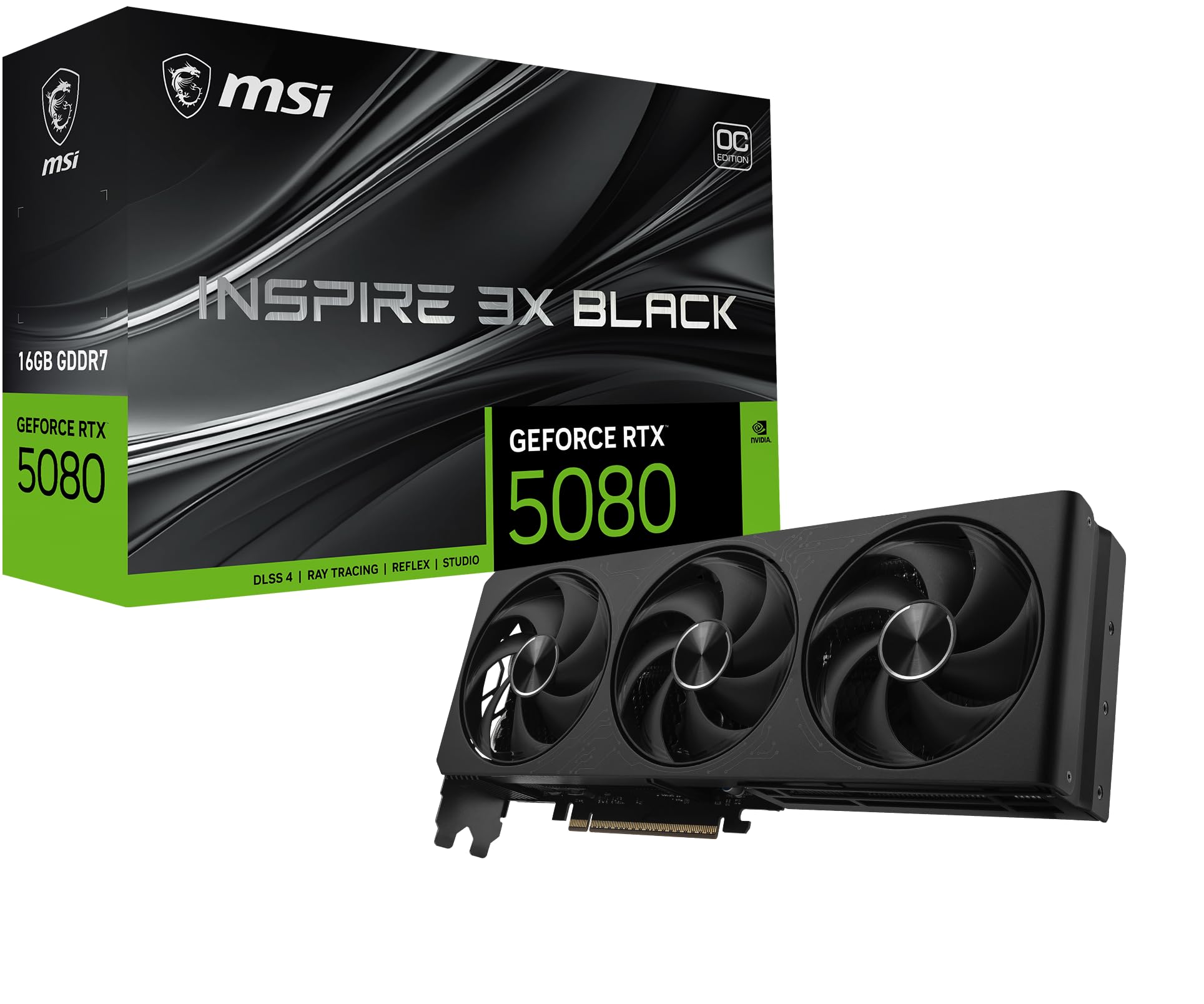
3. MSI GeForce RTX 5080 16G Inspire 3X OC
A 2640 MHz boost clock on a card that weighs just 950 grams — the lightest heavyweight here.
If you want clock speed on the newer architecture, this card delivers: its 2640 MHz boost clock (the top speed the GPU can reach under load) matches the ASUS ROG Strix 4090’s clock and sits well above the 2295 MHz of the PNY 5080 above. The 16 GB of GDDR7 memory carries 30 Gbps of bandwidth across a 256-bit interface — the width of the pipe between the chip and its memory. The wider the interface, the more data flows per second, so textures and frames move faster.
That 950 grams is a real-world advantage nobody advertises. A card this light puts less torque on the PCIe slot, so you are less likely to need a support bracket, and lifting a tower to a LAN setup stops being a back exercise. MSI’s VENTUS-derived cooling keeps the design sleek while still dealing with the heat, and the HDMI 2.1b and DisplayPort 2.1b outputs feed modern high-refresh displays. DLSS 4 uses AI to raise frame rates and cut latency, which is how a 16 GB card stays competitive in demanding games.
Plan for power: MSI recommends a supply of at least 850W. That is not a small ask, and it is the spec most likely to force an upgrade elsewhere in your build. For a compact case where a 3.8-slot monster will not fit, the lighter footprint here is the practical answer.
This card wins on: raw clock speed and a low physical weight in the same package.
Budget for: an 850W power supply — it is a stated requirement, not a suggestion.
4. Nvidia GeForce RTX 3090 Ti Founders Edition

A 4-inch width and a rated 8K display ceiling — the reference card for a display wall.
It fits where bigger cards won’t: NVIDIA’s own Founders Edition packs 24 GB of GDDR6 into a card just 4 inches wide. Compare that to the 5.9-inch girth of the ASUS ROG Strix 4090 further down — the Founders card is the slimmer, more case-friendly shape of the two. It also declares 8K display support (a resolution of 7680 x 4320 pixels), which matters if a display wall or a huge panel is the point of the build.
The 24 GB capacity puts it level with the EVGA 3090 Ti on memory but on the older GDDR6 type rather than GDDR6X, which is one step behind in bandwidth terms. The card is a desktop-class PCI Express unit rated to a maximum resolution of 3840×2160 for its own display path, with 8K listed as the ceiling. For a straightforward reference design rather than a factory-overclocked one, that is the deal.
This is the pick for someone who wants the clean, compact Founders shape and a plain 24 GB of VRAM without the factory clock bump — and who does not need the largest heatsink on the block. If your case is roomy and you want the highest boost figure, the ROG Strix 4090 or the MSI 5080 will serve you better on clock speed.
The narrow-body advantage: at 4 inches wide against the 5.9-inch Strix, this card leaves more room for cable routing and airflow in mid-tower builds, and the reference cooler keeps the profile clean.
Where it gives ground: GDDR6 instead of the newer GDDR6X and GDDR7 memory types elsewhere on this list, so bandwidth per second trails the factory-tuned cards.
Suits you if: a compact, clean-looking build with 24 GB of memory and 8K output ceiling is the goal.
Skip the upgrade if: you want the highest clock figures — the factory-overclocked cards in this list lead there.
5. ASUS ROG Strix GeForce RTX 4090 OC Edition

Fourteen inches of heatsink and axial fans scaled up for 23% more airflow — the card that keeps its cool while it works.
This is the length-and-width reference of the group. At 14.1 inches long and 5.9 inches wide, it sits against the EVGA 3090 Ti’s 11.81-inch frame — so it is the longer of the two by the numbers. It carries 24 GB of GDDR6X with a core clock of 2640 MHz. Owners mention 100 FPS at 4K on the highest settings, with load temperatures holding at 36°C. That is a card working well within itself.
ASUS scales up the axial-tech fans for 23% more airflow, and pairs them with a patented vapor chamber with a milled heatspreader for lower GPU temperatures. Nvidia claims up to 2x performance and power efficiency from the Ada Lovelace streaming multiprocessors, up to 2x AI performance from the 4th-gen Tensor cores, and up to 2x ray tracing performance from the 3rd-gen RT cores. The 24 GB of GDDR6X memory is the older type against the GDDR7 cards on this list, but the factory-overclocked clock speed makes up ground in game.
The size is a real consideration, not a nitpick. Owners describe it as very big, and smaller cases may not close around it. If your tower is mid-size, measure twice. The performance and cooling are the things people rave about, and durability tracks well past a year and a half of use.
Why it earns the spot
- 2640 MHz core clock on the Ada Lovelace architecture
- 23% more airflow from scaled-up axial-tech fans
- Patented vapor chamber with milled heatspreader for lower GPU temperatures
- 24 GB of GDDR6X memory for high-resolution textures
- 3-year warranty
What to plan around
- 14.1 inches long and 5.9 inches wide — small and mid cases may not clear it
- Coil whine is a trade-off some builds notice under load
- GDDR6X memory versus the newer GDDR7 elsewhere
The deciding fact: a 2640 MHz clock with a 24 GB GDDR6X buffer under a chassis-scale heatsink.
Measure first: the 14.1-inch length and 5.9-inch width demand a case that can take a large card.
6. VIPERA NVIDIA GeForce RTX 4090 Founders Edition

16,384 CUDA cores is the raw compute count, and 24 GB of GDDR6X with a 2520 MHz boost is what feeds it.
CUDA cores are the card’s parallel processors — the more of them the chip carries, the more work it can chew through at once, and 16,384 is a figure that speaks for itself. It pairs with a 2520 MHz boost clock, versus 1920 MHz for the EVGA 3090 Ti toward the top of this list. The 24 GB GDDR6X buffer supports the 4K 120Hz HDR and 8K 60Hz HDR output paths and variable refresh rate over HDMI 2.1A, so a high-refresh monitor and a big living-room panel can both live on the desk.
What wins people over beyond the frame rate is how quiet it runs — silence from a card pushing this much data is a rare pairing. Nvidia claims up to 2x AI performance from the fourth-gen Tensor cores and up to 2x ray tracing performance from the third-gen RT cores, while DLSS 3 generates extra frames with AI. It measures 11.97 inches long and 4.84 inches wide, which against the ASUS Strix 4090’s 5.9-inch width gives you a noticeably slimmer install.
The recurring gripe is not the engineering, it is the outlay. The card represents a high-ticket purchase, and opinions on the value split cleanly — some find it worth every penny, others find it a stretch.
Choose it for: a high-frame-rate 4K or 8K display setup where fan noise would intrude on play.
The honest ask: this is a large outlay for a card that trades on silence and compute rather than a bigger memory buffer than the 5090s.
7. MSI Gaming RTX 5090 32G Gaming Trio OC

32 GB of GDDR7 across a 512-bit interface — the widest memory pipe in this whole lineup.
The headline is memory: 32 GB of GDDR7 on a 512-bit interface. That interface is the width of the path between the chip and its memory, and wider means more data flows per clock — the reason this card does not blink at large 4K texture sets. It sits at 2497 MHz extreme performance clock, and MSI rates the display output at 7680 x 4320. Three DisplayPort 2.1a outputs and one HDMI 2.1b output cover a multi-monitor setup without adapters.
Customers note temperatures staying below 85°C under load with quiet fan noise. The GPU Tweak style tuning on MSI’s Blackwell cards keeps the clock and thermal controls accessible without a separate toolset. If you are moving from a 24 GB card, the 32 GB buffer here is the largest tier in this article aside from the two ASUS 5090s below.
Opinions on value split, as they do on any flagship: some call it the best bang for the buck, others find it pricey. That is the honest state of a 32 GB card — the capacity is the point, and you pay for it. If your workload is a single 1440p monitor, the 16 GB cards above will cost less and serve you just as well.
What the 512-bit bus buys you: a wider path between the GPU and its 32 GB memory pool, so high-resolution textures and large creative files move faster without a bottleneck at the bus.
What it costs: value is the split opinion on this card. If 32 GB is not something your workload actually uses, the smaller-memory picks above deliver strong frames for less.
Right for: 4K and multi-panel setups where the 32 GB buffer and 512-bit interface get used.
Overkill for: a single 1440p display, where a 16 GB card will feel identical in game.
8. ASUS ROG Astral GeForce RTX 5090 32GB OC Edition

Four Axial-tech fans and a 3.8-slot heatsink — a cooler built like a server, not a graphics card.
Four fans is the design statement, and the numbers back it: the quad-fan layout boosts air flow and pressure by up to 20% over a conventional arrangement. The 32 GB of GDDR7 memory connects over a 512-bit interface and matches the MSI 5090 above on capacity. Clocked at 2610 MHz in OC mode and 2580 MHz in default mode, it edges past the 2497 MHz of the MSI card on boost figure — a real lead if clock speed is your measure.
ASUS piles on the thermal engineering. A patented vapor chamber and milled heatspreader sit under the fins, and a phase-change GPU thermal pad keeps the chip in firm contact with the cooler. 80-amp MOSFETs underpin the power delivery, the all-metal diecast shroud and frame backplate hold the PCB rigid, and GPU Guard technology secures all four corners plus the bracket. A protective PCB coating guards against moisture, dust and extreme temperatures. Reviewers point out it drawing up to 600 watts, so size your power supply above that figure.
The size is the one caveat that matters before you buy. It is 14.1 inches long and occupies 3.8 slots, so it needs a case with real clearance and adjacent slot spacing — confirm both before ordering. It weighs 6.6 lbs, which puts less strain on the mounting than it sounds like. For a large tower with room to breathe, this is the airflow champion of the lineup.
The engineering you are paying for
- Quad-fan layout boosts air flow and pressure by up to 20%
- 2610 MHz OC mode beats the 2497 MHz MSI 5090 on boost clock
- 32 GB GDDR7 on a 512-bit memory interface
- Phase-change thermal pad and vapor chamber with milled heatspreader
- Protective PCB coating against moisture, dust and temperature extremes
What it demands of your build
- 14.1-inch length and 3.8-slot footprint require a roomy case
- Draws up to 600 watts, so the power supply must be sized for it
- Value opinions split at this tier
Best paired with: a full-size tower, a strong power supply and a slot layout that can host a 3.8-slot card.
The trade: the highest airflow here comes attached to the biggest physical footprint in this list.
Know the Specs
Video memory capacity and type
Video memory, or VRAM, is the card’s scratch pad for textures, frames and model data, measured in gigabytes. The type matters because GDDR7 moves data faster per pin than the older GDDR6X and GDDR6 generations. A card with 24 GB of GDDR6X carries a lot of scratch space, while 16 GB of GDDR7 carries less but in the newer, faster format — so the trade-off is capacity against memory speed.
Boost clock in megahertz
Boost clock is the speed the GPU ramps to when it has thermal headroom. A 2640 MHz figure only means something if the cooler can sustain it, which is why heatsink design and vapor chambers matter as much as the number on the box. A factory-overclocked card with good cooling reaches its boost figure more often than a reference card with a smaller cooler.
Memory interface width in bits
The memory interface is the width of the data path between the GPU and its memory, quoted in bits. A 512-bit interface is a wider path than 256-bit, so more data moves per clock cycle — useful for high-resolution play and large creative files. It is why a 32 GB card on a 512-bit bus behaves differently from a 16 GB card on a narrower interface.
Slot width and card length
Slot width is how many expansion bays the heatsink occupies, and length is the physical card measurement. A 3.8-slot card needs clearance around it, and a 14.1-inch card needs a case that can accept a large object. Check both against your enclosure and adjacent PCIe slots before ordering — these are the specs that stop an otherwise perfect card from fitting.
Common Questions
Will a 3.8-slot card like the ROG Astral fit in a standard mid-tower?
Is 32 GB of GDDR7 better than 24 GB of GDDR6X?
What power supply does the RTX 5090 need?
Does a higher boost clock always mean a faster card?
What is a 512-bit memory interface and why does it matter?
Can I run 8K on an RTX 4090 or 5090?
Why do some cards have a dual BIOS switch?
Is coil whine normal on a flagship graphics card?
Do I need a support bracket for a heavy graphics card?
What does AI TOPS mean on a graphics card?
The Bottom Line
For most builders the world’s most powerful gpu winner is the EVGA GeForce RTX 3090 Ti FTW3 Ultra. Its 24 GB of GDDR6X, a 1920 MHz boost and nine thermal sensors together give you a 4K high-refresh game machine with unusually detailed temperature insight. If the newer memory generation and a bigger 32 GB buffer are the point, the MSI Gaming RTX 5090 32G Gaming Trio OC brings GDDR7 on a 512-bit interface to the table. And for a compact enclosure that rules out a full-size flagship, reach for the ASUS TUF Gaming RTX 5090 OC Edition — it is the SFF-ready (small-form-factor) 32 GB card in this list. For a build that stays quiet in a room where you actually sit, the PNY RTX 5080 Triple-Fan and its stopped-fan Stealth Mode is a thoughtful match.
How we choose
We do not accept paid placement. Every pick is matched to a real buyer and a real use-case; we do not hands-on test units.
Sources
Specifications: manufacturer listings and product documentation. Review insights: verified customer reviews, as of November 2026. Pricing: not shown on this page (it changes often); check the current price via the retailer link.
As an Amazon Associate, Tactical Gear Guy earns from qualifying purchases. This does not affect which products we feature.