Specs are compiled from manufacturer listings and verified buyer reviews and can change over time — please confirm the key details on the product page before buying.
Buying a gaming laptop at this level is really a cooling decision wearing a graphics-card costume. The chip names look identical across half these machines, yet one runs quiet for hours and another throttles twenty minutes into a raid. Below you will find thirteen discrete-GPU laptops sorted by what they actually do for you — screen speed, heat handling, storage room, and travel weight — so you can match one to your desk or your backpack instead of guessing from a spec sheet.
This guide is built by comparing the manufacturers’ published specifications and the patterns across verified customer reviews, so you get each pick’s real strengths and trade-offs instead of marketing spin.
Read on for the strongest options in the world’s laptop for gaming field.
Top Picks

How To Choose The Best World’s Laptop for Gaming
The fastest way to waste money here is to buy the biggest graphics card name and ignore everything around it. A laptop only delivers its frame rate while it stays cool, and it only stays cool if the chassis and fans are built for the heat. Start with thermals, then the screen, then the storage.
Match the refresh rate to what you play
A 240Hz screen redraws the image 240 times a second, which makes fast camera turns feel smooth instead of smeared. If you mostly play competitive shooters, that number earns its keep. If you play slower story games, a 165Hz OLED panel with deeper blacks can feel like the better trade.
Weigh the machine against how you move it
An 18-inch desktop replacement like the Alienware 18 Area-51 is a stay-at-home powerhouse, while a 4.18 lb 16-inch model is something you can actually carry daily. Decide which life you live before you fall for a big screen.
Look past the GPU to memory and storage
32GB of DDR5 memory keeps a game, a browser, and a chat app running together without stutter. A 2TB SSD leaves room for a real game library, and 2TB versus a 1TB drive means fewer uninstall decisions.
Side-by-Side Comparison
| Model | Best For | GPU | Display | Memory | Amazon |
|---|---|---|---|---|---|
| GIGABYTE AERO X16★ Best Overall | Carrying to class or a café | RTX 5070 | 16″ panel | — | Amazon |
| MSI Crosshair 18 HX AIBig-Screen Value | Big-screen play at home | RTX 5070 8GB GDDR7 | 18″ 2560×1600 240Hz | 32GB DDR5 | Amazon |
| Thunderobot Zero 18 ProCooling Champ | Cooling headroom on a budget | RTX 5070 Ti | 18″ 2560×1600 240Hz | 32GB DDR5 | Amazon |
| Lenovo Legion 5 15IRX10 | OLED color and portability | RTX 5070 8GB GDDR7 | 15.1″ WQXGA OLED 165Hz | 32GB DDR5-5600 | Amazon |
| Acer Predator Helios Neo 18 AI | Storage-heavy game libraries | RTX 5070 Ti | 18″ WQXGA 240Hz G-SYNC | 32GB DDR5 | Amazon |
| Acer Predator Helios Neo 16S AI | Color-accurate creative work | RTX 5070 Ti 12GB GDDR7 | 16″ 2.5K OLED 240Hz | 32GB DDR5 | Amazon |
| ASUS ROG Strix G16 | Balanced flagship performance | RTX 5080 | 16″ 2.5K 240Hz | 32GB DDR5-5600 | Amazon |
| Alienware 16 Area-51 | Desk-bound power with support | RTX 5070 Ti | 16″ panel | — | Amazon |
| ASUS ROG Strix G18 | Memory and storage for the long haul | RTX 5070 Ti 12GB GDDR7 | 18″ 2560×1600 240Hz | 64GB DDR5 | Amazon |
| Alienware 18 Area-51 (300Hz) | Fastest panel in the lineup | RTX 5080 | 18″ WQXGA 300Hz | 32GB DDR5 | Amazon |
| Dell Alienware 18 Area-51 | Maxed memory and GPU together | RTX 5090 | 18″ 2.5K 300Hz | 64GB DDR5 | Amazon |
| Lenovo Legion Pro 7i Gen 10 | The absolute top of the ladder | RTX 5090 | 16″ OLED 240Hz | 64GB | Amazon |
Detailed Reviews
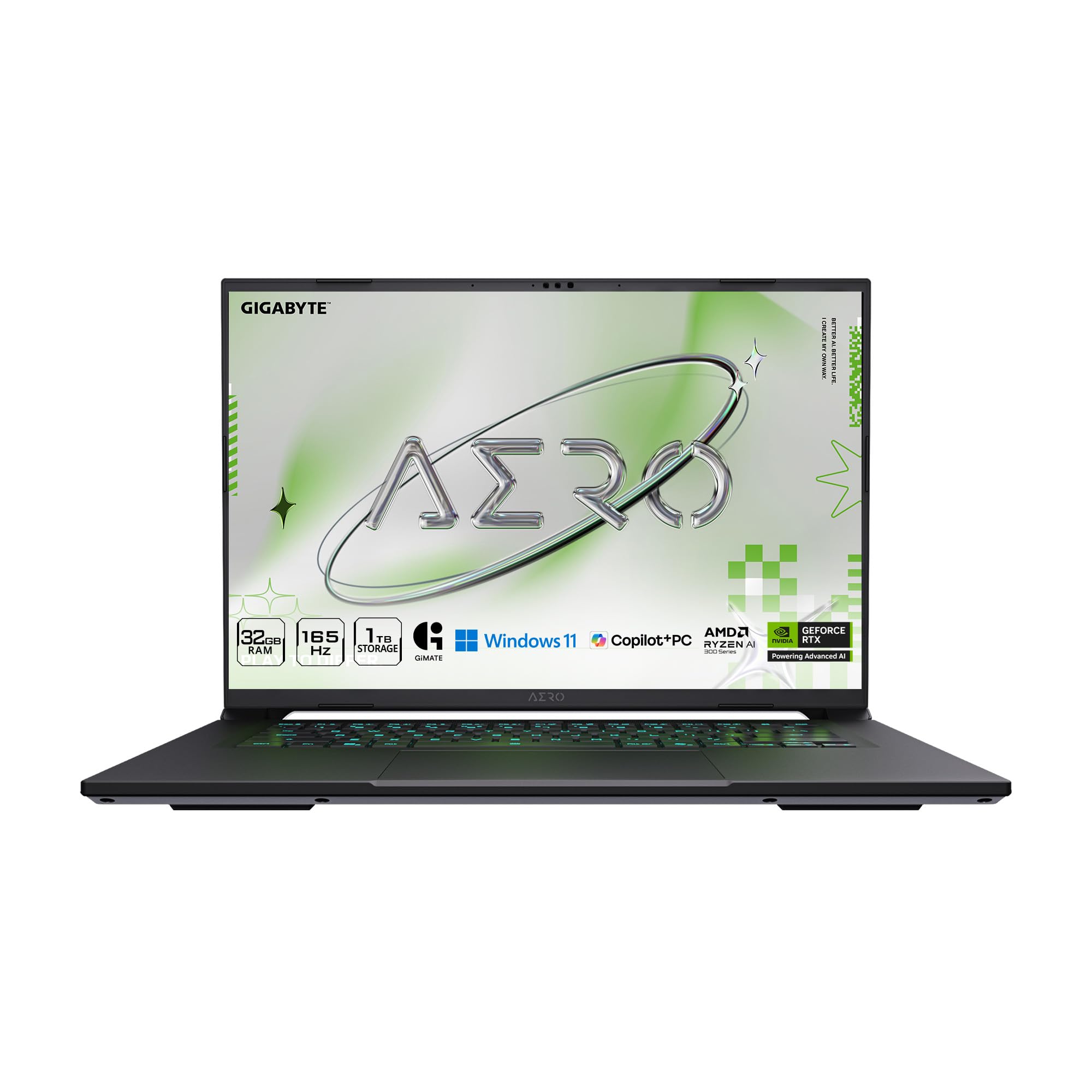
1. GIGABYTE AERO X16 — AMD Ryzen AI 9 HX 370, RTX 5070, 16″
Our pick — 4.0+★ from 90+ verified ratings; the strongest balance of quality and price.
A 4.18 lb, 0.65-inch gaming laptop that fits a standard 16-inch sleeve.
Portability is the whole argument here. The AERO X16 measures 16.75 millimeters (0.65 inches) and weighs 1.9 kilograms (4.18 lbs), which means it rides in a normal laptop sleeve instead of a dedicated gaming bag. Against the MSI Crosshair 18 HX AI at 6.83 lbs, this 4.18 lb machine is the lighter load — a real difference when you are walking across a campus or through an airport.
The AMD Ryzen AI 9 HX 370 processor tops out at 5.1 GHz, and the NVIDIA RTX 5070 runs it with Blackwell architecture and DLSS 4 — AI-driven upscaling that lifts frame rates without dropping visual detail. What wins people over is the performance ceiling relative to size; the machine does not feel like it gave up speed to get thin. Battery life is listed at 14 hours, though buyers report around 4 hours of medium-intensity work on battery, so treat the big number as a light-task figure.
Cooling holds up under load, with the CPU and GPU sitting in the mid-60s °C. The one honest catch is fan noise, which draws the only mixed verdict in the feedback — this is a machine you will notice on a quiet library floor. It runs Windows 11 Home with the GiMATE interface and a Lunar White finish, and it is the crowd favorite at 4.0+ stars across 90+ ratings.
Where it earns its keep
- 4.18 lbs and 0.65 inches is genuinely carry-able daily
- Ryzen AI 9 HX 370 at 5.1 GHz paired with RTX 5070
- Mid-60s °C under load shows the cooling is doing its job
What you should know first
- Fan noise is the most-discussed gripe when the GPU ramps
- Real battery life lands nearer 4 hours than the quoted 14
Reach for this if: you split time between a desk and a bag and refuse to carry a brick.
Look elsewhere if: you need near-silent operation in shared spaces.
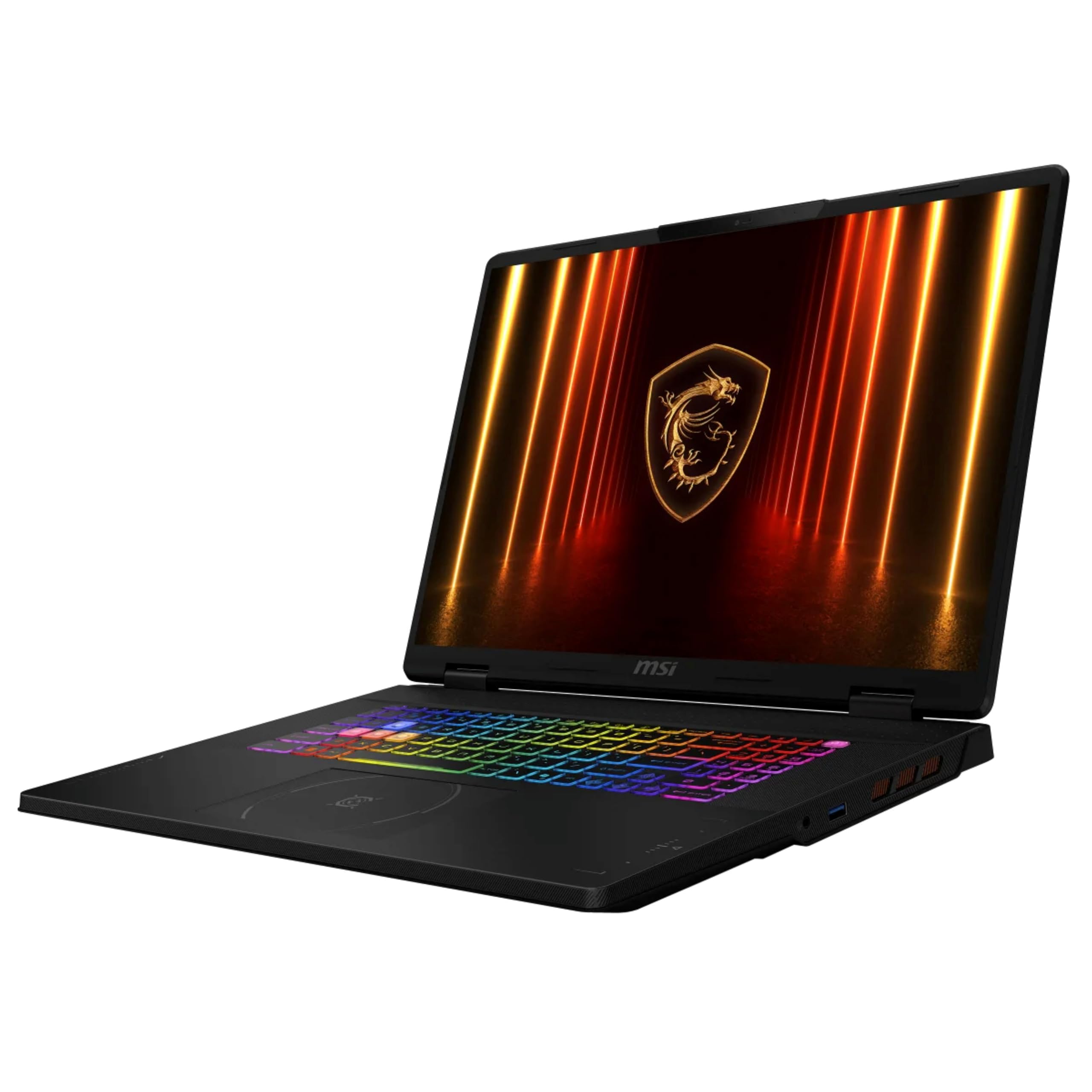
2. MSI Crosshair 18 HX AI
Eighteen inches of 240Hz panel, and 32GB of memory already installed.
The screen is the reason to look here. An 18-inch QHD+ (2560×1600) IPS panel running at 240Hz with 100% DCI-P3 color gives you both fast motion and accurate color — so a shooter feels smooth and an edited photo still looks right. Intel Core Ultra 9 275HX with 24 cores boosts from 2.1 to 5.4 GHz, which is enough headroom to game while encoding in the background.
Storage is the trade-off to weigh. This model carries a 1TB NVMe SSD, while the Acer Predator Helios Neo 18 AI in this list ships 2TB. If your library is large, plan on adding a drive or uninstalling more often. Memory is 32GB of DDR5 5600MHz, so multitasking is not the bottleneck.
Around the edges you get HDMI 2.1, USB-C Thunderbolt 4 with DisplayPort and Power Delivery 3.0, RJ45 Ethernet, Wi-Fi 6E and Bluetooth 5.3, plus a SteelSeries 24-zone RGB keyboard with 99 anti-ghost keys. A 240W adapter feeds the 90Whr four-cell battery, and the whole thing sits at 6.83 lbs. Performance is what earns the praise — it runs like a Core Ultra 9 should — and it holds 4.0+ stars across 30+ ratings.
The plain read: a desk-first 18-inch performer with the screen, memory, and ports already sorted.
Worth knowing: 6.83 lbs is a stay-at-home weight, and the 1TB drive fills faster than you expect.
Good fit for: a fixed battlestation where the laptop rarely leaves the desk.
Think twice if: you need a big game library installed without adding storage.
3. Thunderobot Zero 18 Pro
Three fans and seven heat pipes built to shed 220W without breaking stride.
The cooling engineering is the story. This chassis is designed to sustain 220W of total heat, with 3× Night Owl fans moving up to 19CFM, 7× high-efficiency heat pipes running a combined 2.29m, and 338 ultra-thin copper fins totaling 256000 mm² of surface area. In plain terms, the machine has more places to dump heat, so a long session should not sag as hard as a thinner rival.
Inside sits the Intel Core Ultra 9 275HX with 24 cores and 24 threads, up to 5.40GHz turbo, backed by a GeForce RTX 5070 Ti. Memory is 32GB DDR5 and storage is a 1TB PCIe M.2 SSD. The 18-inch QHD+ panel runs at 240Hz with Thunderobot’s Hummingbird eye-care treatment, which eases glare during long nights.
The build claims to survive 180G impact, 74cm drops, and 500 charge cycles, plus 200K touchpad clicks for the wear parts. Performance is superb by consensus, but the one thing to understand going in is that reliability draws a divided reaction — a few owners hit issues, so buy with a return window in mind rather than blind faith. It earns a strong 4.0+ stars across 10+ ratings.
The thermal case: 220W of sustained dissipation is a serious headroom figure for slow-burn sessions.
Tested to take knocks: drop, pressure, and cycle ratings are unusually thorough for a gaming chassis.
Best suited to: long-session players who want cooling built like industrial gear.
The caveat you accept: a small owner base reports some reliability wobble — check the return terms.
4. Lenovo Legion 5 15IRX10
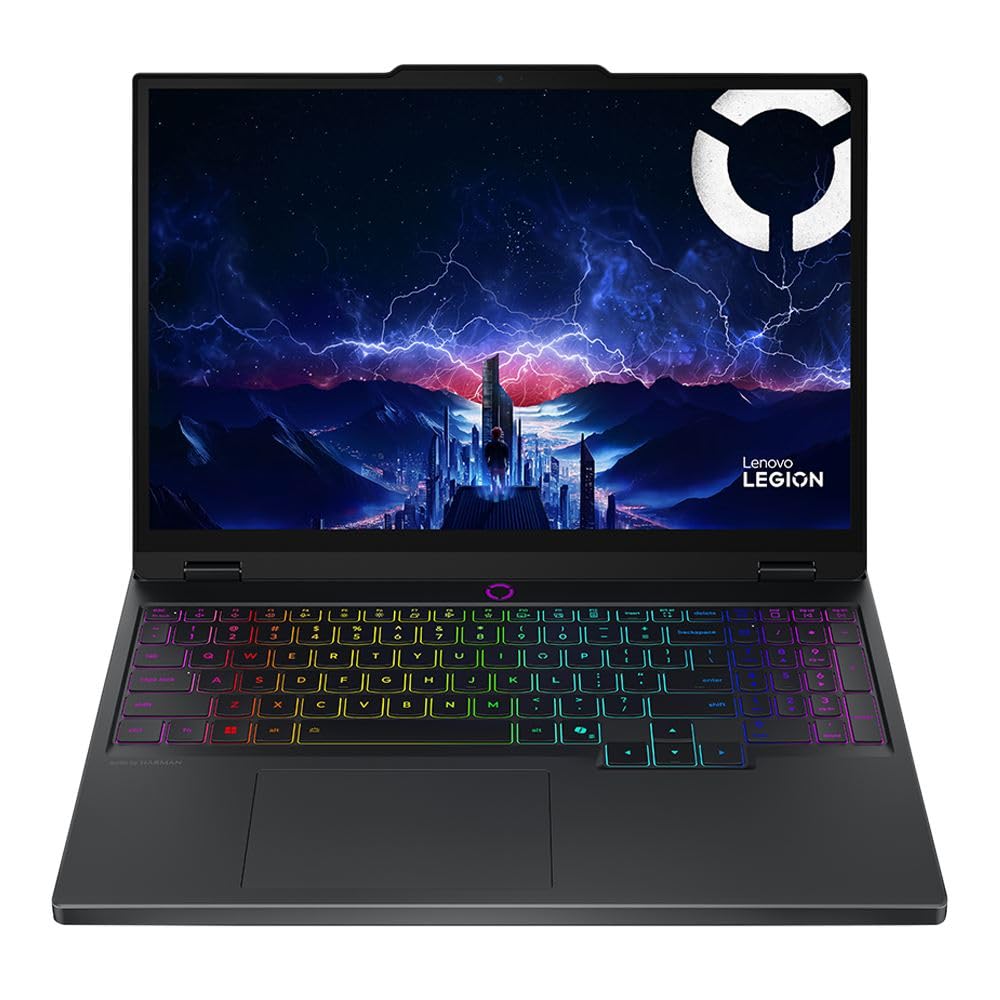
OLED color on a 15-inch body you can lift with one hand.
Color and contrast come first here. The 15.1-inch WQXGA OLED panel turns on true black, so dark rooms in a game read as actual darkness instead of gray haze. Motion is handled at 165Hz, and the comparison worth naming is the Acer Predator Helios Neo 18 AI at 240Hz versus this panel at 165Hz, meaning fast turns look slightly less razor-fine than the top screen in this list.
Where it leads is raw processing pace. The Intel Core i9 14th Gen 14900HX peaks at 5.8 GHz, the highest CPU clock in this whole lineup, and the GIGABYTE AERO X16 peaks at 5.1 GHz. Paired with an RTX 5070 8GB GDDR7, 32GB of DDR5-5600 memory, and a 1TB PCIe Gen4 x4 NVMe SSD, it handles heavy editing as readily as a match.
At 4.19 lbs (1.90 kg) it is a laptop you can commute with, and the connectivity is current: Gigabit LAN, 2×2 WiFi 7 (802.11be), and Bluetooth 5.4. A 5.0-megapixel camera handles calls. This one carries a 4.0+ star rating across 30+ ratings — a small, sharp sample rather than a mass-market track record.
Why the panel wins fans
- OLED blacks and WQXGA clarity in a 4.19 lb body
- 5.8 GHz peak clock is the fastest CPU figure in this lineup
- WiFi 7 and Bluetooth 5.4 keep the wireless side modern
The honest gap
- 165Hz falls short of the 240Hz screens elsewhere here
- Small review base means less long-term data to lean on
The one for you if: you edit photos or video and still want one bag-friendly machine.
Know this going in: competitive shooter players will feel the 165Hz step down.
5. Acer Predator Helios Neo 18 AI

Two terabytes onboard means you stop deciding which games get deleted.
Storage is the headliner. A 2TB PCIe Gen 4 SSD versus the 1TB in the MSI Crosshair 18 HX AI matters once you are installing modern AAA titles at their full size. The 18-inch WQXGA screen runs at 240Hz with a 3ms overdrive response time, and NVIDIA G-SYNC (which syncs the panel to the GPU to remove tearing) keeps motion clean.
Graphics come from an RTX 5070 Ti on Blackwell architecture, rated at 992 AI TOPS, with fourth-gen RT Cores and fifth-gen Tensor Cores for ray tracing and DLSS 4. Memory is 32GB of DDR5 6400MHz across two slots, expandable to 64GB. Cooling uses dual fans with one 5th Gen AeroBlade 3D metal fan plus liquid metal thermal compound applied to the chipset.
Ports cover Thunderbolt 4, USB-C with DisplayPort and 90W charging, three more USB-A ports, HDMI 2.1, Ethernet, a microSD reader, and a Kensington lock slot. It weighs 7.28 lbs, so this is a desk machine by nature. It holds 4.0+ stars across 30+ ratings.
The storage argument: 2TB installed from the start is the quiet luxury of never managing space.
The weight tax: 7.28 lbs and an 18-inch footprint make this a stationary pick.
Go here for: a large installed library without adding a drive on day one.
Pass if: you need to move the machine between rooms regularly.
6. Acer Predator Helios Neo 16S AI
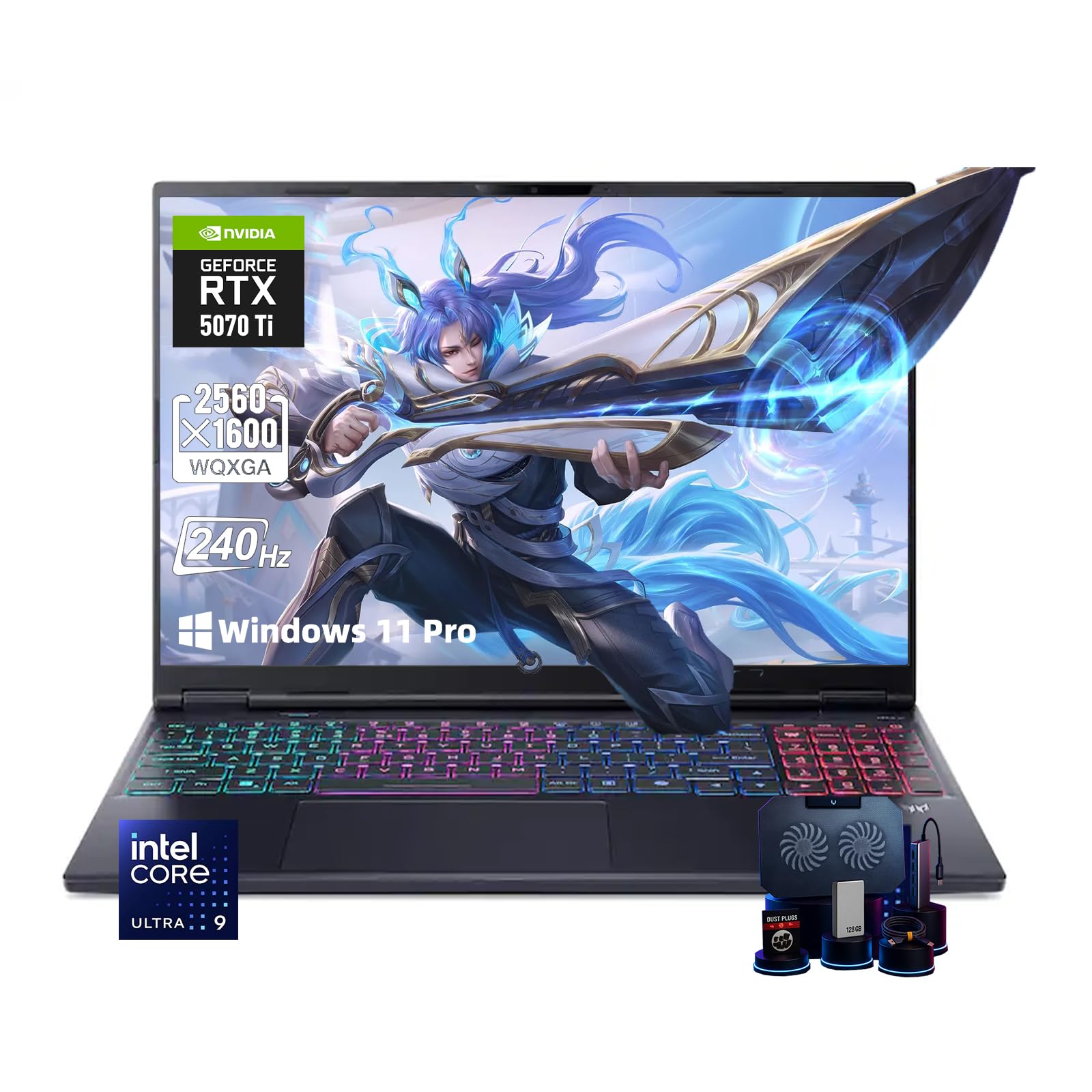
A 500-nit OLED panel with 12GB of VRAM behind it.
Brightness and color accuracy set this apart. The 16-inch 2.5K OLED display hits 500 nits, 100% sRGB, and true black levels, so an edit in a bright room still reads correctly and a dark game scene stays dark. It refreshes at 240Hz, matching the fastest panels here. The GPU is an RTX 5070 Ti with 12GB GDDR7, giving more video memory than the 8GB cards elsewhere in this list — useful for large textures and render buffers.
The 24-core Intel Core Ultra 9 CPU pairs with that card, and a 5th Gen AeroBlade fan plus liquid metal keep a long render from cooking the chassis. This machine supports up to 64GB of DDR5 memory and up to 8TB of PCIe Gen 4 SSD, though it ships with 32GB and 2TB. Windows 11 Pro comes installed, alongside a 4-zone RGB keyboard.
Ports include Thunderbolt 4, HDMI 2.1, multiple USB-A and USB-C connections, and a full-size SD 4.0 card reader — the one slot photographers care about. Among the highest-rated picks here at 4.5+ stars across 10+ ratings, its strongest signal is the creative-work fit rather than raw benchmark bragging.
Direct comparison: 12GB of GDDR7 on the 5070 Ti versus the 8GB on the RTX 5070 cards gives heavy scenes more breathing room.
The reader’s answer: 500 nits beats most OLED panels for daylight visibility.
Built for: photographers and editors who want one machine for both jobs.
Worth noting: the SD card reader and 12GB VRAM are the real differentiators, not the OLED alone.
7. ASUS ROG Strix G16 — Core Ultra 9 275HX, RTX 5080, 16″ 240Hz

An RTX 5080 in a 16-inch chassis that most people can actually carry.
Jumping to the RTX 5080 is the reason this one sits above the 5070 crowd. Blackwell architecture, DLSS 4, and Max-Q power tuning deliver more frames than the mid-tier cards while keeping the 16-inch form usable. The ROG Nebula panel runs 2.5K at 240Hz with a new ACR film that boosts contrast and cuts glare, so a bright window behind you is less of a problem.
Memory is 32GB DDR5-5600, storage is a 1TB PCIe Gen 4 SSD rated up to 7,000MB/s, and cooling uses an end-to-end vapor chamber with tri-fan technology and Conductonaut extreme liquid metal on the chipset. That combination is what keeps performance steady instead of spiking and sagging. A full-surround RGB light bar syncs with the keyboard and ROG peripherals, and Stealth Mode kills the lighting for a meeting.
The thermal feedback splits: some owners mention it stays cool at 81°C under full load, others hit overheating, so airflow around the machine matters. It is the most-reviewed pick here, holding 4.0+ stars across 110+ ratings — that bigger sample is the most reliable read of the bunch.
The case for the 5080
- RTX 5080 with DLSS 4 and Max-Q for higher frames
- Vapor chamber plus tri-fan cooling with liquid metal
- SSD throughput up to 7,000MB/s keeps loads near instant
Where it asks for patience
- Thermal reports split between cool-running and hot-running
- Lighting-heavy chassis is not for a subdued office desk
Pick this when: you want a card above the 5070 tier without jumping to a full 18-inch desktop replacement.
Do not pick it if: you keep the laptop on a soft surface where fans cannot breathe.
8. Alienware 16 Area-51 — Core Ultra 9 275HX, RTX 5070 Ti

A lifting rear chamber that feeds the fans more air than a flat base ever could.
Alienware’s Cryo-Chamber props the rear of the laptop up to open a larger intake, with a clear Gorilla Glass panel letting you see the AlienFX fans spin. It is a design meant to let the RTX 5070 Ti run at higher power limits, which is exactly why this 16-inch model punches above its size. The processor is the same Intel Core Ultra 9 275HX found across this list, pairing CPU, built-in GPU, and NPU for AI acceleration.
Lighting runs the aurora-borealis-inspired AlienFX system, and Dell throws in a year of onsite service — a technician comes to you if a warranted issue cannot be fixed remotely. That support layer is a real part of the value at this tier. Speed is what buyers notice; the machine handles fast-paced online matches without stutter.
The note to carry in is driver setup: an occasional buyer runs into early driver snags, so plan on a first-day update session. It carries 4.0+ stars across 50+ ratings and runs Windows with Bluetooth 5.4 and Wi-Fi.
Support worth naming: a year of at-home service is a comfort no other pick here spells out.
Setup caveat: budget an evening for driver updates before your first long session.
Ideal for: buyers who value at-home repair service as much as frame rate.
Skip if: you want a zero-tinkering first boot.
9. ASUS ROG Strix G18

Sixty-four gigabytes of memory and two terabytes of storage, already installed.
This is the loadout pick. 64GB of DDR5 memory and a 2TB PCIe 4.0 NVMe SSD mean heavy multitasking with no compromise, and the tool-less access panel makes adding more a latch-slide instead of a screwdriver job. The GPU is an RTX 5070 Ti with 12GB GDDR7, matching the 12GB cards elsewhere, and the Intel Core Ultra 9 275HX carries 24 cores up to 5.4 GHz with 36MB cache and Intel AI Boost NPU up to 13 TOPS.
The 18-inch 2560×1600 WQXGA display hits 500 nits at 240Hz with a 3ms response time — bright enough for a sunlit room and fast enough to keep up in a shooter. Cooling is ROG’s tri-fan system, built to hold performance across a long session.
Connectivity is unusually future-proof: Wi-Fi 7, Bluetooth 5.4, 2.5G Ethernet, HDMI 2.1, three USB-A ports, and two Thunderbolt 5 ports with DisplayPort, Power Delivery, and G-SYNC. It rates 4.5+ stars across 20+ ratings, one of the highest scores in this group on a small but glowing sample.
The headroom you get
- 64GB DDR5 and 2TB SSD leave no immediate upgrade need
- Thunderbolt 5 ports are the newest connection on this list
- 500-nit 240Hz panel handles glare and motion together
The trade you make
- 18-inch footprint and desktop-class internals rule out daily carrying
- Small review base means fewer long-term reports to weigh
Choose it for: a desktop replacement that will not need an upgrade for years.
Look past it if: you need something you can toss in a backpack.
10. Alienware 18 Area-51

The only 300Hz panel here, with a 3ms response time on an 18-inch WQXGA screen.
No other pick here hits 300Hz. That refresh rate, paired with a 3ms response time on an 18-inch WQXGA panel, is the most fluid motion picture in this lineup, and it earns its place if competitive shooters are your daily game. Graphics come from an RTX 5080 with Max-Q tuning, a step above the 5070 Ti cards in the middle of this list. Memory is 32GB of DDR5 in a 2x16GB configuration, and storage is a 2TB SSD.
The Cryo-Chamber shows up again with the Gorilla Glass view of the AlienFX fans, and the aurora-borealis ambient lighting moves color across the surface. An Intel Core Ultra 9 275HX handles processing with the NPU in the same package. Heat dissipation is praised — the machine runs cool by wide agreement — and performance is the top positive. On size, consensus is honest: it is big, and that is the point.
Value splits both ways here, with some finding it well worth the outlay and others calling it a stretch. It holds 4.0+ stars across 80+ ratings, a large enough base that the mixed verdict is worth respecting. Also note there is no fingerprint reader.
Where it leads: 300Hz beats every 240Hz panel in this article for pure motion clarity.
The split: cooling and performance carry it; the sense of value does not land the same way for everyone.
For the player who: lives in competitive shooters and wants the smoothest image available.
Weigh carefully if: you want the money to feel obvious — this one asks for belief in the panel.
11. Dell Alienware 18 Area-51

RTX 5090 and 64GB of memory in the same 18-inch body.
Here the GPU and the memory both go to the top shelf. An RTX 5090 pairs with 64GB of DDR5 and a 2TB PCIe SSD, and the 18-inch 2.5K WQXGA anti-glare panel runs at 300Hz. Anti-glare means reflections fade instead of turning the screen into a mirror under overhead lights. Wi-Fi 7 and Bluetooth 5.4 round out the wireless side.
The RTX 50 Series story here centers on DLSS 4 with Multi Frame Generation and Ray Reconstruction, which lift frame rates and sharpen lighting detail, plus NVIDIA Reflex 2 with Frame Warp to cut input lag based on your latest mouse movement. Broadcast tools handle audio cleanup and camera framing for streaming. It is a machine built for both maxed games and AI-assisted creative work.
It rates 4.5+ stars across 20+ ratings, the same score as the Lenovo Legion Pro 7i but on a smaller base. For the user who wants every internal already at its ceiling, that combination is the appeal.
Nothing left to add: 5090 graphics, 64GB RAM, and 2TB storage arrive installed together.
Screen reasoning: anti-glare plus 300Hz covers both daylight rooms and fast motion.
Built for: someone who wants the top GPU and the biggest memory without configuring anything.
Check first: 18 inches and a full desktop load is not a travel machine.
12. Lenovo Legion Pro 7i Gen 10

An RTX 5090 and 64GB of RAM driving a 16-inch 240Hz OLED.
If the goal is simply the highest configuration available, this is where the list ends. An Intel Ultra 9 275HX with 24 cores — 8 performance and 16 efficiency — runs from a 2.7 GHz P-core base to 5.4 GHz, with 36MB of L3 cache behind it. The GPU is an RTX 5090, memory is 64GB, and storage is a 2TB drive, so the heavy lifting is covered before you touch a setting.
The 16-inch 2560×1600 OLED panel refreshes at 240Hz, and OLED brings true black for dark scenes that LCD panels wash out. Two M.2 slots leave an upgrade path open, and the machine connects over Bluetooth 5.3, Ethernet, HDMI, USB, and Wi-Fi. Windows uses Intel’s Ultra 9 platform throughout.
It rates 4.5+ stars across 40+ ratings, giving it a larger sample than the other 4.5+ star pick here. The one thing to accept is that a 5090 and 64GB in a 16-inch chassis is a serious power draw, so this is a plug-in-first machine.
The endgame spec: 5090 graphics plus 64GB RAM is the ceiling of this entire article.
OLED payoff: true black on a 240Hz 16-inch panel makes dark scenes read properly.
Right for: buyers who want every component already maxed and no upgrade regret.
Bear in mind: this configuration runs hot and heavy — plan on desk power, not lap time.
Know the Specs
Refresh rate in Hz
A refresh rate is how many times per second the screen redraws the picture. 240Hz means 240 redraws a second, which keeps a fast camera turn crisp instead of smeared. The highest figure in this list is 300Hz on the Alienware 18 Area-51, and the lowest is 165Hz on the Lenovo Legion 5’s OLED. Neither is “wrong” — one favors competitive motion, the other favors color depth.
GPU wattage and TGP
TGP stands for Total Graphics Power, the ceiling a laptop sets for how much power the graphics chip may draw. The ASUS ROG Strix SCAR 18 states its RTX 5090 runs at 175W TGP, and that headroom is why wattage matters as much as the chip name. Two laptops with the same GPU can perform differently if one limits power to stay cool. Always check both the card and the wattage.
DDR5 memory and VRAM
System memory (DDR5) holds everything running at once — the game, the browser, the chat app. Graphics memory (VRAM) holds textures and frames the GPU is working on. This list spans 32GB and 64GB DDR5, and 8GB, 12GB, and higher VRAM depending on the card. More VRAM helps at high texture settings; more system RAM helps with multitasking and creative apps.
Cooling: vapor chambers and liquid metal
A vapor chamber spreads heat across a wider area than a simple heat pipe, and liquid metal is a thermal compound that transfers heat from the chip more efficiently than standard paste. Together they let a laptop hold its frame rate instead of slowing down when it gets hot. Fan count and fin surface area, like the Thunderobot’s 256000 mm² of fins, are the other half of that story. Quieter fans usually mean less aggressive cooling.
Common Questions
Is a 240Hz screen worth it over a 165Hz OLED?
How much VRAM do I actually need for modern games?
Will an 18-inch gaming laptop fit in a normal backpack?
Does liquid metal cooling really make a difference?
Can I upgrade the RAM and storage later?
Is an RTX 5090 laptop noticeably faster than an RTX 5070?
How long does the battery last when gaming unplugged?
What does G-SYNC or a MUX Switch actually do?
Do I need 64GB of RAM for gaming alone?
Is an 18-inch screen too big for competitive play?
The Bottom Line
For most buyers, the world’s laptop for gaming winner is the GIGABYTE AERO X16 because it pairs an RTX 5070 and a Ryzen AI 9 HX 370 with a 4.18 lb body you can actually carry — a combination no other pick here manages. If a 240Hz Mini LED or OLED screen and top-tier graphics matter more than portability, the Acer Predator Helios Neo 16S AI delivers both with 12GB of VRAM behind a 500-nit OLED. And for the largest installed game library with no upgrade needed, the ASUS ROG Strix G18 brings 64GB of memory and a 2TB SSD from the start.
One honest nudge before you click buy: the AERO X16 carries fewer ratings than the ASUS ROG Strix G16 — 90+ to 110+ — but it holds the same 4.0+ score in a far more portable frame, so the smaller sample is not a weaker machine, just a newer conversation.
How we choose
We do not accept paid placement. Every pick is matched to a real buyer and a real use-case; we do not hands-on test units.
Sources
Specifications: manufacturer listings and product documentation. Review insights: verified customer reviews, as of November 2026. Pricing: not shown on this page (it changes often); check the current price via the retailer link.
As an Amazon Associate, Tactical Gear Guy earns from qualifying purchases. This does not affect which products we feature.