Specs are compiled from manufacturer listings and verified buyer reviews and can change over time — please confirm the key details on the product page before buying.
You will use a chef’s knife every day for decades, so the real question is simple: which blade will still slice a tomato cleanly years from now without you fighting it? The answer is not the flashiest handle or the longest Damascus pattern. It depends on the steel, how hard it is, and whether the handle and balance suit the way you actually cook. Below are nine knives that earn their keep in a working kitchen, sorted by what each one does best.
This guide is built by comparing the manufacturers’ published specifications and the patterns across verified customer reviews, so you get each pick’s real strengths and trade-offs instead of marketing spin.
Hardness, edge angle, and steel type decide how long a blade stays sharp and how carefully you need to treat it — the rest is comfort. Here is what separates a genuine workhorse from a drawer ornament in the search for the World’s Knife.
Top Picks


How To Choose The Best World’s Knife
A chef’s knife is the one tool in your kitchen that touches nearly every meal, so the choice deserves more thought than grabbing whatever looks good on the rack. The three things that decide whether you will love a blade in five years are its steel, its edge angle, and how it feels in your hand during a long chopping session.
Steel Hardness Sets the Sharpness Clock
Rockwell hardness (written as HRC) is a number that measures how hard the steel is, and harder steel holds a sharp edge longer. German knives often sit around 57 to 58 HRC, which keeps them tough and forgiving. Japanese blades push to 60 HRC and above, which means a keener edge but a blade that wants a gentler touch.
Edge Angle: Thin Versus Sturdy
The edge angle is how steeply the blade tapers to its cutting point, measured in degrees per side. A 15-degree edge slices like a razor but can chip if you twist it against a bone. A wider 22-degree edge trades some of that bite for strength that shrugs off tougher jobs.
Weight and Handle Shape
A heavier blade does some of the chopping work for you, but it tires your wrist over a long session. Handle material and shape matter just as much — a contoured Pakkawood grip or a textured synthetic handle changes how secure the knife feels when your hands are wet. Hold the knife before you commit; balance is personal.
Side-by-Side Comparison
| Model | Best For | Blade Length | Blade Steel / Hardness | Handle | Amazon |
|---|---|---|---|---|---|
| Miyabi Birchwood SG2★ Best Overall | Best Overall | 8 inches | SG2 micro carbide powder steel | Karelian Birch | Amazon |
| ZWILLING Professional SLong-Haul Workhorse | Long-haul workhorse | 8 inches | 57 Rockwell hardness | Polymer, 3 rivets | Amazon |
| Wüsthof Classic IkonDouble-Bolster Balance | Double-bolster balance | 8 inches | 58-degree HRC | Resilient Synthetic | Amazon |
| Dalstrong Valhalla | Showpiece with heft | 8 inches | 60+ Rockwell | Celestial Resin & Wood | Amazon |
| Shun Classic Western | Rocking cuts | 8 inches | VG-MAX, 68-layer Damascus | Blonde Pakkawood | Amazon |
| Miyabi Kaizen | Japanese edge on a budget | 8 inches | VG10 Cryodur, Rockwell 60 | Micarta | Amazon |
| Shun Premier Kiritsuke | Vegetable precision | 8 inches | VG-MAX, 16-degree edge | Walnut Pakkawood | Amazon |
| Yoshihiro VG10 Gyuto | Lightweight carving | 8.25 inches | VG10, HRC 60, 46 layers | Rosewood Triple Ring | Amazon |
| Wüsthof Performer | DLC-coated all-rounder | 8 inches | DLC-coated high carbon steel | Glass Filled Nylon | Amazon |
Detailed Reviews
1. Miyabi Birchwood SG2 Japanese Chef’s Knife, 8-inch
Our pick — 4.5+★ from 600+ verified ratings; the strongest balance of quality and price.
A hand-honed Japanese blade that stays razor-sharp through months of real cooking.
What sets this Miyabi apart is the SG2 micro carbide powder steel — a fine-grained steel that lets the maker grind a very thin, very keen edge. That edge is hand-honed on the three-step Honbazuke process to a 9.5 to 12 degree angle per side, which is dramatically steeper than the wide German edges on this list. In plain terms, it glides through a ripe tomato under its own weight instead of crushing it, exactly as owners describe.
The look matches the performance. The 100-layer flower Damascus pattern runs across the blade, and the Karelian Birch handle gives you a warm, comfortable grip that makes long prep sessions easy on the hand. At 1.2 pounds it is 0.6 pounds lighter than the Dalstrong Valhalla below, and its 14.75-inch overall length is 1 inch longer than the Shun Classic. The extra length means more blade to work with on a rocking chop, and the lighter build keeps your wrist fresh.
Customer consensus calls it extraordinary quality with a razor-sharp edge that holds for months, and the one gripe that surfaces is the care a thin Japanese edge demands. You cannot twist it through a chicken joint or hack at frozen food the way you would with a thicker German blade. Treat it as a precision instrument, hand-wash it, and it rewards you — the crowd favorite here, and it earns the top spot on merit.
Where It Wins You Over
- SG2 powder steel takes an exceptionally fine, long-lasting edge
- Hand-honed 9.5–12° angle slices cleanly with almost no downward force
- Karelian Birch handle is comfortable and warm in the hand
- 1.2-pound build and 14.75-inch length give balance and reach
The Trade-Off to Know
- Thin Japanese edge needs a gentle hand — no bone-twisting or frozen food
- Wants hand-washing and regular honing to keep its bite
Reach for this if: you want the sharpest, most precise edge on the list and treat your knives with care.
Think twice if: you hack through bones and frozen meat and want a blade to take that abuse.
2. ZWILLING Professional S 8-inch German Chef’s Knife
The forged German staple built to survive twenty years of hard daily chopping.
The number worth circling for the ZWILLING is its 57 Rockwell hardness — hard enough to keep a keen edge, but a touch softer than the 60-Rockwell Japanese blades above and below it. That softer steel is the point. It laughs off a stray bone chip and is easy to bring back to sharp on a steel or stone, and the ice-hardened FRIODUR blade holds that edge through heavy prep. Its 15-degree edge per side is the widest angle here, giving it a sturdy, chip-resistant feel rather than a delicate one.
Here is the part that wins people over: durability that stretches across decades. Buyers report this knife lasting 20 years, and its single-piece forged steel, full tang, and three-rivet handle back up that staying power. The verdict from owners is that it is one of the best knives they have handled, slicing hard vegetables with ease and feeling well balanced in the hand.
The trade-off is heft. This is an 8-inch forged blade with a substantial polymer handle, so some cooks will notice the weight compared with the feathery Yoshihiro below. But that mass is what puts the knife through a butternut squash without hesitation. If you want a jack-of-all-trades that does not ask to be babied, this is the one to grab — and the count of happy long-term owners speaks to why.
Seasoned steel: 57 Rockwell hardness is the rare blend of sharp edge and forgiving toughness — sharpen it easily, and it keeps coming back for more.
Daily logic: forged single-piece construction, a full tang, and a three-rivet handle make this the lowest-maintenance premium pick on the list.
Great match for: the cook who chops hard squash and root vegetables daily and wants one blade to last a lifetime.
Consider the alternative: cooks who prefer a light, laser-thin wrist will find the heaviness a step too much.
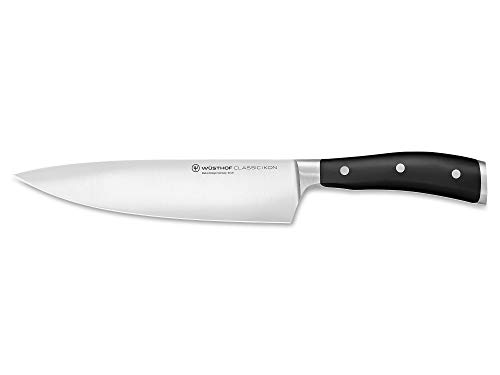
3. Wüsthof Classic Ikon 8″ Chef’s Knife
German precision with a double bolster that sits balanced and steady in your grip.
Wüsthof’s signature here is the double bolster — extra forged steel at the top and bottom of the blade-to-handle junction — which pushes weight forward so the knife feels planted and sure in your hand. Forged from a single block of high carbon stainless steel and tempered to 58-degree HRC (Rockwell hardness scale, a measure of steel hardness), the blade sits just under the 60-Rockwell Japanese steel above. That gives you a hard, long-holding edge with slightly more give than an ultra-thin Japanese grind. Wüsthof’s Precision Edge Technology (a factory grinding method) yields an edge the maker claims is 20% sharper with twice the edge retention of previous models.
What owners circle back to most is the balance. The blade cuts hard items like nuts with ease and stays sharp for long stretches, and the solid weight reads as reassuring rather than clumsy. At 9.6 ounces it is 1.28 ounces lighter than the Shun Classic above, so the balance lands closer to neutral — controlled without feeling tip-heavy. In hand, that means a full day of dicing and mincing without a sore wrist.
The honest caveat: some cooks find it on the expensive side for what it is, and you are paying for the forged German build and that balance rather than a showy Damascus pattern. It is the sensible premium pick — the cook who wants a knife that feels engineered, not decorated, gets exactly that here. Consider it the steady, reliable choice over the flashier handles nearby.
The balance story: the double bolster and 58 HRC steel give you a knife that points precisely and holds its edge, which is why it reads as a professional tool rather than a display piece.
Price honesty: the build justifies the outlay for many, but it is not the value leader on this page — the ZWILLING gives you a similar forged German blade for less coin.
Pick this one if: you value a balanced, slightly forward-weighted knife that feels solid and cuts with control.
Skip the splurge if: you mostly want raw sharpness per dollar and do not care about the double-bolster feel.
4. Dalstrong Chef Knife – 8 inch – Valhalla Series
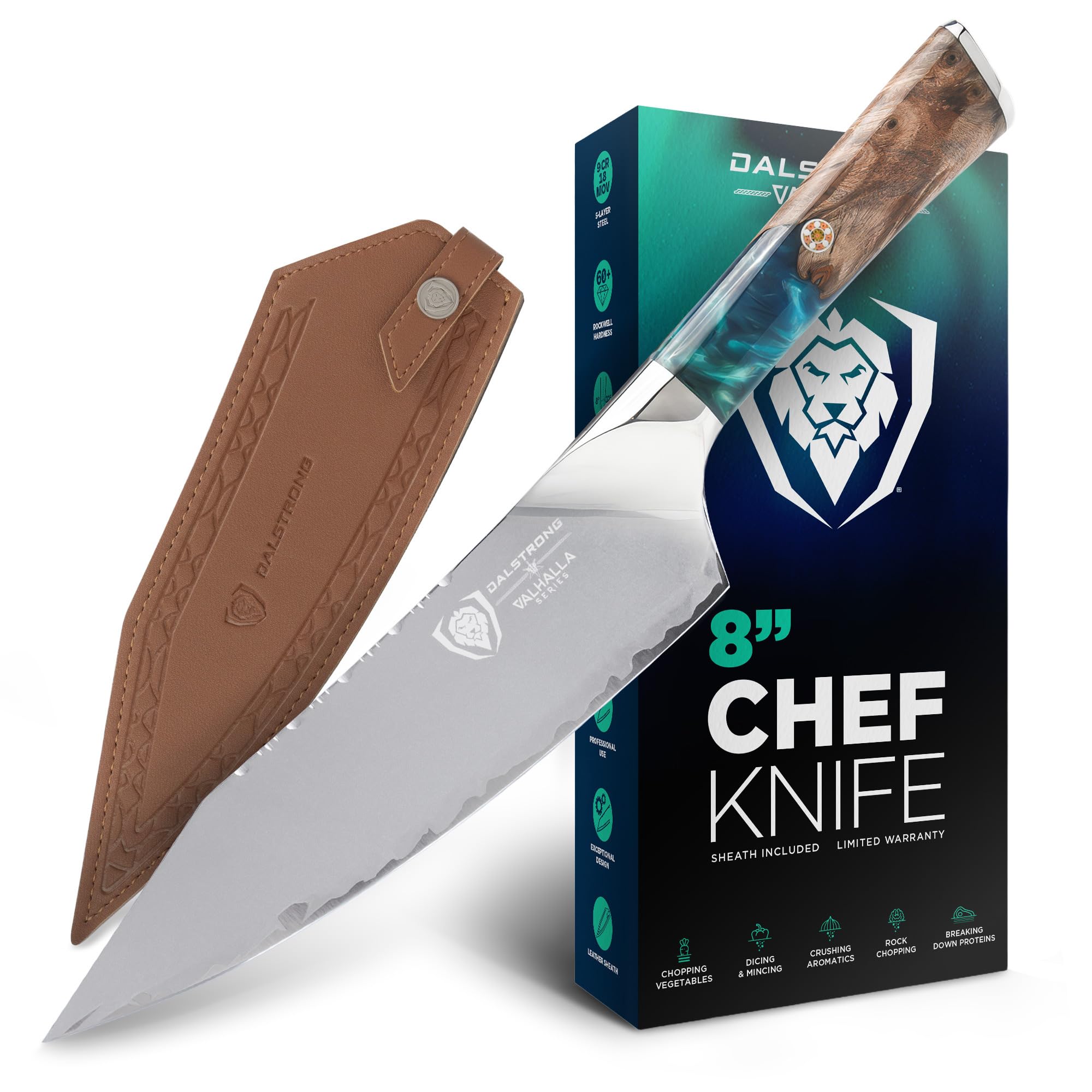
A weighty single-piece blade with a resin-and-wood handle that doubles as counter art.
This is the heaviest knife on the list at 1.8 pounds, and that heft is exactly what lets it power through a butternut squash with a slow, controlled press. The single-piece high-carbon steel runs 60+ Rockwell and is hand-sharpened to 8-12 degrees per side, so the edge is acute enough to slice a soft tomato in half without pressure — a detail owners single out. The stainless bolster and stabilized wood reinforce a handle that will not feel loose in the hand.
Ahead of the curve here is looks. Quality is the thing owners praise most, and the celestial resin-and-wood handle is right behind it — the Nordic-style finish is a genuine conversation starter. That is why it lands on gift lists: a resin-and-wood 8-inch chef knife that stands out on any counter makes a memorable present for birthdays and anniversaries.
The flip side of the 1.8-pound build is that it is 0.6 pounds heavier than the Miyabi Birchwood up top. That matters if you do long fine-dicing sessions, because the wrist carries more of the work. The resin handle also wants wiping down rather than a soak. If you want a blade that looks stunning and chops like a meat cleaver when you ask it to, this is your pick — but it is not the lightweight you reach for on delicate work.
What Makes It Stand Out
- 60+ Rockwell single-piece steel takes a razor edge at 8-12° per side
- Celestial resin and stabilized wood handle is a genuine showpiece
- Valhalla-embossed leather sheath included for storage
- Substantial 1.8-pound weight powers through dense vegetables
What You Give Up
- Heaviest knife here, so long sessions can tire your wrist
- Resin handle wants hand-wiping rather than a long soak
Best fit for: cooks who want a bold-looking blade with heavy chopping authority and a sheath for the drawer.
Look elsewhere if: you do a lot of fine detail work and prefer a lighter, more nimble grip.
5. Shun Classic 8″ Western Cook’s Knife

A Japanese blade built with a Western curve, made for rocking through big vegetables.
The Shun Classic earns its place through the combination of a VG-MAX steel core wrapped in 68 layers of Damascus cladding. That cladding is not just for looks — it stiffens the blade while keeping the cutting edge thin and precise. The 22-degree edge is the strongest of the Japanese blades here, giving it extra muscle for tougher tasks like a butternut squash. In use, it is the knife that keeps its edge for a long time and cuts better than most of what is already in a home cook’s block.
At 13.75 inches overall it is 1 inch shorter than the Miyabi Birchwood, and at 10.88 ounces it is 1.28 ounces heavier than the Wüsthof Classic Ikon. That weight sits in a blade that still reads as light and agile — a combination that makes rocking chopping feel natural rather than laborious. The D-shaped blonde Pakkawood handle works for both right- and left-handed cooks.
The honest note: durability draws mixed feedback, with some owners saying it holds up well and others reporting a chip within a month of use. That is a real split, and it points to how carefully you treat a thin Japanese edge. Keep it away from bones and frozen food and you stay in the happy camp. What wins people over is the balance of beauty and sharpness — the hammered Japanese look comes with a Western cutting action that feels familiar the first time you pick it up.
Why it stays sharp: the VG-MAX core and 68-layer cladding give a stiff, thin blade that holds its edge and rocks through big produce with control.
Handle anyone can use: the D-shaped Pakkawood grip is comfortable and secure for left- and right-handed cooks alike.
the balance: home cooks who want Japanese sharpness with the familiar Western cutting motion for rocking and dicing. skip it if you prefer a laser-thin Japanese blade or rarely rock the knife.
Handle with care: the mixed durability reports mean this blade wants a delicate touch away from bones and frozen food.
6. Miyabi Kaizen 8-Inch Chef’s Knife

The entry ticket to Miyabi’s hand-honed Japanese edge without the premium price.
If the Birchwood above is out of reach, the Kaizen delivers much of the same Japanese character: a VG10 super steel CRYODUR blade (a high-carbon stainless steel), ice-hardened to Rockwell 60, hand-honed on the three-step Honbazuke process to a 9.5 to 12 degree edge. The 65-layer flower Damascus pattern and katana-style edge give it the same shooting-star look on the shelf. In your hand, that means slicing tomatoes and onions with almost no effort — owners describe it as razor-sharp from the start.
At 14.75 inches overall it matches the Birchwood’s length, but at 11.2 ounces it is 0.2 ounces heavier than the Shun Premier below. The difference is negligible in use. The black Micarta handle with linen pattern, mosaic pin, and red accent spacers gives a firm, grippy hold, so it feels secure even during quick chopping. For the money, it is one of the strongest performance-per-dollar picks on this page.
The thing buyers flag most is durability — the consensus is mixed on how the edge holds up over years of heavy use. That fits a 60-Rockwell Japanese blade: outstanding when treated well, less forgiving if you bang it around. Keep it on the board and out of the sink, and it rewards you with sharpness for the long haul. It is the choice for cooks who want to try the Japanese edge experience before committing to a flagship.
Strongest Selling Points
- VG10 Cryodur at Rockwell 60 takes a steep 9.5–12° Honbazuke edge
- 65-layer flower Damascus gives it a striking look
- Micarta handle with mosaic pin grips firmly and securely
- Delivers premium Japanese sharpness at a more accessible price
Where It Asks More
- Durability for heavy, rough use draws mixed opinions
- Thin Japanese edge needs careful handling and hand-washing
Great value for: cooks curious about a sharp Japanese blade who want to spend sensibly on their first one.
Steer clear if: you want a knife to abuse through bones and frozen food without a second thought.
7. Shun Premier 8″ Kiritsuke Knife

A hammered, vegetable-loving Kiritsuke that makes clean julienne work feel simple.
The Kiritsuke is a shape many home cooks have never used, and that is part of its appeal. It is built for julienning or dicing vegetables and for slicing and portioning boneless meat. The VG-MAX core with 68 layers of Damascus cladding gives it a razor edge at a 16-degree angle — steeper than the 22-degree Shun Classic above, so it bites deeper with less effort. The hammered tsuchime finish on the blade is not just decoration; it reduces drag and helps food release instead of clinging.
At 217 g it is light enough for precise, patient knife work, and the contoured walnut-colored PakkaWood handle feels secure for both left- and right-handed cooks. The balance and weight are described as nearly spot-on, so the blade tracks where you point it. Owners mention cutting through frozen bacon with it, a strong sign of what the fresh 16-degree edge can do.
The durability picture is mixed, and value draws split opinions. That is fair for a thin, high-carbon Japanese blade with a decorative hammered finish: it wants care and a clean dry rack rather than a soak in the sink. If you do a lot of vegetable work and want a conversation-starting blade that also performs, this is a genuine step up in precision. Just know the edge wants the same respect the Miyabi up top asks for.
Why cooks love the edge: the 16-degree VG-MAX edge and hammered finish make short work of vegetables and release food cleanly as you slice.
What to watch: durability feedback splits, so keep this fine blade away from bone and give it a dry home.
Made for: cooks who spend their prep time on vegetables and want a precise, food-releasing blade that looks the part.
Not the pick if: you want a do-it-all chopper for heavy meat and bone work.
8. Yoshihiro VG10 46 Layers Hammered Damascus Gyuto
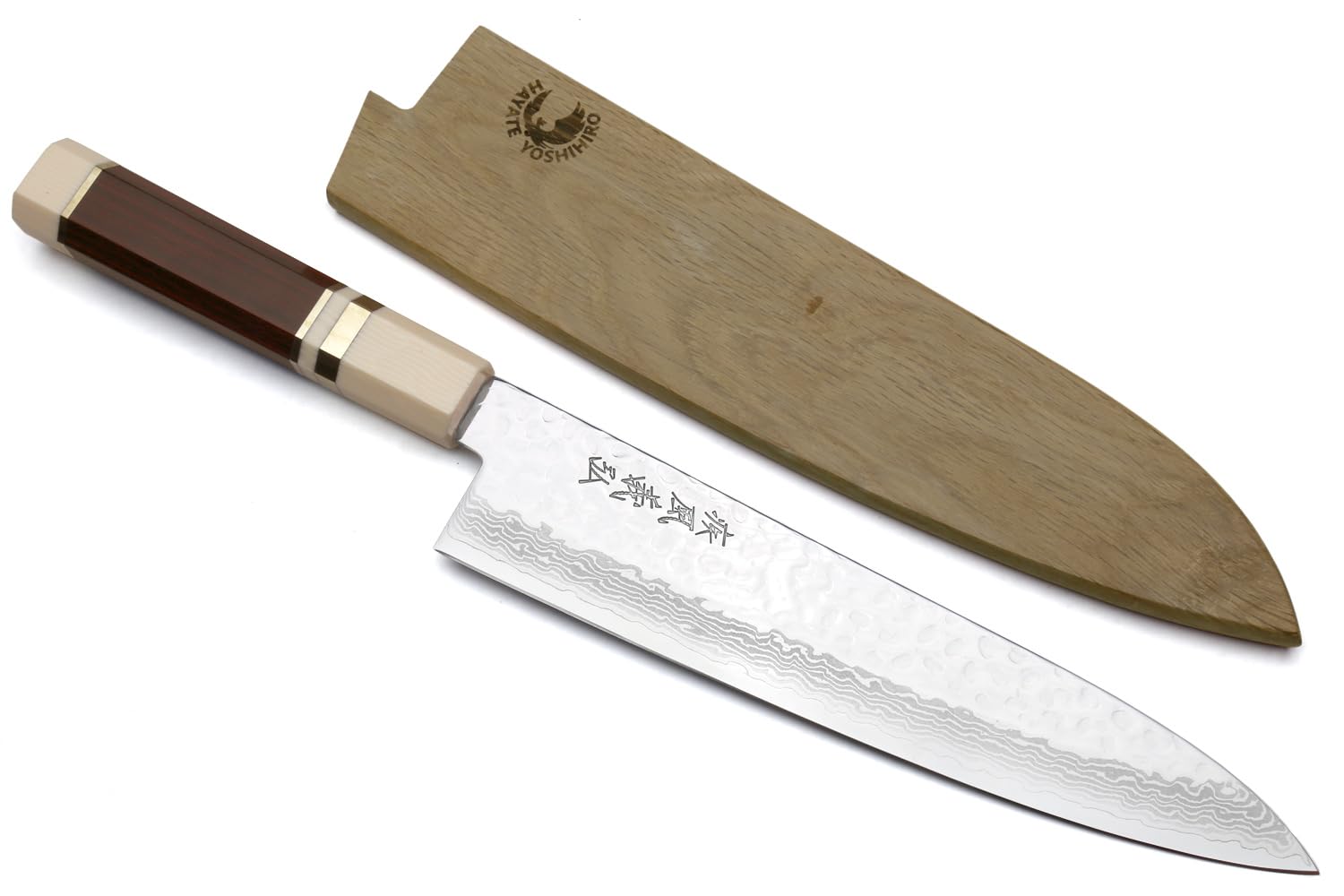
The featherweight Gyuto that sails through potatoes at 4.8 ounces.
Weighing in at just 4.8 ounces, this Yoshihiro is by far the lightest knife on the list — half the weight of the Dalstrong above — and that is the whole reason to own it. The 8.25-inch VG10 core runs at HRC 60 and is forged and hammered with 46 layers of steel in the Damascus tradition. In a Gyuto profile, the curved blade rocks smoothly back and forth, and an extended tip makes quick chopping easy across meat, fish, and vegetables. Owners describe it slipping through potatoes like butter.
The hammered texture on the blade eliminates friction and keeps food from sticking, so you can chop through a batch of onions without stopping to scrape the blade. The traditional Japanese Wa-style octagonal rosewood handle is lightweight and hand-filling. The included natural magnolia wood Saya sheath protects the knife when it is not in use — a nice extra that most picks here do not include.
The compromise of going this light is that it will not power through a dense squash with the same authority as the heavier 1.8-pound Dalstrong. You get agility and precision instead of brute force. For slicing, carving, and detailed vegetable prep, that trade favors the Yoshihiro. It is the knife for cooks who do fine work and want the blade to disappear in their hand.
Why It Feels So Good
- Feathery 4.8-ounce build keeps your hand fresh through long prep
- VG10 at HRC 60 with 46 hammered layers holds a keen edge
- Hammered blade releases food and reduces drag
- Protective Saya sheath keeps it safe between uses
Worth Knowing
- Lightweight means less muscle for dense, tough ingredients
- Wa-style handle shape is a different feel from Western grips
Ideal for: cooks who do a lot of slicing and carving and want a light blade that stays precise all evening.
Not for you if: you prefer a heavy, forward-weighted knife to power through squash and roots.
9. Wüsthof Performer 8″ Chef’s Knife, Black

The black-coated all-rounder with a non-slip grip built for fast, controlled work.
The Performer’s talking point is its DLC (diamond-like carbon) blade coating, which the maker says comes from aerospace and motor-sport applications, raises the surface hardness of stainless steel by 146%, and reduces friction for easier cutting with less force. It is a black blade that stays black as it wears. At 9.12 ounces it is 0.48 ounces lighter than the Wüsthof Classic Ikon above — a fast, agile all-rounder rather than a heavy hitter.
What buyers respond to is the grip and the sheer cutting ease. The Hexagon Power Grip handle on glass-filled nylon resists slipping even when your hands are covered in chicken juices, and the balanced setup puts maximum control at your fingertips. Owners describe it slicing through semi-thawed pork like butter, high praise for an 8-inch all-rounder.
The mixed durability verdict is the one honest note here — the black coating eventually shows wear on a tool you chop on daily, and that is the price of the coated finish. The blade is an 8-inch do-everything shape that handles large ingredients, meat, and herbs with a longer blade for confident control. For someone who wants a sharp, striking, no-slip workhorse for fast-paced cooking, it delivers.
Grip and glide: the DLC coating and Hexagon Power Grip give you less friction and a secure hold, so the knife feels controlled even at speed.
The black-blade cost: the coated finish is the reason it cuts so smoothly, but that same finish is where durability feedback splits over time.
Smart pick if: you want a sleek, non-slip all-rounder that cuts through semi-thawed meat with ease and looks sharp on the board.
Rethink it if: you want a knife whose finish stays flawless for decades regardless of daily chopping.
Know the Specs
Rockwell Hardness (HRC)
This is a scale that measures how hard the steel is, and it predicts how long the edge will hold before you need to hone it. German blades often sit around 57 to 58 HRC, which keeps them tough and easy to maintain. Japanese blades push to 60 HRC and above, which holds a keener edge but chips more easily if you twist or hack. Match the number to how you cook: the higher the hardness, the more care it asks.
Edge Angle (Degrees Per Side)
The angle is how steeply the blade tapers to its cutting point. A steeper 15-degree edge slices like a razor but needs gentle handling. A wider 22-degree edge trades some bite for strength that handles tougher jobs like squash and dense proteins. If you mostly chop vegetables, a steeper angle shines. If you hack through varied ingredients, a wider angle keeps its edge longer.
Blade Steel and Cladding
The steel type and any Damascus cladding layers affect both sharpness and looks. Layers of cladding stiffen a thin core blade so it stays precise without being brittle. A hard, fine-grained core like VG10 or SG2 takes a very keen edge, while a tough high-carbon steel forgives more. Cladding is often decorative, but it also changes how stiff the blade feels in your hand.
Balance and Handle Material
Balance is where the weight sits along the knife, and it decides how controlled the blade feels. A forward-weighted knife does more of the chopping work; a neutral knife feels precise for detail. Handle material matters too — Pakkawood, Micarta, and glass-filled nylon all feel different when wet. Hold a knife before buying if you can, because the handle shape decides how comfortable a long prep session will be.
Common Questions
Is a Japanese or German chef’s knife better for everyday cooking?
What does the edge angle in degrees actually mean for a home cook?
How long will a quality chef’s knife stay sharp with normal use?
Can I put a Damascus-clad chef’s knife in the dishwasher?
Will an 8-inch chef’s knife be big enough for a home kitchen?
Does a heavier knife chop better than a light one?
What handle material is best for a wet kitchen?
Is a Kiritsuke knife worth it over a standard chef’s knife?
Do I need to sharpen a new chef’s knife right away?
How do I keep a thin Japanese edge from chipping?
The Bottom Line
The winner for most cooks is the Miyabi Birchwood SG2 — the finest hand-honed edge on the list, wrapped in a warm Karelian Birch handle that makes every prep session a pleasure. It holds the top spot for a reason: SG2 steel and a 9.5 to 12 degree edge give you the sharpest, most precise cut here. If you want a knife that takes hard daily use without fuss, grab the ZWILLING Professional S, whose 57-Rockwell forged blade has proven itself over decades of heavy chopping. And for light, precise slicing and carving, the Yoshihiro Gyuto is the one to reach for at just 4.8 ounces. Whichever you pick, these nine are the ones truly worth owning.
How we choose
We do not accept paid placement. Every pick is matched to a real buyer and a real use-case; we do not hands-on test units.
Sources
Specifications: manufacturer listings and product documentation. Review insights: verified customer reviews, as of November 2026. Pricing: not shown on this page (it changes often); check the current price via the retailer link.
As an Amazon Associate, Tactical Gear Guy earns from qualifying purchases. This does not affect which products we feature.