Specs are compiled from manufacturer listings and verified buyer reviews and can change over time — please confirm the key details on the product page before buying.
If your knives are tearing tomatoes instead of slicing them, the fix is not a new knife set — it is the right sharpener. The short answer: a compact pull-through tungsten carbide sharpener restores a working edge in seconds with almost no skill, and it is the one most people should buy first. Everything below covers nine real options, from a diamond-rod bench unit with selectable angles to a motorized belt machine that will reshape a damaged bevel.
This guide is built by comparing the manufacturers’ published specifications and the patterns across verified customer reviews, so you get each pick’s real strengths and trade-offs instead of marketing spin.
You will see what each tool actually does to a blade, where it falls short, and which one suits your kitchen drawer or your hunting pack. By the end you will know exactly which world’s knife sharpener earns its place in your kit.
Top Picks


How To Choose The Best World’s Knife Sharpener
The first decision is not brand — it is method. A pull-through sharpener scrapes two fixed abrasive surfaces across the edge at a preset angle. A whetstone is a flat abrasive block you draw the blade over yourself. An electric sharpener spins abrasive wheels or runs a belt. Each one solves a different problem, and buying the wrong method is why sharpeners end up in a drawer.
Match the tool to how dull your knives actually are
A blade that still cuts but drags needs honing or a light touch-up — a few passes through a pull-through or a high-grit stone brings it back. A blade that crushes food or slips on tomato skin needs real grinding, which means a coarse stage, a low-grit stone, or a motorized belt. Know which situation you are in before you buy.
Sharpening angle in degrees — the number that decides edge character
Angle is measured between the blade and the abrasive surface. A shallower angle produces a keener slicing edge that dulls faster. A steeper angle leaves more metal behind the edge, so it survives chopping and field work. If a sharpener lets you pick between settings in degrees, you can put a fine edge on a fillet knife and a sturdy edge on a machete with the same tool.
Grit ratings and why dual-grit kits cover most kitchens
Grit numbers describe abrasive particle size — lower numbers cut faster and coarser, higher numbers polish. A two-sided stone pairing a coarse grit with a fine grit lets you repair a nicked edge, then refine it. Single-grit pull-throughs skip that graduation and simply cut one consistent tooth pattern.
Straight versus serrated blades
Serrated knives have scalloped teeth that a flat stone cannot reach into. Some pull-through sharpeners and multi-stage electric units are built to work both edge types; a plain whetstone user generally hones the flat side and leaves the teeth alone. If your bread knife matters to you, check that the sharpener names serrated blades.
Side-by-Side Comparison
| Model | Best For | Type | Grit / Stages | Weight | Amazon |
|---|---|---|---|---|---|
| AccuSharp Knife Sharpener★ Best Overall | Fast everyday touch-ups | Manual pull-through | Coarse tungsten carbide | — | Amazon |
| The Edgemaker Knife Sharpener Pro 331Most Portable | Portable honing and sharpening | Manual crossed steels | Fine grit | 4.16 ounces | Amazon |
| Work Sharp Benchtop WhetstoneBest Guided Stone | Guided stone sharpening | Benchtop whetstone | Coarse and fine | 2.3 pounds | Amazon |
| Sharp Pebble Whetstone Kit | Beginners learning stones | Dual-grit whetstone | 1000 / 6000 grit | 2.1 pounds | Amazon |
| Presto 08800 EverSharp | Hands-off electric grinding | Electric, 2-stage | Fine; two-stage wheels | 3 pounds | Amazon |
| Mercer Culinary Double Diamond | Pro kitchens and fast honing | Manual, 2-stage | Ultra fine; 100% diamond | 0.25 kg | Amazon |
| Warthog V-Sharp A4 | Multi-angle precision work | Manual V-rod system | 325 grit diamond + finishing steel | 0.62 kg | Amazon |
| Chef’sChoice 15XV EdgeSelect | Converting knives to 15-degree edges | Electric, 3-stage | 100% diamond abrasives | 4.2 pounds | Amazon |
| Work Sharp Ken Onion Mk2 | Reprofiling damaged edges | Electric belt, variable speed | Fine; quick-change belts | 2 pounds | Amazon |
Detailed Reviews
1. AccuSharp Knife Sharpener, Brushed Aluminum
Our pick — 4.5+★ from 28,500+ verified ratings; the strongest balance of quality and price.
Ten seconds of drawing a blade through this and dinner prep stops fighting back.
Here is the appeal in one line: it puts a usable edge back on a kitchen knife in about ten seconds, with no technique to learn. You grip the ergonomic handle, draw the blade through the slot a few times, and you are done. The crowd favorite backs that up — 4.5+ stars across 28,000+ ratings — and what wins people over is simply the build quality of the thing.
The cutting surfaces are diamond-honed tungsten carbide, one of the hardest materials you can put against steel. Those blades reverse, so you get a second working face before the sharpener is spent, and users report getting 5 to 10 years out of each carbide blade before replacing it. It handles chef’s knives, paring knives, serrated knives, fillet knives and cleavers. It is double-beveled and cleans up under the tap or in the dishwasher.
The honest catch: coarse carbide removes metal fast and leaves a toothier edge than a stone. That is great for a battered beater knife, less great for a thin Japanese blade you baby.
Where It Delivers
- Sharpens most blades in about ten seconds with zero learning curve
- Diamond-honed tungsten carbide cutters reverse for double the service life
- Works on straight and serrated edges, and rinses clean or goes in the dishwasher
- Fits left or right hand with a full-length finger guard
Where It Gives Ground
- Coarse carbide takes metal off quickly and leaves a rougher edge than a stone
- Not the tool for a delicate high-end blade you want polished
Reach for this if: you want a drawer gadget that rescues dull kitchen knives in seconds and never asks you to learn an angle.
Look elsewhere if: your priority is a mirror-polished edge on a fine blade — a whetstone kit does that job better.
2. The Edgemaker Knife Sharpener Pro 331
A pocketable pair of crossed steels that brings a blade back in under a minute.
The Edgemaker 331 weighs just 4.16 ounces, so it drops into a hunting pack or a kitchen drawer without you noticing it. You draw the knife through the crossed steels with mild pressure and the tool hones and sharpens in less than one minute. It behaves like a butcher’s steel rather than a grinding wheel, which means it straightens and refines an edge instead of hogging off metal.
The high-impact plastic handle is built to survive a drop, and the steels pull out and rotate so you can expose fresh sharpening surface over years of use. To do that you soak the body in hot water for a minute to expand the plastic, pull the steels, rotate them, and push them back in. It covers wavy and serrated knives too, so the bread knife is not left out. In the kitchen it is the quick touch-up tool — the review pages are full of people using it on EDC pocket knives between real sharpening sessions.
Compared with the AccuSharp above, this one is gentler on the blade but slower to rescue a truly wrecked edge. The 11-inch length gives you a longer stroke to control, though it also means it takes up more drawer space than a stubby pull-through. Quality is the thing that gets praised most here, and the plastic body is the part to treat with a little care when you rotate the steels.
What stands out: reversible steels mean the working surface refreshes instead of wearing smooth, and the 4.16-ounce body travels anywhere.
What to know: it hones more than it grinds, so a badly damaged edge needs a coarser tool first.
Worth it for: hunters, anglers and home cooks who want a light, packable touch-up tool that behaves like a steel.
Less suited to: rebuilding a chipped edge from scratch — that calls for a coarse stone or a belt machine.
3. Work Sharp Benchtop Whetstone Knife Sharpener
Stone sharpening with training wheels — the angle guides do the hard part for you.
Holding a consistent angle by hand is the reason most people give up on whetstones. This unit solves that with 15° and 17° sharpening guides, so you get a repeatable, keen edge without years of practice. The kit includes a 1000 / 6000 combination water stone, a water control base, an anti-skid mat and a user’s guide.
It covers kitchen cutlery, EDC pocket knives, fillet blades and edged tools, which suits cooks, anglers, hunters and DIYers alike. Start on the coarse side to rebuild a dull or nicked edge, then finish fine for a slicing-sharp result. The stone itself is corundum, and the whole package weighs 2.3 pounds — a touch heavier than the Sharp Pebble kit below at 2.1 pounds, which you will notice only when you move it around the counter.
Physically it is the compact one of the group: it measures 4 inches long, 2.25 inches wide and 9.5 inches tall, against the Edgemaker’s 11-inch length, so it stands upright and stores in a narrow gap. Stone quality and size are what buyers single out, and it is sized to handle large knives without running out of runway. It comes with a limited lifetime warranty, which is the strongest coverage on this list.
The reason to pick it: two fixed angle guides take the guesswork out of stone sharpening, and the 1000 / 6000 combo covers repair through polish.
The trade-off: you still supply the motion, so a first session takes patience rather than seconds.
Fits best: someone who wants real stone results but needs the angle held steady for them.
Pass if: you want a knife fixed in one pass with no water, no stone and no setup.
4. Sharp Pebble Whetstone Knife Sharpener, 1000/6000 Grit

A complete stone kit that assumes you have never sharpened anything in your life.
Two grits, one stone, and an angle guide that locks your blade position so you do not have to guess. The 1000-grit side repairs dull or damaged edges; the 6000-grit side polishes to a razor-sharp finish. It is a water-based system, so there is no honing oil to buy and no oily mess on the counter. Beginners get there in about ten minutes, which is the pitch the whole kit is built around.
Everything arrives together: the dual-grit stone, a bamboo base, the angle guide, an instruction manual, a tips-and-tricks ebook and access to sharpening support. The non-slip bamboo base keeps the stone planted while you work, which is the single biggest difference between a calm first session and a wobbling one. It also sharpens scissors, chisels and razors, not just kitchen knives.
At 2.1 pounds it is the lighter of the two stone kits here, edging the Work Sharp at 2.3 pounds. What you give up against that one is the pair of separate fixed-angle guides — the Sharp Pebble relies on a single included guide instead. The maker claims the stone stays flat three times longer than bargain stones — an unverified manufacturer claim; treat the flatness as a reason to buy a known name, not a guarantee.
What Earns Its Place
- Dual 1000 / 6000 grit covers dull-edge repair and final polish in one stone
- Angle guide removes the hardest part of learning a whetstone
- Full kit — stone, bamboo base, guide, manual, ebook and support
- Water-based, so no oil purchase and no mess
Where It Asks More Of You
- You still do the work — first results take around ten minutes of practice
- Only one included guide rather than the two fixed angles some kits ship
Buy this if: you are starting from zero and want every piece of the setup in one box.
skip it if: you want a knife sharpened in one draw rather than a skill you build over a few sessions.
5. Presto 08800 EverSharp Electric Knife Sharpener

Plug it in, draw the blade through two slots, and stop thinking about angles entirely.
This is the hands-off route. Two stages do the work: stage one grinds a precisely angled edge, stage two hones and polishes it. Precision blade guides hold the knife at the ideal angle for you, so there is no guesswork and no wrist technique. You draw the blade through each slot a few times and you are finished.
The wheels are made from Sapphirite, which Presto calls the same ultra-hard material used in professional sharpening shops. It is designed for most non-serrated blades, both kitchen and sport knives, and the unit runs on 120 volts. The body weighs 3 pounds and measures 9.9 inches long, 7.2 inches wide and 4.8 inches tall — small enough to live on the counter, heavy enough that it does not skate while the motor runs.
What it will not do is serrated edges, which is the line to check before you buy if your bread knife is a priority. It also removes metal faster than a manual hone, so a thin blade needs a light hand. Setup takes about two minutes from the start, and it handles even badly dulled knives quickly. Coverage is a 1-year limited warranty, the shortest here.
Best part: the motor and the guides do the whole job, which makes it the least intimidating tool on this list.
The limit: straight edges only — serrated blades are out of scope.
Suits you if: you want an appliance, not a skill, and your knives are all straight-edged.
Not for: serrated bread knives or anyone who wants to preserve as much blade steel as possible.
6. Mercer Culinary Double Diamond Manual Knife Sharpener

A foodservice-grade hand sharpener that leaves an arch-shaped edge built to hold.
You get two stages — one for sharpening and one for honing — built on 100 percent diamond abrasives (the hardest grit used in sharpeners). That leaves an arch-shaped edge, which holds up better than a thin V because more metal sits behind the cutting line. Precision guides hold the angle steady, so your stroke stays simple to use even during a busy service.
It takes straight and serrated knives in the same tool, which matters if you work through a mixed knife roll. The body is polycarbonate with a textured handle that stays put in a wet hand. Mercer builds this for foodservice operations, and it works just as well in a home kitchen for someone who wants a consistent edge without a stone setup.
The honest caveat is longevity. Some users report the diamond coating wearing off before they expected, while others report up to three years of use before it stops reviving an edge. Durability and value are the two points where opinion splits, and the priciest voices in the room call it a little expensive for a hand tool. Given how fast it touches up a working knife, the fair read is that it suits a heavy user who will get the wear out of it.
What owners prize: the diamond abrasives cut quickly on both large and small blades, and the arch-shaped edge resists rolling.
What to weigh: the diamond surface is the wear item — treat it as a tool with a service life, not a lifetime purchase.
Good match for: line cooks and serious home cooks who want a diamond two-stage tool they can grab mid-prep.
Think twice if: you want one sharpener that outlives everything else in your drawer.
7. Warthog V-Sharp A4 Knife Sharpener

Four selectable angles in one bench unit — a filet knife and a machete both get their edge.
Four settings — 15°, 20°, 25° and 30° — let you dial the edge to the blade. A delicate sushi knife wants the shallow setting; a thick bushcraft blade wants the steep one. The patented V-Sharp mechanism holds those angles, and the spring-loaded hones sharpen both sides of the blade at once, which cuts the stroke count in half.
You get a 325 grit natural diamond hone plus a hardened hone steel for finishing, both seated in a metal frame with a solid rubber base and a powder-coat finish. The rubber base is what keeps it planted on a workbench while you pull a heavy blade through. It covers everything from machetes to delicate high-end kitchen knives, so it suits cooks, gardeners, homesteaders, anglers and hunters alike.
Performance is the aspect that dominates opinion here, and it performs on par with far more involved setups. Durability draws some mixed notes — a few mention wear over heavy use, so budget for hone replacement down the line. It is also the bulkiest manual unit on this list, so it wants a bench spot rather than a drawer slot. Where it clearly beats the pull-throughs above is angle control: you are not locked into one factory setting.
Why It Earns The Bench Space
- Four selectable angles — 15°, 20°, 25° and 30° — for everything from filet to machete
- Spring-loaded hones sharpen both bevels simultaneously
- Metal frame, rubber base and powder-coat finish for a stable, planted stroke
- 325 grit natural diamond hone paired with a finishing steel
What It Asks In Return
- Larger footprint than a handheld sharpener, so it needs a dedicated spot
- The hones are a wear part under heavy use
Pick this when: you sharpen several blade types and want the angle to change with the tool.
Alternative route: if you only own kitchen knives, a single-angle pull-through is simpler and takes less room.
8. Chef’sChoice 15XV Electric Knife Sharpener
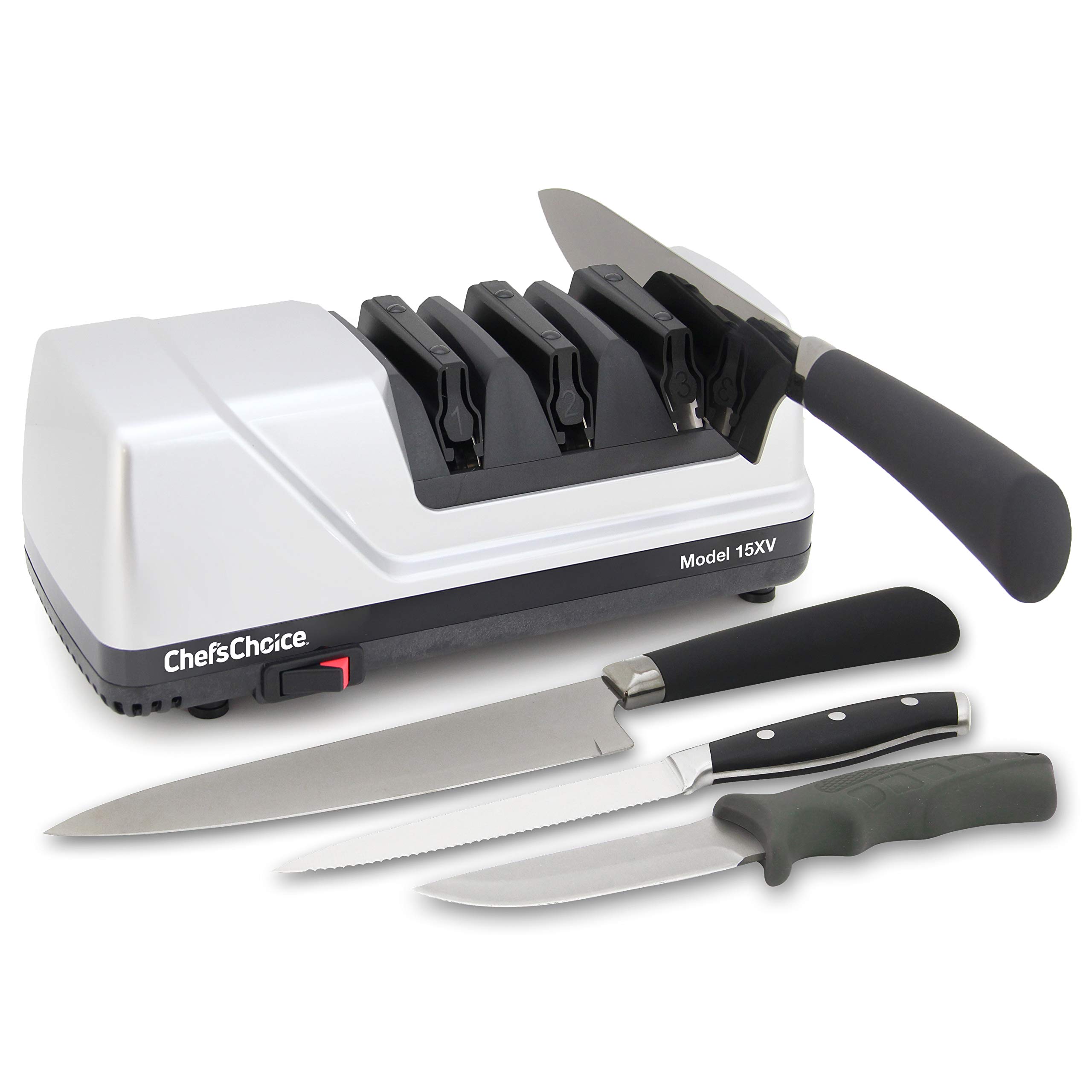
The machine that turns ordinary knives into 15-degree slicers in about a minute.
Most household knives leave the factory with a 20-degree edge. This unit converts them to a 15-degree Trizor XV edge, which is the shallower geometry that makes a blade slide through food rather than push it apart. First-time sharpening takes about a minute; resharpening takes around ten seconds.
Three stages handle the work. Stages one and two carry 100 percent diamond abrasives to sharpen and hone, and stage three uses a patented flexible abrasive system to polish and help prolong serrated blade life. Patented spring guides adjust automatically to hold the correct angle, and a simple on/off switch is the only control you manage. The body measures 10 inches long, 4.25 inches wide and 4.25 inches tall and weighs 4.2 pounds, so it sits solidly on a counter.
The manual is worth the read — it is written around different knife types, which is how you get the most from the three stages. Coverage runs three years limited. The catch is that once you convert a knife to 15 degrees you have committed to that geometry; going back means grinding the bevel again. Thin, hard Japanese blades also want care on a powered machine.
The draw: a 15-degree convex edge plus automatic spring guides removes angle skill from the equation entirely.
The caveat: converting to 15 degrees is a one-way trip without a reprofiling job.
Buy for: a full kitchen knife block that needs a consistent, sharp 15-degree edge with almost no effort per knife.
Not ideal for: a single delicate blade you would rather keep at its original factory angle.
9. Work Sharp Ken Onion Mk2 Electric Knife Sharpener

A guided belt machine that reprofiles a wrecked edge without freehand stone work.
This is the tool for the knife you thought you had ruined. A flexible abrasive belt sharpens and hones in a single guided pass, restoring a factory-keen edge in minutes. You never freehand the angle — the adjustable guide sets a precise, repeatable bevel anywhere from 15 to 30 degrees. Put the shallow end on a fine kitchen knife and the steep end on a thick hunting blade.
Variable speed control is the feature that makes it usable on soft steel. Run the belt slower for a delicate finishing pass and faster to take material off a damaged edge, so you control how aggressively each pass bites. It handles pocket knives, chef cutlery, serrated blades, shears and garden tools, replacing a drawer of single-use sharpeners. Quick-change belts swap in seconds when you move from coarse repair to a polished finish.
At 2 pounds it is far lighter than the Chef’sChoice above at 4.2 pounds, and measuring 7.76 inches long, 10.57 inches wide and 2.93 inches tall it stores easily on a bench between uses. Performance is what buyers praise most — it makes axes and knives razor sharp quickly, and the adjustable angle guide earns its own credit. Instructions draw mixed notes, so watch the setup material before your first belt. Coverage is three years.
What Makes It Different
- Adjustable guide spans 15° to 30°, so each blade gets its intended bevel
- Variable speed belt lets you choose between gentle finishing and aggressive reprofiling
- Handles knives, scissors, serrated blades and garden tools in one unit
- 2 pounds and compact enough to store on a countertop
What To Expect
- The included instructions leave some gaps — plan a practice run on a cheap knife
- A powered belt takes metal fast, so a light hand matters on thin blades
Choose it if: you have a pile of blades across kitchen, shop and garden and want one machine to handle all of them.
Hold off if: a single drawer sharpener for one chef’s knife is all you actually need.
Know the Specs
Sharpening Angle and What It Changes
Angle is the gap between the blade face and the abrasive. A shallow angle produces a thin, keen edge that slices cleanly but dulls sooner. A steeper angle leaves more steel behind the edge for chopping and field work. A sharpener with selectable settings in degrees lets you match that trade-off to the blade in your hand — a filet knife and a machete should not share one angle.
Grit Numbers and Two-Stage Logic
Grit describes abrasive particle size: lower numbers cut fast and coarse, higher numbers refine and polish. That is why dual-grit kits pair a coarse side for repairing dings with a fine side for finishing, and why electric units split the job into stages. A single-grit pull-through skips that graduation, cutting one consistent tooth pattern every time.
Common Questions
Will a pull-through sharpener ruin a good knife?
How often should I sharpen my kitchen knives?
Can I sharpen serrated knives with these tools?
What is the difference between a 15-degree and a 20-degree edge?
Do I need oil for a whetstone?
Can an electric sharpener overheat or damage a blade?
Will a sharpener work on ceramic knives?
How long do these sharpeners last before I replace them?
Is a whetstone better than an electric sharpener?
The Bottom Line
For most kitchens, the world’s knife sharpener winner is the AccuSharp Knife Sharpener, because it fixes a dull blade in about ten seconds without a single lesson. If you want angle control across filet knives and machetes, the Warthog V-Sharp A4 offers four settings in one bench unit. And for a whole knife block that needs a consistent 15-degree edge, the Chef’sChoice 15XV EdgeSelect handles it in about a minute per blade.
How we choose
We do not accept paid placement. Every pick is matched to a real buyer and a real use-case; we do not hands-on test units.
Sources
Specifications: manufacturer listings and product documentation. Review insights: verified customer reviews, as of November 2026. Pricing: not shown on this page (it changes often); check the current price via the retailer link.
As an Amazon Associate, Tactical Gear Guy earns from qualifying purchases. This does not affect which products we feature.