Specs are compiled from manufacturer listings and verified buyer reviews and can change over time — please confirm the key details on the product page before buying.
You touch your keyboard more than any other part of your setup, yet most people buy one that fights their hands or crowds their desk. If you want the short answer: the AULA WIN68 HE is the pick that suits the widest range of buyers, and it costs less than most lunch runs. Below are nine boards grouped by strength: 8,000Hz gaming, silent office switches, split-wrist ergonomics, and full-size number pads.
This guide is built by comparing the manufacturers’ published specifications and the patterns across verified customer reviews, so you get each pick’s real strengths and trade-offs instead of marketing spin.
You will learn which switch type fits your fingers, why a 60% deck saves desk space, and where a split layout earns its keep. Here is the honest rundown of the world’s computer keyboard options worth your desk space.
Top Picks


How To Choose The Best World’s Computer Keyboard
Your fingers can spend hours a day on a keyboard, so comfort matters more than a spec sheet. Three things decide the right pick for you: what you do all day, how much desk space you have, and if you want a cable or a battery. Get those three right and switch specs and RGB become secondary.
Start with your switch, not your brand
Switches are the mechanism under each key, and they come in three flavors. Linear switches push straight down with no bump and no click, which suits fast gaming and quiet offices. Tactile switches give a small bump you can feel at the actuation point, so you know the key registered without bottoming out. Clicky switches add an audible snap — satisfying, but not something your coworkers will thank you for. The AULA WIN68 HE uses magnetic Hall Effect switches (a contactless magnetic sensor instead of metal contacts), and the Cherry KC 200 MX uses MX2A Silent RED linear switches rated for more than 50 million actuations per key.
Match the layout to your desk and your math
Full-size boards pack 104 or 108 keys plus a number pad. A 60% board like the AULA WIN68 HE strips down to 68 keys and saves up to 40% of desktop space, keeping arrow keys and basic function keys via FN combinations. The Logitech Alto Keys K98M sits in the middle with a 98-key compact 1800-style layout that keeps the numpad but trims width. If you type numbers all day, keep the pad. If you game with a wide mouse swing, go smaller.
Wired or wireless — decide by battery patience
Wired boards never need charging and never drop a keystroke. Wireless boards free your desk but ask for battery management. The Logitech MK270 combo claims 36 months of keyboard battery life and 12 months for the mouse. The Nulea split board runs a 200-hour rechargeable battery, and the EPOMAKER TH108 V2 PRO packs a 10000mAh battery rated for up to 200 hours. If you would rather not hunt for a charging cable, those hour counts are the spec to compare. If you hate charging, go wired.
Do not overlook how the deck sounds and feels
Gasket mounting (the internal plate floats on soft cushions instead of screwing hard into the case) is the current standard for a soft, deep typing feel. The Redragon K745 PRO uses a gasket design with 5-layer noise dampening. The Logitech Alto Keys K98M uses a UniCushion gasket mount to absorb vibrations. Both designs soften bottom-out, which is what your fingertips notice by hour eight.
Side-by-Side Comparison
| Model | Best For | Layout / Keys | Switch Type | Connection | Amazon |
|---|---|---|---|---|---|
| AULA WIN68 HE★ Best Overall | Fast gaming on a small desk | 60% / 68 keys | Hall Effect magnetic | USB-C wired | Amazon |
| Logitech MK270 ComboBest Value | Everyday office and home use | Full size + numpad | Low-profile membrane | 2.4GHz wireless | Amazon |
| Nulea Ergonomic SplitSplit Comfort Pick | Wrist-friendly all-day typing | Split ergonomic | Scissor switch | Bluetooth + 2.4G | Amazon |
| Keychron C2 | Mac and Windows dual users | Full size / 104 keys | Tactile mechanical | USB-C wired | Amazon |
| Redragon K745 PRO | Cushioned typing with RGB | Full size / 108 keys | Hot-swap mechanical | USB-C, BT, 2.4GHz | Amazon |
| Cherry KC 200 MX | Quiet office mechanical | Full size / 108 keys | MX2A Silent Red linear | USB-A wired | Amazon |
| EPOMAKER TH108 V2 PRO | Screen and knob customizers | Full size / 104 keys | Gasket mechanical | USB-C, BT, 2.4GHz | Amazon |
| Razer BlackWidow V4 X | Macro-heavy gaming | Full size / 104 keys | Yellow linear | Wired | Amazon |
| Logitech Alto Keys K98M | Compact full-feel with numpad | 1800-style / 98 keys | Marble clicky | Bluetooth, Logi Bolt, USB-C | Amazon |
Detailed Reviews
1. AULA WIN68 HE Mechanical Gaming Keyboard 60%
Our pick — 4.5+★ from 750+ verified ratings; the strongest balance of quality and price.
The small-deck speed machine that reports every keypress eight thousand times a second.
If you play competitive shooters where a tap must register instantly, start here. The AULA WIN68 HE polls at 8,000Hz — that means it checks for keypresses 8,000 times every second, so a tap registers almost the instant it happens. AULA rates the latency at 0.3ms, and compares the response to traditional mechanical boards at 8x faster. That is a manufacturer claim, not a lab test we ran, but the hardware behind it is real: magnetic Hall Effect switches with no metal contact to wear out.
The neat trick with magnetic switches is adjustable actuation. You can set how far down a key must travel before it fires, using AULA’s Windows-only web driver. That driver also handles rapid trigger, SOCD, DKS, macro editing, and per-key remapping without an install. It does not work on Mac, so if you are on macOS, this is not your board.
What wins people over is the build relative to the footprint. The 68-key deck saves up to 40% of desktop space but keeps arrow keys and basic function keys through FN combinations. At 14 inches long it is nearly half a foot shorter than the Keychron C2 at 17.1 inches, so a small desk finally has room for a mouse swing. Owners describe it as feeling like a far more expensive board, and the keys land smooth and quiet with no rattle or ticking to distract you.
Where it earns the desk space
- 8,000Hz polling and 0.3ms latency for near-instant inputs
- Adjustable actuation and rapid trigger via the web driver
- 16.8 million RGB colors with 14 preset lighting effects and south-facing LEDs
- Detachable USB-C cable and a 686g frame that travels in a bag
What to know before you buy
- The web driver works on Windows only — no Mac support
- 60% layout drops the number pad, so heavy spreadsheet work needs FN combos
Reach for this if: you want tournament-grade response speed without a huge footprint, and you game or code on Windows.
Think twice if: your daily work leans on the number pad — a full-size board below will suit you better.
2. Logitech MK270 Full Size Wireless Keyboard and Mouse Combo
Two devices, one tiny receiver, and a battery you will forget is inside.
The MK270’s headline number is time: Logitech rates the keyboard battery at 36 months and the mouse at 12 months. Add the on/off switches and you go months without thinking about batteries at all. For a home desk or an office cubicle, that alone justifies the entry-level price.
The pair connects through a single included USB-A nano receiver, with a rated range up to 33 feet. You get a full-size layout with F-keys, number pad, and arrow keys, plus 8 multimedia hotkeys for internet, email, play/pause, and volume. The keys are low-profile and quiet, and the board has a spill-resistant design with sturdy tilt legs you can set at two heights. The compact mouse is ambidextrous, so left-handed users are covered.
Here is the honest caveat: connectivity is the recurring gripe. Some buyers report the mouse refusing to register or the connection dropping out, while many others say it pairs instantly and runs without fuss. If your machine sits far from the receiver or behind a metal desk, a wired board sidesteps that risk entirely. For the average desktop, though, this is the simple set-and-go choice.
Plastic with a conscience: the mouse housing uses 49% certified post-consumer recycled plastic and the keyboard 54%, so the low price does not mean an all-new-plastic shell.
Best matched to: the buyer who wants one wireless combo for word processing, email, and web browsing with almost no maintenance.
Look elsewhere if: you need mechanical feel or a metal chassis — the plastic build is honest but basic.
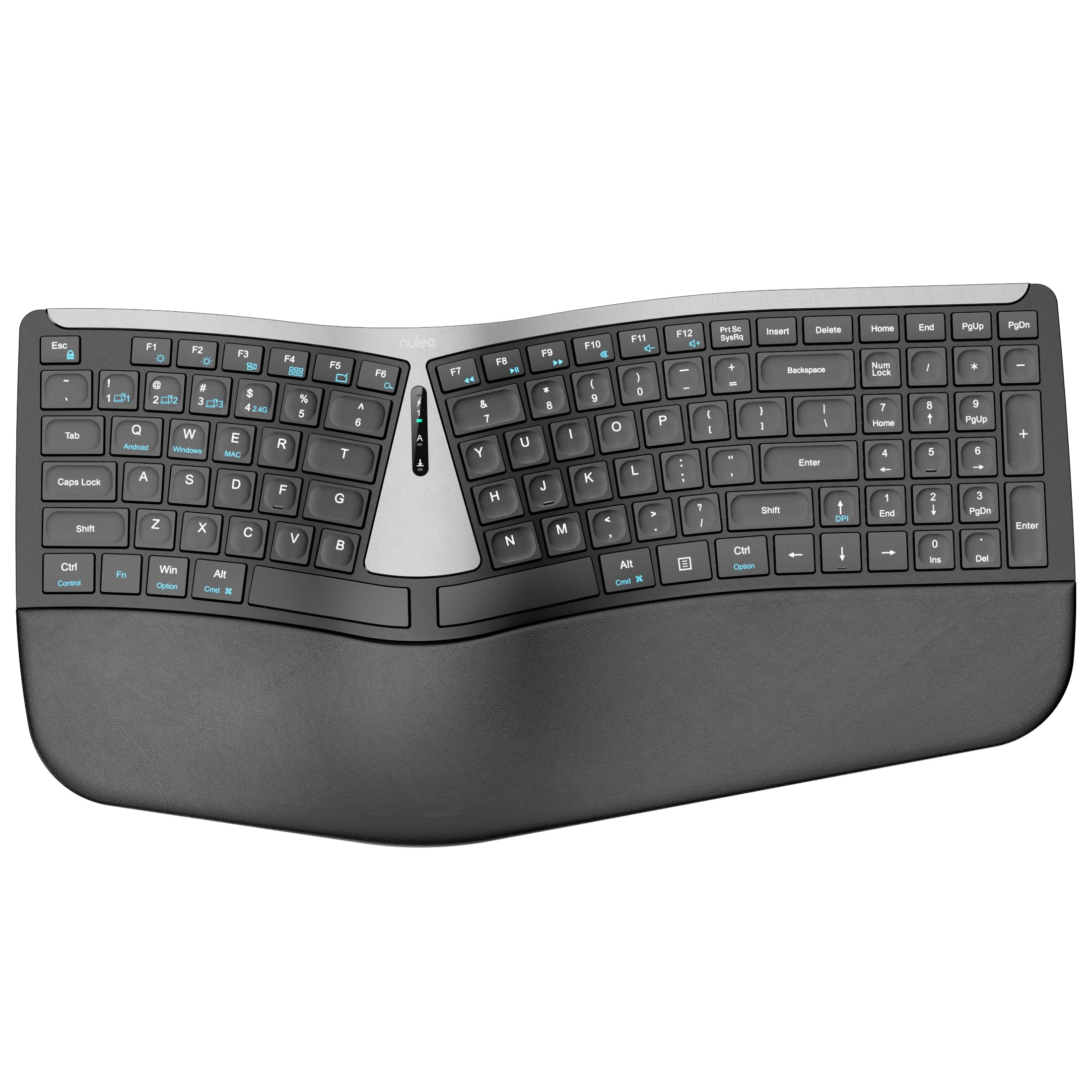
3. Nulea Ergonomic Split Wireless Keyboard
A board that splits your hands apart so your forearms stop twisting inward.
Most keyboards force your wrists to angle toward each other all day. The Nulea RT07B splits the deck into two halves angled outward, which the maker says reduces forearm muscle twisting. A soft palm rest sits underneath to keep your wrists supported through long sessions. Your forearms land straighter the moment you sit down.
Battery anxiety is handled: a 200-hour rechargeable battery with USB-C charging keeps the board running for weeks of normal work between top-ups. The keys are scissor-switch — the same low-travel mechanism as a laptop, with rapid rebound and even pressure across the cap. Dual-mode wireless covers both Bluetooth and 2.4G, so you can hop between a laptop, desktop, and tablet without re-pairing.
What buyers respond to first is the overall typing quality, with comfort close behind. It is a quiet, flat, laptop-style feel rather than a deep mechanical thock, so if you crave tactile feedback this is the wrong lane. But if your wrists ache by 5 p.m., the outward-angled halves are the reason to buy it.
The trade worth naming: scissor keys give you short travel. Touch typists who like a deep, bouncy press will find this board flatter and less dramatic than a gasket mechanical.
Pick this one when: you type for a living and want your forearms in a neutral position with a battery that outlasts your workweek.
The one adjustment: the split layout retrains your muscle memory for a day or two — budget that break-in time.
4. Keychron C2 Wired Mechanical Keyboard

The full-size desktop board that treats Mac and Windows as equals.
Most mechanical keyboards are built for Windows first and Mac second — if at all. The Keychron C2 ships with extra keycaps for both systems, a dedicated Siri or Cortana key, and a Mac-tune layout that still covers Windows. If you switch between an iMac and a work PC, you do not have to swap boards.
The 104-key deck is genuinely large. At 17.1 inches long it runs close to half a foot longer than the AULA WIN68 HE’s 14 inches, and it weighs 1.5 kg. The upside of that size is a full number pad and no FN combinations for everyday keys. Two-level adjustable feet at 6° and 9° let you tune the typing angle, and the braided USB-C cable keeps power constant — no battery, no dropouts.
The pre-installed tactile Brown switches deliver a bump you can feel without a loud click, rated to 50 million keystrokes. The retro colorway earns consistent praise for looking at home in an office as well as a game room, and the sound has that deep, satisfying thock people chase. Reliability is the one mixed spot — a share of owners mention quirks — so treat this as a strong wired workhorse rather than a ruggedized field board.
Why the C2 holds its ground
- Native Mac and Windows support with bonus keycaps in the box
- Tactile Brown switches rated to 50 million keystrokes
- Dual-level feet at 6° and 9° for a natural typing tilt
- Full 104-key layout with number pad and multimedia keys
The fine print
- No backlight on this version — not a late-night-in-the-dark board
- At 1.5 kg it stays on the desk; this is not a travel pick
Who it is built for: the dual-OS desk that wants real mechanical feel with zero battery maintenance.
Skip the C2 if: you need illuminated keys or a compact footprint for a small setup.
5. Redragon K745 PRO Wireless Keyboard
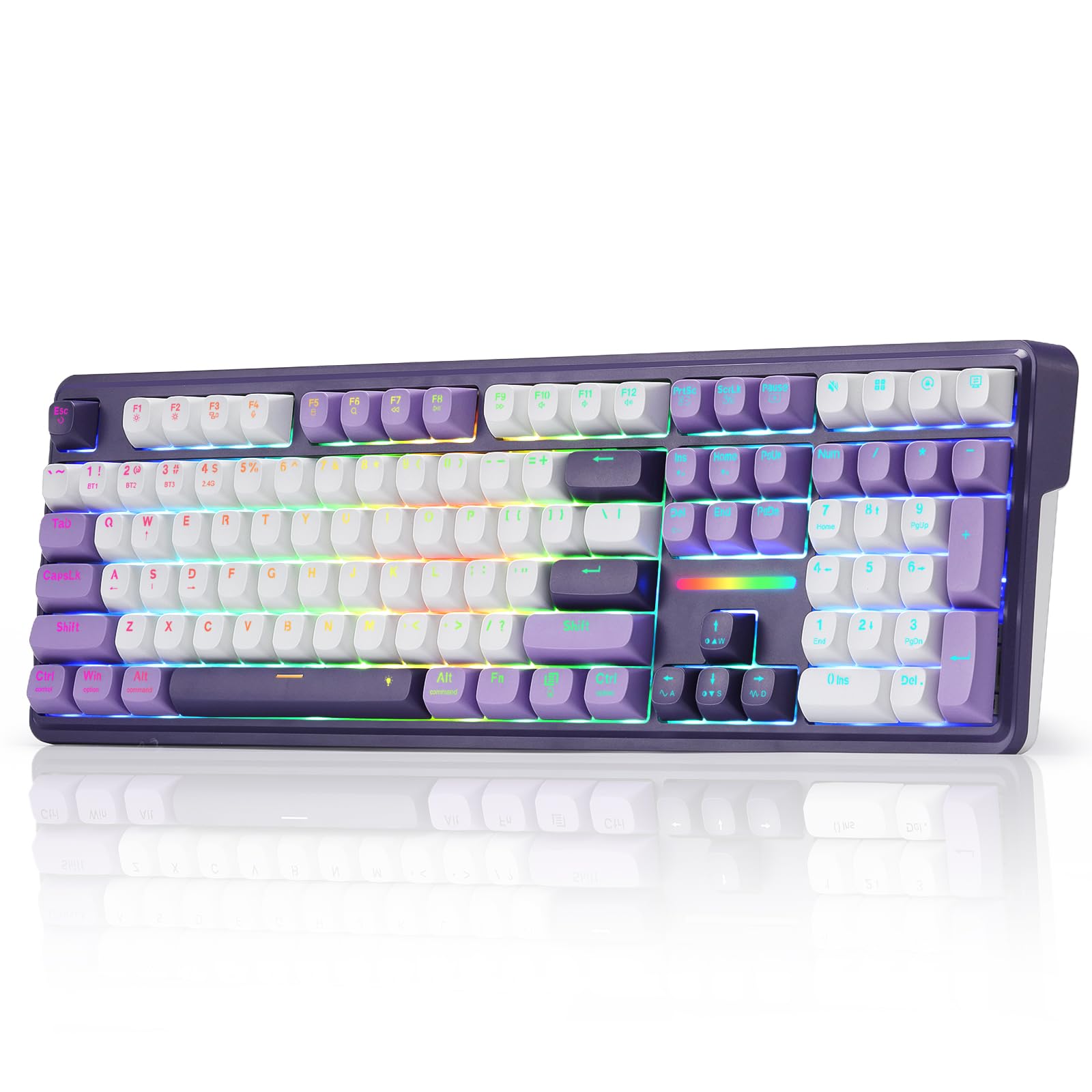
A cushioned full-size deck that jumps between PC, laptop, and tablet without re-pairing.
Three ways to connect is the selling point here: USB-C wired, Bluetooth, and 2.4GHz wireless. You can move from a desktop to a laptop to a tablet and the board follows you, no re-pairing dance in between. The 108-key layout brings the number pad and a set of four dedicated hotkeys that default to mute, calculator, screen lock, and desktop.
The typing feel comes from a gasket-mounted build with 5-layer noise dampening, which Redragon describes as a soft, silky bounce. Owners call the sound creamy and the feel buttery, and one comparison in the reviews sums it up: it performs like boards that cost far more. Round translucent PBT keycaps let the RGB glow through cleanly and resist the greasy shine that ABS caps pick up over months of use.
The socket accepts almost any 3-pin or 5-pin switch, so you can swap in a favorite set later. Pro software lets you remap the four hotkeys, build macros, and design custom light shows. At 0.88 kg it is lighter than the Keychron C2’s 1.5 kg, which makes it an easier board to move around a shared desk.
What the price buys: gasket cushioning, hot-swap sockets, PBT caps, and tri-mode wireless in one board — a lot of premium features stacked into a single mid-range deck.
Your board if: you want a full-size layout with a soft, quiet, customizable feel and freedom from a single connection type.
Consider the trade-off: the round keycap shape is a distinct look and feel — square-cap loyalists may want to swap them.
6. Cherry KC 200 MX Wired Mechanical Office Keyboard

Cherry’s quiet linear switches on an anodized metal plate — mechanical without the clatter.
This is the board for the open-plan office. The MX2A Silent RED switches are linear — they push straight down with no click and no bump — and Cherry builds in damping so the sound stays muted. You get the mechanical feel and precision without the typing that makes coworkers turn around.
The deck sits on an anodized metal plate, which adds weight and a firm, planted feel. The keycaps are molded and laser-etched for abrasion resistance, so the lettering stays legible even after years of use. Full N-key rollover (all keys register at once) and anti-ghosting cover fast typing and games. Two non-slip fold-out feet let you set your angle, and the 108-key layout adds four keys for the calculator and volume.
Cherry rates each MX2A switch for more than 50 million actuations, so this is a long-haul tool rather than a novelty. Buyers single out the aluminum base for its looks and the key pressure for feeling just right. It is a wired USB-A board, so plan for a cable and no backlight.
The durable angle: a metal plate, abrasion-resistant keycaps, and switches rated past 50 million actuations — the construction targets years of daily work, not a season of it.
Made for: anyone who wants a mechanical board that stays quiet enough for a shared office or a late-night desk.
Weigh first: this is a USB-A wired board with no wireless option — think desk-only.
7. EPOMAKER TH108 V2 PRO Mechanical Keyboard

A full-size board with a tiny screen and a dial that does more than look clever.
The feature no one else here has is the built-in screen and rotary knob. The screen shows keyboard information, adjusts backlight settings, and even plays custom GIFs, drawings, or photos. The knob toggles screen pages and volume by default — hold FN and turn it to swap — and you can remap it for scrolling a playlist or firing off a macro.
Under the display sits a gasket deck cushioned with PORON, latex, IXPE, silicone, and foams. That stack produces a soft, bouncy press with a deep, marbly sound — the maker’s “creamy” profile. The 104-key full-size layout keeps the number pad, and the 1000Hz polling with 2ms latency gives fast input without noise.
Wireless life is generous: a 10000mAh battery powers up to 200 hours of use, and tri-mode connection covers 2.4GHz, Bluetooth, and USB-C. Weighing over 1 kg, it stays planted during a frantic match. The catch is that all that cushioning and the screen add up to a chunkier, heavier board — great on a desk, less so for a commute.
The customization payoff: a web-based driver that needs no installer lets you remap keys, record macros, upload GIFs, and sync the clock across devices — the knob and screen are genuinely programmable, not decoration.
Pick it for: a big-desk setup where a deep, cushioned typing feel and a customizable display are worth the size and weight.
Look past it if: you want a slim, portable board or a plain minimalist look — this one brings visual theater.
8. Razer BlackWidow V4 X Mechanical Keyboard

Six macro keys on the left and linear switches tuned to fire fast and quiet.
For a MMO or strategy player who maps a dozen commands, the six dedicated macro keys along the left column are the reason to buy. You can program them to your playstyle, so your most-used abilities sit under one finger press. Add the multi-function roller and secondary media keys and your volume and playback controls never leave reach.
The Yellow mechanical switches are linear with 1.2mm of travel between actuation and reset and 45g of required force. That short distance means a tap fires and resets quickly — rapid inputs without a click, helped along by built-in sound dampeners. A foam layer under the circuit board and lubricated stabilizers keep the rattle down. Feels light and quick rather than heavy and stiff.
Chroma RGB lets you customize every key from more than 16.8 million colors and effects, with dynamic lighting tied to hundreds of Chroma-integrated games. Doubleshot ABS keycaps use thick walls and a molding process that keeps the legends from wearing off. At 20.5 inches long and 8 inches wide this is the biggest deck here, so measure your desk before you commit.
Why gamers pick it
- 6 dedicated macro keys programmable to your playstyle
- 1.2mm actuation distance and 45g force for fast, quiet fire
- Chroma RGB with per-key lighting across 16.8 million colors
- Doubleshot ABS keycaps built to resist legend wear
Where it asks for room
- 20.5 inches long — the largest footprint in this list
- Wired only, so no wireless desktop freedom
The right fit: the player who wants macro keys and fast linear switches on a full-size wired deck.
The question to ask: does your desk have the width? This one needs more room than any other board here.
9. Logitech Alto Keys K98M Wireless Mechanical Gasket Keyboard
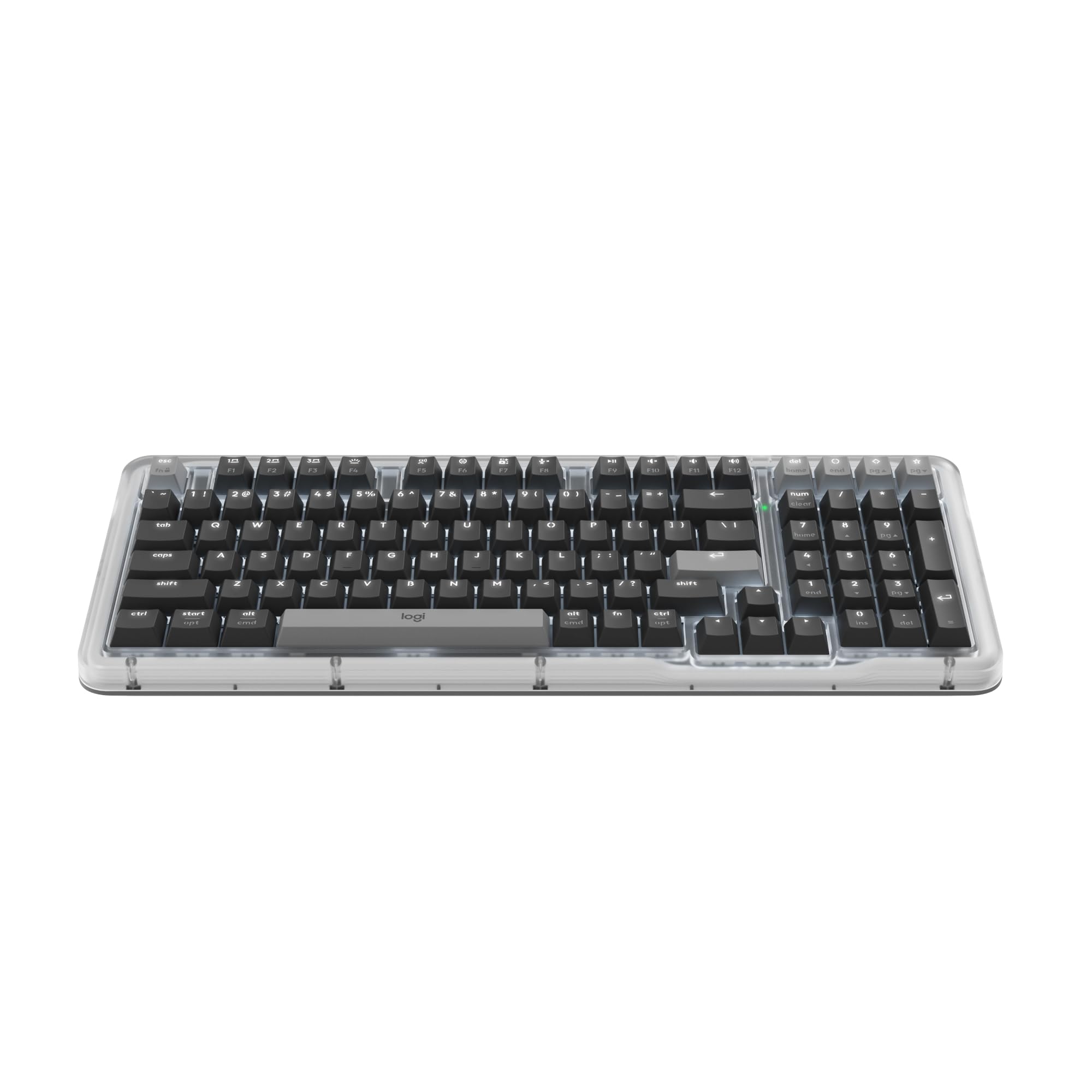
A 98-key deck that keeps the number pad but trims width — with a typewriter click.
Logitech calls the layout 1800-style: 98 keys plus a numpad, but more compact than a traditional 104-key full-size. You keep the number pad you use and drop the extra width you do not. That makes it a fit for desks where a standard full-size board feels sprawling.
The feel is clicky and typewriter-like, with hot-swappable Marble Switches and concave keys. A gasket mount called UniCushion absorbs vibrations, so the presses feel cushioned rather than harsh. The lighting is non-RGB — white backlighting only — but the keys stay readable day or night. Battery life runs up to 12 months on Bluetooth Low Energy or the Logi Bolt USB receiver, and USB-C recharging works even while you type.
Programming comes through the Logi Options+ app, which lets you set Action Keys and assign AI-enhanced shortcuts to a single click. Bluetooth and Logi Bolt both work across Windows and macOS. The housing is recycled plastic. What owners respond to most is the sound — it replicates a typewriter click faithfully — and the soft, tactile key feel.
Honest sizing: the layout is compact, but the click is real. Clicky switches carry a distinct sound signature — charming at home, less ideal in a shared quiet office.
Choose this when: you want number-pad productivity on a narrower deck and a tactile, typewriter-style click with a year between charges.
Reconsider if: you need RGB lighting or a silent board — this one is white-backlit and proudly loud.
Know the Specs
Polling Rate
Polling rate is how often the keyboard reports your keypresses to the computer, measured in Hertz (Hz). A 1,000Hz board checks a thousand times a second; the AULA WIN68 HE checks 8,000 times a second, which shortens the gap between your finger moving and the character moving. For everyday typing you will not notice. For competitive games where a tenth of a second matters, a higher rate feels more immediate.
Switch Type
Switches are the mechanism under each key. Linear switches, like the Cherry MX2A Silent Red and the Razer Yellow, push down smoothly with no bump or click — fast and quiet. Tactile switches, like the Keychron Brown, give a small bump you feel at the moment the key fires. Clicky switches, like the Marble switches on the Alto Keys K98M, add an audible snap on every press.
Layout Size
Layouts trade keys for desk space. A 60% board like the AULA WIN68 HE keeps 68 keys and saves up to 40% of desktop space by folding function keys into FN combinations. A 98-key 1800-style layout like the Alto Keys K98M keeps the number pad but trims width. A full-size 104 or 108-key board keeps everything at full width.
Connectivity and Battery
Wired boards such as the Keychron C2 never need charging. Wireless boards come in three modes: 2.4GHz through a dongle for the most stable link, Bluetooth for device switching, and USB-C for charging. Tri-mode boards like the Redragon K745 PRO and EPOMAKER TH108 V2 PRO cover all three. Battery numbers vary widely — the Nulea split board runs 200 hours, while the MK270 combo is rated in months.
Common Questions
What is the difference between linear, tactile, and clicky switches?
Will a 60% keyboard slow down my number typing?
How long does a wireless keyboard battery actually last?
Can I use these keyboards with a Mac?
Is a higher polling rate really noticeable for gaming?
What does hot-swappable mean on a keyboard?
Do I need a wrist rest with a split keyboard?
How do I keep a mechanical keyboard quiet in an office?
Can a wireless keyboard connect to more than one device?
How long do mechanical key switches last?
The Bottom Line
For most buyers, the world’s computer keyboard winner is the AULA WIN68 HE because it pairs an 8,000Hz polling rate and adjustable magnetic switches with a small 68-key deck that fits a tight desk. If you want a full-size quiet mechanical for a shared office, reach for the Cherry KC 200 MX. And for wrists that need a neutral angle all day, the Nulea Ergonomic Split is the one to grab. One honest nudge: the AULA leads on price-to-feature even against boards from the bigger brands here — its Windows-only driver is the one thing to check before you commit.
How we choose
We do not accept paid placement. Every pick is matched to a real buyer and a real use-case; we do not hands-on test units.
Sources
Specifications: manufacturer listings and product documentation. Review insights: verified customer reviews, as of November 2026. Pricing: not shown on this page (it changes often); check the current price via the retailer link.
As an Amazon Associate, Tactical Gear Guy earns from qualifying purchases. This does not affect which products we feature.