Specs are compiled from manufacturer listings and verified buyer reviews and can change over time — please confirm the key details on the product page before buying.
Your laptop’s built-in webcam is why video calls look soft, grainy, and washed out. A dedicated webcam fixes that, but the shelf is confusing: some units promise 4K, some promise privacy shutters, some promise AI tracking, and several promise all three. The picks below are the ones where the promise holds, and each entry explains what the camera physically gives you and who it suits.
This guide is built by comparing the manufacturers’ published specifications and the patterns across verified customer reviews, so you get each pick’s real strengths and trade-offs instead of marketing spin.
You will see which units use a small sensor and which use a large one, what field of view really does to your framing, and where a fixed-focus lens will let you down. For most people, the right choice depends on sensor size and how you mount it, which is why this breakdown of the worlds cams keeps circling back to those two things.
Top Picks


How To Choose The Best Worlds Cams
The camera you want depends on where it sits and what you are pointing it at. A desk camera staring at your face for meetings has different needs from an outdoor unit watching a driveway. Sort those two jobs first, and the rest of the decision gets much simpler.
Sensor size before megapixel count
The sensor is the chip inside that catches light, and its physical size decides how clean your image looks in a dim room. A large sensor gathers more light, so your face stays sharp instead of turning mushy and gray. Megapixel numbers are easier to advertise, but they do not rescue a small sensor in a dark office.
Field of view decides your framing
Field of view is the angle the lens sees, written in degrees. A narrow angle frames you tight like a portrait, while a wide angle pulls in your desk, your background, and anyone sitting beside you. If you present as a group, the wider number helps. If you want a clean head-and-shoulders shot on a small monitor, the tighter one is easier to live with.
Focus, mounting, and the privacy question
Fixed focus means the lens is set once and everything past a certain distance stays acceptably sharp — fine for a seated call, weak for holding a document up close. Autofocus adjusts as you move, which matters if you show objects or shift around the room. Check the mount too: a clip for a monitor, a tripod thread, or a magnetic base all change how quickly you can reposition. And if the camera stays plugged in all day, a built-in shutter or lens cap is a small feature you will appreciate.
Side-by-Side Comparison
| Model | Best For | Max Resolution | Focus | Field Of View | Amazon |
|---|---|---|---|---|---|
| AVerMedia Live Streamer Cam 313★ Best Overall | Everyday meetings and teaching | 1080p Full HD | Fixed Focus | — | Amazon |
| Insta360 Link 2 ProTop Performer | Rooms where you move around | 4K UHD (3840 pixels) | Manual-and-Auto | — | Amazon |
| Elgato Facecam 4KCreative Control | Creators who want manual control | 4K at 60 FPS | Automatic, Manual | 16:9 aspect | Amazon |
| Creative Live! Cam Sync V3 | Big-detail desk recording | 2K QHD (2560 x 1400) | — | — | Amazon |
| EMEET C60E Dual-Camera 4K | Streaming with close-up switching | 4K UHD | PDAF Autofocus | — | Amazon |
| Ring Floodlight Cam 2K | Outdoor driveway and door watch | 2K Retinal | — | Wide-angle | Amazon |
| Mevo Start | Multi-camera live streaming | 1080p HD | — | — | Amazon |
| Creative Live! Cam Sync 1080p V2 | Hands-free meeting calls | 1080p Full HD | — | 77° | Amazon |
| Rettru Mini WiFi Hidden Camera | Small-space watching on a budget | 1080p HD | Auto Focus | 160 degrees | Amazon |
Detailed Reviews
1. AVerMedia Live Streamer Cam 313
Our pick — 4.5+★ from 600+ verified ratings; the strongest balance of quality and price.
The everyday workhorse that turns without you touching the laptop.
For a teacher running a morning class or a remote worker on back-to-back calls, the thing that matters is that the picture simply works every time. This unit delivers 1080p Full HD video over a plain USB connection, which is the resolution nearly every meeting platform streams without complaint anyway. It is plug-and-play — no driver hunting, no software install to get a picture on screen.
The detail that quietly earns its place is the 360° swivel. You can spin the body to face a whiteboard, angle it down at a product on the desk, or point it sideways at a colleague, all without shifting your laptop or your monitor. That single mechanical trick is why this camera suits classrooms and small studios so well — the framing changes in a second.
It also shows good manners about privacy: a built-in shutter slides over the lens when the call ends, so nobody is watching a connected camera by accident. The dual microphone handles a normal speaking volume, and owners consistently point to clarity and reliability as the reasons they stay happy with it. What wins owners over is that it needs no setup or babysitting.
Where it quietly wins
- 1080p Full HD picture over plain USB — no drivers to install before your first call
- 360° swivel lets you reframe for a whiteboard or a product demo without moving your laptop
- Built-in privacy shutter covers the lens when the meeting ends
- Dual microphone picks up your voice for classroom and meeting use
The honest limits
- Fixed focus lens — sharp at seated distance, weaker if you push documents close to it
- Tops out at 1080p, so it will not fill a 4K workflow
- No zoom control, so framing is entirely down to where you swivel it
Pick this if: you host classes, stream, or sit in meetings all day and want a camera that just shows up to work.
Think twice if: you need to hold a document inches from the lens or edit in 4K — the fixed focus and 1080p ceiling will hold you back.
2. Insta360 Link 2 Pro
A camera that physically turns its head to keep you in frame.
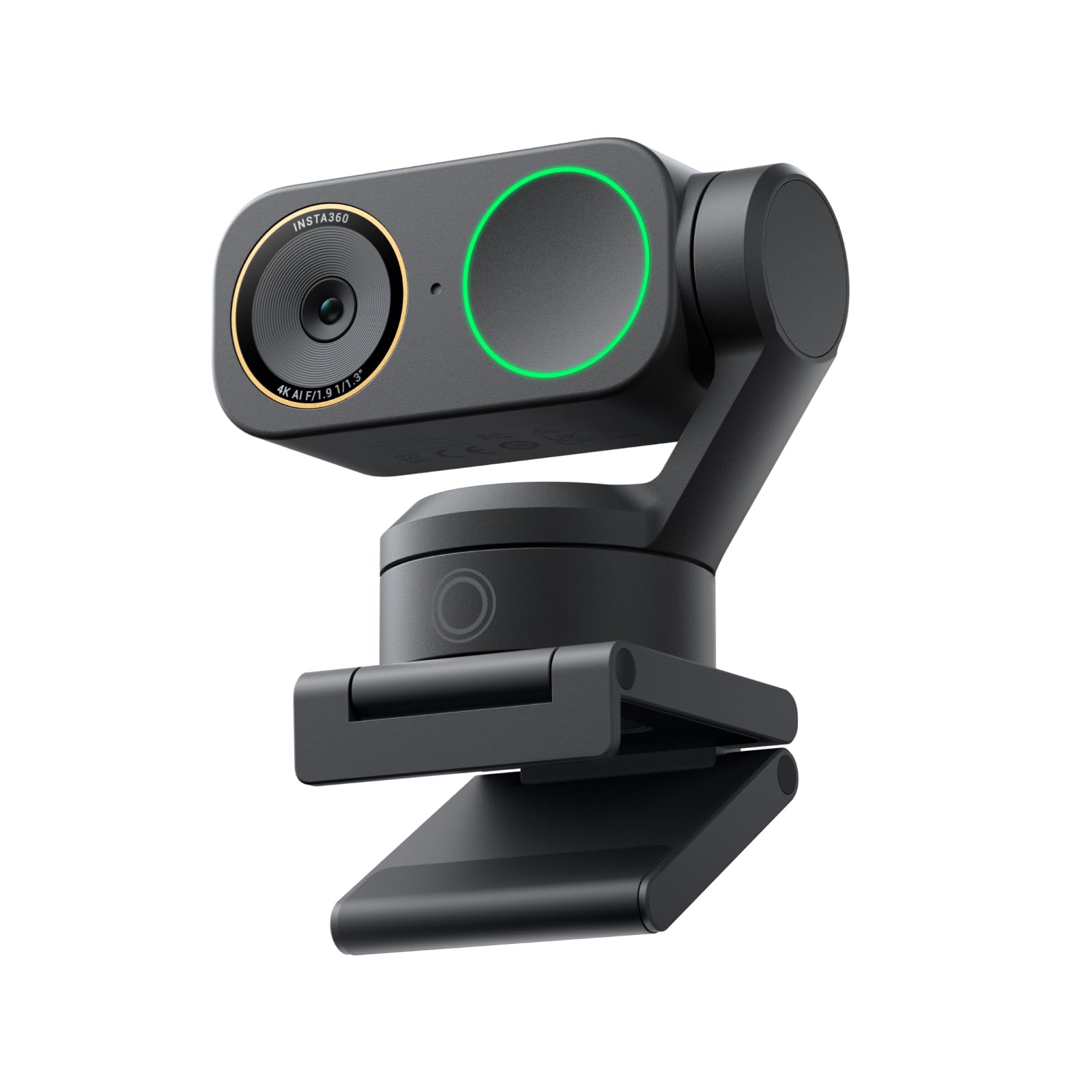
If you teach from a whiteboard, demo at a workbench, or pace while you present, a fixed camera leaves you half out of shot. The Link 2 Pro solves that mechanically: it is a PTZ unit, meaning it pans, tilts, and zooms the whole body of the camera to follow you around the room. Its AI tracking does that automatically, so you can walk to a shelf and the frame follows.
The picture benefits from a genuinely large 1/1.3” sensor — that measurement is the diagonal of the light-catching chip, and a bigger one gathers more light, so a dim office does not turn your face into mush. Video tops out at 4K, and the effective still resolution is 8 mp. Compare that with the 2 mp stills on the AVerMedia above and you can see where the extra detail lives. Directional dual mics with beamforming pull your voice forward and push background noise back.
Stream Deck integration and hand gestures round out the control — you can start tracking or flip to Whiteboard Mode without touching a keyboard. The catch worth knowing: Insta360 states this unit is not compatible with ARM-based Windows systems or Windows Hello face recognition, so check your machine before buying. Reliability across long sessions is the other thing to watch, since the performance reports are not unanimous.
What it changes: a 1/1.3” sensor plus physical pan-and-tilt means clean low-light video and a frame that follows you — no more cropping yourself out of the shot.
Check first: Windows on ARM and Windows Hello are both off the table per Insta360, so a Surface-style ARM laptop or face-login setup will need a different camera.
Right camera for: presenters, trainers, and streamers who move while they talk and want the lens to keep up.
Not the one for: anyone on an ARM-based Windows machine or a Windows Hello setup — compatibility ends there.
3. Elgato Facecam 4K
Built for the desk where someone actually tweaks the settings.
Most webcams hand you one auto setting and call it a day. This one goes the other direction: 4K video at 60 FPS, a Sony STARVIS 2 CMOS sensor, and Elgato Prime Lens glass, all adjustable. The framerate is the part creators feel — 60 FPS keeps motion smooth instead of smeary. If you stream gameplay or move your hands a lot on camera, that headroom is the whole point.
Then there is the DSLR-flavoured bit: the front accepts any standard 49mm lens filter, the same thread size you would screw onto a mirrorless camera. A polarizer or a diffusion filter changes your shot in a way no software slider can match. The free Camera Hub app handles effects and settings, and a built-in flash memory stores your presets so they survive a reboot. Uncompressed video and HDR support are in the spec sheet too.
Here is the honest part — the reviews are split. Some owners find it excellent and others feel it falls short of the marketing, with grainy images in the mix on the unhappy side. Treat it as a camera that rewards setup and punishes a bad room. Light it properly and it plays; assume it will rescue a dark corner and you may join the disappointed group.
The creative argument: 4K at 60 FPS on a Sony STARVIS 2 sensor, with a 49mm filter thread and manual focus — the most adjustable camera on this list.
The caveat to size: image reports are genuinely mixed, so this rewards good lighting and a bit of tuning rather than plug-and-pray.
Reach for it when: you want to tune focus, white balance, and filters by hand and you already own a decent key light.
Look elsewhere if: you want a camera to nail the shot on its own with zero fiddling — this one expects you to drive.
4. EMEET C60E Dual-Camera 4K
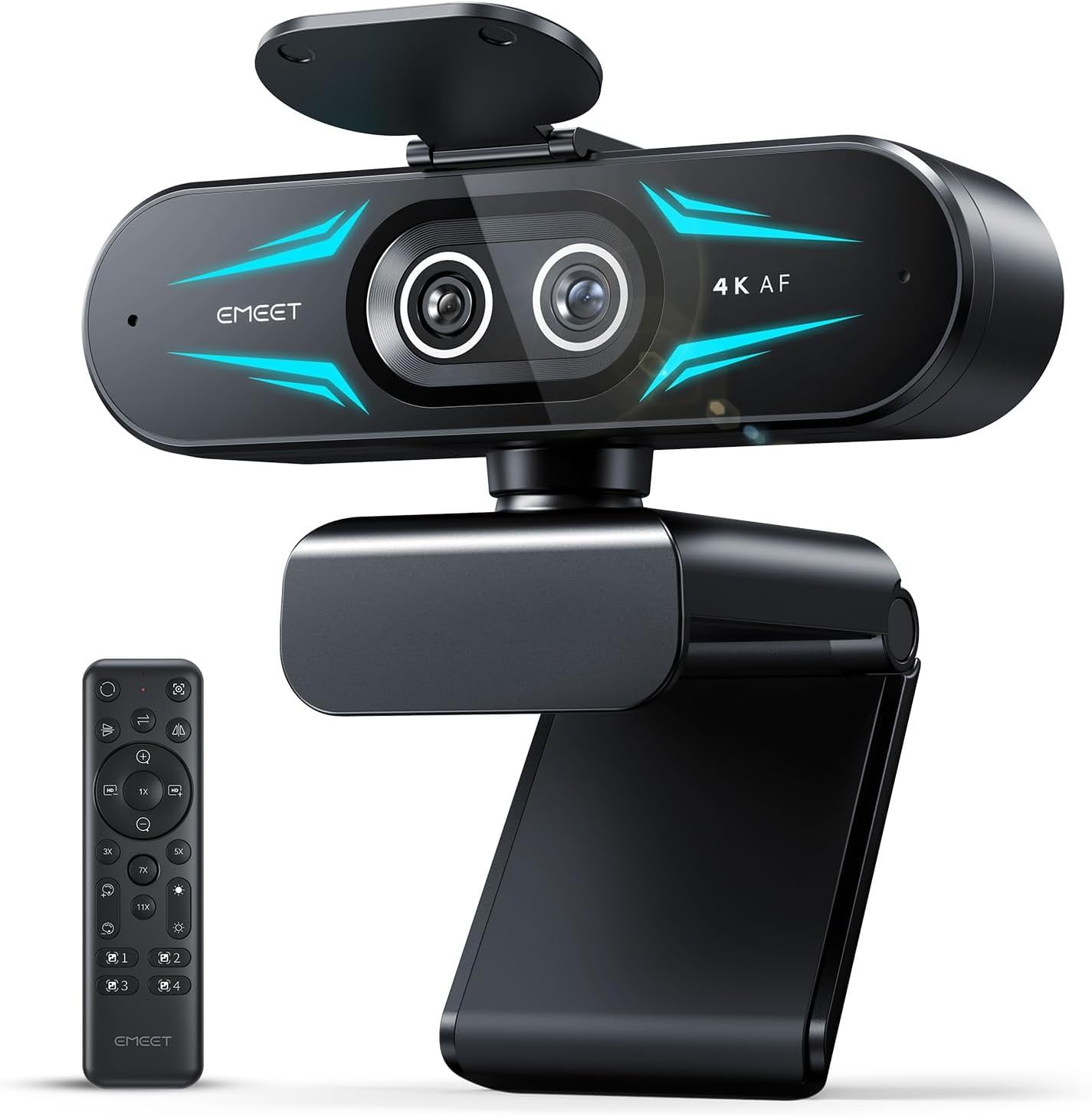
Two lenses on one body, so you can cut from wide shot to close-up.
Product demos and hands-on teaching run into the same wall: a wide shot shows the whole desk but loses the small part you are trying to explain. This camera attacks that with two lenses sharing one 1/2.8″ CMOS 4K sensor. A gray wide-angle lens grabs the full scene, and a blue telephoto lens picks up close detail from a recommended distance of 13.8 in.
Zoom runs from 1X up to a max of 11X, covering steps like 3X, 5X, and 7X along the way, and PDAF autofocus keeps that zoom locked on. Note that zoom is not supported in 4K, 60FPS, or YUY2 modes — check your recording mode if the zoom control seems inert. Two omnidirectional mics pick up voice within a 9.8ft radius, and the body mounts to a 1/4” tripod thread. A remote and the EMEET STUDIO software let you adjust zoom and color without leaving your seat.
There is RGB lighting on the front, and it is more than decoration: the glow shows the camera is live and helps you spot it on a busy desk. Windows 10/11 64-bit and macOS 10.14+ are both supported, along with OBS, Twitch, YouTube, and Facebook. For someone who needs one camera to do both a talking-head shot and a tight product shot, the dual-lens design saves you buying two units.
What earns its keep
- Two lenses on one 1/2.8″ CMOS 4K sensor — wide scene or close detail on demand
- Zoom from 1X up to 11X with PDAF autofocus holding focus through the range
- Remote plus EMEET STUDIO software for zoom and color changes mid-stream
- Dual omnidirectional mics with a 9.8ft pickup radius
What to plan around
- Zoom is not supported in 4K, 60FPS, or YUY2 modes, so you trade resolution for reach
- Telephoto close-ups want the recommended 13.8 in working distance
- The RGB lighting is a taste call — not everyone wants a lit camera on their monitor
The one for you if: you demo products, teach hands-on skills, or stream a desk where small details matter.
Different camera if: you shoot everything in 4K at 60 FPS — that mode disables zoom, which is this pick’s main trick.
5. Creative Live! Cam Sync V3

The step up from 1080p for anyone who reads screens all day.
Displays have moved past 1080p, and a 1080p camera is now the soft spot in an otherwise sharp setup. This unit delivers 2K QHD at 2560 x 1400 and 30 fps, and it captures 3.68 mp stills — noticeably more detail than the 2 mp stills on both the AVerMedia and the Cam Sync 1080p V2. Reviewers consistently single out image quality above everything else, which is exactly where a resolution bump should show.
The 4X digital zoom is the feature to understand before you buy. Digital zoom crops into the sensor rather than moving glass, so pushing to 4X softens the image — it is not the crisp optical reach that the EMEET’s telephoto lens gives you. Some owners say the zoom works as promised and others say it does nothing at all. Go in expecting a framing tool for a head-and-shoulders shot at 2X, not a spyglass, and you will be satisfied.
Elsewhere it behaves well: the lens cap shields you from unwanted access and keeps dust off the glass, 360° rotation and 30° tilt let you aim it, and a 1.8m (5.9 ft) cable plus universal clip covers most desk setups. The dual mics with NoiseClean-out (noise reduction) handle a normal room. If you want the sharpest everyday call picture without jumping to a premium workflow, this is the sensible middle.
Value read: 2K QHD at 2560 x 1400 with 3.68 mp stills puts real detail into meetings without a premium-tier outlay.
Honest trade-off: the 4X is digital, so it crops and softens — treat it as a framing tool, not a zoom lens.
Go with this: you sit in meetings and want a clearly sharper picture than 1080p without the premium-tier spend.
Not this one: you need true optical reach or a zoom you can trust at full extension — the digital crop will disappoint.
6. Ring Floodlight Cam 2K

A floodlight and a camera fused into one outdoor unit.
Watching a driveway at night needs light, and that is the reason this unit pairs its camera with ultra-bright motion-activated floodlights. It records Retinal 2K wide-angle video, and up to 6x Enhanced Zoom brings a face or a number plate into focus. Video quality can vary with your internet bandwidth and the device’s temperature, so a strong signal at the mounting spot keeps it at its best.
What owners respond to most is the picture itself, with the adjustable brightness and two-way talk not far behind. Motion detection fires an alert to your phone the moment something moves, and Live View lets you see and speak to whoever is standing there. If a visitor ignores the light, the built-in siren sounds from the Ring app with a tap — a genuine deterrent at the front door.
Two things to plan for. First, the smarter features like rewatching past events and intelligent alerts need a compatible Ring Protect Plan subscription, sold separately — without it you get the live view and alerts but not the full history. Second, the lighting and sound quality are the areas where reviews split, so if you mainly want a floodlight over a camera, expect a good one rather than a perfect one. Installation is a DIY job guided by the app, or you can bring in an installer.
Why it earns the spot
- Retinal 2K wide-angle video with up to 6x Enhanced Zoom for detail
- Motion-activated floodlights brighten a driveway or patio on approach
- Two-way Talk and Live View so you can answer the door remotely
- Built-in siren triggered from the Ring app
Costs and caveats
- Event history and intelligent alerts require a compatible Ring Protect Plan, sold separately
- Lighting and sound quality draw mixed feedback, so it is stronger as a camera than as a light
- Video clarity can dip with weak internet bandwidth or temperature extremes
Made for: a front door, driveway, or side yard where you want light and a camera in one install.
Consider a different path: if you want recorded history without any ongoing subscription, add up what the plan costs over time first.
7. Mevo Start

A cable-free camera built to link up with two more for a multi-angle feed.
Most cameras on this list want a USB cable to a laptop. This one is a self-contained streaming camera with a built-in battery good for up to six hours, which changes where you can put it. It streams live over Wi-Fi or Ethernet, no cables required, and you can plug it into power for continuous use when a shoot runs long. Recorded video lands as 1080p HD in MP4 format on a C10 speed memory card over a UHS-I interface.
The reason to choose this over any of the desk cameras is multi-camera: you can sync up to three Mevo Start units for HD multi-camera streaming right from the start. The Mevo Multicam App controls them wirelessly, and Auto-Director handles switching between angles so one person can run the whole production. Each camera carries its own built-in microphone, and you can route external audio in for a more advanced setup.
Now the part that deserves a straight warning: the reviews here are less settled than the rest of the list. Those who love it describe the video as clear and the setup as simple, while a smaller group hits connectivity trouble or finds it unreliable in places. Video quality and the 1080p ceiling are not in doubt — the link between camera and network is where the risk sits. If you can run it over Ethernet at the venue, you sidestep most of that.
The one thing it does that others cannot: sync up to three units for multi-camera HD streaming, all driven from the Mevo Multicam App and its Auto-Director.
Straight talk: reliability reports are mixed and the whole system leans on your network — wired Ethernet at the venue is the safer bet.
Worth it for: solo creators and event streamers who want multiple angles with no cables trailing to a laptop.
Better to skip: if the venue’s Wi-Fi is unreliable and you cannot run Ethernet, because the multi-camera magic depends on a stable link.
8. Creative Live! Cam Sync 1080p V2

The camera that mutes and unmutes itself so your hands stay free.
Taking notes while speaking on a call is the tiny friction this unit sets out to remove. Its SmartComms Kit includes VoiceDetect, which unmutes you automatically as you talk, and NoiseClean-out, which cancels steady background noise during the call. Those features run through the Creative app on Windows 10. For anyone presenting while scribbling notes, that is a small but real convenience.
The optics are aimed at a group rather than a solo portrait: a wide 77° field of view pulls more of the room in with minimal distortion, so two or three people can sit together in front of one camera. A 1080p Full HD picture (1920×1080 resolution) and dual built-in mics with improved pickup cover the audio side. UVC compliance (USB Video Class, a plug-and-play standard) means no driver install, and the 1.8m (5.9 ft) cable gives you slack to place it away from the port. The body is also smaller than its predecessor and rotates 360° horizontally with 30° tilt.
The integrated lens cover protects you from unwanted access and keeps dust off the glass. Two honest notes come from the spec sheet itself: there is no autofocus, and brightness control is a weak spot in the feedback. Neither is a problem for a seated, lit meeting — both become one if you shoot toward a bright window or move around. Owners consistently rate the image quality at the front of the pack, which is the part that shows up in every call.
The wins that show up daily
- VoiceDetect unmutes you automatically as you speak, hands free
- 77° field of view fits two or three people in one frame
- NoiseClean-out cancels steady background noise on calls
- UVC compliant with a 1.8m (5.9 ft) cable and integrated lens cover
Fit notes before you buy
- No autofocus — a seated call is fine, moving around is not
- Brightness control is the weaker point, so a bright window behind you will cost you
- The SmartComms Kit needs the Creative app on Windows 10
Fits best: a small team or note-taking presenter who wants hands-free audio and a group-friendly frame.
Choose something else if: you work in a room with a bright window behind you or you move around while talking.
9. Rettru Mini WiFi Camera

A small wired watcher with a very wide view and a very low bar to entry.
This is the simplest tool on the list: an indoor/outdoor cube camera with a 160 degree field of view, so one unit covers a wide slice of a room or a doorway. It records in 1080p HD at 30 frames per second over Wi-Fi using the V380 Pro app, which runs on iOS and Android. Night vision reaches 26FT, and the infrared lights are invisible while recording, so a dark hallway stays watchable.
Important and easy to miss: there is no built-in battery. You must connect a mobile power supply for it to run, which changes where it can go — it needs a cable to a power source. Motion detection is adjustable and pushes an alert with images to your phone, and loop recording overwrites the oldest file when the card fills, so it keeps going without you clearing space.
Be clear about what you are buying. Reviewers find it hard to set up and awkward to keep connected to the internet, and the quality of the picture and its size draw criticism too — the word “smallest” in the name has not matched everyone’s expectations. If you want a budget watcher for a pet or a doorway and you can accept a fiddly first setup, it covers the basics. If you want it to just work on day one, the desk cameras above are the safer road.
The trade you are making: a 160 degree view and 26FT night vision over Wi-Fi for the lowest entry point on this list.
The reality check: setup and connectivity are the recurring complaints, and there is no built-in battery, so plan a power cable from the start.
For the buyer who: needs a cheap second set of eyes on a pet, a doorway, or a garage and can spend an evening on setup.
Wrong tool if: you expect a plug-and-play camera that stays connected without fuss — this one asks for patience.
Know the Specs
Sensor Size
The sensor is the chip inside the camera that catches light. Its size is usually written as a fraction with a quote mark, like 1/2.8″ or 1/1.3″. A larger sensor gathers more light, so your face stays clean instead of grainy in a dim room. Megapixels tell you how many dots go into the picture; sensor size tells you how good those dots look. When you compare two cameras, the bigger sensor usually wins in a normal office.
Field of View
Field of view is the angle the lens sees, written in degrees. A number near 77° frames you and maybe one colleague. A number near 160° sweeps across a whole room or a wide doorway. Wider is not automatically better — it shrinks your face and pulls in more background clutter. Match the angle to your job: tight for talking-head calls, wide for room coverage or a group.
Fixed Focus vs Autofocus
A fixed-focus lens is set once and stays there, so anything at a normal seated distance looks acceptably sharp. Autofocus adjusts as you move or hold something up close. If you present documents or shift in your seat, autofocus earns its keep. If you sit still and talk, fixed focus is one less setting to worry about.
Digital Zoom vs Optical Reach
Digital zoom crops into the picture and stretches it back up, so the closer you get the softer the image becomes. Optical zoom or a separate telephoto lens moves real glass, so detail survives the zoom. When a spec sheet lists a digital number like 4X, read it as a framing tool rather than a true zoom lens.
Common Questions
Will a USB webcam work with Zoom, Teams, or Google Meet without extra software?
Is a 4K webcam worth it if my calls only stream at 1080p?
What does field of view in degrees actually change on my screen?
Do these cameras have a microphone or do I need a separate one?
Can the Ring Floodlight Cam record without a subscription?
How many Mevo Start cameras can I link for a multi-angle stream?
Is digital zoom the same as optical zoom on a webcam?
Why does a webcam need a privacy shutter or lens cap?
Can a compact Wi-Fi camera hold a connection reliably outdoors?
Do any of these cameras need to be plugged into mains power?
The Bottom Line
For most people, the worlds cams answer is the AVerMedia Live Streamer Cam 313, because it gets you a clean 1080p picture, a swivel you can reframe in a second, and a privacy shutter without asking you to learn any software. It handles teaching, streaming, and back-to-back meetings without fuss.
If your work happens away from a desk and you move while you present, the Insta360 Link 2 Pro physically follows you with its pan-and-tilt body and a large 1/1.3” sensor. And if you demo small objects or need both a wide and a close shot from one camera, the EMEET C60E Dual-Camera 4K does that with two lenses on one body.
One nudge for the shopper who likes a proven pick: the AVerMedia holds a 4.5+ rating over 600+ ratings, and that pattern of reliability is the reason it sits at the top rather than raw resolution. Whatever you choose, buy for the room you actually shoot in — sensor size and mounting decide more of your daily experience than the megapixel count.
How we choose
We do not accept paid placement. Every pick is matched to a real buyer and a real use-case; we do not hands-on test units.
Sources
Specifications: manufacturer listings and product documentation. Review insights: verified customer reviews, as of November 2026. Pricing: not shown on this page (it changes often); check the current price via the retailer link.
As an Amazon Associate, Tactical Gear Guy earns from qualifying purchases. This does not affect which products we feature.