Specs are compiled from manufacturer listings and verified buyer reviews and can change over time — please confirm the key details on the product page before buying.
Getting binoculars wrong usually feels the same way: you raise them at first light, and the buck is a brown smudge you cannot judge. The number on the front of the box did not lie to you — the glass and the coatings behind it did. This guide walks through which pairs actually hold a sharp, bright image when the light is leaving your side of the ridge, and which ones you should leave on the shelf.
This guide is built by comparing the manufacturers’ published specifications and the patterns across verified customer reviews, so you get each pick’s real strengths and trade-offs instead of marketing spin.
You will see how magnification, objective lens size, and field of view trade against each other, so a spec sheet stops being a puzzle and starts reading like a decision. That is the whole point of this breakdown of the world’s binoculars.
Top Picks


How To Choose The Best World’s Binoculars
The fastest way to buy wrong is to treat magnification as a score. A 25x giant and an 8x birding pair both deserve a place in your pack — for entirely different jobs. Decide what you are glassing and how far, then let the numbers below narrow the shelf.
Match magnification to the ground, not to the brochure
Higher magnification means a narrower slice of the world in your eyepiece — that is the trade every hunter makes. A 15x pair reaches far across a canyon, while an 8x pair stays steady in your hands and gives you a wide picture of a treeline. If you cannot hold it still, all that extra reach turns into wobble.
Objective lens size sets your dawn and dusk cut-off
The objective lens is the big front glass that gathers light. A 100mm lens pulls in far more light than a 42mm one — which is exactly why giant astronomy binoculars exist. But a bigger lens adds bulk and weight, so most full-size field binoculars settle around 42mm as the everyday compromise.
Field of view tells you how easy tracking will be
Field of view is the width of the scene you see, usually quoted in feet at 1,000 yards. Wide is friendly: you find the animal faster and follow a bird in flight without losing it. Narrow is precise: it magnifies harder but demands a steady mount and patient eye placement.
Exit pupil and eye relief keep the view comfortable
The exit pupil is the little beam of light that lands on your eye — divide objective size by magnification and you get it. A larger beam is easier to line up and brighter in dim light. Eye relief is the gap you hold your eye from the glass; if you wear glasses, longer eye relief keeps your lenses from fighting the eyecups.
Coatings are where cheap glass gives itself away
Fully multi-coated lenses mean anti-reflective layers on every air-to-glass surface. That detail is what removes haze and lets colour come through honestly. Nitrogen purging and O-ring seals are the other half of the story — they keep fog and moisture from ruining a morning once the temperature swings.
Side-by-Side Comparison
| Model | Best For | Magnification | Objective Lens | Field of View | Amazon |
|---|---|---|---|---|---|
| Vortex Diamondback HD 15×56★ Best Overall | Long-range Western hunting | 15x | 56 mm | 230 feet | Amazon |
| Nikon PROSTAFF P3 10×42Smart First Buy | First serious all-rounder | 10x | 42 mm | 367 feet | Amazon |
| Nikon Monarch M5 8×42Birding Specialist | Birding with glasses | 8x | 42 mm | 335 feet | Amazon |
| Celestron SkyMaster 25×100 | Deep-sky astronomy on a tripod | 25x | 100 mm | 3 degrees | Amazon |
| Vortex Viper HD 10×42 | All-day hunts with a harness | 10x | 42 mm | — | Amazon |
| Canon 12×36 IS III | Shaky hands, long sessions | 12x | 36 mm | 55.3 degrees | Amazon |
| ZEISS Conquest HDX 10×42 | Premium glass for bad weather | 10x | 42 mm | 345 feet | Amazon |
| Swarovski EL 10×42 FieldPro | Optics-first buyers | 10x | 42 mm | 6.4 degrees | Amazon |
| ZEISS Victory SF | Widest premium panorama | — | — | 64 degrees | Amazon |
Detailed Reviews
1. Vortex Diamondback HD 15×56 Binoculars
Our pick — 4.5+★ from 750+ verified ratings; the strongest balance of quality and price.
15×56 glass that turns a distant ridge into a countable set of tines.
This is the pair you want if your glassing sessions happen across big country. The 15x magnification and 56mm objective lenses are built for long reach — enough power to pick an animal apart at distance rather than stare at a shape. Vortex itself recommends a tripod with this model to kill handshake, and a tripod adaptor is included in the box so you are not hunting for an accessory.
Where it separates from the wider field-binos is the squeeze. Its 230 feet of field of view is the narrowest on this list against the Nikon PROSTAFF P3’s 367 feet — real numbers worth knowing before you buy. In practice that means you trade ease-of-finding for detail-at-distance, and you find your target by panning slower, not by swinging wide. Glass quality is why it holds its place: clarity is the thing buyers rave about, backed by fully multi-coated lenses and a dielectric prism coating that keeps colour honest.
Then there is the weatherproofing. Argon purging and O-ring seals keep it clear through rain and temperature swings, and Armortek protects the exterior lenses from scratches and oil. The GlassPak harness is included too, which matters on a 56mm pair — that is a lot of glass to hang off a neck strap. The trade-off to accept is that narrow view and the near-certainty you will want a tripod or window mount for the steadiest look.
Where it pulls ahead
- 15x power plus 56mm lenses reaches across big, open country
- Dielectric coating and fully multi-coated glass keep colours accurate
- Argon purged and O-ring sealed for rain, fog, and temperature swings
- Tripod adaptor and GlassPak harness both come in the box
- Transferable lifetime VIP warranty covers repair or replacement
The honest giveback
- 230 feet of view is the narrowest here — slower to find your target
- Needs a tripod for its best work; hand-holding 15x is a fight
- Weight is a point of mixed feeling among buyers on long carries
Right call for: western hunters glassing wide basins who will mount it and scan patiently.
Think twice if: you want a lightweight pair for close brush or quick one-handed looks.
2. Nikon PROSTAFF P3 10×42 Binocular
A 367-foot field of view that makes finding your subject feel almost automatic.
If you have never owned a serious pair, start here. The 10×42 setup is the classic all-rounder recipe — enough pull to identify a bird or a deer, and a 42mm objective that gathers usable light at dawn and dusk. The headline number is that field of view: 367 feet, ahead of the Vortex Diamondback HD’s 230 feet by a wide margin. That matters most in the moment you raise the glass and need to land on a moving animal fast.
The optics are multilayer-coated with a silver-alloy prism coating, which is Nikon’s route to vivid colour and reduced reflection. Fiberglass-reinforced polycarbonate under rubber armor keeps the grip secure and the weight light enough for travel — the compact, easy-to-carry feel is a consistent theme in owner feedback. The turn-and-slide eyecups and 15.7mm eye relief let glasses wearers keep their specs on without fighting the rubber.
You get a wide view for tracking moving subjects: a 62.9-degree apparent angle of view (how wide the scene looks through the eyepiece) is the widest among the traditional 10×42 pairs here, so you can follow a bird across the sky without losing it. What it will not do is match premium glass in the last minutes of legal light. O-ring seals and nitrogen purging (gas filling that stops internal fogging) cover wet weather and rapid temperature change. You also get the lead-and-arsenic-free Eco-Glass formulation, which is a nice-to-have for anyone who cares how the optics were made.
Best value of the bunch: a full 10×42 with a genuinely generous view, weatherproofing, and enough eye relief for eyeglasses, at an entry point that leaves room for a good harness.
The compromise: judge it as a daylight-and-twilight tool — if you habitually glass the final ten minutes before dark, the Monarch M5’s larger 5.3mm exit pupil gives your eye more light to work with.
Pick it when: you want one pair that handles birds, deer, and ballgames without a second thought.
Pass it over if: you already own premium glass and expect the same low-light reach.
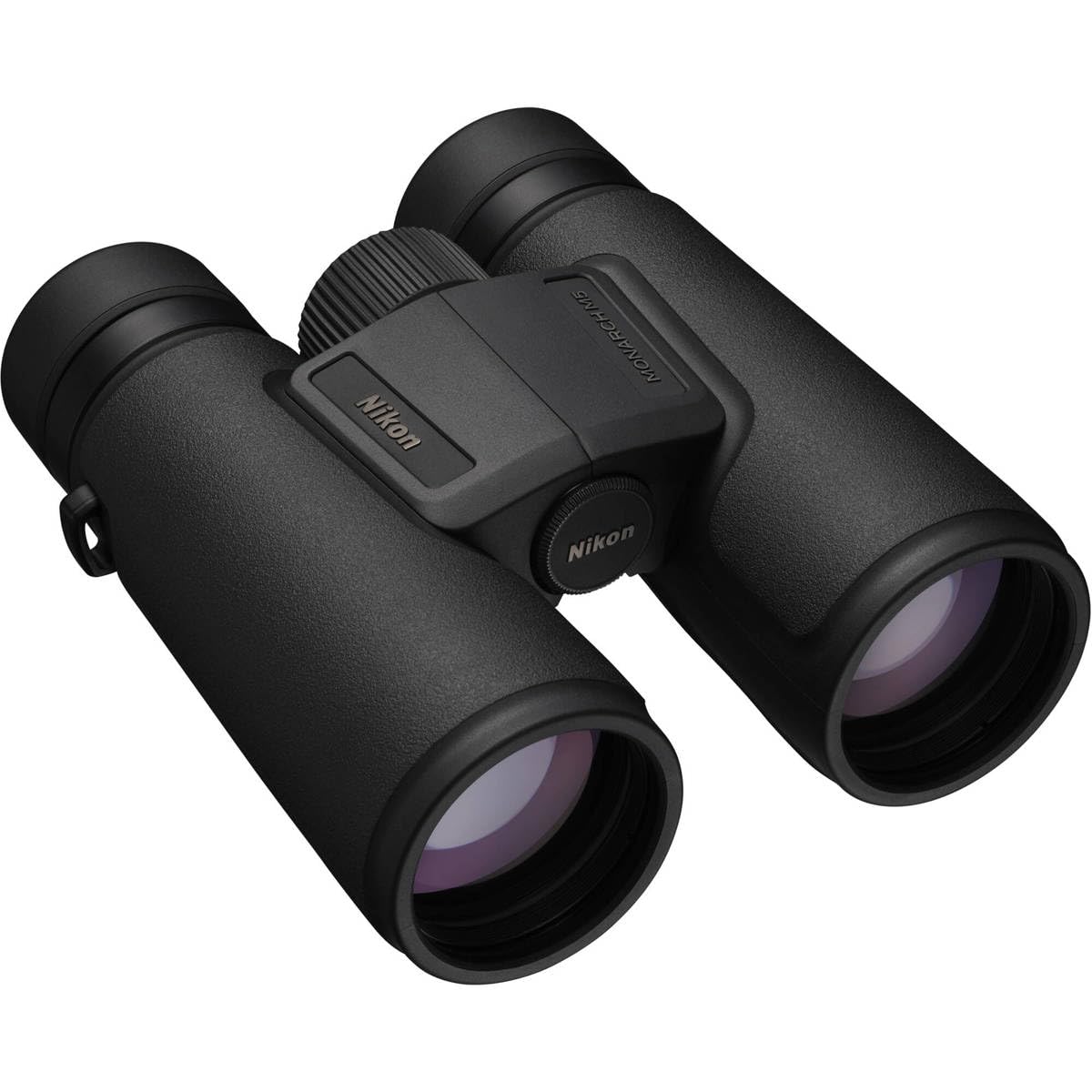
3. NIKON Monarch M5 Binoculars 8×42
An 8×42 birding glass with a 5.3mm exit pupil and 19.5mm eye relief for eyeglass wearers.
Your view stays bright when the light drops, thanks to a 5.3mm exit pupil (the beam of light that reaches your eye) — the largest here compared with the Vortex Diamondback HD’s 3.7mm. The Monarch M5 pairs that with 8x magnification, the birding standard for a reason: steadier hands, wider scene, less searching. That 5.3mm exit pupil is why your eye lands naturally in the balance and this pair feels easy to hold a view with.
The glass is the real story. Extra-low dispersion (ED) glass fights chromatic aberration — that colour fringing you see on a bird’s outline against bright sky — and dielectric prism coatings push light transmission up for natural colour. Owners rate optical quality above everything else, and it is easy to see why: 8.2 feet of close focus pulls intricate feather detail right into your lap. The 19.5mm eye relief is the longest of the traditional field pairs here, which is why eyeglasses wearers keep coming back to it.
Waterproof, fogproof nitrogen purging and O-ring seals make it a year-round tool, and the rubber-armored body takes knocks without drama. It gives up magnification reach versus the 10x and 12x options, so long-distance identification is not its job. Judge it as the close-to-mid-range birding instrument it is built to be.
What earns it the birding spot
- ED glass cuts colour fringing on birds against bright sky
- 5.3mm exit pupil is the biggest beam in this group
- 19.5mm eye relief handles eyeglasses comfortably
- Close focus down to 8.2 feet for near-detail viewing
- Fully multi-coated with phase-corrected dielectric prisms
What to weigh
- 8x leaves you short on reach for open-country spotting
- Field of view of 335 feet sits under the PROSTAFF P3’s 367 feet
Built for: birders, glasses wearers, and anyone who values a relaxed, wide, colour-true view over raw power.
Not the tool for: judging antlers a half-mile out across open country.
4. Celestron SkyMaster 25×100 Giant Astronomy Binoculars
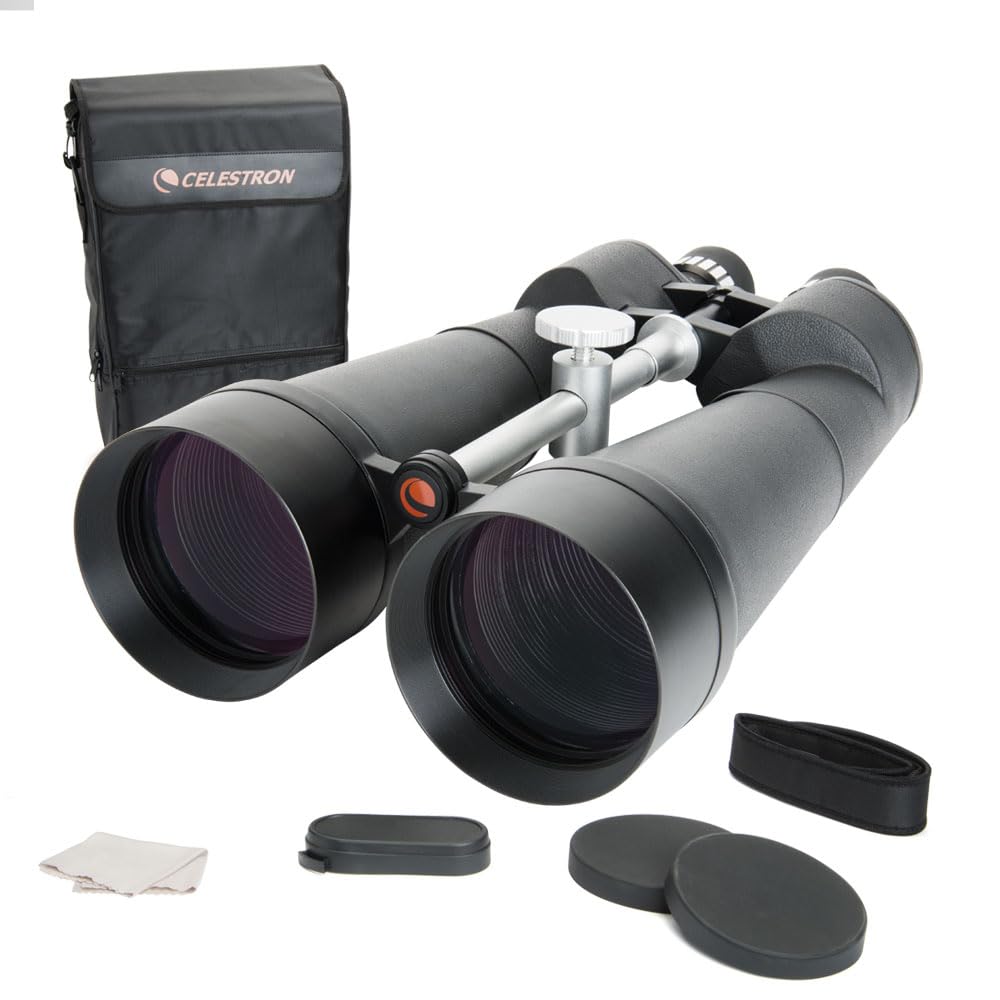
100mm objective lenses that turn a star field into something you can study.
Read the numbers before anything else: 25x magnification and 100mm objective lenses. That is 25x against the Nikon Monarch M5’s 8x, and 100mm against the PROSTAFF P3’s 42mm — two of the largest jumps on this page. Those figures explain the whole design. This is a light-collecting instrument for dim conditions, whether that means a nebula overhead or a hillside at last light.
BaK-4 prisms are the engine, maximizing light throughput to your eye so the image stays bright and detailed rather than grey. Quality is what wins people over here, with versatility close behind — it does double duty on sky and land. But the honest picture includes the weight and stability notes. This is a big, tripod-dependent pair: Celestron recommends a traditional photo tripod, and the built-in ¼”-20 adapter mounts to most in seconds. Hand-holding 25x is not realistic.
You get a narrow tunnel of view: its 3 degrees (the width of the scene you see) is tight, and some buyers report alignment trouble rather than a clean single image — an occasional unit issue rather than a design promise, but worth knowing before you mount a heavy pair. The rubber-armored housing is water-resistant for unexpected weather, and the package includes a case, neck strap, and lens caps.
The reason to buy: 100mm of glass at a price that undercuts the premium field binoculars by a wide stretch makes deep-sky viewing and long-distance land scanning accessible.
The reality check: plan on a solid tripod and give the collimation a careful look when it arrives — the view splits opinions between a bright window and a doubled image.
Choose it if: you want maximum light-gathering for astronomy or stationary land viewing and already own or will buy a tripod.
Look elsewhere if: you need something to carry in a pack or raise to your eye on the move.
5. Vortex Viper HD Roof Prism Binoculars 10×42

A 10×42 with XR-coated edge-to-edge clarity and an included GlassPak chest harness.
For a hunter who is on his feet all day, the Viper HD 10×42 is a strong argument. The 10×42 spec is the same recipe as the PROSTAFF P3, but the glass is a step up: XR anti-reflective coatings on a high-density optical system deliver edge-to-edge clarity and bright, full views in low light. Clarity is the thing buyers praise most here, and the value for a pair at this level is the second thing they keep coming back to.
Ergonomics get real attention. A rubber-armored chassis with thumb indents gives the grip a molded feel rather than a slippery one, and the locking right-eye diopter tailors each barrel to your eyes. Twist-up eyecups with 17mm of eye relief rest comfortably against the face. Argon purging and O-ring seals give a lifetime of waterproof, fogproof performance, and Armortek on the exterior lenses shrugs off scratches, oil, and dirt.
What seals it for field work is the included GlassPak chest harness — comfortable, protected carry that keeps the binoculars at hand instead of swinging off a neck strap. The smooth center focus wheel is a point of mixed feeling in feedback, so expect to tune the feel to your taste rather than assume it is perfect on day one. Otherwise this is a close, clean step below the premium tier.
Why it earns the harness
- High-density glass with XR coatings for edge-to-edge clarity
- Thumb-indent rubber armor keeps the grip locked in
- Argon purged and o-ring sealed for lifetime fog and water resistance
- GlassPak chest harness included for strain-free all-day carry
- Locking diopter and 17mm eye relief suit a wide range of eyes
The catch to know
- Focus wheel feel draws mixed feedback — some find it less slick than the glass
Best matched to: the hunter or hiker who wears his binoculars on his chest from first light to last.
Only a maybe if: you want the absolute widest field — the PROSTAFF P3 beats it there on paper.
6. Canon 12×36 Image Stabilization III Binoculars

12x power you can hold still, thanks to image stabilization borrowed from Canon’s camera lenses.
Here is the pair that solves the oldest problem in glassing: every bit of magnification you add makes handshake worse. The Canon 12×36 uses vari-angle prism image stabilization, optics technology borrowed from Canon’s EF lenses, to electronically cancel that wobble. For anyone who has watched a distant animal bounce around a 12x view, this is the fix — and it is why the stabilization stands out more than any other attribute in feedback.
The optical package is genuinely clever. Porro II prisms preserve resolution and cut light loss, while a doublet field-flattener keeps images sharp and nearly distortion-free from edge to edge. The 36mm objective diameter is smaller than the 42mm field pairs, so you are trading a little light-gathering for the compact body and the stabilizer. Improved power efficiency stretches battery life, which matters because this is the only powered pair on the list.
Comfort details are thoughtful: long eye relief of 14.5mm helps glasses wearers, and the low-reflective exterior design suits birdwatching. The honest trade-off is that narrow 3mm exit pupil and the need to keep the stabilizer fed. It is a viewing-tool choice, not a light-gathering monster.
The stabilizer win: 12x power that stays glued to your subject, sharp edge to edge, in a compact body — the combination that keeps people glassing for hours at the stars.
What you give back: that 3mm exit pupil wants good light, and a small 36mm objective will not match a 56mm pair at dusk.
Go for it if: steady hands are your weak point and you want real power without a tripod.
Skip the upgrade if: you glass mostly in dim light and need the light-gathering of a larger front lens.
7. ZEISS Conquest HDX Binoculars 10×42

A weatherproof 10×42 that pushes light through to your eye even in the worst grey the sky can throw.
ZEISS builds this pair around one headline number: 90% light transmission. That is the share of the light hitting the front lens that reaches your eye, and it explains why the view holds up when the sky turns to slate. ED glass, aspheric lenses, and FieldFlattener Technology combine to keep sharpness edge to edge across the entire field of view — the kind of detail you notice when you are panning a dark treeline for a body.
The coatings are the weather story. ZEISS’s LotuTec keeps the view clear in all conditions, while the T* coating brings high-contrast images in adverse light and twilight. A fast, smooth focus wheel completes a full turn in just 1.3 rotations, so a running animal snaps into focus quickly. Glass quality is what buyers praise most, with finer detail at distance as the follow-up point — exactly the promise the optics make.
The housing is magnesium under full rubber armoring: lightweight, but waterproof, fogproof, shockproof, and nitrogen purged. Removable flip-down covers and an easy-access tripod interface are small touches that matter in the field. Field of view is a modest 345 feet — this pair favors crisp reach over a wide panorama.
The optical case
- 90% light transmission keeps dawn and dusk views bright
- ED glass with FieldFlattener for edge-to-edge sharpness
- LotuTec sheds rain and grime for an all-weather view
- 1.3-rotation focus wheel for quick, precise pull-in
- Magnesium housing, fully rubber armored, nitrogen purged
What a buyer should weigh
- 345-foot field of view is narrower than the PROSTAFF P3’s 367 feet
- A smaller owner pool means less day-to-day long-term feedback to lean on
Best for: the dedicated field user who values transmission and weather coatings over raw field width.
Only if you can live with: a tighter picture than the budget-friendly Nikon 10×42.
8. Swarovski EL 10×42 Binocular with FieldPro Package

A 10×42 you buy once and hand down, sealed submersible to 13 feet.
If image quality matters more to you than anything else, the EL is the reference point. Image quality is the thing buyers praise most here — fantastic clarity and excellent focus, with immense light gathering standing out. SWAROVISION, SWAROBRIGHT, and SWAROCLEAN technologies back that up, and the 10×42 setup keeps the exit pupil at 4.2mm for a comfortable eye box.
Durability is not an afterthought. The body is rated submersible tight up to 13 feet (4 meters), and the FieldPro package brings the Field Bag, eyepiece and objective covers, and a Lift carrying strap. Twenty millimeters of eye relief is the most generous field-friendly number here, and the ±5 diopter adjustment range accommodates a real spread in eye strength. The warranty split is transparent: lifetime on the optics, ten years on the other parts.
Value, though, is the split opinion. Some buyers call it worth it; others find the cost hard to justify when the 10×42 field is crowded. That is a fit note, not a fault — the glass itself earns the praise. Think of the EL as a lifetime lens you keep, not a season-by-season purchase.
For the buyer who: wants the finest clarity and a body that survives a drop in the creek, and is willing to commit to one pair for years.
Reconsider if: you are still deciding what magnification suits you — a mid-tier pair first will teach you that more cheaply.
9. ZEISS Victory SF Binocular
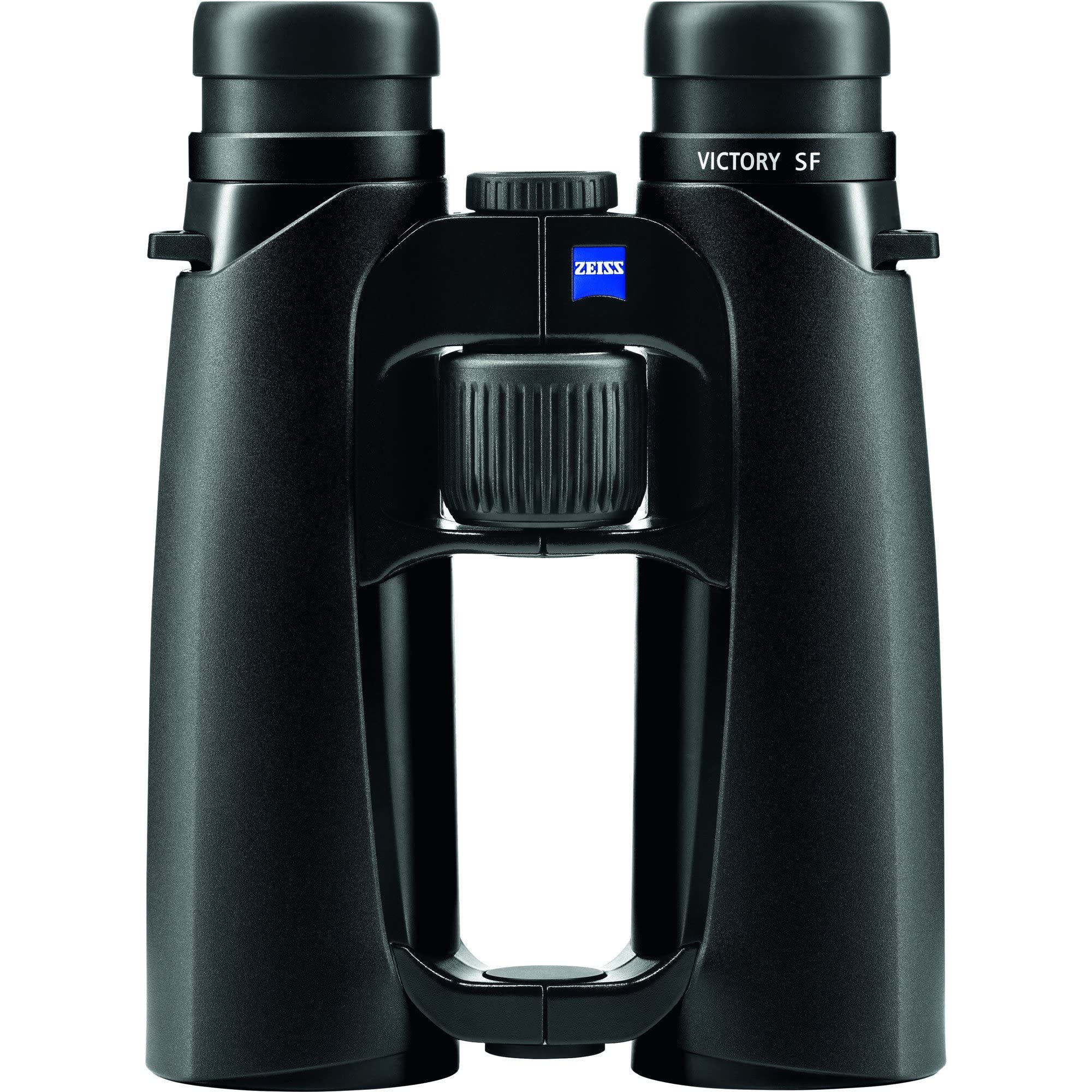
A 64-degree field of view that sweeps difficult terrain in one pass.
Start with the field of view, because that is the Victory SF’s calling card: 64 degrees, and an 8-degree apparent angle of view. In plain terms that is a broad window that gives you an overview of difficult ground rather than a tunnel into it. Pair that with 92% light transmission and you have a pair built to show you everything at once, even in twilight or harsher conditions.
The optics philosophy is the Ultra-FL Concept — several SCHOTT fluoride glass elements combined into one system for colour fidelity, brightness, contrast, and the finest resolution of details. ZEISS’s T* coating is tuned to each lens individually, and LotuTec keeps the view clear when the weather turns wet. The 5.3mm exit pupil and 18mm eye relief make the view easy to fall into, and the center-focus design keeps adjustments natural.
What you accept is that a very wide field and the finest glass come at the top of the market, and the owner pool is small enough that long-term field feedback is thin. This is a statement optic for the buyer who wants the broadest, brightest picture Zeiss can build.
The panorama argument: 64 degrees of field plus 92% transmission is the widest, brightest combination on this list — terrain overview rather than tunnel vision.
Pay attention to: the price of admission and the small number of owners to draw experience from — buy this for the view, not for group wisdom.
Its buyer: the glass collector or guide who wants the broadest premium field and watches in all weather.
Hold off if: you have not yet decided between wide-field and high-magnification needs — the answer changes which premium pair fits.
Know the Specs
Magnification and objective lens
The two numbers in a name like “10×42” mean magnification and front-lens size in millimeters. Higher magnification pulls distant detail closer but narrows your view and amplifies handshake. A larger objective gathers more light for dawn, dusk, and stars but adds weight and bulk. Choose the pair that matches your ground and your hand strength, not the biggest number on the shelf.
Exit pupil and eye relief
Exit pupil is the beam of light that reaches your eye — a bigger beam lines up easier and stays bright in dim light. Eye relief is the gap between your eye and the eyepiece; longer relief keeps glasses from bumping the glass. Both decide how comfortable a long viewing session feels, so check them alongside magnification.
Field of view
Field of view is the width of the scene you see, quoted in feet at 1,000 yards or in degrees. A wide view finds and follows a moving subject quickly. A narrow view magnifies harder and suits a tripod. Trackers want wide; distance judges want narrow.
Coatings, purging, and armor
Fully multi-coated glass with anti-reflective layers on every surface removes haze and keeps colour honest. Nitrogen or argon purging with O-ring seals keeps fog and moisture out when temperatures swing. Rubber armor and lens coatings handle the knocks, scratches, and grime of real field use.
Common Questions
Is 10×42 a good all-around binocular size?
Do I need a tripod for 15x or 25x binoculars?
What is exit pupil and why does it matter at dusk?
Can I use binoculars with eyeglasses?
Are waterproof and fogproof the same thing?
Is image stabilization worth it over higher magnification?
What field of view should I aim for birding?
How long should a good pair of binoculars last?
Does a bigger objective lens always mean a better view?
Should I buy a budget pair before a premium one?
The Bottom Line
For most people, the world’s binoculars winner is the Vortex Diamondback HD 15×56 because it delivers genuine long-range reach with colour-true, weatherproof glass and a harness in the box — a combination that holds up across big country. If you want a first serious all-rounder with the widest view for the money, grab the Nikon PROSTAFF P3 10×42. And for straining the night sky or a distant hillside without touching the glass to your eye, the tripod-mounted Celestron SkyMaster 25×100 is the one to reach for.
How we choose
We do not accept paid placement. Every pick is matched to a real buyer and a real use-case; we do not hands-on test units.
Sources
Specifications: manufacturer listings and product documentation. Review insights: verified customer reviews. Pricing: not shown on this page (it changes often); check the current price via the retailer link.
As an Amazon Associate, Tactical Gear Guy earns from qualifying purchases. This does not affect which products we feature.