Specs are compiled from manufacturer listings and verified buyer reviews and can change over time — please confirm the key details on the product page before buying.
Buy the adapter that matches how you actually travel: if you carry a laptop, get one with a 70W USB-C port; if you pack light and just need your phone charged, a compact five-port model does the job. Most people overpay by buying the wrong pin style, not the wrong brand. This guide cuts straight to which of these nine works in the sockets you are heading toward.
This guide is built by comparing the manufacturers’ published specifications and the patterns across verified customer reviews, so you get each pick’s real strengths and trade-offs instead of marketing spin.
Below you will find which models pull ahead on plug coverage, port count, and fuse safety — the practical detail behind every world wide travel adapter worth packing.
Top Picks

How To Choose The Best World Wide Travel Adapter
The single most common mistake is buying a travel adapter expecting it to make a 110V hair dryer work in a 230V socket. It will not. Every adapter on this list only reshapes the plug — it moves the same wall voltage straight through to your device. What you are really shopping for is plug coverage, port count, and charging wattage.
Check your device’s voltage label before you pack anything
Flip your laptop charger or phone brick over and look for “100-240V” printed on it. That range means the device handles both American and European wall power, so an adapter is all you need. A device marked only 120V is the one that needs a converter — and a converter is a bulky, heavy box, not the palm-sized plugs reviewed here.
Decide between swappable pins and a sliding block
The Targus breaks into separate interchangeable adapters that stay together in one small package. Most others here use pins that slide and lock into one housing. Neither is better in every case — the breakup style can be more flexible in tight sockets, while the all-in-one block is harder to lose a piece of.
Match USB-C wattage to your heaviest device
A 20W port trickles a phone back to life but will barely nudge a laptop. Look for a 70W or 75W USB-C port if a laptop travels with you. If your heaviest device is a tablet or phone, a lower-wattage adapter with more ports usually serves you better for the size and weight you save.
Side-by-Side Comparison
| Model | Best For | Max USB-C Output | Outlets | Weight | Amazon |
|---|---|---|---|---|---|
| Epicka 70W GaN PD★ Best Overall | Laptop travelers | 70W | 6 | 5.1 oz | Amazon |
| HAPOW PD20WBudget Champion | Phone-only trips | 20W | 5 | 4.8 oz | Amazon |
| Targus UniversalClassic Reliability | Simple plug swapping | — | 1 | 5.12 oz | Amazon |
| meta-ant 7-in-1 | Cruise cabins | 4.2A shared | 7 | 110 g | Amazon |
| Hero International | Multi-device charging | GaN III | 5 | — | Amazon |
| UGREEN 45W 6-Port | Compact carry | 45W | 6 | 135 g | Amazon |
| MOMAX 70W 7-in-1 | Wide socket coverage | 70W | 7 | 6.35 oz | Amazon |
| Baseus Enercore CG11 | No-cable travel | 70W | 2 | — | Amazon |
| Epicka 75W GaN PD | Fastest laptop charge | 75W | 5 | 0.25 kg | Amazon |
Detailed Reviews
1. Epicka 70W GaN PD Universal Travel Adapter
Our pick — 4.5+★ from 750+ verified ratings; the strongest balance of quality and price.
One six-outlet brick that runs your laptop and phone at the same time.
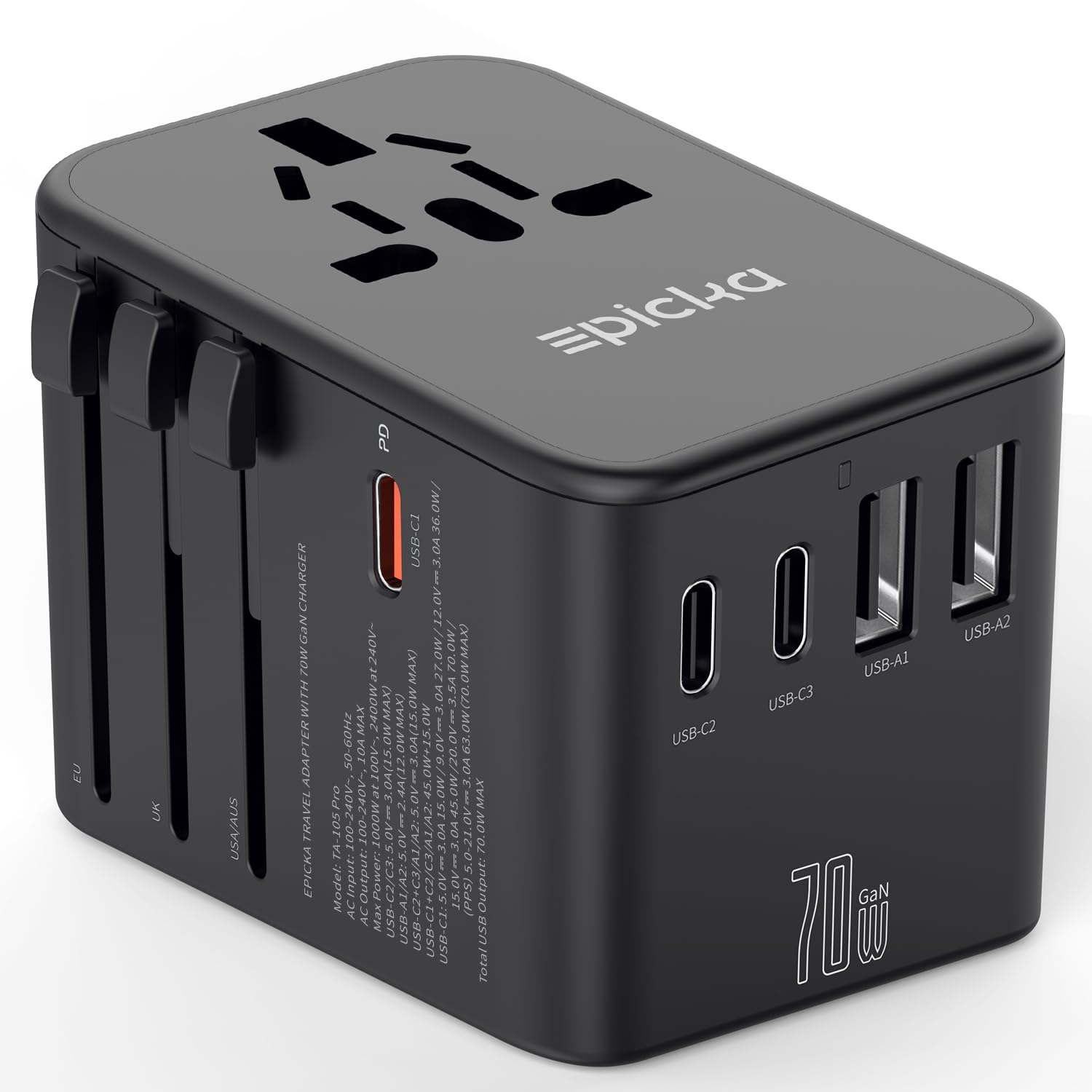
Four plug types in one housing end the “which plug fits where” scramble. Four plug types live in one housing and reach sockets in 200+ countries — Type C for most of Europe, Type G for the UK, Ireland and Singapore, Type I for China and Australia, Type A for the US and Japan. The USB-C1 port pushes up to 70W through PD3.0 (Power Delivery, a charging standard that negotiates the fastest safe speed with your device), so a USB-powered laptop refills overnight while a tablet and phone top up off the remaining four ports.
Six outlets in total — one AC socket plus three USB-C and two USB-A — is why this sits at the front of the pack. Physically it is the smallest here at 2.05 x 1.97 x 2.8 inches, so it disappears into a jacket pocket next to a phone.
The separate plug lock keeps it firm in a vertical wall socket instead of drooping. The built-in 10A fuse and separate plug lock add a layer of safety, and two spare fuses ship in the box. One honest limit: it does not convert voltage, so a 120V-only hair dryer is still out of bounds, and the maker itself advises against high-power appliances over 2000W because the fuse will pop.
Where it wins
- 70W PD3.0 output runs a laptop and phone together
- Compact 2.05 x 1.97 x 2.8 inch body at 5.1 ounces
- Built-in 10A fuse plus two spare fuses included
- Separate plug lock keeps pins steady in vertical sockets
Worth knowing
- Does not convert voltage, only plug shapes
- High-power appliances above 2000W will trip the fuse
Grab this one: anyone traveling with a USB-C laptop, tablet, and phone who wants one brick to cover every socket on the trip.
Think twice: if your bag carries a hair dryer or electric kettle, no adapter here helps — that needs a converter.
2. HAPOW Universal Travel Adapter PD20W
The travel-bag staple for anyone who leaves the laptop at home.
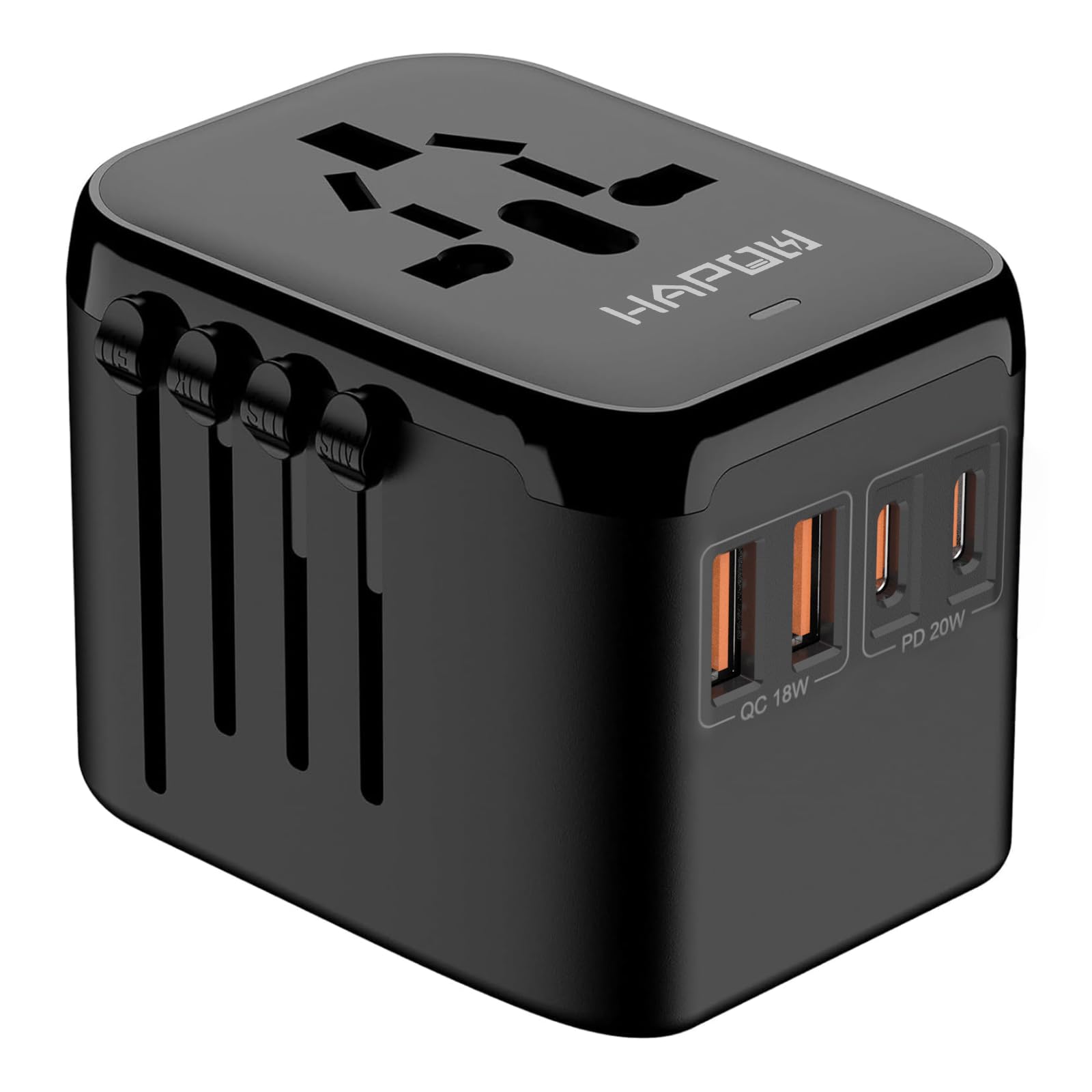
For a phone, a watch, and earbuds, its 20W USB-C ports are plenty. Its pair of USB-C ports run PD 20W (Power Delivery, a smart standard that waits for your device to ask for the speed it can take), and the two USB-A ports handle QC 18W (Quick Charge, a fast-charge standard used by many Android phones). Smart charging auto-detects each device and adjusts, so four things can sit plugged in at once without you thinking about order.
Double 10A fuse protection guards against short circuit, overload, overcurrent, and overheat, and it carries FCC and CE certification. The pin setup slides between Type A, C, G, and I for outlets across North America, Europe, the UK, Italy, and Australia. At 4.8 ounces — a shade lighter than the Targus at 5.12 ounces — it will not weigh down a carry-on.
The trade-off to be honest about: 20W will not charge a laptop, and its max rating is 1000W at 100V and 2500W at 250V. Treat it as a phone-and-gadget charger and the 20W ports do exactly what they should.
Who it fits: the light packer doing a multi-country Europe run with only phones and a tablet needs nothing more than this.
The honest limit: no laptop support at 20W, so power-users should step up to the Epicka 70W.
Pick this if: your devices top out at phones, watches, and earbuds and you want reliability without bulk.
Skip if: a laptop is in your bag — 20W will leave it crawling.
3. Targus Universal Travel Adapter (APK01US1)
No USB ports, no fuss — just the plug shapes and a sturdy shell.
This one takes a different road: a divider-based design where the needed plugs break apart and travel together in one small package. High-impact polycarbonate plastic shrugs off the bottom of a backpack. Red safety shutters over the live contacts block accidental finger contact, and the whole thing folds into a compact, flexible stack.
It covers sockets across Africa, Asia, the Caribbean, Central America, Europe, the Middle East, and North America, including the round European outlets. There is one AC outlet and no USB at all, so pair it with your own charger. At 5.12 ounces it is a touch heavier than the HAPOW’s 4.8 ounces, and notably larger in the hand at 5.6 x 3 x 7.6 inches in its packaging footprint.
Who this is for is narrow but real: someone who wants a tough, simple plug changer with nothing to go wrong electronically, or who prefers the breakup style in tight, angled hotel sockets.
The case for it: build quality and durability are why this has stayed a travel staple — it is a plug adapter built to be thrown in a bag for years.
What you give up: no USB charging ports and no fast-charge brains, so bring your own bricks.
Choose it for: ruggedness and simple plug conversion across a very wide spread of regions.
Reach past it if: you want to skip carrying separate chargers — there is no USB here.
4. meta-ant European Travel Plug Adapter 7-in-1
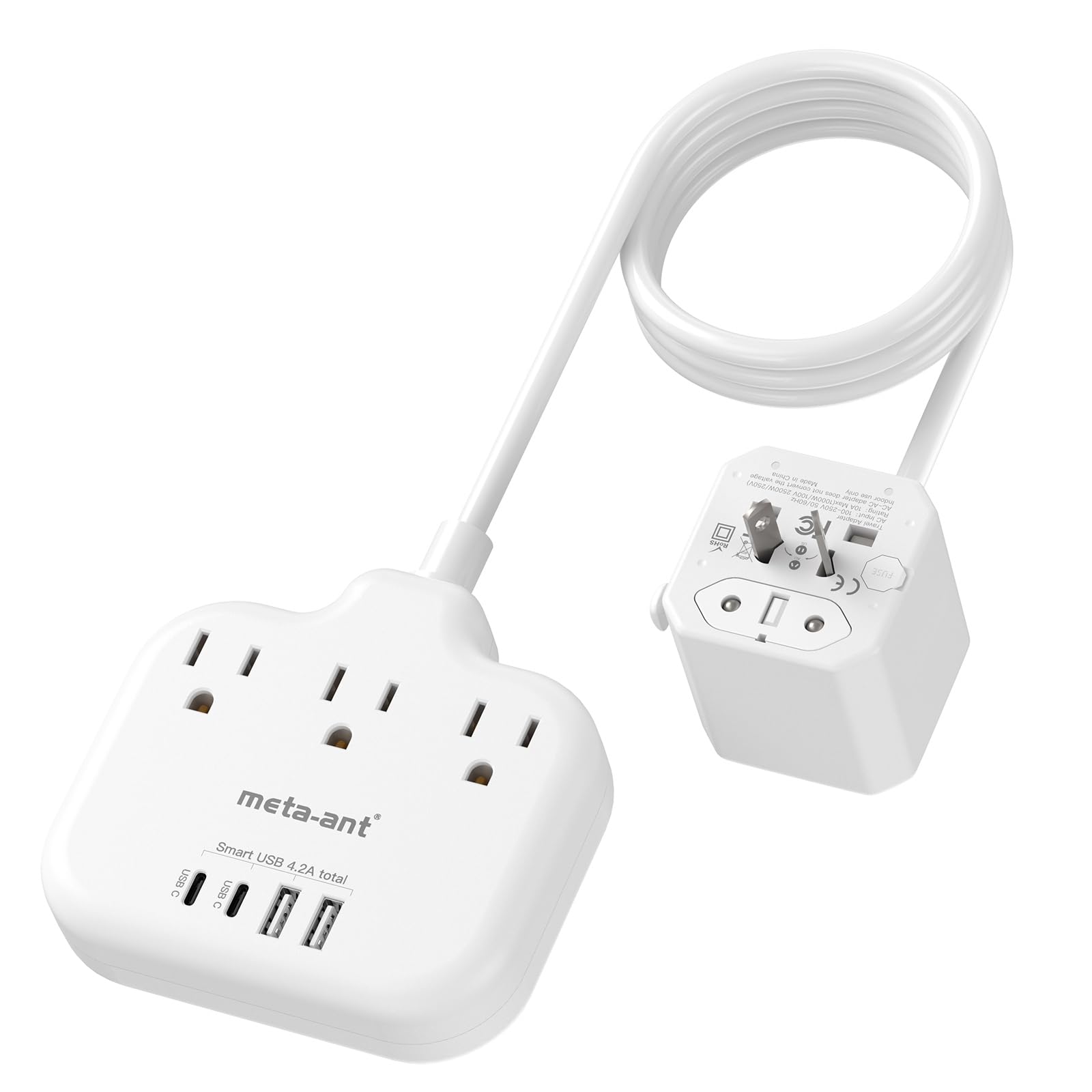
A power strip that folds flat — three AC outlets on a bendable cord.
One hotel socket becomes a whole charging station here. Three American outlets (rated 10A/2500W) sit alongside two USB-C and two USB-A ports, all on a 5ft flexible power cord — so you can place it on a nightstand while the wall socket stays behind the desk. The cord twists and bends, which means it will not block the neighboring outlet or light switch.
The seven-outlet count is the biggest on this list, well ahead of the Targus’s single outlet, and that reach plus the cord is the whole point. Pins slide and lock between Type A, C, G, and I for 200+ countries. At 110 g and 4.3 x 3.3 x 1.1 inches, it still slips into a backpack. It is built without surge protection, which is why it complies with most cruise line rules — that free-from-surge design is a deliberate feature, not a shortcut.
The catch: no USB-C PD wattage is specified, only a combined 4.2A, so a high-draw laptop will want its own charger. And like every pick here, it is not a voltage converter.
Standout feature: the 5ft cord turns an awkward hotel single-socket into a usable desk-side hub for digital nomads and cruise passengers.
Be aware: 4.2A shared across the USB ports is not laptop-grade speed, and it does not convert voltage.
Made for: cruise cabins, shared hotel rooms, and anyone who needs three AC plugs plus four USB at once.
Not for: travelers who want a tiny pocket brick — this is a mini power strip with a cord.
5. Hero International Travel Power Adapter
The one backed by a lifetime replacement and built on GaN III chips.
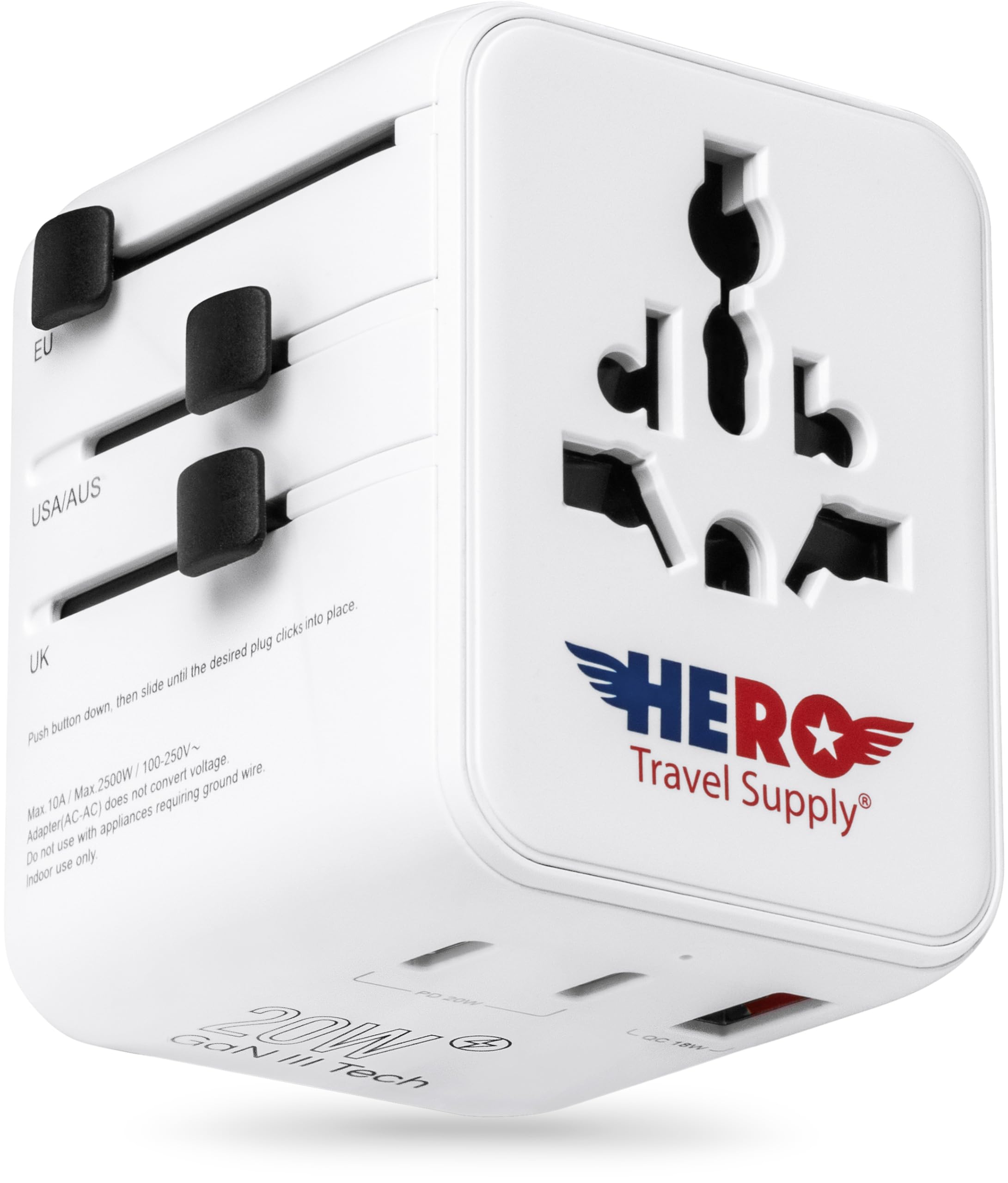
Not many travel adapters come with a lifetime replacement guarantee — this one does, plus each unit is individually tested in the USA before it ships. Inside, GaN III technology (gallium nitride, a semiconductor that runs cooler and more efficiently than older silicon parts) keeps the unit light and quick to charge. Coverage runs across 100+ countries with plug types A, B, C, E, F, G, I, J, and K — the widest plug-type spread on this list.
It charges up to five devices at once: two regular US outlets plus one USB-A and two USB-C. Dual-voltage hair dryers, curling irons, and straighteners are fine up to 10 amps, though it does not convert voltage. Its nine plug types (A, B, C, E, F, G, I, J, K) cover more socket shapes than any other pick here.
The recurring gripe is fit: some units sit loose and fall out of certain wall sockets, so a plug with a firm grip matters. Beyond that, the wide plug-type coverage makes it a strong all-rounder for multi-continent trips.
The lifetime promise: a replacement guarantee plus pre-shipment testing is a comfort for high-mileage travelers.
The loose-fit caveat: falling out of some sockets is the honest weak spot — check the fit in each country.
Suits you if: you want huge plug-type coverage plus a lifetime replacement safety net.
Pass if: a rock-solid grip in every socket is your top priority — this can work loose.
6. UGREEN 45W 6-Port Universal Travel Plug Adapter
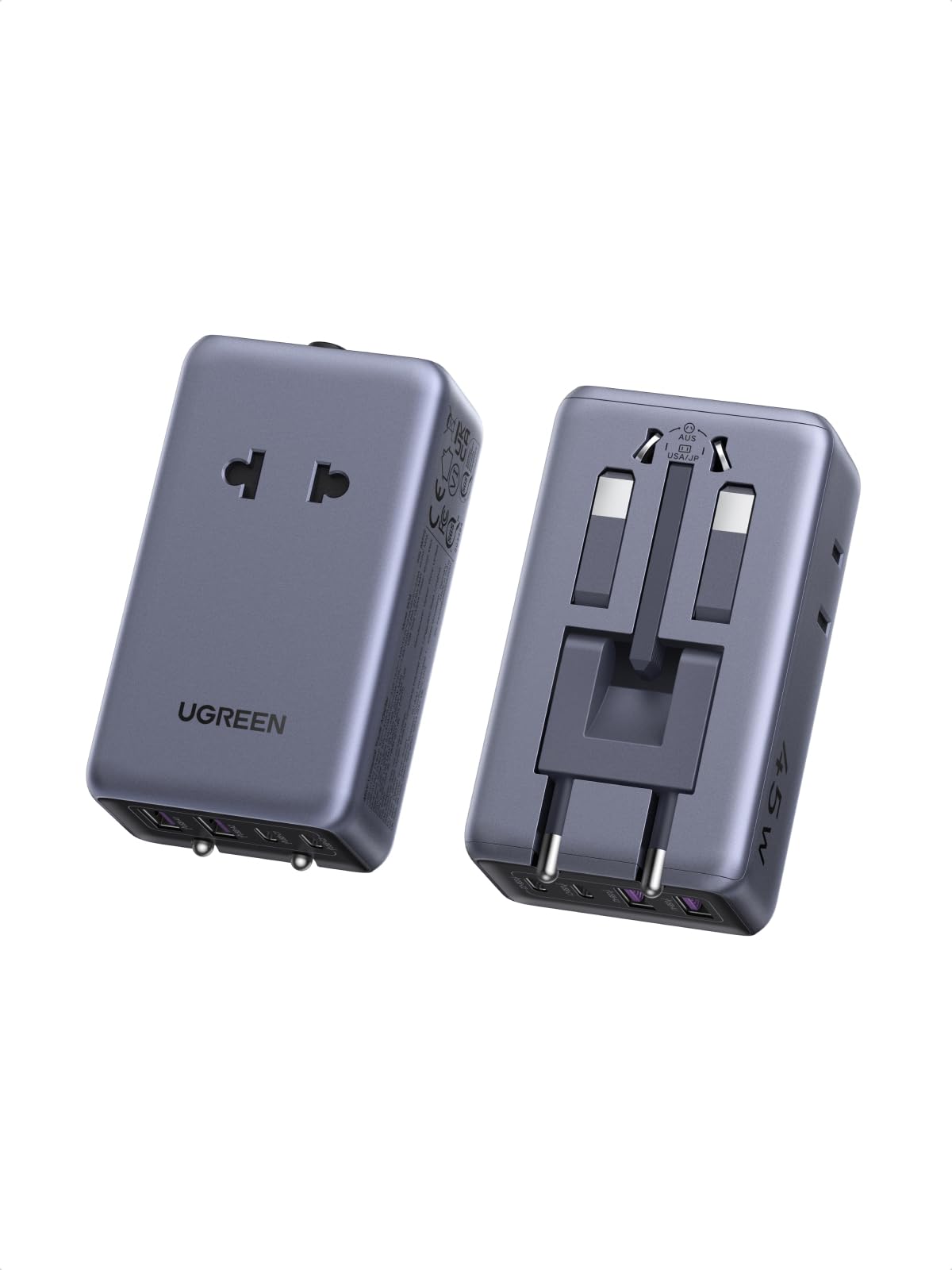
Retractable pins and a 45W charge in the smallest footprint here.
The pins fold away when not in use, which kills the snagging and pocket-scratch problem other adapters have. Six outlets — 2 USB-C, 2 USB-A, and 2 AC — fit inside a body measuring 3.48 x 2.05 x 1.22 inches at 135 g. The same 45W USB-C port (Power Delivery, which negotiates the best speed your device accepts) can push a phone to roughly 40% in 30 minutes, per the maker’s figures.
Multi-port charging is what it is known for — a laptop, phone, and watch can all ride on one device at once. Safe-inside-and-out construction uses UL 94 V-0 flame-retardant PC material with a GaN-II chip, automatic shut-off, and safety shutters to block accidental contact. It carries CE, FCC, and UKCA certification. Pins swap across Type A, C, E, F, G, and I for Italy, the UK, Australia, Japan, Korea, and beyond.
Be realistic about speed. Charging speed draws mixed feedback — the reviews split on how fast it really is — so if raw wattage for a big laptop is the mission, this is a step below the 70W picks. As always, it is not a voltage converter.
Why it travels well: foldable retractable pins plus a 3.48 x 2.05 x 1.22 inch body make it the easiest to tuck in a handbag or carry-on.
The speed reality: 45W handles a phone fast but is not a 70W-class laptop charger, and charger speed is the split opinion here.
Reach for this if: compactness ranks first and your heaviest device is a tablet or phone rather than a big laptop.
Look elsewhere if: you need maximum laptop wattage — move up to a 70W model.
7. MOMAX 70W Universal Travel Adapter 7-in-1

A seven-outlet GaN brick that has been tested from Syria to Italy.
Compatibility is this adapter’s whole reputation — buyers report it working in Syria, Egypt, and Italy, one of the widest real-world reach records on this list. Pins cover Type C, A, G, and I across 200+ countries. Inside, a 70W PD USB-C port handles laptops and tablets, while QC3.0, PPS, FCP, SCP, and AFC protocols take care of phones and smaller gear, so several devices can share it in various combinations.
Advanced GaN technology keeps it compact and cool rather than overheating. The redesigned AC plugs make inserting and removing easy, which matters when hotel sockets are stiff. Safety is deep: ROHS, CE, and FCC certifications, a built-in 10A fuse, and protections against overheat, overcurrent, overcharge, short circuit, overpower, and overvoltage. Seven outlets — two AC plus two USB-C and two USB-A — put it among the most generous here.
The honest note: charging speed gets mixed reviews, and at 6.35 ounces it is on the heavier side for a pocket. It does not convert voltage, either — that stays true of every model on this page.
Where it shines: broad socket compatibility across tricky regions plus 70W PD for a laptop and a deep protection suite.
Trade-off: 6.35 ounces nudges the pocket-brick limit, and charging speed draws split opinions.
Best for: well-traveled types heading to less-common destinations who still want laptop-grade 70W charging.
Consider the Epicka instead if: you want the same power in a lighter body with steadier socket grip.
8. Baseus Enercore CG11 70W Universal Travel Adapter

A braided USB-C cable lives inside the shell, so nothing tangles.
The trick here is the built-in retractable USB-C cable, braided in nylon to handle daily wear. Pull it out and charge — no extra cord to pack or lose. That cable delivers up to 70W max (Power Delivery, the smart standard that matches your device’s safe top speed), and the whole unit charges up to six devices at once, keeping a laptop, tablet, phone, and more topped up. Pins span Type C, G, I, and A for 200+ countries across Europe, Asia, the US, and Australia.
Owners lean on it for multi-country trips because it just works region to region, and the retractable cable is the detail people mention with genuine appreciation. The fireproof, shock-resistant PC shell carries dual 10A fuses and protection against over-power, short-circuit, and overheating, plus CE and FCC certification. Free of surge protection, it is cruise-ship friendly.
Two things to weigh: compactness draws mixed feedback — some find it bulkier than expected — and it holds just two AC outlets, unlike the seven-outlet MOMAX. It is not a voltage converter.
The cable victory: a braided retractable USB-C cable inside the body removes the single most-lost item from your travel kit.
Weigh this: only two AC outlets and a bulkiness some find more than they expected.
Perfect for: frequent flyers who hate packing cables and want 70W laptop charging built in.
Look to the MOMAX if: you need more AC outlets — this tops out at two.
9. EPICKA 75W GaN PD Universal Travel Adapter

The highest wattage on the page, in the same small footprint.
Push 75W through GaN parts and you get the fastest laptop charging here. All three USB-C and two USB-A ports support PD3.0 or Quick Charge 3.0, so a tablet, USB-powered laptop, phone, and console can all ride at speed. The body is the same compact shape as the 70W Epicka at 3.3 x 2.1 x 2.2 inches, yet it delivers more peak wattage — enough to fast-charge a Chromebook and an iPhone simultaneously at full speed.
Build is the other half of the story: it holds up in hotels, planes, and trains, and the versatile port mix is why owners treat it as the one brick to pack. Four plug types cover Type C for Europe, G for the UK, I for Australia and China, and A for the US and Japan, reaching 200+ countries. The built-in 10A fuse, safety shutters, separate plug lock, RoHS, CE, and FCC certifications, and a 2-year limited warranty round it out. Cruise-ship friendly thanks to no surge protection.
The thing to note: it does not work with Type D (India) or Type M (South Africa) sockets, and high-power appliances above 2000W will pop the fuse. Also, do not buy an extra fuse without matching it to the model and current rating.
Peak power pick: 75W across five ports with PD3.0 and QC3.0 makes it the strongest laptop charger in this group.
Two gaps: India and South Africa socket types are not supported, and it is not a voltage converter.
Go for it if: maximum wattage and a two-year warranty matter, and your trip skips India and South Africa.
Skip if: you are headed to Type D or Type M regions — this will not fit.
Know the Specs
USB-C PD Wattage (20W vs 70W vs 75W)
Power Delivery wattage is the real speed limit for anything you charge over USB-C. A 20W port tops up a phone comfortably but leaves a laptop crawling. A 70W or 75W port matches what many laptops want, so a single overnight charge of your work machine is realistic. Match the number to your heaviest device before anything else.
Plug Types A, C, G, and I
Type A is the flat US two-pin; Type C is the round European two-pin; Type G is the chunky UK three-pin; Type I is the slanted Australian/Chinese pin. An adapter listing all four covers North America, most of Europe, the UK, Australia, and China. Watch for the gaps — Type D (India) and Type M (South Africa) often fall outside these four and need their own adapter.
Adapter vs Voltage Converter
An adapter reshapes the plug only and passes the same wall voltage through. A converter changes that voltage. Every pick on this list is an adapter, so the device you plug in must handle dual voltage — look for “100-240V” printed on it. If it says 120V only, you need a converter, not any adapter here.
Fuses and Safety Shutters
A built-in 10A fuse is the self-sacrificing part that pops to cut power if something overloads, protecting your device and the socket. Safety shutters block fingers from touching live contacts. Spare fuses in the box — as on both Epicka models — mean you are not stuck if one trips mid-trip.
Common Questions
Will a travel adapter let me use my hair dryer in Europe?
What is the difference between a travel adapter and a voltage converter?
Can a 20W adapter charge a laptop?
Do these adapters work in India and South Africa?
Are travel adapters allowed on cruise ships?
How many devices can one travel adapter charge at once?
What do the extra fuses in the box do?
Will a travel adapter fit a recessed or angled hotel socket?
Do I need a separate adapter for the UK if I already have a European one?
Why do some travel adapters run hotter than others?
The Bottom Line
For most travelers, the world wide travel adapter winner is the Epicka 70W GaN PD — it pairs 70W laptop charging with six outlets and a pocket-sized 2.05 x 1.97 x 2.8 inch body, and it holds steady in a vertical wall socket. If raw speed is the priority and your trip skips India and South Africa, the Epicka 75W pushes the highest wattage on the page. And for cruise cabins or shared hotel rooms where you need several AC plugs at once, the corded meta-ant 7-in-1 turns one socket into a desk-side hub.
How we choose
We do not accept paid placement. Every pick is matched to a real buyer and a real use-case; we do not hands-on test units.
Sources
Specifications: manufacturer listings and product documentation. Review insights: verified customer reviews, as of November 2026. Pricing: not shown on this page (it changes often); check the current price via the retailer link.
As an Amazon Associate, Tactical Gear Guy earns from qualifying purchases. This does not affect which products we feature.