Specs are compiled from manufacturer listings and verified buyer reviews and can change over time — please confirm the key details on the product page before buying.
Your first decision is scale, not brand. A 1/48 kit (a model that is one forty-eighth the size of the real plane) is the balance for most builders — big enough that cockpit detail and decals read clearly, small enough that the finished plane still fits on a shelf. If you want the least fuss, pick a kit that needs no glue. If you want the classic hobby experience, pick one that does. Below you will find nine World War 2 aircraft models that each solve a different problem, from a screwdriver-only starter plane to a twin-engine bomber with a fully detailed cockpit.
This guide is built by comparing the manufacturers’ published specifications and the patterns across verified customer reviews, so you get each pick’s real strengths and trade-offs instead of marketing spin.
The good news is that the top pick is a crowd favorite at 4.5+ stars across 300+ owners. The trick is matching kit scale, assembly method, and paint requirements to your own patience level, which is exactly what this list of World War 2 Aircraft Models sorts out for you.
Top Picks

How To Choose The Best World War 2 Aircraft Models
The most common beginner mistake is buying a big, cheap bomber as a first kit. Bigger means more parts, and more parts means more places for a fit problem to show up after you have already glued the fuselage shut. Start by deciding what you actually want from the model, then let the numbers below narrow the shelf.
Decide whether you are gluing or screwing
A screw-together or snap kit needs no glue, so you go from box to display stand in one sitting. A glue-and-paint kit is a weekend project — it demands filler, sanding, and a steady hand. Neither is better; they suit different people. If you want to build with a child in the room, the no-glue route removes the solvent entirely.
Match the scale to your shelf and your eyes
Scale is the ratio of model to the real aircraft, so a 1/48 kit is about half the size of a 1/72 kit of the same plane. 1/48 gives you readable cockpit detail and decals you can actually place. 1/72 keeps the footprint small and is easier to fit into a row of several planes.
Check what is in the box before you commit
Paint and glue are frequently not included, even on premium kits. Read the included-components line carefully: a kit that lists a 24-page booklet and die-cut parts is a different evening than one that lists only plastic sprues. Decal options matter too — two or three marking schemes let you build a plane no one else on your shelf owns.
Side-by-Side Comparison
| Model | Best For | Scale | Weight | Assembly | Amazon |
|---|---|---|---|---|---|
| Tamiya Models A6M2 Zero Fighter★ Best Overall | Best all-round build | 1/48 | 7.04 oz | Glue and paint | Amazon |
| New Ray P-51D Red Tails 1:48Quickest Display | Instant shelf piece | 1/48 | 0.23 kg | Screwdriver, no glue | Amazon |
| Academy F6F-3/5 HellcatSmallest Footprint | Tight-space builders | 1/72 | 0.1 kg | Glue and paint | Amazon |
| Atlantis B-24J Bomber | Moving-part fun | — | 0.18 kg | Glue and paint | Amazon |
| Guillow’s Curtiss P-40 Warhawk | Flying or display | 16 1/2″ wingspan | — | Balsa build | Amazon |
| Tamiya F4U-1D Corsair | Detail chasers | 1/48 | 9.6 oz | Glue and paint | Amazon |
| Tamiya Messerschmitt Bf109E-4/7 Trop | Easy starter kit | 1/48 | 222 g | Glue and paint | Amazon |
| Revell B-17F Memphis Belle | Centerpiece bomber | — | 635 g | Glue and paint | Amazon |
Detailed Reviews
1. Tamiya Models A6M2 Zero Fighter Model Kit
Our pick — 4.5+★ from 350+ verified ratings; the strongest balance of quality and price.
The Zero that turns a first glue kit into a weekend you actually finish.
The number that tells you the most here is 7.4 inches — the finished length of a plane that still leaves room on a bookshelf. It is a 1/48 scale kit, so the cockpit, the cowling, and the markings all stay large enough to work with comfortably. Two figures come in the box as well, which means you can set a pilot beside the aircraft and give the display a bit of scale.
What wins people over is the surface detail. Owners consistently describe the finished Zero as an excellent representation of the real aircraft, with crisp panel lines that read properly under a coat of paint. The build itself is forgiving: the parts fit together well, the instructions are clear enough to follow without second-guessing, and the whole thing goes together in a sensible order. Paint and glue are not included, so budget for those separately.
Against the Corsair further down this list, the trade-off is size. The Corsair weighs 9.6 oz against this kit’s 7.04 oz — that extra heft is a bigger, more intricate model with folded-wing options. The Zero is the easier first build of the two and the one to start with.
What earns the top slot
- 1/48 scale keeps detail readable and still fits a shelf
- Clear instructions and good part fit make it approachable
- Two included figures add display value
- Panel and cockpit detail holds up under paint
Where it asks more of you
- Paint and glue are not in the box
- 7.04 oz of plastic means fewer parts than the bigger bombers
- No folding-wing or variant options to extend the build
Straight verdict: Pick this if you want one dependable 1/48 kit that builds cleanly the first time.
Look elsewhere if: You want movable surfaces or a twin-engine centerpiece.
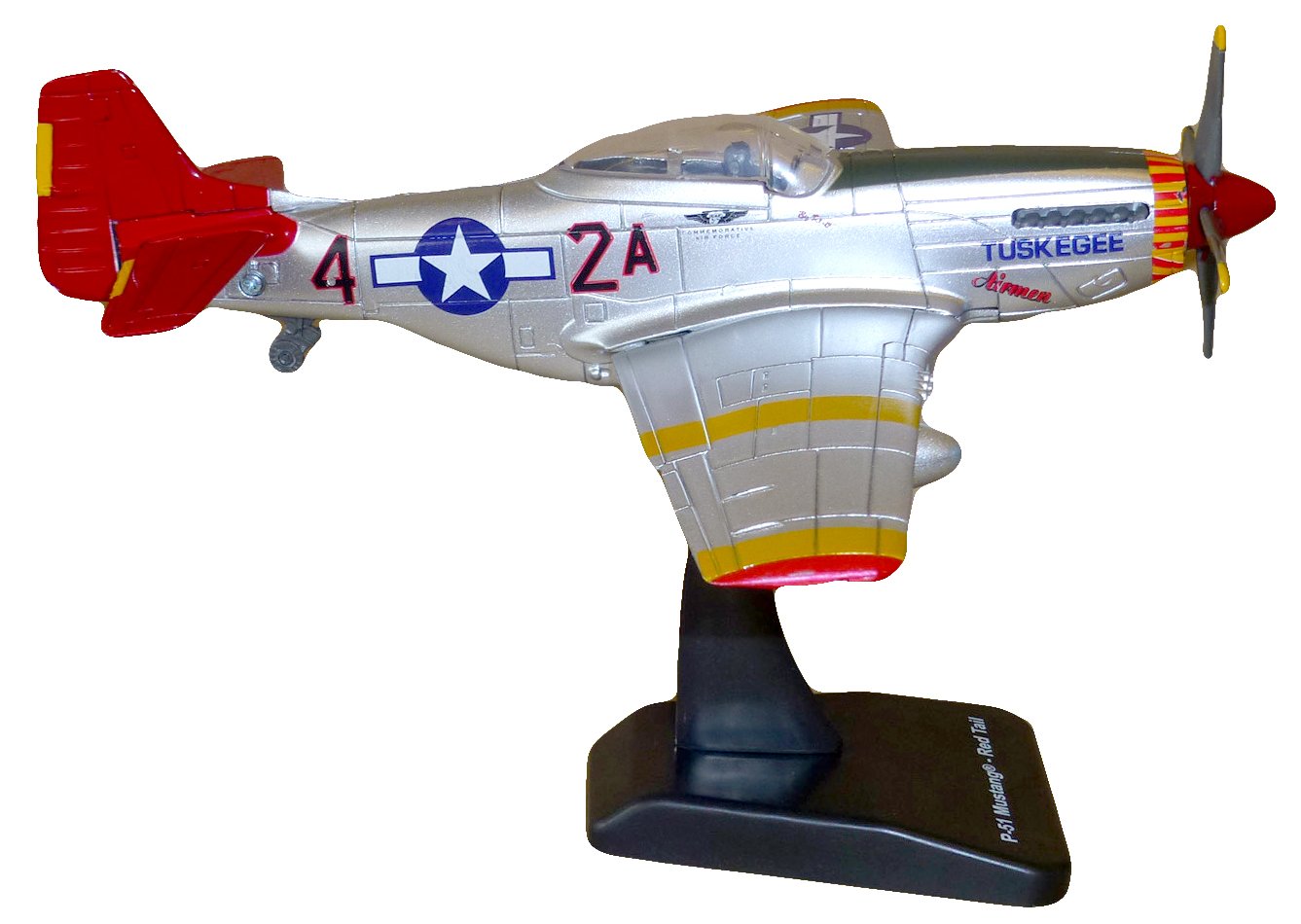
2. New Ray P-51D Red Tails 1:48
A Red Tail Mustang that goes from box to shelf with one screwdriver.
Most WWII models on this list ask you to glue, fill, and paint. This one does not. The P-51D arrives pre-painted in its red-tail scheme, and the only tool you need is the screwdriver that comes in the box. That is the whole appeal — no solvent, no drying time, no chance of a paint job going wrong.
The dimensions suit a desk display: the fuselage runs about 7 1/2 inches and the wingspan about 9 inches wide. It sits on a removable plastic stand, so you can lift the plane off for a closer look and clip it back on afterward. It is built for indoor use and weighs 0.23 kg, which means it stays put rather than tipping over.
Compare it to the Academy Hellcat, which weighs 0.1 kg and is a proper glue kit. The New Ray is the heavier, finished object — 2.3x the weight of the Academy kit — because it is a pre-painted display model rather than a build project. Both are legitimate, but only the New Ray gives you the afternoon back. The honest limit is depth of detail: a pre-painted replica cannot match a hand-built kit with a cockpit you assembled and painted yourself.
The buyer it suits: someone who wants a WWII fighter on the shelf today, not next weekend — a gift, a desk piece, or a child’s first aircraft.
The catch to weigh: the age recommendation on the listing starts at 3 years and up, but the small removable stand and propeller assembly still reward a careful hand.
Reach for this if: assembly is the obstacle, not the fun part.
Pass if: you want to say you built it yourself.
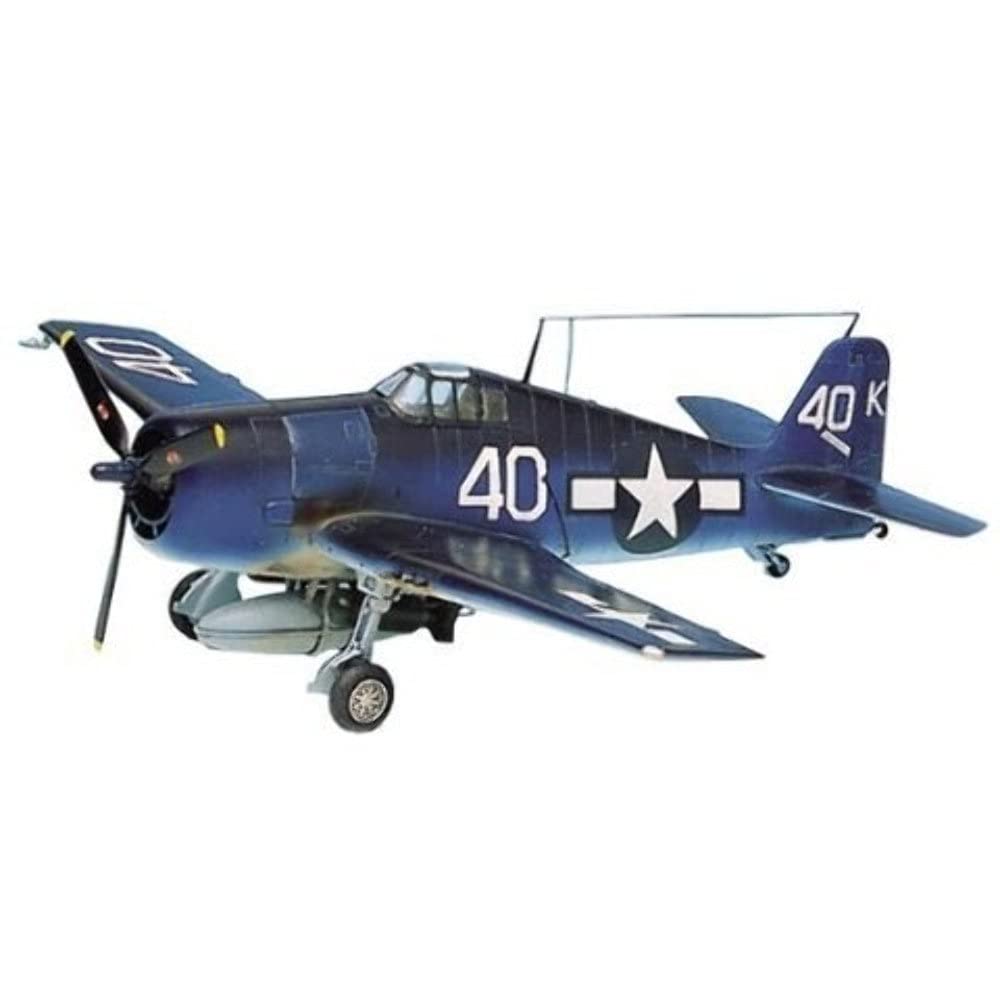
3. Academy WWII U.S. Navy Fighter F6F-3/5 Model Kit
A Hellcat you can build two ways from a single small box.
This is the kit for the person with one narrow shelf. It is a 1/72 scale model, so the finished Hellcat takes up a fraction of the space a 1/48 build would — which is exactly the point, and exactly the point of friction. Size is the one thing owners split on here: some find it larger than expected and others say it is very small. Read the scale before you buy and you will land on the right side of that line.
Where the kit earns its place is the build itself. It goes together quickly, and the cockpit interior and landing gear carry detail that looks out of proportion to the tiny frame. The parts let you build either the -3 or the -5 version, and authentic markings for both versions are included, so you get two different aircraft from one purchase.
What makes the build satisfying is that the plastic is engineered to come together without drama — the enjoyment of the finished model is the theme running through owner feedback, with the speed of assembly right behind it. Paint and glue are not included, so this is a glue-kit evening rather than a screwdriver job.
Where the detail lives: cockpit and landing gear are the standout areas on a 1/72 airframe that weighs 0.1 kg.
Size reality check: if you want a big-format build you can paint in broad strokes, jump to a 1/48 kit instead.
Best fit: tight-space builders who want the option of two aircraft versions.
Second thought: the small scale makes fiddly landing-gear work harder than on a 1/48 kit.
4. Plastic Model KIT B24J BOMBR

A Liberator with turrets that turn and wheels that roll.
The moving parts are the whole story here. This Atlantis B-24J bomber comes with rotating turrets, movable guns, landing gear with rolling wheels, and both a pilot and co-pilot figure. It also sits on a swivel stand, so you can pose it at whatever angle looks best on the shelf. At 0.18 kg it is a light kit for a four-engine aircraft, and the finished model is one you will want to pick up and fiddle with.
That movability is the reason to choose it over the Revell B-17F further down. The B-17F weighs 635 g and is a serious centerpiece build with a detailed cockpit and four bombs in the bomb bay; the B-24J trades some of that interior depth for parts that actually move. Neither is a better kit — the B-24J is for handling, the B-17F for interior depth.
The trade-off is that a model with working turrets and rolling gear has more small, moving pieces to keep track of. Plan the build so those sub-assemblies go in last, after the fuselage is sealed and painted. Paint and glue are not included.
Why it stands out
- Rotating turrets and movable guns give it a handling quality most kits lack
- Rolling landing gear and a swivel stand make display posing easy
- Two crew figures add scale to a four-engine bomber
What to plan around
- Moving parts need care so they do not bind after painting
- Interior detail is lighter than the Revell bomber’s full cockpit
- Paint and glue sold separately
The one to buy when: you want a bomber that is fun to handle, not just to look at.
When to skip past: you are after a maximum-detail interior build.
5. Guillow’s Guillow Curtiss P-40 Warhawk
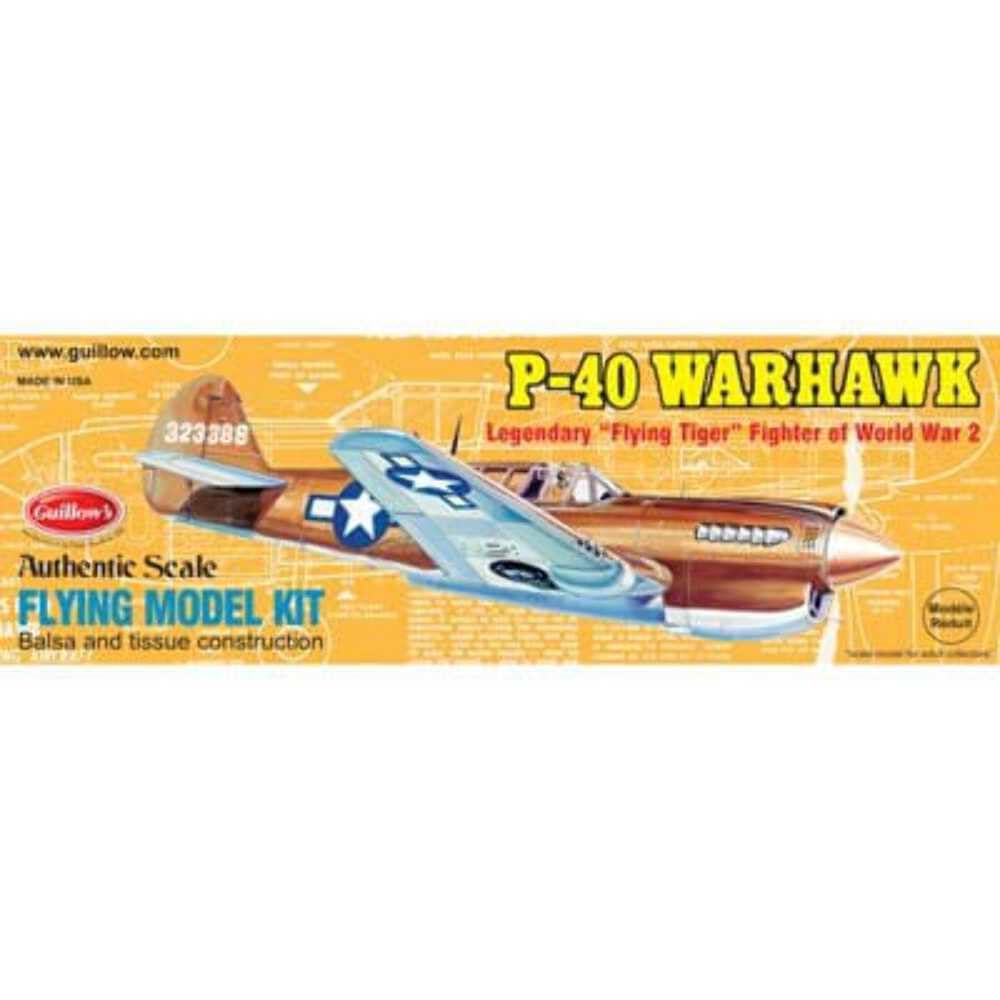
Balsa, tissue, and a 24-page booklet — a P-40 you can actually fly.
This is a different craft entirely from the plastic kits on this list. The Guillow’s P-40 is built from die-cut balsa parts, covered in tissue, and finished with the included decals and plastic parts. The wingspan comes in at 16 1/2 inches, and the whole thing is aimed at builders ages 10 and up — the brand pitches it as an entry-level plane kit. It is made in the USA.
The instructions guide you toward either a flying model or a static display, which is the choice that makes this one unusual. A balsa airframe you cover yourself is light enough to fly, and the trade-off is that balsa is softer and less forgiving of a hard landing than polystyrene. Laser-cut quality is what buyers talk about most — parts are described as cutting cleanly, and the wing and fuselage joints come out precise.
Watch the booklet, though. Feedback on the instructions is split: some find the build straightforward, while others say the 24-page guide is thin on help when something does not line up. Read it fully before cutting anything, and this kit rewards you with a model that looks genuinely different from every plastic plane on the shelf.
The craft difference: tissue-and-balsa construction means every step is visible in the finished surface — no filler can hide a sloppy joint.
The patience factor: budget more evenings than a snap-together kit, and treat fragility as part of the deal.
Pick it for: the builder who wants a P-40 that can leave the shelf and fly.
Think again if: you want a rigid airframe you can handle without care.
6. Tamiya 61061 F4U-1D Corsair

A Corsair with folded wings and markings for three real aces.
The options are what you are paying for. This 1/48 Corsair can be assembled with its wings folded, includes a pilot figure, and ships with two types of canopy windshield plus markings for three aircraft flown by U.S. aces. The kit also captures the F4U-1D’s taller tailwheel, higher pilot seat position, and wider propeller blades. At 9.6 ounces it is the heaviest single-engine kit here.
Fit is where this kit separates itself. The parts line up cleanly, which matters on a plane with a gull wing and a folding mechanism — those are the areas where a loose joint shows. Detail is the second strength: the cockpit and engine area carry the Tamiya reputation for accuracy that owners call out again and again.
Set against the Zero above, the Corsair is 9.6 oz to the Zero’s 7.04 oz, and that extra plastic buys you the folding-wing build and the ace markings. What it also buys is complexity. Assembly feedback splits between builders who find it fairly easy and those who find it difficult, so go in expecting a longer build than the Zero and a more impressive result.
The case for the Corsair
- Wings fold for a compact, characterful display
- Three ace marking schemes plus two canopy options
- Gull-wing parts fit cleanly, the hardest area on this airframe
The fine print
- Longer, more demanding build than the Zero
- Value for money splits opinion among buyers
- Paint and glue are extra
Go for it if: folded wings and ace markings are the display you have in mind.
Hold off if: you want a kit you can finish in one evening.
7. Tamiya 300061063 Messerschmitt BF109E-4/7 Trop

The angular Bf109, and a kit that does not fight you on the way in.
For a first 1/48 build, ease matters more than extra parts. This Bf109E-4/7 Trop is the simplest build in this list to get through — the assembly is straightforward, and the parts are detailed enough that you will not feel short-changed. The kit captures the square canopy of the Trop variant and includes parts for the E-7 drop tank and its rack, so the finished plane has something hanging under the belly.
At 222 g it sits between the lighter Academy Hellcat and the heavier FW190 below it. The silhouette is the draw: the angular lines of the Bf109 are captured cleanly, and the whole model reads as a Messerschmitt at a glance rather than a generic single-engine fighter.
What it does not give you is variety. There is one airframe and one marking path here, where the Corsair offers folding wings and the FW190 offers a choice of variant. If you want a no-drama build that you can finish and put on the shelf without second-guessing, that simplicity is the point. Paint and glue are not in the box.
Why beginners reach for it: the assembly sequence is the least demanding of any kit on this page.
The honest ceiling: detail is strong but the options are thin — no alternate canopy or variant build.
Best for: a first 1/48 kit, or a quick build between bigger projects.
Not for: builders who want variant options and extra parts.
8. Revell of Germany B-17F Memphis Belle Plastic Model Kit

A Flying Fortress with a full cockpit, a bomb bay, and two identities.
This is the one that becomes the shelf. The Revell B-17F weighs 635 g (about 1.4 pounds), several times the plastic in any single-engine kit here, and that mass goes into four detailed radial engines (round engines with cylinders arranged in a circle), a rotating MG turret (a machine-gun turret that turns), a tail-end MG, four bombs on bomb bay racks, and a cockpit with consoles, an instrument panel, individual seats, and a detailed radio compartment. Movable ball and top turrets are included as well.
Two decal sets come in the box — U.S.A.A.F. markings for both the “Memphis Belle” and “The Shamrock Special” — so you choose which bomber you are building. That is a real decision on a model this size, because you will spend a long time with the fuselage before the decals go anywhere near it.
Model glue and paint are not included, and a build this dense will use a lot of both. Set aside more evenings than anything else on this list and treat the cockpit as its own project before you close the fuselage halves. The result is a bomber that dwarfs the fighters beside it.
What you get for the work
- Four radial engines and a fully outfitted cockpit
- Bomb bay with four bombs and racks
- Decals for two named B-17F aircraft
- Movable turrets add handling interest
What it demands
- Glue and paint sold separately, and you will need plenty
- A long multi-evening build, not a quick project
- 635 g of model needs a shelf with real clearance
The right call for: a builder ready to make one bomber the centerpiece of a collection.
Not the right call for: a quick weekend kit or a first build.
Know the Specs
Scale (1/48 vs 1/72)
Scale is the ratio between the model and the real aircraft, so a 1/48 plane is roughly half the size of a 1/72 one. Bigger scale means bigger parts, easier decal placement, and a cockpit you can actually see into. Smaller scale keeps the footprint down but makes landing gear and small sub-assemblies harder to handle with tweezers.
Assembly method
Snap or screw kits need no solvent and go together in one sitting — ideal for a gift or a desk display. Glue-and-paint kits ask for filler, sanding, and drying time, and they produce a model you can customize. The listing usually tells you which you are buying in the included-components line.
Included components
Check what is in the box before you buy. Common inclusions are pilot figures, decal sheets, a display stand, and instruction booklets. Common exclusions are paint, glue, and finishing supplies — those are missing from most kits on this list, so factor them into your build plan and budget.
Marking options
Decals determine which real aircraft your model represents. A kit with one marking scheme builds one plane; a kit with three ace schemes or two named bombers lets you pick a subject. More options mean more flexibility and often a reason to buy a second copy of the same kit.
Common Questions
Do these WWII model kits come with glue and paint?
Is 1/48 or 1/72 scale better for a first model?
Can the Guillow’s P-40 actually fly?
How much shelf space does a finished 1/48 WWII fighter take up?
What is the difference between the Tamiya Corsair and the Tamiya Zero?
Does the Atlantis B-24J come with moving parts?
How long does a model like the Revell B-17F take to build?
Are these kits suitable for kids?
What does a WWII model kit weigh and does it matter?
The Bottom Line
The world war 2 aircraft models worth starting with is the Tamiya A6M2 Zero Fighter, because a 1/48 kit with clear instructions, dependable part fit, and two figures in the box is the least risky way to finish a build you are proud of. If you would rather skip the glue entirely, the New Ray P-51D Red Tails gets a finished Mustang on the shelf in minutes. And for the builder ready to make one model the centerpiece of a collection, the Revell B-17F Memphis Belle delivers four engines and a full cockpit in one box. One nudge worth acting on: the two highest-scoring kits on this page are Tamiya 1/48 builds, and that consistency is the single best signal you can use to pick a first kit with confidence.
How we choose
We do not accept paid placement. Every pick is matched to a real buyer and a real use-case; we do not hands-on test units.
Sources
Specifications: manufacturer listings and product documentation. Review insights: verified customer reviews, as of November 2026. Pricing: not shown on this page (it changes often); check the current price via the retailer link.
As an Amazon Associate, Tactical Gear Guy earns from qualifying purchases. This does not affect which products we feature.