Specs are compiled from manufacturer listings and verified buyer reviews and can change over time — please confirm the key details on the product page before buying.
You want a phone that disappears into a coin pocket, but you still need to make calls, run WhatsApp, and get through a full day. The tricky part is that “small” means wildly different things here — some of these are 3-inch toys that struggle as daily phones, while the top pick packs a proper Android 13 system and a 48 MP camera into a genuinely tiny body. The short answer: if you want the most complete tiny phone you can actually live with, the Unihertz Jelly Star is the one to beat, and it is the crowd favorite at 4.0+ stars across 400+ ratings. Below you’ll find the honest trade-offs of each, from kid-friendly budget picks to a rugged waterproof mini, so you choose the tiny phone that fits how you actually use it.
This guide is built by comparing the manufacturers’ published specifications and the patterns across verified customer reviews, so you get each pick’s real strengths and trade-offs instead of marketing spin.
A tiny phone works best as a second handset, a kid’s first device, or a glovebox backup — match the screen size, carrier bands, and battery to that job rather than chasing the smallest spec sheet. This breakdown covers exactly that, so here is how to judge the world smallest smartphone for your own pocket and habits.
Top Picks


How To Choose The World Smallest Smartphone
A mini phone is not just a shrunken version of a normal handset — every spec gets harder to fit into a small body. That means you have to prioritize. Decide which two things matter most to you (calls and battery, or apps and storage, or toughness) and let the rest slide, because no tiny phone does everything well.
Check your carrier bands before anything else
The single biggest reason a mini phone disappoints is network compatibility. A phone only makes calls and data where its supported 4G bands match your carrier’s. Some models here list T-Mobile and Verizon support only, and others explicitly warn they won’t work on AT&T or Cricket. Look up the exact band list for the phone and confirm your SIM’s network covers it before you buy — otherwise you have a pocket camera that never rings.
Match the screen to the job
Small screens range from around a 3-inch panel up to a 5-inch one, and the difference matters. A 3-inch screen is glovebox-sized but cramped for typing and maps, while a 5-inch display is the most usable as a real daily phone. Screen density (pixels per inch, or how sharp text and icons look) decides whether small text is readable or a strain, so pair your size preference with a decent density figure.
Battery and storage decide daily usefulness
Battery capacity (mAh, the size of the power tank) is the honest limit on a phone this small — several of these run out before a full day of heavy use. Storage (GB) and RAM decide how much you can install and how smoothly apps run. If you only call and text, a modest setup is fine; if you want maps, photos, and social apps, aim for the bigger storage and RAM numbers.
Side-by-Side Comparison
| Model | Best For | Display | Memory | Battery | Amazon |
|---|---|---|---|---|---|
| Unihertz Jelly Star★ Best Overall | Most complete tiny daily phone | 3-Inch | 8GB RAM / 256GB | 2000 mAh | Amazon |
| Mini Phone 4G 3.0″ HD (IBOZOU)Best Value | Light travel and backup phone | 3.0-Inch HD | 3GB RAM / 32GB | 2600 mAh | Amazon |
| Mini Phone 64GB (BLKE AIR) | A kid’s first phone | 3.7-Inch HD | 4GB RAM / 64GB | 2000 mAh | Amazon |
| Ulefone Note 22 | Simple everyday and backup use | 5.0-Inch | 3GB RAM / 32GB | 3000 mAh | Amazon |
| Cutwif Mini 4G Rugged | Outdoor and waterproof duty | 3.88-Inch HD | 6GB RAM / 128GB | 3000 mAh | Amazon |
| Palm Phone PVG100 (Renewed) | Slip-in-a-pocket secondary handset | 3.3-Inch | 32GB | — | Amazon |
Detailed Reviews
1. Unihertz Jelly Star
Our pick — 4.0+★ from 400+ verified ratings; the strongest balance of quality and price.
The one tiny phone that keeps a flagship brain inside a 3-inch shell.
What makes the Jelly Star the pick here is raw capability crammed into a 3-inch body: an octa-core MediaTek Helio G99 processor (a chip with eight cores that runs everyday apps smoothly), 8GB of RAM and 256GB of storage. That storage is the standout — you get 256GB here versus 32GB on the pink Mini Phone below, so it holds a whole photo and app library without a microSD card. The 3-inch screen draws 291 pixels per inch, so text and icons stay readable even on that small panel.
The transparent back with its LED light and dynamic notification makes it a genuinely fun object to pull out, and that enjoyment is what wins people over. It runs Android 13, supports NFC (tap-to-pay and quick pairing), has a 3.5 mm headphone jack, a programmable button, an infrared port, and a fingerprint open up. Dual nano SIM and USB OTG round out the connectivity. One hard limit you must respect: it officially supports T-Mobile and Verizon only, so check your network first.
The catch is battery and rough handling. On a 2000 mAh battery, heavy app use will have you hunting a charger before the evening, and the recurring gripe is that the glass demands care — a drop can mean a screen break. The camera is a 48 MP rear unit but delivers mixed real-world results, so treat it as a convenience shooter, not a photographer’s tool. As owners put it, you buy this for the joy of a working tiny phone, not for a marathon battery.
pocket titanium build
- Tops the list here on storage: 256GB versus 32GB on the pink Mini Phone
- 8GB RAM beside the Ulefone Note 22’s 3GB means far smoother multitasking
- Android 13 with NFC, fingerprint open up, headphone jack, and a programmable button
- 3-inch screen at 291 pixels per inch keeps small text crisp
tiny battery drain
- Carrier-locked in practice — T-Mobile and Verizon only
- 2000 mAh battery struggles under heavy use
- Glass is fragile; plan on a case and careful handling
- Camera output is mixed despite the 48 MP figure
carry light: you want the most capable tiny Android phone and are on T-Mobile or Verizon.
need big screen: you need a phone that runs two heavy days per charge — this is a charge-every-night device.
2. Mini Phone 4G 3.0″ HD (IBOZOU)
A glovebox-sized handset for days you don’t want a big phone in your pocket.
If you want a phone that slips into the smallest pocket and still takes calls, this is built for that. It measures 94 by 47.4 by 12.5 mm — small enough to sit in a coin pocket and light on a hike or bike ride. The battery is where it earns a look: 2600 mAh, which beats the Jelly Star’s 2000 mAh. The 3.0-inch HD screen runs 240 pixels per inch, and there’s a face open up plus a 3GB/32GB setup with room for a memory card up to 128GB.
What you get for the everyday basics is solid — voice and video calls, email, MP3, FM radio, GPS navigation, and access to most Google Play Store apps like WhatsApp and TikTok. Dual SIM standby lets you run two lines. The honest limit is battery endurance: a 2600 mAh cell that buyers report doesn’t stretch a heavy day’s use, so plan to charge it nightly.
Wi-Fi connectivity is the other thing to test early — it works on the listed 2G, 3G, and 4G bands, but confirm your network before relying on it. Treat this as a light-use travel, backup, or secondary phone rather than a full-time main device.
travel-first compact body: a 94 mm body that keeps a bigger 2600 mAh battery than the more expensive Jelly Star makes it the value pick for pocket-and-go use.
weak camera output: everyday heavy use outruns the battery, so it wants a nightly charge and light app loads.
go roaming: hikers, cyclists, and travelers who want a featherweight backup handset for calls and maps.
want polish: you need all-day power on a main phone — this one won’t stretch that far.
3. Mini Phone 64GB (BLKE AIR)
A first phone sized for little hands, with a camera made for playground moments.
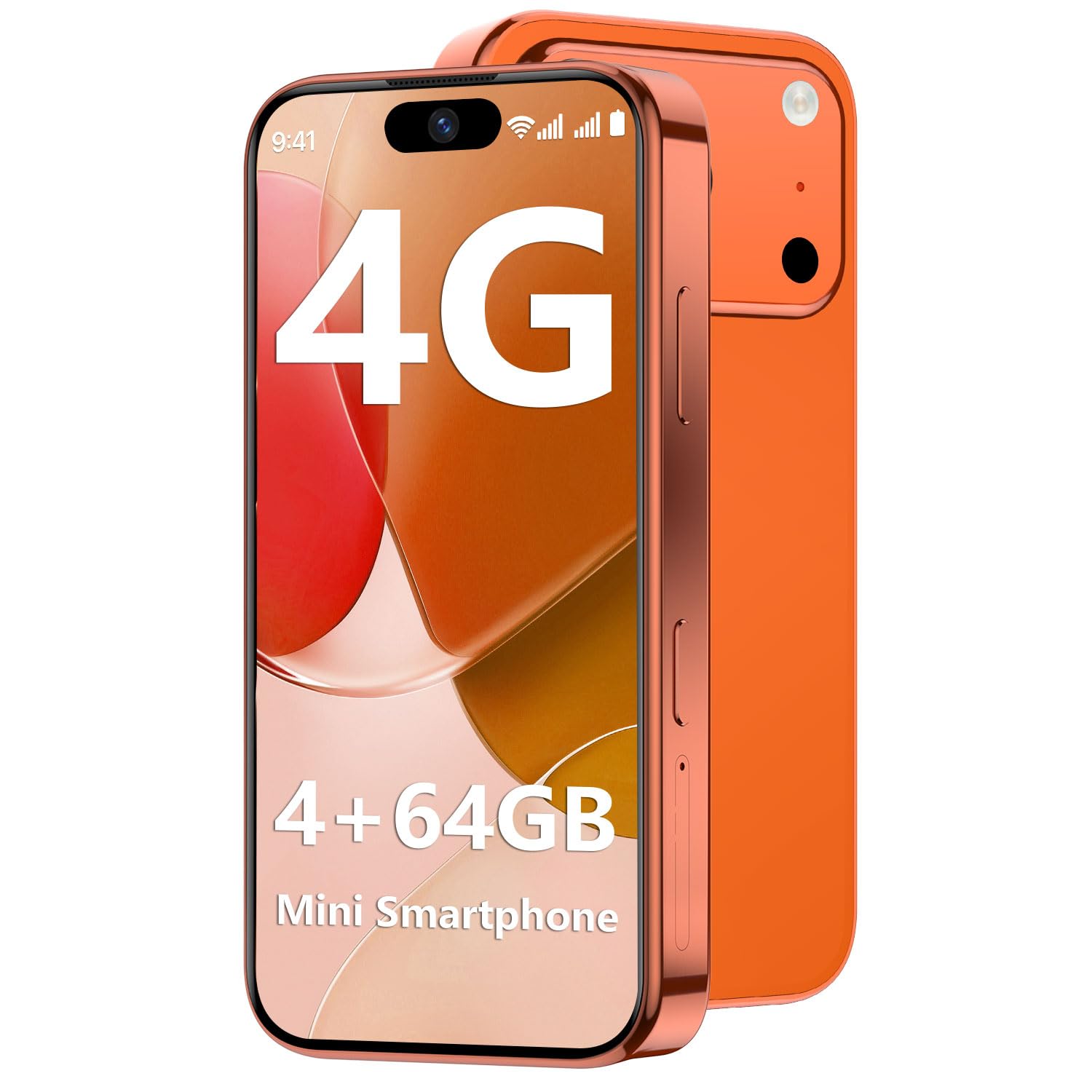
This one is aimed straight at a young owner. It’s 3.8 by 1.8 by 0.4 inches and weighs 0.17 lb — light enough for a small child to hold one-handed. The 3.7-inch HD LCD screen is built for little fingers, and there’s a 4GB RAM / 64GB storage setup with room for a TF card up to 128GB. The camera pairing is the friendliest of the kid-oriented options: a 5 MP front camera for selfies and video calls with family, and an 8 MP rear camera versus the Ulefone Note 22’s 2 MP rear.
Power comes from a 2000 mAh battery that runs a full Android OS with Google Play Store access, so WhatsApp parent calls and kid-friendly educational apps are all on the table. It’s a dual SIM dual standby handset with built-in GPS, stereo speakers, and hotspot capability. What makes it work for parents is the child-friendly focus — a 3.7-inch screen and 0.17 lb body built as a dedicated device for a kid, not a hand-me-down full-size phone.
The caveat is connectivity: the same network matching that applies to any open up phone here applies double for a kid’s device, and it won’t work on networks it doesn’t list bands for. For parents who want an easy-to-use first phone sized for small hands, this is the one to grab.
store more: a parent buying a child their first phone — compact, camera-ready, and easy for small hands.
demand speed: you’ve confirmed your family’s network uses the listed bands, since connectivity is the one thing to lock down first.
4. Ulefone Note 22
The largest screen on this list, built for simple calls, texts, and maps.
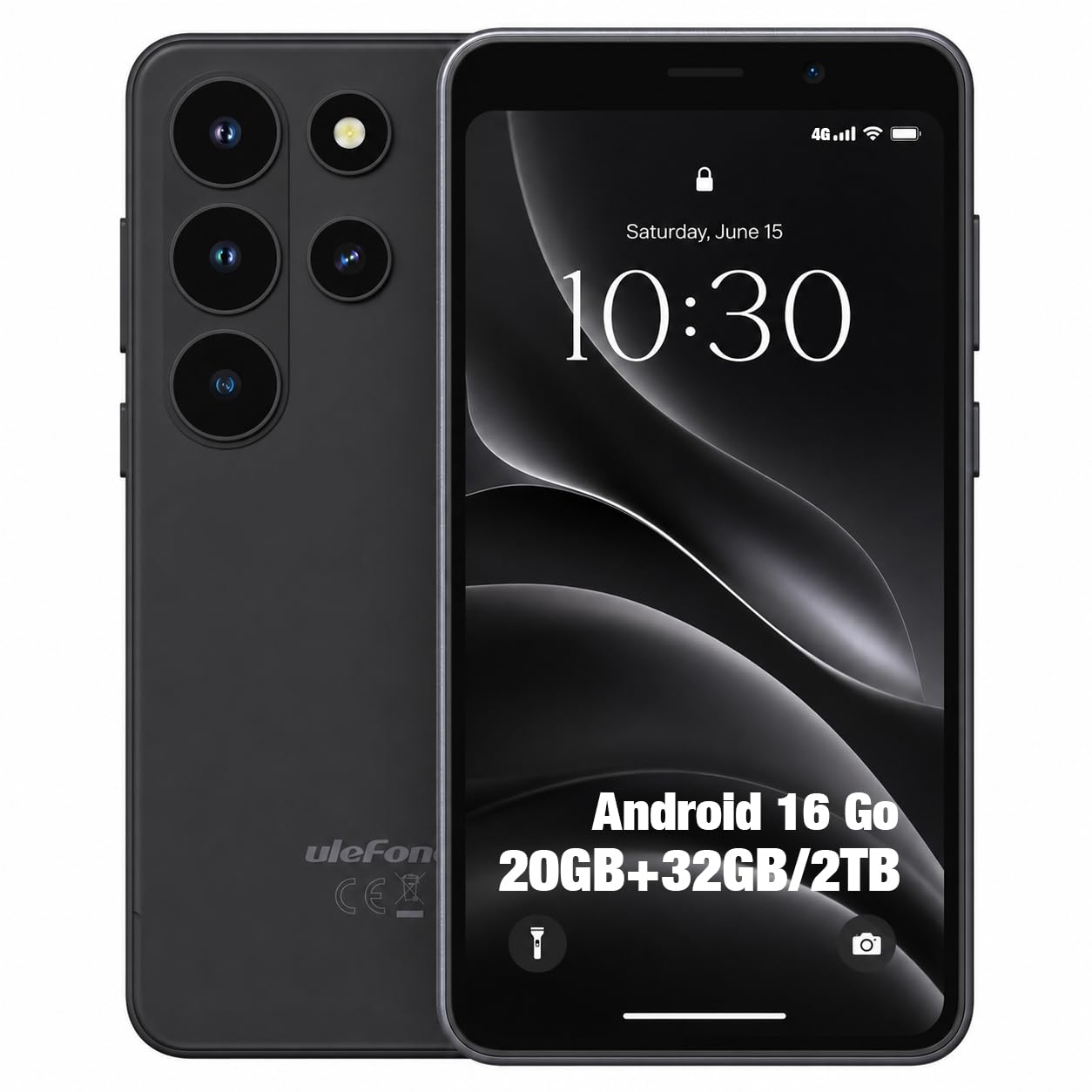
The Note 22 takes a different route to “compact”: at 5.0 inches, its screen is the biggest here versus the 3-inch Jelly Star. That makes it the most comfortable of the group for typing, reading maps, and light browsing. It’s the practical pick for someone who wants a small, affordable phone that still feels like a normal phone in the hand.
On the spec side, you get 3GB physical RAM with support for up to 17GB virtual RAM, 32GB of internal storage, and a microSD slot that takes cards up to 2TB. The battery is a removable 3000 mAh cell with up to 208 hours of standby, so it sips power between charges. There’s a triple card slot (two nano SIMs plus a microSD at once), 4G LTE, 2.4GHz Wi-Fi, Bluetooth 4.2, and multi-system GPS. First thing to know: remove the yellow insulating tab from the battery before you power it on, or it simply won’t turn on.
The trade-off is real though — this phone runs basic hardware for essential tasks, so don’t expect heavy gaming, and confirm the carrier first, because it isn’t compatible with AT&T or Cricket. Its cameras are modest (2 MP rear, 0.3 MP front), and the two extra circles on the back are decorative, not cameras. Buy it as a simple everyday or backup phone for calls, texts, and maps.
roomy big display: the 5.0-inch display beats the 3-inch Jelly Star on typing and map reading, backed by a removable 3000 mAh battery and a 2TB-capable microSD slot.
bulky in pocket: basic internals and modest cameras mean this is a simple-use phone, and AT&T/Cricket compatibility is off the table.
watch video: you want the roomiest screen in a compact body for calls, texts, and maps.
small hands: you’re on AT&T or Cricket, or you want a decent camera.
5. Cutwif Mini 4G Rugged

A pocket phone that shrugs off water, dust, and a knock on the trail.
For anyone who spends time outdoors, the IP68 rating is the headline. IP68 means it’s built for water resistance plus shock resistance and dust protection in a 360-degree shell, so a splash or a dusty trailhead bag isn’t a worry. It measures 101 by 50.7 by 17.2 mm, so it’s the chunkiest small phone here — thicker and tougher rather than daintier. The 3.88-inch HD screen runs 267 pixels per inch, and there’s even a built-in LED light for night work.
The internals are serious for a mini: an octa-core 2.0GHz processor, 6GB of RAM, and 128GB of storage with room for a 128GB card. That puts it ahead of the pink Mini Phone’s 3GB/32GB setup for running apps and holding photos. It’s a dual SIM dual standby phone running Android 12, with OTG, face open up, a 5 MP front camera, FM radio, and GPS navigation.
The honest limit: rugged phones this small are a niche, and the feedback on day-to-day functionality is genuinely mixed, so give it a thorough test-drive in your first week. Also keep your charger at or below 20W to avoid overheating the battery. If your days involve trails, beaches, or job sites and you want a tiny phone that takes abuse, the IP68 shell is the reason to pick this one.
rough trips: hikers, cyclists, and outdoor workers who need a mini phone that survives water and knocks.
want slim: the extra bulk (17.2 mm thick) and a mixed reliability record mean you should test it carefully early on.
6. Palm Phone PVG100 (Renewed)

The original small-screen companion phone, now available renewed.
The Palm Phone earns its place through sheer pocketability — this is a handset owners describe as fitting into a pocket, even a wallet, while still offering the functionality of a full-size phone in miniature. The 3.3-inch touchscreen with a 3.5 mm headphone jack and a fingerprint sensor rounds out a design built to disappear. It’s a renewed unit, so it costs less than new stock while giving you the classic Palm form.
It runs 2G, 3G, and 4G networks with Wi-Fi, and the front camera is an 8 MP sensor — notably sharper than the Ulefone Note 22’s 0.3 MP front camera. That makes it the better of the two for face-to-face video calls on a tiny screen. It’s a Verizon-focused model sold open up, and the 32GB of storage is enough for calls, messages, and a lean app set.
What to weigh: a renewed phone may show cosmetic wear, and the older platform means you should confirm your network and app needs before committing. On the plus side, a 300+ review base backs it as a well-known small-phone option. If you want the smallest pocket companion at a lower entry than the Jelly Star, the Palm is a proven choice.
digital detox: you want the smallest, lightest companion phone at a lower entry point and can live with a renewed unit.
main device: confirm your network coverage, since it’s a Verizon-focused open up model.
Know the Specs
Battery capacity (mAh)
Milliamp-hours (mAh) measure how much power the battery holds — the size of the fuel tank. On these tiny phones the tank is small, so a 2000 mAh cell like the Jelly Star’s drains faster under heavy use than a 3000 mAh cell like the Ulefone Note 22’s. Bigger mAh tends to mean more hours, but app load and screen brightness matter just as much as the number.
Display size and pixel density
Screen size (inches, measured corner to corner) decides whether a phone feels like a toy or a real daily driver. Pixel density (pixels per inch, or PPI) decides how sharp it looks — the Jelly Star’s 291 PPI keeps small text crisp, while a lower figure can look softer. Match your size preference to a density you can read comfortably.
RAM and storage
RAM (GB) is the phone’s short-term workspace — more RAM like the Jelly Star’s 8GB keeps apps switching smoothly. Storage (GB) is the long-term cupboard for photos and apps, and the Jelly Star’s 256GB holds far more than the 32GB options here. If you download a lot, look for a microSD slot to expand it.
Carrier bands and IP ratings
Carrier bands are the radio frequencies a phone speaks; if your network’s bands aren’t on the list, calls won’t work — several picks state T-Mobile/Verizon support or warn against AT&T/Cricket. An IP rating like IP68 states how well a phone resists water and dust, which on the rugged Cutwif means protection from splashes and trail conditions.
Common Questions
Will the Unihertz Jelly Star work on my carrier?
Why won’t my Ulefone Note 22 turn on when I first unbox it?
Is a mini phone good for a child’s first phone?
How much battery life can I expect from a tiny phone?
Does the Cutwif rugged mini phone survive water?
Can I expand storage on these mini phones?
Is a 3-inch screen too small to type on?
What does it mean that the Palm Phone is renewed?
Which mini phone has the best camera for a small phone?
Do these tiny phones support dual SIM cards?
The Bottom Line
For the best balance of real capability in a truly tiny body, the Unihertz Jelly Star wins — 8GB of RAM, 256GB of storage, Android 13, and a fun transparent design you rarely find at this scale, as long as you’re on T-Mobile or Verizon. If you want the biggest room to type and read on a compact phone, the Ulefone Note 22 gives you a 5.0-inch screen and a removable 3000 mAh battery. And for outdoor days where water and knocks are a real risk, the Cutwif Mini 4G Rugged is the one to reach for with its IP68 shell. Pick the mini phone that matches how you’ll actually use it — daily driver, backup, kid’s first handset, or trail phone.
How we choose
We do not accept paid placement. Every pick is matched to a real buyer and a real use-case; we do not hands-on test units.
Sources
Specifications: manufacturer listings and product documentation. Review insights: verified customer reviews, as of November 2026. Pricing: not shown on this page (it changes often); check the current price via the retailer link.
As an Amazon Associate, Tactical Gear Guy earns from qualifying purchases. This does not affect which products we feature.