Specs are compiled from manufacturer listings and verified buyer reviews and can change over time — please confirm the key details on the product page before buying.
If you want one answer: buy a dual-zone compressor fridge with a SECOP compressor and a 110–240V AC brick, because that combination is what lets the same box freeze meat in a truck bed and chill drinks in a kitchen overseas. The catch most people hit first is voltage — a fridge sold as 110V-only can be the wrong appliance the moment you plug it in outside the United States. This guide covers seven portable compressor refrigerators that genuinely accept international mains power, from a compact weekend cooler to a 75L cabinet you can sit on.
This guide is built by comparing the manufacturers’ published specifications and the patterns across verified customer reviews, so you get each pick’s real strengths and trade-offs instead of marketing spin.
You will see how compressor type, dual-zone control, and AC input range change what a fridge can do on a boat, in an RV, or in a garage on another continent. The picks below are ranked so the strongest all-rounder sits first and the budget-friendly options sit last, which makes the best World Refrigerator easier to spot at a glance.
Top Picks


How To Choose The Best World Refrigerator
Start with the plug, not the lid. A portable fridge that only accepts 110V mains is a paperweight in most of the world, so the AC input range is the first thing to check. Every pick here accepts either 110–240V AC or a 220-240V export setup, so you can pre-cool it from a wall socket in another country and then run it from a vehicle’s 12V or 24V DC line.
Read the voltage range before anything else
A dual-voltage fridge has a built-in AC transformer, which is the part that converts wall power into something the compressor can use. When a listing says 110–240V AC, that transformer is designed to swallow both a US 110V socket and a European or Asian 220-240V socket without a separate step-down converter. If a listing only names 110V, you would need an external converter, and that adds heat and a failure point to a machine that already runs for hours at a time.
Dual zone versus one compartment with a divider
A true dual zone gives each compartment its own temperature setting, so you can run a freezer at 0°F next to a fridge at 38°F. Some units use a single control with a divider instead: the small side simply tracks the large side and stays colder by a fixed margin. That works for drinks and a bit of ice, but it is not the same as two independent temperature settings. Check which one you are buying before you plan a week of frozen meals.
Compressor type and why it matters on rough ground
The compressor is the pump that moves refrigerant, and it is the part that decides how fast the box cools and how quietly it runs. A SECOP compressor is the name-brand option on several picks here, and the listings state it keeps running at up to a 40° tilt, which covers steep driveways and a boat at anchor. Cheaper units may use a generic compressor with no tilt rating published at all.
Energy draw, battery protection, and runtime
Annual energy consumption in kWh is a rough annualized number, and it is the best apples-to-apples figure for comparing two fridges’ thirst. A three-level battery protection setting cuts the compressor when your vehicle battery drops too low, so you can leave the fridge plugged into the car overnight without flattening the battery you need for the morning start. If you run off a solar power station, that protection and a low-wattage ECO mode matter even more.
Side-by-Side Comparison
| Model | Best For | Capacity | Cooling Range | AC Input | Amazon |
|---|---|---|---|---|---|
| ICECO VL60 Dual Zone★ Best Overall | Long trips and full-week meal storage | 60 liters | 0°F to 50°F | 110–240V AC | Amazon |
| Tecnolove 25L Dual-CompartmentBest Value | Weekend camping with wheels and a handle | 27 quarts | -4°F to 68°F | 100–240V AC | Amazon |
| Megiu 12V Dual Zone 25 Quart | Glass-door visibility in a van or truck cab | 25 quarts | -18℃ to +15℃ | 110–240V AC | Amazon |
| VEVOR 12 Volt Refrigerator | App control and wine-bottle storage | 45 liters | -4°F to 68°F | 110–240V AC | Amazon |
| zcamp UD55 Dual Zone | Rolling a big cooler to the campsite | 52 quarts | -4°F to 68°F | 100–240V AC | Amazon |
| ICECO VL75 ProD | Two people’s food for a full week | 79 quarts | 0°F to 50°F | 110–240V AC | Amazon |
Detailed Reviews
1. ICECO VL60 Dual Zone Portable Refrigerator
Our pick — 4.5+★ from 650+ verified ratings; the strongest balance of quality and price.
A 60-liter dual-zone SECOP fridge that holds the line on a 40° tilt
For a couple doing multi-week road trips or a family that needs a real freezer and a real fridge side by side, the ICECO VL60 is the pick that asks the fewest compromises. It runs 0°F to 50°F across two independently controlled zones — that means you can hold frozen steaks in one half and cold drinks in the other, or turn both halves into freezers when you are stocking up. The dual-voltage AC input of 110–240V means the same unit pre-cools from a wall socket at home or a socket in another country, and then runs from 12V/24V DC in the vehicle.
What wins people over is how quickly and steadily it pulls temperature down, plus the low power usage across long sessions. The metal shell, thickened inner wall, and foldable pull-down lock create a genuinely insulated box, and the height is shaped to sit under a pickup tonneau cover. On the energy side the listing states 199 kWh per year — a figure that reads heavy next to the Tecnolove’s 45 kWh per year, but the ICECO is carrying more than twice the interior volume, so the per-liter cost of cold is less lopsided than the raw number suggests. Two removable wired baskets let you lift a whole load out and restock in one move, and the interior lights help you find a bottle at night without a headlamp.
The honest catch is the SECOP’s preference for a set-up that can carry its start-up draw: it is happiest on a dedicated 12V line or a solid AC source, and the 60-liter body is a two-person lift when full — one full of drinks is not a grab-and-go cooler. Owners consistently say the build feels solid and justifies the price over years of service, and its plate-height profile suits long-haul use. If you want a single fridge that can live in a garage in the US, then shift to a European socket without an adapter, this is the version of the category that actually delivers it.
Where it earns its keep
- Two independently controlled zones let you freeze and chill at the same time
- 110–240V AC input paired with 12V/24V DC makes it genuinely travel-ready across countries
- SECOP compressor is rated to keep running at up to a 40° tilt
- MAX mode for a fast pull-down and ECO mode when you are conserving battery
- Metal shell and thickened inner wall hold cold well between door openings
The honest trade-offs
- 199 kWh per year is the highest annual draw among the mid-tier picks here
- 60 liters loaded with drinks is a two-person carry, not a solo grab-and-go
- You pay a clear premium over the smaller 25–27 quart options
Built for: long trips, serious overlanding, or a second fridge that has to travel internationally.
Reconsider if: you need a one-hand carry or you are running a modest single battery in a small camper.
2. Tecnolove 25L Car Refrigerator Freezer
The 45 kWh-a-year compact that pulls 68°F down to 32°F in 15 minutes
This is the fridge for the weekend camper who wants a cooler that actually freezes without draining the vehicle battery. Its annual energy consumption of 45 kWh is the lowest figure in this whole set, and it holds up to 46 cans of 355ml drinks in a 27-quart body. The compressor and 360-degree direct cooling, backed by 45mm of foam and composite insulation, take the box from 68°F down to 32°F in 15 minutes and down to -4°F in 50 minutes — so you can load warm drinks at the trailhead and have them cold before dinner. No ice, no drain-and-refill ritual.
Where this one beats the bigger units on practical terms is transport. All-terrain wheels and a telescoping handle turn the 27.8 lb body into a rolling case, and the magnetic lid with a rubber gasket keeps the cold sealed while it bounces across gravel. The listing states it stays stable on 45-degree slopes, and a built-in drain plug makes the end-of-trip cleanout quick. ECO mode uses under 25W while MAX mode stays under 1kWh per day, so a modest battery or a small solar panel can carry it.
The quiet operation at 45dB means it will not dominate a tent at night, and the three-level battery protection (H / M / L) is the safety net that stops the compressor before your starter battery is flat. The touchscreen handles Fahrenheit and Celsius switching, which is a small thing until you are camping somewhere that only thinks in Celsius. On the cost-per-cold-liter basis, comparing its 45 kWh against the ICECO VL60’s 199 kWh shows exactly where the trade sits: you give up 60 liters of space to get an extremely frugal, genuinely portable box. It also chills skincare and breast milk as readily as drinks, so it suits more than just beverage duty.
Sized right for weekend trips: 27 quarts and 46 cans is a realistic two-person camping load, and the wheels and telescoping handle mean you are not performing a lift-and-shuffle at the trailhead.
One thing to plan around: a single 25-liter fresh capacity means a long trip for a family of four will need a second run for refills.
Right choice when: a weekender needs real freezing power and the lowest annual draw in the group.
Wrong choice when: you are provisioning for more than two people for a full week.
3. Megiu 12 Volt Car Refrigerator Dual Zone 25 Quart

A glass door so you see the cold before you open it
If you are bulding out a van or truck cab and want a fridge that looks like it belongs there, this is the one. The glass front and matte finish stand apart from every plastic-lidded box on this list, and the 58cm width is narrow enough to tuck into a cab or a trunk without eating the whole bay. That visibility is not just styling: the glass door lets you see what is inside before you lift the lid, so less cold air escapes into the cab.
It wins people over on cooling — the copper-wired compressor pulls an empty cabinet down to -18℃ (-0.4℉) within two hours, and the foaming agent and insulation keep the box frozen for several hours after the power is cut. The temperature range runs -18℃ to +15℃, so the same unit is a fridge or a freezer depending on the setting. Its 100 kilowatt hours per year puts it mid-pack on energy, and the average operating power of 40W keeps the daily load under 1kWh. The small zone tracks the large zone’s temperature at a fixed 5–8℃ colder, which makes it a useful soft-freeze space for ice cream rather than a second full-control zone.
Where the spec sheet starts to strain is the control scheme and the size. That small zone follows the large one rather than offering independent settings, so this is not a true two-temperature fridge. And the 25-quart capacity earns a mixed verdict among owners — plenty for two on a trip, seriously tight for a family provisioning for a week. The plain-plastic inner tank in HIPS is easy to wipe out, and the compressor comes with a 3-year warranty to the accessories’ 1 year, which is longer coverage than several picks here offer. Weighing in at 12kg, it is a manageable single-person carry but not a lightweight.
What it does beautifully
- Glass door and matte finish look the part in a van or truck cab
- Reaches -18℃ from an empty cabinet within two hours
- 3-year warranty on the compressor and a 12/24V DC cable included
- 40W average draw keeps it under 1 kWh per day
Points to weigh first
- The 3-quart small zone tracks the large zone and cannot be set independently
- 25 quarts is a tight load for more than two people
- Glass front deserves care on rough roads
Suits: van and truck builds where the fridge is on show, and short trips for two.
Does not suit: you need two genuinely independent temperature zones.
4. VEVOR 12 Volt Refrigerator

A 45-liter box you can tune from your phone before you reach the truck
Anyone who keeps a fridge in a vehicle knows the small annoyance of forgetting to drop the temperature before a trip. The VEVOR solves that with app control, so you can set the target from your phone before you even open the tailgate. The 45-liter body holds 48 cans of 330ml cola, 28 bottles of 550ml drinks, or 15 bottles of 750ml red wine, and the cup holders keep drinks upright on a bumpy road. That capacity suits a crew heading out for a weekend, not a solo camper.
Cooling speed and performance are the aspects buyers talk about most, and for good reason: it reaches -4°F to 68°F, kept fresh by the compressor, and the digital display and built-in LED make temperature management simple. The removable basket is handy for organizing and the built-in handle makes it moveable. Three battery protection levels (low, medium, high) guard against overload and short circuits. Its 190 kWh per year is higher than the Megiu’s 100 kWh, which is the honest cost of the extra capacity.
The catch a buyer should know about is the control scheme. This is a dual-zone-by-compartment layout with a single control — the left large compartment can freeze, but the right fridge zone’s temperature cannot be adjusted separately. If you need two genuinely independent temps, an ICECO or zcamp will serve you better. For most people on road trips, camping, fishing, and tailgates, that single-control compromise is easy to live with, and the CE-certified build and reversible door orientation mean it will slot into a van or cabin without fuss.
App control earns its place: pre-cooling from your phone is the sort of convenience that changes the routine on a hot afternoon, and the built-in LED and digital display handle everything once you are inside.
Reach for it if: you want app control, room for wine bottles, and three-tier battery protection in a mid-size box.
Pass on it if: you need the fridge and freezer halves to run at genuinely separate temperatures.
5. zcamp UD55 Dual Zone Car Refrigerator
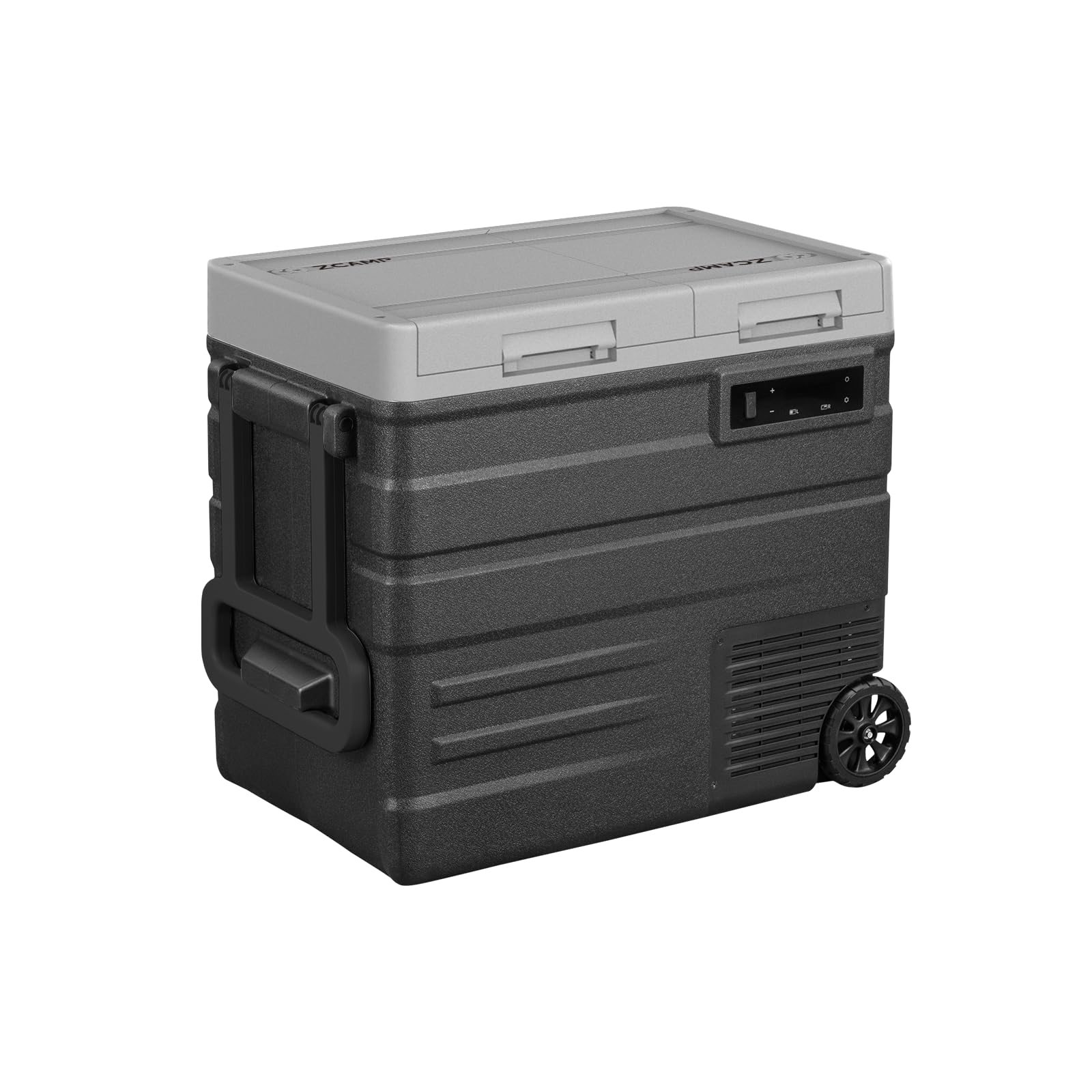
A 52-quart dual-zone fridge with wheels that rolls to the campsite
Wheels on a 52-quart fridge sound like a small detail until you have carried a full cooler 200 yards from the truck. The zcamp UD55 pairs integrated wheels with a pull handle, so the whole thing rolls across packed gravel the way a rolling suitcase does. The 52 quarts (49.1L) split into a 13.4L freezer and a 35.7L fresh compartment, and the reversible door means you can arrange the kitchen side to suit whichever side of the campsite you park on.
Its quality is the thing buyers call out, and the spec sheet backs the claim up: the dual-zone design runs -4°F to 68°F with separate controls, the temperature memory restores your last settings after a power cycle, and the multi-stage battery protection keeps the vehicle battery from being drained flat. A USB charging port, drain plug, LED control panel, interior lighting, and a mounting slot round out the practical side, and the noise stays below 45 decibels, which is quiet enough to sleep beside.
On energy it draws 218 kWh per year, which is the highest figure here, and that is worth thinking about if you run a small solar array or a modest single battery. The optional solar input helps if you already have a panel set up, and the 1-year unit / 2-year compressor warranty is a reasonable split. It’s rated for travel, truck, SUV, RV, van, camping, and boat, and the 13.4L freezer holds a couple of frozen meals while the fresh side carries a week of drinks and produce for two.
Why it rolls ahead
- Integrated wheels and pull handle make a 52-quart load genuinely mobile
- 13.4L freezer and 35.7L fresh side run on separate temperature controls
- Temperature memory restores your settings after a power cut
- USB charging port and interior LED for practical camp use
The careful-buyer notes
- 218 kWh per year is the heaviest draw in this set
- The 1-year whole-unit warranty is shorter than the compressor coverage
- Loaded up with ice and drinks, it is still a two-handed move
Made for: campsite-first trips where you roll the cooler the last stretch and need a real freezer section.
Look elsewhere if: you run a small battery bank and want the lightest possible daily draw.
6. ICECO VL75 ProD 12V Refrigerator
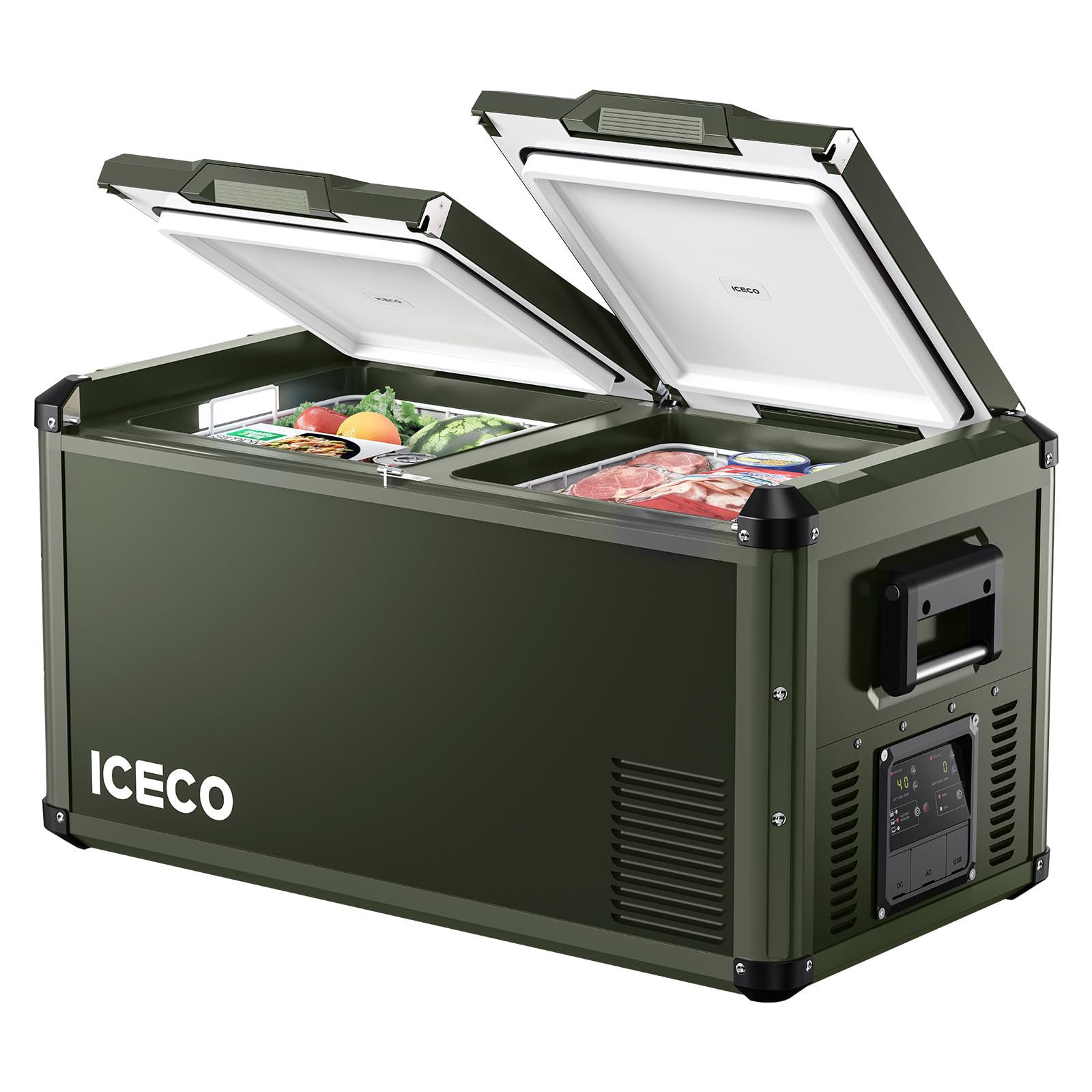
A 79-quart cabinet that opens from either side, even in a cramped rig
For two people doing a full week of provisions, the VL75 ProD is the pick that never makes you dig. Its 79-quart capacity — 75 liters of freezer volume in the listing — holds enough for two adults’ food storage, and the dual zones each carry their own temperature control: freezer/fridge, fridge/freezer, both freezers, or both fridges, depending on how you load it. It runs 0°F to 50°F on the SECOP compressor, with MAX for fast cooling and ECO for saving power, and the same 40° tilt stability as the rest of the ICECO range.
Where this one earns its premium is the lid and the shell. The metal shell accepts magnetic accessories — fridge stickers, magnetic hooks, magnetic batteries — and the height means it can do duty as a table top between meals. Owners single out build quality and cooling consistency, and the olive green colorway on this special edition is its own small pleasure.
The 232 kWh per year is the highest annual figure in this whole group, so if you are off-grid on a modest array, that is a figure to respect. The 5-year compressor warranty and 1-year parts coverage are the strongest split here, and ICECO backs it with local and phone support that answers within 24 hours including weekends. There is one honest wrinkle in the owner experience — durability opinions run mixed, which is worth knowing when you weigh the metal shell and the warranty against the way you plan to use it. For a cabin install or a long-haul RV, the capacity and the lid flexibility are what you are paying for, and the price reflects that it is the biggest, most feature-heavy unit here.
The strong points
- 79-quart capacity holds a full week of food for two people
- Multi-opening lid changes direction without assembly — genuinely useful in tight vans
- Dual doors keep cold air in the other side while one is open
- 5-year compressor warranty with 24-hour weekend support
What to think about
- 232 kWh per year is the heaviest annual draw here — plan your solar and battery around it
- Owner opinions on long-term durability are mixed
- It is the largest and most expensive unit in the group, so it wants dedicated space
Best matched to: a full-time RV or cabin where one fridge serves two people for days at a stretch.
Second-guess if: your power supply is small or you need to move the fridge in and out between trips.
Know the Specs
AC input range (110–240V vs 220-240V)
The AC input range is the spread of wall voltages a fridge’s built-in transformer can accept. A 110–240V rating means the same unit runs from a US socket and from a higher-voltage socket abroad without a separate converter. That is the difference between a fridge that travels and one that stays put. If a listing names a narrower range, you would need an external adapter to use it in most of the world, and every added adapter is one more warm box to fail.
Annual energy consumption in kWh
The kWh figure is the annualized electricity the fridge consumes at a typical duty cycle, and it is the cleanest way to compare two units’ thirst side by side. It matters most in an RV or truck where the power comes from a battery and a solar panel rather than a mains socket. A lower figure means your battery bank recharges faster after an overnight run, and your solar panel can keep up in less sun.
Dual zone vs single-control compartments
A true dual zone gives each compartment its own thermostat, so one half can run as a freezer while the other holds chilled produce. A single-control layout with two compartments only lets you set the large side, and the small side follows at a fixed margin. That works fine for drinks and a bit of ice cream, but it is not the same as two independent settings. Decide which one your trip schedule needs before you commit.
Compressor type and tilt rating
The compressor is the pump at the heart of the fridge, and it is what separates a portable compressor fridge from an old ice chest. A SECOP compressor is the name-brand option on several picks here, and the listings rate it to run at up to a 40° tilt. That rating is what lets a fridge keep working on rough trails and steep driveways — exactly the conditions a vehicle install faces.
Common Questions
Will a 110–240V fridge work in a country with 220V mains power?
Do these fridges run from a car’s 12V socket without draining the battery?
What is the difference between a true dual zone and a single-control fridge?
Can a portable compressor fridge sit at an angle on a hill or a boat?
How much room do I need for a 52-quart or 75-quart fridge?
What does the compressor warranty actually cover?
Can I power one of these from a solar power station?
Do I need ice or a separate freezing pack?
How loud is a 12V compressor fridge at night?
Will the fridge work while the vehicle is moving over rough terrain?
The Bottom Line
For most buyers, the world refrigerator to reach for is the ICECO VL60 Dual Zone, because the 110–240V AC input, the SECOP compressor’s 40° tilt rating, and the independent dual zones cover home, vehicle, and international travel without a converter. If you need the lightest possible daily draw, the Tecnolove 25L at 45 kWh per year and 27.8 lbs is the budget-smart choice. And for a full week of provisions for two, the ICECO VL75 ProD at 79 quarts is the one to load up. The VL60’s 4.5+ star rating across a large owner base means you’re buying a well-tested design, not a gamble.
How we choose
We do not accept paid placement. Every pick is matched to a real buyer and a real use-case; we do not hands-on test units.
Sources
Specifications: manufacturer listings and product documentation. Review insights: verified customer reviews, as of November 2026. Pricing: not shown on this page (it changes often); check the current price via the retailer link.
As an Amazon Associate, Tactical Gear Guy earns from qualifying purchases. This does not affect which products we feature.