Specs are compiled from manufacturer listings and verified buyer reviews and can change over time — please confirm the key details on the product page before buying.
Buying a laptop is mostly a screen-and-memory decision, and almost nobody tells you that up front. If you want the short answer: pick a machine whose display you can actually read at arm’s length and whose memory (RAM — the short-term workspace your open tabs live in) can carry every program you run at once. Everything else, from processor branding to how thin the lid is, matters far less than those two things. This guide walks through nine machines that genuinely do the job, explains what each one is best at, and flags the honest trade-off on each.
This guide is built by comparing the manufacturers’ published specifications and the patterns across verified customer reviews, so you get each pick’s real strengths and trade-offs instead of marketing spin.
The picks below range from a big-screen budget workhorse to a 3K touchscreen convertible. Each shortlist entry gets a plain-English read on who it fits and where it falls short, so you can pick the right World Laptop for your desk, your bag, and your budget on the first try.
Top Picks


How To Choose The Best World Laptop
Start with the two things you cannot upgrade later: the screen and the memory. A laptop with a sharp display and enough RAM feels quick for years. A laptop with a dim, low-resolution panel and 4GB of memory feels slow from week one, no matter what processor name is printed on the sticker. Work down this list in order and you will land on the right machine.
Memory and storage decide whether it feels fast
RAM is the desk space where open tabs and programs sit while you work. With 4GB, a dozen browser tabs plus a video call will start to stutter. With 8GB you are comfortable for everyday office work. With 16GB you can run a spreadsheet, a browser full of tabs, and a photo editor at the same time without the machine grinding to a halt. Storage matters too: an SSD (solid-state drive, a memory chip with no spinning parts) boots in seconds, while a spinning drive leaves you staring at a logo.
The display is the part you stare at all day
Resolution is simply how many dots the screen can draw. A 1920 x 1080 panel — usually called Full HD — gives you crisp text and room for two windows side by side. A 1366 x 768 panel gives you far fewer dots, so documents look softer and you fit less on screen. Refresh rate is how many times per second the image redraws: 60Hz is the everyday standard, while 120Hz or 165Hz makes scrolling and motion look noticeably smoother.
Weight, ports, and battery life
If the laptop lives in a bag, weight and port selection matter as much as the chip inside. Look for USB-C ports that can charge and carry video, plus a full-size HDMI if you plug into a monitor or projector. Battery figures are almost always measured under specific test settings, so treat a long-hour claim as an indicator rather than a promise, and expect real mixed use to land below the headline number.
Side-by-Side Comparison
| Model | Best For | Display | Memory | Refresh Rate | Amazon |
|---|---|---|---|---|---|
| Samsung 16” Galaxy Book5 Pro 360★ Best Overall | Creatives who want a 3K touchscreen convertible | 16″ 3K AMOLED (2880×1800) touch | — | 120Hz | Amazon |
| Acer Aspire 14 AI Copilot+ PCAI Powerhouse | Travel and study with 1TB of storage | 14″ WUXGA (1920×1200) | 16GB LPDDR5X | — | Amazon |
| Microsoft Surface Laptop (2024)All-Day Pick | All-day battery in a 13.8″ touchscreen shell | 13.8″ touchscreen | 16GB | — | Amazon |
| msi Katana 15 | Gaming and heavy graphics work | 15.6″ QHD | 16GB DDR5 | 165Hz | Amazon |
| Dell 15.6 Laptop | Everyday home and office computing | 15.6″ FHD | 8GB | — | Amazon |
| HP 14″ Business Student Slim | Bundled software and accessories from the start | 14″ (1366 x 768) | 16GB RAM | 60Hz | Amazon |
| Acer Aspire Go 15 | Everyday tasks with a Full HD panel | 15.6″ FHD IPS | 8GB LPDDR5 | 60Hz | Amazon |
| Lenovo Chromebook 14″ | Light web work and online classes | 14″ FHD touchscreen | 4GB RAM | — | Amazon |
| ASUS Lightweight 15.5″ | Basic tasks on a slim budget | 15.5″ FHD (1920 x 1080) | 4GB LPDDR4 | 60Hz | Amazon |
Detailed Reviews
1. Samsung 16” Galaxy Book5 Pro 360 Copilot+ PC
Our pick — 4.5+★ from 200+ verified ratings; the strongest balance of quality and price.
A 16-inch 3K AMOLED touchscreen that folds flat, with the pen already in the box.
The first thing you notice is the panel. It is a 3K AMOLED touchscreen running 2880 x 1800 pixels, which means fine text and photo detail stay crisp at normal viewing distance. Samsung pairs that with a refresh rate up to 120Hz, double the 60Hz you get on the ASUS Lightweight 15.5″ below — so scrolling a long PDF looks glassy instead of smeary. The included S Pen adds tilt sensitivity for note-taking and sketching, and you are not buying a stylus separately.
Battery is rated at up to 25 hours, measured under specific test settings, which covers a full working day for most people. Buyers report it clears a full workday without hunting for an outlet. It is also a convertible: the hinge rotates the screen around so the laptop becomes a tablet for reading and drawing.
The honest catch sits in reliability. The review pages carry a recurring thread about the machine freezing, and that is the one complaint that shows up often enough to name. It is not universal, and the performance feedback is overwhelmingly positive when the machine is running well. If you need a laptop that never misses a beat under a deadline, weigh that carefully.
What earns its place at the top
- 16-inch 3K AMOLED touchscreen at 2880 x 1800 keeps documents and photos sharp
- 120Hz refresh means motion and scrolling look smooth, not stepped
- S Pen included, so sketching and markup work without extra cost
- Up to 25 hours of battery life, measured under specific test settings
- HDMI, USB-A, two Thunderbolt 4 ports, headphone jack and microSD slot — no dongle for the basics
Where it asks for patience
- Freezing is the recurring gripe in the review pages
- A 16-inch convertible is a bag commitment, not a slip-into-a-tote machine
- Pentouch and pen work is its home turf — heavy gaming is not
Buy this if: you want the best screen on this list and you build your day around documents, photos, and pen work.
Look elsewhere if: a sudden freeze mid-deadline would cost you real money — the reliability thread is worth a sober look first.
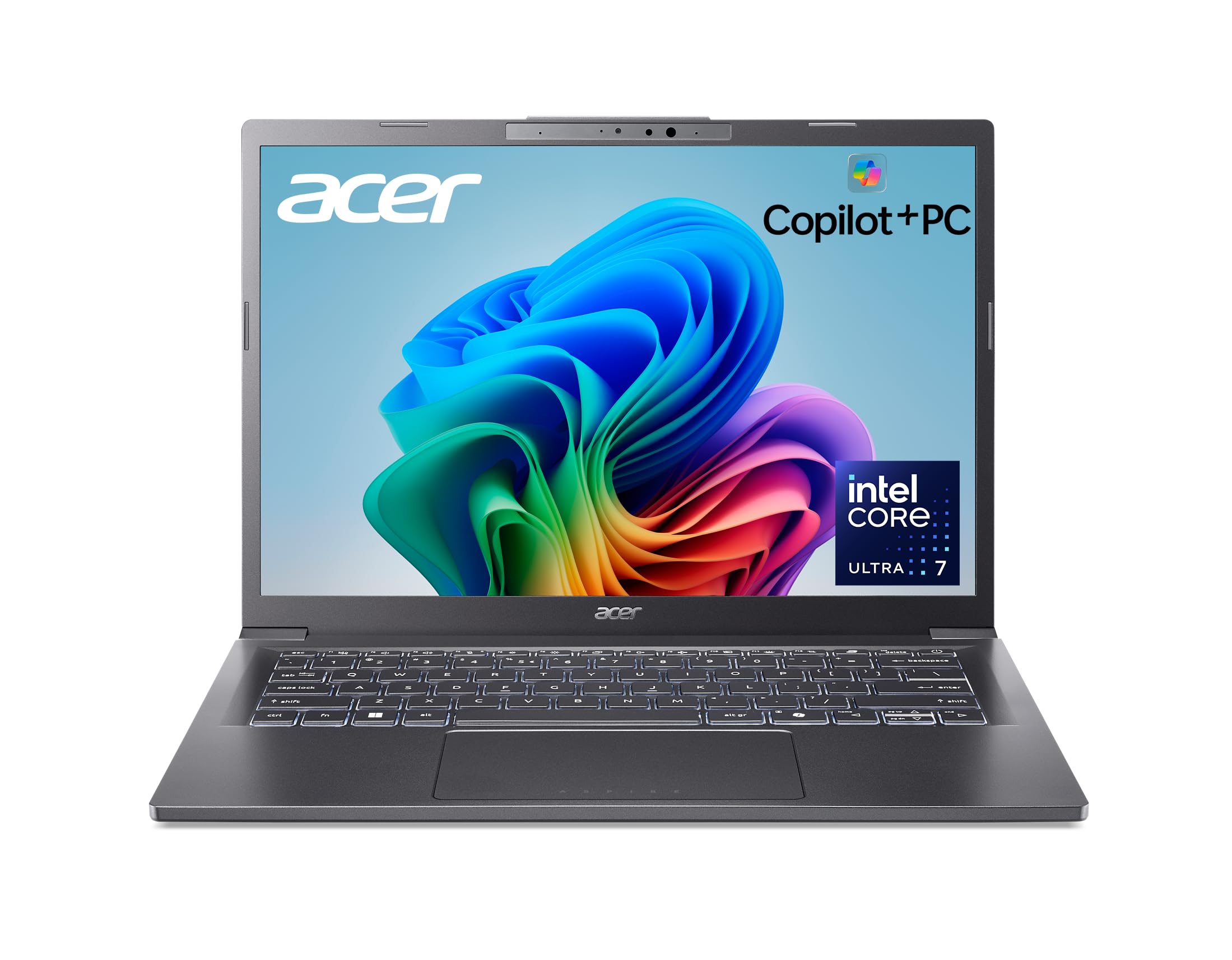
2. Acer Aspire 14 AI Copilot+ PC
Storage you will not fill in a hurry: a full 1TB SSD in a 14-inch aluminium body.
Storage is the headline, and it is a big one. This Acer carries a 1TB SSD, which means you can hoard photo libraries, project files, and a season of downloaded video without a single external drive. That is the most storage on this list, and it pairs with 16GB LPDDR5X memory — the fast, low-power type — so a browser full of tabs and a video editor can share the machine without a stutter.
The display is a 14-inch WUXGA panel at 1920 x 1200, which gives you a taller working area than a standard widescreen — more lines of a document visible before you scroll. The processor is an Intel Core Ultra 7 Processor 256V with an AI chip inside, and Acer’s 180-degree hinge lets the screen lie flat on a desk for sharing. The aluminium chassis keeps it travel-friendly.
Battery is rated up to 22 hours, measured under specific test settings, and owners mention it stretches through heavy-use days. What it does not give you is a high-refresh gaming panel; a 60Hz refresh at this resolution prioritises clarity over motion, which is the right call for a work machine but not for fast games.
The travel-and-study read: 1TB of storage plus 16GB of memory is the combination that keeps a student or remote worker from ever managing files or closing tabs. The 1920 x 1200 panel is the practical sweet of laptop resolutions — tall enough to read, sharp enough for photos.
The trade-off: a 60Hz panel at this size is a working screen, not a gaming one, and the AI chip is aimed at productivity apps rather than a graphics card.
Reach for this if: you carry a lot of files and want a machine you can stuff into a rucksack without worrying about storage.
Skip if: you want a high-refresh display for fast-paced games — that is the next pick’s territory.
3. Microsoft Surface Laptop (2024)
The battery is the story: up to 20 hours in a 13.8-inch touchscreen that weighs almost nothing.
Microsoft rates this machine at up to 20 hours of battery life, and customers note it runs through a full day and often into a second without reaching for the charger. What wins people over most is exactly that runtime, followed closely by the size and weight: a 13.8-inch touchscreen that slips into a bag without a second thought. The Snapdragon X Plus chip inside is a 10-core processor with a dedicated AI unit, paired with 16GB of RAM and 512GB of SSD storage.
The 13.8-inch touchscreen is the right compromise size — big enough for two windows, small enough to carry daily. Owners find the taller 3:2 proportions noticeably more usable than a traditional widescreen Windows laptop. Wi-Fi 7 and Bluetooth 5.2 are on board for wireless, and you get USB-C connectivity for displays and drives.
Here is the one you should think about before buying: performance is the most-discussed and most mixed topic in the feedback, and that is largely a compatibility story. The Snapdragon chip runs a different architecture from Intel, so some desktop software — especially older specialist apps — may not run natively or at full speed. Modern mainstream apps generally work fine, but if your workflow depends on a niche Windows program, check it against this chip first.
Why it carries the all-day crown
- Up to 20 hours of battery life, enough for a full working day away from an outlet
- 13.8-inch touchscreen that balances screen space against a genuinely portable shell
- 16GB RAM and 512GB SSD cover serious multitasking and file storage
- Wi-Fi 7 and Bluetooth 5.2 keep wireless connections current
The compatibility asterisk
- Performance feedback is mixed, largely because the Snapdragon architecture does not run every legacy Windows app natively
- Value-for-money feedback is also mixed — this is a premium-priced machine
- No HDMI on the spec sheet — plan on USB-C for a monitor
The honest verdict: if you live in mainstream browser and Microsoft apps and you hate carrying a charger, this is the machine that disappears into your day.
The caveat worth hearing: if a specific legacy Windows program is essential to your job, confirm it runs on Snapdragon before you commit.
4. msi Katana 15 Gaming Laptop

A 165Hz QHD panel and an RTX 4070 — the fastest moving picture on this list.
Refresh rate is the number that separates this from everything above it. The 15.6-inch QHD screen redraws 165 times per second, roughly in the same league as the Samsung’s 120Hz and well clear of the 60Hz panels on the Acer and ASUS picks. That makes fast motion — a racing game, a fast-scrolling timeline — read as smooth instead of stuttered. Driving that panel is an NVIDIA GeForce RTX 4070 graphics card, backed by an Intel Core i7-13620H processor, 16GB of DDR5 memory, and a 1TB NVMe SSD.
Owners call the QHD picture crisp and the gaming performance excellent, with most modern games running at higher graphic settings. Cooler Boost 5 handles heat, which matters because a gaming laptop throttles when it gets hot. Battery is rated at up to 10 hours, measured under specific test settings — fine for a workday, but you will want the charger nearby for a long gaming session.
The thing to know before buying: build quality and reliability feedback is mixed, and a slice of that feedback mentions crashes. The other reality is weight. A 15.6-inch gaming laptop with a discrete graphics card and a cooling system built to dissipate heat is a desk-first machine — not something you want to carry all day. If portability is your priority, the Surface or the Aspire 14 will serve you far better.
For the gamers and renderers: a 165Hz QHD display, RTX 4070 graphics, 16GB DDR5 and a 1TB SSD is a serious performance package for the money. If your day includes gameplay or 3D rendering, this is where the list turns from productivity toward power.
For everyone else: 10 hours of rated battery and the bulk of a gaming chassis make this a poor daily carry — its strengths are wasted if you mostly write emails.
The call: gamers and 3D workers get the most machine for their money here.
The check: crashes appear in the reliability feedback, so buy from a seller you can return to if the unit misbehaves.
5. Dell 15.6 Laptop

A no-nonsense 15.6-inch Full HD desk machine with a numeric keypad built in.
What wins people over here is simple: build quality. This is the most solid-feeling machine on the list for plain everyday computing, and the setup is quick and painless — unbox, sign in, get to work. The 15.6-inch Full HD panel gives you crisp text for documents and email, and Dell ComfortView software helps reduce blue light output for long viewing sessions. The roomy keyboard includes a separate numeric keypad and calculator hotkey, which is a real convenience for anyone who spends the day in spreadsheets.
The spec sheet reads as a sensible everyday build: an Intel Core 3 100U processor, 8GB of RAM, Windows 11 Home, and Bluetooth 5.3 for wireless accessories. Lifted hinges give the keyboard a slight ergonomic tilt, and Dell includes a one-year onsite service plan — they come to you if a covered hardware issue cannot be resolved remotely. That service commitment is a meaningful reason to pick this over a cheaper no-name machine.
The mixed part is speed and battery. Some users find it very quick, others notice long login times, and battery is the most-discussed negative in the feedback. Treat this as a plugged-in desk machine that can handle a trip to the sofa unplugged, not an all-day-away computer. Fan noise also comes up in the feedback — under load you will hear it.
The case for the Dell
- 15.6-inch Full HD screen with Dell ComfortView blue-light reduction
- Full numeric keypad and calculator hotkey for spreadsheet work
- One year of onsite service — Dell comes to you if a covered issue cannot be fixed remotely
- Lifted hinges angle the keyboard for more comfortable typing
Where it falls short
- Battery life is the most-discussed negative in the feedback — this is a desk machine first
- Speed feedback is mixed, with some reporting long login times
- Fan noise shows up when the machine is working hard
Who it suits: the home or office worker who keeps a charger on the desk and lives in spreadsheets and documents.
Who should walk past: road warriors and anyone who needs a laptop to last a full day unplugged.
6. HP 14″ Business Student Slim Computer
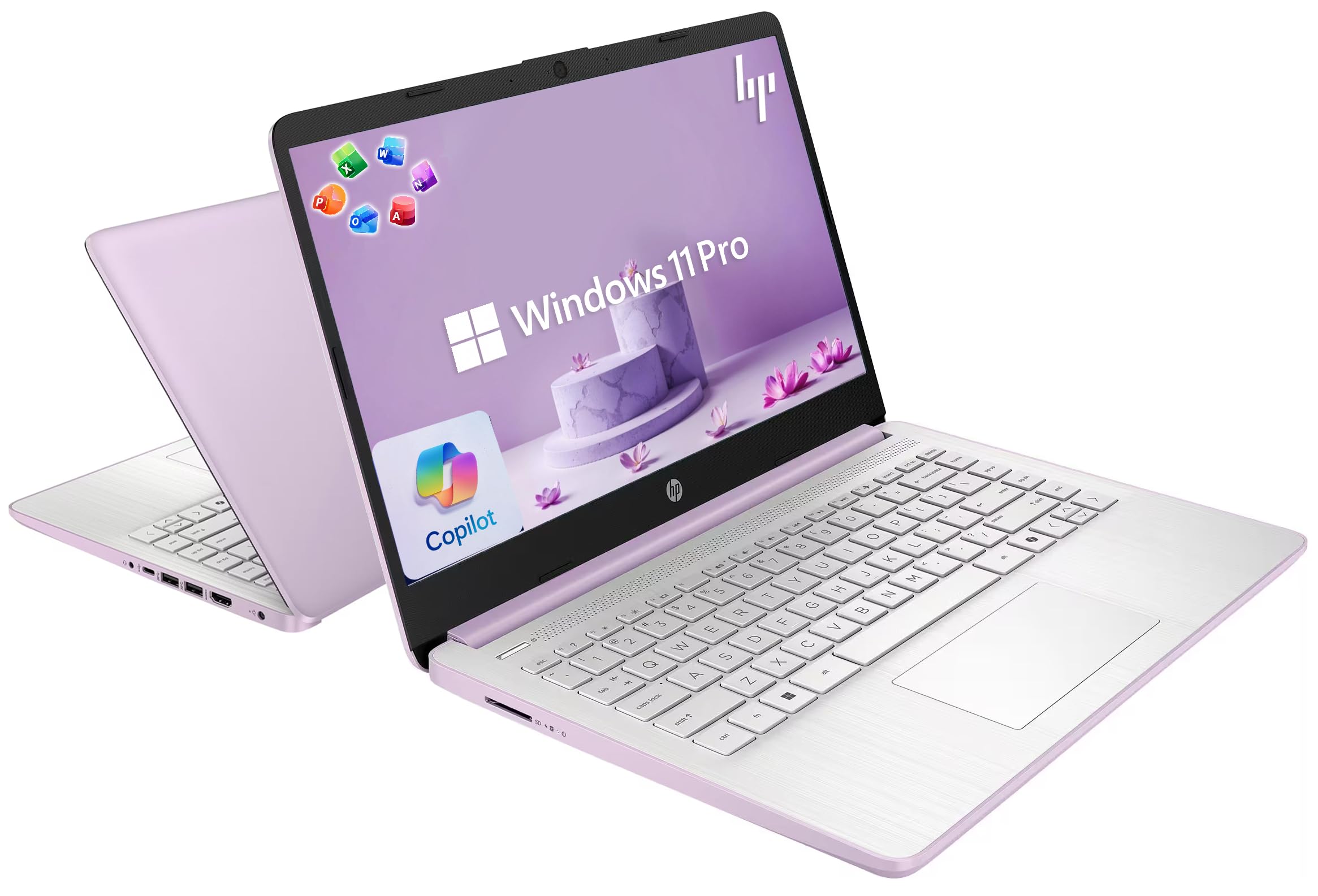
The only pick here that lands with a mouse, a dock, an external drive, and Office already loaded.
Memory is the standout. This HP carries 16GB of RAM, the same working headroom as the Surface and the Acer Aspire 14, so a dozen browser tabs and a spreadsheet can share the machine without grinding. Storage is 128GB of UFS flash plus a 500GB external drive in the box, which together covers everyday files and then some. The processor is an Intel Processor N150 running up to 3.6GHz, a quad-core chip built for mainstream tasks rather than heavy lifting.
The bundle is what makes this interesting. You get a 6-in-1 USB-C hub with HDMI and card readers, a wireless mouse and mouse pad, an HDMI cable, a USB extension cord, and the 500GB portable drive. Microsoft Office is preloaded with Word, Excel, OneNote, Outlook, PowerPoint, and Access — so a student or small-office buyer is not paying separately for the software. Windows 11 Pro is included, and the Honey Lavender colour is genuinely different from the sea of black and grey.
Be honest about the screen and the battery. The 14-inch panel maxes out at 1366 x 768, the lowest resolution on this list, so text looks softer and you fit less on screen than a Full HD panel would allow. Battery feedback is mixed, with some finding it weak, and the lifespan topic also draws negative comments. This is a plug-in workstation for a desk, not an all-day wanderer.
The bundle math: 16GB of RAM, Office already loaded, a dock, a mouse, and a 500GB external drive is a complete desk setup from one box. If you are equipping a student or a home office from scratch, that package saves you assembling everything piece by piece.
The screen reality: 1366 x 768 on a 14-inch panel is the resolution you settle for, not the one you want. Pair it with an external monitor through the included HDMI hub and the trade-off mostly disappears.
Worth it for: students and home-office setups that need everything on day one, without shopping for accessories separately.
Think twice if: you read fine print on screen all day — the 1366 x 768 panel is the weak link here.
7. Acer Aspire Go 15 AI Ready Laptop
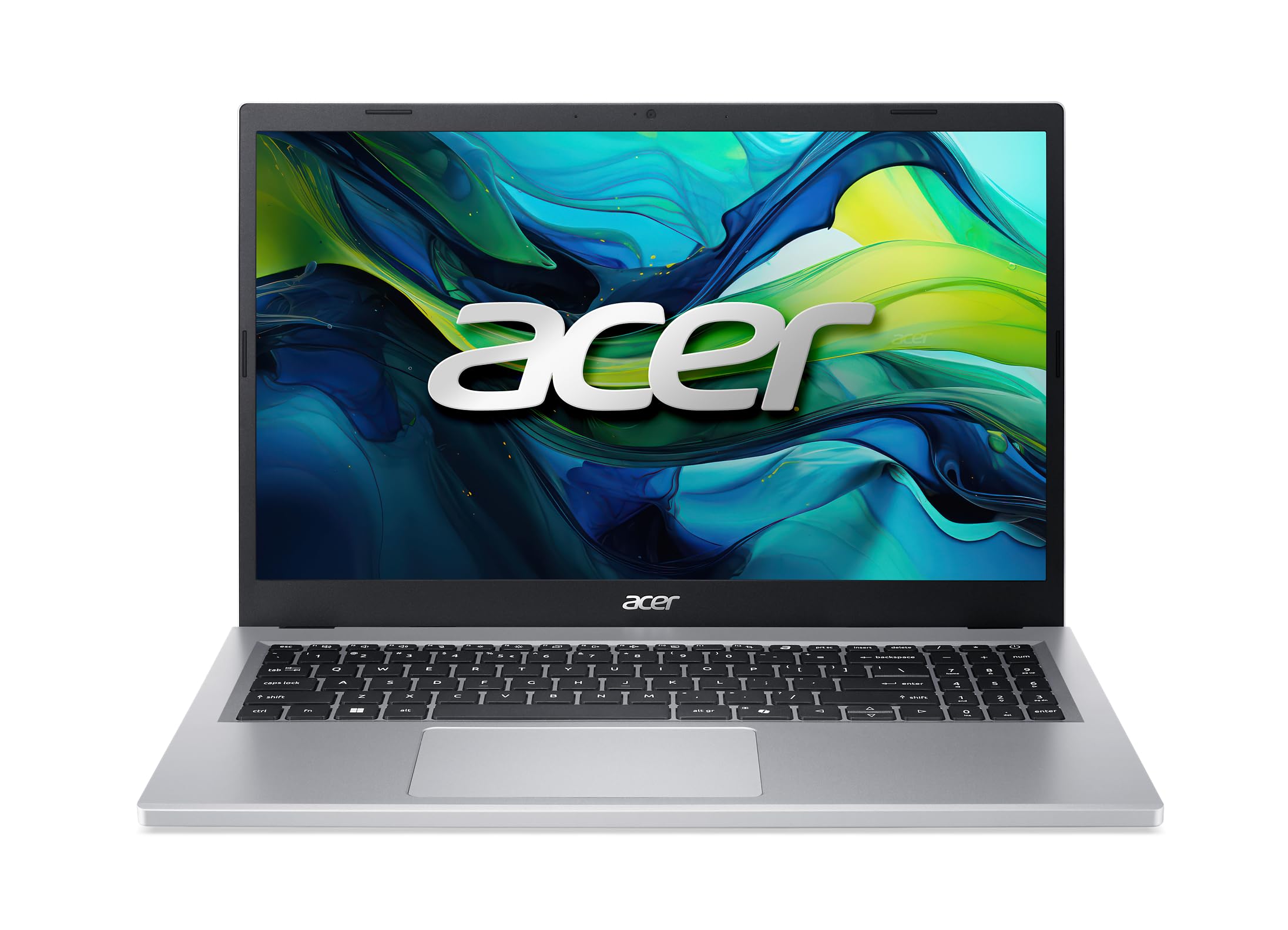
A Full HD panel and 8GB of fast memory at the entry end — the boring, dependable choice.
The processor is the number to note: an AMD Ryzen 3 7320U running at a maximum 4.1GHz. That is more than double the 2GHz ceiling of the Lenovo Chromebook further down this list, and for everyday apps it translates into a machine that opens tabs and switches windows without a pause. It is paired with 8GB of LPDDR5 memory and a 128GB PCIe SSD — enough for a full browser plus office work, and enough storage for documents and photos if you do not hoard video.
The 15.6-inch 1080p Full HD IPS panel is the reason to pick this over cheaper entry machines. IPS means wide viewing angles, so the screen does not wash out when you tilt the lid or share it at a table. Acer BluelightShield lowers blue light output, and dual full-function USB-C ports plus HDMI 2.1 mean you can plug into a monitor or projector without an adapter hunt. Wi-Fi 6 is on board.
Where it lands honestly: this is a laptop for everyday use, not a workstation. The processor handles browsing, email, video, and documents well, but heavy multitasking with a video editor open will push it. If that is your day, the Acer Aspire 14 with 16GB gives you real headroom.
Why it wins at its level: a Full HD IPS screen and 8GB of LPDDR5 memory at the value end is the combination that keeps a laptop feeling usable years in. Many machines in this tier cut the screen first — this one did not.
The limit: 128GB of storage fills quickly if you shoot photos or keep video locally, so budget for an external drive at some point.
Pick it for: a first laptop or a dependable everyday machine where the screen should not feel like a penalty.
Pass it over for: creative editing sessions that need 16GB of memory and more storage elbow room.
8. Lenovo Chromebook 14″ Touchscreen
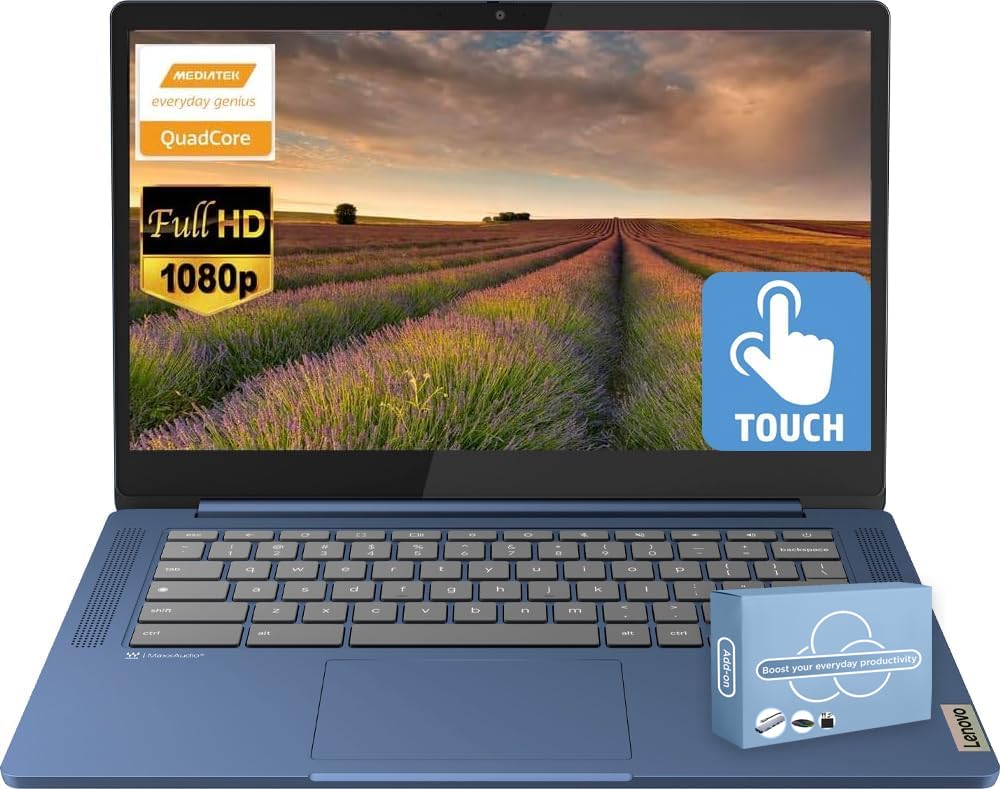
A 14-inch Full HD touchscreen for web work, classes, and nothing heavier.
This is a Chrome OS machine, and that changes the buying decision more than any spec. It runs web apps, Google Classroom, Zoom, and browser-based work beautifully, and it does so on very little power. The 14-inch touchscreen runs 1920 x 1080 with IPS technology for wide viewing angles, and the finger-touch navigation suits the Chrome environment. Owners single out the hardware quality, and setup is quick — sign in with a Google account and you are running.
The processor is a MediaTek Kompanio 520, an octa-core chip running up to 2GHz, paired with 4GB of RAM and 64GB of eMMC storage plus a 64GB memory card in the box. It also arrives with a 6-in-1 USB-C dock, a wireless mouse, an HDMI cable, and a mouse pad — a complete class setup. A 720p webcam with a privacy shutter and dual array microphones handles video calls, and Wi-Fi 6 plus Bluetooth 5.1 round out the connectivity.
The honest limits are real: 4GB of RAM and 64GB of storage are enough for web work and not much else. Connectivity also draws mixed feedback — a slow internet connection shows up in the comments, which may be a router or a Wi-Fi issue rather than the laptop. Windows programs will not run here at all. If you need Office desktop apps or specialty software, this is the wrong pick regardless of how good the price looks.
Where it shines
- 14-inch Full HD touchscreen with IPS wide viewing angles
- Webcam privacy shutter for classes and calls
- Ships with a dock, mouse, HDMI cable, and a 64GB memory card
- Chrome OS boots fast and updates in the background
Accept these going in
- 4GB RAM and 64GB eMMC limit you to web work
- Windows desktop software will not run on Chrome OS
- Slow-connection complaints appear in the connectivity feedback
The clean answer: a student who lives in a browser and Google Classroom gets a sharp touchscreen and a complete starter kit.
The hard line: if you need Office desktop or a specialist Windows app, this machine cannot run it — look at the Acer Aspire Go instead.
9. ASUS Lightweight 15.5″ Full HD Laptop

A large Full HD screen and a backlit keyboard at the simplest budget rung.
The screen is the reason this is on the list. It is a 15.5-inch Full HD panel at 1920 x 1080, the same resolution as the Acer Aspire Go and the Lenovo, which means crisp text and real room for two windows side by side. A backlit keyboard is a genuinely useful touch for evening typing, and the 1 USB Type C plus 2 USB Type A ports plus a headphone/microphone combo jack cover the basics. This is a renewed unit, so it has been through a refurbishment process and arrives in Star Black.
The performance ceiling is where you should set expectations. The Intel Celeron processor tops out at 2.76GHz with 4GB of LPDDR4 memory and a 128GB SSD — spec figures that describe a machine built for browsing, email, video, and basic documents. The refresh rate is 60Hz, the everyday standard. For a student on a tight budget or a second machine for the kitchen table, that is enough.
The honest warning comes from the feedback: boot times are slow, and everyday performance is described as sluggish once you push it. This is not a machine for multitasking or for anyone who expects a laptop to feel snappy. The upside is a large Full HD screen and a backlit keyboard at the simplest price tier on this list — a fair trade if you only need the basics.
The value read: a 15.5-inch 1920 x 1080 screen and a backlit keyboard together is the reason to consider this at the budget rung. You get the big, clear display that cheaper machines often cut.
The patience read: 4GB of RAM and a Celeron processor at 2.76GHz will feel slow when you open a lot at once. Buy it for one or two things at a time, not for a dozen tabs.
Suits: a tight-budget student or a backup machine where a big Full HD screen matters more than speed.
Doesn’t suit: anyone who runs many tabs or wants a laptop that feels quick out of the gate.
Know the Specs
Refresh rate in Hz
Hertz is how many times per second the screen redraws its picture. 60Hz is the everyday baseline and looks fine for documents and web pages. 120Hz and 165Hz redraw more often, so scrolling and fast motion look smoother and less stepped. It matters most for gaming and video, and least for typing email. On this list, the msi Katana 15 runs 165Hz and the Samsung Galaxy Book5 Pro 360 runs up to 120Hz.
RAM and storage type
RAM is your working desk — the space open programs and tabs occupy. 4GB is fine for web-only use, 8GB is comfortable for everyday office work, and 16GB lets you run a browser full of tabs alongside heavier apps. Storage type matters too: an SSD uses memory chips with no moving parts and boots in seconds, while eMMC is a cheaper flash type that is slower but still silent.
Resolution and panel type
Resolution counts the dots on screen. 1920 x 1080 (Full HD) gives crisp text and room for two windows; 2880 x 1800 (3K) adds finer detail for photo and design work; 1366 x 768 draws far fewer dots and looks softer. IPS panels offer wide viewing angles so the screen stays readable when you tilt it. AMOLED panels produce deeper blacks and richer colour than standard LCD.
Battery claims and processor naming
Manufacturers measure battery life under specific test settings, so a 25-hour claim is an indicator, not a guarantee — mixed real use typically lands lower. On the processor side, look past the brand name to the model number and its maximum speed: a number like 4.1GHz or 4.9GHz describes how hard the chip can push a single task, while core count describes how many tasks it can share at once.
Common Questions
Is 8GB of RAM enough for a laptop in everyday use?
What is the difference between 60Hz and 120Hz or 165Hz screens?
Can the Lenovo Chromebook run Microsoft Office desktop apps?
Will the Microsoft Surface Laptop run all my Windows programs?
How do the battery-life claims on these laptops hold up?
Is 128GB of storage enough for a laptop?
What does AMOLED mean on the Samsung Galaxy Book5 Pro 360?
Do I need a separate graphics card in my laptop?
What should I check about ports before choosing a laptop?
Is a renewed laptop like the ASUS a risk?
The Bottom Line
For most people shopping a World Laptop, the the world laptop that earns the top spot is the Samsung Galaxy Book5 Pro 360 — nothing else here pairs a 2880 x 1800 AMOLED touchscreen with a 120Hz refresh rate and a pen in the box, and it holds 4.5+ stars across 200+ ratings. If battery life is what you lose sleep over, the Microsoft Surface Laptop lasts up to 20 hours in a 13.8-inch shell you barely notice in a bag. And when storage and price matter more than a monster screen, the Acer Aspire 14 AI hands you a 1TB SSD and 16GB of memory without flinching.
Two more worth naming in the same breath: the Dell 15.6 is the steady plug-in desk companion with a numeric keypad and a year of onsite service built in, and the HP 14 is the rare pick that arrives as a complete setup — Office loaded, dock, mouse, and a 500GB drive in the box. If gaming or 3D rendering is your day job, the msi Katana 15 with its 165Hz QHD panel and RTX 4070 is the only one here built for it.
One last thought before you click buy: match the machine to how you actually work, not to the biggest number on the box. A 15.5-inch Full HD screen and a backlit keyboard at the budget rung, as on the ASUS Lightweight, will serve an occasional user better than a 3K display they never exploit. Size the panel and the memory to your real week, and you will be happy with the laptop long after the unboxing excitement fades.
How we choose
We do not accept paid placement. Every pick is matched to a real buyer and a real use-case; we do not hands-on test units.
Sources
Specifications: manufacturer listings and product documentation. Review insights: verified customer reviews, as of November 2026. Pricing: not shown on this page (it changes often); check the current price via the retailer link.
As an Amazon Associate, Tactical Gear Guy earns from qualifying purchases. This does not affect which products we feature.