Specs are compiled from manufacturer listings and verified buyer reviews and can change over time — please confirm the key details on the product page before buying.
Shortwave listening lives or dies on one thing: whether the signal arrives clean or dissolves into hiss. Every radio below genuinely receives world band (shortwave) frequencies, so the real question is which one pulls weak stations out of the static without forcing you to fight the tuning dial. If you want the fastest answer, the QODOSEN DX-286 is the crowd favorite and the one most listeners should start with. The rest of this list splits by what you actually plan to do with the radio — scan distant broadcasters, chase aviation and weather channels, or just keep a dependable analog set on the kitchen counter.
This guide is built by comparing the manufacturers’ published specifications and the patterns across verified customer reviews, so you get each pick’s real strengths and trade-offs instead of marketing spin.
Shortwave is the part most buyers underestimate, because a radio that sounds great on FM can still struggle the moment you switch to a distant band. Below you’ll find the tuning controls, bandwidth settings, and battery setups that actually decide reception quality on a world band portable radio.
Top Picks


How To Choose The Best World Band Portable Radio
Your first decision is not brand. It is how you tune: a digital tuner with direct frequency entry, or an analog dial you spin by hand. Direct entry lets you type a known shortwave frequency and land on it instantly, so you skip the searching. An analog dial suits slow, patient sweeping and is easier for casual listening, but it demands more hunting to find a station.
Sensitivity, selectivity, and the chip inside
Sensitivity is how faint a station the radio can pull in. Selectivity is how well it rejects a strong station bleeding into the one next door. A dual-conversion receiver (a design that filters the signal in two stages) tends to handle both better. So does a modern DSP or automotive-grade chip, which is why the DX-286’s NXP TEF6686 chip is such a talking point among long-distance listeners.
Do you need SSB?
SSB (Single Side Band) is the transmission mode used by ham operators and many long-range utility stations. If you only want music, news, and international broadcasters, you can skip it. If you want to hear amateur radio or emergency-adjacent transmissions, look for a radio that explicitly lists SSB — here that means the Tecsun PL880, the C. Crane CC Skywave SSB 2, and the Sangean ATS-909X2.
Bandwidth filters and squelch
A bandwidth filter narrows the slice of signal the radio listens to, which can cut adjacent-channel noise on a crowded band. Squelch works differently — it mutes the radio until a signal is strong enough to be worth hearing, so you are not sitting through constant hiss while scanning.
Power and portability
Battery choice shapes how you travel. AA alkalines are easy to swap anywhere; an included 18650 rechargeable cell can be topped up over USB. Check whether the radio charges its own batteries or requires you to remove them, and note the stated runtime if the manufacturer publishes one.
Side-by-Side Comparison
| Model | Best For | Bands | Tuning / Chip | Power | Amazon |
|---|---|---|---|---|---|
| QODOSEN DX-286★ Best Overall | Everyday shortwave scanning | LW / AM / FM / SW | NXP TEF6686, 1000 presets | 18650 rechargeable (included) | Amazon |
| Panasonic RF-562DRetro Pick | Retro analog listening | AM / FM / SW | Analog dial | Battery operated (2 batteries) | Amazon |
| XHDATA D109WBWeather-Ready | Weather alerts and emergency use | FM / AM / SW / LW / WB (NOAA) | DSP chip, ATS auto search | Rechargeable + USB-C | Amazon |
| Tecsun R9700DX | Budget dual-conversion shortwave | 12-band AM / FM / SW | Dual conversion | Built-in battery charger | Amazon |
| Eton Elite Traveler | International travel with memory presets | AM / FM / LW / SW | Digital, RDS for FM | Battery operated | Amazon |
| Sangean ATS-405 | Five-way tuning flexibility | FM / AM / SW (2.3–26.10 MHz) | Digital, 108 presets | 4 AA + built-in charger | Amazon |
| Tecsun PL880 | Serious shortwave and SSB listening | AM / FM / LW / SW + SSB | PLL dual conversion | Battery operated | Amazon |
| C. Crane CC Skywave SSB 2 | Off-grid emergency and travel | AM / FM / SW / NOAA / VHF Air + SSB | Digital with bandwidth settings | 2 AA, approx 70 hrs (earbuds) | Amazon |
| Sangean ATS-909X2 | Full-featured multi-band desk listening | FM / SW / MW / LW / Air + SSB | PLL synthesized, 1674 presets | AC or battery (batteries not included) | Amazon |
Detailed Reviews
1. QODOSEN DX-286 Portable Radio
Our pick — 4.5+★ from 600+ verified ratings; the strongest balance of quality and price.
A shirt-pocket shortwave receiver running an automotive-grade tuner chip.
The DX-286 carries an NXP TEF6686 chip — an automotive-grade tuner originally built for car radios, which explains why it digs out weak stations so cleanly. Its signal-to-noise ratio is rated at SNR ≥ 60dB, meaning the gap between the broadcast and the background hiss stays wide even on a crowded band. It covers LW, AM, FM, and SW, with shortwave running from 1711 to 27000 kHz for international broadcasters. What wins people over most is the sound — it is the single trait owners talk about more than anything else, ahead of FM reception and raw performance.
Where it separates from the analog competition is tuning control. You get 1000 cross-band memories spread across 100 editable pages, direct frequency input, and an antenna attenuator plus switch for taming strong local signals that would otherwise swamp a weak one. A telescopic whip rotates a full 360° and supports an external antenna if you want to push range further. Physically it is genuinely pocketable at 5.28″L x 1.18″W x 2.99″H — small enough for a shirt pocket, which is unusually compact for a set with this much tuning hardware inside.
The honest catch: that tiny enclosure puts limits on speaker output, so critical listening still favors headphones through the stereo headphone output. And shortwave is a skill — the chip helps, but you still need patience and an external antenna to reach distant broadcasters. Compare the presets to the Eton Elite Traveler and the gap is stark: 1000 here versus 500 there, a 2.0x difference that matters if you like keeping a deep library of stations. The box includes an 18650 rechargeable battery, fleece bag, carrying case, and USB cable.
Where it wins
- Automotive-grade TEF6686 chip gives strong sensitivity and selectivity for weak-signal hunting
- 1000 cross-band memories across 100 pages — double the Eton Elite Traveler’s 500
- Antenna attenuator and antenna switch let you manage strong local signals
- Compact 5.28″L x 1.18″W x 2.99″H frame, plus 18650 battery and carry case in the box
Where it gives ground
- Small body limits speaker presence — headphones do the heavy lifting for serious listening
- Full shortwave mastery still needs an external antenna and tuning patience
Solidly the top pick: the listener who wants a compact set with real tuning tools and a deep memory bank, at 4.5+ stars across 600+ ratings.
Want a bigger speaker first: a larger-bodied set like the Tecsun PL880 will sound fuller in a room.
2. PANASONIC RF-562D AM FM SW Shortwave Transistor Radio
A metal-bodied analog dial radio that looks the part and runs for ages.
The reason to buy this one is not a spec sheet — it is the analog dial and the retro look. The RF-562D is a battery-operated transistor radio wrapped in a metal enclosure, with an 8cm speaker handling the output. Owners prize exactly that character, and the retro design earns a lot of the praise. A pair of batteries lasts a long time, which suits a radio that sits on a shelf and gets picked up once a week.
Physically it is the largest set in this group at 8.27″L x 2.56″W x 4.72″H, and that is a real 57% more bulk than the DX-286’s 5.28″L x 1.18″W x 2.99″H frame. That bulk buys an 8cm speaker and a larger dial, so it suits a kitchen counter or bedside table rather than a jacket pocket. Functionality checks out — it works across all its bands, AM, FM, and SW included, and at 500 g it sits heavily enough to stay put while you tune.
Set your expectations around what an analog dial does. There is no numeric display to type a frequency into, so you sweep and listen rather than jump straight to a station. Sound quality is the most discussed topic among owners and the consensus is genuinely divided — some find it full, others thin. Treat this as a listener-focused radio for casual shortwave and local AM/FM, not a dedicated long-range tuner.
Best for: anyone who wants a good-looking analog radio that stays alive on batteries and works on all three bands.
Trade-off to know: dial tuning and mixed sound reports mean you should hear it before committing to serious shortwave sessions.
The right buyer: someone drawn to the metal body and the dial more than to digital presets.
Not for you: if you want direct frequency entry to land on a known shortwave station fast, a digital set serves you better.
3. XHDATA D109WB Portable Shortwave Weather Radio
A shortwave radio with a weather band and an SOS button built in.
The D109WB is the pick for anyone who wants a radio that also earns its place in an emergency kit. It adds a NOAA weather band (162.40–162.55MHz) with weather alert on top of FM, AM, SW, and LW, so you can pull the latest forecast without a phone signal. There is also an SOS alert function for calling for help, two alarm clocks with MP3, radio, and beep modes, and an ATS auto-search that scans and stores stations for you. The 39cm antenna handles the pulling-in of stations, and shortwave runs 1711–29999kHz.
Power is where it shines for portability. You can run it on the rechargeable battery or charge it over USB Type-C, and the LCD shows remaining power so you are never guessing. It also doubles as a Bluetooth MP3 speaker for playing music from your phone. At 5.9″L x 1.45″W x 3.07″H it is a genuinely small travel companion.
Be honest with yourself about the shortwave side. FM reception is the standout, and the sound quality is a strong point, but shortwave reception draws mixed reports — some find it struggles compared with more expensive sets. Build quality is a similar story: solid on most units, with a minority describing it as fragile. Reliability is the most-discussed topic, and it is a split consensus rather than an outright knock. If shortwave is your main mission, spend more. If you want a versatile weather-and-music radio that happens to include shortwave, this fits.
Reasons it earns a spot
- NOAA weather band with alert, plus SOS function for emergency use
- USB-C charging and a battery-level readout on the LCD
- Doubles as a Bluetooth speaker for everyday listening
- Compact 5.9″L x 1.45″W x 3.07″H and 39cm antenna
Where to temper expectations
- Shortwave reception draws mixed reports relative to premium sets
- Build quality divides opinion — treat it with care
Built for: the household that wants one radio covering weather alerts, music, and casual shortwave.
Look elsewhere if: shortwave is your reason for buying — this one leads on weather, not long-range tuning.
4. Tecsun R9700DX 12-Band Dual Conversion Shortwave Radio
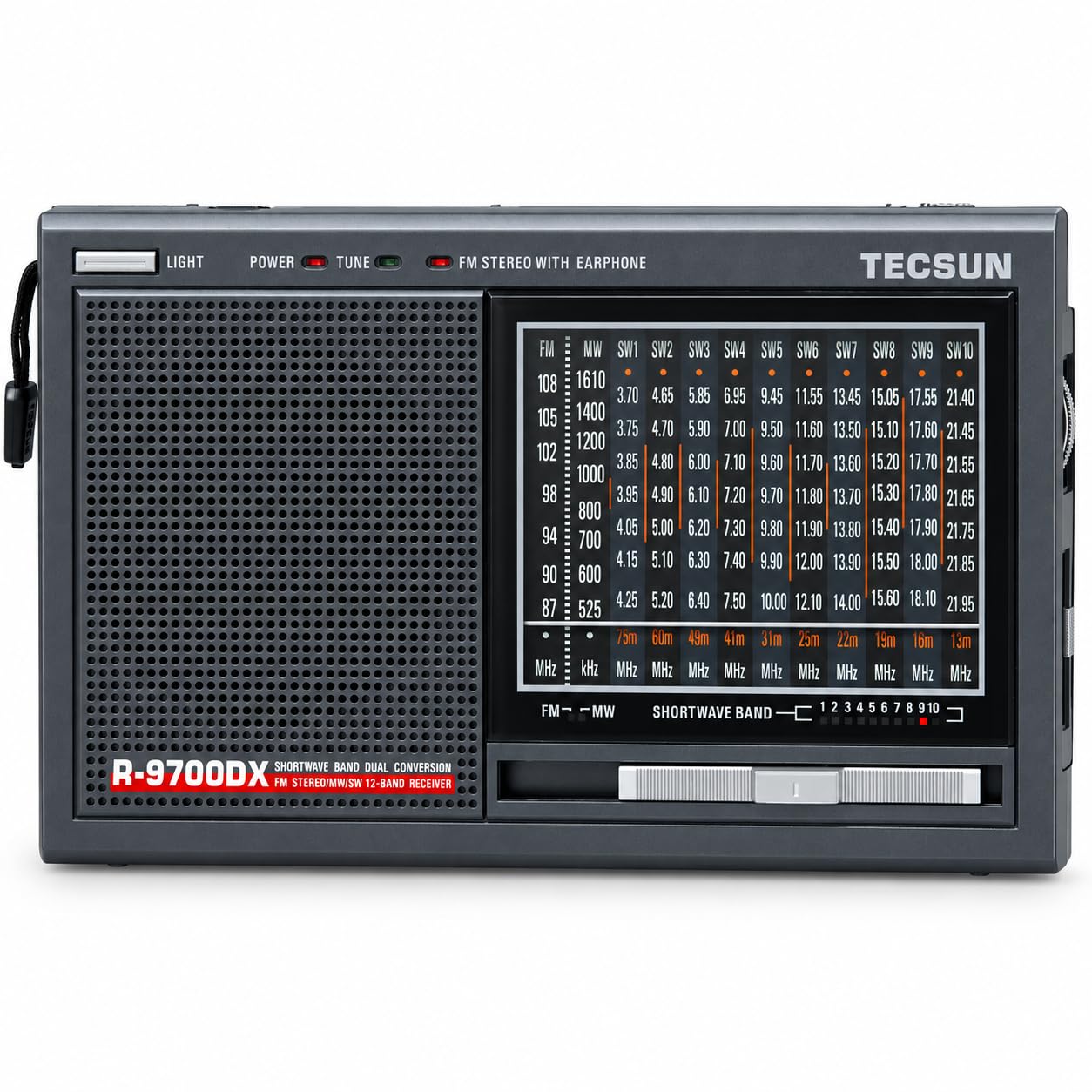
Twelve bands and a dual-conversion tuner at an entry-level outlay.
Dual conversion is the headline here. It is a receiver design that filters the incoming signal in two stages, which generally means better sensitivity and selectivity than a single-conversion analog set. The R9700DX pairs that with 12-band coverage across AM, FM, and shortwave, a back-lit frequency display so you can read the dial at night, and a built-in battery charger. In the box you get a shortwave antenna and an AC adapter, plus a one-year warranty — unusually complete for a radio at this level.
Owners consistently describe the sound as full rather than tinny, which is a real compliment for a compact analog receiver. Tuning is straightforward, and it pulls a fair number of stations on both shortwave and medium wave. At 7.13″L x 1.22″W x 4.57″H and 16 ounces it has some presence without being a burden to move around.
The trade-off is that this is an analog-style receiver, so you are dial-tuning rather than typing in a frequency. Unlike the DX-286 above, there is no 1000-station memory bank or direct frequency keypad. For a listener who enjoys the act of finding a station, that is part of the appeal. For someone who wants to punch in 9,650 kHz and go, it is friction.
The case for it: a dual-conversion tuner, 12 bands, and a full accessory kit make this one of the strongest entry points into shortwave listening.
The honest limit: analog tuning means hunting for stations rather than entering them directly.
Reach for this if: you want proper dual-conversion shortwave reception without a premium outlay.
Pass if: you expect a digital keypad and stored memories for fast frequency hopping.
5. Eton Elite Traveler AM/FM/LW/SW Radio with RDS

An international travel radio with 500 stored stations and a world clock.
For a radio that crosses borders with you, the Eton Elite Traveler is purpose-built. It tunes AM, FM, Longwave, and Shortwave with automatic or manual digital tuning, including Auto Tuning Storage to fill its memory for you. You get 500 memory stations, an alarm, a 120-minute sleep timer with snooze, and a world clock — the exact feature set that makes a hotel room in another time zone feel manageable. A high-contrast orange LCD keeps the display readable, and a 3.5mm earphone jack lets you listen late without disturbing anyone.
On FM it adds RDS (Radio Data System), which displays station call letters, music genre, song title, and artist right on the screen. That helps when you scan unfamiliar stations in a foreign city and want to know what you have landed on. The frame measures 6.3″L x 1.72″W x 4.76″H, so it slips into a carry-on without eating space.
The sound is where opinions split most. Some find it plenty for travel use; others describe the output as tinny, and the most-discussed topic among owners is a divided view on overall sound. Reception and functionality also draw mixed reports, and battery life earns only a split verdict. The compact size is one of its more reliably praised traits. It is a smart travel tool, not a bench-top shortwave rig — judge it on that basis.
What it does well: 500 memories, RDS readouts, and a world clock make it a natural fit for international travel.
Where it wobbles: sound quality is the most debated point, so heavy FM listening in a room may leave you wanting more.
Right call for: the frequent traveler who wants stored stations and a world clock in one compact radio.
Skip the shortlist if: sound quality above all else drives your decision — a larger speaker set wins there.
6. Sangean ATS-405 FM-Stereo/AM/Shortwave World Band Receiver

Five ways to find a station, so you pick the method that suits the band.
The ATS-405 is built around tuning flexibility. You can reach a station five different ways: 10-key direct frequency access, auto scan, manual tuning, memory recall, or push-button tuning. That variety matters on shortwave, where some frequencies need a keypad and others reward slow scanning. It covers full shortwave across 14 meter bands from 2.3 to 26.10 MHz, with 108 presets split evenly at 36 FM, 36 AM, and 36 SW. Fine tuning steps down to 1 kHz so you can nudge a fading station back into focus.
A squelch control lets you set a receiving threshold so weak, unusable transmissions get muted instead of filling your ears with hiss. Owners prize the sound and the bandwidth controls in particular. The three-position tone and bandwidth switches draw specific praise for how effectively they clean up a broadcast. It runs on 4 AA batteries with a built-in charger and LED indicator, and comes with a carrying pouch and AC adapter.
The honest caveat is complexity. Ease of use is a split question — some owners find the controls intuitive, others describe the radio as complicated to operate. Its listed dimensions, 9.6″L x 8.7″W x 3.1″H, also make it the bulkiest set on this list by a wide margin, so it is a stay-at-home or pack-in-the-car companion rather than a pocket radio. Budget a little time with the manual before you judge it.
Strong points worth weighing
- Five distinct tuning methods, from keypad entry to rotary scanning
- Squelch control mutes weak transmissions so scanning stays comfortable
- 108 presets split across FM, AM, and SW
- Full 14 meter shortwave bands, 2.3–26.10 MHz, with 1 kHz fine tuning
Costs of admission
- Controls can feel complicated until you learn them
- Bulkier body suits a table or car rather than a pocket
Made for: the tinkerer who wants every tuning route available on one radio and will read the manual.
Better to avoid if: you want something you can operate without studying a control layout.
7. Tecsun PL880 Portable Digital PLL Dual Conversion Radio
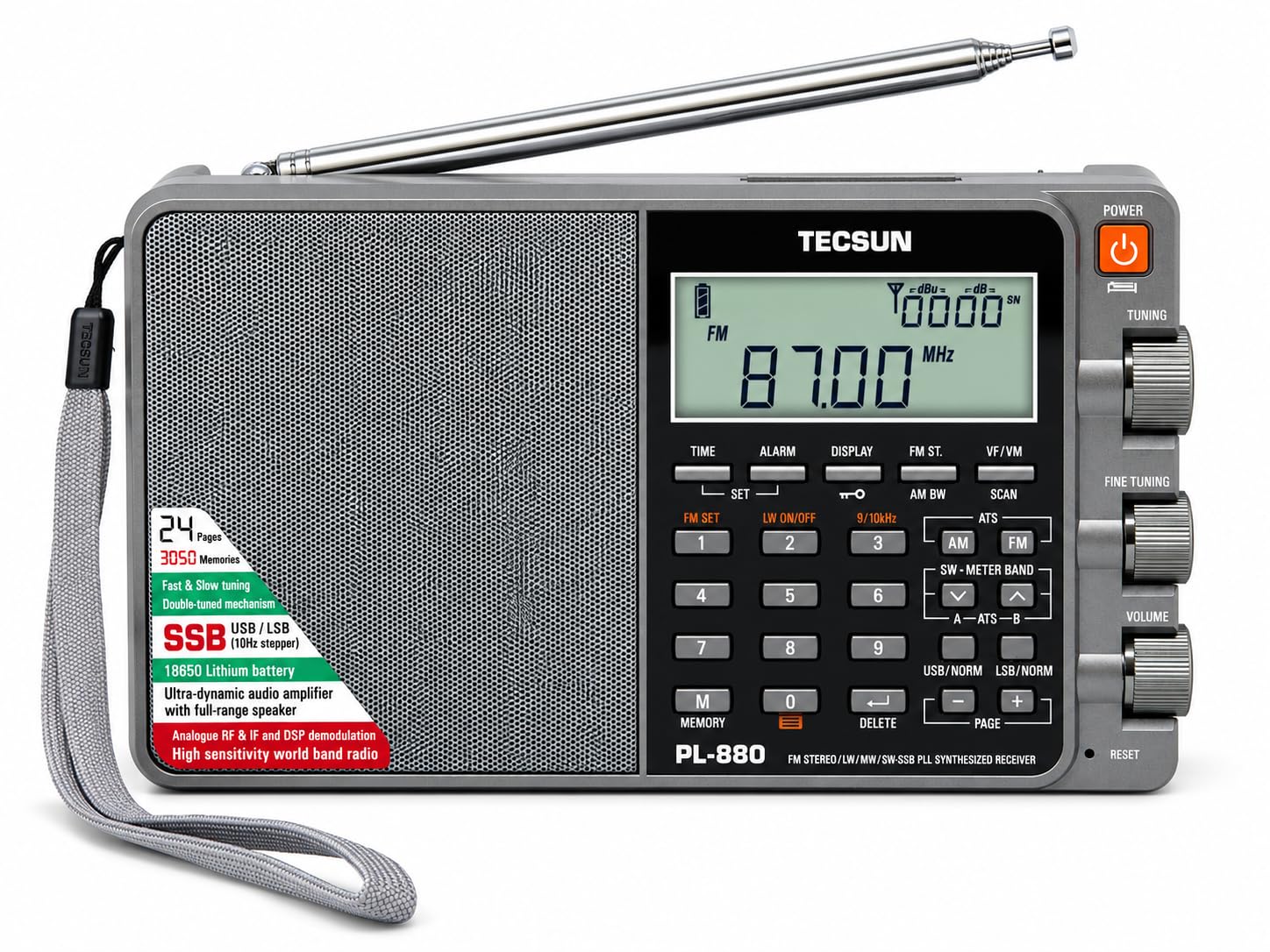
The shortwave listener’s shortwave radio, with SSB and fine bandwidth control.
Two numbers tell you what this radio is for. It runs a PLL synthesized digital dual-conversion receiver, and it offers 4 and 5 selectable bandwidth filters on AM and SSB respectively. Translated: you can narrow the slice of signal the radio hears until a crowded band clears up, and you can pull in Single Side Band transmissions — the mode ham operators and utility stations use. A 10 Hz tuning step on SSB lets you fine-tune a voice until it sounds natural rather than garbled, and a separate fine-tuning knob makes that adjustment physically easy.
Full band coverage runs AM, FM, Longwave, and Shortwave with SSB included. There is a 24-hour alarm clock and a sleep timer adjustable from 0 to 120 minutes. Sound quality is the runaway favorite here — it is what owners praise above everything else, ahead of reception and value. Audio is described as superb on both AM and FM, and the set is solidly built for its tier. Medium wave, short wave, and FM performance all draw positive reports.
The one weak note is battery life, the only mixed signal in an otherwise strong record. Plan around it with fresh cells before a long listening session. It also includes a one-year USA warranty, which softens the premium outlay this set commands. Compared with the analog R9700DX from the same maker, this is the step up into digital tuning and SSB.
Why it earns its place: SSB with a 10 Hz tuning step plus selectable 4- and 5-position bandwidth filters make it a genuine listening instrument.
The limitation to plan for: battery life is the one area owners rate with hesitation, so carry spares.
Worth it for: the hobbyist who wants to work SSB and shape bandwidth by hand.
Overkill if: you only listen to local FM and AM and never touch a sideband.
8. C. Crane CC Skywave SSB 2 Portable Travel Radio
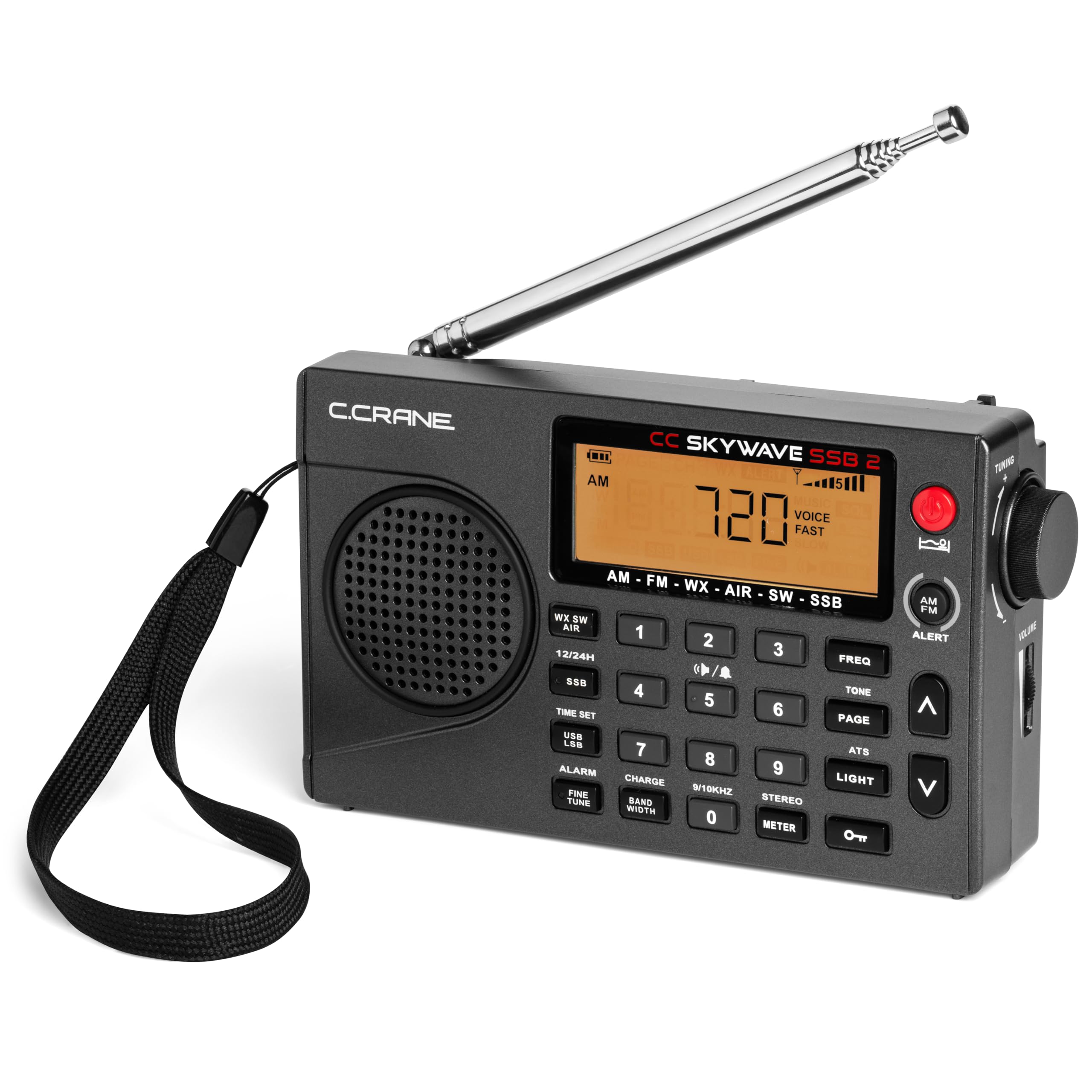
One of the smallest multiband radios you can buy with Single Side Band inside.
The frequency coverage is the whole story with the Skywave SSB 2. It handles AM, FM, NOAA weather with alert, shortwave from 1711 to 29999 kHz with Single Side Band, and VHF Aviation (Airband) so you can scan aircraft communications. That is an unusually wide spread for a radio this size, and 10 aviation memories can be scanned for activity while you are waiting for a plane to call in. The claim that lands hardest is its place as one of the smallest multiband radios with SSB — a genuine travel advantage.
Runtime is stated at roughly 70 hours on earbuds and roughly 60 hours through the built-in speaker, running on two AA alkaline batteries. That runtime covers multi-day camping or backpacking trips away from a wall outlet. It weighs 6.0 oz without batteries and measures 4.75″ W x 3″ H x 1.1″ D, so it disappears into a pack. Sensitivity and selectivity are enhanced by multiple bandwidth settings, with selectable fast or fine tuning on every band except weather. Four hundred memories, a lighted LCD, a rotary volume and tuning knob, and a fold-out back stand round it out.
Accessories are serious: a shortwave antenna jack that can improve shortwave reception with an external antenna, high-quality earphones, a faux leather carry case, and a 23-foot portable shortwave reel antenna. The one split verdict is value for money — some owners feel the outlay is fully earned, others push back on it. Frequency coverage and far-off station pickup are the traits owners appreciate most, with compact size a close second for camping and backpacking trips. A one-year limited warranty covers it.
Standout capability: AM, FM, NOAA weather, shortwave with SSB, and VHF Airband in a 6.0 oz body.
Worth knowing: value is the one point owners divide on, so weigh the wide band coverage against the premium tier.
Reach for it if: you want maximum band coverage in the smallest possible pack for off-grid trips.
Could skip if: aviation and SSB mean nothing to you — simpler radios cover your ground.
9. Sangean ATS-909X2 Multi-Band Radio

The memory-bank monster: 1,674 station presets across three separate banks.
If you like knowing every station you have ever found is still there waiting, the ATS-909X2 delivers. It stores 1,674 presets across three individual memory banks, plus 42 time zones with daylight-saving settings and two editable city names. That is a travel-and-listening library in a single radio. Tuning comes five ways — direct frequency, auto scan, manual, memory recall, and rotary — with fine tuning and quick shift controls. The DSP tuner handles FM while a PLL synthesized circuit handles MW, LW, and SW.
New here is an Air band mode covering 118 to 137 MHz, so you can listen to aviation traffic. SSB runs USB and LSB with a 10 or 20 Hz fine tuning step, and you get manual and automatic bandwidth control plus a squelch function to eliminate weak transmissions. Dual conversion applies to SW, LW, MW, and Air. A larger LCD measuring 3.33″ x 1.95″ with LED backlight keeps RDS and signal readouts visible, and the RDS data covers PS, PTY, RT, SNR, and RSSI. Three alarm timers, a humane wake buzzer, tone controls for music, normal, and news, and an individual headphone amplifier fill out the feature set.
Sound quality is the trait that carries this radio — it is praised more than anything else, ahead of features and build. The appearance and build both draw steady approval. But reception and value are the split points: FM reception is a mixed verdict, and some owners find AM reception disappointing while others feel the radio is overpriced for what they get. Reliability is the most-discussed topic overall and reads as a split view rather than a clean win. The 8.17″L x 1.34″W x 5.31″H frame is a desk radio, not a pocket one, and batteries are sold separately despite the built-in charger.
What sets it up top
- 1,674 presets across three memory banks — the deepest library on this list
- Air band 118–137 MHz plus SSB with 10 or 20 Hz fine tuning step
- Manual and automatic bandwidth control with squelch
- Large 3.33″ x 1.95″ LED-backlit LCD with full RDS readouts
Where it asks patience
- FM and AM reception reviews divide, and value is contested at the top tier
- Batteries are not included, so budget for four before first use
Built for: the listener who wants every band, every memory, and a large readable display in one desk unit.
Second thoughts if: AM is your main band — reception reports there are the least settled.
Know the Specs
Dual Conversion and DSP Chips
A dual-conversion receiver filters the incoming signal in two stages instead of one, which usually means cleaner separation between a strong local station and a weak distant one. A DSP chip (a digital signal processor) does similar work in software, and an automotive-grade chip like the NXP TEF6686 was originally designed to survive the noisy electrical environment of a car. Both approaches exist to do the same job: keep a faint shortwave signal audible when a stronger one sits nearby.
SSB and Bandwidth Filters
SSB (Single Side Band) is a transmission mode that carries voice without a separate carrier wave, used by ham operators and long-range utility stations. Radios that list SSB also usually offer a fine tuning step — 10 Hz on the Tecsun PL880, 10 or 20 Hz on the Sangean ATS-909X2 — so you can zero in on a voice. Bandwidth filters are related: they narrow the slice of signal the radio listens to, which cuts hiss and adjacent-channel bleed when a band is crowded.
Squelch and Attenuators
Squelch sets a threshold so the radio stays silent until a signal is strong enough to be worth hearing — useful when you are scanning a band and do not want to sit through static. An attenuator does the opposite job: it weakens an incoming signal so a very strong local station does not overwhelm the receiver. The DX-286 includes both an antenna attenuator and an antenna switch for exactly this kind of signal management.
Presets and Memories
Memory counts range widely on this list, from 108 presets on the ATS-405 to 1,674 on the ATS-909X2. More memories matter if you collect stations across many bands and want them stored by page or bank. The DX-286 splits its 1000 cross-band memories across 100 editable pages, which lets you organize by region or by band. Fewer presets is not a flaw — it just means a simpler interface.
Common Questions
What does world band actually mean on a portable radio?
Do I need SSB to listen to international shortwave broadcasters?
Why does my shortwave reception change between day and night?
Is a dual-conversion receiver better than a single-conversion one?
How long will a portable shortwave radio run on batteries?
Can a shortwave radio pick up airport and aviation traffic?
What is a squelch control for on a shortwave radio?
Will an external antenna improve shortwave reception on these radios?
How many station presets do I realistically need?
Is a larger radio always better for shortwave reception?
The Bottom Line
For most listeners, the world band portable radio to buy is the QODOSEN DX-286 — an automotive-grade TEF6686 tuner chip, 1000 cross-band memories, and a genuinely pocketable frame in one package. It holds the highest rating on this list and the deepest memory bank outside the ATS-909X2’s 1,674 presets. If working SSB and shaping bandwidth by hand is the goal, grab the Tecsun PL880 — its 4 and 5 selectable bandwidth filters and 10 Hz SSB tuning step are built for exactly that. And for off-grid trips where band coverage beats everything, the C. Crane CC Skywave SSB 2 packs AM, FM, NOAA weather, shortwave with SSB, and VHF Airband into 6.0 oz.
One last nudge: the DX-286 holds 4.5+ stars across 600+ ratings and stores 1000 presets — double the Eton Elite Traveler’s 500 — so you can save far more stations. No other radio here pairs 1000 presets with a 5.28-inch pocketable frame.
How we choose
We do not accept paid placement. Every pick is matched to a real buyer and a real use-case; we do not hands-on test units.
Sources
Specifications: manufacturer listings and product documentation. Review insights: verified customer reviews, as of November 2026. Pricing: not shown on this page (it changes often); check the current price via the retailer link.
As an Amazon Associate, Tactical Gear Guy earns from qualifying purchases. This does not affect which products we feature.