Specs are compiled from manufacturer listings and verified buyer reviews and can change over time — please confirm the key details on the product page before buying.
You need clothes that survive the job, not clothes that look like they might. The short answer: the Carhartt Dearborn long-sleeve tee is the safest starting point for most men, and the Carhartt R01 Duck Bib Overall is what you graduate to when the work gets cold and dirty. Everything below is picked for real durability — heavy fabric, reinforced seams, pockets that hold tools — not for how it looks on a website.
This guide is built by comparing the manufacturers’ published specifications and the patterns across verified customer reviews, so you get each pick’s real strengths and trade-offs instead of marketing spin.
Workwear lives or dies on fabric weight, seam construction, and fit — three things you cannot judge from a product photo. This guide breaks down each so you can match a pick to your trade, your climate, and your body.
Top Picks


How To Choose The Best Workwear Clothes for Men
Pick the fabric for your job, not the brand name. A framer who kneels and drags lumber all day needs different fabric than a mechanic who stands in one spot and reaches overhead. Your work decides the fabric weight, the pocket layout, and if you need stretch to bend comfortably or stiffness to shrug off abrasion.
Fabric weight tells you how long it lasts
Workwear fabric is measured in ounces per square yard — the higher the number, the denser and heavier the cloth. A heavy cotton duck (a tightly woven, stiff cotton canvas) resists tears and scrapes far longer than a thin fashion tee. The Carhartt R01 bib uses 12-ounce, 100 percent ring-spun cotton duck, and the Carhartt Dearborn tee uses 6.75-ounce, 100% cotton jersey, so both sit on the heavier end for their garment type. Heavier fabric also feels warmer, which matters in January and can feel like too much in July.
Knees and seams take the abuse first
Look for reinforcement exactly where your body bends. “Double knee” means a second layer of fabric over the knee panel, and “chap-style double-front construction” means that panel is stitched as a separate piece you can slide knee pads into. Triple-needle stitching runs three parallel rows of thread along the main seams, which adds holding power where a single row would pull apart. If you kneel on concrete or gravel daily, these details will outlast any fabric upgrade.
Stretch versus stiffness is a real trade-off
Stretch fabric blends — usually a mix of cotton, polyester, and a small percentage of elastane (the elastic fiber that lets fabric snap back) — let you squat, climb, and reach without the pants fighting you. Stiff cotton duck protects better against abrasion but takes longer to break in. Ask yourself which hurts your day more: fabric that binds your knees, or fabric that wears through. Most trades end up owning at least one of each.
Layering decides your comfort in cold and rain
A work shirt alone works in moderate temperatures. For cold, you add a mid-layer like an insulated work pant or a fleece-lined jacket. For wind and wet, you want a water-resistant outer shell. Buy base layers that fit loose enough to layer under, because a tight long-sleeve tee under a canvas coat will restrict your shoulders all day.
Side-by-Side Comparison
| Model | Best For | Fabric Weight / Build | Fabric Content | Key Construction Feature | Amazon |
|---|---|---|---|---|---|
| Carhartt Dearborn Loose LS T-Shirt★ Best Overall | Year-round base layer and solo shirt | 6.75 oz cotton jersey | 100% cotton (Ash 99%/1% polyester; Heather gray 90% cotton/10% polyester) | Left chest pocket, side-seamed construction | Amazon |
| Dickies Short Sleeve Work ShirtWarm-Weather Workhorse | Warm-weather daily uniform | — | — | Traditional fit, twill button-down | Amazon |
| Dickies Tough Max Duck Double Knee PantDouble-Knee Tough | Kneeling and bending work | — | Duck cotton canvas | Double-knee reinforcement, triple-needle seams | Amazon |
| DEWALT Protradesman Loose Fit Work Pants | Tradesmen carrying tools in pockets | — | 60% cotton / 38% polyester / 2% elastane | Holster pockets plus 11 total pockets | Amazon |
| Wrangler Ranger Work Utility Pants | Long days on rough ground | 4 lb packed weight | 100% cotton ripstop | Reinforcement in high-wear areas | Amazon |
| HISEA Sherpa Work Jacket | Cold-weather jobsite outer layer | — | — | Sherpa lining, water-resistant canvas shell | Amazon |
| Carhartt Iconic R01 Duck Bib Overall | Cold, dirty, heavy-duty work | 12 oz ring-spun cotton duck | 100% cotton duck | Chap-style double-front with cleanout bottoms for knee pads | Amazon |
| TRUEWERK Insulated Work Pants T3 WerkPant | Frigid conditions and winter work | 24.40 oz fabric weight | 84% ripstop polyester / 16% spandex with hex fleece backing | 4-way stretch, water-resistant DWR treatment | Amazon |
| TRUEWERK Tower WerkParka | Midweight coat for cold days | Level 3 of 4 warmth | Outer 84% elastic nylon / 16% spandex; inner 100% high-stretch polyester | DWR treatment, 4-way stretch | Amazon |
Detailed Reviews
1. Carhartt Men’s Dearborn Loose LS T-Shirt
Our pick — 4.5+★ from 51,000+ verified ratings; the strongest balance of quality and price.
A heavyweight cotton tee that layers under a coat without bunching at the shoulders.
This is the shirt that quietly does most of the work in a cold-weather setup. The fabric is a 6.75-ounce, 100% cotton jersey — a knit cotton cloth with a dense hand feel — so it sits heavier than a normal tee on your skin. That weight is why it works alone in fall and layers easily under a crewneck sweatshirt or a canvas coat when the weather turns. The loose fit gives you room to swing your arms and reach overhead, which matters more than most buyers realize until they try to move in a slim long-sleeve tee.
The pocket is a small detail that earns its keep. A generous left-chest pocket holds a phone, a pen, or a folded work order without sagging the shirt out of shape. Side-seamed construction means the shirt body is stitched up the sides rather than cut as one tube, and that reduces the twisting you get when a tee rides up after a few washes. For a shirt this heavy, that construction detail is the difference between a shirt you wear for years and one you retire early.
Fit is where it gets tricky. The loose cut runs big for some buyers and dead-on for others, and the sleeves run long enough that some find them too long while others tuck them in happily. At 1 pound packed, this shirt is far easier to pack or layer than heavier gear like the Wrangler Ranger pants, which ship at 4 pounds. Size down if you want a closer fit, or lean into the roomier cut if you plan to wear it as a base layer. It holds 4.5+ stars across 51,000+ ratings, and owners call it “the best work shirt on the market.”
Why trades keep reordering it
- 6.75-ounce cotton jersey holds up to daily wear
- Loose cut layers under a coat without binding
- Side-seamed body resists twisting
- Left chest pocket carries everyday essentials
Where the sizing bites
- Runs big for buyers expecting a standard fit
- Sleeve length is long for shorter arms
- 100% cotton needs a cold wash to keep its shape
Buy this if: you want one heavy tee that works alone in fall and as a layer all winter.
Think twice if: you want a close fit — the loose cut and long sleeves will surprise you.
2. Dickies Men’s Short Sleeve Work Shirt
The short-sleeve button-down that turns a hot, dusty shift into a tolerable one.
If your summer work is standing in sun or heat, this is the shirt to reach for. It is a short-sleeve twill button-down — twill being a woven fabric with a diagonal rib that resists wrinkling and holds its shape. The traditional fit leaves room to move without the loose drape of the Carhartt tee above, and the lightweight cloth keeps you comfortable in moderate climates without feeling like a plastic bag. Button-down construction means you can open the collar on hot days and still look put-together at a job site or a client meeting.
What wins people over is how long the cloth holds up. Owners describe the twill as wearing like iron and lasting for years of five-day-a-week wear. The stitching also earns praise for being clean and tight, which is what keeps a twill shirt from blowing out at the shoulder seams. For a uniform shirt worn daily, durability is the whole point, and this one delivers it without the stiffness of a heavy canvas bib.
One thing to know: this is a short-sleeve shirt, so it is a warm-weather pick, not a winter layer. If you work in cold conditions, pair it with the Carhartt R01 bib below or wear it under a jacket. The trade-off is honest — you get breathable cloth and a clean look, but not the abrasion resistance of a 12-ounce duck. For most daily wear in mild to hot climates, that is the right trade.
The durable-uniform angle: twill construction, traditional fit, and a clean button front make this the shirt that handles hot shifts and still looks presentable.
The honest limit: it is a warm-weather short-sleeve, so cold job sites need a layer over or under it.
Reach for this if: your work runs hot and you want a shirt that survives daily wear.
Look elsewhere if: you need a winter layer or heavy abrasion protection.
3. Dickies Mens Tough Max Duck Double Knee Pant
Double-knee pants built for the worker who spends the shift on their knees.
Duck cloth is the tell here. The term signals an exceptionally durable cotton canvas, and these pants back it up with double-knee reinforcements that let you bend and kneel without wearing through the front panel. Triple-needle seams run along the main joins, and reinforcement through the pants adds holding power where a single stitch would pull. The regular fit and straight leg sit slightly below the waist, so they stay put when you are up and down all day. From the garden to the construction site, that knee panel is the feature that decides whether the pants survive the season.
The stretch is what makes them wearable rather than stiff. Enough give lets the fabric flex with real work, so you are not fighting the pants every time you squat. Quality leads the feedback by a clear margin, with stretch close behind — that combination of tough cloth and movement is exactly what buyers in this category want.
The catch is fit and sizing. Some find them true to size while others note the waist runs snug, so check the size chart against your actual waist rather than ordering your usual number. A few buyers question long-term seam durability under heavy load, and pockets draw mixed feedback. For most buyers those are small notes against a pant that does the knee work well. If you kneel daily and want a dedicated double-knee pant without going to a full bib, this is the straightforward pick.
Built for the kneel-and-bend shift
- Double-knee reinforcement saves the front panel
- Triple-needle seams add holding power
- Stretch fabric flexes with real work
- Regular fit with straight leg stays put
What to watch on sizing
- Waist can run snug for some buyers
- Seam durability draws mixed reports under heavy load
- Pockets split opinion
Best for: workers who kneel on concrete or gravel and burn through ordinary jeans.
Check first: the waist sizing — order against your measured waist, not your usual number.
4. DEWALT Protradesman Work Pants
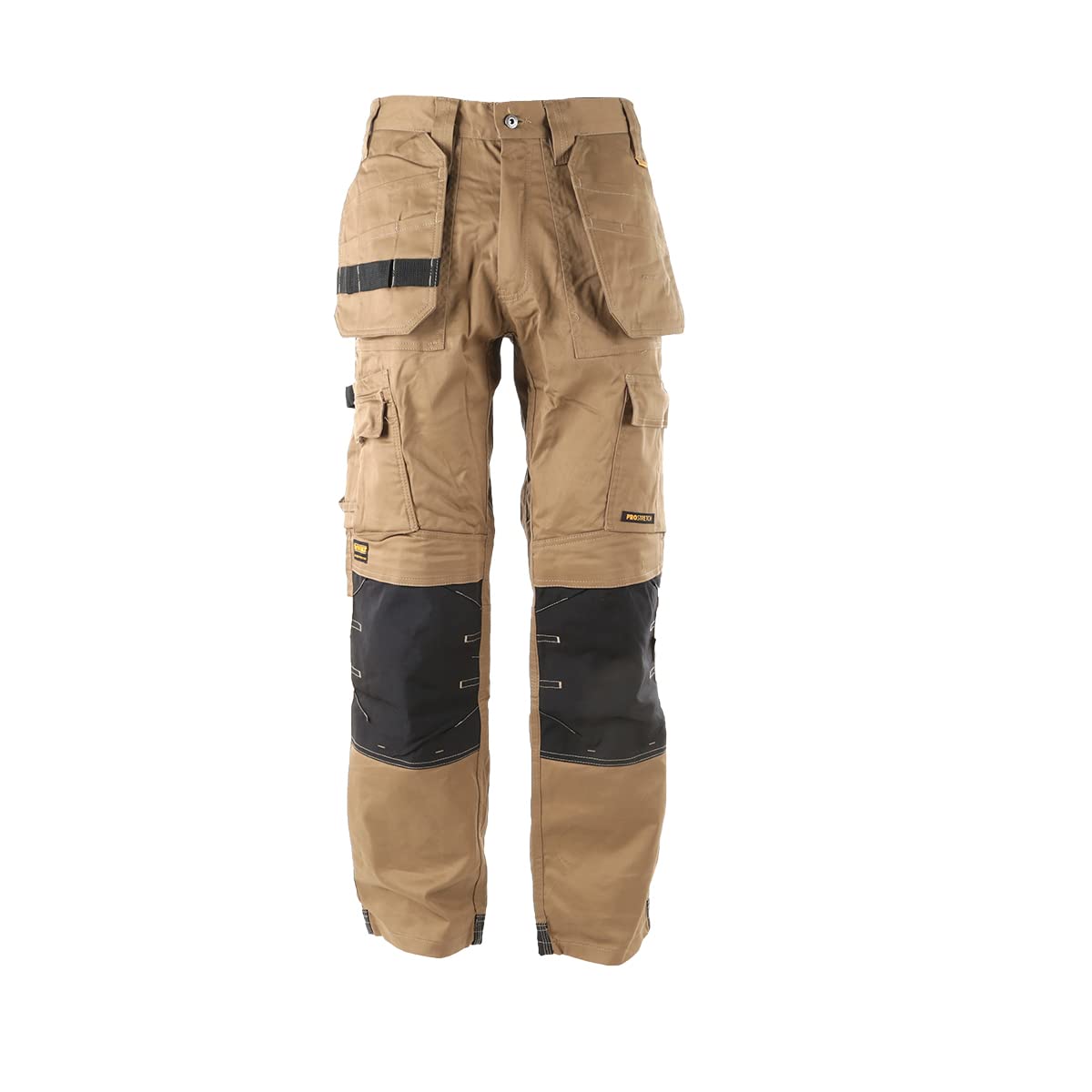
Eleven pockets and holster pouches put your tools at your fingertips instead of in a bag.
The pocket count is the whole pitch: 11 pockets in total, including holster pockets that hang at the hip for quick tool access, plus cargo, front, back, cell phone, and knee pad pockets. The fabric is a 60% cotton / 38% polyester / 2% elastane blend — elastane being the elastic fiber that lets the cloth stretch and recover — so the pants move with you while staying breathable. A loose fit gives a generous cut through the seat and thigh, and the zip-and-button fastening keeps everything secure when you are up and down a ladder. Reinforced knee pad pockets add another layer of durability where you need it most.
Fit is what earns the most praise here, with the tool pouches close behind — buyers report the built-in pouches are excellent for construction work where you need a screwdriver or tape measure within arm’s reach. Functionality and overall value also land well, and the pants look presentable enough for a client-facing day.
The honest catch is construction. The stitching looks strong on inspection, but owners mention a crotch seam failing after three uses on at least one pair — treat that as a quality-control variable rather than a guaranteed issue. Sizing also draws mixed feedback, so measure before you order. If you carry a lot of tools and want them on your body rather than in a bag, the holster layout makes these worth a look.
The pocket-first design: holster pouches plus 11 total pockets make this the pant for a tradesman who works out of his pockets all day.
The construction caveat: stitching looks solid, but a crotch seam failure has been reported — check the seams when the pants arrive.
Pick these if: you want tools on your hips and a stretch fabric that moves with you.
Skip the gamble if: you cannot afford a seam failure mid-shift — inspect the crotch stitching on arrival.
5. Wrangler Men’s Ranger Work Utility Pants

Ripstop cotton that resists tears and carries a load of tools without sagging.
Ripstop is a woven fabric with a grid of thicker threads that stops a tear from spreading — a small snag stays small instead of running down the leg. These Ranger pants are 100% cotton ripstop with triple-needle stitching and added reinforcement in high-wear areas, and the Room2Move fit is cut for a wider range of motion. The pockets are a genuine feature: lots of storage without the pants ballooning, which matters when you are carrying a tape, a phone, and a handful of fasteners.
Durability is the headline here. Owners describe the ripstop as wearing like iron, and the pants hold up across work and casual wear without looking like you borrowed them from a job site. The 4-pound packed weight is heavy against the Carhartt Dearborn tee’s 1 pound, and the package runs 15 x 12 x 2 inches versus 12.4 x 7.6 x 1.8 inches, so plan storage accordingly. That weight is the cost of thick cotton that resists abrasion.
The waist sizing is the recurring note: some buyers find the fit great, others say it runs small in the waist. Order against a measured waist rather than your usual size. If you want a tough cotton pant that handles rough ground, tools, and a weekend of yard work without complaint, this is a strong all-around choice.
The crowd favorite for rough work: ripstop cotton, reinforced high-wear areas, and pockets that hold real tool loads.
Order carefully: the waist runs small for some — measure before you buy.
6. HISEA Men’s Sherpa Work Jacket
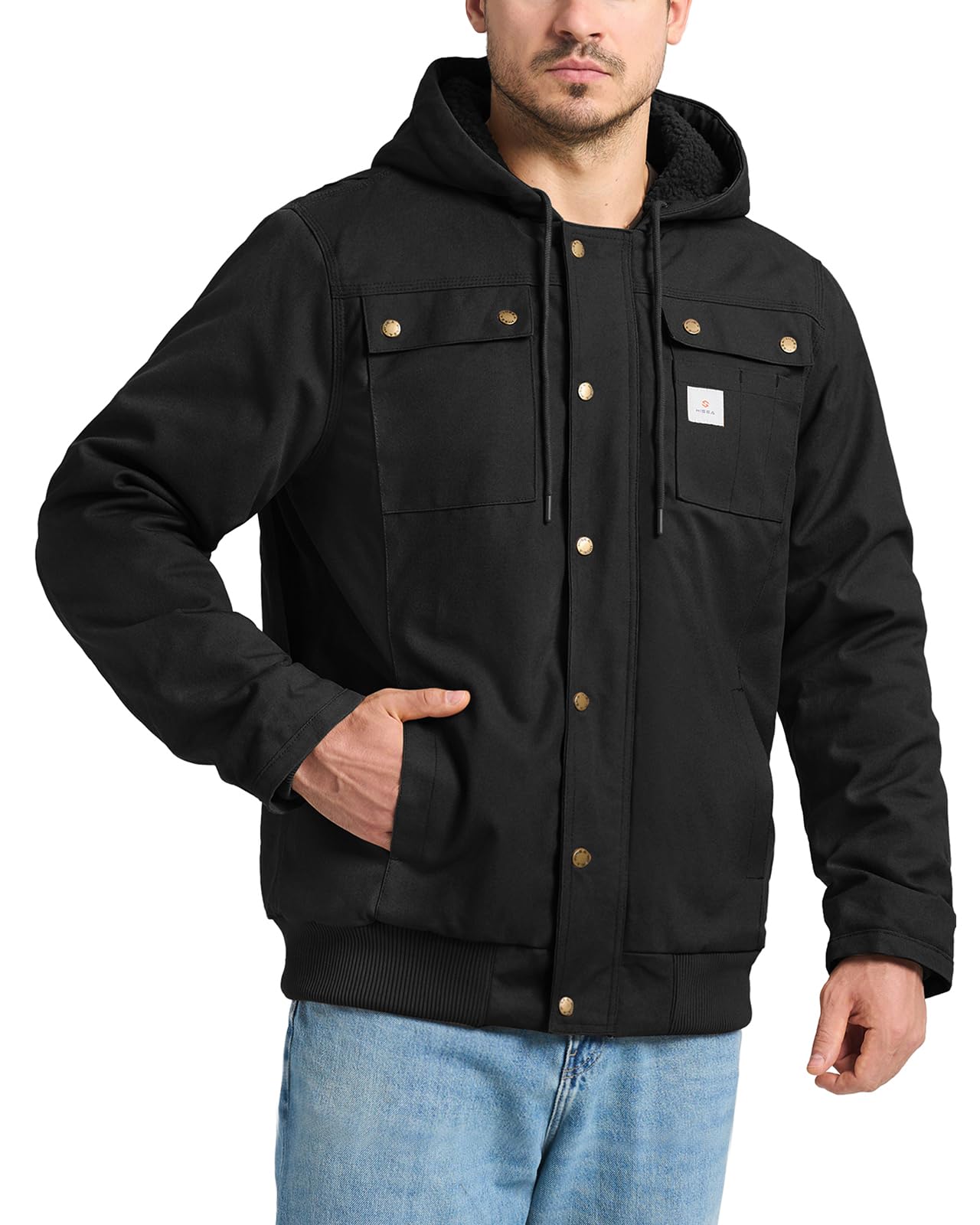
A sherpa-lined canvas coat that turns a biting winter shift into a normal one.
For cold-weather work, the outer layer does two jobs: block wind and hold warmth. This HISEA jacket is a hooded canvas coat with a water-resistant shell and a sherpa lining — sherpa being a thick, fleecy pile that traps warm air against your body. The chest, hand, and inner pockets give you places to stash gloves, a phone, and a wallet, and the hood adds coverage when the weather turns. Buyers in XXL specifically praise the fit, which is worth knowing if you are a bigger build.
Buyers rate it durable and warm enough for winter, and comfortable through a full shift rather than a quick trip outside. For buyers who work outdoors in cold months, that combination is exactly the point.
Two honest notes. The weight splits opinion — some find it not heavy to wear, others consider it somewhat heavy, so if you are sensitive to bulky outerwear, try it on before committing to a full season. And the zipper draws negative feedback from multiple buyers, so treat it gently and check the pull when the jacket arrives. Apart from those two points, this is a warm, well-made canvas coat that earns its place in a winter work setup.
What lands well: a well-made canvas shell, a warm sherpa lining, and a hood that covers you in real winter weather.
Handle with care: the zipper is the weak point — check it on arrival and zip deliberately.
Wear it if: you work outside through winter and want a warm canvas coat with a hood.
Look elsewhere if: you want a light jacket or have had trouble with zippers on workwear before.
7. Carhartt Men’s Iconic R01 Duck Bib Overall

Twelve-ounce duck cloth with a knee-pad-ready double front and a hammer loop.
This is the heavy layer in the lineup. The fabric is 12-ounce, 100 percent ring-spun cotton duck (a tightly woven, heavy cotton canvas) — versus the Carhartt Dearborn tee’s 6.75-ounce jersey — and that density is why a bib overall shrugs off scrapes, snags, and cold that would wear through a lighter pant. The chap-style double-front construction has cleanout bottoms, so you can slide knee pads in and pull them out without cutting the fabric. Adjustable front-elastic suspenders and stretch side panels let the bib move with you instead of hanging stiff.
The pocket layout is built for real work: a bib pocket with a zipper closure that holds electronics securely, two more storage pockets with a pen stall, two large lower-front ledge pockets, and two reinforced back pockets. Metal rivets sit at vital stress points, the main seams are triple-stitched, and a 360-degree kick panel protects the hem from boot wear. The right-leg hammer loop is a small detail that tells you this was designed by someone who actually swings one. The packed weight is 3.13 pounds, so it ships heavy and feels substantial on.
Sizing is where you need to pay attention. The waist runs small for some buyers, and leg length draws mixed notes — some find them exact, others say oddly sized or too short. Order against measured dimensions and consider trying one size against the chart before committing to a full season of work. For cold, dirty jobs where you need body coverage and tool access together, this is the classic answer.
Why the bib is worth the weight
- 12-ounce duck cotton resists scrapes and cold
- Chap-style double front takes knee pads
- Bib pocket zips electronics shut
- Triple-stitched seams and rivets at stress points
- Hammer loop and 360-degree kick panel
Where sizing gets tricky
- Waist runs small for some buyers
- Leg length splits opinion — check the chart
- At 3.13 pounds it feels heavy on warm days
The classic cold-weather choice: a 12-ounce duck bib for dirty, cold work where pants alone are not enough.
Measure twice: order against the size chart — the waist and leg length both split opinion.
8. TRUEWERK Men’s Insulated Work Pants – T3 WerkPant
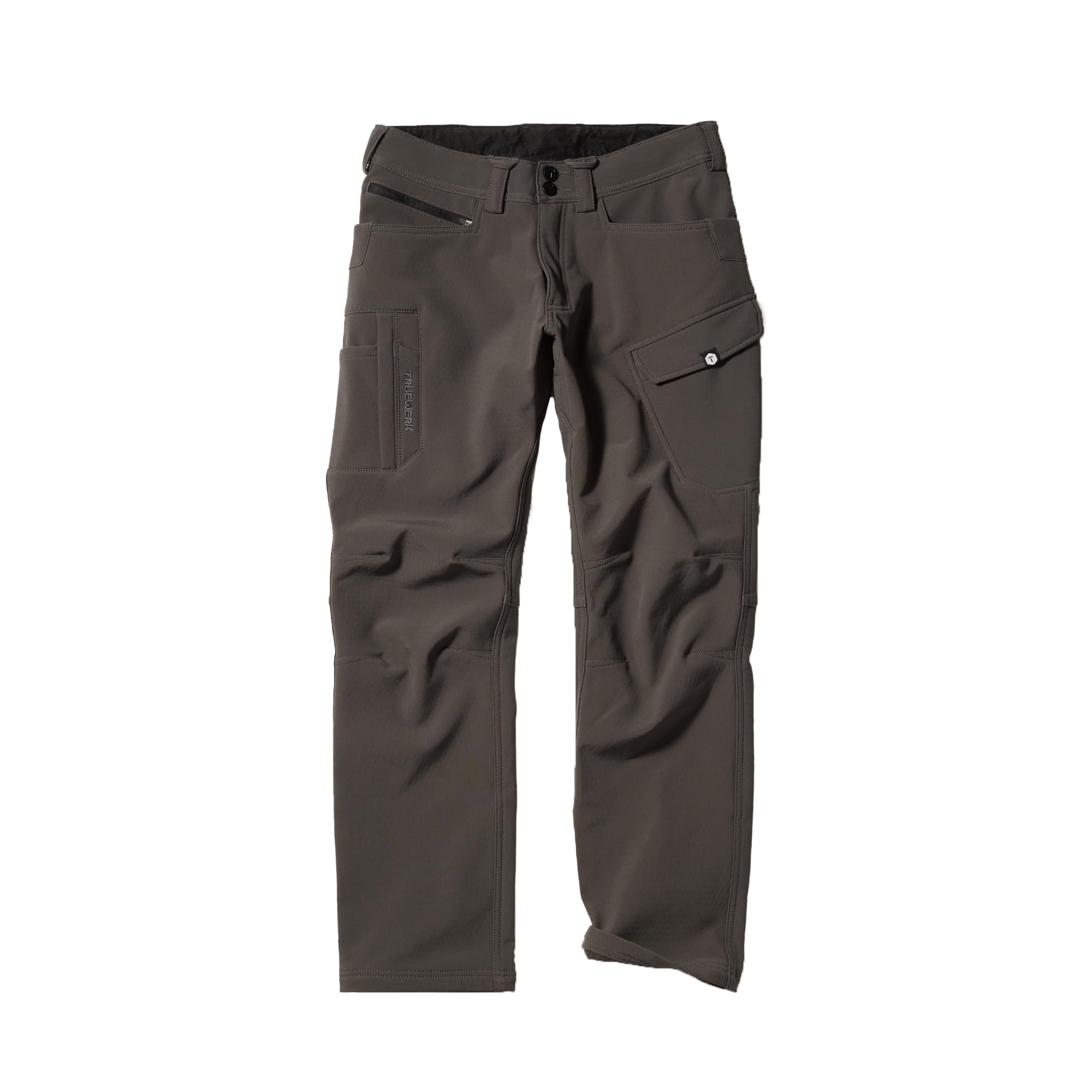
Insulated pants for frigid shifts where regular work pants leave you shivering.
These are the cold-weather pants in the lineup. At 24.40 ounces, the fabric is the heaviest in the TRUEWERK line, built from 84% ripstop polyester and 16% spandex with a hex fleece backing — the fleece traps warmth while the ripstop shell resists tears. A DWR treatment (a durable water-repellent coating that makes rain bead and roll off) adds water resistance, and 4-way stretch lets the pants move in every direction. If you work outside in frigid conditions and regular pants leave your legs numb, this is the layer designed for it.
Warmth is the feature buyers value most, and the hex fleece backing keeps legs warm without overheating when you move between a heated cab and a cold site. Water resistance repels rain, and durability holds through washes. For a winter work pant, that combination is what you are paying for.
The fit is the honest wrinkle. Some find the waist roomy while others report it runs too large, so consider sizing down if you are between sizes. TRUEWERK’s own guidance suggests sizing up in general because the waistband is more structured than the stretch fabric, but buyer feedback points the other way on the T3 specifically. Read the size chart carefully and, if in doubt, check the return policy before you commit.
The winter-work build: a 24.40-ounce fabric with hex fleece backing, water-resistant DWR, and 4-way stretch for cold outdoor shifts.
The fit question: waist sizing splits opinion on this model — read the chart and check returns before committing.
Choose these if: you work in frigid conditions and need insulated pants that move with you.
Sort your size first: the waist runs large for some buyers — measure and check the return policy.
9. TRUEWERK Men’s Work Coat – Tower WerkParka
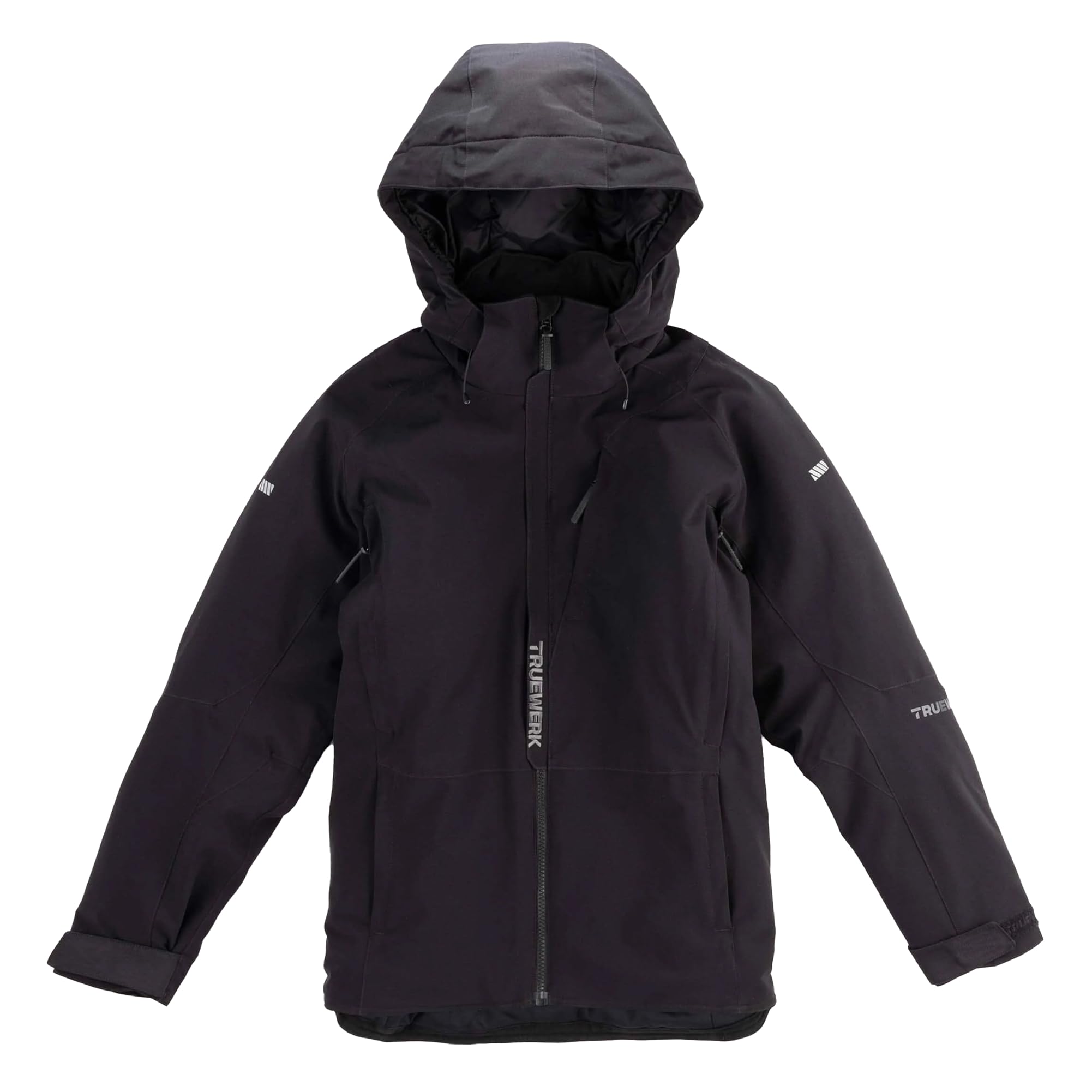
A midweight work coat rated Level 3 of 4 warmth for cold, windy days on site.
TRUEWERK rates this coat at Level 3 of 4 warmth, which puts it in midweight territory — warm enough for cold days but not a full deep-winter parka. The outer is 84% elastic nylon and 16% spandex with a 100% high-stretch polyester inner, giving it 4-way stretch and a DWR treatment that makes rain bead and roll. That combination means the coat moves with your shoulders when you reach overhead, and it sheds a light shower instead of soaking it up. For a fall-through-spring worksite, that is a sensible balance.
Buyers single out wind resistance and warmth as the coat’s two strongest traits. The coat holds up in varied weather and stays comfortable across a full shift, which is what you want from a midweight shell rather than a heavy parka. Quality is the strongest note in the feedback, so if you are looking for a coat that survives more than one season, this one is built to do it.
The fit is the one to sort before you commit. Some buyers find it well-fitting while others hit sizing issues, so check the chart against your chest measurement. And the water resistance, while present, is rated for rain rather than a downpour — if you work in sustained heavy weather, a fully waterproof shell is the better call. For cold, windy, mostly dry days, this is a strong midweight layer that moves with you.
Where it shines: Level 3 of 4 warmth, wind resistance, and 4-way stretch that keeps your shoulders free on overhead work.
Where it stops: the DWR coating handles rain, not a sustained downpour — go heavier for wet climates.
This suits you if: you want a midweight coat for cold, windy, mostly dry job sites.
Not for you if: you work in heavy rain, where a fully waterproof shell is the correct layer.
Know the Specs
Fabric weight in ounces
Fabric weight tells you how dense and durable the cloth is — higher numbers mean heavier, tougher fabric that resists tears and holds warmth better. Lightweight jersey sits around 6.75 ounces, while heavy duck cloth runs to 12 ounces and the insulated TRUEWERK pant reaches 24.40 ounces. A heavier number is not automatically better; it simply means more protection and more warmth, which suits cold or abrasive work but feels like too much in hot weather.
Duck, ripstop, and twill explained
Duck is a tightly woven, stiff cotton canvas built to take abrasion. Ripstop is a fabric with a grid of thicker threads that stops a tear from spreading. Twill is a woven cloth with a diagonal rib that resists wrinkles and holds a shape. Each one solves a different problem — duck for scrape resistance, ripstop for tear control, twill for a clean look on a daily uniform.
Double knee and chap-style construction
Double-knee pants add a second layer of fabric over the knee panel, so the outer layer takes the wear when you kneel. Chap-style double-front construction is a separate stitched panel with cleanout bottoms, letting you slide knee pads in and out. Both extend the life of a pant that spends its day on concrete or gravel.
DWR and stretch fabrics
DWR stands for durable water-repellent — a coating that makes rain bead and roll off the fabric instead of soaking in. It handles a light shower well but is not a substitute for a fully waterproof shell in sustained rain. Stretch fabrics use a small percentage of elastane or spandex to let the cloth snap back after you bend or reach, which matters on a job where you squat and climb all day.
Common Questions
How do I pick the right workwear fabric for my job?
What does double knee actually mean on work pants?
Should I size up or down in Carhartt workwear?
Are insulated work pants worth buying for winter?
What is the difference between a work bib and work pants?
Will a long-sleeve work tee layer under a canvas jacket?
How should I wash DWR-treated work pants?
Do holster pockets actually hold tools without sagging?
Is ripstop better than duck cloth for workwear?
What does DWR mean on a work coat?
The Bottom Line
For most men, the workwear clothes for men starting point is the Carhartt Dearborn Long-Sleeve Tee — a 6.75-ounce cotton jersey that layers under a coat and wears alone in fall, with a loose cut and side-seamed body built to survive daily use. If your work is hot and you want a shirt that lasts, grab the Dickies Short Sleeve Work Shirt. And if you need cold-weather coverage with tool access, the Carhartt R01 Duck Bib Overall is the classic 12-ounce duck answer — it has fewer ratings than the Dearborn tee, but it earns its place with chap-style double-front construction and a hammer loop.
How we choose
We do not accept paid placement. Every pick is matched to a real buyer and a real use-case; we do not hands-on test units.
Sources
Specifications: manufacturer listings and product documentation. Review insights: verified customer reviews, as of November 2026. Pricing: not shown on this page (it changes often); check the current price via the retailer link.
As an Amazon Associate, Tactical Gear Guy earns from qualifying purchases. This does not affect which products we feature.